American Street Summary, Characters and Themes
American Street by Ibi Zoboi is a young adult novel about migration, family, faith, survival, and the hard bargains people make when they are trapped between hope and danger. The story follows Fabiola Toussaint, a Haitian American teenager who reaches Detroit without her mother after U.S. immigration officials detain her.
Living with her aunt and cousins at the corner of American Street and Joy Road, Fabiola tries to understand a country that promises freedom but often demands sacrifice. The novel blends realistic social struggle with Haitian spiritual belief, showing how identity can be both an anchor and a test.
Summary
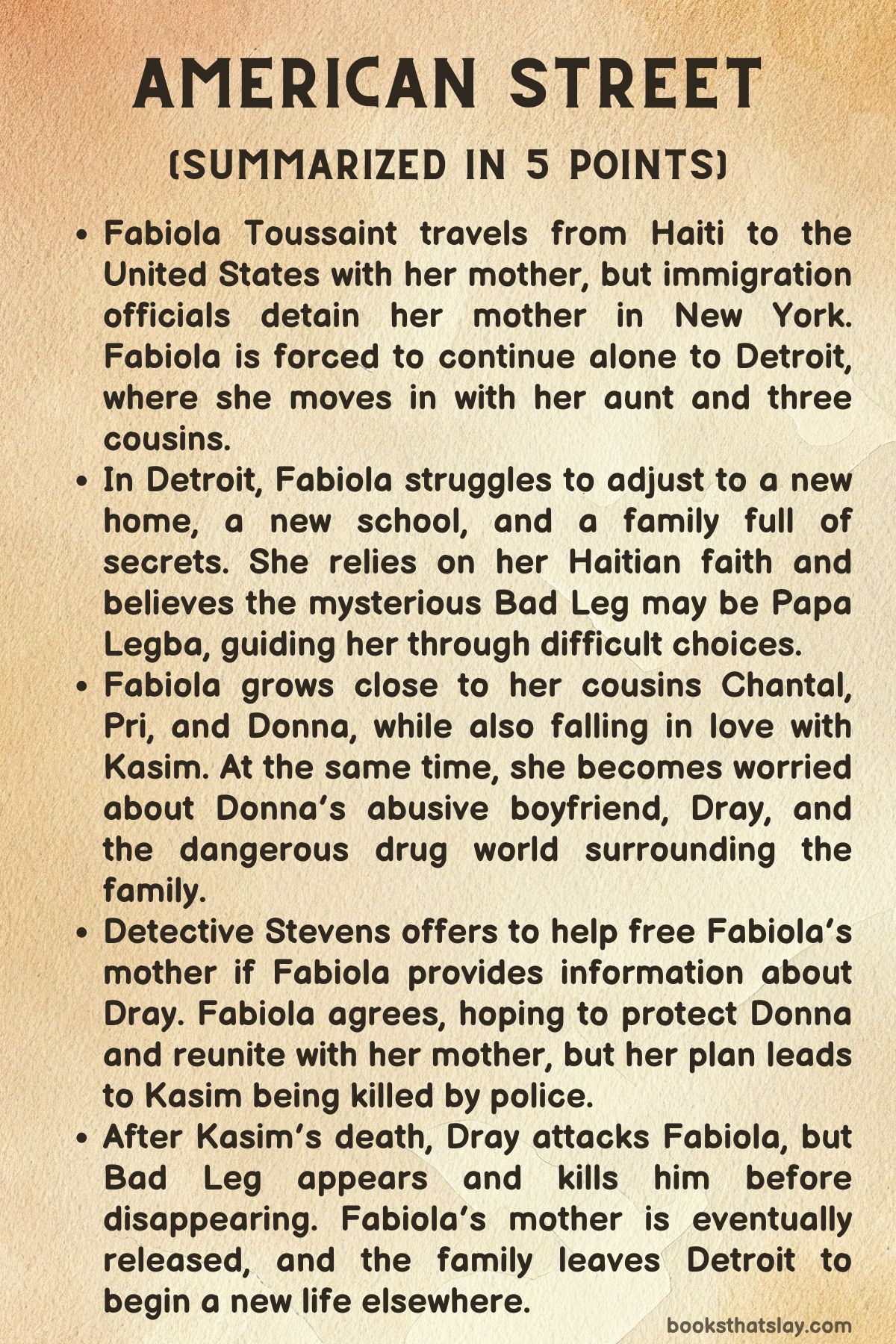
Fabiola Toussaint arrives in the United States from Haiti with her mother, Valerie, whom she calls Manman. Fabiola was born in America, so she is allowed to enter the country, but her mother is detained by immigration officials in New York.
Fabiola is forced to continue alone to Detroit, where she is supposed to live with her aunt, Marjorie, known as Matant Jo, and her three cousins. The separation shocks her.
She reaches Detroit cold, frightened, and uncertain whether America is really the place of promise she and her mother imagined.
Her cousins Chantal, Pri, and Donna pick her up from the airport. They are known as the Three Bees: Chantal is the responsible and intelligent one, Pri is tough and sharp, and Donna is beautiful, stylish, and tied to a dangerous boyfriend named Dray.
The girls take Fabiola to their home at the corner of American Street and Joy Road. Fabiola quickly learns that the house is not the grand American home she pictured.
Matant Jo is ill after a stroke, speaks sharply, and insists that Fabiola use English rather than Creole. Chantal has given up bigger academic dreams to stay near home and care for the family.
Fabiola feels alone in this new world. She misses Haiti, her mother, Creole, familiar food, and the spiritual practices that shaped her life.
She continues to pray to the Haitian lwas, especially Papa Legba, the spirit of crossroads and opened gates. Outside the house, she notices a strange man called Bad Leg, who sings riddles on the street corner.
Fabiola comes to believe that Bad Leg may be Papa Legba in human form, guiding her through the difficult choices ahead.
At school, Fabiola is known less as herself and more as the cousin of the Three Bees. Their reputation protects her but also places her under attention.
She befriends Imani, who helps her adjust to schoolwork and American expectations. Fabiola also meets Kasim, a kind young man connected to Dray.
Kasim works at a café, treats her gently, and calls her Fabulous. Their relationship gives Fabiola warmth in a life suddenly full of worry.
Yet even her growing love for Kasim cannot erase the fear that her mother may be deported.
Fabiola soon encounters Detective Stevens, a woman who says she can help get Manman released. The detective wants information about Dray, whom she suspects of being connected to a bad batch of drugs that killed a white girl from Grosse Pointe Park.
Fabiola is uneasy about talking to the police, but she is desperate. She sees Dray as a violent presence in Donna’s life.
He beats Donna, controls her, and moves through Detroit with money, power, and menace. Fabiola begins to believe that helping the detective could save both her mother and her cousin.
As Fabiola gets closer to Kasim, she also learns more about her family’s hidden life. Matant Jo once came to Detroit with hope, joining her husband Phillip in a city tied to work, cars, and the dream of American success.
After Phillip was killed, that dream began to rot. Matant Jo accepted money from Uncle Q, a local criminal figure, and used it to support her family.
Over time, she became involved in lending money and dealing with people connected to drugs. Her daughters also became tied to this dangerous economy.
Fabiola is horrified to discover that her cousins, not just Dray, have sold drugs and owe Uncle Q a large debt.
This discovery shakes Fabiola’s sense of right and wrong. She loves her cousins and understands that they have been shaped by loss, poverty, and the need to survive.
At the same time, she cannot ignore the damage caused by the drug trade or the violence surrounding them. She wants to free Manman, protect Donna, and avoid betraying her new family.
Every choice seems to hurt someone.
The house itself carries a long history of broken dreams. It has belonged to immigrants, workers, Black families, and families trying to make a future in Detroit.
Each generation brought hope, but death, racism, economic collapse, crime, and violence left marks on the home. For Fabiola, the address becomes more than a location.
It represents the promises and failures of America, especially for those who come believing hard work will guarantee safety.
Fabiola’s bond with Kasim deepens. He shows her parts of Detroit, talks about his family, and dreams of making honest money.
He is not innocent of the world around Dray and Q, but he wants something better. Fabiola feels loved by him, and for a moment she can imagine a life in America that includes joy.
Yet her secret work with Detective Stevens keeps pulling her toward danger.
Fabiola eventually forms a plan to get Dray arrested at a party in Grosse Pointe Park. She manipulates him into believing she can help him sell drugs and passes information to Detective Stevens.
To protect her cousins, she lies and convinces them not to attend the party. She believes she has found a way to remove Dray from Donna’s life and secure her mother’s release without sacrificing the people she loves.
The plan goes terribly wrong. Fabiola realizes too late that Kasim, not Dray, may be going to the party.
She tells her cousins what she has done, and they rush to the scene. Police are already there.
Fabiola finds out that Kasim has been shot and killed by police. His death destroys her.
The boy who offered her gentleness and hope becomes another Black life lost to violence and suspicion. Protests later spread across the city, and Kasim’s name becomes a public symbol, but that cannot give Fabiola back the person she loved.
After Kasim’s death, Dray comes to the house full of rage. He blames Fabiola for the police operation and accuses her of being a snitch.
He also turns on Donna. The confrontation becomes violent.
Dray attacks Fabiola and points a gun at her. Just when it seems she may die, Bad Leg appears and shoots Dray.
To Fabiola, this confirms his identity as Papa Legba, the spirit at the crossroads. He disappears, leaving the girls alive but forever changed.
In the aftermath, Fabiola grieves Kasim and reckons with the cost of her choices. She did what she thought would save her mother and protect her cousin, but her actions helped set events in motion that led to Kasim’s death.
Donna mourns Dray despite the harm he caused her. The family is left with sorrow, guilt, and the need to move forward.
Detective Stevens keeps her promise: Manman is released from immigration custody and allowed to stay in the United States. Matant Jo, her daughters, and Fabiola leave the house on American Street behind.
They go to reunite with Manman and begin again somewhere else. By the end of American Street, Fabiola has become part of the Four Bees, naming herself the brave one.
Her American beginning is marked by loss, but also by survival, truth, and the painful knowledge that freedom often comes at a price.
Characters
Fabiola Toussaint
Fabiola is the emotional and moral center of American Street, a Haitian American teenager who arrives in Detroit carrying both hope and fear. Her identity is shaped by two homelands: she was born in the United States, but Haiti is where she grew up, learned her language, practiced her faith, and formed her understanding of family.
When her mother is detained, Fabiola is forced into independence before she is ready. Much of her character comes from this sudden pressure.
She is grieving, frightened, and homesick, but she is also observant, determined, and willing to act when she believes someone she loves is in danger. Her belief in the lwas gives her strength and structure in a world that feels unfamiliar.
Papa Legba, Ezili-Danto, and other spiritual figures help her interpret Detroit, especially when ordinary explanations seem inadequate.
Fabiola’s greatest conflict is between loyalty and survival. She wants to free her mother, protect Donna from Dray, keep her cousins safe, and hold on to her own sense of right and wrong.
These desires cannot all exist peacefully. Her decision to work with Detective Stevens shows both courage and innocence.
She believes she can control the consequences if her intentions are good, but she learns that systems of policing, immigration, drugs, and street violence are far larger than her personal plans. Her love for Kasim reveals a softer side of her, one that wants ordinary happiness, tenderness, and a future.
His death forces her to face the cost of her choices. By the end, Fabiola is no longer simply the girl who came from Haiti.
She has become someone who understands that America can offer freedom and wound people at the same time.
Manman
Manman, whose given name is Valerie, is Fabiola’s mother and the source of much of Fabiola’s emotional strength. Although she is physically absent for most of the story because she is held by immigration authorities, her presence is constant.
Fabiola thinks of her, prays for her, writes to her, and measures many of her choices against what Manman would want. Manman represents Haiti, memory, language, faith, and maternal protection.
Her detention turns the immigrant dream into a crisis from the beginning. She comes to America hoping for reunion and a better future, but instead she is trapped by the very system that promises order and opportunity.
Manman is also a complex figure because her love can feel protective and limiting at the same time. Fabiola wonders whether her mother’s plans gave her enough freedom to become her own person.
Manman’s instructions are practical and loving: focus on school, stay safe, and let adults handle adult matters. Yet Fabiola cannot obey passively because her mother’s freedom is at stake.
In this way, Manman becomes both a person and a motive. She is the reason Fabiola enters dangerous moral territory.
Her eventual release brings relief, but it does not erase the damage done during her absence. Manman’s character shows how immigration detention affects not only the person detained, but also the family members who must make desperate choices from the outside.
Chantal
Chantal is the oldest of the cousins and functions as the responsible head of the younger generation. She is intelligent, disciplined, and deeply aware of how fragile her family’s life is.
Her academic ability once promised a future beyond Detroit, but she chooses community college and home life because she cannot abandon her mother and sisters. This decision makes her both admirable and tragic.
She carries responsibility like a duty, but that duty has narrowed her life. She often speaks like someone older than she is because she has had to become a caretaker too early.
Chantal’s relationship with Fabiola is layered. She tries to guide Fabiola through school, American customs, and family rules, but she also hides painful truths.
Her silence about the family’s involvement in drugs reveals how survival can turn honesty into a risk. Chantal understands Detroit in a way Fabiola does not.
She knows that danger can come from criminals, police, poverty, and reputation. Her warnings are not always warm, but they come from experience.
Chantal also carries grief for her father and resentment over lost possibilities. She remembers Haiti and Creole, but she has built a guarded American self.
Fabiola’s arrival forces her to confront the parts of her identity she has tried to manage or bury.
Pri
Pri, short for Princess, is the physically tough cousin who protects the family through aggression, confidence, and fearlessness. She is quick to curse, fight, and confront anyone who threatens her sisters.
Her toughness is not empty performance. It has developed from years of living in a world where softness can be used against a person.
Pri knows the value of reputation, especially for young women in her neighborhood. Being feared gives her a form of safety.
As one of the Three Bees, she helps create the family’s public image as untouchable.
At the same time, Pri is more vulnerable than she first appears. Her bond with Donna and Chantal is fierce, and her anger often comes from love.
She mocks Fabiola at times, but she also accepts her into the family structure. Her romantic interest in Taj gives readers a glimpse of a private self that exists beyond fighting and intimidation.
Pri’s character challenges simple ideas about strength. She can be harsh, but she is not cruel by nature.
Her aggression is a survival language. She has learned that in Detroit, especially in the circles surrounding her family, being gentle in public may invite harm.
Pri’s growth lies in allowing Fabiola to become part of the sisterhood, turning the Three Bees into the Four Bees.
Donna
Donna, short for Primadonna, is the cousin most closely connected to beauty, desire, and danger. She is stylish, admired, and highly conscious of appearance, but her beauty has also made her vulnerable to objectification from a young age.
Her relationship with Dray is one of the most painful parts of the story. She believes his violence is tied to love and protection because he has defended her from other men and made her feel chosen.
This emotional confusion shows how abuse can trap someone not only through fear, but also through attachment, history, and need.
Donna’s character is not defined only by victimhood. She is loyal, proud, and emotionally intense.
She loves her sisters and wants to maintain the status of the Three Bees. Her jealousy toward Imani comes from insecurity and from the unstable bond she has with Dray.
She knows he hurts her, yet she cannot fully detach from him. This makes her frustrating at times, but also deeply human.
Donna’s grief after Dray’s death is important because it refuses a simple moral response. Even though Dray abused her, he was part of her life for many years.
Her sorrow shows the complicated emotional aftermath of abuse. Donna represents the difficulty of leaving someone who has harmed you when that person has also become tied to your identity.
Matant Jo
Matant Jo, or Marjorie, is Fabiola’s aunt and the damaged matriarch of the Detroit household. She once came to America with hope, joining her husband in a city where work and homeownership seemed to promise stability.
After her husband’s death, she became physically and emotionally wounded. Her stroke makes her body visibly marked by suffering, while her bitterness reveals a deeper injury.
She is stern with Fabiola, especially about speaking English, because she sees adaptation as necessary for survival. To her, America requires hard choices, and sentiment can be dangerous.
Matant Jo’s moral complexity comes from the way she supports her family. After losing her husband, she accepts money connected to criminal activity and eventually becomes involved in lending money and profiting from dangerous networks.
She is not simply greedy; she is a widow trying to keep her children alive and comfortable in a city that has taken much from her. Yet her choices also expose her daughters to the very danger she wants to protect them from.
Her longing for her sister Valerie shows that beneath her hardness is grief and loneliness. Matant Jo is a portrait of what happens when the immigrant dream collapses under loss, illness, debt, and fear.
Kasim
Kasim is Fabiola’s love interest and one of the gentlest figures in the novel. He is connected to Dray and Q, but he is not like them in spirit.
He is polite, affectionate, and thoughtful with Fabiola. He works at a café, dreams of having his own place, and wants a life built on honest money.
His relationship with Fabiola gives both characters a brief space of innocence and possibility. Through him, Fabiola experiences romance, comfort, and a version of Detroit that includes music, museums, food, family, and dreams.
Kasim’s tragedy lies in his closeness to danger despite his desire to move away from it. He has made mistakes and has ties to the drug world, but he is also trying to imagine a better self.
His loyalty to Dray and Q keeps him near the violence that eventually kills him. When police shoot him, his death becomes part of a larger pattern of Black lives being treated as disposable.
The public protests after his death turn him into a symbol, but Fabiola remembers him as a person: the boy who called her Fabulous, kissed her, and made her believe in a future. Kasim’s character shows how young people can be punished not only for what they do, but for the environments they are unable to fully escape.
Dray
Dray is violent, controlling, and dangerous, but the novel gives enough background to show how he became that way without excusing his actions. He abuses Donna, intimidates others, carries a gun, and moves through Detroit with the confidence of someone protected by criminal power.
He represents the immediate threat inside Fabiola’s new life. To Fabiola, he becomes linked with death and destruction, especially because of his treatment of Donna and his connection to drugs.
Dray’s history reveals a boy shaped by brutality from an early age. Q used him as a child, placing him inside violence before he had the maturity to understand or refuse it.
The revelation that Dray accidentally killed Fabiola’s uncle gives his character a heavy role in the family’s pain. He is both a product of street violence and a carrier of it.
His love for Donna is possessive rather than healthy. He thinks control, jealousy, and force prove devotion.
His grief over Kasim shows that he is capable of attachment, but that attachment does not redeem the harm he causes. Dray’s death ends his immediate threat, but it also leaves behind grief and moral unease, especially for Donna.
Uncle Q
Uncle Q is the criminal power behind much of the family’s trouble. He owns a club, manages drug activity, and uses money, fear, and obligation to control others.
His influence reaches Dray, Kasim, Matant Jo, and the Three Bees. Q is dangerous because he operates like a businessman and a father figure at the same time.
He gives money, offers protection, and creates dependency, but everything he gives comes with a price.
Q’s role in the story shows how crime can become woven into economic survival when legitimate opportunities disappear. He is not merely an outside villain who enters the family’s life.
He has been there since Phillip’s death, offering money when the family was vulnerable. That first payment becomes the beginning of a long moral debt.
Q understands weakness and uses it. His demand for repayment from the girls shows that he sees even young people as tools in his business.
Through Q, the novel examines how poverty, grief, and limited opportunity can make dangerous systems feel unavoidable.
Detective Stevens
Detective Stevens represents law enforcement, but she is not presented as a simple figure of justice. She approaches Fabiola with an offer: information about Dray in exchange for help freeing Manman.
This offer places a frightened teenage girl in a dangerous position. Detective Stevens speaks about stopping drug dealers and preventing more deaths, but her methods are manipulative.
She understands Fabiola’s desperation and uses it.
Her character raises questions about power. Fabiola has very little power in America.
Her mother is detained, her family is hiding secrets, and she does not fully understand Detroit’s social rules. Detective Stevens uses the language of help, but she asks Fabiola to risk her safety and betray people close to her.
The result is disastrous. Kasim dies during the police operation, and Fabiola must live with the consequences.
Detective Stevens may keep her promise about Manman, but the cost is devastating. She shows how institutions can treat vulnerable people as instruments while claiming to act for the public good.
Bad Leg
Bad Leg is one of the most mysterious figures in American Street. To others, he is a homeless man who sings strange songs on the corner.
To Fabiola, he is Papa Legba, the lwa of crossroads, gates, and choices. Whether read as a literal spiritual presence or as a symbolic guide, Bad Leg gives shape to Fabiola’s inner conflict.
He appears at moments when she must choose between loyalty and truth, silence and action, Haiti and America, safety and risk.
His songs often sound like warnings. They do not give Fabiola clear answers, but they push her to recognize that every path has consequences.
His position at the corner of American Street and Joy Road is central. He stands where names promise national belonging and happiness, yet the lives around him are full of loss.
When he kills Dray and then disappears, the spiritual and realistic worlds meet in a decisive act. For Fabiola, this confirms that the lwas have not abandoned her.
Bad Leg represents guidance, judgment, and the uncertain border between faith and reality.
Imani
Imani is Fabiola’s first real friend at school and serves as a bridge into American teenage life. She helps Fabiola understand school expectations, especially the need for research and citations in academic writing.
Unlike the Three Bees, Imani is not bound by family loyalty to protect a dangerous reputation. She can see things about Fabiola’s cousins and Dray that Fabiola initially struggles to accept.
Her perspective helps challenge Fabiola’s assumptions.
Imani also becomes part of the danger surrounding Dray. His unwanted attention makes her uncomfortable, and Donna’s jealousy creates conflict between the girls.
Imani’s role shows how girls can be pulled into male violence even when they have done nothing to invite it. She is intelligent, friendly, and cautious, but she is not immune to the social pressures around her.
Her friendship with Fabiola matters because it gives Fabiola a relationship outside family and romance. Through Imani, Fabiola begins to learn how to belong in school and in Detroit without fully losing herself.
Themes
Immigration, Belonging, and the Broken American Promise
American Street presents immigration as both a dream and a wound. Fabiola comes to the United States believing that America will offer safety, opportunity, and reunion with family, but her first experience is separation from her mother.
Because Fabiola was born in the United States, she has legal access to the country, while Manman is detained and threatened with deportation. This contrast shows how citizenship can divide even a mother and daughter.
The novel does not treat immigration as a simple journey from poverty to success. Instead, it shows how arrival can bring confusion, loneliness, and fear.
Detroit is not the shining America Fabiola imagined from television. It is cold, economically damaged, and full of people trying to survive after their own dreams have been reduced.
The house at American Street and Joy Road carries symbolic weight because its name suggests national hope and happiness, while its reality is grief, debt, illness, and danger. Fabiola’s struggle to belong is not only cultural.
She must learn new language patterns, school rules, family secrets, and social codes. Her story shows that immigration is not completed by crossing a border.
True belonging requires safety, dignity, family unity, and the freedom to build a future without being forced into impossible choices.
Family Loyalty and Moral Compromise
Family love in the novel is powerful, but it is never simple. Fabiola’s loyalty to her mother drives almost everything she does after arriving in Detroit.
She is willing to speak with Detective Stevens, spy on Dray, and risk her own safety because Manman’s release matters more than anything else. At the same time, Fabiola becomes attached to her cousins and aunt, who take her in even though their household is full of secrets.
Once she learns that her own family is involved in selling drugs, her moral world becomes unstable. She wants to protect them, but she also knows their actions have harmed others.
This conflict gives the story much of its emotional force. The Three Bees also live by family loyalty.
Chantal sacrifices her ambitions for her mother and sisters. Pri protects the family through toughness.
Donna remains tied to Dray partly because he has become tangled with her ideas of love and protection. Matant Jo’s choices are also rooted in family survival, though those choices expose her daughters to criminal danger.
The novel shows that loyalty can be noble, but it can also become a trap when it demands silence about harm. Love does not always lead characters toward justice.
Sometimes it pushes them toward secrecy, denial, and compromise.
Faith, Spirituality, and the Search for Guidance
Fabiola’s Haitian spiritual beliefs are central to how she understands the world. Her prayers, rituals, candles, and belief in the lwas are not decorative details.
They are a serious part of her identity and a source of strength when everything around her feels uncertain. Papa Legba becomes especially important because Fabiola is constantly standing at crossroads.
She must choose whether to trust the police, whether to protect her cousins, whether to act against Dray, and whether to hold on to Haiti while adjusting to America. Bad Leg’s presence on the street corner gives physical form to this spiritual conflict.
Others dismiss him as unstable or homeless, but Fabiola sees meaning in his songs and movements. Her belief allows her to read Detroit through a Haitian lens rather than surrendering completely to American explanations.
The novel respects this faith by making it emotionally and narratively powerful. Spirituality helps Fabiola survive separation from Manman, grief over Kasim, and fear inside Matant Jo’s house.
Yet faith does not protect her from consequences. The lwas may guide, warn, or appear, but Fabiola must still make choices herself.
Spiritual belief gives her language for suffering, but it does not remove suffering. It helps her endure and interpret a world where justice is uncertain.
Violence, Survival, and the Cost of Power
Violence appears in many forms throughout the story: domestic abuse, police violence, street crime, immigration enforcement, economic pressure, and historical racism. Dray’s abuse of Donna is one of the most visible examples.
His violence is intimate and repeated, hidden beneath claims of love and protection. Donna’s attachment to him shows how abuse can distort a person’s understanding of care.
Street violence also shapes the lives of Dray, Kasim, Q, Matant Jo, and the Three Bees. For many characters, power comes from being feared, having money, carrying weapons, or controlling debts.
This kind of power may offer temporary protection, but it also keeps people trapped in danger. Kasim’s death shows another form of violence: the state’s power over Black bodies.
He is trying to move toward a better life, but his connection to dangerous people and the assumptions of police lead to his death. The novel also connects present violence to history.
The house has seen death across generations, and Detroit’s economic decline has left communities vulnerable to crime and desperation. Survival often requires characters to become hard, secretive, or morally compromised.
The tragedy is that the tools they use to survive can also destroy them or the people they love.