And There Was Light Summary and Analysis
And There Was Light: Abraham Lincoln and the American Struggle by Jon Meacham is a biography of Abraham Lincoln that studies the moral growth of a man who became central to America’s fight over slavery, democracy, and national survival. Rather than presenting Lincoln as flawless, the book shows him as ambitious, cautious, prejudiced in ways shaped by his time, yet steadily drawn toward a larger vision of freedom.
Meacham follows Lincoln from frontier poverty to the presidency, tracing how books, grief, politics, religion, and war formed his conscience. The result is a portrait of leadership under pressure, where private doubt and public duty meet.
Summary
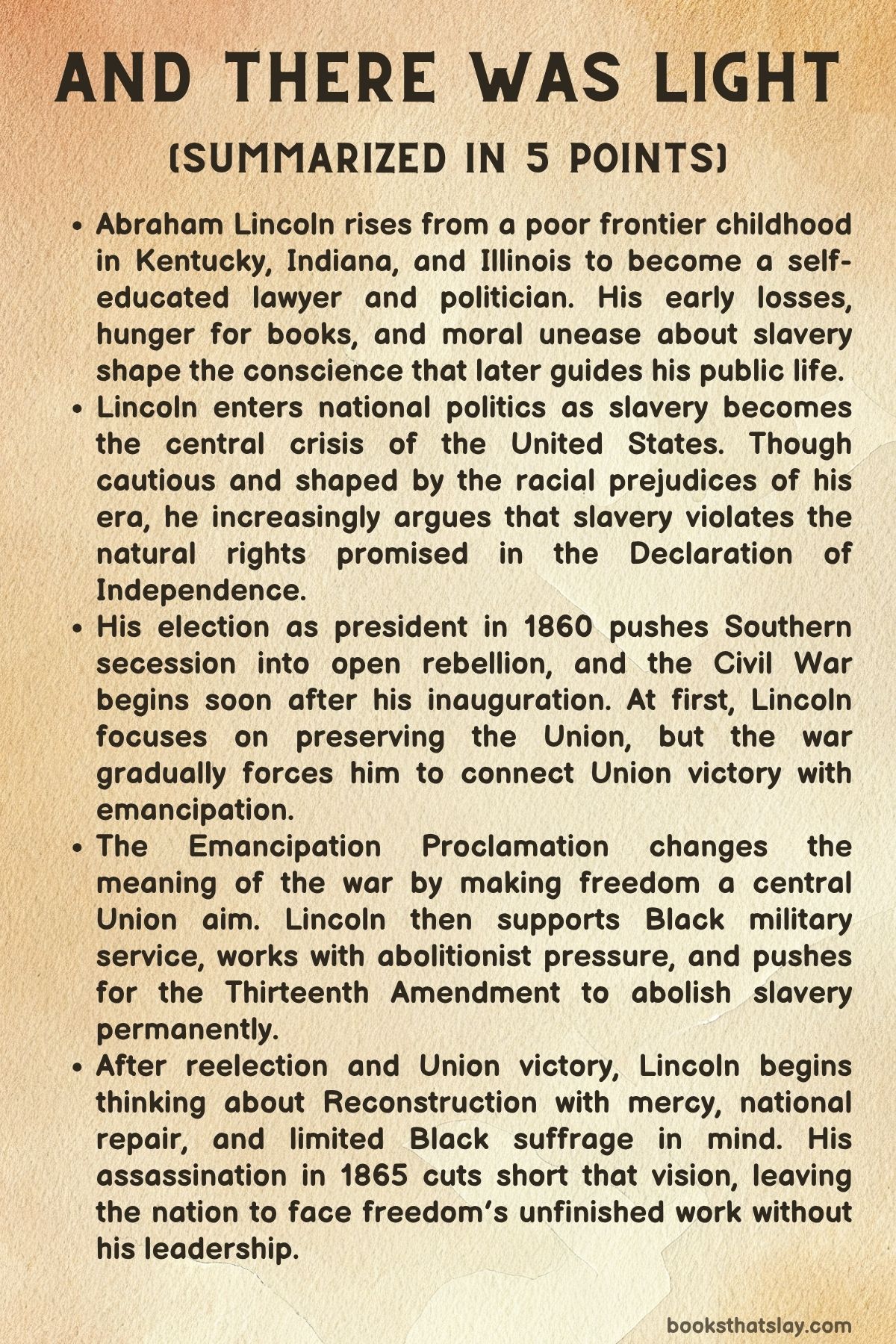
Jon Meacham’s And There Was Light follows Abraham Lincoln’s life as a story of moral development, political calculation, and national crisis. Lincoln was born in Kentucky in 1809 into a poor frontier family.
His early life was marked by hardship, limited schooling, family tension, and loss. His father, Thomas Lincoln, struggled as a farmer and carpenter, and Lincoln never felt close to him.
His mother, Nancy Hanks Lincoln, died when he was still a child, leaving a wound that shaped his memory of childhood. His stepmother, Sarah Bush Lincoln, became an important supporter, encouraging his love of reading and learning.
Though Lincoln had little formal education, he read deeply, absorbing the Bible, school readers, histories, and works that gave him a strong sense of language and moral argument.
As a young man in Indiana and later Illinois, Lincoln worked as a laborer, ferryman, clerk, postmaster, surveyor, and eventually lawyer. His travels exposed him to slavery, especially during a trip to New Orleans, where the slave trade left a lasting impression on him.
He entered politics as a Whig, admiring Henry Clay and believing that government should help people do what they could not do alone. Lincoln first ran for the Illinois legislature in 1832 and lost, but he won in 1834 and began building a reputation for wit, discipline, and practical intelligence.
During these years, he also endured personal sorrow, especially the death of Ann Rutledge, a woman he loved, which deepened his lifelong struggle with depression.
Lincoln’s early political career developed during a period when slavery increasingly dominated American public life. Although Illinois was technically a free state, racism was widespread, and even many antislavery politicians did not support full equality for Black Americans.
Lincoln shared some of the racial assumptions of his era, yet he also believed slavery was morally wrong. He opposed its expansion, admired antislavery leaders such as Clay, and saw the Declaration of Independence as a promise that all people had natural rights.
His opposition to slavery was not always radical or immediate; he often favored gradual change, legal caution, and compromise. Still, Meacham shows that Lincoln’s conscience kept pulling him toward firmer resistance.
Lincoln married Mary Todd in 1842. Their marriage was politically meaningful and emotionally difficult.
Mary was intelligent, ambitious, and deeply interested in politics, but the marriage was troubled by debt, grief, and emotional strain. They had four sons, but only one, Robert, lived to adulthood.
The deaths of Eddy and later Willie were devastating to both parents. These personal losses shaped Lincoln’s religious reflections.
He was never conventionally religious, and his beliefs were often marked by doubt, reason, and fatalism. Yet over time, especially during the Civil War, he spoke more often of providence, divine will, and the burden of moral responsibility.
Lincoln served one term in Congress beginning in 1847. He opposed the Mexican-American War and feared that new territories gained from Mexico would expand slavery.
After leaving Congress, he returned to Illinois and practiced law, but national events brought him back into politics. The Compromise of 1850, the Fugitive Slave Act, and especially the Kansas-Nebraska Act of 1854 convinced him that slavery’s expansion had to be resisted.
The Kansas-Nebraska Act overturned earlier limits on slavery’s spread and allowed settlers in new territories to decide the question. Lincoln saw this as a major moral and political danger.
The rise of the Republican Party gave Lincoln a new political home. He challenged Stephen Douglas, first in the Senate race of 1854 and then more famously in 1858.
Their debates placed slavery at the center of national attention. Douglas defended white supremacy and popular sovereignty, while Lincoln argued that slavery violated the natural rights promised in the Declaration of Independence.
Lincoln did not call for full social or political equality between Black and white Americans, and Meacham does not excuse that. Instead, he presents Lincoln as a flawed man moving within a racist society while still pressing toward the idea that no one had the right to own another person.
Lincoln lost the Senate race, but the debates made him a national figure.
In 1860, Lincoln became the Republican nominee for president. His victory revealed the deep fracture in the country.
He won strong support in the North but almost none in the South. Southern leaders saw his election as a threat to slavery and began moving toward secession.
South Carolina left the Union before Lincoln even took office, and other states followed. Lincoln rejected compromise that would permanently protect slavery’s expansion, but he also insisted that he had no constitutional power to abolish slavery where it already existed.
His aim at first was to preserve the Union and prevent the spread of slavery.
Lincoln was inaugurated in March 1861. Almost immediately, the crisis at Fort Sumter forced a decision.
When Confederate forces attacked the fort in April, the Civil War began. Lincoln called for troops and used broad executive power to defend the Union, including suspending habeas corpus in some cases.
At first, he framed the war as a struggle to preserve the nation, not to abolish slavery. He had to consider the border states, where slavery remained legal but loyalty to the Union was essential.
He also faced pressure from Radical Republicans, abolitionists, Democrats, generals, soldiers, and a divided public.
As the war continued, Lincoln came to see emancipation as both morally necessary and militarily useful. He moved slowly, partly because he believed timing mattered.
In 1862, after the Union victory at Antietam, he issued the preliminary Emancipation Proclamation, which took effect on January 1, 1863. It declared enslaved people free in areas under Confederate control and allowed Black men to serve in the Union army.
The proclamation did not end all slavery, but it changed the meaning of the war. The Union was now fighting not only for national survival but also for freedom.
Lincoln’s relationship with Frederick Douglass became an important part of this transformation. Douglass criticized Lincoln’s caution but came to respect his sincerity and political courage.
Lincoln listened, adjusted, and gradually moved toward supporting limited Black suffrage. Meanwhile, the war brought terrible losses.
Union defeats, public anger, the draft, racial violence, and Mary Todd’s distress all weighed on him. Yet victories at Gettysburg and Vicksburg in 1863 shifted momentum.
At Gettysburg, Lincoln gave his famous address, defining the war as a test of whether democratic government could survive and promising a new birth of freedom.
In 1864, Lincoln sought reelection while the war was still raging. His chances looked uncertain as casualties mounted and the public grew weary.
The capture of Atlanta by General Sherman helped restore confidence, and Lincoln defeated George McClellan. His reelection confirmed that the Union would continue the war until victory and that emancipation would not be abandoned.
Lincoln then pushed for the Thirteenth Amendment, which would abolish slavery throughout the United States. Congress passed it in January 1865, giving Lincoln what he considered a great moral victory.
As the Confederacy collapsed, Lincoln turned toward Reconstruction. He wanted reunion without revenge, but he also began to support some rights for formerly enslaved people, including voting rights for certain Black men.
His Second Inaugural Address framed the war as a judgment on the whole nation for slavery, not merely on the South. He called for charity, firmness, and healing.
In April 1865, Union forces captured Richmond, and Robert E. Lee surrendered to Ulysses S. Grant. Lincoln seemed ready to guide the country into a difficult peace.
That future ended on April 14, 1865, when John Wilkes Booth shot Lincoln at Ford’s Theatre. Lincoln died the next morning.
His assassination shocked the nation and changed the course of Reconstruction. Andrew Johnson became president and failed to carry forward Lincoln’s larger vision.
Meacham ends by showing that Lincoln’s death was not only the loss of a president but also the loss of a leader whose moral imagination had grown with the crisis. And There Was Light presents Lincoln as necessary but not perfect: a man shaped by ambition, sorrow, doubt, and conscience, who helped move the United States closer to freedom while leaving unfinished work for generations to come.
Key People
Abraham Lincoln
Abraham Lincoln is the central figure of And There Was Light, and Meacham presents him as a man whose greatness develops through conflict rather than certainty. He begins life in poverty, with little formal education and a troubled relationship with his father, but he builds himself through reading, argument, legal practice, and political ambition.
His mind is restless and practical, drawn to moral questions but also trained by law and politics to consider timing, public opinion, and constitutional limits. Lincoln’s opposition to slavery is sincere, yet Meacham does not present him as free from racial prejudice.
He is a man of his century, shaped by white America’s assumptions, but he also grows beyond many of them by insisting that Black people possess natural rights and cannot justly be reduced to property. His inner life is marked by depression, grief, doubt, and a deepening sense of providence.
The deaths of loved ones, especially his sons, sharpen his awareness of suffering. As president, he becomes a figure of endurance: cautious but capable of bold action, practical but morally serious, humble yet ambitious, and increasingly willing to use power to save the Union and destroy slavery.
Mary Todd Lincoln
Mary Todd Lincoln is presented as intelligent, politically aware, ambitious, and emotionally volatile. She comes from a socially prominent Kentucky family and shares Lincoln’s interest in politics, which makes their relationship more than a domestic partnership.
She understands ambition and public life in a way few women around Lincoln could, and her belief that he might rise to the presidency reflects both her political imagination and her confidence in him. At the same time, Meacham shows her as a deeply troubled person whose marriage is strained by anger, grief, financial recklessness, and emotional instability.
Her spending creates embarrassment for Lincoln, while the deaths of their children leave her shattered. Mary’s grief takes her toward spiritualists and mediums, showing her desperate need to remain connected to the dead.
She is not merely a difficult wife in the biography; she is also a woman crushed by repeated loss and trapped within the limited emotional and social options available to her. Her presence reveals the private cost of Lincoln’s public life.
Thomas Lincoln
Thomas Lincoln, Abraham Lincoln’s father, represents the world of poverty, labor, and emotional distance from which Lincoln tries to separate himself. He is uneducated, unlucky in work, and shaped by frontier hardship.
Meacham shows that Lincoln did not admire his father and never developed a warm adult bond with him. Thomas wants his son to perform manual labor and does not fully understand or support Abraham’s hunger for books.
This tension becomes central to Lincoln’s self-creation. The son’s intellectual ambition grows partly in opposition to the father’s expectations.
Thomas is not portrayed as evil, but as limited, practical, and emotionally unavailable. His death, which Lincoln does not attend in person, suggests how permanent the distance between them had become.
In Lincoln’s memory, his father belongs to the life he escaped: a life of poverty, physical work, and narrow opportunity.
Nancy Hanks Lincoln
Nancy Hanks Lincoln is important less because of extensive direct action in the biography and more because of what her absence means. Lincoln’s mother dies when he is still young, and her death becomes one of the early griefs that shape his emotional life.
Meacham notes that Lincoln’s feelings about her are not simple. Her family background carried social stigma, and Lincoln later preferred to describe himself as a child of the frontier rather than as the child of either parent.
Still, her early bond with him matters. Her death contributes to the pattern of loss that repeats throughout Lincoln’s life.
Nancy becomes part of the shadowed emotional background from which Lincoln emerges, connecting his public seriousness to private sorrow.
Sarah Bush Lincoln
Sarah Bush Lincoln, Lincoln’s stepmother, plays a quietly decisive role in his development. Unlike Thomas Lincoln, she recognizes Abraham’s unusual qualities and supports his desire to read and learn.
Her encouragement helps protect the young Lincoln’s intellectual life in a household where books and schooling are scarce. She sees something valuable in him before the wider world does.
Her role is maternal but also formative: she helps make possible the self-educated Lincoln who will later become lawyer, speaker, politician, and president. In a life often marked by emotional distance, Sarah provides a rare form of practical affection.
She does not create Lincoln’s ambition, but she gives it room to survive.
Ann Rutledge
Ann Rutledge represents youthful love and early emotional devastation in Lincoln’s life. Meacham presents her as an excellent match for Lincoln, someone whose death leaves him in deep grief.
Whether later legends exaggerated the romance or not, her place in the narrative is significant because it shows how intensely Lincoln could feel loss. Her death contributes to the recurring pattern of melancholy that follows him through adulthood.
Ann’s importance lies not in political influence but in emotional consequence. She becomes part of the private history that helps explain Lincoln’s sadness, his inwardness, and his capacity to understand suffering.
Joshua Speed
Joshua Speed is one of Lincoln’s closest friends and serves as an important witness to his emotional and moral life. Speed is connected to Lincoln during periods of depression, uncertainty, and political growth.
Their friendship gives readers access to Lincoln’s vulnerability, especially at moments when he struggles with love, ambition, faith, and slavery. Speed is also significant because he is a slaveholder, which places him at the center of Lincoln’s personal confrontation with the moral contradictions of American society.
Lincoln’s letters to Speed reveal the pain slavery causes him and show how he tries to reason with someone he loves but morally disagrees with. Speed therefore represents the intimate side of national conflict: slavery is not only a public issue but a moral crisis inside friendships, families, and private loyalties.
Henry Clay
Henry Clay is Lincoln’s political model and moral influence. Lincoln admires him as a statesman committed to the Union, internal improvements, compromise, and opposition to slavery’s expansion.
Clay’s politics teach Lincoln that government can be an instrument for public good and that slavery can be opposed through constitutional and political means. Clay also represents the older Whig tradition from which Lincoln emerges.
His influence helps explain Lincoln’s preference for gradual action, legal process, and national unity. Yet Clay’s limitations also foreshadow Lincoln’s own early caution.
Clay stands for a politics that hates slavery but hesitates before radical solutions. Lincoln inherits that caution, then eventually moves beyond it under the pressure of war.
Stephen Douglas
Stephen Douglas functions as Lincoln’s major political rival and ideological contrast. He is ambitious, skilled, and popular, but Meacham presents his position on slavery as morally evasive and racially aggressive.
Douglas’s doctrine of popular sovereignty allows settlers to decide whether slavery will exist in new territories, which Lincoln sees as a surrender of moral principle. In their debates, Douglas appeals openly to white supremacy, while Lincoln argues that Black people possess natural rights even if he does not yet support full equality.
Douglas is important because he forces Lincoln to clarify his own beliefs in public. Their rivalry turns Lincoln into a national figure and makes slavery’s moral meaning impossible to avoid.
Douglas represents political success without moral depth, while Lincoln increasingly represents political caution pushed by conscience.
Frederick Douglass
Frederick Douglass is one of the strongest moral voices in the narrative. A formerly enslaved man, abolitionist, writer, and speaker, he exposes the hypocrisy of a nation claiming liberty while permitting slavery.
Meacham uses Douglass not only as a historical figure but also as a moral judge of Lincoln’s progress. Douglass criticizes Lincoln’s delays, compromises, and racial limitations, yet he eventually comes to trust him.
This trust is not blind admiration; it is a hard-earned recognition that Lincoln is moving, however slowly, toward freedom. Douglass’s meetings with Lincoln show a significant shift in American political life: a Black abolitionist speaks directly to the president and presses him toward justice.
Douglass represents moral urgency, while Lincoln represents the burden of political power. Their relationship gives the book one of its clearest measures of Lincoln’s growth.
Jefferson Davis
Jefferson Davis stands as Lincoln’s opposite in the struggle over Union, slavery, and political meaning. As president of the Confederacy, Davis defends a society built on slavery while claiming constitutional legitimacy and divine approval.
Meacham presents him as part of a Southern leadership class that sees secession not as rebellion but as restoration. Davis’s worldview rejects the moral force Lincoln finds in the Declaration of Independence.
Where Lincoln increasingly treats equality as the nation’s central promise, Davis treats slavery and state sovereignty as foundations of Southern identity. His role is important because he embodies the cause Lincoln must defeat.
Davis is not merely a military opponent; he represents a rival interpretation of America.
John Brown
John Brown appears as a militant abolitionist whose actions intensify the national crisis. His raid at Harpers Ferry fails, but it terrifies the South and forces the country to confront the possibility that slavery will end through violence.
Lincoln condemns Brown’s methods while sharing the belief that slavery is wrong. This distinction is crucial.
Brown represents moral certainty without political restraint, while Lincoln tries to oppose slavery through law, elections, and constitutional power. Brown’s presence sharpens the contrast between radical action and political strategy.
He also reveals how far the slavery crisis has moved beyond compromise. His death makes him a martyr to some and a threat to others, increasing the pressure on Lincoln and the nation.
Ulysses S. Grant
Ulysses S. Grant becomes the military partner Lincoln needs to win the Civil War. Unlike earlier Union generals who hesitate, delay, or fail to use their advantages, Grant brings persistence and aggression.
Meacham presents him as essential to the Union’s final success because he understands that the war must be fought to completion. Grant’s rise also reflects Lincoln’s ability to change course and recognize competence.
Lincoln needs a general who will act with the same determination that the political crisis demands. Grant is not the moral center of the biography, but he becomes a practical instrument of Lincoln’s moral and national aims.
Through Grant, Lincoln’s policies gain the military force necessary to preserve the Union and make emancipation irreversible.
George B. McClellan
George B. McClellan represents hesitation, ego, and the limits of military leadership without political alignment. As a Union general, he has organizational talent but repeatedly frustrates Lincoln through caution and delay.
His reluctance to act decisively becomes a major burden during the war’s early years. McClellan’s later presidential campaign against Lincoln also gives him symbolic importance.
He becomes the candidate of war-weariness and compromise at a moment when Lincoln believes the Union must continue until slavery is destroyed and the rebellion defeated. McClellan’s character helps show why Lincoln’s leadership required patience as well as firmness.
Lincoln must manage not only enemies in the Confederacy but also commanders and politicians whose goals do not match the moral direction the war has taken.
William Seward
William Seward is one of Lincoln’s most important advisers and a key member of his cabinet. Initially, Seward might appear more experienced and politically polished than Lincoln, but over time he becomes part of the president’s governing circle rather than its master.
His advice to delay the Emancipation Proclamation until after a Union victory is especially significant. Lincoln accepts this practical counsel, showing that he can combine moral purpose with political timing.
Seward’s role demonstrates how Lincoln leads: he listens, absorbs, adjusts, and then decides. Seward is also a victim of the assassination conspiracy, which shows that Booth’s plan was aimed not only at Lincoln but at the federal government itself.
John Wilkes Booth
John Wilkes Booth is the embodiment of racist hatred and Confederate resentment after defeat. A successful actor and Southern sympathizer, he sees Lincoln as a tyrant and believes assassination can avenge the Confederacy.
His murder of Lincoln is not presented as an isolated act of madness but as an expression of the violent ideology Lincoln had fought. Booth’s hatred is especially revealing because he reacts with fury to Lincoln’s movement toward Black citizenship and voting rights.
He kills Lincoln just as the president is beginning to imagine Reconstruction with limited Black suffrage. Booth therefore represents the refusal of the defeated slaveholding order to accept moral and political change.
His act robs the country of Lincoln’s leadership at the moment it is most needed.
Andrew Johnson
Andrew Johnson becomes one of the most tragic political figures in the aftermath of Lincoln’s death. Chosen as Lincoln’s running mate to broaden the ticket and appeal to Union Democrats, he is presented by Meacham as a disastrous successor.
His racism and weakness during Reconstruction reverse or obstruct many of the possibilities Lincoln had begun to consider. Johnson’s presidency allows former Confederates to regain power and leaves freed people exposed to violence, discrimination, and political betrayal.
His character matters because he shows how much depended on Lincoln’s continued leadership. Johnson does not simply replace Lincoln; he reveals the damage caused when moral imagination and political authority are separated.
Robert E. Lee
Robert E. Lee appears as the Confederacy’s most important military figure and the commander whose surrender marks the effective end of the war. His role in the narrative is tied to Southern resistance, military skill, and the eventual collapse of the Confederate cause.
Lee’s surrender to Grant signals that the war for slavery and secession has failed. He is less developed as an inner character than Lincoln or Douglass, but symbolically he carries the weight of Confederate military honor and defeat.
His final negotiation with Grant helps move the story from war toward Reconstruction.
Robert Todd Lincoln
Robert Todd Lincoln is important as the only Lincoln son to survive into adulthood. His presence highlights the family’s repeated losses and the emotional burden carried by his parents.
During Lincoln’s assassination, Robert’s shock and denial deepen the tragedy. He is not central to the political argument of And There Was Light, but he matters as part of Lincoln’s private world.
Through Robert, readers see Lincoln not only as president but as a father whose public burdens are joined to personal grief.
Willie Lincoln
Willie Lincoln’s death is one of the most significant private events in Lincoln’s presidency. His loss devastates both Abraham and Mary and changes the emotional and religious tone of Lincoln’s life.
After Willie’s death, Lincoln reflects more often on God, providence, suffering, and human purpose. Willie becomes a symbol of the personal sorrow that accompanies national catastrophe.
His death does not remove Lincoln from duty; instead, it deepens his sense that grief must be endured and transformed into action. Through Willie, Meacham shows how private mourning and public responsibility exist together in Lincoln’s wartime presidency.
Thaddeus Stevens
Thaddeus Stevens represents Radical Republican pressure on Lincoln from the antislavery left. He wants stronger, faster action against slavery and is associated with the push for the Thirteenth Amendment.
His sharp remark about the amendment passing through corruption with the help of the purest man in America captures one of the book’s central political tensions: moral victories often require imperfect methods. Stevens helps show that Lincoln was not alone in ending slavery.
He was part of a larger political movement that included radicals, abolitionists, Black activists, soldiers, and lawmakers. Stevens’s role also reminds readers that Lincoln’s moderation was contested by people who believed justice could not wait.
Themes
Conscience and Moral Growth
Conscience in And There Was Light is not fixed at birth; it develops through reading, suffering, argument, political defeat, and exposure to injustice. Lincoln begins with an instinctive dislike of slavery, but that feeling has to be tested against ambition, law, public opinion, racism, and national crisis.
Meacham’s portrait is powerful because Lincoln is not treated as a saint who always knows the right answer. He is often slow, cautious, and limited by the prejudices of white America.
Yet his conscience keeps returning to the same moral fact: slavery is wrong because it denies human beings the right to the fruit of their labor and the dignity promised by the Declaration of Independence. This moral growth becomes most visible during the Civil War.
Lincoln first fights to preserve the Union, but he gradually recognizes that the Union cannot be morally saved while slavery remains protected. His conscience does not replace politics; it works through politics.
He waits, calculates, listens, and compromises, but when the time comes, he acts. The Emancipation Proclamation and the Thirteenth Amendment show conscience becoming policy, and policy becoming national transformation.
Slavery, Race, and the Meaning of Freedom
Slavery is presented not simply as an institution but as the central moral test of the United States. The conflict over slavery exposes the gap between the nation’s language of liberty and its practice of human bondage.
Meacham repeatedly shows that opposition to slavery did not automatically mean belief in racial equality. This distinction is important in Lincoln’s case.
He condemns slavery and argues that Black people possess natural rights, yet he also makes statements and supports positions that reflect the racism of his society. The book does not erase these contradictions.
Instead, it uses them to show how difficult and uneven moral progress can be. Freedom begins as a legal and political question about whether slavery can expand into new territories, then becomes a military question during the Civil War, and finally becomes a constitutional question through the Thirteenth Amendment.
Yet even abolition does not complete freedom. The later failures of Reconstruction, the rise of racist violence, and the betrayal of Black rights show that ending slavery is not the same as creating justice.
Freedom requires law, citizenship, protection, education, wages, voting rights, and sustained political will.
Democracy Under Pressure
Democracy in the book is fragile, contested, and constantly at risk of being destroyed by fear, ambition, violence, and minority rule. Lincoln’s election in 1860 creates a crisis because a large part of the South refuses to accept a democratic outcome that threatens slavery’s future.
Secession becomes a rejection of the idea that political defeat must be accepted within a constitutional system. Lincoln understands that the Civil War is therefore not only about territory or even slavery, but about whether a democratic republic can survive internal rebellion.
This is why the 1864 election matters so much. Holding a national election during a civil war proves that the Union is still committed to self-government, even under extreme strain.
Lincoln’s leadership shows that democracy requires both restraint and strength. He uses extraordinary executive power, including military force and suspension of habeas corpus, but he does so in the name of preserving constitutional government rather than replacing it.
The book asks a hard question: can a government be strong enough to save liberty without becoming a threat to liberty itself? Lincoln’s answer is imperfect but serious.
Democracy survives only when law, elections, moral purpose, and public sacrifice remain connected.
Grief, Providence, and Leadership
Lincoln’s leadership is shaped by grief as much as by ambition or intellect. The deaths of his mother, Ann Rutledge, his sons Eddy and Willie, and thousands of soldiers create a life surrounded by loss.
Meacham shows that Lincoln’s sorrow does not make him passive. Instead, grief deepens his awareness of human suffering and gives his public language a solemn moral weight.
After Willie’s death, Lincoln’s reflections on God and providence become more personal and urgent. He does not claim easy knowledge of God’s will.
His religious thought is marked by uncertainty, humility, and a belief that human beings must act rightly even when they cannot fully understand divine purposes. This becomes central to his wartime leadership.
In the Second Inaugural Address, Lincoln refuses to present the North as purely innocent or the South as the only guilty party. He frames slavery as a national sin and the war as a judgment that belongs to history and providence.
This humility gives his leadership moral seriousness. He seeks victory, but not revenge.
He wants justice, but also restoration. Grief teaches him that power must be joined to mercy, and that national healing requires truth before reconciliation.