An American Childhood Summary and Analysis
An American Childhood is Annie Dillard’s memoir of growing up in Pittsburgh in the 1950s, shaped by family, class, curiosity, books, science, nature, and rebellion. Rather than telling a simple childhood story, Dillard studies the process of becoming conscious: how a child begins to notice place, injustice, beauty, fear, knowledge, and the expectations placed on her.
The book follows her from early childhood through adolescence, showing a restless mind learning to observe the world with intensity. It is also a portrait of Pittsburgh, her witty parents, privileged society, and the private hunger to live awake.
Summary
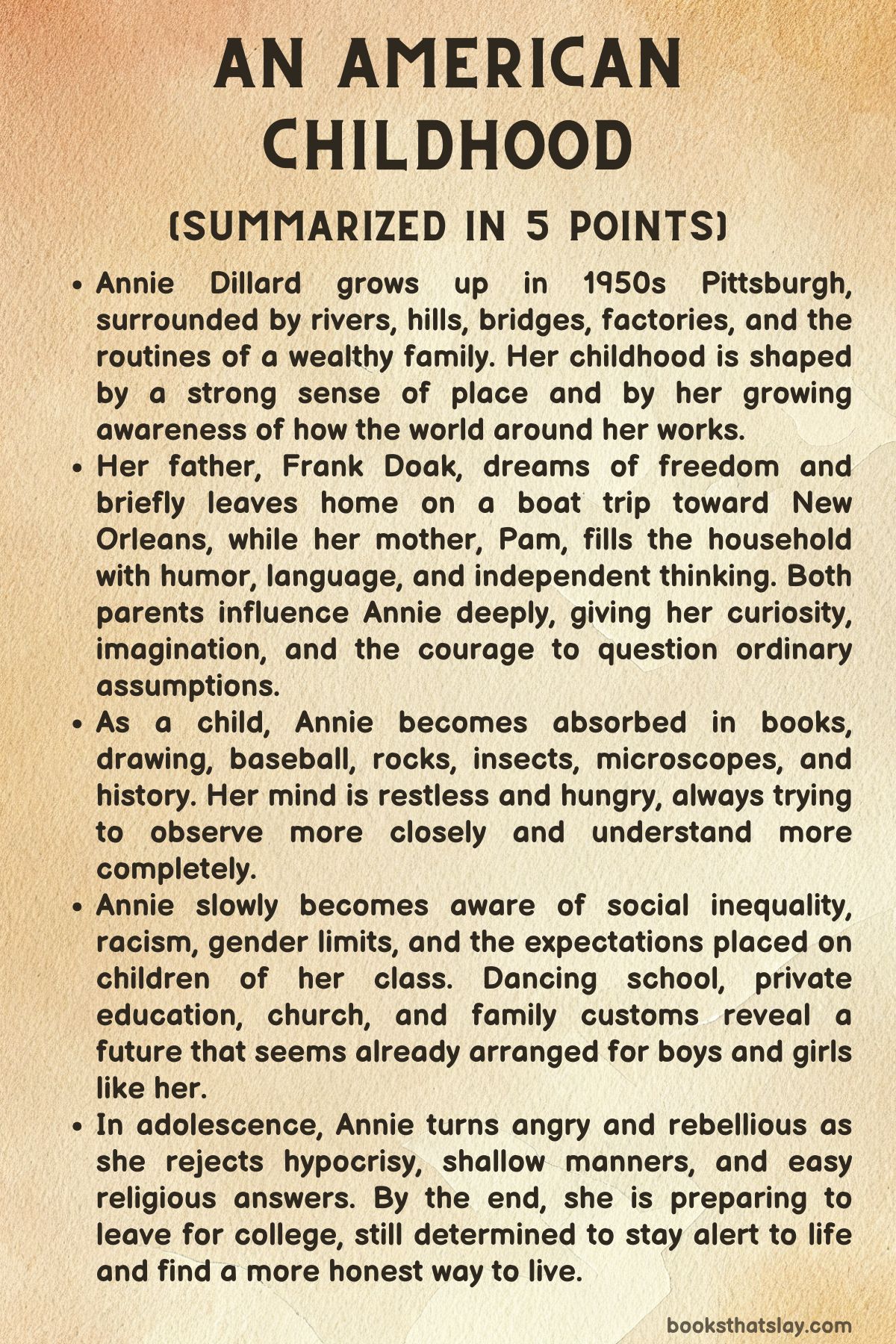
An American Childhood begins with Annie Dillard’s memory of Pittsburgh, the city that formed the ground of her early life. The rivers, hills, bridges, factories, old families, and neighborhoods are not just scenery; they are the first map of her mind.
She grows up in a prosperous family, surrounded by comfort, social customs, and the expectation that life will follow a set path. Yet from the beginning, she is drawn toward attention, movement, knowledge, danger, and the strange fact of being alive.
One of the earliest defining figures in her life is her father, Frank Doak. He is fascinated by Mark Twain, river travel, and Dixieland jazz.
When Annie is ten, he leaves his job, sells his shares in the family business, and sets out in a small boat on a dream journey downriver toward New Orleans. His goal is to reach the home of the music he loves.
Annie’s mother supports him, staying behind with the children. But the journey does not last.
Loneliness, autumn darkness, and concern over gossip send him home before he reaches his destination. His failed voyage stays in Annie’s memory as an image of longing, freedom, and the limits that society can place on a person.
Annie’s early childhood is marked by fear, wonder, and discovery. As a small girl, she is terrified by a moving shape of light that appears nightly on her bedroom wall.
She believes it is some deadly presence until she realizes it is only the reflection from a passing car. This pattern repeats throughout her childhood: the world first appears strange or threatening, then becomes explainable, though never less remarkable.
She notices adults’ aging skin, her parents’ beauty when they dress for a night out, the silence of the suburb after men leave for work, and the sudden noises that break through ordinary days.
Her mother, Pam, is one of the great forces in the household. She is funny, sharp, imaginative, and allergic to dull conformity.
She loves jokes, wordplay, odd phrases, and surprise. She teaches her children not only how to laugh but how to think, how to question easy judgments, and how to resist empty social rules.
When Annie uses a racist slur after hearing it from a neighborhood boy, her mother responds firmly, making her apologize and understand that such language is wrong. This moment becomes part of Annie’s first awareness of the moral world beyond her own comfort.
As Annie grows, her neighborhood becomes an open field of exploration. She roams on foot and by bicycle, learning streets, alleys, fields, and social boundaries.
She watches boys play sports, falls in love from a distance, and eventually learns to play football and baseball with them. She loves the discipline of baseball, especially pitching, where concentration matters more than noise or display.
Yet she also learns that girls are kept out of certain arenas. Little League belongs to boys; girls are directed elsewhere.
Annie accepts what she must, but she feels the unfairness.
Her family spends summers at Lake Erie with her grandparents. These visits show her another version of family life, full of strong personalities, old habits, servants who are treated as part of the household, and arguments over taste that matter deeply to adults.
Her grandmother, Oma, is vivid and opinionated, while her grandfather is kind and generous. Annie learns that families can disagree without breaking apart, and that love often survives beneath quarrels over furniture, clothes, manners, and style.
At ten, Annie enters a private girls’ school and begins to see more clearly the social order into which she has been born. Dancing school becomes one of the rituals preparing girls and boys for their expected adult roles.
The boys from the right families are trained for future power in business and society; the girls are prepared for marriage, motherhood, and volunteer work. Annie is disturbed by how early these futures seem arranged.
She notices popularity, wealth, courtship, and class, and she begins to understand that privilege has rules as strict as any law.
At the same time, her mind is opening in every direction. She discovers books, drawing, libraries, science, and natural history.
She reads with hunger and tries to find systems for identifying great novels. At the Homewood library, located in a mostly Black neighborhood, she begins to understand inequality in a direct way.
She can lie on the marble floor reading during the day, while the adults around her work for little money and live in crowded conditions. The unfairness chills her.
Her childhood privilege no longer feels invisible.
Annie’s curiosity becomes almost physical. She draws constantly, studies rocks, collects specimens, longs for a microscope, and investigates pond water, blood, urine, insects, and minerals.
She wants to know how things work. Her father encourages this habit by answering her questions about machines, bridges, boats, steam engines, and construction.
Yet she also learns that he does not know everything. When he explains the economy in a way that suggests money naturally benefits everyone, her mother counters with the example of poor Black sharecroppers.
Annie sees that intelligence and love do not prevent blindness.
The natural world gives Annie some of her strongest lessons. A moth emerging from its cocoon in a jar cannot spread its wings because the container is too small.
Its wings remain ruined, and when it is released outside, it can only stagger forward. Annie is horrified by the waste and cruelty of the accident, but she is also struck by the moth’s persistence.
It keeps moving because it is alive. This image reflects one of the book’s main ideas: life is powerful, vulnerable, and often damaged by the limits imposed on it.
History also seizes Annie’s imagination. She becomes absorbed in the French and Indian War, in Pittsburgh’s forts and old battles, and later in World War II.
Reading about death camps, war memoirs, and nuclear threat changes her sense of the world. School drills for possible atomic attack no longer seem abstract.
She imagines how her family might survive in the basement and how she would ration supplies. Knowledge expands her, but it also burdens her.
The adult world is full of suffering, hypocrisy, and danger.
By adolescence, Annie’s energy turns into anger. She feels trapped by the polished society around her, where people seem committed to repeating the same roles generation after generation.
The lives of wealthy women appear especially narrow: marriage, children, manners, clothes, and social performance. She wants something more real, more honest, more intense.
Her rage grows wild. She rebels against church, writes a long angry letter to the pastor, questions why a loving God would allow suffering, and finds no satisfying answer.
She gets involved in reckless behavior, including a drag race that ends in a crash, and she is later suspended from school for smoking.
Her parents are frightened and hurt by her rebellion, but Annie herself does not fully understand it. She reads French poets, thinks about her boyfriend, draws strange faces, and searches for a philosophy that can match her hunger for truth.
When she discovers Emerson, she finds a voice that speaks to her desire for a larger spiritual unity outside conventional religion. His ideas help her imagine a reality beyond the social world she despises.
By the end of the memoir, Annie is preparing to leave for Hollins College. Adults hope college will smooth her rough edges, but she wants to keep them because they may help her break through to the real world.
The book closes from the viewpoint of the adult writer looking back. Childhood, for Dillard, is not simply a lost time; it is the period when consciousness first breaks open.
The central act of life is waking up again and again to the world, to place, to injustice, to beauty, to knowledge, and to one’s own fierce desire to live fully.
Key People
Annie Dillard
Annie Dillard is the central consciousness of An American Childhood, and her character is built less through a conventional plot than through the growth of perception. As a young child, she is intensely alert to fear, mystery, sound, light, and movement.
The frightening shape on her bedroom wall shows how vividly her imagination works before reason catches up with it. As she grows older, that same alertness turns into curiosity.
She wants to know how machines work, how rocks can be identified, how insects live, how books are organized, how history shaped Pittsburgh, and how the adult world functions. Annie is restless, competitive, and physically energetic, but she is also deeply intellectual.
She plays sports with boys, rides through neighborhoods, investigates nature, reads constantly, draws faces, and tests limits. Her childhood is a steady movement from innocence toward sharper awareness.
She begins to notice race, class, gender restrictions, religious contradictions, and social hypocrisy. By adolescence, her curiosity becomes anger because she can see more than her society wants her to see.
Her rebellion is not simple misbehavior; it is the reaction of a young mind refusing to accept a life already planned for her. Annie’s deepest trait is her hunger to be awake: to see fully, remember fully, and live with seriousness.
Frank Doak
Frank Doak, Annie’s father, is charming, intelligent, adventurous, and limited in ways Annie slowly comes to understand. His planned river journey to New Orleans reveals a romantic side of him.
He loves Mark Twain, boats, jazz, and the idea of a freer life outside corporate Pittsburgh. His decision to leave his job and travel alone suggests courage and longing, but his return before reaching New Orleans also shows how strongly he remains tied to respectability, family expectations, and public opinion.
Frank is a loving father who takes Annie seriously. He answers her questions carefully and teaches her about machines, bridges, boats, and engineering.
Through him, Annie learns the pleasure of asking how things work. Yet he is not presented as all-knowing.
When he explains economics in a way that overlooks poverty and racial injustice, Annie sees that her father’s intelligence has boundaries. This discovery is important because it marks a shift in her childhood: she can love and admire him while also recognizing his blind spots.
Frank represents imagination constrained by class, habit, and social pressure.
Pam Doak
Pam Doak, Annie’s mother, is one of the most vivid and powerful figures in Annie’s childhood. She is witty, unpredictable, verbally brilliant, and deeply opposed to dull conformity.
Her humor is not decorative; it is a way of thinking. She teaches her children timing, irony, wordplay, and the pleasure of turning ordinary situations into comedy.
She also teaches them independence of judgment. When Annie repeats a racist slur she has heard from another child, Pam responds with moral seriousness and insists that Annie apologize.
This moment shows that Pam’s playfulness exists alongside firm ethical clarity. She refuses to let her children accept prejudice, snobbery, or social assumptions without thought.
Pam often unsettles people for fun, but her eccentricity has purpose: she wants life to remain alive, surprising, and mentally active. For Annie, Pam is almost larger than life, a source of language, rebellion, affection, and intellectual freedom.
She gives Annie permission to question the world, even though Annie’s later rebellion also frightens and wounds her.
Amy Doak
Amy, Annie’s younger sister, is quieter and more composed than Annie. She is described as beautiful, intelligent, and well-behaved, and her presence helps define Annie by contrast.
Where Annie is intense, unruly, and often restless, Amy seems more graceful and socially acceptable. Annie’s feelings toward Amy include affection and some jealousy, which makes their sisterly relationship believable.
Amy is not treated as an enemy or rival in a dramatic sense; rather, she represents a different way of being a girl in the same family. Her quietness highlights Annie’s unruly energy and her difficulty fitting into the expectations placed before her.
Amy also belongs to the emotional structure of the household. When Annie’s behavior hurts the family, Amy’s presence reminds readers that Annie’s rebellion affects not only her parents but also her sisters.
Amy helps show that childhood is not experienced alone. Each child grows within the gaze, comparison, and emotional life of the others.
Molly Doak
Molly, the youngest Doak sister, enters Annie’s life when Annie is old enough to notice babyhood as something precious and passing. Annie enjoys caring for and playing with Molly, and Molly becomes part of Annie’s vow to remember everything.
Through Molly, Annie becomes aware of time, loss, and the duty of memory. A baby changes quickly, and Annie senses that if she does not hold these moments in consciousness, they will vanish.
Molly also brings out Annie’s tenderness. Though much of Annie’s character is associated with curiosity, rebellion, and anger, her relationship with Molly shows care and attachment.
Later, when Annie’s adolescent trouble upsets the family, Molly’s distress reveals the emotional cost of Annie’s actions. Molly is young, but she matters because she represents innocence, family continuity, and the fragile beauty of details that childhood often loses unless someone preserves them.
Oma
Oma, Annie’s grandmother, is colorful, strong-willed, opinionated, and full of personality. She has vivid tastes, firm preferences, and a presence that cannot be ignored.
Her arguments with Pam over home decoration, clothing, and taste reveal differences between generations, but they also show how family conflict can exist inside deep loyalty. Oma’s taste may seem excessive or strange to others, but Annie eventually understands that taste is not the same as morality.
This insight matters because much of Annie’s social world treats taste, class, and manners as if they were moral truths. Oma helps expose that mistake.
She belongs to an older family world of money, habit, domestic hierarchy, and strong feeling. Her final appearance in Florida, when Annie is fifteen, also shows how adolescence changes perception.
What once seemed vivid can become irritating or boring to a teenager in revolt. Oma is important because she embodies family history, social tradition, and the complicated love that survives disagreement.
Annie’s Grandfather
Annie’s grandfather is remembered as kind, generous, and stable. He is less flamboyant than Oma, but his presence gives the family a sense of warmth and continuity.
His role as a bank vice-president and member of a prosperous family places him within the secure upper-class world Annie inherits, yet he is not reduced to wealth or position. He is part of the affectionate atmosphere of the Lake Erie summers, where family routines, servants, children, and adults create a world that feels both privileged and intimate.
His death marks one of Annie’s encounters with loss. It also leads to the family’s move into the old stone house, linking private grief with a change in place.
Through him, Annie experiences the way family history is carried through houses, neighborhoods, and memories. He represents the older structure of the Doak family: gentle, prosperous, and rooted in the past.
Mary Burinda
Mary Burinda, the Hungarian housekeeper at the grandparents’ home, is a beloved member of the extended household. Her background carries a history of loss, especially the deaths of many family members during the flu epidemic.
This detail gives her character a depth beyond her domestic role. She is part of Annie’s childhood world, but she also brings into that world the reality of suffering that exists outside Annie’s protected life.
Mary’s presence reveals the layered nature of the family household, where servants are loved and included but still occupy a different social position. Annie’s memory of Mary suggests affection, but it also quietly points toward class difference.
Mary is important because she widens the emotional and historical range of Annie’s childhood environment. Through her, the memoir acknowledges lives marked by hardship, immigration, service, endurance, and memory.
Henry Watson
Henry Watson works as butler, groundskeeper, and chauffeur, and he is also treated as a beloved figure in the family’s summer household. Like Mary, he occupies a complex place: he is close to the family, valued by them, and remembered with affection, yet his role is shaped by class and service.
His presence reveals the social structure that supports Annie’s privileged childhood. The children experience him as part of the family setting, but adult readers can see the unequal arrangements beneath that affection.
Henry helps show that Annie’s world is not only made of parents, siblings, schools, and neighborhoods; it is also supported by people whose labor makes comfort possible. His character contributes to one of the memoir’s quiet tensions: love and hierarchy can exist in the same space, but that does not erase the hierarchy.
Margaret Butler
Margaret Butler, the family maid, is most important in the episode where Annie repeats a racist insult she has learned from another child. Margaret’s role in that scene is brief but significant.
She becomes the person toward whom Annie must take responsibility. Pam’s insistence that Annie apologize turns Margaret from a background figure into someone whose dignity must be recognized.
The episode reveals the racial and social assumptions surrounding Annie’s childhood, especially the way children absorb language before understanding its cruelty. Margaret’s presence forces a moral awakening.
Annie learns that words have consequences and that prejudice is not an abstract issue. Margaret also represents the Black workers whose lives intersect with wealthy white households but are often kept at the margins of the children’s understanding.
Her character matters because she becomes part of Annie’s early education in justice, shame, and respect.
Tommy Sheehy
Tommy Sheehy is a neighborhood boy whose influence exposes Annie to ugliness she does not yet understand. When he tells her to use a racist slur, he becomes a source of moral contamination in the story, though he is still a child himself.
His action shows how prejudice is passed casually between children, often as a form of social daring or imitation. Tommy also belongs to Annie’s fascination with Catholic children and their different schooling, rituals, and social world.
To Annie, the Sheehys are both familiar and strange. Tommy’s role is not large, but it is sharp.
He helps trigger one of Annie’s early lessons in language, race, and obedience. Through him, the memoir shows that childhood innocence is not pure; children carry the attitudes of the adult world even before they understand them.
Jo Ann Sheehy
Jo Ann Sheehy appears most memorably as the Catholic girl skating in the street after the snowfall. Her graceful performance fascinates Annie’s family because it is beautiful, self-contained, and unusual.
Jo Ann represents the mystery of other children’s lives. She belongs to the Catholic world that Annie finds both frightening and attractive, especially because Annie is fascinated by nuns and Catholic schooling.
Jo Ann’s skating creates a moment of silent wonder. She is not analyzed through speech or action in the way Annie’s family members are; instead, she is remembered as an image of physical grace and otherness.
Her importance lies in how Annie sees her. Jo Ann becomes part of Annie’s growing awareness that the world contains forms of beauty and experience outside her own household and social training.
Barbara “Pin” Ford
Barbara “Pin” Ford is Annie’s best friend during a period when imagination, history, and outdoor play dominate Annie’s life. Together they play in the woods, act out scenes inspired by frontier history, and practice stealth and invention.
Pin is important because she shares Annie’s active, exploratory childhood. Their friendship is not centered on polite domestic play but on movement, fantasy, and physical freedom.
Through Pin, Annie’s interest in Native American life, the French and Indian War, and local history becomes a lived game rather than only a subject in books. Pin helps reveal Annie’s need for companionship in adventure.
She is not merely a side character; she is part of the social world that allows Annie to test bravery, imagination, and identity. Their friendship shows childhood as a space where learning and play are often inseparable.
Judy Schoyer
Judy Schoyer introduces Annie to a different version of privilege. Judy’s family is wealthy, old, educated, liberal, and culturally sophisticated.
Their farm near Paw Paw, West Virginia, becomes a place Annie loves intensely. The Schoyers attend opera, welcome foreign visitors, and live in a way that feels broader and more intellectually open than Annie’s own family world.
Judy herself matters because she gives Annie access to that atmosphere. Through Judy’s family, Annie sees that wealth does not have to mean only social ritual, dances, manners, and corporate futures.
It can also include art, learning, travel, and cultivated openness. Yet Annie’s love for Paw Paw becomes almost painful because it awakens desire for a life she cannot fully possess.
Judy’s role is therefore connected to longing. She represents the attraction of a wider, more cultured world that Annie senses but cannot yet enter permanently.
The Pastor
The pastor appears during Annie’s adolescent break with church. His role is important because he becomes the adult representative of religious authority at the moment when Annie’s questions become too urgent for easy answers.
Annie asks why suffering exists if God is loving, and the books he offers do not satisfy her. He is not portrayed as cruel or foolish; rather, he is inadequate to the scale of Annie’s need.
His failure is partly institutional. The church offers structure, language, and tradition, but Annie wants truth that can stand against war, injustice, death, and human pain.
The pastor’s inability to answer her marks a turning point in her spiritual life. He helps show that Annie’s rebellion is not only social but metaphysical.
She is not rejecting religion for convenience; she is rejecting answers that feel too small for the world she has begun to see.
Themes
Awakening and Consciousness
The central movement of An American Childhood is the gradual awakening of a mind. Annie’s childhood is not presented as a simple sequence of family events; it is shown as the process by which a person becomes aware of being alive.
Early in life, she experiences the world through fear, fascination, and sensory intensity. The moving light on her bedroom wall terrifies her until she understands its cause, but the explanation does not reduce the wonder of the event.
This pattern continues as she grows. Books, sports, drawing, rocks, insects, microscopes, history, and city streets all become ways of sharpening consciousness.
To Annie, living fully means noticing. She wants to see the world as accurately and intensely as possible.
This theme also connects to memory. She feels a duty to remember her sister’s babyhood, the old house, the streets, the sounds, and the moments that would otherwise disappear.
The adult writer looks back not only to record childhood but to understand how awareness forms. Childhood becomes valuable because it shows the first moments when the self rises into attention and begins to recognize the world as real, complex, and shared.
Family, Influence, and Independence
Annie’s family shapes her deeply, but the memoir also shows her gradual separation from that family. Frank gives her curiosity about machines, boats, construction, jazz, and adventure.
Pam gives her language, humor, independence, and moral alertness. Her grandparents give her a sense of family history, comfort, and inherited social position.
Her sisters give her tenderness, comparison, jealousy, and responsibility. These influences are powerful, but Annie does not simply absorb them.
She tests them. She learns from her father but later sees where his explanations fail.
She adores her mother’s wit but eventually turns her own sharpness against the world her parents inhabit. Her family gives her the tools of attention and judgment, and those same tools make her harder to control.
This creates one of the memoir’s strongest tensions: parents want children to become intelligent and independent, but true independence may lead children to reject family values. Annie’s adolescence is painful because her rebellion hurts the people who formed her.
Yet her anger is also a sign that their lessons succeeded. She has learned to think, and once she thinks seriously, she cannot pretend that inherited customs are enough.
Class, Race, and Social Expectation
Annie grows up inside a privileged Pittsburgh world where class expectations are treated as natural. Private schools, dancing lessons, family businesses, church attendance, inherited houses, and carefully managed courtship rituals all prepare children for predetermined adult roles.
Boys are expected to become corporate leaders; girls are expected to become wives, mothers, and socially useful women. At first, Annie observes this world from within, but gradually she becomes disturbed by it.
She notices that wealth affects popularity, marriage prospects, confidence, and freedom. Her time at the Homewood library brings racial and economic inequality into sharper focus.
She sees that she can spend her days reading on a marble floor while Black adults nearby work long hours for little money. The episode involving Margaret Butler and the racist slur also reveals how prejudice circulates through ordinary childhood speech.
Annie’s mother responds by making the moral stakes clear. The memoir does not present Annie as instantly enlightened; rather, it shows awareness developing through discomfort.
Class and race are not abstract topics for her. They enter through places, words, servants, libraries, neighborhoods, and family conversations.
Her later anger grows partly from recognizing how much injustice polite society hides.
Rebellion, Anger, and the Search for Truth
Annie’s adolescence is marked by rage, but that rage has roots in perception. By the time she is fifteen and sixteen, she has read about war, death camps, suffering, poverty, religion, and history.
She has also seen the narrowness of the social future prepared for her. The polished world around her begins to feel false.
Churchgoing seems hypocritical, gender roles seem suffocating, and adult manners seem designed to cover over real questions. Her rebellion takes risky and painful forms: reckless behavior, smoking, conflict with school, anger toward her parents, and rejection of church.
Yet beneath the disorder is a serious hunger for truth. She wants answers large enough to address suffering and injustice.
The pastor’s books fail her because they do not meet the force of her questions. French poetry attracts her intensity but does not settle her.
Emerson gives her a more satisfying vision because he suggests spiritual unity and self-reliance beyond conventional religion. Annie’s rebellion is therefore not merely teenage defiance.
It is the struggle of a young person trying to cut through inherited falsehoods and reach a reality that feels honest, demanding, and alive.