Angela’s Ashes Summary and Analysis
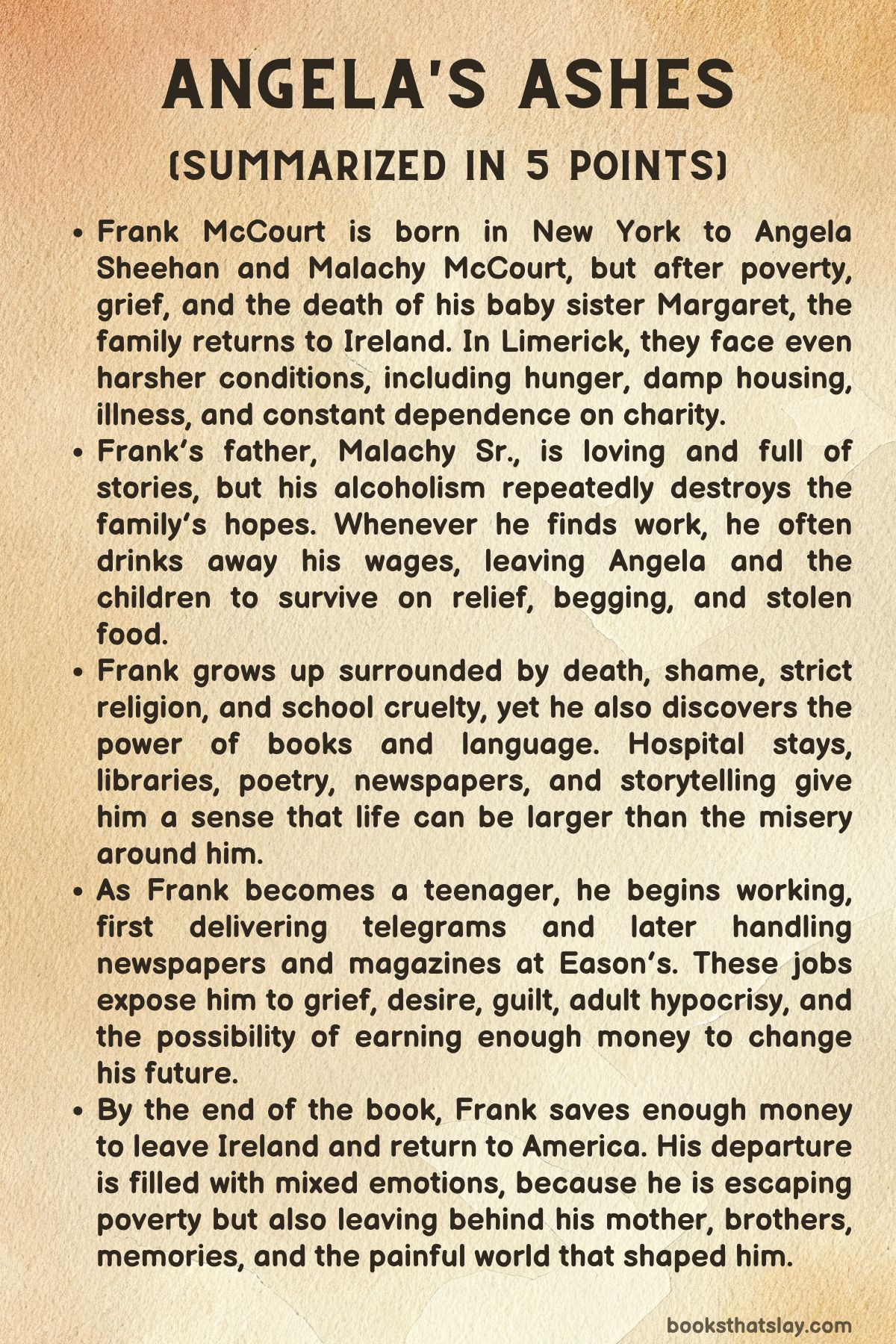
Angela’s Ashes is Frank McCourt’s memoir of childhood poverty, family loss, and survival in Ireland and America. Told with sharp memory and dark humor, the book follows young Frank from his birth in Brooklyn to his hard years in Limerick, where rain, hunger, illness, shame, religion, and his father’s drinking shape daily life.
Yet the story is not only about suffering. It is also about a boy discovering language, books, work, desire, anger, guilt, and ambition. McCourt writes with plainspoken honesty, showing how a damaged family can still contain love, wit, and moments of grace.
Summary
Angela’s Ashes begins with Frank McCourt looking back on his early childhood and the family history that shaped him. He is born in New York to Angela Sheehan of Limerick and Malachy McCourt of Northern Ireland.
Angela and Malachy marry after Angela becomes pregnant, pushed into the marriage by her relatives, who believe Malachy must take responsibility. Their life in America is unstable from the start.
Malachy is intelligent, proud, and full of stories, but he is also unreliable and drinks away whatever money he earns. Angela tries to care for the children, but poverty keeps closing in.
Frank is followed by his brother Malachy, then twins Oliver and Eugene, and later a baby sister, Margaret. Margaret’s birth briefly changes the household.
Malachy adores her and even stops drinking for a time, giving the family a rare sense of hope. When Margaret dies as an infant, both parents collapse into grief.
The boys are neglected, and Angela’s cousins arrange for the family to return to Ireland, believing life might be better there.
The family first reaches Malachy’s relatives in the north, but there is no room for them. They then try Dublin, where Malachy seeks money he believes he is owed for his past involvement with the IRA.
He receives nothing. With few choices left, the family goes to Limerick, Angela’s home city.
There, they find little welcome and less comfort. Angela’s mother dislikes Malachy, and the family is forced into poor lodgings filled with fleas and misery.
Life in Limerick is cold, wet, and degrading. The McCourts depend on charity, food dockets, and whatever work Malachy can find.
Angela must face the humiliation of asking for help from officials who treat the poor with contempt. Malachy sometimes finds employment, but payday often ends with him drinking in pubs while Angela and the children wait at home hungry.
Each time work appears, the family hopes things will improve; each time, Malachy’s drinking destroys that hope.
Illness and death follow the family. Oliver becomes sick and dies, leaving Angela unable to remain in the place where he died.
The family moves, but Eugene, confused by his twin’s absence, also becomes ill and dies. Angela is broken by the deaths, while Malachy turns again to alcohol.
Frank grows up surrounded by funerals, sickness, hunger, and the fear that children can vanish from life with little warning.
The McCourts move to Roden Lane, where conditions are filthy and unsafe. Their home floods, and it sits beside a lavatory used by the whole lane.
Still, ordinary family life continues in small ways. Christmas is poor but shared.
A new baby, Michael, is born. Malachy tries to repair the boys’ shoes with scraps, and the family keeps searching for scraps of dignity amid dirt and hunger.
School introduces Frank to another form of hardship. Teachers are often cruel, using fear, beatings, and shame to control hungry boys.
Religion dominates childhood in Limerick, and Frank grows up frightened by sin, confession, Communion, and the possibility of damnation. His First Communion, which should be a joyful milestone, becomes a humiliating ordeal after he becomes sick and his grandmother accuses him of vomiting God in her yard.
Yet the religious world is not entirely harsh. Some priests show kindness, and Frank learns that mercy can exist beside judgment.
Frank’s childhood is also filled with strange humor and vivid neighbors. Boys tell dirty stories and invent schemes.
Families fight, borrow, beg, and gossip. Frank meets people who are poor, sick, eccentric, generous, cruel, or all of these at once.
He begins to understand that adults are flawed and that respectability often has more to do with class than goodness. When he is rejected as an altar boy because of his appearance and poverty, Angela recognizes the insult clearly.
As Frank grows older, books and language become a way out. He is drawn to stories, poetry, Shakespeare, saints’ lives, and newspapers.
During a serious bout of typhoid fever, he spends time in the hospital and meets Patricia, an older girl who introduces him to literature that stays with him. Her death wounds him deeply, but the words she shared remain part of him.
Later, librarians and teachers notice his intelligence, even though institutions repeatedly shut doors in his face.
Malachy eventually goes to England for work during wartime, and the family hopes he will send money home like other men do. The money rarely comes.
Reports suggest he is drinking his wages away in England, just as he did in Limerick. Angela considers desperate options, even the possibility of putting the boys in an orphanage so she can work, but she refuses when she thinks of the cruelty they might face there.
The family survives on relief, begging, stealing, and the thin kindness of others.
When Angela falls ill with pneumonia, Frank steals lemonade and bread to help her and feed the family. The boys beg from wealthier homes and steal coal, trying to keep themselves alive.
Their situation becomes so bad that a guard discovers the state of the household and Angela is taken to the hospital. The boys are sent to Aunt Aggie, whose house is harsh and loveless.
Malachy returns briefly, promises again to send money, then leaves again.
Frank becomes increasingly aware of shame. He sees Angela begging outside a church and feels crushed by it.
He discovers from family documents that his parents married after he was conceived, and he worries about being born in sin. He works for Mr. Hannon delivering coal and experiences pride, responsibility, and the joy of being useful.
But his eyes are weak, and the job ends when Angela fears he may damage his sight.
The family is eventually evicted after burning parts of the wall for firewood. They move in with Laman Griffin, Angela’s cousin.
The arrangement is degrading. Laman gives Frank errands and powerfully controls the household.
Frank suspects a sexual relationship between Laman and Angela, which fills him with anger and shame. After Laman refuses to lend him a bicycle despite an earlier promise and then throws him out, Frank leaves and moves in with Uncle Pat.
Living apart from Angela gives Frank a rough independence. He steals bread and milk, searches for work, and keeps reading.
He becomes a telegram boy at fourteen, earning money and seeing the private griefs of Limerick households. The job teaches him that the poor often tip better than the rich, and that official rules can feel cruel when people are hungry or helpless.
He gives much of his pay to support Angela, especially after she leaves Laman and stays with Uncle Pat.
As a teenager, Frank also confronts desire, guilt, and adulthood. He begins a sexual relationship with Theresa Carmody, a young woman suffering from consumption.
When she dies, Frank believes he has helped condemn her soul and is tormented by guilt. Later, after his first drunken night at sixteen, he strikes Angela during an argument about Laman.
Horrified by himself, he seeks confession. A gentle Franciscan priest assures him that Theresa is in heaven and offers the compassion Frank badly needs.
Frank leaves telegram work for a job with Eason’s, delivering newspapers and magazines. The job brings him closer to writing, reading, and the wider world.
He and coworkers secretly profit from selling pages containing a forbidden birth control advertisement, and Frank saves money with growing determination. He also writes threatening letters for Mrs. Finucane, a moneylender, discovering that his skill with words can earn cash.
By seventeen and eighteen, Frank’s goal is clear: he wants to return to America. When Mrs. Finucane dies, he takes hidden money from her house to complete his fare.
His family holds a farewell party, marked by sadness, pride, and uncertainty. Frank leaves Ireland in 1950, carrying guilt, excitement, resentment, love, and ambition.
Instead of arriving directly in New York, his ship travels up the Hudson River. In America, he spends a strange first night ashore with strangers, drink, temptation, and a sense that his old life is ending.
Angela’s Ashes closes by pointing toward the next part of Frank’s life, the life he will build after surviving the hunger and shame of Limerick.
Key Figures
Frank McCourt
Frank McCourt is the central figure of Angela’s Ashes, and the book follows his growth from a confused child into a young man determined to escape poverty and shape a life of his own. As a boy, Frank is sensitive, observant, hungry, ashamed, curious, and often frightened by the religious rules surrounding him.
He absorbs the humiliations of poverty with a sharp awareness that many adults do not see him as fully worthy because of his class, his clothes, his illness, or his family’s condition. Yet Frank is not written as purely innocent.
He steals food when starving, lies when afraid, feels sexual desire, acts in anger, and carries guilt intensely. These flaws make him human rather than simply pitiful.
His greatest strength is his intelligence, especially his love for language. Books, poems, newspapers, and stories give him a private world larger than Limerick’s lanes and charity offices.
By the end of the story, Frank has become someone who understands pain without letting it completely define him. His journey is not a clean rise from misery to success; it is a difficult movement toward self-respect, independence, and possibility.
Angela McCourt
Angela McCourt is Frank’s mother, and she is one of the most sorrowful and enduring figures in the book. She begins as a young woman trapped by pregnancy, marriage, and poverty, then becomes a mother forced to watch several of her children suffer and die.
Angela’s life is shaped by hunger, shame, illness, begging, and the constant failure of her husband to provide. She is not portrayed as a perfect mother.
Grief sometimes makes her passive, exhaustion leaves her unable to protect her children fully, and her dependence on others places the family in painful situations. Still, her weakness must be understood in the context of extreme deprivation.
Angela is not careless because she lacks love; she is worn down by a world that gives poor women few choices. Her moments of begging, pleading, or accepting help from cruel relatives reveal how poverty attacks dignity.
Her relationship with Frank becomes especially complicated as he grows older and begins to judge her choices. Yet beneath the anger between them lies a bond formed by shared suffering, survival, and the painful knowledge that love cannot always provide food, shelter, or safety.
Malachy McCourt Sr.
Malachy McCourt Sr., Frank’s father, is one of the most conflicted characters in Angela’s Ashes. He is charming, imaginative, patriotic, and capable of tenderness, especially when he tells stories or speaks to his sons with warmth.
He gives Frank a sense of identity, imagination, and Irish history, and his love for his children is real. At the same time, his alcoholism causes enormous damage.
Again and again, he gets work, earns wages, and drinks the money while his family waits hungry at home. His failure is not a single mistake but a repeated pattern that turns hope into disappointment.
The tragedy of Malachy is that he is not a monster; he is a loving father whose addiction and pride make him destructive. His northern Irish background also marks him as an outsider in Limerick, and this adds to the family’s sense of social isolation.
He represents the pain of wasted potential. Frank loves him, resents him, admires him, and fears becoming like him.
Malachy’s character shows how affection can exist beside betrayal, and how a parent can shape a child through both tenderness and harm.
Malachy McCourt Jr.
Malachy McCourt Jr. is Frank’s younger brother and one of his closest companions in childhood. He shares Frank’s hunger, hardship, and family instability, but he is often presented as lighter, more charming, and more socially appealing.
While Frank tends to be inward, anxious, and burdened by guilt, Malachy Jr. often seems more naturally cheerful and expressive. His resemblance to Angela gives him a different place in the family, while Frank is more strongly associated with his father.
Malachy Jr. also reflects the way children in the book are forced to grow up within adult failures they cannot control. He experiences the same poverty, moves, deaths, and disappointments, yet the story does not give him Frank’s deep interior voice.
This makes him important as both a brother and a contrast. Through him, Frank is not alone; childhood misery becomes shared experience.
Malachy Jr. also helps show the family as a living unit rather than only a background for Frank’s personal suffering.
Oliver McCourt
Oliver McCourt, one of the twins, represents the terrible fragility of childhood in the McCourt family’s world. His illness and death are among the earliest events that teach Frank how quickly life can disappear.
Oliver does not live long enough to develop into a complex speaking figure, but his importance lies in the effect his death has on the family. Angela is devastated and cannot remain in the place where he died.
Eugene, his twin, cannot understand where Oliver has gone, and this confusion becomes part of the family’s sorrow. Oliver’s death also shows the brutal reality of poverty, where sickness is made worse by poor housing, poor nutrition, and limited medical care.
He stands for all the children whose lives are treated as almost ordinary losses in a world used to deprivation. His absence continues to shape the emotional atmosphere of the family.
Eugene McCourt
Eugene McCourt, Oliver’s twin, is deeply affected by his brother’s death even though he is too young to understand it fully. His grief is shown through confusion, searching, and emotional decline.
Eugene’s own illness and death soon after Oliver’s make the family’s suffering feel almost unbearable. Like Oliver, Eugene is not developed through long dialogue or adult personality, but his role in the book is powerful.
He shows how children experience loss before they have the language to explain it. His bond with Oliver also gives his death a special sadness, as though one twin cannot remain in the world without the other.
For Angela, Eugene’s death adds another wound to an already broken heart. For Frank, it becomes part of the childhood pattern in which hunger, sickness, funerals, and religious explanations surround everyday life.
Margaret McCourt
Margaret McCourt is Frank’s baby sister, and her brief life reveals a different side of Malachy Sr. Her birth brings tenderness into the household, especially through the father’s devotion to her. For a short time, Malachy stops drinking and appears capable of becoming the father Angela and the children need.
Margaret therefore becomes a symbol of possibility. Her death destroys that fragile hope and sends both parents into grief.
Though she appears only briefly, Margaret has great emotional importance because she shows what the family might have been if love alone were enough to save them. Her death also marks one of the first major collapses in the family structure.
After losing her, Angela and Malachy are so overcome that the boys are neglected, leading relatives to intervene and send the family back to Ireland.
Michael McCourt
Michael McCourt is one of Frank’s younger brothers born after the family returns to Limerick. He grows up amid the same poverty and instability but is often seen through Frank’s protective older-brother perspective.
When Frank earns money, one of his happiest acts is treating Michael to food and entertainment, which shows Frank’s growing sense of responsibility. Michael’s presence also shows that childhood continues even in miserable conditions.
Babies are born, children play, brothers share moments of pleasure, and the family keeps going despite repeated loss. Michael does not carry the same tragic weight as Oliver, Eugene, or Margaret, but he helps represent the surviving children whose lives depend on the fragile efforts of Angela and Frank.
Alphonsus “Alphie” McCourt
Alphie is the youngest McCourt child, born when the family is already exhausted by poverty. His birth should bring joy, but it instead exposes Malachy Sr.’s failure once again.
Money sent for Alphie’s birth and baptism is entrusted to Malachy, who drinks it away. In this sense, Alphie becomes tied to one of the clearest examples of Malachy’s betrayal.
As a baby, Alphie is vulnerable and dependent, and his presence increases the family’s burden while also reminding readers of Angela’s continuing motherhood under impossible conditions. He is important less for his individual actions than for what he reveals about the family’s cycle: birth, hope, need, male failure, and female endurance.
Grandma Sheehan
Grandma Sheehan, Angela’s mother, is harsh, judgmental, and often unkind, but she is also one of the few relatives who provides practical help when the family is desperate. She dislikes Malachy Sr. almost immediately and sees him as a poor husband for Angela.
Her treatment of Frank can be severe, especially during moments of religious panic and family conflict. She often speaks with bitterness, and her charity is rarely gentle.
Yet Grandma is not simply cruel. She helps with burials, housing, and survival when no better support exists.
Her character reflects a world where poverty has made tenderness difficult. She believes in respectability, Catholic order, and social judgment, but she also understands the practical demands of death, food, and shelter.
Her death removes one of the family’s difficult but necessary supports.
Aunt Aggie
Aunt Aggie, Angela’s sister, is one of the most severe adults in Frank’s childhood. She is sharp-tongued, resentful, and often cruel to the McCourt boys when they are placed in her care.
Her anger seems to come from bitterness, exhaustion, and contempt for Malachy Sr.’s failures. Frank experiences her as humiliating and harsh, especially when she insults him or treats him as a burden.
Yet Aggie is not without complexity. At times, she shows reluctant kindness, such as when she helps Frank get clothes for his job.
These moments do not erase her cruelty, but they prevent her from becoming a flat villain. Aggie represents the hard edge of family obligation: she helps because kinship demands it, but she often makes the help painful.
Her character shows how poverty can turn relatives against one another, making every extra mouth feel like an accusation.
Uncle Pa Keating
Uncle Pa Keating, Aggie’s husband, provides warmth, humor, and humane advice in contrast to many harsher adults. He tells stories, notices Frank’s struggles, and eventually gives him important guidance about following his own desires rather than simply obeying expectations.
When Frank reaches the age for his first pint, Pa takes the place that Malachy Sr. should have held. This act is both comic and sad, because it shows Pa’s kindness while also underlining the father’s absence.
Pa is not a grand rescuer, but he gives Frank moments of adult respect. He sees Frank not only as a poor boy but as a person with choices.
In a book where many adults shame children into obedience, Pa’s rough generosity matters.
Uncle Pat Sheehan
Uncle Pat, also called Uncle Ab, is Angela’s brother and another figure shaped by poverty and limitation. He is eccentric, vulnerable, and treated by others with a mixture of affection and mockery.
When Frank leaves Laman Griffin’s house, Uncle Pat’s home becomes a refuge, even if it is not comfortable or stable. His presence gives Frank a place to go when he can no longer remain with Angela and Laman.
Uncle Pat’s character is important because he belongs to the same world of damaged adults who have little power but still offer fragments of shelter. He is not a strong guardian, yet his home allows Frank to begin a more independent stage of life.
Delia and Philomena
Delia and Philomena, Angela’s cousins in America, are religious, forceful, and deeply concerned with moral respectability. They push Malachy Sr. into marrying Angela after her pregnancy, framing the situation through shame, sin, and duty.
They later intervene when the family collapses after Margaret’s death, helping arrange the return to Ireland. Their actions are practical, but their manner is judgmental.
They represent a type of Catholic social authority in which morality is tied to appearance, marriage, and reputation. At the same time, their intervention keeps the children from being entirely abandoned in grief.
They are not gentle figures, but they act when action is needed.
Nora Molloy
Nora Molloy is a vivid example of a poor Limerick mother fighting humiliation with aggression, wit, and nerve. She knows how to pressure charity officials and shopkeepers, and she uses religious guilt to force people into giving what the poor are owed or what they desperately need.
Her husband drinks heavily, and her own mental health is fragile, but she continues to battle for survival. Nora’s constant bread baking suggests both anxiety and care.
She is fierce because she has to be. Through her, the book shows that poor women often survive by becoming loud, difficult, and impossible to ignore.
She is a contrast to Angela, who is more often crushed by shame. Nora’s boldness offers a different model of resistance.
Mikey Molloy
Mikey Molloy is one of Frank’s childhood companions and a source of strange knowledge, comic confusion, and religious anxiety. His physical condition, visions, and delayed First Communion make him stand apart from other boys.
He introduces Frank to forbidden stories and ideas, which then trouble Frank’s conscience. Mikey’s presence reflects how children absorb adult religion in distorted, fearful, and often funny ways.
He is both vulnerable and mischievous. His world is marked by illness, family instability, and superstition, yet he also gives Frank access to the secret language of children: dirty jokes, half-understood sins, and rumors about bodies and souls.
Mikey Spellacy
Mikey Spellacy brings dark humor into the book’s treatment of death. His family is overwhelmed by consumption, and he becomes so used to the rituals of mourning that he thinks of wakes partly in terms of food, school absence, and small benefits.
This does not make him heartless; rather, it shows how constant exposure to death can distort a child’s responses. When death is common, children learn to treat it as part terror, part opportunity, and part routine.
Mikey’s own eventual death from consumption gives his earlier behavior a bitter sadness. He represents a society where illness is so familiar that even children build jokes and schemes around it.
Paddy Clohessy
Paddy Clohessy is one of Frank’s school friends and one of the clearest mirrors of poverty outside the McCourt family. His home is marked by sickness, hunger, and emotional emptiness.
When Frank spends time there, he sees that his own family is not alone in its suffering. Paddy’s father is sick with consumption, and the household carries the stillness of people who have been worn down.
Paddy joins Frank in acts of hunger-driven rebellion, such as stealing food and skipping school. His character shows how poverty creates a shared childhood culture of theft, fear, and loyalty.
He also helps Frank understand that misery is not exceptional in Limerick; it is everywhere.
Billy Campbell
Billy Campbell is part of Frank’s boyhood circle and often appears in moments of mischief, embarrassment, or adventure. He joins Frank in schemes, games, and forbidden acts, helping show the ordinary playfulness that survives even in poverty.
Billy’s teasing also affects Frank’s choices, such as when Frank gives up Irish dancing after being mocked. This makes Billy important as part of the social pressure of childhood.
For Frank, friends can offer escape from home, but they can also deepen shame. Billy represents the rough companionship of boys who are growing up in a world where hunger and humor exist side by side.
Quigley
Quigley is one of Frank’s schoolmates and functions as a messenger of consequence in the story. When Frank skips school and steals food, Quigley warns him that his parents have been informed.
He is not a major emotional figure, but he belongs to the network of children who carry news, rumors, threats, and judgments through Limerick. His role shows how public childhood is in Frank’s world.
A boy’s actions rarely remain private; school, church, neighbors, and family are all connected.
Quasimodo Dooley
Quasimodo Dooley is one of the neighborhood boys associated with adolescent curiosity, bodily shame, and comic disaster. His nickname itself shows the cruelty of children and the way physical difference becomes public identity.
His scheme to help other boys spy on girls exposes the confused sexual curiosity of boys raised in a strict religious culture. The incident ends badly when Mikey Molloy falls and is injured, turning childish desire into fear and consequence.
Quasimodo’s role is brief but important because he belongs to Frank’s awakening awareness of sex, guilt, and secrecy.
Mr. Benson
Mr. Benson, one of Frank’s teachers, represents the cruelty of institutional religion when it is enforced through fear. He prepares boys for First Communion, but his methods are violent, humiliating, and cold.
Rather than making faith a source of comfort, he makes it frightening. Through Mr. Benson, the book criticizes an education system that treats poor children harshly while claiming moral authority.
He is not simply a strict teacher; he is part of a larger structure that uses shame to control children. His presence helps explain Frank’s anxious relationship with sin and confession.
Mr. “Dotty” O’Neil
Mr. O’Neil is another harsh teacher at Leamy’s National School. His obsession with Euclid and his indifference to the hunger of his pupils make him a memorable figure of educational cruelty.
When he toys with food in front of starving boys, he reveals a lack of compassion that is more damaging than ordinary strictness. He represents the failure of adults who value discipline and intellectual order while ignoring the physical suffering directly in front of them.
For Frank, school is not a safe escape from poverty; it is another place where poverty is exposed and punished.
Mr. O’Halloran
Mr. O’Halloran is one of the few educational figures who sees Frank’s promise clearly. He believes Frank should continue his education and encourages Angela to seek a place for him with the Christian Brothers.
His support matters because it gives Frank a glimpse of recognition. Unlike teachers who shame or beat boys, Mr. O’Halloran notices intelligence and effort.
Yet his good intentions are limited by class barriers. When Angela and Frank are rejected, it becomes clear that talent alone cannot easily overcome social exclusion.
Mr. O’Halloran represents possibility, but also the frustration of possibility blocked by institutions.
Catherine O’Riordan
Catherine O’Riordan, the librarian, plays an important role in Frank’s intellectual development. She recognizes his hunger for reading and gives him access to books, shelter, and encouragement.
The library becomes one of the few places where Frank can encounter a wider world without paying for it. Catherine’s praise of his reading gives him dignity and confidence.
However, she also enforces moral boundaries when she discovers him reading sexual material and bans him. This makes her a complex gatekeeper of knowledge.
She opens the door to learning, but only within the limits of what her society considers proper. Her character shows both the generosity and restrictions of respectable adult guidance.
Patricia
Patricia is the older girl Frank meets in the hospital, and she becomes one of the most important figures in his awakening love for literature. She introduces him to powerful language and poetry, giving him something beautiful in a place associated with sickness and death.
Her kindness is quiet but lasting. Because she is ill herself, her friendship with Frank carries the sadness of temporary connection.
Her death affects him deeply, not only because he loses a friend but because she represents a world of imagination that briefly entered his suffering. Patricia helps Frank understand that words can outlast people and that literature can become a form of companionship.
Seamus
Seamus, the hospital janitor, is a warm and compassionate adult who treats Frank with unusual kindness. He carries messages, shares news, recites poems, and helps preserve Frank’s connection to Patricia after they are separated.
Seamus is not educated in a formal sense, but he has emotional intelligence and respect for language. His memorization of poems shows that literature belongs not only to schools and libraries but also to ordinary working people.
He gives Frank comfort during illness and loss. In a story filled with adults who shame or neglect children, Seamus stands out as someone who sees a sick boy’s loneliness and responds with care.
Mr. Timoney
Mr. Timoney is an eccentric man who hires Frank to read to him, giving Frank another early experience of earning money through words. His relationship with Frank is unusual and brief, but it matters because it connects reading with value.
Frank’s ability to read is not just a school skill; it becomes useful, wanted, and paid. Mr. Timoney’s decline and removal to the City Home add another note of sadness.
Like many figures in the book, he appears at the edge of society, vulnerable to age, loneliness, and institutional control. His dog Macushla and his odd household make him memorable as part of Limerick’s world of strange, damaged, and lonely adults.
Mr. Hannon
Mr. Hannon is one of the kindest working men in Frank’s life. By giving Frank work delivering coal, he gives him not just wages but pride.
Frank’s time with Mr. Hannon allows him to feel capable, trusted, and admired. Driving the horse and being seen by schoolmates gives Frank a rare moment of triumph.
Mr. Hannon also treats Frank with warmth that resembles fatherly affection, and Mrs. Hannon later tells Frank that her husband thinks of him almost as the son he never had. His worsening health and the end of the job are painful because they cut short one of Frank’s few dignified experiences of work.
Mr. Hannon represents honest labor, kindness, and the fragile pride available to the poor.
Mrs. Hannon
Mrs. Hannon deepens the emotional meaning of Frank’s relationship with Mr. Hannon. Her conversation with Frank reveals how much her husband valued him, giving Frank a sense of being loved and respected outside his own family.
She is gentle and grateful, and her words give Frank a memory of adult appreciation that contrasts sharply with the insults he often receives elsewhere. Her role is brief but emotionally important because she confirms that Frank has mattered to someone.
In a childhood filled with shame, that recognition carries great weight.
Laman Griffin
Laman Griffin is one of the most disturbing adult figures in the book. He offers shelter to Angela and the children after their eviction, but his help comes with control, humiliation, and exploitation.
He makes Frank perform degrading chores, such as emptying his chamber pot, and uses his power over the household to dominate Angela. Frank’s awareness of the sexual relationship between Laman and Angela fills him with rage because he sees his mother’s dependence as another form of humiliation.
Laman is important because he shows how charity can become abuse when one person controls another person’s shelter and survival. He is not merely unpleasant; he represents the danger faced by the poor when they must rely on those who can use need as leverage.
Theresa Carmody
Theresa Carmody is a young woman with consumption who becomes Frank’s first sexual partner. Her role is deeply tied to Frank’s adolescent confusion about desire, sin, and death.
Theresa is physically vulnerable but emotionally direct, and she offers Frank tenderness at a time when he is lonely, ashamed, and eager for adult experience. After her death, Frank is consumed by guilt, believing that their sexual relationship may have endangered her soul.
Theresa’s character therefore becomes part of Frank’s struggle with Catholic teaching and bodily desire. She is not simply a symbol of temptation; she is a sick young woman seeking comfort and closeness before death.
Her memory stays with Frank because she connects love, shame, pleasure, and grief in a way he is not mature enough to understand.
Father Gregory
Father Gregory is one of the most compassionate religious figures in the story. When Frank is overwhelmed by guilt after drinking, striking Angela, and remembering Theresa, Father Gregory responds not with condemnation but with mercy.
He listens gently and assures Frank that Theresa is in heaven. This moment is crucial because it offers Frank a version of faith different from the fear-based religion of schoolmasters and harsh moralists.
Father Gregory shows that religion can heal rather than wound. His kindness does not erase Frank’s guilt, but it gives him relief and helps him imagine forgiveness.
Through Father Gregory, the book presents spiritual authority at its best: humane, patient, and loving.
Mrs. Finucane
Mrs. Finucane is a moneylender who hires Frank to write threatening letters to people who owe her money. She is stingy, hard, and exploitative, but she also recognizes Frank’s talent with language.
Her employment gives him another way to earn money through writing, though the work itself is morally uncomfortable. Frank’s letters frighten people into paying their debts, showing how words can be used as weapons as well as sources of beauty.
After Mrs. Finucane dies, Frank steals from her hidden money to pay for his passage to America. Her character is tied to the book’s moral gray areas: survival often requires actions that are neither pure nor easily condemned.
She helps Frank escape, but not through generosity.
Mrs. O’Connell
Mrs. O’Connell, Frank’s supervisor at the telegram office, represents bureaucratic discipline and emotional distance. She expects telegram boys to obey rules and ignore the needs of poor recipients.
Her attitude clashes with Frank’s sympathy for people suffering in homes he visits. She is not shown as deeply cruel in the dramatic sense, but she belongs to a system that values procedure over compassion.
Her criticism of Frank and later contempt when he leaves the telegram job reflect a narrow view of respectability and employment. Through her, Frank learns that work can offer independence but also demand moral compromise.
Mrs. Barry
Mrs. Barry, like Mrs. O’Connell, is associated with the authority of the telegram office. She participates in the workplace culture that mocks, judges, and controls boys like Frank.
Her role is smaller, but she helps create the atmosphere of petty power that Frank faces when entering the adult working world. She represents the sort of respectability that looks down on poverty while depending on poor boys’ labor.
When Frank leaves for Eason’s, the disapproval from women like Mrs. Barry shows that even small acts of self-direction can be treated as insolence by those who expect obedience.
Mr. McCaffery
Mr. McCaffery, Frank’s boss at Eason’s, is anxious, controlling, and highly concerned with public morality and business reputation. His panic over the birth control advertisement reveals the strict sexual culture of the time and the fear surrounding anything considered improper.
Yet his workplace also gives Frank access to newspapers, magazines, and the world of print. Under Mr. McCaffery, Frank enters a job closer to reading and writing than his telegram work had been.
Mr. McCaffery is therefore both a comic authority figure and an indirect contributor to Frank’s development. His panic becomes the basis for Frank and his coworkers’ profitable scheme, showing how repression can create its own underground market.
Eamon and Peter
Eamon and Peter, Frank’s coworkers at Eason’s, bring mischief, practical knowledge, and opportunism into his working life. They help Frank turn the forbidden advertisement pages into a way of making money.
Their scheme is morally questionable, but it is also clever and revealing. They understand that what authority tries to suppress can become valuable.
Eamon and Peter represent a more worldly kind of education than school provides. Through them, Frank learns how boys and young men survive by reading systems, bending rules, and using secrecy to their advantage.
Mr. Harrington
Mr. Harrington is a grieving Englishman whose encounter with Frank turns chaotic, frightening, and darkly comic. Drunk and abusive after his wife’s death, he forces Frank into an uncomfortable situation marked by alcohol, insults, religious anxiety, and violence.
Frank’s attempt to baptize Mrs. Harrington’s corpse shows both his fear for souls and his confused effort to do good according to the religious ideas he has absorbed. Mr. Harrington’s rage turns the scene into one of humiliation and danger.
He represents grief without grace, a man whose sorrow comes out as cruelty. His Englishness also adds tension in a book where Irish identity and resentment toward England are frequent background forces.
Mr. and Mrs. Sliney
Mr. Sliney is the elderly man Angela cares for when she takes work as a maid. Though he is not a central figure, his household offers Angela a form of employment and gives Frank occasional moments of relative calm when Angela invites him for tea.
The Sliney home contrasts with the instability of the McCourt family’s living arrangements. It represents service work, class difference, and the small ways Angela tries to regain dignity through labor.
Mr. Sliney matters mainly because Angela’s work for him marks a stage in which she is no longer entirely trapped in the humiliating dependence connected with Laman Griffin.
Bill Galvin
Bill Galvin is a Protestant lodger connected to Grandma’s household. His presence exposes Frank to the religious divisions of Irish society, where Catholic and Protestant identities carry suspicion, gossip, and social meaning.
Frank’s task of bringing him dinner leads to one of the memorable incidents in which hunger overcomes duty and Frank eats the meal himself. Bill is not deeply developed, but his role shows how religious difference is woven into daily life.
He also becomes part of Frank’s education in temptation, punishment, and the power of hunger to defeat rules.
Mr. Quinlivan
Mr. Quinlivan, connected with the charitable society, represents the public face of organized charity. He has power over poor families seeking help, and that power allows him to judge, delay, or deny.
His encounter with Nora Molloy shows that charity often depends less on compassion than on pressure, shame, and performance. Mr. Quinlivan is important because he belongs to a system where the poor must prove their suffering and endure humiliation to receive basic necessities.
Through him, the book criticizes charity that protects its own respectability more carefully than it protects hungry children.
Mr. Kane and Mr. Coffee
Mr. Kane and Mr. Coffee are officials who handle relief, and they embody the cruelty of bureaucratic poverty. They force Angela to explain and defend her need in public, turning assistance into humiliation.
Their power comes not from physical violence but from procedure, questioning, and exposure. They make the poor feel morally guilty for being poor.
For Frank and his brothers, watching Angela endure this treatment is painful because it shows them how society strips dignity from their mother. These men are important because they make clear that poverty in the book is not only lack of money; it is also the experience of being judged by those who control access to survival.
Mr. Heggerty
Mr. Heggerty is the man Malachy Sr. seeks in Dublin for compensation connected to his past service. His failure to provide anything helps crush the family’s hope soon after their return to Ireland.
Although he is not developed as a personal character, he represents false expectation and institutional neglect. Malachy believes his past sacrifices should mean something, but they bring no support.
This moment helps push the family toward Limerick and deeper poverty. Mr. Heggerty’s role shows how political history and personal hardship do not always translate into practical help.
Tim Boyle
Tim Boyle, the Irishman from Mayo who brings Frank ashore in America, appears near the end of the book as Frank crosses into a new life. He is practical, social, and worldly, introducing Frank to an American night that is strange, exciting, and morally confusing.
His presence helps mark the transition from Irish childhood to American adulthood. Tim is not a guide in a formal sense, but he becomes part of Frank’s first experience of freedom after the voyage.
Through him, America appears not as a pure dream but as a place of appetite, chance, and unfamiliar behavior.
The Traveling Priest
The traveling priest who accompanies Frank near the end serves as a final reminder of the religious world Frank carries with him from Ireland. His discomfort with the party and its sexual looseness contrasts with Frank’s curiosity and excitement.
The priest represents old rules crossing into a new country, while Frank stands between guilt and desire, fear and freedom. His presence makes Frank’s first American experience more complicated, because even as Frank reaches the place he has dreamed of, he has not fully escaped the moral training of his childhood.
The priest helps show that leaving Ireland does not instantly free Frank from the inner voices formed there.
Themes
Poverty and the Destruction of Dignity
Poverty in Angela’s Ashes is not shown only as hunger or lack of money; it is shown as a force that attacks the body, the home, the family, and the sense of self. The McCourts live in damp, diseased rooms, wear ruined clothes, sleep in infested beds, and depend on charity that often comes with insult.
Hunger pushes Frank and his brothers to steal bread, milk, lemonade, and coal, not because they lack morals but because survival has become more urgent than obedience. The cruelty of poverty is also social.
Angela must ask for relief from officials who question her in front of others, turning need into public shame. Frank learns early that the poor are watched, judged, and dismissed.
Even school and church, which should offer protection or guidance, often become places where poverty is exposed through clothing, sickness, smell, and hunger. The theme is powerful because the book refuses to make poverty noble.
It shows how poverty can make people bitter, passive, dishonest, frightened, and cruel, while also showing that these responses come from pressure rather than natural weakness. Dignity survives only in fragments: a meal shared, a kind word, a book borrowed, a job done well, or a child still imagining escape.
Family, Love, and Failure
The McCourt family is held together by love, but love in the story is never enough by itself. Angela loves her children, yet grief and exhaustion often leave her unable to protect them from hunger, illness, and humiliation.
Malachy Sr. loves his sons and fills their lives with stories, songs, and patriotic feeling, yet his alcoholism repeatedly harms them. This creates one of the book’s central emotional conflicts: the people who give comfort are often the same people who cause pain.
Frank’s feelings toward his father are especially complicated. He admires Malachy’s imagination and tenderness, but he also understands that every payday may become another betrayal.
Angela, too, becomes a figure Frank both loves and judges. As he grows older, he becomes angry at her dependence on Laman Griffin and ashamed when he sees her begging.
Yet his anger is mixed with pity, because he knows how few choices she has. The family bond is therefore not idealized.
It is damaged, resentful, loyal, and necessary. Siblings share hunger and small pleasures, relatives offer help with bitterness, and parents fail even while loving their children.
The book presents family as a place of survival, but also as the place where wounds are deepest because expectations are highest.
Religion, Guilt, and Mercy
Religion shapes Frank’s imagination from childhood, giving him language for sin, confession, heaven, hell, shame, and forgiveness. Catholic belief surrounds nearly every stage of life: baptism, First Communion, confession, confirmation, death, sexuality, and charity.
For a child like Frank, religion is often frightening because adults teach it through rules and punishment. Teachers beat boys while preparing them for holy rituals, and Frank becomes terrified that small mistakes or bodily accidents might offend God.
Sexual desire becomes especially painful because he understands it through the idea of mortal sin. After Theresa dies, his guilt is not only emotional but spiritual; he fears that their actions may have condemned her.
Yet the book does not present religion as only oppressive. Some priests offer compassion, and Father Gregory’s kindness gives Frank one of his most important experiences of mercy.
This contrast matters. Religion can be used to shame the poor, control children, and intensify fear, but it can also offer comfort when human judgment becomes unbearable.
Frank’s spiritual life is therefore full of conflict. He wants purity but lives in a body driven by hunger, sickness, anger, and desire.
The theme shows a boy trying to understand whether God is another judge like the adults around him or a source of forgiveness beyond them.
Education, Language, and Escape
Language becomes Frank’s strongest path toward freedom. Formal schooling is often harsh, and many teachers are cruel, but words themselves offer Frank a world beyond hunger and damp rooms.
He is drawn to stories from his father, poems in the hospital, Shakespeare on the radio, saints’ lives in the library, newspapers at work, and the letters he writes for others. Reading gives him pleasure, but it also gives him power.
When he reads to Mr. Timoney, writes threatening letters for Mrs. Finucane, or works around newspapers at Eason’s, language becomes connected to money, movement, and ambition. Books also give Frank a private identity that poverty cannot fully crush.
Even when institutions deny him advancement, individual figures such as Patricia, Seamus, Catherine O’Riordan, and Mr. O’Halloran help him see that his mind matters. Education in the book is not limited to classrooms.
Frank learns from hunger, work, streets, hospitals, libraries, pubs, and shame. By the time he saves enough to leave for America, his escape is not only physical.
He has learned to observe, remember, and turn suffering into language. That ability becomes the deeper form of survival: not just leaving Limerick, but gaining the voice to tell what happened there.