Animals Make Us Human Summary and Analysis
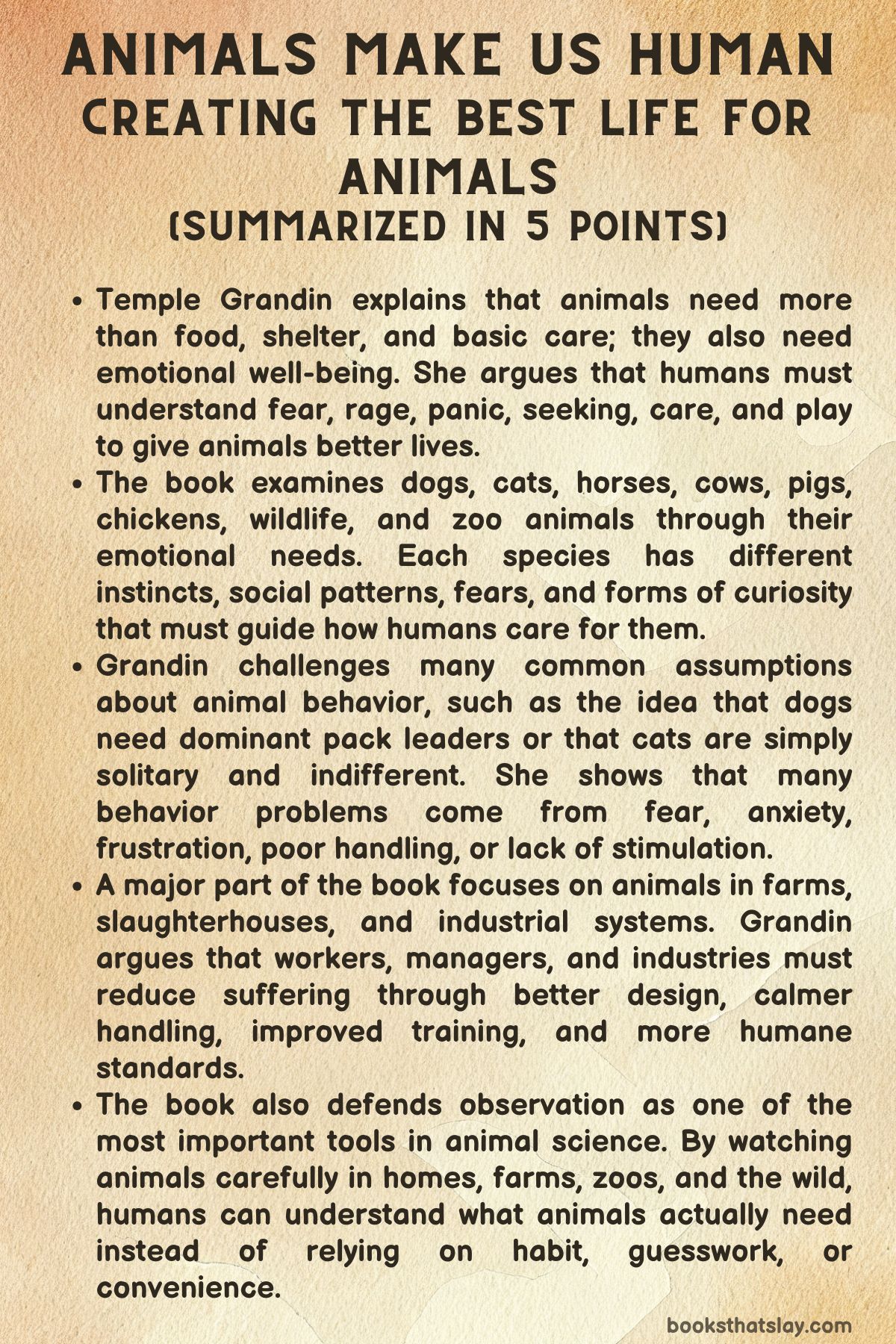
Animals Make Us Human: Creating the Best Life for Animals by Temple Grandin is a nonfiction book about animal welfare, emotion, and the responsibilities humans have toward animals in homes, farms, zoos, and the wild. Grandin argues that animals cannot be understood only through outward behavior; their emotions must be taken seriously.
Using neuroscience, field observation, and her own experience as an animal scientist and person with autism, she explains how fear, rage, panic, seeking, care, and play shape animal lives. The book is both practical and ethical, asking people to improve animal treatment by understanding what different species truly need.
Summary
Animals Make Us Human begins with a central question: what do animals need in order to be happy?
Temple Grandin argues that animal welfare cannot be measured only by food, shelter, and the absence of obvious injury.
Animals also need emotional well-being. To understand that, humans must pay attention to the core emotional systems in the brain.
These include seeking, rage, fear, panic, care, and play. Seeking is connected to curiosity, exploration, anticipation, and the drive to work toward goals.
Rage can arise from frustration, confinement, or blocked needs. Fear appears when animals sense danger.
Panic is linked to separation and social loss. Care and play also matter, especially for young animals and social species.
Grandin explains that caretakers often make mistakes when they focus only on behavior rather than the emotion behind it. For example, captive gerbils that dig obsessively may not simply need more digging material; they may need a feeling of safety.
In the same way, pacing, rocking, chewing, biting, and other repetitive behaviors in captive animals often signal distress. A good life for animals requires reducing fear, rage, and panic while encouraging seeking and play.
The book then looks at dogs. Grandin explains that dogs are unusual because they have evolved to be highly responsive to humans.
Unlike cats and many other animals, dogs can be motivated by human approval. She challenges the idea that dogs need humans to act as dominant pack leaders.
That model came from studies of unrelated captive wolves, not from wolves living naturally in the wild. In the wild, wolves usually live in family groups, not strict dominance packs.
Grandin suggests that dogs should be treated more like children who need structure, guidance, and boundaries rather than domination.
Dogs need social contact, exercise, and mental stimulation. They should not be left alone all day, because isolation can activate panic and separation anxiety.
Walks are especially important because they satisfy the dog’s seeking system and resemble the free-roaming life dogs were built for. Training should rely on positive reinforcement, patience, and clear expectations.
Commands such as “stay” and “wait” teach dogs impulse control and help them manage frustration. Grandin also discusses fear-based aggression, dominance-related aggression, breed differences, and anxiety.
She emphasizes that dogs are individuals and that their emotional needs must be understood before behavior problems can be solved.
Cats are treated differently because they were never domesticated in the same deep way as dogs. They came near human settlements largely because agriculture attracted rodents, giving cats a reliable source of prey.
Their relationship with humans is mutualistic rather than fully dependent. They benefit from living near people, but they do not rely on human approval the way dogs do.
This is why cats are harder to train through praise alone and usually respond better to food rewards and clicker training.
Grandin explains that cats have strong fear systems because they remain closer to their wild ancestors. They may hide from strangers, fear veterinary visits, or become anxious when their territory changes.
Urine-marking and litter box problems often come from anxiety rather than defiance. Cats can also move quickly from fear into rage because they have less emotional inhibition than some other animals.
Still, cats are more social than people often think. They can form colonies, enjoy human company, and benefit from play.
Since cats are natural hunters, toys, games, and training can redirect their seeking system in healthy ways.
Horses are prey animals, so fear dominates much of their behavior. They are highly sensitive to sudden movement, unfamiliar objects, and small changes in their surroundings.
Grandin criticizes harsh old training methods that tried to force foals to tolerate frightening stimuli. Instead, she recommends slow, calm exposure.
Foals should learn that humans are safe by watching their mothers interact calmly with people. Horses should be introduced gradually to objects such as flags, balloons, bicycles, saddles, and bits.
A horse may develop long-lasting fear from a single frightening event. Grandin gives examples of horses becoming afraid of ordinary objects after one bad experience.
Because horses notice details that humans overlook, handlers must try to see the world from the horse’s point of view. Grandin’s visual thinking helps her recognize stress triggers that others miss.
She argues that good horse welfare depends on good training, positive cues, and careful prevention of fear. Fear can turn into rage, and poor handling can lead to dangerous behavior that might have been avoided.
Cows are also prey animals, though they respond differently from horses. When frightened, they tend to group together rather than flee immediately.
Dairy cows are more used to humans because they are handled often, but beef cattle may remain fearful. Grandin says fear is the biggest welfare issue for cows.
Sudden movement, yelling, anger, electric prods, and rough handling all cause distress. Her own sensitivity to intense stimuli helps her understand cattle reactions.
Grandin has spent much of her career improving cattle handling systems. She recommends designing chutes and facilities that reduce fear, limiting what cattle can see when they are restrained, and using calm handling methods.
She also discusses panic caused by early weaning and regrouping. Calves and mothers should be separated in ways that reduce distress, and herds should not be broken up unnecessarily.
Grandin believes that many welfare problems in the cattle industry come from human habits. Workers must be trained, supervised, and taught that animals feel fear and pain.
Pigs are described as intelligent, active, curious animals with a strong seeking system. When allowed to roam, they spend much of their time exploring and rooting.
Industrial farming often denies them these natural activities. Sow stalls, crowded pens, hard floors, and lack of stimulation create fear, panic, frustration, and aggression.
Grandin argues that pigs need straw, chewable objects, toys, and room to explore. They enjoy novelty and can even play games for fun.
She is especially critical of large-scale pig operations where abuse and neglect are common. She argues that humane treatment must be enforced from the top down.
Managers need to be present, employees must be trained, and harmful tools such as electric prods should be removed. She also criticizes breeding pigs for extreme body size when it harms their mobility and quality of life.
Education, better management, and better breeding choices are essential to improving pig welfare.
Chickens and other poultry receive attention because Grandin believes their suffering is often ignored. Chickens are small, so workers may wrongly assume they do not feel much pain or emotion.
In industrial systems, laying hens and meat birds may suffer from overcrowding, injuries, lack of veterinary care, poor euthanasia methods, and harmful genetics. Selective breeding has produced birds that grow too fast, become too heavy, suffer broken bones, and show increased aggression.
Grandin argues that poultry welfare requires better handling, better housing, better breeding, and clearer injury standards. She helped develop simple scoring systems for problems such as lameness so workers could identify suffering more easily.
She also believes the public would demand better treatment if people could see inside poultry facilities. Chickens have fear, panic, rage, and seeking needs, and industrial systems often frustrate all of them.
The book also discusses wildlife and the importance of observation. Grandin praises researchers such as Jane Goodall, whose fieldwork changed scientific views of animals.
She argues that modern science sometimes overvalues statistics and computer models while undervaluing direct observation. Watching animals in their natural environments has helped scientists understand chimpanzees, cheetahs, elephants, bears, salmon, bison, and ecosystems.
Observation also shapes Grandin’s own work in farms and slaughterhouses.
In the section on zoos, Grandin explains that modern zoos have improved by creating more natural habitats and providing enrichment. Zoo animals need environments that support their emotional systems.
Prey animals must be protected from fear triggers that humans may not notice. Predators need play, novelty, and chances to work for food because they cannot hunt live prey in captivity.
Social animals must be housed in suitable groups to prevent panic and isolation.
In the afterword, Grandin addresses why she continues working with the meat industry despite its cruelty. She believes she can help more animals by improving conditions within existing systems than by standing outside them.
She argues that humans have a duty to give animals good lives, even when animals are raised for food. For Grandin, the central moral issue is quality of life.
Animals Make Us Human asks readers to see animals as emotional beings and to build human systems around that truth.
Key Figures
Temple Grandin
Temple Grandin is the central human presence in Animals Make Us Human, not as a fictional protagonist, but as the guiding mind through which the book’s ideas are shaped. She appears as a scientist, observer, reformer, and advocate whose personal experience with autism gives her a distinctive way of understanding animals.
Her visual thinking allows her to notice details that other people overlook, such as the way a horse reacts to a slight change in equipment or the way cattle respond to visual distractions in a chute. Grandin’s character is defined by practical compassion.
She does not approach animal welfare only as an emotional cause; she treats it as a field that requires careful observation, science, design, training, and accountability. Her work in farms, slaughterhouses, zoos, and animal facilities shows her willingness to enter difficult spaces rather than simply condemn them from outside.
This makes her one of the most complex figures in the book: she cares deeply about animals, yet she also works within industries that use animals for food. Her moral position rests on the belief that animals must be given good lives, handled calmly, and protected from needless fear, pain, panic, and frustration.
Dogs
Dogs are presented as emotionally dependent, socially responsive animals whose lives have been shaped by their long relationship with humans. In the book, they stand apart from many other animals because they are deeply tuned to human approval, body language, and emotion.
Grandin rejects the idea that dogs should be treated as pack animals who need a dominant human leader. Instead, she portrays them as creatures who need guidance, structure, companionship, and positive teaching.
Dogs are not shown as simple pets whose only needs are food and exercise; they require social contact, meaningful activity, play, patience, and emotional security. Their panic system can be activated when they are left alone for long periods, and their frustration can turn into behavior problems when they are not taught self-control.
Grandin’s analysis makes dogs seem close to children in the sense that they need boundaries without intimidation. They are also individuals, shaped by breed tendencies, past experiences, fear, confidence, and the quality of human care they receive.
Their importance in Animals Make Us Human lies in how clearly they reveal that love for animals must be matched with knowledge.
Cats
Cats are analyzed as independent, alert, fear-sensitive animals whose relationship with humans is very different from that of dogs. Grandin presents them as only partly domesticated when compared with dogs, which explains why they do not respond as strongly to human approval and are less eager to obey for praise alone.
Their character in the book is shaped by their identity as hunters. They are curious, watchful, territorial, and driven by a strong seeking system that is closely connected to stalking and play.
At the same time, they are easily unsettled by unfamiliar people, changed environments, veterinary visits, and threats to their territory. Behaviors that humans may see as stubborn or spiteful, such as hiding, scratching, urine-marking, or avoiding the litter box, are explained as signs of fear, anxiety, or discomfort.
Grandin also challenges the common belief that cats are purely solitary. She shows that they can enjoy human company, form social groups, and benefit from play and training.
Cats emerge as animals who ask humans to earn trust rather than assume it.
Horses
Horses are portrayed as highly sensitive prey animals whose behavior is strongly shaped by fear. Their character in the book is marked by alertness, memory, and a powerful instinct to react to possible danger.
They notice small details in their surroundings and can become frightened by objects or movements that seem harmless to humans. Grandin’s treatment of horses emphasizes that many so-called behavior problems are actually fear responses created by poor handling, sudden exposure, or traumatic experiences.
A horse that resists a tool, saddle, bit, or setting may not be defiant; it may be remembering a frightening event or reacting to a sensory change that humans have failed to recognize. Horses require patient socialization and gradual exposure to new experiences.
Grandin is especially critical of harsh training methods that force young horses to endure fear instead of teaching them calm confidence. In her view, good handling depends on seeing the world from the horse’s perspective.
Horses therefore become symbols of how easily human ignorance can create suffering, and how careful observation can prevent it.
Cows
Cows are shown as social, cautious prey animals whose welfare depends heavily on calm handling and well-designed environments. In the book, they are not treated as anonymous farm units but as feeling creatures with fear, panic, memory, and social needs.
Grandin emphasizes that cattle are especially sensitive to yelling, sudden movement, anger, unfamiliar objects, and physical force. Their fear can be intensified in chutes, transport systems, and slaughter facilities, especially when people use electric prods or handle them roughly.
Cows also experience distress when separated too abruptly from calves or familiar herd members. Grandin’s analysis gives cows a quiet emotional depth.
They may not show distress in ways that humans easily recognize, but their reactions are real and measurable. Her own connection to cattle is one of the most personal parts of the book because she compares their sensitivity to intense stimuli with aspects of her own sensory experience.
Through cows, Animals Make Us Human argues that industrial settings must be judged not only by efficiency, but also by how they affect animal emotion.
Pigs
Pigs appear as intelligent, curious, active animals whose strongest need is the opportunity to explore. Grandin presents them as mentally lively creatures who suffer greatly when confined in barren industrial environments.
Their seeking system is central to their character: they want to root, investigate, chew, move, and solve problems. When these needs are blocked, pigs can become frustrated, fearful, aggressive, or emotionally damaged.
The book’s view of pigs is especially critical of factory farming practices that place sows in restrictive stalls, deny them movement, and keep them from acting on basic natural impulses. Pigs are also shown as playful and capable of learning.
They enjoy novelty, rewards, and mental challenges, which makes their deprivation in industrial systems even more troubling. Grandin’s analysis of pigs exposes the gap between their intelligence and the conditions in which many are raised.
They are not passive livestock in her account; they are alert, feeling beings whose welfare depends on stimulation, space, humane management, and workers who understand that pigs experience both pain and emotional distress.
Chickens and Other Poultry
Chickens and poultry are presented as some of the most neglected animals in human care. Grandin shows that their suffering is often ignored because they are small, numerous, and wrongly assumed to be less sensitive than larger animals.
In the book, chickens are not treated as simple or insignificant creatures. They have fear, rage, panic, social bonds, and a strong need to peck, search, move, and interact with their environment.
Industrial poultry systems frustrate nearly all of these needs. Overcrowding, poor cages, rough handling, injuries, neglect, and harmful breeding practices create lives filled with stress.
Grandin pays close attention to the damage caused by selective breeding, especially when birds are bred to grow so quickly or heavily that their bones and bodies cannot support them properly. Chickens also suffer when separated from natural maternal bonds and when forced into environments that provoke aggression.
Their role in the book is morally important because they reveal how easily suffering becomes invisible when animals are treated as products rather than living beings.
Wildlife
Wild animals in the book represent the importance of observing animals in their natural worlds before making claims about what they need. Grandin discusses animals such as chimpanzees, cheetahs, elephants, bears, salmon, and bison to show that behavior in captivity cannot fully explain how a species lives.
Wildlife is characterized by complexity: animals form social systems, make choices, respond to trauma, shape ecosystems, and depend on environmental relationships that humans often misunderstand. Cheetahs, for example, could not be bred successfully in captivity until researchers learned more about their natural mating behavior.
Elephants’ violent behavior can be better understood when connected to trauma caused by poaching and social destruction. Bears that seem wasteful when eating salmon are actually part of a larger ecological process that nourishes other animals and soil.
Wildlife in the book therefore functions as a reminder that animals cannot be reduced to isolated behaviors. They must be understood within habitats, histories, social structures, and ecological roles.
Zoo Animals
Zoo animals are portrayed as captive creatures whose emotional health depends on whether humans can recreate enough of the challenges, choices, and social conditions of the wild. Grandin presents them as varied beings with different emotional priorities.
Prey animals in zoos are especially vulnerable to fear, even when the trigger is something humans barely notice, such as a color, object, or visual disturbance. Predators, by contrast, often suffer when their seeking and play systems are not engaged.
Since they cannot hunt in captivity, they need toys, food puzzles, novelty, and activities that make them work for rewards. Zoo animals also need companionship suited to their species, because isolation can activate panic.
The book does not present zoos as automatically cruel or automatically humane. Instead, it judges them by how well they observe animals, recognize distress, provide enrichment, and adjust care to each species’ emotional life.
Zoo animals show that captivity can only be ethical when it is active, thoughtful, and responsive.
Jane Goodall
Jane Goodall appears as an important figure connected to field observation and scientific discovery. She is not a main character in the ordinary narrative sense, but her presence in the book carries intellectual weight.
Grandin admires Goodall because her work with chimpanzees changed how scientists understood the boundary between humans and animals. Goodall’s discovery that chimpanzees use tools challenged old assumptions about human uniqueness and helped expand respect for animal intelligence.
Her career also represents a nontraditional path into science, which Grandin clearly values because her own route was also shaped by obstacles and unconventional strengths. Goodall’s importance lies in what she symbolizes: patient observation, openness to surprise, and the willingness to let animals reveal truths that controlled systems may hide.
Through Goodall, the book defends fieldwork as a serious form of knowledge. She stands for the idea that science should not lose touch with direct watching, practical experience, and respect for the living world.
Themes
Animal Emotions as the Basis of Welfare
Animal welfare in Animals Make Us Human is built around the idea that behavior is only the visible surface of a deeper emotional life. Grandin argues that humans often misread animals because they try to correct outward actions without asking what emotional system is producing those actions.
A pacing zoo animal, a dog that panics when left alone, a cat that urinates outside the litter box, or a horse that resists equipment may not be acting badly in any human moral sense. These behaviors may be expressions of fear, panic, rage, frustration, or unmet seeking needs.
This theme changes the standard for good care. It is not enough for an animal to be alive, fed, and contained.
The animal must also have a life where fear is reduced, panic is prevented, rage is not provoked, and curiosity or play can be expressed. Grandin’s approach is important because it connects compassion with neuroscience.
She does not ask readers to imagine animals as humans, but she does insist that animals possess emotional systems that deserve practical respect. The result is a more demanding idea of responsibility: people must learn what each species feels, not just what each species does.
The Moral Responsibility of Human Control
Humans control nearly every environment described in the book: homes, farms, slaughterhouses, barns, cages, zoos, transport systems, and veterinary spaces. Because humans hold that control, they also carry responsibility for the emotional consequences of these spaces.
Grandin repeatedly shows that animal suffering is often created not by unavoidable necessity, but by poor design, ignorance, impatience, rough handling, or economic pressure. A chute can be built in a way that terrifies cattle, or it can be designed to keep them calmer.
A pig facility can deny all exploration, or it can provide straw and social grouping. A dog can be left alone all day, or its social needs can be considered before adoption.
This theme is powerful because it refuses easy excuses. Grandin understands that many animals live in captivity or commercial systems, but she does not accept that these systems must be careless.
Her position is practical and ethical at once. If humans benefit from animals, whether through companionship, labor, food, research, or education, they owe those animals conditions that reduce distress and support natural needs.
Control becomes morally acceptable only when it is paired with knowledge, restraint, and care.
Observation Over Assumption
Careful observation is presented as one of the most valuable tools humans have for understanding animals. Grandin criticizes approaches that rely too much on assumptions, rigid theories, or models detached from real animal behavior.
The outdated idea of the dominant dog pack, the misunderstanding of captive wolves, the failure to recognize fear triggers in horses or antelope, and the inability to breed cheetahs successfully in captivity all show what happens when humans impose explanations before watching closely. Observation allows people to see what animals are actually responding to.
A color, a shadow, a sound, a piece of equipment, a social separation, or a lack of novelty may explain behavior that otherwise seems mysterious. This theme also values fieldwork and hands-on knowledge.
Grandin respects science, but she argues that science loses power when it becomes too distant from lived animal experience. Direct watching helps researchers, handlers, farmers, trainers, and zookeepers notice patterns that cannot be understood through theory alone.
Observation is not passive in the book; it is an ethical act. To observe well is to take animals seriously enough to let their behavior teach humans what they need.
The Cost of Industrial Efficiency
Industrial systems often aim to save time, reduce labor, increase production, and maximize profit, but Grandin shows that these goals can come at a serious cost to animals. Pigs confined in sow stalls, chickens bred for extreme growth, cattle rushed through stressful handling systems, and poultry treated roughly because they are small all reveal how efficiency can hide suffering.
The problem is not only cruelty by individual workers, though that appears too. The deeper problem is that large systems can normalize poor conditions until people stop recognizing them as harmful.
Grandin’s discussion of poultry is especially revealing because workers and managers may come to see broken wings, lameness, crowding, or neglect as ordinary. Once suffering becomes routine, reform requires new standards, education, supervision, and public accountability.
This theme does not argue that every commercial use of animals will disappear. Instead, it asks whether production systems can be redesigned so that animals still have decent lives.
Grandin’s answer is demanding but practical: industries must change equipment, training, breeding choices, housing, and management. Efficiency cannot be the only measure of success when the beings inside the system can feel pain, fear, panic, frustration, and relief.