An Offer From a Gentleman Summary, Characters and Themes
An Offer From a Gentleman by Julia Quinn is a Regency romance inspired by the Cinderella story, but it gives its heroine sharper dignity and a stronger will than a simple fairy-tale retelling might suggest. The novel follows Sophie Beckett, the unacknowledged daughter of an earl, who grows up in a noble household but is treated as a servant after her father’s death.
Her brief enchanted meeting with Benedict Bridgerton at a masquerade ball changes both their lives. The story explores class, family, longing, pride, and the difficult question of whether love can survive when society refuses to approve it.
Summary
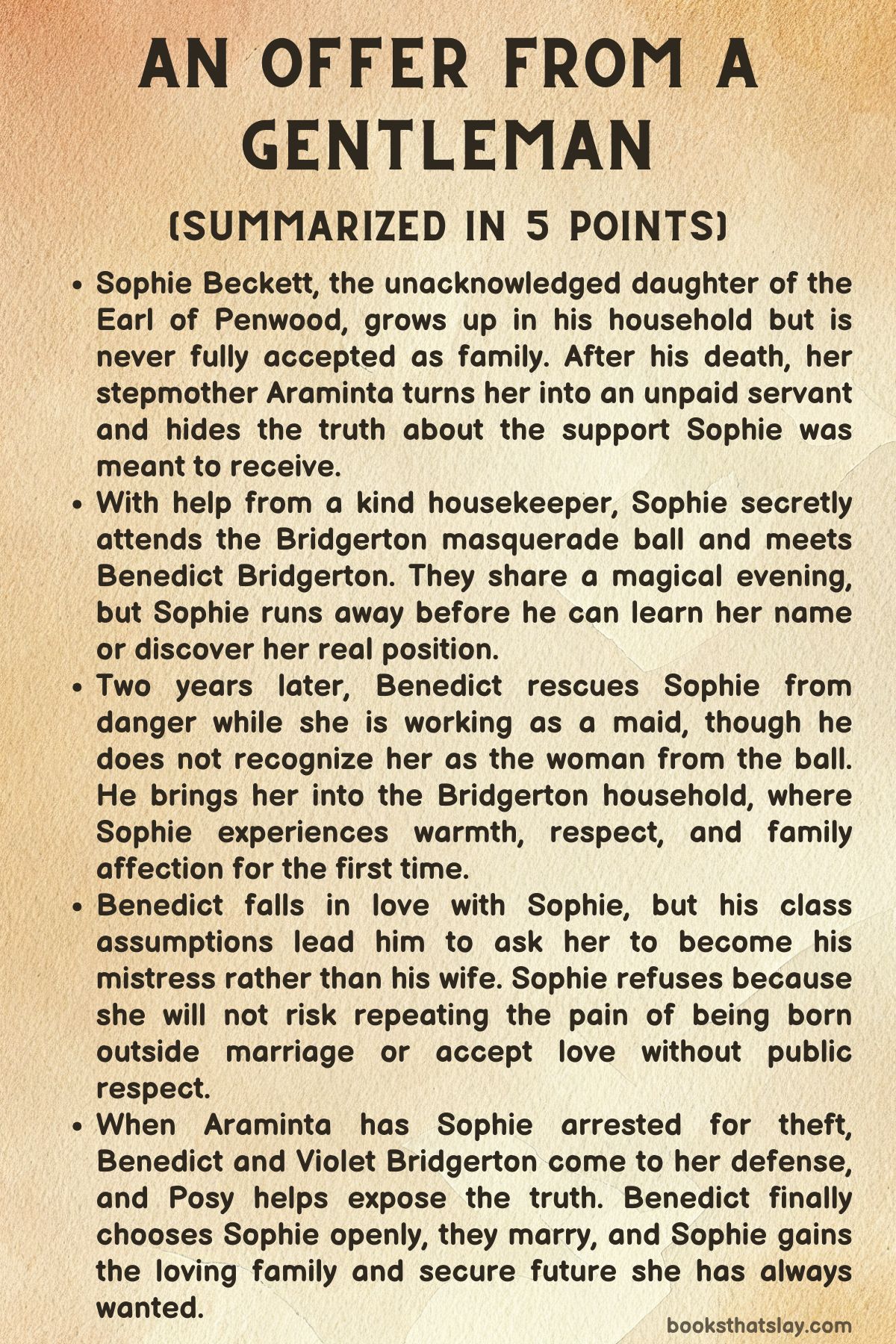
Sophie Beckett’s life begins with loss and uncertainty. When she is three years old, her mother dies, and her grandmother brings her to Penwood Park, the estate of the Earl of Penwood.
Sophie closely resembles the earl, and although he never openly names her as his daughter in a socially secure way, he allows her to stay in his household. She receives an education, lives among the servants and family spaces, and is treated with a certain level of comfort, but never with full acceptance.
Her position remains unclear: she is neither a true servant nor a proper young lady of the aristocracy.
When Sophie is ten, the earl remarries. Sophie hopes that the new countess, Araminta, and her daughters, Rosamund and Posy, will become the family she has always wanted.
Instead, Araminta quickly makes it clear that Sophie is not welcome as an equal. Rosamund follows her mother’s cruelty, while Posy is gentler and sometimes tries to be kind.
After the earl dies, Araminta takes control of Sophie’s future. The earl’s will provides money for Araminta if she supports Sophie until she turns twenty, but Araminta hides the truth and forces Sophie into unpaid service as a lady’s maid.
Sophie remains in the house because the outside world feels dangerous and uncertain.
Years later, the Bridgerton family hosts a masquerade ball. Sophie watches Araminta, Rosamund, and Posy prepare for the event, wishing she could attend even for one night.
After they leave, the housekeeper helps Sophie dress in an old gown that belonged to the late earl’s mother. Sophie completes the costume with gloves and a pair of Araminta’s shoes.
For a few stolen hours, she enters the world that has always been denied to her.
At the ball, Benedict Bridgerton, the second Bridgerton son, is tired of being seen only as one of many handsome siblings. Then he notices Sophie, radiant with happiness and mystery.
He does not know who she is, and she refuses to tell him her name. They dance, talk, and escape to a private terrace.
Sophie knows the night cannot last, but the freedom of the mask allows her to act like the lady she might have been. Benedict is captivated by her, and Sophie is equally drawn to him.
Their connection feels immediate and powerful. When he asks to see her again, Sophie panics, knowing that her real life cannot survive his scrutiny.
As the guests are about to unmask, she runs away.
Benedict is left with only one clue: a glove bearing the Penwood crest. He goes to Penwood House, hoping to identify the woman from the ball.
Araminta’s daughters do not match the woman he remembers, but Araminta notices the glove and realizes Sophie must have gone to the masquerade. Furious, she confronts Sophie, confirms that Sophie wore her shoes, locks her in a closet, and orders her to leave the next morning.
Sophie has little money and nowhere to go. Before leaving, she takes a pair of jeweled shoe clips from Araminta, partly as a desperate act and partly as a small payment against years of unpaid labor.
Posy helps free her, and Sophie leaves Penwood House behind.
Two years pass. Benedict never forgets the woman in silver from the masquerade.
He continues to think of her and wonders whether he can marry anyone else while still hoping to find her. Sophie, meanwhile, has struggled to survive as a servant.
She eventually works in the household of Philip Cavender, but his behavior toward her becomes threatening. When she attempts to leave, Philip and his drunken friends try to force themselves on her.
Benedict, who is attending a nearby house party, intervenes and rescues her.
Sophie recognizes him instantly as the man she has loved in memory for two years, but Benedict does not recognize her. She is thinner, dressed as a maid, and no longer the glittering woman from the masquerade.
Benedict asks about her background, and Sophie hides the truth. He senses something unusual about her manners and education, but he accepts her explanation that she was raised in a generous household where she learned alongside young ladies.
Benedict takes Sophie to his country cottage, where bad weather and illness change the nature of their time together. He becomes feverish, and Sophie cares for him through the night.
While tending him, she sees his sketchbook and discovers that he drew the woman from the masquerade. The image proves that he has not forgotten that night, which hurts and comforts her at the same time.
When the housekeepers arrive, Sophie is embarrassed by the improper appearance of the situation, but Benedict insists that she be treated with respect.
As Benedict recovers, he grows increasingly attached to Sophie. He admires her intelligence, wit, and spirit.
She challenges him in ways most people do not. He is also strongly attracted to her and begins to feel that she matters to him beyond desire.
Sophie struggles because she loves him but knows that society will never easily accept a servant as his wife. Benedict, shaped by class expectations even while resisting them, asks Sophie to become his mistress.
Sophie refuses. She will not risk bearing a child outside marriage and condemning that child to the same pain she endured.
Her refusal frustrates Benedict, who does not yet fully understand the depth of her fear or the value of her principles.
Determined not to abandon her, Benedict brings Sophie to his mother Violet Bridgerton’s house and arranges for her to work there as a lady’s maid. Violet quickly senses that Sophie is more educated than an ordinary servant and suspects there is more to her story.
Sophie, in turn, is deeply moved by the Bridgerton family’s warmth. Violet, Eloise, Francesca, Hyacinth, and the others treat her with a kindness she has rarely known.
For the first time, Sophie experiences something close to family.
Benedict continues visiting and seeking Sophie out. Their conversations become more intimate, and Sophie sees past his social identity as the second Bridgerton son.
She recognizes his artistic soul and encourages that part of him. Benedict realizes that Sophie knows him in a way few people do.
His feelings deepen into love, but he is still conflicted. He believes he loves Sophie, yet part of him remains tied to the fantasy of the masked woman he lost years earlier, never realizing that both women are the same person.
Sophie’s fear of discovery grows when she sees Araminta nearby. Posy recognizes Sophie, raising the possibility that Araminta will learn where she is.
Benedict takes Sophie to his house after finding her upset, and their emotional closeness leads to physical intimacy. Sophie does not regret loving Benedict, but she still refuses to become his mistress.
Benedict reminds her that marriage between them seems impossible, and this wounds her deeply. She leaves the encounter with her heart broken, knowing she cannot accept less than respectability.
After a period of separation and misery, Benedict visits his mother and speaks with her about love across class boundaries. Violet makes it clear that she would support him if he loved someone outside their rank.
This helps Benedict face the truth: he loves Sophie and wants to marry her. Soon after, he finds Sophie playing with children while blindfolded.
With her eyes covered, he suddenly recognizes her as the woman from the masquerade. He is furious that she kept the truth from him.
Sophie explains that she had reasons to hide: pride, fear, and the certainty that a servant’s dreams rarely come true. She finally admits that she is the Earl of Penwood’s daughter, born outside marriage.
Hurt by Benedict’s anger and convinced that she must leave, Sophie resigns from Violet’s household. Violet, who values Sophie and sees her goodness, treats her with compassion.
Before Sophie can depart safely, Araminta spots her and calls for a constable, accusing her of theft. Sophie is arrested and taken to jail, where Araminta visits to threaten and humiliate her.
Araminta claims Sophie stole both the shoe clips and a ring. She also admits that her hatred came from jealousy: Sophie represented the earl’s affection and Araminta’s own failure to secure the place she wanted.
Benedict arrives at the jail with Violet and the magistrate. He declares Sophie his fiancée and defends her fiercely.
Posy also appears and tells the truth, claiming responsibility for the shoe clips to protect Sophie. The situation exposes Araminta’s cruelty and the way she misused the earl’s arrangements for Sophie.
Violet pressures Araminta into presenting Sophie publicly as the respectable ward of a family friend, creating a socially acceptable story that will allow Sophie and Benedict to marry. Posy breaks from her mother, and Violet offers her a home.
Sophie finally strikes back at Araminta, not only for the way Araminta treated her, but for failing to love Posy and Rosamund equally. Benedict takes Sophie home, where he gives her the declaration she has needed all along: he loves her, not as a fantasy, not as a servant, and not as a substitute for the masked woman, but as Sophie herself.
He tells her that she saw him clearly, beyond his place in the Bridgerton family. Sophie accepts his love, and they begin their life together.
Years later, Sophie and Benedict have been married for seven years and have three sons, with another child on the way. Sophie has become part of the Bridgerton world and is regularly mentioned in Lady Whistledown’s society column.
Posy, too, finds happiness. Living under Violet’s kindness gives her a new life, and she eventually meets Mr. Woodson, the new rector.
Their immediate affection leads to marriage and a large family. Sophie and Benedict’s story closes with security, love, and the family Sophie always wanted.
Characters
Sophie Beckett
Sophie Beckett is the emotional center of An Offer From a Gentleman, and her character is shaped by the painful gap between who she is by birth and how society allows her to live. As the unacknowledged daughter of the Earl of Penwood, she grows up near privilege but never fully inside it.
This makes her life especially cruel because she understands manners, education, refinement, and family life, yet she is denied the security those things should have given her. Her strongest quality is dignity.
Even after Araminta reduces her to unpaid service, Sophie does not lose her sense of self. She may be forced into the role of a servant, but she never accepts the idea that she is worthless.
Sophie’s longing for love is deeply tied to her fear of repeating her mother’s fate. She knows what it means to be born outside marriage and treated as a social embarrassment, so her refusal to become Benedict’s mistress is not simply moral stubbornness.
It is an act of self-protection and future protection. She will not knowingly bring a child into the same insecurity that wounded her.
This makes her one of the most principled figures in the book. Her love for Benedict is sincere, but she refuses to let love erase her judgment.
Sophie’s growth lies in moving from survival to belonging. By the end, she gains not only romance but also legitimacy, family, and a place where she is loved openly rather than hidden away.
Benedict Bridgerton
Benedict Bridgerton begins the novel as a man who is loved by his family but still feels partly unseen. As the second Bridgerton son, he is often identified through his birth order rather than his individuality.
This frustration explains why Sophie’s recognition of him matters so much. She sees him not as “Number Two,” not as an eligible gentleman, and not merely as a handsome aristocrat, but as a man with an artist’s soul.
Benedict’s desire to be known becomes one of the key emotional forces behind his attraction to her.
His character is romantic, impulsive, protective, and flawed. He rescues Sophie from danger and offers her safety, but he also tries to control her choices when he thinks he knows what is best.
His request that she become his mistress reveals how deeply class assumptions shape him, even when he believes himself to be kind. He loves Sophie, but at first he imagines a future on terms that protect his own comfort more than her dignity.
His real development comes when he recognizes that Sophie’s refusal is not rejection but self-respect. By choosing marriage and public commitment, Benedict becomes worthy of the love he has been asking for.
His arc in An Offer From a Gentleman is not only about finding the mysterious woman from the masquerade, but about learning to love the real woman before him.
Araminta, Lady Penwood
Araminta is the main antagonist of the book, and her cruelty is rooted in jealousy, insecurity, greed, and social pride. She enters Sophie’s life as a stepmother figure but refuses every chance to become a mother to her.
Instead, she treats Sophie as a threat. Sophie’s resemblance to the earl and her presence in the household remind Araminta of everything she cannot control: her husband’s past, his affection, and her own failure to produce the kind of family legacy she wanted.
Rather than confronting her humiliation honestly, she turns it into punishment.
Araminta’s treatment of Sophie is not merely unkind; it is systematic. She hides the truth about the earl’s financial provisions, forces Sophie into unpaid labor, humiliates her, and later accuses her of theft to destroy her future.
Her obsession with rank makes her morally small. She cares about appearances but ignores justice, family, and compassion.
Her favoritism toward Rosamund and harshness toward Posy also show that she damages her own daughters. Araminta is important because she represents the social system at its most heartless: she understands how reputation, legitimacy, and class can be used as weapons, and she uses them whenever it benefits her.
Posy Reiling
Posy Reiling is one of the gentlest supporting characters in the novel, and her quiet goodness becomes increasingly important as the story develops. Unlike her mother and sister, Posy does not take pleasure in Sophie’s suffering.
She is not always powerful enough to stop the cruelty around her, but she recognizes it as wrong. Her kindness appears in small but meaningful ways, such as helping Sophie when she is locked away and later telling the truth when Sophie is accused.
Posy’s character shows that goodness does not always begin as bold rebellion. At first, she is timid, awkward, and trapped under Araminta’s authority.
She has grown up in a household where love is conditional and approval depends on obedience. Yet when the moment truly matters, Posy chooses conscience over comfort.
Her public defense of Sophie marks her moral turning point. By separating herself from Araminta, she gains the possibility of a happier life.
Her later marriage to Mr. Woodson completes her movement from a neglected daughter into someone loved for her own nature. Posy’s arc is softer than Sophie’s, but it is still powerful because it shows the courage required to become kind in an unkind home.
Rosamund Reiling
Rosamund Reiling reflects the worst lessons Araminta teaches. She is vain, proud, and cruel, largely because she has been raised to believe that rank and beauty make her superior to others.
Unlike Posy, she does not resist her mother’s values. She absorbs them and repeats them.
Her treatment of Sophie shows a lack of empathy and imagination; she sees Sophie only as someone beneath her, not as a person with feelings, history, or dignity.
Rosamund’s role in the book is smaller than Araminta’s, but she is still important because she shows how cruelty can be inherited as behavior. She is not the architect of Sophie’s misery, but she benefits from it and helps normalize it.
Her pride also makes her emotionally shallow. She wants admiration and status, but the story gives no sign that she understands love in any meaningful way.
Through Rosamund, the novel contrasts outward social eligibility with inner worth. She may be considered more acceptable than Sophie by the standards of society, but morally and emotionally she is far poorer.
Violet Bridgerton
Violet Bridgerton is one of the strongest moral anchors in the story. As Benedict’s mother, she is loving, observant, and socially intelligent, but she is never merely a polite aristocratic matron.
She understands people. From early on, she senses that Sophie is not an ordinary maid and that Benedict’s interest in her is serious.
Her response is not scandal or rejection, but curiosity and compassion. Violet’s warmth toward Sophie gives the heroine one of her first experiences of being treated as worthy without having to prove herself through suffering.
Violet also represents a better form of family authority. She wants her children to marry happily, but she does not treat marriage only as a social arrangement.
Her conversation with Benedict about love across class lines becomes a turning point because it gives him permission to choose honestly. She is also decisive when Sophie is arrested, using her position to challenge Araminta and protect Sophie.
Violet’s kindness is not passive. It has force behind it.
In An Offer From a Gentleman, she embodies the kind of family Sophie has always longed for: affectionate, protective, imperfectly playful, and deeply loyal.
Lady Whistledown
Lady Whistledown functions as the sharp social observer of the book. Her columns frame the public world in which the characters live, reminding readers that society is always watching, judging, and gossiping.
She comments on balls, marriages, reputations, and scandals, often with humor, but her presence also creates pressure. In a world where one printed remark can shape public opinion, secrecy becomes both protection and danger.
Her role is especially important because Sophie’s life depends so heavily on what society knows and does not know. Benedict can move through gossip with relative safety because he is wealthy and male, but Sophie cannot.
Lady Whistledown’s commentary highlights the unequal stakes of reputation. At the same time, her wit gives the novel a lively social rhythm, placing private romance against the larger spectacle of the ton.
She is not central to the love story in a direct sense, but she shapes the atmosphere around it. Through her, the book shows that romance in this world is never entirely private.
Colin Bridgerton
Colin Bridgerton appears as Benedict’s charming younger brother, but his role is more than comic ease. He has a quick social intelligence and often sees more than people expect.
Early in the story, his presence at the masquerade helps Sophie identify Benedict, and later his conversation with Benedict becomes important in pushing him toward moral clarity. Colin’s advice that Benedict should marry Sophie is direct and practical.
He cuts through the social hesitation that has trapped Benedict and points out that the opinions of cruel or shallow people should not determine a life.
Colin also brings humor and movement to the Bridgerton family scenes. His discomfort about his mother’s attempts to match him with Penelope reveals his immaturity in matters of love, yet his insight into Benedict’s situation shows that he is growing.
He is playful, but not foolish. His character helps show the Bridgerton family as affectionate and argumentative in a natural way.
He also acts as a contrast to Benedict: where Benedict broods, Colin often speaks plainly.
Eloise Bridgerton
Eloise Bridgerton is curious, outspoken, and energetic. She represents the lively intelligence of the Bridgerton sisters and contributes to the sense that the family is warm rather than stiff.
Her interest in Benedict’s whereabouts and in Sophie’s arrival shows her sharp attention to family matters. She notices changes and asks questions, which makes her feel active within the household rather than decorative.
Eloise’s treatment of Sophie is important because it adds to Sophie’s feeling of being welcomed. Sophie has spent much of her life being reminded of what she is not allowed to be, but in Violet’s home, women like Eloise speak to her with friendliness and interest.
Eloise helps create that atmosphere of acceptance. She also reflects the Bridgerton habit of emotional involvement: family members do not simply ignore one another’s lives.
They interfere, tease, investigate, and care. Through Eloise, the household becomes more vivid, and Sophie’s longing for family becomes easier to understand.
Penelope Featherington
Penelope Featherington appears as a wallflower figure who understands social discomfort from her own position. She is not central to Sophie and Benedict’s romance, but her presence strengthens the book’s interest in people who are overlooked.
Violet’s concern that Benedict dance with Penelope shows Violet’s sympathy for young women who are excluded or embarrassed in society. Penelope’s painful moment when she overhears Colin’s objections to marrying her also reveals the cruelty that can occur casually in polite spaces.
Penelope’s role parallels Sophie’s in a quieter social register. Sophie is excluded because of birth and class; Penelope is dismissed because she does not fit society’s preferred image of charm and desirability.
Both characters show that the ton can be careless with vulnerable people. Penelope’s presence also helps deepen Colin’s characterization, since his thoughtless words reveal his immaturity.
She brings emotional realism to the social world of the novel by showing that not all wounds are dramatic; some happen in conversation, in drawing rooms, and on doorsteps.
Anthony Bridgerton
Anthony Bridgerton has a smaller role in the book, but he contributes to the strong family structure around Benedict. As the eldest Bridgerton son, he carries authority and steadiness.
When Penelope is hurt by Colin’s remarks, Anthony’s decision to escort her home shows maturity and social responsibility. He recognizes discomfort and acts with courtesy.
Anthony’s presence also reminds readers that Benedict is part of a large, established family with its own hierarchy. Benedict may feel reduced to his birth order, but Anthony’s role as the eldest son carries expectations too.
The contrast between the brothers helps define Benedict’s struggle for individuality. Anthony does not dominate the story, but his controlled, protective manner reinforces the Bridgertons’ loyalty and their ability to act when someone needs support.
Hyacinth Bridgerton
Hyacinth Bridgerton brings youthful liveliness into the book. As the youngest Bridgerton sibling, she helps reveal the warmth of Violet’s household and gives Sophie opportunities to experience family life in its most playful form.
Her scenes with Sophie, especially around games and children, are important because they place Sophie in a domestic space filled with trust and ease.
Hyacinth also indirectly contributes to Benedict’s recognition of Sophie. When Sophie is playing blind man’s bluff, the covered eyes help Benedict see the resemblance between the maid he knows and the masked woman he has never forgotten.
Hyacinth’s presence in that moment makes the discovery feel natural rather than forced. More broadly, she represents the innocence and openness of the Bridgerton home.
Around Hyacinth, Sophie is not treated as a burden or an embarrassment. She is simply included.
Francesca Bridgerton
Francesca Bridgerton appears as part of the Bridgerton family circle, and while she is not given as much attention as some of her siblings, her presence contributes to the household’s atmosphere of sisterly conversation and acceptance. She helps show that the Bridgerton women are not isolated figures but part of a lively domestic unit where talk, teasing, and shared routines matter.
For Sophie, Francesca’s inclusion in family scenes is meaningful because it expands the world of kindness she experiences in Violet’s home. Sophie has known households where women compete, belittle, and obey hierarchy.
The Bridgerton women offer a different model. Francesca’s role may be quiet, but it supports one of the book’s most important emotional contrasts: Penwood House is a place of fear and rank, while Violet’s home is a place of care and belonging.
The Earl of Penwood
The Earl of Penwood is absent for most of the story, yet his choices shape Sophie’s life. He gives Sophie shelter, education, and material comfort, but he does not give her full public recognition.
This half-acceptance becomes one of the central wounds of her life. He appears generous compared with Araminta, but his failure to secure Sophie’s position clearly leaves her vulnerable after his death.
His character is morally complicated because his affection, if it exists, is weak in practice. He provides for Sophie in his will, but he does not ensure that she will be protected from Araminta’s cruelty.
By leaving Sophie’s future dependent on someone who resents her, he creates the conditions for years of abuse. The earl represents a form of paternal failure common in the social world of the novel: he does enough to ease his conscience, but not enough to defend his child’s dignity.
Sophie’s later pain comes not only from Araminta’s cruelty but from his inability to claim her fully.
Philip Cavender
Philip Cavender is a predatory figure whose role reveals the danger Sophie faces as an unprotected working woman. His pursuit of her is not romantic; it is an abuse of power.
As her employer, he understands that Sophie’s livelihood depends on remaining in service, and he tries to use that vulnerability against her. The scene in which Benedict rescues her makes clear that Sophie’s social position exposes her to threats that aristocratic women are usually shielded from.
Philip’s importance lies in showing that Sophie’s fear of the world outside Penwood House was not imaginary. Araminta’s home is cruel, but paid service elsewhere also carries danger.
Philip sees Sophie not as a person but as someone he can pressure because she lacks family, money, and status. His behavior sharpens the stakes of Benedict’s later choices.
If Benedict truly wants to protect Sophie, he must do more than rescue her once. He must respect her agency and offer her a life that does not depend on secrecy.
Mrs. Gibbons
Mrs. Gibbons, the Penwood housekeeper, plays a small but memorable role as one of Sophie’s early helpers. By dressing Sophie for the masquerade, she gives her a brief experience of beauty, freedom, and possibility.
Her action is not merely practical; it is an act of kindness toward a young woman who has been denied joy. In a household ruled by Araminta’s bitterness, Mrs. Gibbons quietly preserves some sense of humanity.
She also functions as a fairy-godmother figure within the book’s Cinderella structure. However, her help is limited by reality.
She can give Sophie a dress and a few hours at a ball, but she cannot permanently change Sophie’s status or protect her from Araminta afterward. That limitation makes her kindness more touching.
Mrs. Gibbons shows that small acts of compassion matter, even when they cannot solve everything.
Mr. and Mrs. Crabtree
Mr. and Mrs. Crabtree, the caretakers at Benedict’s cottage, add warmth and humor to the country-house section of the book. Mrs. Crabtree in particular brings comic practicality to an awkward situation.
Her discovery of Sophie in Benedict’s room could have been disastrous, but the tone around the Crabtrees softens the impropriety and gives the cottage scenes a domestic texture.
They also help reveal Benedict and Sophie in a less formal environment. Away from London society, rank feels less rigid, and their connection becomes more personal.
The Crabtrees’ ordinary household presence makes the cottage feel lived-in rather than merely romantic. Their role is modest, but they help create a space where Sophie briefly experiences care, rest, and a different rhythm of life.
Mr. Woodson
Mr. Woodson appears later as Posy’s romantic match, and his role is mainly to complete Posy’s emotional rescue from Araminta’s household. As the new rector, he suggests steadiness, kindness, and moral seriousness.
His immediate connection with Posy gives her the kind of acceptance she has not received from her mother.
His importance is less about personal complexity and more about what he represents for Posy. He offers a future in which she is valued rather than compared, criticized, or dismissed.
Through him, the book extends its promise of happiness beyond Sophie and Benedict. Posy’s marriage shows that leaving a cruel family system can open the door to a gentler life.
Themes
Class, Legitimacy, and Social Worth
Class determines nearly every danger Sophie faces. She is educated like a lady, born from aristocratic blood, and connected to a noble household, yet the circumstances of her birth leave her without legal or social protection.
Her life exposes the cruelty of a society that values appearances more than character. The same manners and refinement that would be admired in a recognized daughter become suspicious in a maid.
Benedict notices Sophie’s grace and education, but even he initially interprets them through class assumptions rather than seeing the full truth. This theme becomes especially powerful because Sophie’s moral worth is never in doubt.
She is honest, loyal, intelligent, and brave, yet she must constantly defend her right to dignity. The novel criticizes a world where legitimacy can decide whether a woman is protected or exploited.
An Offer From a Gentleman uses Sophie’s position to show that social labels often have little connection to human value. By the end, Sophie’s acceptance does not erase the injustice she suffered, but it does challenge the system that tried to define her as lesser.
Love, Desire, and Respect
The romance between Sophie and Benedict depends not only on attraction but on the difficult growth from desire into respect. Benedict is drawn to Sophie from the beginning, first as the mysterious woman at the masquerade and later as the maid who challenges and fascinates him.
Yet his early love is incomplete because he wants Sophie without fully understanding the cost of what he asks. When he suggests that she become his mistress, he imagines he is offering affection, comfort, and protection.
Sophie understands that such an arrangement would leave her vulnerable and repeat the very wound that shaped her life. Her refusal is one of the strongest expressions of self-respect in the story.
She loves Benedict, but she will not accept a form of love that makes her socially dependent and morally exposed. Benedict’s transformation comes when he recognizes that love cannot be separated from honor.
To love Sophie truly, he must choose her publicly, listen to her fears, and value her principles. The book presents romance as something that must mature beyond longing into responsibility.
Family, Belonging, and Chosen Kinship
Sophie’s deepest hunger is not wealth or status but family. Her childhood gives her shelter without belonging, and Araminta’s household teaches her that family can become a site of rejection rather than love.
This makes her experience with the Bridgertons especially moving. Violet’s home offers conversation, teasing, warmth, and ordinary kindness, all of which feel extraordinary to Sophie because she has lived so long without them.
The Bridgerton family is not idealized as silent or perfect; they meddle, question, joke, and interfere. Yet their involvement comes from affection rather than control.
Violet’s acceptance of Sophie is crucial because it gives her a maternal kindness she has never truly known. Posy’s journey also develops this theme.
Though she is Araminta’s daughter, she must leave that biological family structure in order to find emotional safety. The story suggests that family is not only a matter of blood or name.
It is made through protection, loyalty, recognition, and the willingness to stand beside someone when society turns against them.
Female Vulnerability and Moral Courage
The book repeatedly shows how vulnerable women can be when they lack money, family protection, or social power. Sophie’s position makes her dependent on the decisions of others: the earl, Araminta, employers, magistrates, and men like Philip Cavender.
Her danger is not abstract. She faces unpaid labor, public accusation, sexual threat, imprisonment, and the possibility of social ruin.
Yet the story does not present her only as a victim. Sophie’s courage appears in her repeated insistence on choice.
She leaves Penwood House, resists Philip, refuses Benedict’s offer of mistresshood, and tells the truth when it matters. Posy also shows moral courage, though in a different form.
Her decision to oppose Araminta publicly is a major act for someone trained to submit. Violet’s courage comes through social authority used for justice; she steps into the jail and forces the truth into the open.
Together, these women show different kinds of strength. The theme argues that courage is not always dramatic or loud.
Sometimes it is a refusal, a confession, a rescue, or the decision to stop obeying cruelty.