An Ordinary Man Summary and Analysis
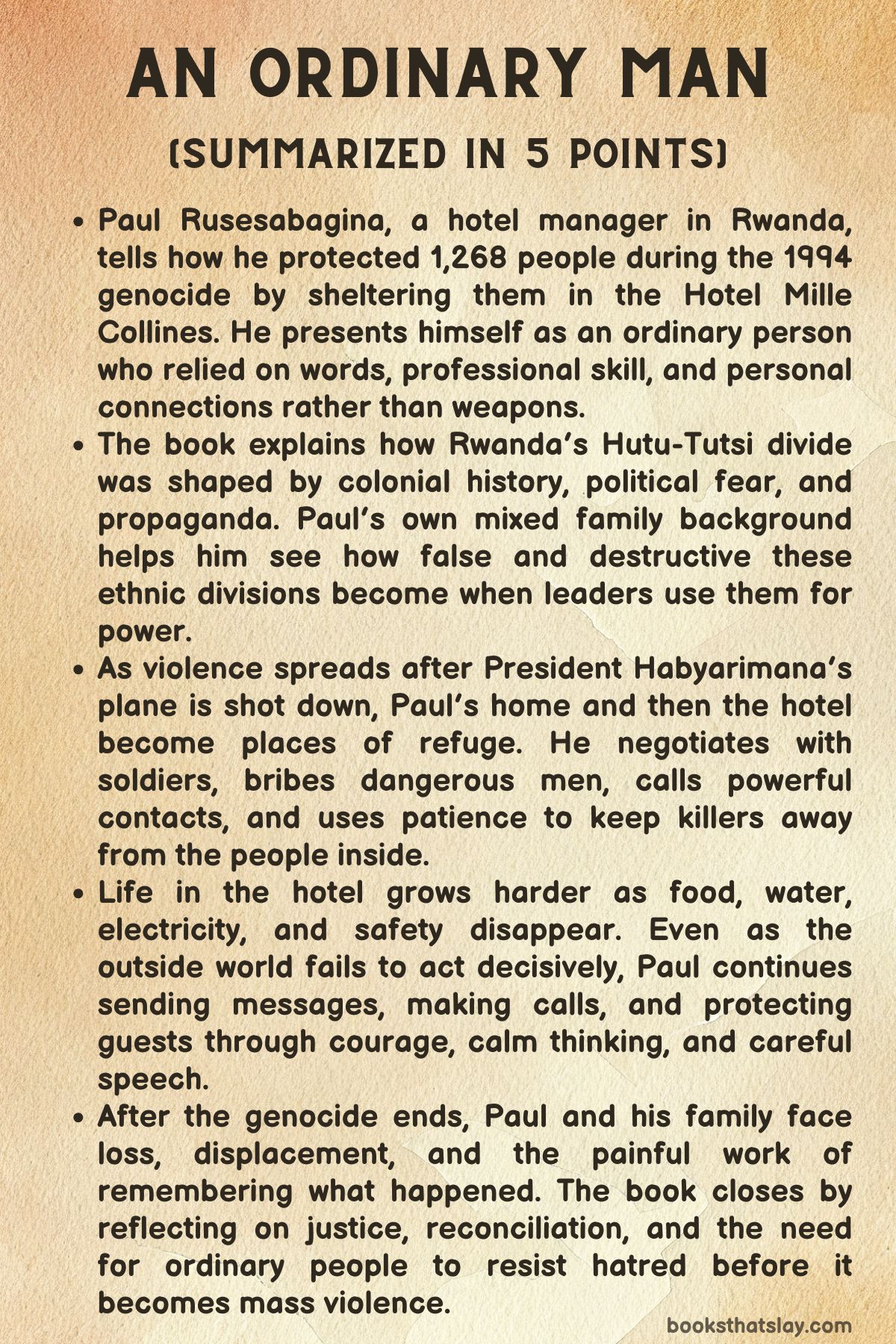
An Ordinary Man by Paul Rusesabagina is a memoir about survival, moral courage, and the Rwandan genocide of 1994. Rusesabagina, a hotel manager in Kigali, tells how he used negotiation, personal connections, patience, and carefully chosen words to protect 1,268 people who took shelter inside the Hotel Mille Collines.
The book also explains how colonial history, political fear, propaganda, and ethnic division helped create the conditions for mass murder. At its center, the book is not only about one man’s actions, but also about the power of decency when institutions and governments fail.
Summary
An Ordinary Man tells the story of Paul Rusesabagina, a Rwandan hotel manager who became known for sheltering more than 1,200 people during the 1994 Rwandan genocide. The memoir begins with Paul presenting himself not as a soldier, politician, or saint, but as an ordinary person who used the tools he had.
Those tools were not weapons. They were words, patience, charm, memory, favors, and the professional habits he had learned in the hotel business.
Paul explains that Rwanda’s ethnic division between Hutu and Tutsi was not a natural hatred passed down unchanged through time. He sees it as a political and historical construction, shaped and strengthened by European colonial rule.
Before the genocide, these identities could be fluid and personal. During the violence, however, they became matters of life and death.
Paul himself stands inside this complexity. His father’s line makes him Hutu, while his mother is Tutsi.
This mixed background teaches him early that ethnic labels are unstable and unfair, yet he later sees how deadly they can become when powerful people use them to control others.
Much of Paul’s moral outlook comes from his childhood. He grows up in a Rwandan village where family history, community reputation, and hospitality matter deeply.
His father, Thomas Rupefure, is respected because he is fair, calm, and wise. Paul admires him and learns from his example.
Thomas teaches his children that a person must know where he comes from, must value words, and must offer shelter to those in danger. One memory stays with Paul strongly: when he is a child, his father protects frightened Tutsis during the violence of the late 1950s.
This act becomes a model for Paul’s later choices. He learns that hospitality is not simply politeness.
It can be a moral duty.
Paul later moves toward city life and begins working in the hotel industry. The Hotel Mille Collines in Kigali fascinates him.
It represents modernity, status, international culture, and the wider world beyond village life. Inside the hotel, diplomats, businesspeople, tourists, government figures, and ordinary Rwandans meet.
Paul discovers that he has a gift for service. He speaks languages, remembers names, understands status, and knows how to make people feel respected.
These skills help him rise through the ranks. He eventually becomes assistant general manager at the Mille Collines and later general manager of the Hotel Diplomates.
His personal life also changes. His first marriage to Esther ends, and he later marries Tatiana, a nurse who is Tutsi.
Paul’s family life becomes part of the danger he faces, because the political climate in Rwanda grows increasingly hostile toward Tutsis. The government of President Juvénal Habyarimana becomes more repressive, and extremist Hutu voices gain strength.
A popular radio station, RTLM, begins by attracting listeners with music and humor, but it gradually spreads hatred. Tutsis are described as enemies and insects.
The radio becomes one of the tools that prepares ordinary people to accept, support, or participate in murder.
Paul is clear that the genocide was not a sudden explosion of ancient tribal anger. He argues that it was about power.
Hutu leaders feared losing control, especially after the rise of the Rwandan Patriotic Front, a Tutsi-led rebel force formed partly by exiles. As the RPF gains military strength, the government and extremist groups turn fear into propaganda.
The Arusha Accords offer hope for a shared government, and the arrival of United Nations troops creates the appearance of security. Paul and many others hope that Rwanda may step back from disaster.
That hope ends on April 6, 1994, when President Habyarimana’s plane is shot down near Kigali. Almost immediately, roadblocks appear, soldiers and militias begin checking identity cards, and organized killing starts.
Paul’s home becomes a shelter for frightened neighbors. He tries to get help from United Nations forces, but they refuse to escort his family to safety.
Soldiers then come to his house and demand that he open the Hotel Diplomates. When they also want him to kill the refugees hiding with him, Paul realizes that moral argument will not work.
He offers a large bribe instead. Greed saves lives where conscience fails.
Paul gets his family and the people with him to the Hotel Diplomates, only to find that the new government has taken it over as temporary headquarters. He then makes his way to the Hotel Mille Collines, where he sees a chance to protect people.
The hotel soon becomes a refuge. Hutus and Tutsis, adults and children, officials and ordinary citizens crowd into its rooms and corridors.
The place that once symbolized elegance and comfort becomes a fragile island of safety surrounded by slaughter.
Paul’s position is dangerous and uncertain. He has no real army and no guarantee of protection.
The hotel survives partly because of confusion, partly because of a few policemen stationed outside, and partly because Paul keeps calling powerful people who know him. He contacts generals, business leaders, foreign officials, and company executives.
He uses every relationship he has built through years of hospitality work. He flatters dangerous men, delays them, bargains with them, and reminds them that the world may be watching.
Again and again, he depends on conversation to buy time.
Conditions inside the hotel worsen. Water and electricity fail.
Food runs low. Guests drink from the swimming pool and eat whatever supplies can be found.
Fear is constant. People know that militias outside want to enter the building and kill them.
Paul tries to maintain order, not because order can erase the horror outside, but because panic would make everyone more vulnerable. The hotel becomes a strange community of survival, where small acts such as sharing food or staying quiet can help people live another day.
Paul also tries to alert the outside world. When phone service fails, he uses a fax machine to send messages to foreign governments and institutions.
He contacts Belgium, the United States, and others, begging for help. Most appeals are ignored.
The world’s failure is one of the book’s strongest accusations. Paul is especially critical of the United States and other powerful countries for refusing to act decisively or even to clearly name the killings as genocide.
To him, international leaders had enough information to know what was happening, but they chose caution, language games, and self-interest over human lives.
Inside the hotel, Paul repeatedly faces men who are ready to kill. One of the most important examples involves Thomas Kamilindi, a reporter hiding at the Mille Collines.
After Thomas speaks to international radio about the violence, he becomes a target. When an army colonel comes looking for him, Paul uses persuasion to protect him.
He understands that many violent men still want to feel respected, important, or reasonable. Paul uses that weakness.
He does not defeat them physically. He manages their pride long enough to keep people alive.
As the genocide continues, the danger around the hotel grows. The Interahamwe militia becomes more aggressive, and the Mille Collines is seen as a prize.
Paul knows that the hotel may be attacked at any time. He receives orders to evacuate or close the hotel, but he resists, calls contacts, and plays officials against one another.
At one point, he uses the interests of people at the Hotel Diplomates to secure water for those at the Mille Collines. His survival strategy is practical, improvised, and morally focused.
He does not have the luxury of pure choices. He bribes, flatters, lies, and bargains because each delay can save lives.
An attempted evacuation brings fresh suffering. Paul arranges for Tatiana and the children to leave with a group of refugees, while he stays behind because he believes his presence is still protecting those in the hotel.
But the names of the evacuees are broadcast on the radio, exposing them to attack. The convoy is stopped by militia members, and the refugees are beaten and terrorized.
Tatiana is singled out because she is Tutsi and because she is Paul’s wife. The refugees are eventually brought back to the hotel, alive but shaken.
Later, militia members enter the Mille Collines while Paul is away meeting General Bizimungu. Paul and the general rush back, and Bizimungu orders the soldiers to leave.
The hotel is saved again, but only barely. Eventually, a more successful evacuation takes place, and Paul leaves the Mille Collines with sorrow.
The building has become more than a workplace. It has become the site of his greatest fear, greatest responsibility, and greatest act of resistance.
After leaving the hotel, Paul and his family are moved by the Rwandan Patriotic Front to a camp. Life there is difficult and uncertain.
The RPF has ended the genocide, but Paul does not present them as flawless liberators. He notices theft, harsh treatment, and the seeds of future resentment.
The genocide officially ends after the RPF captures Kigali and forms a new government. Paul and Tatiana later visit their home areas and learn the scale of their family losses.
Many of Tatiana’s relatives have been killed by neighbors.
Although Paul returns to hotel work, Rwanda remains unsafe for him. Friends warn that his life is at risk.
He eventually leaves with his family and begins again in Belgium, where he runs a taxi business. His story later becomes widely known through the film Hotel Rwanda, and Paul becomes a public speaker and humanitarian figure.
He uses this attention to speak about genocide, reconciliation, justice, and the danger of forgetting.
In the closing part of An Ordinary Man, Paul reflects on genocide more broadly. He compares Rwanda with other mass killings in places such as Cambodia, Bosnia, and Iraq.
Each genocide has its own causes, but he sees common patterns: leaders who seek power, propaganda that dehumanizes victims, fear that spreads through society, and ordinary people who are encouraged to kill as part of a group. He also questions whether Rwanda’s traditional justice system is enough to answer crimes of such scale.
For Paul, true peace requires truth, accountability, and memory.
The memoir ends with a sober but hopeful belief. Paul knows that history can return in violent forms when wounds are ignored.
Yet he also believes that ordinary people can refuse evil in quiet but meaningful ways. His own story shows that courage is not always loud or dramatic.
Sometimes it is a hotel manager making one more phone call, offering one more argument, opening one more room, and saying no when the world has chosen silence.
Key Figures
Paul Rusesabagina
Paul Rusesabagina is the central figure of the book and the moral force around whom its events are built. He is presented as an ordinary man who becomes extraordinary because he refuses to surrender his judgment during a time of mass cruelty.
His strength does not come from physical power or political authority, but from patience, tact, memory, and language. As a hotel manager, Paul has spent years learning how to read people, calm anger, flatter pride, and negotiate with difficult guests.
During the genocide, those professional skills become tools of survival. He treats generals, soldiers, businessmen, and militia leaders as men whose egos can be managed, even when they are capable of murder.
This makes him a deeply practical hero. He does not depend on idealistic speeches when they will not work.
He bribes when bribery can save lives, lies when truth would be dangerous, and delays violent men long enough to protect those inside the hotel.
Paul’s character is also shaped by his childhood and his father’s teachings. He grows up understanding that words carry weight and that hospitality is a serious duty.
His father’s decision to shelter endangered Tutsis during earlier violence becomes a model that Paul later follows on a much larger scale. His mixed background also helps him see the absurdity of rigid ethnic categories.
Though identified as Hutu through his father’s line, he has a Tutsi mother and a Tutsi wife, which makes the division between Hutu and Tutsi feel both intimate and false to him. In An Ordinary Man, Paul becomes a witness to how invented divisions can become deadly when political leaders turn them into weapons.
His courage lies in his refusal to accept the logic of genocide, even while surrounded by people who have accepted it completely.
Paul is not shown as a flawless or sentimental figure. He is controlled, strategic, and sometimes emotionally reserved.
He knows when to speak softly, when to appear respectful, and when to use another person’s vanity to his advantage. His heroism is grounded in restraint.
Instead of making dramatic gestures, he keeps calling contacts, finding food, bargaining for water, moving people to safety, and inventing reasons for killers to wait. This makes his character powerful because he represents a form of courage that is disciplined rather than theatrical.
He proves that moral resistance can happen through careful conversation, steady presence, and repeated small decisions made under pressure.
Tatiana Rusesabagina
Tatiana Rusesabagina, Paul’s wife, is one of the most vulnerable and emotionally significant figures in the book. As a Tutsi woman married to a Hutu man, she stands at the center of the danger created by Rwanda’s ethnic politics.
Her identity makes her a target, but her relationship with Paul also gives the violence a deeply personal dimension. The threat to Tatiana is never abstract.
Through her, the book shows how genocide enters the home, the marriage, and the family. Paul is not only trying to protect hotel guests or strangers; he is also trying to protect the woman he loves and their children from a system that has decided she is disposable.
Tatiana’s suffering is most visible during the failed evacuation, when she is singled out and abused by the militia. Her pain reveals the special cruelty directed at Tutsi women, especially those connected to people seen as obstacles by extremists.
Yet Tatiana is not important only because she suffers. She also represents endurance.
She survives terror, displacement, loss, and the murder of many members of her family. Her later journey with Paul to learn what happened to their relatives shows the long aftermath of genocide.
Survival does not bring immediate peace; it brings knowledge, grief, and the burden of remembering.
Tatiana’s character also helps reveal Paul’s emotional depth. Paul often presents himself as practical and controlled, but his concern for Tatiana exposes the fear beneath his composure.
When he sends her and the children away during an evacuation, his decision shows both love and sacrifice. He wants them safe, but he stays behind because others still depend on him.
Tatiana therefore becomes central to the book’s moral conflict: the pull between private duty to family and public duty to people seeking protection.
Thomas Rupefure
Thomas Rupefure, Paul’s father, is one of the most important influences on Paul’s character. Although he does not occupy the central action of the genocide, his values shape the decisions Paul makes later.
Thomas is respected in his village because he is calm, fair, and wise. His words matter to the community, and Paul grows up seeing him as a model of authority rooted in dignity rather than force.
Thomas teaches Paul that family history is essential, that a person must listen to elders, and that words can guide conduct across generations.
Thomas’s act of sheltering endangered Tutsis during earlier ethnic violence becomes one of the clearest moral lessons of Paul’s childhood. He does not treat hospitality as a casual virtue.
For him, sheltering people in danger is part of what a decent person must do. This lesson returns with great force when Paul later opens the hotel to people fleeing death.
In that sense, Thomas’s presence continues through Paul’s actions. Paul’s courage is not sudden; it grows from a tradition of responsibility that he first sees in his father.
Thomas also represents an older Rwanda, where community relationships and moral obligations could resist political hatred. His example stands against the later world of propaganda, roadblocks, and identity cards.
Through Thomas, the book suggests that ordinary moral education can matter during extraordinary crises. A father’s stories, habits, and decisions may become the foundation on which a son acts when history turns violent.
Paul’s Mother
Paul’s mother is significant because her Tutsi identity makes Paul’s own background more complex than the ethnic categories used during the genocide. She is not described with the same level of detail as Paul’s father, but her presence is essential to the book’s understanding of identity.
Through her, Paul learns that Hutu and Tutsi are not cleanly separated worlds. They exist within families, marriages, neighborhoods, and personal histories.
His own life contradicts the extremist claim that these groups are natural enemies.
Her identity also helps Paul recognize the cruelty of reducing people to labels. The genocide depends on making Tutsis seem separate, foreign, and less than human.
Paul’s mother makes that idea impossible for him to accept. Tutsi identity is not an abstraction to him; it is part of his family.
This gives his opposition to hatred a personal foundation. His mixed background does not make him safe from the moral crisis around him.
Instead, it sharpens his understanding that ethnic hatred is both false and destructive.
Paul’s mother also represents the quiet human reality hidden beneath political language. When governments, militias, and radio broadcasters speak of groups, the book reminds readers that those groups are made up of mothers, spouses, children, neighbors, and friends.
Her role may be limited in the action, but her importance lies in how she helps form Paul’s resistance to the false simplicity of ethnic division.
Gerard
Gerard, Paul’s childhood friend, represents the damage caused by ethnic discrimination long before the genocide begins. His expulsion from school because he is Tutsi shows how prejudice becomes institutional before it becomes openly murderous.
Gerard is not punished for anything he has done. He is punished for an identity assigned to him by society.
His lost education and limited future reveal how ethnic politics can quietly destroy lives even in periods that seem less violent than genocide.
Gerard’s story is important because it shows that the genocide did not arise in isolation. The mass killing of 1994 was preceded by years of exclusion, humiliation, and unequal treatment.
Gerard becomes an example of how a child’s future can be narrowed by a category he did not choose. His experience also affects Paul’s understanding of injustice.
Paul sees that ethnic identity can determine opportunity, safety, and dignity in ways that are arbitrary and cruel.
As a character, Gerard represents the ordinary victims of a society trained to accept unfairness. He is not a public leader or military figure, but his life shows the cost of hatred in everyday terms.
Through him, the book makes clear that genocide begins before the first killings. It begins when people accept that some children deserve less than others.
Esther
Esther, Paul’s first wife, belongs to an earlier stage of Paul’s adult life, before the genocide becomes the defining event of the book. Her role is tied to Paul’s period of religious study and his first attempt to shape a future for himself.
Their marriage eventually ends, but her presence helps show Paul’s development as a young man still searching for his vocation. At first, Paul studies to become a pastor, but he loses interest and later finds his true calling in the hotel business.
Esther’s character is not explored as deeply as Tatiana’s, but she is part of the personal history that forms Paul’s path. Through the end of their marriage, the book shows that Paul’s life before the genocide contains ordinary failures, changes, and transitions.
He is not introduced only as a heroic figure frozen in one moment of history. He is a man who has made personal mistakes, changed direction, and rebuilt his life.
Esther also helps mark the difference between Paul’s earlier ambitions and his later identity. His movement away from religious training and toward hotel work becomes crucial because the hotel becomes the place where he saves lives.
In this indirect way, Esther belongs to the chain of events that leads Paul toward the skills and position he later uses during the crisis.
General Augustin Ndindiliyimana
General Augustin Ndindiliyimana is one of the powerful military figures Paul contacts during the genocide. His importance lies in the fact that he can influence whether the hotel survives or falls.
When Paul reaches out to him, the general helps remove a roadblock outside the Hotel Mille Collines. This action shows how Paul’s network of contacts becomes a lifeline for the people sheltering inside.
The general is not presented as a simple savior. Rather, he represents the kind of authority Paul must constantly negotiate with.
In An Ordinary Man, survival often depends on men who are morally compromised, politically involved, or capable of looking away from violence. Paul cannot wait for perfect allies.
He must work with whoever has power at a given moment. Ndindiliyimana’s usefulness shows the uneasy moral landscape Paul has to move through.
His character also reveals the importance of status and personal connection. Paul is able to ask for help because he has spent years cultivating relationships with influential people.
The general’s response does not end the danger, but it buys time. In the book’s world, time itself becomes a form of rescue.
General Roméo Dallaire
General Roméo Dallaire, the commander associated with the United Nations forces in Rwanda, represents the limits of international peacekeeping during the genocide. Paul turns to him for protection, hoping that UN troops can guard the hotel and prevent slaughter.
Dallaire’s inability to provide the help Paul requests reflects the restrictions placed on UN forces and the larger failure of the international community.
Dallaire is not shown as personally cruel or indifferent in the same way as the killers. His tragedy is different.
He is connected to an institution that has soldiers on the ground but lacks the authority or political backing to stop the genocide decisively. Through him, the book shows how bureaucracy, neutrality, and limited mandates can become deadly when mass murder is taking place.
A peacekeeping force that cannot protect civilians becomes a symbol of abandoned responsibility.
As a character in the book, Dallaire helps sharpen Paul’s isolation. Paul cannot rely on the United Nations to save the hotel.
He must rely on phone calls, favors, negotiation, and his own judgment. Dallaire’s role therefore strengthens one of the book’s central realities: during the crisis, formal power often fails, while informal human action becomes the only available defense.
General Bizimungu
General Bizimungu is one of the most dangerous and useful figures in Paul’s struggle to protect the hotel. He has power over soldiers and militias, and Paul repeatedly tries to influence him.
Bizimungu’s importance becomes especially clear when militia members enter the Hotel Mille Collines and threaten the refugees. Paul rushes back with him, and Bizimungu’s warning forces the armed men to leave without killing anyone.
Bizimungu represents the morally unstable nature of power during the genocide. He is not a pure protector, but he is someone whose authority can be used to prevent immediate slaughter.
Paul understands this and treats him carefully. He appeals to his pride, his rank, and his sense of consequence.
The relationship between Paul and Bizimungu shows Paul’s skill at handling dangerous men without directly confronting them in ways that would lead to disaster.
His character also demonstrates how survival during genocide can depend on temporary bargains with people who are not morally reliable. Paul does not have the privilege of choosing only noble allies.
He must persuade people who may be selfish, vain, frightened, or brutal. Bizimungu’s presence in the book shows how thin the line is between life and death when one order from a powerful man can either unleash violence or stop it.
Thomas Kamilindi
Thomas Kamilindi is a journalist who shelters at the Hotel Mille Collines and becomes a target after speaking to international radio about the genocide. His role in the book highlights the danger of truth during a period built on propaganda and denial.
By describing what is happening, Thomas threatens those who want the killing hidden, minimized, or controlled through lies. His voice becomes dangerous because it reaches beyond Rwanda.
Paul’s effort to protect Thomas reveals both men’s courage. Thomas risks his life by telling the world what he has seen, while Paul risks his position and safety by hiding him and negotiating with those sent to kill him.
Thomas’s situation shows that speech can threaten violent power. The same book that emphasizes Paul’s belief in words also presents Thomas as a man whose words make him a marked person.
Thomas also stands in contrast to RTLM, the hate radio station. While RTLM uses speech to dehumanize and incite killing, Thomas uses speech to witness and expose.
This contrast makes him a morally important character. He shows that language can either prepare people to murder or call attention to murder.
His presence deepens the book’s concern with the ethical power of words.
President Juvénal Habyarimana
President Juvénal Habyarimana is a central political figure in the conditions that lead to genocide. His authoritarian rule, the fear surrounding his government, and the tensions connected to his leadership all shape the national crisis.
Paul’s refusal to wear the president’s badge shows his resistance to forced political loyalty. That refusal may seem small, but in a repressive system, even small acts of independence can carry risk.
Habyarimana’s death becomes the immediate trigger for the mass killings, though the book makes clear that the genocide was not simply a spontaneous reaction to the plane crash. His assassination gives extremists the opening they need to begin an organized campaign of murder.
In this way, his character is tied both to the long political decay before the genocide and to the moment when violence erupts publicly.
As a figure in the book, Habyarimana represents a state built on fear, loyalty tests, and ethnic manipulation. His rule helps create an atmosphere where propaganda can spread and where power becomes more important than the lives of citizens.
His death is important, but the book’s deeper concern is with the system of suspicion and control that grows during his presidency.
The Interahamwe
The Interahamwe functions less as a single character and more as a collective embodiment of organized cruelty. This government-backed Hutu militia carries out much of the killing and terror during the genocide.
In the book, they represent what happens when propaganda, political permission, group pressure, and hatred turn ordinary people into killers. Their violence is intimate and brutal, often carried out with machetes and direct physical cruelty.
The Interahamwe’s role is terrifying because they are not distant military machines. They are often local men, neighbors, and young people who have been encouraged to see Tutsis as enemies or insects.
This makes their violence especially disturbing. The book shows that genocide is not only planned by leaders; it is enacted by people who accept the language of dehumanization and find power in group violence.
For Paul, the Interahamwe are the constant threat outside the hotel doors. Their desire to enter the Mille Collines gives the book much of its tension.
They represent the collapse of ordinary social trust. Once neighbors become killers and roadblocks become death traps, the hotel becomes one of the few remaining spaces where human decency is still being defended.
The Rwandan Patriotic Front
The Rwandan Patriotic Front, or RPF, is the Tutsi-led rebel force that fights the Rwandan army and eventually takes control of Kigali, ending the genocide. In the book, the RPF is important because it changes the course of the war and stops the killing campaign that has consumed Rwanda.
However, Paul does not portray the RPF in purely idealized terms. He recognizes that its victory ends one horror, but he also observes troubling behavior among its soldiers.
Paul’s time in the camp after leaving the hotel shapes his view of the RPF. He sees soldiers taking food, treating displaced people harshly, and creating new resentments.
This does not erase the fact that the RPF stops the genocide, but it complicates the idea of simple liberation. The book resists turning history into a clean story of good and evil armies.
Instead, it shows how war damages moral behavior even among those fighting against a genocidal regime.
The RPF’s role also marks the transition from immediate survival to aftermath. Once Kigali falls, the question is no longer only who will live through the next hour.
The question becomes what kind of country Rwanda will become after so much death. Through the RPF, the book begins to examine the difficult future of justice, memory, and political power after genocide.
RTLM Broadcasters
The broadcasters of RTLM are some of the most destructive figures in the book because they show how words can prepare a society for murder. At first, the station gains popularity through music, entertainment, and the appearance of independence.
Once it has public trust, it spreads anti-Tutsi propaganda and normalizes hatred. Its language turns human beings into targets by calling them cockroaches and enemies.
The danger of RTLM lies in its ability to make violence sound acceptable, even necessary. Its broadcasters do not kill with machetes, but they help create the mental conditions in which machetes are used.
They give listeners a shared vocabulary of hate and make murder feel like participation in a collective cause. This makes them central to the book’s understanding of genocide as a social process.
RTLM also stands as the dark opposite of Paul’s use of language. Paul uses words to delay violence, calm killers, and protect lives.
RTLM uses words to inflame fear, spread lies, and encourage slaughter. In An Ordinary Man, this contrast gives language enormous moral weight.
Speech is never neutral; it can either defend humanity or help destroy it.
Sabena Corporation Contacts
Paul’s contacts within the Sabena Corporation play an important role in his attempts to protect his family, employees, and hotel guests. These figures are not developed as deeply as Paul or Tatiana, but they represent the value of professional relationships in a crisis.
Paul’s years in the hotel industry give him access to people beyond Rwanda, and he uses those connections as part of his survival strategy.
The Sabena contacts also show how institutions can help in limited but meaningful ways. They cannot stop the genocide, but they can answer Paul’s calls, make arrangements, and apply pressure.
Paul’s connection to an international hotel company gives the Mille Collines a degree of visibility that other places do not have. That visibility becomes part of the hotel’s protection.
Their role reinforces one of the book’s practical lessons: relationships built in ordinary times can matter deeply in extraordinary times. Paul’s professionalism before the genocide is not separate from his heroism during it.
The respect he has earned through work becomes a resource he can spend to save lives.
The Refugees at the Hotel Mille Collines
The refugees sheltering at the Hotel Mille Collines are among the most important collective figures in the book. They include Tutsis, moderate Hutus, families, children, journalists, and people from different walks of life.
Their presence transforms the hotel from a place of luxury into a place of desperate protection. They are frightened, hungry, crowded, and uncertain, but they also form a temporary community built on survival.
Their importance lies in how they humanize the scale of genocide. Numbers such as 1,268 can feel abstract, but the book presents these people as individuals with families, fears, and fragile hopes.
Their dependence on Paul raises the moral stakes of every decision he makes. If he leaves, fails, or angers the wrong person, they may die.
The refugees also show that decency can continue under extreme pressure. Inside the hotel, Hutus and Tutsis sleep beside one another, share limited resources, and endure fear together.
Their community stands against the propaganda outside, which insists that coexistence is impossible. By surviving together, they become living proof that Rwanda’s ethnic hatred was not inevitable.
Themes
The Power of Words
Words carry life-or-death force throughout An Ordinary Man. Paul repeatedly shows that language can become a tool of protection when physical defense is impossible.
He does not command an army, own weapons, or control the political situation, but he understands how to speak to powerful and dangerous men. He flatters their pride, reminds them of their reputations, appeals to their interests, and delays their violence through careful conversation.
His skill as a hotel manager becomes a moral weapon because he has learned how to calm anger without humiliating the person in front of him. At the same time, the book shows the destructive power of language through RTLM, whose broadcasters use jokes, insults, music, and propaganda to make hatred sound normal.
The contrast is sharp: Paul uses words to preserve humanity, while the radio uses words to erase it. This theme makes speech a matter of responsibility.
Language is not treated as harmless commentary. It can build fear, justify cruelty, expose truth, or protect the vulnerable.
Paul’s belief that words saved the people in the hotel is not an exaggeration; it is the central proof that in a world ruled by violence, speech can still interrupt death.
Hospitality as Moral Courage
Hospitality in the book is not limited to good manners, professional service, or kindness to guests. It becomes a form of moral courage.
Paul learns from his father that a person in danger must be given shelter, regardless of identity or circumstance. That childhood lesson becomes the ethical foundation of his actions during the genocide.
The Hotel Mille Collines is designed for comfort, business, and status, but under Paul’s care it becomes a sanctuary. Opening rooms to refugees is not a symbolic act; it is a direct refusal of the logic of extermination.
The killers outside want people separated, identified, and destroyed. Inside the hotel, Paul protects a mixed community of people whose lives contradict the hatred surrounding them.
His hospitality is practical as well as moral. He finds water, searches for food, manages fear, and maintains enough order to keep people alive.
This theme shows that courage does not always appear as open confrontation. Sometimes it appears as the decision to keep the doors open when closing them would be safer.
Paul’s hospitality carries risk because every person he shelters increases his danger, yet it also preserves the idea that civilization depends on protecting the vulnerable.
The Failure of the International Community
The book presents the international community’s response to Rwanda as a failure of will, language, and moral responsibility. Foreign governments and institutions have information about the killings, but they avoid decisive action.
Paul sends messages, makes calls, and seeks help from outside powers, yet most of his appeals are ignored or answered too weakly. The United Nations presence creates an early impression that civilians may be protected, but its limited mandate prevents meaningful intervention at crucial moments.
This failure is especially painful because the genocide is not hidden from the world. Journalists, diplomats, peacekeepers, and governments know enough to understand that mass murder is taking place.
Yet political caution and self-interest shape their response. The refusal to clearly name the violence as genocide becomes part of the problem, because avoiding the word helps avoid the duty to act.
This theme gives the book a strong moral accusation: passivity can assist violence when the facts are already visible. The outside world may not swing the machetes, but its hesitation leaves victims alone with those who do.
Paul’s experience in the hotel becomes a direct challenge to global powers that had far more resources than he did but showed far less urgency.
Identity, Propaganda, and Manufactured Hatred
The book treats ethnic hatred as something constructed, taught, and politically exploited rather than as an unavoidable truth. Paul’s own family background challenges the idea that Hutu and Tutsi identities are naturally opposed.
His life contains both identities, and his marriage to Tatiana further proves how deeply connected Rwandans are across ethnic lines. The genocide depends on denying that shared humanity.
Political leaders and propagandists turn social categories into weapons, using history, fear, and falsehood to convince people that their neighbors are enemies. RTLM plays a major role in this process by repeating dehumanizing language until violence seems acceptable to listeners.
The book shows that propaganda works by simplifying reality. It takes complex families, friendships, histories, and communities and reduces them to labels.
Once people accept those labels as absolute, cruelty becomes easier. This theme also explains why Paul resists ethnic thinking so strongly.
He has seen how arbitrary these divisions are, but he also knows how deadly they become when backed by state power and public repetition. The genocide is therefore shown not as a sudden madness, but as the result of organized messages, political fear, and the steady training of ordinary people to stop seeing others as fully human.