Apple: Skin to the Core Summary and Analysis
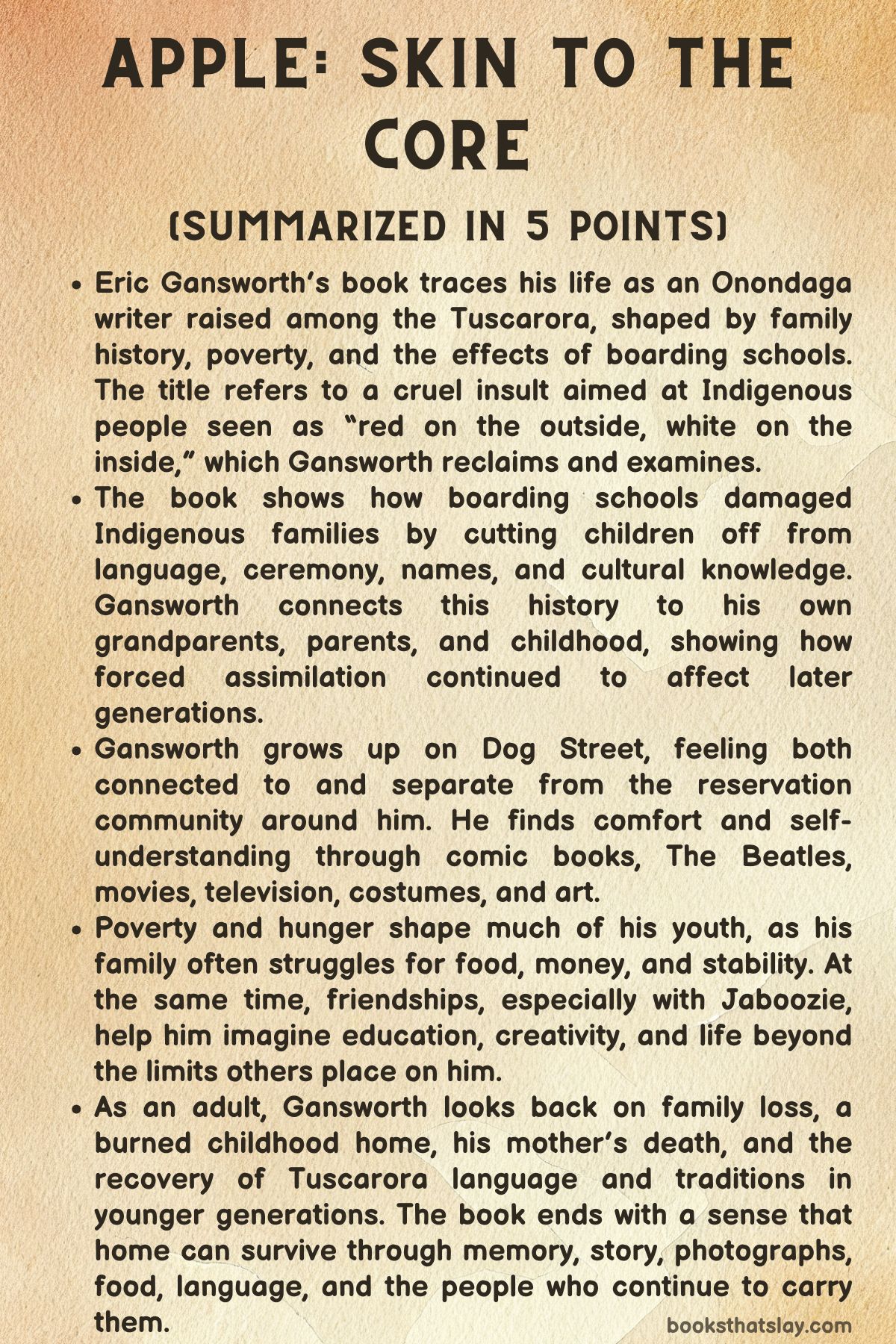
Apple: Skin to the Core by Eric Gansworth is a memoir in verse about family, survival, memory, and the long reach of colonial violence. Gansworth writes from his life as an Onondaga person raised among the Tuscarora, carrying both belonging and estrangement.
The book uses music, especially The Beatles, along with comic books, movies, family photographs, and reservation life to trace how identity is shaped by what is inherited, lost, hidden, and recovered. Apple is also about language, hunger, poverty, racism, art, and the difficult work of telling the truth without reducing a family or a community to pain.
Summary
Apple begins with the meaning of its title: a slur aimed at Indigenous people seen as “red on the outside, white on the inside.” Eric Gansworth uses that word not to accept its cruelty, but to examine the history that made such a label possible. He looks back at the damage done by boarding schools, where Indigenous children were taken from their families, renamed, forced into uniforms, separated from their languages, and trained to leave their own communities behind.
The book makes clear that this violence did not end with one generation. It shaped grandparents, parents, children, family names, daily habits, and even what people believed they should forget.
Gansworth’s family history carries the direct marks of that system. His grandfather and siblings were sent to Carlisle, where their lives were remade according to white American expectations.
His grandfather returned, but not untouched. His name was changed, his body and appearance were controlled, and his connection to home was permanently altered.
Gansworth’s grandmother, remembered through old recordings, spoke Tuscarora and made cornhusk dolls, yet even her traditions existed under pressure from outsiders who wanted to study, classify, and interpret Indigenous life. The author grows up only a few generations away from this forced erasure, aware that a family can be made to disappear not only by violence, but by paperwork, renamed identities, broken memory, and silence.
The memoir also shows how survival can look ordinary from the outside. Gansworth’s grandmothers become known by family nicknames rather than traditional terms.
His mother does not learn beadwork because her mother considers it a backward skill. Christianity, boarding school lessons, and colonial ideas reshape domestic life and gender roles.
Yet Indigenous knowledge does not vanish completely. It remains in language fragments, clan names, ceremonies, stories, foods, songs, and family behavior.
Gansworth grows up surrounded by traces of culture, but not always with full access to them. This gap becomes one of the central tensions of the book: he belongs to his people, but he often feels outside the knowledge that should have been his inheritance.
The story then moves into Gansworth’s childhood on Dog Street, the nickname for the road where he grows up on the Tuscarora reservation. He is born in 1965, the youngest of seven children, much younger than most of his siblings.
His mother works hard, the family struggles with money, and his older sister helps raise him. There are few photographs of him as a baby, and much of his early life is reconstructed from memory, family stories, and the objects his siblings leave behind.
These objects matter: records, posters, comic books, and photo albums become tools for understanding a life that was not always carefully documented.
Gansworth often feels different within his own family. His siblings enjoy sports, while he loves comic books, television, costumes, and imagination.
Batman becomes one of his nicknames, and pop culture gives him a private language for understanding himself. The Beatles, The Lone Ranger, Lost in Space, Fantastic Four, Star Wars, David Bowie, and later cult films all become points of recognition.
He sees in them possibilities of escape, transformation, loneliness, masks, damaged fathers, outsiders, and strange forms of hope. These references do not distract from reservation life; they help him explain it.
Popular culture becomes a mirror in which he can see parts of himself that his immediate world does not always have words for.
His father is mostly absent. When he appears, he is distant, critical, or confusing.
Gansworth remembers trying to get his attention as a child and being ignored. Later, his father gives small amounts of money when asked, makes cutting remarks about books and drawing, and shows little interest in the person his son is becoming.
The author connects these visits to comic-book and Star Wars images of fathers who are powerful, damaged, unreachable, or frightening. His father is not presented as a simple villain, but his absence leaves a wound.
Gansworth grows up with the ache of wanting recognition and learning not to expect it.
Poverty shapes much of his childhood and adolescence. Food often runs short near the end of the month.
Hunger becomes a repeated test, one that teaches caution, shame, longing, and restraint. At other people’s houses, he notices full meals and takeout food but is not always invited to stay.
When he earns money through difficult summer labor, half often goes to household bills. He spends some of the rest on secondhand clothes, trading cards, records, and once on enough fast food to feel what it is like to be fully satisfied.
The satisfaction does not last. Hunger returns, and with it the knowledge that one meal cannot undo years of scarcity.
School is another place where Gansworth learns how others see him. On the reservation, teachers can be temporary, careless, or cruel.
Off the reservation, he encounters low expectations and racism. He is discouraged from college-track classes and made to feel that his ambitions are unrealistic.
He is told what he is good at “for an Indian” and what he should not attempt because of poverty. When he writes imaginatively, adults misunderstand the truth behind his fiction.
He begins to see that institutions often misread Indigenous students, not because the students lack ability, but because the adults have already decided what their futures should be.
Friendship offers a different education. Jaboozie, his close friend, teaches him beadwork and cornhusk doll making, shares music with him, talks with him, explores with him, and later passes him books that open doors.
She shows him that creativity and traditional knowledge can survive in small acts. Their friendship is curious, intense, and formative.
Together they nearly die when they get trapped by fire in the swamp. Later, when she leaves for college, she becomes proof that another life is possible.
Through her, Gansworth sees that books, films, and art can be studied seriously, not just loved in secret.
As he grows older, Gansworth wants to leave the reservation but also fears what leaving means. His mother understands more than she says.
She tells him he can come home, that she will keep his things, and that his future will still lead him back at times. His work at a scrapyard injures his hands, making college feel both urgent and distant.
A community college nearby finally offers a path forward because it does not require the SAT. At college, he struggles at first, especially in medical courses, but he learns how to study and succeeds.
He works with bones in anatomy classes while thinking about Indigenous remains kept in museums, treating the study of the body as something that demands respect.
Eventually he moves into his own apartment off the reservation. His mother doubts that he will truly leave, since many family members return.
But he senses that his break is real. Visits home become strange.
He feels like a guest in the house where he grew up. Mail stops being forwarded.
Dog Street becomes part of the past even while it remains central to his identity. Leaving does not free him from home; it changes the way home lives inside him.
The later sections of Apple focus more directly on return, loss, language, and memory. Gansworth reflects on love, including his relationship with Larry, and on the limits of inherited vocabulary to describe certain forms of desire.
He thinks about exposure, secrecy, and the risks of being seen clearly. He returns to his childhood home and finds it damaged, then later lost to fire.
Much of the family’s photographic record is destroyed. The fire becomes another form of erasure, but also another occasion for remembering.
Objects vanish, yet stories remain, and family members recreate lost images through speech, memory, and shared imagination.
Death becomes more frequent as the memoir moves forward. Gansworth loses relatives, reflects on his father’s funeral, remembers his mother’s strength, and learns harder truths about family history.
His mother, who endured poverty and disappointment, is shown as practical, protective, sharp, and loving in ways that are not always sentimental. After her death, tobacco smoke helps guide her spirit toward the Skyworld.
Smoke and ash gather many meanings: cooking, ceremony, cigarettes, house fire, grief, and passage.
The book also turns toward renewal. Recordings made by an ethnographer, once part of an outsider’s attempt to study Indigenous people, become useful to younger Tuscarora learners.
The voice of Gansworth’s grandmother travels across time and helps future generations recover language. Younger relatives take part in Naming Ceremonies, learn Tuscarora, grow traditional foods, and marry within cultural practices that Gansworth did not fully know as a child.
His nephew’s wedding gives him a ribbon shirt, an object he once lacked when school asked him to represent a tradition his family had been prevented from keeping. This gift helps heal an old feeling of exclusion.
By the end, Gansworth stands between loss and return. He cannot recover everything: not full fluency, not all the photographs, not the childhood home, not the family members who have died, not the uninterrupted cultural inheritance that boarding schools tried to destroy.
Yet Apple insists that absence is not the whole story. Language can be relearned.
Food traditions can be revived. Songs can be remembered.
A burned house can still exist in an aerial photograph, in a sister’s message, and in the mind’s view of home from above. The memoir closes with the possibility that the dead see Dog Street from the sky as they travel onward, and that one day the author may see it that way too, returning through memory, spirit, and story.
Key Figures
Eric Gansworth
Eric Gansworth is the central figure of the book, both its narrator and its subject. In Apple, he presents himself as a child shaped by poverty, family silence, cultural inheritance, and a constant feeling of being partly inside and partly outside the world around him.
He grows up on Dog Street on the Tuscarora reservation, but because he is Onondaga among Tuscarora people, he often feels displaced even within Indigenous community life. This feeling deepens because he does not inherit full access to language, ceremony, or traditional knowledge.
He knows he belongs, but he also knows there are parts of that belonging that have been damaged before they could reach him.
As a child, Eric is observant, imaginative, and sensitive to difference. He does not fit easily into his family’s expectations.
While many of his siblings enjoy sports, he gravitates toward comic books, television, costumes, records, movies, and art. Batman, The Beatles, Fantastic Four, Star Wars, David Bowie, and cult films become more than entertainment for him.
They help him understand loneliness, masks, transformation, absent fathers, and the wish to escape. He reads himself through these figures because his own world often gives him no direct language for his fears or desires.
Eric’s hunger is not only physical, though physical hunger is a major part of his childhood. He is hungry for food, recognition, education, love, language, art, and a future larger than the one others imagine for him.
He works difficult jobs, gives money to his household, buys small pleasures when he can, and still carries the shame and longing that come from scarcity. His move toward college marks an important shift: he begins to see that the life he wants may be possible, even if no one has clearly shown him the path.
As an adult narrator, Eric is careful with memory. He does not present his childhood as simple misery, nor does he romanticize the reservation.
He remembers warmth, humor, music, family ties, and friendship, but he also records racism, poverty, hunger, violence, absence, and loss. His identity as an artist and writer grows from his need to preserve what history tried to erase.
By the end of the book, Eric is not fully healed in a neat way, but he has turned memory into testimony. His voice becomes a way to hold family, culture, grief, and survival together without pretending that any of them are uncomplicated.
Eric’s Mother
Eric’s mother is one of the strongest presences in the book. She is practical, hardworking, protective, and emotionally complex.
She raises her children in poverty, often with little help from Eric’s father, and she does what she must to keep the household functioning. Her love is not always expressed through open tenderness.
It appears in labor, warnings, small sacrifices, practical advice, and the willingness to endure hardship so her children can keep going. She cleans houses while pregnant, stretches food and money, takes Eric to ask his father for help when there is no other option, and later encourages him toward college when she sees that scrapyard labor is damaging him.
Her character also carries the effects of colonial history. She does not pass down every traditional skill or story, partly because the generation before her was taught to reject certain Indigenous practices as backward.
Her own relationship to tradition is therefore shaped by loss and caution. She knows the reservation, its dangers, its habits, and its limits, but she also knows the outside world is not automatically safer.
When Eric prepares to leave, she tells him he can always return, which reveals both love and resignation. She understands migration as part of survival, but she also knows that leaving home carries emotional cost.
Eric’s mother is also a figure of hidden strength. Later revelations show that she once defended her children from a threatening relative with fierce physical courage.
This changes the reader’s understanding of her. She is not merely a tired mother trying to get through each week; she is someone who has had to make brutal choices to protect her family.
Her smoking, BINGO nights, tea-leaf reading, and guarded speech make her vivid and human. She is flawed, worn down, funny, sharp, and resilient.
Her death becomes one of the book’s most powerful losses. The smoke associated with her life, from cigarettes to ceremony, turns into a symbol of passage.
Through her, the book shows how mothers in damaged communities often become the last defense between children and collapse. She cannot give Eric everything he needs, but she gives him enough to survive, leave, remember, and write.
Eric’s Father
Eric’s father is marked mainly by absence. He appears only occasionally in Eric’s life, and those appearances often leave confusion or pain behind.
He is an ironworker, associated with physical labor and distance, but he is not a steady emotional presence. When Eric is young, he longs for his father’s attention, yet his father barely notices him.
These moments create a lasting wound because Eric wants to be seen, approved of, and understood by the man who remains just out of reach.
His father’s comments are often dismissive or cruel. When Eric needs glasses, his father suggests that books are ruining his eyes.
When Eric shows him his artwork, his father tells him to stop drawing what he considers worthless images and draw Indians instead. This criticism is especially painful because Eric’s art is one of the few places where he can form a self beyond poverty and expectation.
His father’s inability to recognize that talent reflects a broader failure to understand his son’s inner life.
At the same time, the book does not reduce him to a simple antagonist. His alcoholism, poverty, lack of stable warmth, and own possible wounds remain part of the background.
He gives money when asked, though not enough to become reliable. He seeks warmth in Eric’s mother’s house during one winter, which makes him seem less powerful and more broken than Eric once believed.
He is damaging, but he is also damaged.
Eric often understands his father through pop culture, especially Star Wars. The Darth Vader comparison makes sense because his father is distant, intimidating, and tied to a painful inheritance.
Yet Eric’s father is not grand or mythic in daily life; he is ordinary in his failures. His character represents the emotional damage passed through families when colonial history, poverty, masculinity, and addiction shape what men are able or unable to give their children.
Big Umma
Big Umma, Eric’s maternal grandmother, represents the generational impact of boarding school and the survival strategies that followed. She does not appear as a fully present grandmother in Eric’s life because she dies when he is still a baby, but her influence remains powerful through family memory.
She is one of the women whose choices helped shape what Eric’s mother did and did not inherit. Her refusal to let Eric’s mother learn beadwork because she considered it a backward skill reveals how deeply colonial education entered family life.
Practices that once carried cultural meaning became, in some eyes, signs of shame or impracticality.
Big Umma’s character shows how oppression can make people police their own traditions. Her rejection of certain Indigenous skills is not presented as personal weakness but as evidence of what boarding schools were designed to do.
They taught Indigenous children to associate survival with distance from their own cultures. By passing that lesson on, Big Umma becomes both a survivor of violence and an unwilling carrier of its effects.
Her nickname also matters. Instead of being called by a traditional Tuscarora word for grandmother, she is known through a family term shaped by proximity and adaptation.
This naming pattern reflects a world where language has not disappeared entirely, but has been altered by history. Big Umma’s presence in the book is therefore quiet but essential.
She helps explain why Eric grows up with gaps in cultural knowledge and why recovery in later generations feels both necessary and difficult.
Little Umma
Little Umma, Eric’s paternal grandmother, is one of the most important links between the family’s past and its possible future. Like Big Umma, she is shaped by the boarding school system, but she is also preserved through recordings made by an ethnographer.
These recordings become complicated objects. They began as part of an outsider’s study of Indigenous people, yet later they help younger family members and community members hear Tuscarora spoken by an elder.
Little Umma’s voice, captured in one historical context, becomes a gift in another.
She also makes cornhusk dolls, and her decision to give them faces reveals her independence. Traditionally, faceless dolls avoid inviting spirits into the features, but Little Umma does not simply follow expectations.
Her choice suggests that she is practical, self-aware, and perhaps resistant to being seen as a quaint cultural specimen. She is not merely a symbol of tradition; she is a person who interprets tradition in her own way.
In old age, Little Umma’s mind returns at times to the boarding school, showing that the trauma of that place never fully left her. Her confusion is not just personal decline; it is history resurfacing.
Through her, Apple shows how cultural violence lodges in memory and the body. Yet her voice also becomes part of language revitalization.
Younger generations hear her and learn from her, which means that what was nearly lost is not entirely gone. Little Umma becomes a figure of pain, endurance, and unexpected continuity.
Eric’s Grandfather
Eric’s grandfather stands at the center of the family’s boarding school history. Sent to Carlisle with his siblings, he survives a system designed to separate him from his name, culture, family, and original identity.
His changed surname becomes a sign of that violence. The alteration from Gansevoort to Gansworth may look small on paper, but in the book it represents a much larger effort to make Indigenous people easier for white institutions to manage and absorb.
His return from Carlisle does not mean restoration. He brings back the marks of what was done to him, and those marks affect later generations.
His children do not receive a stable transmission of language and tradition. His family life reflects the patriarchal lessons imposed by colonial systems.
When Eric’s mother works as a teen, her father takes her pay, repeating a pattern of labor exploitation connected to the boarding school program. In this way, Eric’s grandfather is both victim and participant in the continuation of harm.
His character is therefore morally complicated. The book does not ask the reader to ignore what he endured, but it also does not hide the ways he enforced harshness within his own family.
He represents the tragedy of survival under systems built to remake people. What happened to him did not stay with him alone.
It entered names, work, money, gender roles, and family memory.
Jaboozie
Jaboozie is one of the most life-giving figures in Eric’s youth. She is his friend, teacher, intellectual companion, and one of the people who helps him imagine a different future.
She introduces him to beadwork, cornhusk doll making, deeper music, books, and ways of thinking that expand his world. Her importance lies not only in what she teaches but in how she treats Eric: as someone curious, capable, and worth speaking to seriously.
Their friendship is rooted in shared questioning. Both are drawn to books, music, ideas, and experiences beyond the narrow expectations placed on them.
Jaboozie does not make Eric feel strange for wanting more. Instead, she encourages that hunger for knowledge.
When she gives him books, especially works that show the reservation or cult film culture as subjects worthy of attention, she helps him see that his own interests can belong to a larger artistic and intellectual life.
She also represents movement. Jaboozie leaves the reservation for college, returning at intervals with new knowledge.
Her leaving is not a betrayal of home; it is a model of possibility. For Eric, who often feels trapped between duty, poverty, and desire, her path shows that departure can be a form of growth.
Their near-death experience in the swamp fire also gives their bond an almost mythic intensity, but the book keeps it grounded in youth, danger, and shared recklessness.
Jaboozie’s role in Eric’s development is profound because she connects creativity, tradition, and escape. She teaches him that cultural practice can be made from scraps, that books can change the shape of a life, and that friendship can become an informal education when formal systems fail.
Eric’s Siblings
Eric’s siblings form a shifting background of care, distance, teasing, inheritance, and influence. Because Eric is much younger than most of them, he grows up almost as a separate generation within the same household.
They help raise him, leave things behind for him, argue with him over television, and shape his sense of family life. His older sister, especially, takes on responsibility when their mother works, becoming part sibling and part caregiver.
His brothers and sisters also represent paths that Eric might or might not follow. Some work, return home, remain tied to the reservation, or try to awaken the family to Indigenous issues.
One brother buys the family a television, while another leaves Eric Beatles albums that become central to his imagination. These gestures matter because objects passed down by siblings become Eric’s archive.
Records, posters, albums, and memories help him build a self.
The siblings also expose the loneliness of being the youngest. They move out, start adult lives, and leave Eric with belongings but also with absence.
He inherits fragments rather than full companionship. Their teasing and attempts to understand whether he is “alien” reflect the fact that he does not fit the family’s usual patterns.
Yet they are not simply dismissive. They care in uneven ways, through gifts, warnings, jokes, and occasional guidance.
As adults, the siblings help preserve what the family lost. One sister sends Eric an aerial photograph of their childhood home, giving him a new way to see the place that shaped them.
This final act shows how family memory survives collectively. No one person holds the whole record; the siblings each carry pieces.
Eric’s Oldest Brother
Eric’s oldest brother has a special role because of his connection to Vietnam, work, gifts, and music. When he is drafted, his departure marks the intrusion of national history into family life.
His return brings one of Eric’s most memorable childhood gifts: the Batmobile bought with army pay. For Eric, who loves Batman, this gift is extravagant and unforgettable.
It gives him a moment of being seen in a household where money is always short.
Later, this brother leaves behind Beatles albums, which become a major part of Eric’s emotional and artistic world. That inheritance is more than a stack of records.
It gives Eric a structure for memory and self-expression. Music becomes a way of arranging experience, and his brother’s abandoned albums become a bridge between sibling life and artistic formation.
This brother also participates in trying to connect the family to Indigenous cultural and political awareness. His changing musical tastes and interest in Indigenous media show an attempt to wake the household to broader Native identity and representation.
He is not fully developed as an individual in the same way Eric is, but his influence is lasting. Through him, Eric receives both pop culture and a stronger sense that Indigenous life exists beyond the stereotypes available in mainstream media.
Eric’s Sister
Eric’s sister is important as a caregiver and later as a keeper of family memory. As a teenager, she helps raise Eric while their mother works, which gives her a maturity and responsibility beyond her years.
Her presence shows how poverty redistributes parental labor within families. Older children become caretakers, not because they choose that role freely, but because the household needs them.
She is also shown as someone who works hard and studies, hoping to move toward a better future. Eric compares such effort to background singers waiting for a chance to be heard, which suggests that she carries talent and ambition in a world that may not give her much space.
Her life reflects the quiet labor of many women in the book: necessary, often underpraised, but central to survival.
Later, she becomes one of the people who communicates difficult news gently. When their mother’s health declines, she calls Eric and prepares him carefully.
This shows emotional intelligence and compassion. At the end, by sending the aerial photograph of Dog Street, she gives Eric a recovered piece of family history.
Her role becomes both intimate and symbolic: she helps care for the living and preserve the dead.
Jaboozie’s Sister
Jaboozie’s sister appears briefly, but her story about the grease fire leaves a strong impression. After being badly burned when a frying pan breaks, she continues to use the same pan because she refuses to let fear control her life.
This response makes her a figure of stubborn resilience. Her lesson is not abstract; it comes through the body, pain, and daily domestic life.
Her character adds to the book’s larger understanding of survival. Survival is not always dramatic or noble.
Sometimes it means using the same damaged object again because life requires it. Her refusal to be ruled by fear reflects a kind of courage that Eric notices and remembers.
In a book filled with fire as danger, destruction, ceremony, and transformation, her experience gives fire another meaning: injury that does not end a person’s agency.
Jeannie
Jeannie appears as a friend who teaches Eric to dance. Her role is smaller than Jaboozie’s, but she matters because she helps Eric enter forms of social and bodily confidence he does not naturally possess.
Dance, in the book, is connected to culture, romance, awkwardness, and belonging. Eric often feels uncertain in social spaces, and Jeannie gives him practical knowledge that helps him move differently through them.
She also belongs to the wider network of young people who shape Eric outside formal school and family structures. Much of his education comes from peers, especially girls and young women who show him music, art, books, dancing, and ways of reading the world.
Jeannie’s presence adds warmth to the portrait of adolescence. She represents the small, formative exchanges through which a young person learns how to inhabit a body and a community.
Larry
Larry is significant as Eric’s romantic partner and as part of Eric’s adult understanding of love. Through Larry, the book examines desire that does not fit easily into the vocabulary Eric has inherited.
When Eric considers Tuscarora words related to love, lust, and attachment, he finds that none of them fully describes what he feels. This absence does not make the feeling less real.
Instead, it reveals the limits of language when experience moves beyond what a community has named or preserved.
Larry’s character is not developed through extensive action, but his importance lies in what his presence allows Eric to understand. Love becomes another area where Eric experiences both belonging and estrangement.
He is Indigenous, artistic, queer, and shaped by family history, yet not all of those identities are equally spoken in the worlds he comes from. Larry helps bring forward the question of how to live honestly when language, tradition, and family expectation do not fully make room for one’s life.
Nate
Nate is the artist friend who asks Eric to model nude for an art commission. His role is brief but revealing.
By asking Eric to expose his body for art, Nate introduces questions of vulnerability, trust, and being seen. Eric agrees only on the condition that Nate return the favor, but Nate leaves town before doing so.
This broken exchange leaves Eric feeling exposed without balance.
Nate’s action connects to the book’s broader concern with who has the right to look at whom. Indigenous people in the book are often studied, photographed, renamed, classified, or displayed by outsiders.
Nate is not the same as an ethnographer, but the emotional structure is similar: Eric gives something intimate and does not receive equal recognition in return. The artwork makes him feel revealed, perhaps even used.
Nate’s character therefore helps develop the book’s interest in art as both expression and risk.
The Ethnographer
The ethnographer is one of the book’s most complex secondary figures. He records Little Umma and others speaking Tuscarora, conducts tests, and writes about the community.
At first, he represents the outsider gaze: the academic impulse to study Indigenous people as subjects, organize their responses, and interpret their minds. His Rorschach tests are especially troubling because they carry the danger that Indigenous difference will be misused to support racist conclusions.
Yet the ethnographer is not portrayed as entirely harmful. He later regrets aspects of his work, and the recordings he leaves behind become valuable to language revitalization.
This makes him an ambiguous figure. His work participates in a history of extraction, but it also accidentally preserves something that later generations need.
The book does not erase that contradiction.
His description of Eric as being from Tuscarora but not fully of Tuscarora reveals the limits of his understanding. He tries to categorize Eric, but the category says more about the observer than the observed.
Through him, Apple critiques outside authority while also acknowledging that even flawed archives can become tools for recovery when returned to the people whose lives they recorded.
Howdy
Howdy, the last fluent speaker of Tuscarora, represents both loss and responsibility. His death marks the end of an era, but his work preparing language materials gives future generations a way forward.
He understands that language cannot survive by memory alone; it needs teaching tools, learners, discipline, and community commitment.
Howdy’s importance lies in his preparation for a future he may not personally witness. By making worksheets and supporting language learning, he acts against disappearance.
His character stands in contrast to the boarding school mission that tried to sever Indigenous children from their languages. If Carlisle and similar institutions worked to silence Tuscarora, Howdy works to keep it speakable.
For Eric, Howdy also intensifies regret. Eric wishes he had learned more of the language when he was young.
Howdy’s fluency becomes a reminder of what was available but fragile, present but not fully passed on to him. Still, the younger generation’s growing skill in Tuscarora suggests that Howdy’s labor was not wasted.
He becomes a figure of cultural duty and renewal.
Eric’s Nephew
Eric’s nephew represents a younger generation with stronger access to cultural knowledge than Eric had. He leads or participates in language revitalization efforts, speaks Tuscarora well, and becomes part of the community’s cultural renewal.
His presence shows that history does not move only toward loss. Even after boarding school, silence, poverty, and fire, a family can recover parts of what were taken.
His wedding is especially meaningful because it brings Eric into a renewed sense of belonging. Eric designs invitations using clan symbols, and in return he receives a ribbon shirt.
This gift repairs an old wound from childhood, when he lacked traditional clothing and felt exposed as an outsider during a school activity. Through his nephew, cultural practice is not frozen in the past; it is active, generous, and able to include Eric in a way he once missed.
Eric’s Cousin
Eric’s cousin appears in several important moments connected to home, memory, and continuity. As a young person, he climbs the dam wall with Eric to watch the sunrise, sharing a moment that becomes tied to land, loss, and the knowledge that Eric will soon leave.
The dam itself carries a history of dispossession because it affects family land, so the cousin’s presence helps connect ordinary youth experience to the larger history of what has been taken.
Another cousin continues mowing the grass after the childhood home burns, a gesture that suggests loyalty to place even after the house is gone. The same cousin’s childhood story about killing kittens and being forced to leave the bloodstains until grass covered them introduces a harsh lesson about guilt, consequence, and time.
The grass becomes a symbol of how evidence can be covered without being erased. In this way, Eric’s cousins help the book think about land as memory: damaged, changed, but still carrying what happened there.
Eric’s Aunt and Uncle in Las Vegas
Eric’s aunt and uncle who move to Las Vegas represent departure from the reservation and the strange distance that can grow inside families. As a child, Eric receives a Lone Ranger costume made by his aunt, which gives him another connection to masks, play, and identity.
Their move away gives them a somewhat glamorous or mysterious quality in his imagination, but when they return later, they seem like strangers.
Their characters show that leaving home does not always create freedom in a simple sense. It can also produce disconnection.
Eric is drawn to the idea of leaving, but through them he sees that absence changes relationships. Their visits become markers of time, showing how family members can become unfamiliar when separated by geography, years, and different lives.
Eric’s Uncle
Eric’s uncle is remembered through music, disability, family closeness, and later troubling revelations. Eric helps him with chores because he has an amputated leg, and he associates him with songs played on guitar.
After the uncle’s death, Eric wonders whether anyone remembers the chords well enough to pass them on. This makes the uncle part of the book’s concern with cultural and family transmission: songs can vanish if no one carries them.
Yet Eric’s mother later reveals that this uncle once threatened her older children, and she had to defend them violently. This changes the emotional meaning of Eric’s memories.
The uncle cannot remain only the fond figure Eric knew. He becomes an example of how family memory can be partial and how later knowledge can complicate love.
The book allows both truths to stand: Eric loved aspects of his uncle, and his uncle also caused fear and danger before Eric could remember.
Jay Silverheels and Tonto
Jay Silverheels and Tonto are not family members, but they function as important cultural figures in Eric’s imagination. Tonto, from The Lone Ranger, is one of the few Indigenous characters available to him on television, and Jay Silverheels’s real background gives that figure a local connection.
Eric knows that Silverheels came from a place not far from his own community, which makes the Hollywood image feel both distant and strangely personal.
Tonto represents the problem of representation. He is visible, but not free from stereotype.
He is present beside the Lone Ranger, but not centered in his own story. Eric wonders whether Jay Silverheels was lonely in Hollywood, surrounded by people who could not speak his language.
This imagined loneliness echoes Eric’s own feelings of isolation. Through Tonto and Silverheels, the book shows how limited representation can still matter deeply to a child who is searching for himself, even when that representation is flawed.
Wyatt Wingfoot
Wyatt Wingfoot, the Indigenous character from Fantastic Four, is another fictional figure who matters to Eric’s self-understanding. At first, Wyatt seems to offer hope because he is connected to a tribe that appears wealthy and powerful.
He does not have superpowers, but survival itself begins to look like a kind of power to Eric. For a poor Indigenous child, the idea of an Indigenous comic-book character with dignity and resources is meaningful.
That hope is later damaged when Eric recognizes how stereotypical the comics become. Wyatt and other Indigenous characters are not allowed full heroic complexity; they become victims or background figures needing rescue.
Eric’s disappointment reveals his growing critical awareness. He wants representation, but he also learns that being included in a story is not enough if the story still sees Indigenous people through shallow ideas.
Wyatt’s character matters because he charts Eric’s movement from hungry identification to sharper critique.
Themes
Cultural Erasure and Cultural Recovery
Apple presents cultural erasure as a deliberate historical process rather than a vague loss over time. Boarding schools attack names, hair, clothing, language, family structure, religion, and memory.
Children are not merely educated in a new system; they are trained to distrust the worlds they come from. The harm continues after they return home because they carry the lessons of shame, silence, and assimilation into their families.
This is why Eric grows up with gaps in language and tradition. The missing knowledge is not accidental.
It is the result of policies designed to make Indigenous children leave their communities emotionally even if they physically return.
Yet the book does not stop at loss. Recovery appears in recordings, language worksheets, Naming Ceremonies, traditional marriages, heritage gardens, cornbread, ribbon shirts, clan symbols, and young people learning Tuscarora.
These acts matter because they show culture as living practice rather than museum material. Recovery is not perfect or complete.
Eric cannot simply reclaim fluency or undo the shame passed through generations. Still, each act of learning, making, naming, and remembering pushes against disappearance.
The book’s emotional power comes from this tension: history has taken much, but it has not taken everything. What survives does so through effort, family, community, and the refusal to let broken transmission become final silence.
Poverty, Hunger, and the Shape of Desire
Hunger in the book is both literal and emotional. Eric grows up in a household where food can run out before money returns, and this scarcity teaches him to measure desire carefully.
He learns not to take too much, not to expect abundance, and not to assume that being near food means being invited to eat. Scenes of watching other families receive takeout or sitting in homes where breakfast is plentiful reveal the quiet humiliation of poverty.
Hunger becomes a social experience as much as a bodily one. It teaches Eric where he stands in relation to others.
This scarcity affects how he views money, work, pleasure, and adulthood. When he earns wages, the money feels large at first, but household bills quickly claim much of it.
Small purchases become acts of self-making: records, clothes, trading cards, books, and fast food all carry emotional weight because they briefly answer a deeper lack. Even the wish to leave a restaurant full and satisfied becomes a major desire because fullness has not been dependable.
Poverty also narrows the futures adults imagine for him. College seems almost impossible because of cost, tests, and low expectations.
Yet hunger also fuels ambition. Eric wants more than survival, and that wanting becomes one force that pushes him toward education, art, and departure.
Pop Culture as Identity, Escape, and Critique
Comic books, music, television, movies, and costumes give Eric a language for experiences that his immediate surroundings often cannot explain. Batman helps him think about masks and hidden selves.
The Beatles give structure to memory and a sense that working-class boys can make art that changes the world. Star Wars helps him understand his painful relationship with his father.
David Bowie opens up ideas about performance, disguise, and self-creation. Cult films show him that strange stories and outsiders can be taken seriously.
These cultural materials are not casual references; they are part of how Eric builds a self.
At first, pop culture offers escape and recognition. Eric sees possibilities in characters who are alien, masked, orphaned, powerful, or misunderstood.
But as he grows older, he also becomes more critical. Tonto and Wyatt Wingfoot matter because they are Indigenous figures in mainstream media, yet they also expose the limits of representation controlled by outsiders.
Visibility can still carry stereotype. Admiration can coexist with disappointment.
This tension makes pop culture one of the book’s richest subjects. It helps Eric survive, but it also teaches him to question who gets to tell stories and who is reduced to a sidekick, symbol, or victim.
His eventual identity as an artist grows from loving these works while also recognizing their failures.
Home, Leaving, and Return
Dog Street is both a real place and the emotional center of Eric’s life. It is where he grows up poor, curious, hungry, loved, embarrassed, and restless.
It holds family objects, arguments, music, pets, cousins, danger, and memory. Yet home is never simple.
The reservation gives him belonging, but it also makes him feel trapped and sometimes excluded. He is Onondaga among Tuscarora people, connected to the community but not always fully at ease within it.
The desire to leave grows from this tension. He wants a future that his home does not seem able to offer, but leaving also means becoming a stranger to the place that formed him.
His mother understands this better than anyone. She tells him he can return, keeps his things, and reads his future as one marked by departure and return.
When Eric moves out, visits home begin to feel different. He becomes a guest in the house where he was raised.
Later, the house is damaged and then destroyed by fire, turning physical home into memory. Still, home does not disappear.
It remains in photographs, food, language, smoke, relatives, grass, and the view of Dog Street from above. The book suggests that leaving home does not end one’s relationship with it.
Sometimes departure makes the meaning of home sharper, more painful, and more necessary.