Another Country Summary, Characters and Themes
Another Country by James Baldwin is a novel about love, race, sexuality, ambition, shame, and the loneliness of people trying to know one another in 1950s New York and beyond. Centered on a group of artists, writers, actors, and musicians, the book follows the damage left behind by Rufus Scott, a Black jazz drummer whose suffering exposes the limits of friendship and liberal sympathy.
Baldwin writes with fierce emotional clarity about people who want freedom but often wound those closest to them. The book is both a social portrait and an intimate study of desire, guilt, and self-deception.
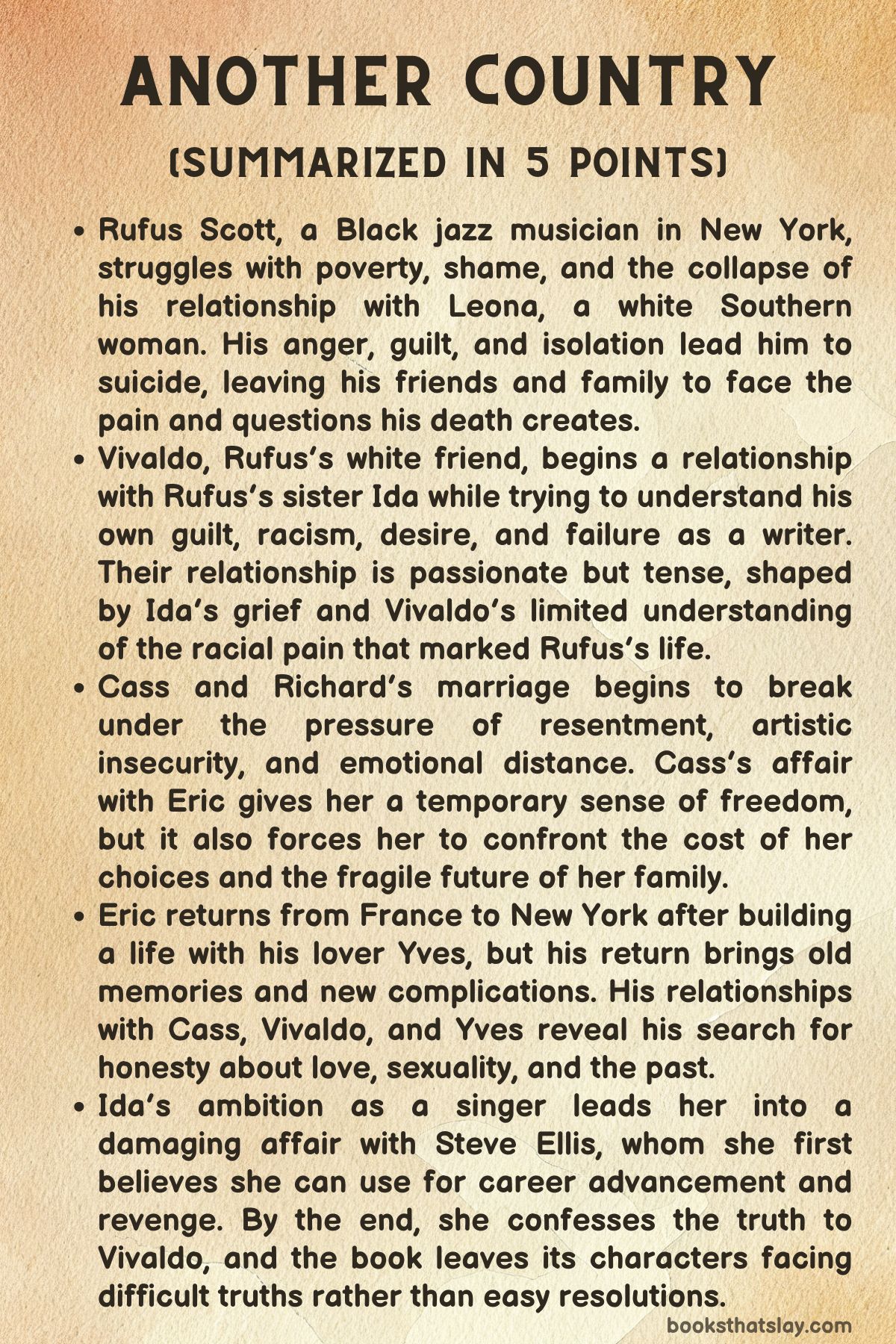
Summary
Another Country begins with Rufus Scott, a Black jazz musician in Greenwich Village, moving through New York in a state of poverty, hunger, humiliation, and despair. Once a respected drummer with friends, lovers, and a place in the city’s artistic life, he has fallen into destitution.
He sleeps in public places, wanders the streets, and feels too ashamed of his appearance to enter restaurants. His present misery is tied to memories of Leona, a young white woman from the South whom he met after a performance months earlier.
Rufus and Leona’s relationship begins with need, attraction, and pain. She is fragile, lonely, and wounded by an abusive marriage and the loss of her child.
Rufus first feels tenderness toward her, but their relationship soon becomes marked by public hostility, racial pressure, sexual anxiety, and violence. When Rufus walks with Leona, people stare at them because he is Black and she is white.
His landlord, neighbors, family, and strangers all react to their relationship, and their gaze eats into him. He feels watched, judged, and cornered.
His anger turns inward and outward. He becomes cruel to Leona, accuses her, beats her, and eventually commits sexual violence against her.
Though he knows he has hurt her badly, he cannot free himself from rage or shame.
Rufus’s closest friend, Vivaldo, a young white novelist, tries to help but does not fully understand him. Vivaldo has known Rufus through friendship, art, bars, and shared hardship, yet his love for Rufus is mixed with blindness.
Rufus once depended on him after a racially charged bar fight, but he also resents what Vivaldo cannot see. When Vivaldo witnesses Leona’s suffering, he tries to intervene, but Rufus reacts with suspicion and violence.
After Leona has a mental collapse and is taken away by her family, Rufus loses what little stability he has left.
One night, Rufus goes to Vivaldo’s apartment after weeks of disappearing. He admits he has been wandering the city and prostituting himself to survive.
Vivaldo feeds him and offers help, but Rufus is already trapped in a despair that his friends cannot reach. Later, after meeting Cass and Richard, friends from his circle, Rufus leaves the bar alone.
He rides the subway, misses his stop on purpose, and makes his way to the George Washington Bridge. Thinking that his pain will never end, he jumps from the bridge and dies.
Rufus’s death becomes the central wound around which the rest of the novel turns. Cass, Richard, Vivaldo, and Rufus’s sister Ida all respond to his absence in different ways.
Cass is a white woman married to Richard, a novelist whose book is about to be published. Their marriage looks stable from outside, with children and domestic order, but Cass feels trapped, unseen, and tired.
Richard is proud of his success yet insecure, especially around younger writers such as Vivaldo. When Rufus’s body is found, Cass mourns him and worries about Vivaldo, while Richard takes a colder view, unable to forgive Rufus for what he did to Leona.
At Rufus’s funeral, Vivaldo is forced to face guilt and confusion. He tells Cass a disturbing story from his youth, when he and other boys sexually abused and robbed a young gay man.
The memory makes him wonder what kind of person he really is and whether the violence of his past still lives in him. The funeral also brings him closer to Ida.
He is drawn to her beauty, anger, and grief, and he begins to imagine that loving her might allow him to repair something connected to Rufus. This hope is selfish as well as sincere.
Months later, Vivaldo is struggling to write his novel and has begun a relationship with Ida. Their love is passionate but uneasy.
Vivaldo wants to be close to her, but he is haunted by race, by Rufus’s death, and by his own uncertainty about Black life in America. Ida is attracted to him but wary.
She knows that white men often desire Black women while failing to understand them as full human beings. When they attend a party celebrating Richard’s book, Vivaldo becomes jealous of Steve Ellis, a powerful television producer who flirts with Ida and promises career opportunities.
Ida notices Vivaldo’s suspicion and contempt, and she accuses him of seeing her through the same degrading lens as other white men. They reconcile, but the distrust remains.
The novel then shifts to Eric, a white actor from Alabama who once had a relationship with Rufus and now lives in France with his lover Yves. Eric has built a quieter life in Europe, but he is preparing to return to New York for a stage role.
He loves Yves, yet he fears what America will do to them. His memories reveal a childhood shaped by emotional distance, racial hierarchy, and the need to hide his sexuality.
He remembers Black servants in his parents’ home with more warmth than he remembers his own family, and he recalls leaving the South after his relationship with a Black boy became known. Eric’s return to New York brings him back into the circle that Rufus left behind.
Back in New York, Eric meets Cass and Richard before going to hear Ida sing. Cass observes that Eric seems calmer than he once was, but Yves’s absence weighs on him.
At Cass and Richard’s home, their sons return after a fight with Black boys, and the incident exposes the racial anxieties and marital tensions inside the family. Richard and Cass argue bitterly.
Cass feels Richard does not see her, while Richard believes Cass looks down on him and resents his work.
Eric goes on to Ida’s performance, where Vivaldo introduces him to her. Ida sings publicly for the first time, and though her voice is rough and untrained, she commands the room.
She dedicates a song to Rufus, making his memory present again. Ellis is also there, watching and calculating.
He sees Ida’s potential and offers to help her career. Vivaldo’s jealousy deepens as men look at Ida, and Eric senses the ugliness beneath the polite surface of their group.
As time passes, the relationships become more strained. Vivaldo and Ida live together in a small apartment, both trying to pursue artistic ambitions while working ordinary jobs.
Vivaldo suspects Ida is having an affair with Ellis but is afraid to confront her. Ida resents the limits of Vivaldo’s understanding.
To her, he claims to have loved Rufus but failed to recognize the suffering that was destroying him. She doubts that a white man who missed Rufus’s pain can truly understand hers.
Cass, meanwhile, begins an affair with Eric. She is drawn to his self-knowledge and his difference from Richard.
Eric responds to her, but he knows his feelings are complicated by Yves and by his own need to understand himself. Their affair gives Cass a sense of freedom, but it also forces her to confront the wreckage of her marriage.
Richard eventually suspects her and, after learning the truth, reacts with anger and violence. He slaps her, insults her, and then collapses into shame.
Cass is left to consider whether she can leave him, whether she can lose her children, and whether survival may mean returning to the very marriage that has wounded her.
Eric and Vivaldo also share an intimate night together after drinking and talking about love, sexuality, Rufus, Cass, Ida, and Yves. For Vivaldo, the experience opens a new understanding of himself.
He does not treat it as a simple change in identity but as a moment that clears away some of his fear. He feels love for Eric, though he senses that what happened may remain unspoken afterward.
Their closeness is interrupted by Cass’s call, and everyday complications return.
The emotional climax comes when Ida finally tells Vivaldo the truth about Ellis. Rufus’s death filled her with anger and a desire for revenge against the white world she believes helped destroy him.
She wanted to use her sexuality and talent to gain power, to avoid being used as Rufus had been used, and to punish those who had failed him. Ellis helped her career and treated her with a kind of calculated kindness, but he also used his position to possess her.
Ida admits that the affair became a trap. She thought she was taking control, but she came to see that she had become another victim of the same forces she wanted to defeat.
Her confession leaves Vivaldo shaken. He feels revulsion, pity, love, and emptiness, and he realizes that his own novel has been missing a truth about human pain and responsibility.
At the end, Yves arrives in New York to join Eric. His arrival offers a fragile note of possibility rather than a neat resolution.
The characters remain damaged, uncertain, and unfinished. Cass may return to Richard.
Vivaldo and Ida may or may not survive the truth between them. Eric must face what it means to love Yves in America.
Rufus is gone, but his life and death continue to expose what others refuse to face: that love without honesty becomes possession, that desire can carry violence, and that no one can escape the racial, sexual, and emotional histories that shape them. Another Country ends as a study of people trying, often poorly, to live truthfully with themselves and one another.
Characters
Rufus Scott
Rufus Scott is the central absence of the book: he dies early, but his pain shapes nearly every relationship that follows. In Another Country, Rufus is a Black jazz drummer whose fall from artistic promise to homelessness and suicide exposes the brutal emotional cost of racism, sexual shame, poverty, and isolation.
He is not written as a simple victim, because Baldwin also shows the harm Rufus causes, especially to Leona. His tenderness, need, rage, cruelty, and self-hatred exist together.
He wants love, but he cannot receive it without feeling judged or trapped. His relationship with Leona becomes the clearest sign of this inner fracture.
Public hostility toward their interracial relationship feeds his fear and humiliation, and instead of confronting the world that wounds him, he turns his violence toward the woman who loves him. Rufus’s tragedy lies in the fact that he understands some of what he has done, yet cannot find a way back to dignity, intimacy, or self-forgiveness.
His suicide is not just a private collapse; it becomes an accusation against the friends who loved him imperfectly and the society that gave him so little room to survive.
Vivaldo Moore
Vivaldo is one of the most searching and self-divided figures in the novel. He sees himself as Rufus’s friend, as an artist, and as someone capable of loving across racial boundaries, but the book steadily reveals how limited his self-knowledge is.
His guilt over Rufus’s death is sincere, yet it is mixed with vanity and confusion. He wants to believe that loving Ida can heal something connected to Rufus, but this desire places a burden on Ida that she never asked to carry.
Vivaldo’s relationship with Ida shows both his emotional courage and his blindness. He wants to love her honestly, but he is haunted by jealousy, racial anxiety, sexual insecurity, and fear of what he does not understand.
His unfinished novel mirrors his unfinished self: he lacks the truth he needs to write because he has not yet faced the truth of his own life. His confession about abusing a young gay man in his youth also complicates him deeply, showing that his moral guilt is not limited to what he failed to do for Rufus.
Vivaldo is not false in his longing for love, but he often mistakes longing for understanding.
Ida Scott
Ida Scott is Rufus’s sister, and her character carries grief, anger, ambition, and self-protection in equal measure. She enters the story after Rufus’s disappearance and death, but she quickly becomes one of the strongest voices in the book’s examination of race and desire.
Ida does not allow Vivaldo or the others to soften Rufus’s suffering into a sentimental memory. For her, Rufus’s death is tied to the way Black people are seen, used, feared, and misunderstood by white people.
Her relationship with Vivaldo is sincere, but it is never innocent. She loves him, yet she doubts whether he can ever truly understand the world that shaped her and destroyed her brother.
Ida’s affair with Steve Ellis reveals her most painful contradiction. She believes she can use Ellis for her career and for revenge against the kind of white power that consumed Rufus, but she gradually realizes that she has been caught inside the very system she thought she was manipulating.
Her confession to Vivaldo is one of her most vulnerable moments because she stops performing control and admits shame, exhaustion, and emotional defeat. Ida is proud and guarded, but beneath that pride is a young woman trying to survive grief without being consumed by it.
Leona
Leona is one of the saddest characters in Another Country, not because she is passive, but because her need for love leaves her dangerously exposed. She is a white Southern woman carrying the wounds of an abusive marriage, separation from her child, and deep loneliness.
When she meets Rufus, she reaches for him with a desperation that he first responds to with tenderness. Their relationship could have been a refuge for both of them, but it becomes a place where private pain and public racism turn destructive.
Leona loves Rufus and keeps trying to understand him even after he abuses her. Her tragedy is that love makes her vulnerable to someone whose own wounds have become violent.
She is also important because her presence forces other characters to confront the reality of interracial intimacy in a racist society. The way strangers, neighbors, and even friends react to her relationship with Rufus helps reveal the hostile pressure surrounding them.
Leona is not merely a symbol of suffering; she is a damaged person who wants care, safety, and belonging, and who is broken further by a relationship shaped by fear, rage, and social contempt.
Cass Silenski
Cass is a woman whose outward life appears stable but whose inner life is filled with dissatisfaction, hunger, and shame. She is married to Richard, has children, and moves within a circle of artists and intellectuals, yet she feels unseen in her own home.
Her sympathy for Rufus shows that she is capable of emotional perception, but she is also limited by her position as a white woman who can observe suffering without fully sharing its consequences. Cass’s affair with Eric is not simply a romantic escape.
It is an attempt to feel alive and recognized after years of feeling reduced to wifehood and motherhood. She is drawn to Eric because he seems to possess a self-awareness Richard lacks.
Still, Cass is not free from illusion. She wants passion, but she also fears the cost of breaking apart her family.
Her conflict after Richard discovers the affair shows how trapped she feels by social expectations, motherhood, financial dependence, and emotional habit. Cass is intelligent and sensitive, but she is also hesitant, often unable to turn insight into action.
Her character shows how even privilege can become a kind of confinement when a life is built on evasion rather than honesty.
Richard Silenski
Richard is a successful writer whose public achievement hides private insecurity. His newly published novel gives him social status and professional validation, but it does not make him emotionally generous.
He often seems threatened by people who possess the artistic seriousness or emotional intensity he fears he lacks. His relationship with Vivaldo is strained by envy, and his marriage to Cass is marked by resentment.
Richard wants admiration from Cass, but he senses that she does not fully respect him as an artist or as a man. This insecurity turns bitter when he learns of her affair.
His violence toward Cass reveals the weakness beneath his pride; he tries to reassert control when emotional authority slips away from him. Yet Richard is not portrayed as a monster without complexity.
He is ashamed after hurting Cass, and his collapse suggests that he knows he has failed morally. His limitations are those of a man who wants the rewards of love and art without facing the fear, humility, and self-examination they demand.
Richard’s role in the book is to show how conventional success can coexist with emotional poverty.
Eric Jones
Eric is one of the few characters who has done serious work toward self-acceptance, though he remains far from settled. A white actor from Alabama, he carries the history of Southern racism, family coldness, and sexual secrecy.
His past relationship with Rufus, his love for Yves, and his affair with Cass all reveal different parts of him. Unlike Vivaldo, Eric has a clearer understanding of his sexuality, but he still fears abandonment and instability.
His life in France with Yves gives him a measure of peace, and his return to New York tests whether that peace can survive the pressures of old friendships, ambition, memory, and desire. Eric’s affair with Cass is emotionally significant but also morally complicated.
He eventually recognizes that he has used Cass to learn something about himself rather than loving her fully. This honesty separates him from characters who remain trapped in denial.
His tenderness toward Vivaldo also opens a brief space where Vivaldo can encounter his own sexuality without immediate shame. Eric is not pure or blameless, but he is among the most self-aware figures in the story.
He understands that love requires truth, even when truth causes pain.
Yves
Yves represents both love and uncertainty in Eric’s life. He is younger, French, and deeply attached to Eric, but he is not simply a symbol of escape from America.
His own history is marked by war, resentment, and complicated feelings toward his mother. He urges Eric to return to New York for work, which shows both faith in Eric’s talent and confidence in their relationship.
Still, Eric worries that America may change them, or that Yves may one day no longer need him. Yves’s importance lies partly in what he offers Eric: a relationship that has more openness and tenderness than many of the other bonds in the book.
His arrival in New York near the end creates a moment of possibility. It does not solve Eric’s conflicts, but it gives him a chance to test love in the place he once fled.
Yves also broadens the novel’s emotional map beyond American categories, while still showing that no country is free from history, shame, or private sorrow.
Steve Ellis
Steve Ellis is a figure of power, opportunity, and exploitation. As a television producer, he has access to the professional world that younger artists want to enter.
To Vivaldo, he is a threat because he can offer Ida the career support Vivaldo cannot. To Ida, he first appears as someone she might use for advancement and revenge.
Yet Ellis’s power is never neutral. His interest in Ida is shaped by race, sex, age, and professional control.
He can be charming and useful, but his usefulness is part of the trap. He understands how to make desire look like patronage and how to make exploitation seem like opportunity.
His relationship with Ida reveals the cost of entering artistic and commercial spaces controlled by men like him. Ellis is not drawn as violently as some characters, but his harm lies in his polished entitlement.
He treats people as material for his pleasure, career plans, and influence. In this sense, he represents a quieter but deeply damaging form of domination.
Jane
Jane is a minor but revealing character. As Vivaldo’s former girlfriend, she belongs to the social world of bohemian New York, yet her comments and behavior expose the shallow provocations of that world.
Her loud remarks about race help provoke a bar fight that leaves Rufus and Vivaldo badly beaten, showing how careless white speech can create danger that others must physically bear. Jane also appears later as someone who teases Vivaldo about his relationship with Ida, reflecting the casual racism and sexual judgment surrounding interracial love.
She is not central to the plot, but she helps define the atmosphere in which the main characters live. Jane represents a type of person who treats rebellion, sexuality, and racial talk as social performance without understanding the consequences.
Through her, the novel shows that prejudice does not always appear as open hatred; it can also appear as mockery, curiosity, and reckless speech.
Paul and Michael
Paul and Michael, Cass and Richard’s sons, are minor characters, but they matter because they reveal how adult conflicts enter family life. Their fight with a group of Black boys alarms Cass and Richard and brings racial fear into the domestic space.
The boys are not developed as independent psychological portraits, yet their presence raises the stakes of Cass and Richard’s failing marriage. Cass cannot consider her affair, her loneliness, or a possible separation without thinking of her children.
Richard also uses the children as part of the emotional pressure surrounding their marriage. Paul and Michael represent the future that adults claim to protect while repeating the same patterns of fear, anger, and evasion.
Their childhood does not exist outside the racial and emotional conflicts of the adult world; it is already being shaped by them.
Grace and Henry
Grace and Henry appear in Eric’s memories of his Southern childhood, but their role is important because they reveal the racial structure of the world that formed him. Grace works as a cook for Eric’s family, and Henry works as a handyman.
Eric remembers them with affection, especially Henry, and their presence seems warmer and more human to him than his own emotionally distant parents. Yet the fact that they can be dismissed without clear explanation reminds readers that affection does not erase hierarchy.
Eric’s bond with them exists inside a system where Black labor supports white domestic life while remaining vulnerable to white authority. Their memory helps explain why Eric grows up with a divided understanding of race: he feels love and attachment, but he is also part of a household built on inequality.
Grace and Henry are therefore small but meaningful figures in his moral formation.
LeRoy
LeRoy is part of Eric’s past and helps reveal the danger surrounding same-sex desire and interracial intimacy in the South. His relationship with Eric becomes known in their community, contributing to Eric’s need to leave for New York.
Although LeRoy does not occupy much space in the story, his importance is emotional and historical. He represents one of Eric’s earliest experiences of desire crossing the boundaries that his society violently polices.
Through LeRoy, the book shows that Eric’s sexuality cannot be separated from race, place, and fear. The memory also clarifies why Eric’s later life in Europe feels like a release, even if not a complete cure.
LeRoy remains a sign of what Eric had to flee and what he has spent years trying to understand.
Madame Belet
Madame Belet is a minor figure from Eric and Yves’s life in France. Her presence helps establish the world Eric is leaving behind when he returns to New York.
She belongs to a quieter European setting where Eric has found distance from America and from his earlier wounds. Through her conversations with Yves and Eric, the book gives a sense of ordinary life around their relationship, making their love feel lived-in rather than abstract.
She is not a major force in the plot, but she helps contrast the relative calm of France with the pressure, ambition, racial conflict, and emotional danger waiting in New York. Her role is atmospheric, but it matters because the atmosphere around Eric and Yves is part of what Eric fears losing.
Barbara Wales, Loring Montgomery, and Sydney Ingram
Barbara Wales, Loring Montgomery, and Sydney Ingram belong to the literary and professional circles surrounding Richard, Vivaldo, and the New York arts scene. They are minor characters, but they help define the world of ambition in Another Country.
Their presence at Richard’s celebration reminds Vivaldo that artistic success is not only about talent; it also depends on agents, editors, producers, parties, introductions, and social performance. Vivaldo’s discomfort around them shows his insecurity as an unpublished writer who both wants recognition and distrusts the world that grants it.
Sydney Ingram, as another young writer, reflects Vivaldo’s anxieties about literary identity and competition. These figures widen the book’s portrait of artistic life, where creative desire is constantly pressured by envy, networking, commerce, and the fear of failure.
Themes
Race, Intimacy, and the Limits of Understanding
Race in Another Country is not treated as a distant social issue; it enters bedrooms, friendships, parties, marriages, sidewalks, bars, and artistic ambition. Rufus and Leona’s relationship shows how public racism can distort private love until tenderness becomes inseparable from humiliation and rage.
Rufus feels the eyes of strangers and acquaintances on him whenever he is with Leona, and that pressure feeds a violence he cannot control. Vivaldo’s relationship with Ida develops under the shadow of the same racial divide.
He wants to believe love can overcome history, but Ida repeatedly forces him to see that affection does not automatically create understanding. His friendship with Rufus did not enable him to recognize the depth of Rufus’s suffering, and this failure makes Ida doubt him.
Baldwin presents interracial connection as possible but never easy, because every intimate bond carries the weight of unequal history. White characters often want forgiveness, closeness, or moral innocence without fully understanding what Black characters have endured.
The novel insists that love without truth becomes another form of blindness, and that racial understanding requires more than sympathy, attraction, or liberal self-image.
Love, Desire, and Possession
Love in the book is rarely clean or peaceful. Characters reach for one another because they are lonely, frightened, ashamed, or desperate to become someone new.
Rufus wants tenderness from Leona but turns her into the target of his rage. Vivaldo loves Ida but also wants her to redeem his guilt over Rufus.
Cass seeks freedom with Eric, yet her affair is tied to the emptiness of her marriage rather than a fully independent vision of her life. Eric cares for Cass but eventually admits that he has used her to learn something about himself.
These relationships show how desire can become possession when people refuse to see the other person clearly. The characters often confuse being needed with being loved, and they often use intimacy as proof that they exist, matter, or have power.
Baldwin’s treatment of love is unsentimental because he understands that people can love sincerely and still cause damage. The question running through these relationships is not whether love exists, but whether love can survive honesty.
Only when characters begin to admit their fear, selfishness, and shame does love become something more than hunger.
Sexuality, Shame, and Self-Knowledge
Sexuality in the novel is a route toward truth, but it is also surrounded by fear, violence, and social judgment. Rufus’s past with Eric, Vivaldo’s youthful assault on a gay man, Eric’s hidden life in Alabama, and Vivaldo’s later intimacy with Eric all show how deeply sexuality is shaped by shame.
Baldwin does not present sexual identity as a simple category that explains a person. Instead, he shows sexuality as part of a larger search for self-knowledge.
Eric is the character most able to speak honestly about desire, though even he remains uncertain and afraid of loss. Vivaldo’s encounter with Eric unsettles his fixed idea of himself and briefly frees him from some of his fear.
Yet the book also shows how sexual repression can become cruelty. Vivaldo’s story of abusing a gay man in his youth reveals how shame can turn outward as violence.
Ida’s relationship with Ellis adds another layer, showing how sex can be used as currency, revenge, opportunity, and control. Across the novel, desire reveals what characters hide from themselves.
It can expose tenderness, but it can also uncover domination, cowardice, and need.
Art, Ambition, and Moral Responsibility
Nearly every major character is connected to art: Rufus is a musician, Vivaldo is a writer, Ida is a singer, Richard is a novelist, and Eric is an actor. Yet the book refuses to treat art as separate from moral life.
Rufus’s music does not save him from despair. Richard’s publication does not make him wiser or kinder.
Vivaldo cannot finish his novel because he has not yet understood the emotional truth he is trying to write about. Ida’s singing offers her a path toward self-expression, but her career becomes tangled with Ellis’s power and her own grief-driven desire for revenge.
Eric’s acting career gives him professional direction, but his return to New York forces him to confront unfinished emotional business. Baldwin suggests that art demands more than talent; it requires honesty about oneself and the world.
The artistic circles of New York are filled with ambition, envy, parties, agents, editors, and producers, but beneath the surface lies a deeper question: what does the artist owe to truth? The characters who avoid self-knowledge become false in their art and their relationships.
The ones who suffer toward honesty may not become happy, but they move closer to being real.