Arrow of God Summary, Characters and Themes
Arrow of God is Chinua Achebe’s novel about power, pride, faith, and colonial rule in Igbo society. Set in the six villages of Umuaro, it follows Ezeulu, the chief priest of Ulu, as he tries to defend his god’s authority while facing rivals within his community and pressure from British officials outside it.
The novel shows a world under strain: old customs remain strong, but Christianity, colonial government, family conflict, and personal ambition begin to change daily life. Achebe presents Ezeulu not as a simple hero or villain, but as a complex man whose strength becomes dangerous when joined with isolation and anger. It’s the 2nd book of the African Trilogy.
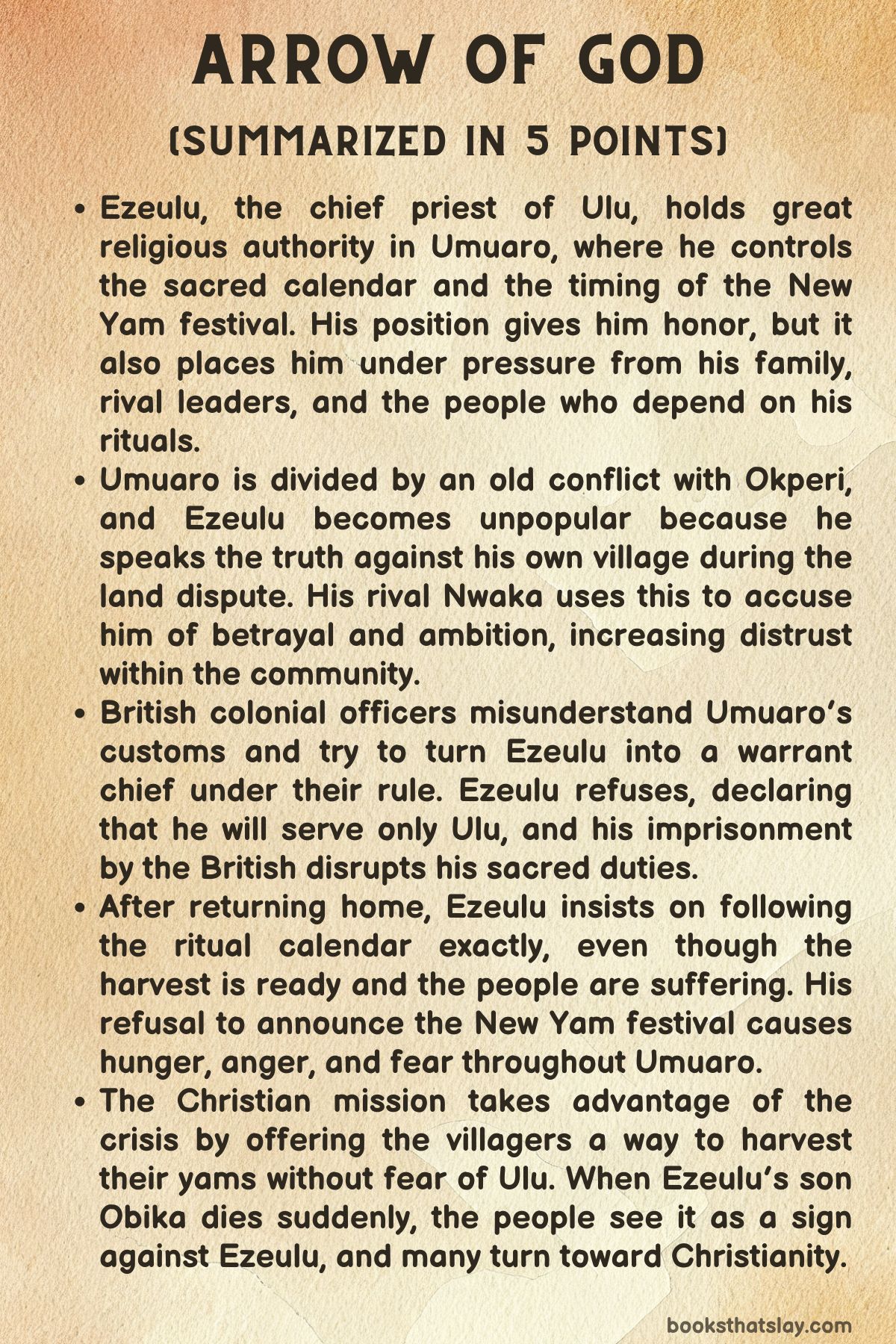
Summary
Arrow of God begins with Ezeulu, chief priest of Ulu, watching for the new moon. His duty is tied to the calendar of Umuaro, a union of six Igbo villages, and his role gives him both honor and burden.
Each new moon matters because Ezeulu must eat one sacred yam from Ulu’s storehouse, and the passing of these yams determines when the New Yam festival can be held. From the start, he feels the weight of his office.
He knows he has power, but he also wonders whether that power is truly his or whether he is only an instrument of Ulu.
Ezeulu’s household reflects the wider tensions in Umuaro. He has several wives and many children, and their rivalries, fears, and loyalties shape much of his life.
His youngest son, Nwafo, appears to have a special closeness to him, and Ezeulu suspects that Ulu may one day choose Nwafo as the next chief priest. His eldest son, Edogo, is thoughtful and skilled as a carver, but he worries about his father’s favor and about the burden of priesthood.
Obika, another son, is handsome and energetic but reckless, often drinking too much and acting without restraint. Oduche, whom Ezeulu has sent to the Christian mission, becomes a source of anxiety because his contact with the new religion places him between his father’s world and the world of the white man.
The conflict inside Umuaro has roots in an earlier war with Okperi. Ezeulu had warned the villages not to fight because he believed their claim to disputed land was unjust.
Most of Umuaro ignored him and supported men like Nwaka, who accused Ezeulu of weakness and ambition. A messenger named Akukalia was sent to Okperi with symbols of peace and war, but his pride and anger led him to insult his hosts and break a sacred object.
He was killed, and the war followed. The British officer Captain Winterbottom intervened, stopped the fighting, seized the villagers’ guns, and awarded the disputed land to Okperi.
Because Ezeulu had testified truthfully before the British, many in Umuaro came to see him as a man who had betrayed his people.
Winterbottom, known among the people as the breaker of guns, believes strongly in British authority. He sees Africans through the narrow lens of empire, even when he claims to understand them.
Under a new colonial policy of indirect rule, he decides that Umuaro needs a local chief who can rule on behalf of the British administration. Since Ezeulu already holds religious authority, Winterbottom chooses him as the best candidate for this new office.
He misunderstands both Ezeulu’s position and the political structure of Umuaro, assuming that a sacred title can easily be turned into a colonial one.
Meanwhile, Ezeulu’s enemies inside Umuaro become bolder. Nwaka, backed by Ezidemili, priest of the older deity Idemili, challenges Ezeulu’s standing.
The rivalry between Ulu and Idemili is also a rivalry between priests, histories, and forms of authority. This conflict worsens when Oduche, influenced by Christian teaching, traps a sacred royal python in a box.
Since the python is associated with Idemili, the act is seen as a terrible offense. Ezeulu is furious, but he also refuses to withdraw Oduche from the mission.
He had sent the boy there to learn the white man’s knowledge, believing that a wise man should send one eye ahead to see what the future may bring.
The Festival of the Pumpkin Leaves briefly gives the appearance of unity. Women gather with leaves, the villages take part in ritual action, and Ezeulu performs his sacred duties before the people.
For a moment, Umuaro seems whole again. Yet beneath the ceremony, old resentments remain.
Ezeulu’s enemies still distrust him, and the arrival of colonial power continues to disturb the community’s balance.
The British presence becomes more direct through a road-building project led by Mr. Wright. Young men of Umuaro are forced into unpaid labor, and Obika is whipped after arriving late.
The incident humiliates him and angers the villages, but it also shows the limits of their power. Some men speak of resisting the white man, while others warn that open defiance would only bring prison and punishment.
Moses Unachukwu, a Christian convert who knows English, explains that the white man’s power cannot be ignored and that knowledge of his ways may be necessary for survival.
Ezeulu is later summoned to Okperi by the British administration. For a chief priest, leaving his hut in response to such an order is no small matter.
He calls the elders of Umuaro to discuss the summons. Nwaka accuses him of creating his own problem through his closeness to the white man.
Others advise caution, knowing the danger of refusing British authority. Ezeulu finally goes, accompanied by Obika, but events have already turned against him.
Winterbottom falls ill, and Tony Clarke, the assistant district officer, takes charge. Clarke follows orders without understanding their full meaning and detains Ezeulu.
During his confinement, Ezeulu grows more inward and more certain that Umuaro has offended both him and Ulu. He misses a new moon while away from home, which has serious ritual consequences because he cannot eat the sacred yam at the proper time.
Clarke eventually presents him with Winterbottom’s offer: Ezeulu is to become warrant chief of Umuaro. Ezeulu refuses.
He declares that he will be no one’s chief except Ulu’s. Clarke, angered and embarrassed, sends him back into confinement.
Ezeulu’s refusal changes how people see him. Some who thought he wanted power from the British are shocked that he rejected it.
Others begin to feel he has been mistreated. After more than a month, Clarke releases him.
Ezeulu returns to Umuaro in heavy rain, cold and shaken but inwardly focused on revenge. At first, he thinks of his quarrel in personal terms: he has been insulted by the British, doubted by his people, and attacked by rivals.
But then he senses Ulu rebuking him, reminding him that the fight is not his private battle. Ezeulu begins to wonder whether he has confused his own anger with the will of the god.
Life in Umuaro resumes, but the missed month has changed everything. The sacred yams have not been eaten in their proper order, and Ezeulu insists that he must follow the ritual law exactly.
When the elders ask him to announce the New Yam festival, he refuses because there are still yams left. The harvest is ready, and if the people do not gather it, the crops will spoil.
The elders plead with him to eat the remaining yams quickly or allow them to take responsibility for any offense against Ulu. Ezeulu refuses.
He says the custom cannot be broken and that the gods sometimes use human beings as a whip.
His decision brings suffering to Umuaro. The people cannot harvest their new yams without the festival, and hunger spreads.
Families begin to struggle, and resentment against Ezeulu deepens. Some believe he is punishing Umuaro for allowing the British to imprison him.
Others think he has become too proud and has placed himself above the community. Akuebue, his trusted friend, tries to reason with him, warning that when brothers fight, strangers inherit what belongs to them.
But Ezeulu remains fixed on the law of Ulu.
The Christian mission sees an opportunity. John Goodcountry tells the people that they can bring their offerings to the Christian God and harvest without fear of Ulu.
The crisis that Ezeulu creates now becomes a path for Christianity to gain power. People who might once have hesitated begin to turn toward the church because it offers a way out of hunger and fear.
At last, Ezeulu eats the final yam and announces that the New Yam festival will come after the proper interval. But before the crisis can be resolved, tragedy strikes his household.
Obika, though unwell, agrees to carry the Ogbazulobodo during a funeral rite. Filled with the force of the spirit, he runs through the village, but the strain overwhelms him.
He collapses and dies. His death breaks Ezeulu.
He cannot understand why Ulu would strike him in this way after using him as an instrument.
To the people of Umuaro, Obika’s death is a sign that Ulu has judged his own priest. They conclude that no man, however great, is greater than his people.
Ezeulu’s fall weakens Ulu as well, and the Christian mission gains many new followers. The yams are harvested in the name of the Christian God, and the old religious order loses its hold.
Arrow of God ends with Ezeulu ruined, Umuaro changed, and colonial Christianity strengthened not only by British power, but by the divisions, pride, and suffering within the community itself.
Characters
Ezeulu
Ezeulu is the central figure of Arrow of God, and his character is built around the tension between sacred duty and human pride. As the chief priest of Ulu, he occupies a position that is larger than ordinary political leadership.
He controls the ritual calendar, announces important festivals, and serves as the visible representative of a god who unites the six villages of Umuaro. Yet the book does not present him as a simple symbol of tradition.
He is intelligent, observant, brave, and deeply committed to what he believes is the truth, but he is also severe, proud, suspicious, and sometimes unable to separate divine will from personal anger. His refusal to support Umuaro’s unjust war with Okperi shows moral courage, but it also isolates him from his people.
Later, when he is imprisoned by the British and returns home humiliated, he allows his bitterness toward Umuaro to shape his handling of the sacred yams. Ezeulu’s tragedy lies in the fact that he may be right about many things, but his rigidity turns rightness into destruction.
He sees himself as the arrow in Ulu’s bow, yet the book raises the painful question of whether he is still guided by Ulu or by wounded pride.
Nwaka
Nwaka is Ezeulu’s major rival within Umuaro and represents the force of public opposition against the chief priest. He is persuasive, proud, and skilled at turning communal suspicion into open resistance.
His conflict with Ezeulu is not only personal; it is also political and religious. Nwaka challenges Ezeulu’s authority by suggesting that the chief priest wants too much power and has grown too close to the white man.
He understands the fears of the people and uses them effectively. When Ezeulu gives truthful testimony in favor of Okperi, Nwaka frames it as betrayal.
When the British summon Ezeulu, Nwaka again uses the moment to accuse him of creating his own trouble. His alliance with Ezidemili also gives his opposition spiritual weight.
Nwaka is not merely a villain, however. He expresses a genuine anxiety within Umuaro: the fear that one man’s authority may become greater than the community itself.
Through Nwaka, the novel shows how public opinion can both challenge dangerous pride and deepen social division.
Captain T. K. Winterbottom
Captain Winterbottom is the face of British colonial authority in the book. He considers himself experienced, practical, and knowledgeable about African society, but his confidence is shaped by prejudice and imperial arrogance.
He believes he understands the people he governs, yet he repeatedly misreads their customs and political structures. His decision to appoint Ezeulu as warrant chief reveals this misunderstanding clearly.
He assumes that because Ezeulu holds religious authority, he can be turned into a political chief for British convenience. Winterbottom is not foolish in a simple sense; he has observed certain failures of colonial policy and knows that artificial chiefs can become corrupt.
Still, his thinking remains trapped inside the colonial belief that Africans must be managed by British power. His illness during the crisis is also important because it shows how fragile colonial control can be.
Even while absent or weakened, his decisions continue to damage Umuaro. Winterbottom’s role in Arrow of God is therefore not only that of an individual official, but of a system that claims order while creating confusion.
Tony Clarke
Tony Clarke is younger, less experienced, and more uncertain than Winterbottom. As Assistant District Officer, he inherits a situation he does not fully understand and tries to act with the authority expected of him.
His handling of Ezeulu exposes the danger of administrative power in the hands of someone who lacks cultural understanding. Clarke is not always cruel; at moments, he shows discomfort with thoughtless colonial behavior, such as when he objects to disrespect toward a local sacrifice.
This suggests that he has some sensitivity. Yet sensitivity alone does not make him just.
When Ezeulu refuses the position of warrant chief, Clarke feels personally insulted and responds by keeping him imprisoned. He wants to preserve the dignity of the Administration, but what he really protects is the appearance of colonial control.
Clarke’s character shows how ordinary insecurity, when backed by government power, can cause serious harm. He is not as openly hardened as Winterbottom, but he is still an agent of the same system.
Obika
Obika is one of Ezeulu’s most vivid sons, and he embodies energy without discipline. He is handsome, physically strong, admired by others, and capable of bold action, but he is also reckless, proud, and often weakened by drink.
His attack on Akueke’s abusive husband shows both his loyalty and his lack of restraint. He wants to defend his sister, but he does so with such violence that the act becomes dangerous in itself.
His whipping by Wright is another key moment because it humiliates him and becomes a public sign of colonial domination. Yet Obika is not presented only as a careless young man.
His marriage to Okuata begins to bring out a more responsible side of him, and Ezeulu briefly sees hope that marriage may steady him. His death after carrying the Ogbazulobodo is devastating because it destroys that hope.
Obika’s end becomes more than a family tragedy; it is read by Umuaro as a sign that Ezeulu has gone too far. In this way, Obika becomes the personal sacrifice through which Ezeulu’s public authority collapses.
Oduche
Oduche is Ezeulu’s son who enters the Christian mission, and his character stands at the meeting point of tradition and colonial religion. Ezeulu sends him to the mission not because he has abandoned Ulu, but because he wants one of his sons to learn the white man’s knowledge.
Oduche’s position is therefore strategic at first. He is meant to observe, learn, and perhaps help his father understand a rising power.
However, Oduche does not remain only a watcher. He becomes influenced by Christian teaching, especially the idea that converts must prove their faith by rejecting old sacred symbols.
His attempt to kill the royal python is a major act of religious violation. He cannot bring himself to kill it directly, so he traps it in a box, which reveals both his fear and his desire to prove himself.
Oduche is young, impressionable, and caught between obedience to his father and loyalty to a new faith. Through him, the book shows how conversion can begin inside one family before it changes an entire community.
Edogo
Edogo, Ezeulu’s eldest son, is quiet, thoughtful, and artistically gifted. As a carver, he is connected to the spiritual and cultural life of the community, especially through his work on masks and sacred images.
Unlike Obika, he does not act through sudden force. He observes, reflects, and often worries.
His position as the eldest son is painful because he does not receive the full confidence or affection that might be expected from his father. He senses Ezeulu’s growing favor toward Nwafo and fears that family politics may be working against him.
At the same time, he does not necessarily want the priesthood, which makes his anxiety more complex. Edogo’s character shows the burden of inheritance.
He is close enough to sacred tradition to respect it, but also close enough to understand how heavy it can be. His calmness sometimes frustrates Ezeulu, who sees it as coldness, yet Edogo’s restraint often makes him one of the more balanced figures in the family.
Nwafo
Nwafo is Ezeulu’s youngest son and the child most closely associated with the future of Ulu’s priesthood. Ezeulu senses that Ulu may have marked him as the next chief priest, and this gives Nwafo a special place in the household.
He is young, observant, and deeply attached to his father’s sacred role. When Ezeulu is away in Okperi, Nwafo worries about the new moon and nearly imitates his father’s ritual action.
This moment reveals his desire to step into the sacred space Ezeulu occupies, even though he is not yet ready. Nwafo’s character is important because he represents continuity, but that continuity becomes uncertain as Ezeulu’s authority breaks down.
If the old order is weakening, then Nwafo’s possible future as chief priest is also threatened. He is not powerful in the present, but symbolically he carries the question of whether Ulu’s authority can survive into the next generation.
Akuebue
Akuebue is Ezeulu’s trusted friend and one of the few people whose words can truly reach him. He functions as a voice of reason, patience, and social balance.
Unlike Nwaka, he challenges Ezeulu without trying to humiliate him. He understands Ezeulu’s greatness, but he also sees his danger.
Akuebue warns him about the consequences of isolation and tries to make him understand how Umuaro views his actions. His advice about Oduche, Obika, and the New Yam crisis shows that he is deeply concerned not only for Ezeulu but also for the community.
Akuebue’s wisdom lies in his ability to see several sides of a problem at once. He knows that the white man is dangerous, that Umuaro has been unfair to Ezeulu, and that Ezeulu’s anger may still destroy them all.
His friendship gives the book one of its strongest moral anchors. He cannot save Ezeulu, but his presence makes Ezeulu’s refusal to listen even more tragic.
Ezidemili
Ezidemili is the priest of Idemili and one of the spiritual rivals of Ezeulu. His conflict with Ezeulu is rooted in the religious history of Umuaro, where Ulu became the central deity after the six villages united.
Older deities, including Idemili, lost some public authority when Ulu rose in importance. Ezidemili’s resentment therefore reflects a deeper struggle among gods, priests, and traditions.
His support for Nwaka gives Nwaka’s political opposition a sacred dimension. The royal python incident intensifies his role because the python belongs to Idemili, and Oduche’s act becomes an offense against Ezidemili’s religious authority.
Ezidemili is not as fully developed emotionally as Ezeulu, but his presence matters because he shows that tradition is not one united force. The old religious world contains rivalry, jealousy, memory, and competition.
Through Ezidemili, Arrow of God avoids presenting Igbo religion as simple or uniform.
Ugoye
Ugoye is Ezeulu’s younger wife and Oduche’s mother. Her position in the household is shaped by tension, especially because Oduche’s actions bring shame and danger to her hut.
She is protective of her son and distressed by his involvement with the Christian mission, yet she has limited power to oppose Ezeulu’s decisions. Her anxiety after the royal python incident reveals the vulnerability of women and mothers inside a patriarchal household.
Ugoye also faces hostility from Matefi, whose jealousy and anger often sharpen domestic conflict. Despite this, Ugoye is not merely passive.
Her presence shows the emotional cost of Ezeulu’s strategies. When he sends Oduche to learn the white man’s ways, Ugoye must live with the consequences inside the home.
She represents the quieter suffering caused by decisions made by powerful men.
Matefi
Matefi is one of Ezeulu’s wives and the mother of Obika. She is often associated with anger, jealousy, and rivalry within the household.
Her conflict with Ugoye shows how a polygamous family can become a place of competition, especially when children’s status affects the standing of their mothers. Matefi is protective of her own children and quick to express grievance when she believes they have been wronged.
Her loudness and bitterness can make her seem harsh, but the book also shows that her emotions come from insecurity and maternal concern. She watches Ezeulu’s shifting favor among his sons and feels the pressures that come with household politics.
Through Matefi, domestic life becomes a smaller version of Umuaro itself: divided, watchful, proud, and easily wounded.
Akueke
Akueke is Ezeulu’s daughter, and her return from an abusive marriage reveals important details about family honor, gender, and justice. Her husband Ibe beats her, and Obika responds by violently punishing him.
Akueke’s situation shows that women can be vulnerable inside marriage, but it also shows that a woman’s birth family may still intervene when abuse becomes intolerable. Ezeulu eventually supports her return to her husband’s family after discussions with her in-laws, but he also warns that quarrels between husband and wife should not become violence.
Akueke’s character is important because she reveals how personal suffering is handled through kinship negotiation. Her experience also brings out different sides of Obika and Ezeulu: Obika’s fierce loyalty and Ezeulu’s concern for order, reputation, and proper settlement.
Okuata
Okuata is Obika’s wife, and her arrival marks a hopeful change in Obika’s life. She is described as striking and dignified, and her wedding ceremonies emphasize beauty, custom, anxiety, and expectation.
Her virginity matters socially because it confirms her honor in the eyes of both families, and her nervousness shows how heavily women are judged by communal standards. Okuata’s marriage to Obika appears to promise stability.
Ezeulu is pleased to see Obika become more careful and serious after marriage, suggesting that Okuata may help him mature. Yet that promise is cut short by Obika’s death.
Okuata’s role is therefore tied to lost possibility. She enters the story as a sign of renewal, but her future is quickly darkened by the collapse of Ezeulu’s household.
Moses Unachukwu
Moses Unachukwu is one of the most important Christian converts in Umuaro. He knows English and acts as an interpreter between the villagers and the colonial world.
His knowledge gives him unusual status because he can understand and explain the white man’s language, a skill many others lack. Moses represents the practical power of conversion and education.
He is not only a religious figure; he is also a cultural mediator. Some villagers distrust him because they suspect that closeness to the white man can become betrayal.
Yet others recognize that men like Moses may be necessary in a changing world. His warning that the white man will drive away old customs captures one of the book’s central anxieties.
Moses stands for adaptation, but also for the unsettling fact that adaptation may assist the very forces that weaken traditional life.
John Goodcountry
John Goodcountry is a Christian teacher whose influence pushes local converts toward open rejection of traditional religion. He encourages believers to prove their faith by challenging sacred customs, and his teaching helps inspire Oduche’s attack on the royal python.
Goodcountry is determined, strategic, and alert to opportunities. During the New Yam crisis, he recognizes that hunger and fear have created a chance for the church to gain followers.
He tells the people that they can offer their yams to the Christian God and harvest without fear of Ulu. His role shows that religious change does not happen only through belief; it also happens through timing, pressure, and practical need.
Goodcountry understands that a hungry community may accept a new spiritual path if it offers immediate relief.
Mr. Wright
Mr. Wright is the colonial road builder, and his character displays the brutality that often supports imperial projects. He sees African laborers in degrading terms and uses unpaid work to complete the road between Okperi and Umuaro.
His whipping of Obika is a key moment because it turns colonial power into physical humiliation. Wright is not interested in understanding the people around him.
He values obedience, labor, and control. At the same time, his conversations with Clarke reveal that he is socially beneath men like Winterbottom in the colonial hierarchy.
This does not soften him; instead, it helps show how colonial systems contain their own class tensions while still uniting Europeans over African subordination. Wright’s character makes visible the everyday violence behind roads, administration, and so-called progress.
John Nwodika
John Nwodika is Winterbottom’s steward, but his relationship with Ezeulu complicates the simple division between servant and collaborator. At first, people are suspicious of him because he works for the white man and belongs to Umunneora.
Yet he shows kindness to Ezeulu during his imprisonment, making sure he is fed and treated with respect. He explains that he entered the white man’s service as part of a search for money and opportunity, but he does not intend to remain a servant forever.
Nwodika represents one kind of practical survival under colonial rule. He is neither a full rebel nor a mindless servant.
He is a man trying to use the new order for his own advancement. Ezeulu’s fondness for him suggests that he recognizes intelligence and ambition in the young man, even if others remain doubtful.
Akukalia
Akukalia is a proud and impulsive messenger whose actions help ignite the war between Umuaro and Okperi. Sent with symbols that should allow Okperi to choose peace or war, he fails to control his temper.
His secret impotence makes him especially sensitive to insult, and when he feels mocked, he reacts violently. By breaking Ebo’s ikenga, he commits a serious offense, and Ebo kills him.
Akukalia’s death becomes a turning point because it gives Umuaro a reason to continue toward war, even though Ezeulu has warned that the cause is unjust. Akukalia represents the danger of masculine pride when it is tied to public honor.
One man’s insecurity becomes a disaster for two communities.
Ebo
Ebo is the Okperi man who kills Akukalia after Akukalia breaks his ikenga. Though his role is brief, it is important because his action shows how sacred objects carry deep personal and spiritual meaning.
The ikenga represents strength, achievement, and the power of the right hand. When Akukalia destroys it, he attacks more than property; he attacks Ebo’s dignity and spiritual identity.
Ebo’s violent response helps trigger wider conflict, but the book makes clear that Akukalia’s provocation was severe. Ebo’s character reminds readers that war often grows from moments where pride, sacred value, and public insult meet.
Okeke Onenyi
Okeke Onenyi is Ezeulu’s younger brother and a medicine man. His relationship with Ezeulu is strained because of old family and spiritual tensions.
Their father’s powers were divided between them, and Okeke had questioned the oracle’s choice of Ezeulu as chief priest. This history makes their brotherhood uneasy.
Okeke’s presence shows that Ezeulu’s conflicts are not limited to public rivals like Nwaka; they also exist inside his own kinship circle. He is one of the men who later joins the elders in asking Ezeulu to resolve the New Yam crisis, which places him within the collective voice of Umuaro against Ezeulu’s rigid position.
Mary Savage
Mary Savage is the missionary doctor who treats Winterbottom during his illness. She is described as severe and unfeminine, and her role is mainly connected to the colonial community rather than Umuaro itself.
Yet she matters because her care helps restore Winterbottom and later leads to marriage. She represents another side of the colonial presence: medicine, mission influence, and European domestic life in Africa.
Her character also shows that colonial power is not only military or administrative. It includes medical institutions, missionary networks, and personal relationships that support the wider colonial structure.
Obiageli
Obiageli is one of Ezeulu’s daughters and appears often in domestic scenes with the younger children. Her role is small but meaningful because she helps show the everyday life of Ezeulu’s compound beyond public ritual and political conflict.
Through her questions, songs, and interactions with Nwafo and other children, the book shows how children absorb the tensions of the adult world. When she and Nwafo chant about Christians and pythons, their play reflects the serious religious conflict surrounding Oduche’s act.
Obiageli represents the way social change enters childhood speech and imagination.
Ojiugo
Ojiugo is Ezeulu’s daughter by one of his wives and is involved in household conflict, especially around Oduche and the new religion. Her curiosity, jealousy, and quarrel with Oduche reveal the emotional strain inside the family after the royal python incident.
When Oduche attacks her and the women take sides, the household becomes a stage for larger divisions over Christianity, loyalty, and status. Ojiugo’s role may be secondary, but she helps show that Ezeulu’s compound is not a peaceful private space.
It is full of rival claims, sharp words, and social pressure.
John Jaja Goodcountry, Blackett, and the Mission Converts
The mission figures together represent the rising Christian presence in Umuaro. Blackett impresses Oduche because he is Black and yet appears to possess knowledge associated with white power, making him a powerful model for the young convert.
Goodcountry gives that mission sharper local force by urging converts to reject sacred traditions. The converts as a group show that Christianity does not enter Umuaro only from outside; it is carried forward by local people who reinterpret power, faith, and survival.
Their presence becomes especially important during the famine, when the church offers an alternative to Ulu’s authority.
The Elders of Umuaro
The elders of Umuaro are not one single character, but they function as a collective force in the book. They represent communal memory, public judgment, caution, and political pressure.
At times they are easily swayed, as when they support the war against Okperi despite Ezeulu’s warning. At other times, they act with practical wisdom, especially when they ask Ezeulu to allow the harvest before the crops are ruined.
Their relationship with Ezeulu is complex. They need him because he serves Ulu, but they also fear the danger of one priest holding the entire agricultural year in his hands.
By the end, their interpretation of Obika’s death becomes decisive. They conclude that Ulu has rejected Ezeulu’s pride, and this judgment helps redirect the village toward Christianity.
Themes
Power, Pride, and the Limits of Authority
Power in Arrow of God is never simple, because authority comes from many sources at once: gods, ancestors, elders, colonial officers, wealth, age, gender, and public speech. Ezeulu’s authority as chief priest is sacred, but it depends on the trust of Umuaro.
Winterbottom’s authority comes from empire, but it depends on force and misunderstanding. Nwaka’s authority grows through persuasion and public anger.
The book shows that power becomes dangerous when it stops listening. Ezeulu is not wrong to defend the customs of Ulu, and he is not wrong to reject the British offer of warrant chief.
His failure comes from treating his sacred office as if it places him beyond ordinary communal pain. When the harvest is delayed, the people do not experience his decision as pure obedience to Ulu; they experience it as punishment.
The tragedy is that Ezeulu’s authority is real, but not limitless. A priest may speak for a god, but he still lives among people.
Once his power becomes separated from their survival, it begins to destroy both him and the god he serves.
Tradition Under Pressure
Custom in the novel is living, detailed, and serious. Festivals, sacred yams, marriage rites, greetings, sacrifices, masks, and the handling of sacred animals all show a society with deep systems of meaning.
These practices are not decorative; they organize time, settle conflict, define honor, and connect the living to gods and ancestors. Yet the book also shows that tradition is not frozen or perfectly united.
Ulu became powerful because the six villages once needed unity, which means even sacred institutions have histories. Idemili’s priest resents Ulu’s rise, and Nwaka uses older religious loyalties to challenge Ezeulu.
Christianity places new pressure on these internal tensions. Oduche’s treatment of the royal python is shocking because it attacks a sacred symbol from inside Ezeulu’s own household.
The New Yam crisis then reveals how vulnerable tradition can become when ritual law conflicts with hunger. Achebe does not mock custom, but he also does not idealize it.
He shows its beauty, strength, and order while also showing how pride, rivalry, and fear can weaken it from within.
Colonial Misunderstanding and Its Consequences
The British officials believe they are bringing order, but much of the disorder in the book grows from their inability to understand the society they govern. Winterbottom thinks he knows Umuaro because he has spent years in the region, yet he mistakes Ezeulu’s priestly role for something that can be converted into a colonial chieftaincy.
Clarke thinks he is defending administrative dignity when he imprisons Ezeulu, but he does not understand the ritual damage caused by keeping the chief priest away through the new moon. Wright sees local men mainly as labor, and his whipping of Obika turns road building into humiliation.
Colonial power is dangerous not only because it is violent, but because it is confident in its ignorance. The British system demands obedience to categories that do not fit the local world.
It invents chiefs where none existed, rewards compliance, punishes hesitation, and then calls the result order. The damage spreads beyond official decisions.
It changes family strategy, religious conversion, labor, public fear, and the timing of harvest itself.
Division Within the Community
The fall of Umuaro’s old order is not caused by colonial pressure alone. The book repeatedly shows that internal division prepares the ground for outside power.
The war with Okperi begins because Umuaro refuses to listen to Ezeulu’s warning. Ezeulu’s later suffering becomes worse because many villagers already distrust him.
Nwaka and Ezeulu damage each other through rivalry, and the priests of Ulu and Idemili carry older religious competition into present politics. Even Ezeulu’s household reflects this pattern: wives quarrel, sons compete, daughters argue, and Oduche’s Christianity turns the family into a site of religious conflict.
Akuebue’s warning that strangers inherit when brothers fight captures the movement of the entire story. The white man gains influence not simply by being powerful, but because Umuaro is divided over land, gods, pride, and authority.
By the time hunger comes, the Christian mission can offer a practical escape because communal trust has already been weakened. The final tragedy is therefore collective as well as personal.
Ezeulu falls, but the village also loses part of itself.