As Brave As You Summary, Characters and Themes
As Brave As You by Jason Reynolds is a middle-grade novel about two Brooklyn brothers, Genie and Ernie, who spend a summer with their grandparents in rural Virginia while their parents try to repair their marriage. Through Genie’s curious eyes, the story explores family secrets, fear, pride, masculinity, and what bravery really means.
The book balances humor and tension as the boys meet their blind grandfather, learn about their late uncle, face mistakes they cannot easily undo, and begin to understand the pain carried by older generations. It is a warm, thoughtful story about growing up and seeing family more clearly.
Summary
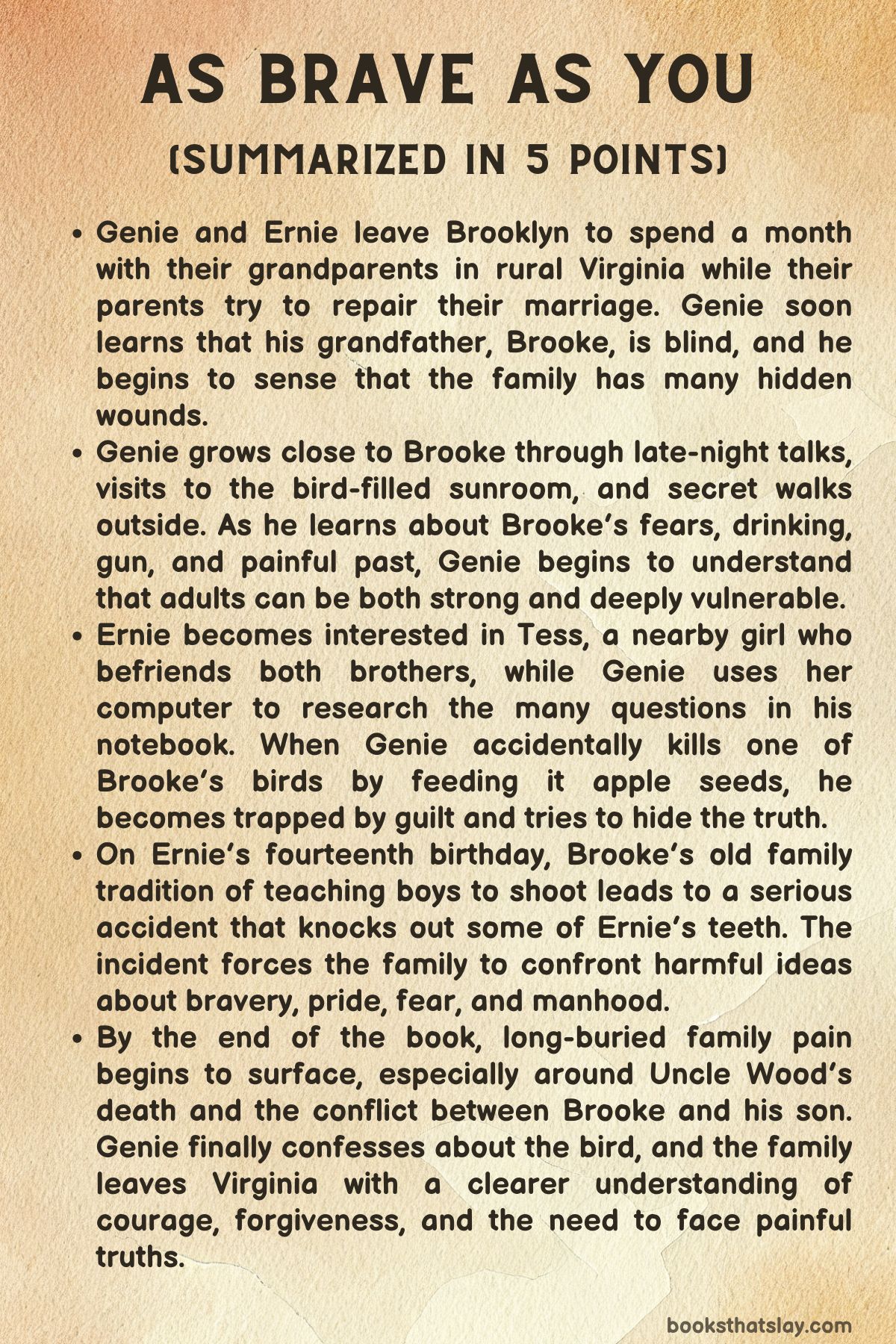
Eleven-year-old Genie and his older brother, Ernie, leave Brooklyn for rural Virginia, where they are meant to spend a month with their paternal grandparents. Their parents are taking time away in Jamaica to work through problems in their marriage, though the boys do not fully understand what is happening between them.
The trip already feels strange to Genie because his father has not seen his own father in nearly ten years. Genie knows there is some kind of distance between them, but no one has explained it in a way that satisfies him.
When the boys arrive late at night, they meet their grandmother, who welcomes them into the house. The next morning, Genie discovers an old toy fire truck in the room where he and Ernie are staying.
He later learns that it belonged to Uncle Wood, his father’s brother, who died while serving in the military. The toy carries emotional weight for the family, especially for their grandmother, though Genie does not understand the full story yet.
At breakfast, Genie meets his grandfather, Brooke, and is shocked to learn that Brooke is blind. Genie feels upset that his parents never told him, but his father explains that Brooke did not want the boys forming ideas about him before meeting him in person.
The boys’ parents soon leave, and Genie feels uneasy about being left behind. Ernie adjusts more easily, but Genie is full of questions.
He begins talking with Brooke, who surprises him by allowing him to ask more questions than most adults do. Genie is used to adults becoming tired of his curiosity, so he finds this refreshing.
At the same time, Brooke unsettles him. Genie discovers that his grandfather keeps a gun, and although he wants to know more, Brooke shuts down that line of questioning.
Outside, Genie and Ernie meet Tess, a girl who lives nearby. She is confident, practical, and friendly with their grandparents.
She makes earrings from flattened bottle caps and sells them at a local market. She takes the boys to a small bar where the bartender plays a joke on them, making them think they are drinking beer when it is really ginger beer.
Ernie is quickly drawn to Tess, while Genie is more interested in the fact that she has internet access at home, something his grandparents’ house does not have.
Life at their grandparents’ house follows a routine. Their grandmother wakes them early, gives them chores, and has them pick peas that she sells at the market.
Genie begins to spend more time with Brooke, especially in a locked room that has fascinated him since his arrival. The room turns out to be a sunroom filled with plants, fake grass, and caged birds.
Brooke, who rarely goes outside, uses the room as a substitute for the outdoors. He feeds the birds dead flies brought by Crab, Tess’s father, who hunts on the family’s land and also brings Brooke liquor.
Brooke’s blindness shapes much of his life. Genie learns that his grandfather avoids leaving the house because he has memorized the inside but feels unsafe outside.
Years earlier, after he lost his sight, Brooke was bitten by a poisonous snake in the yard. The scar from the bite remains on his ankle, and the fear remains with him as well.
One night, Brooke asks Genie to help him walk outside. Genie guides him barefoot through the yard, and Brooke becomes emotional.
Genie begins to understand that his grandfather’s blindness is not just a fact about him; it has changed his relationship with the world.
Meanwhile, Genie and Ernie grow closer to Tess. They visit her house often, where Genie uses the computer to research answers to the many questions he keeps in his notebook.
Tess’s mother is extremely afraid of germs and keeps the house covered and cleaned, but she gradually becomes part of the boys’ summer world too. Ernie and Tess spend more and more time together, and Ernie becomes self-conscious about impressing her.
Genie’s own problems begin when he makes a serious mistake in Brooke’s sunroom. One day, while feeding the birds, he runs out of dead flies and gives one of the birds apple seeds from Brooke’s can.
Later, he discovers that the bird has died. Horrified, he researches the matter and learns that apple seeds contain poison in small amounts.
Genie believes he has killed Brooke’s bird and panics. With Ernie and Tess, he decides to find another bird to replace it.
Crab has told Tess about an old house in the woods on the grandparents’ property that is full of birds, so the children go there.
The old house is eerie and decayed, with a tree growing through it and birds living inside. Genie and Ernie find signs that people have been there, including beer cans and cigar stubs.
They also see old birdcages, which connect the place to Brooke’s past. They realize that none of the birds there can replace the dead swallow because Brooke would hear the difference in its song.
The boys return without solving the problem. When their grandmother hears about the house, more family history begins to surface.
It once belonged to Brooke’s parents, and Brooke’s father was deeply damaged by his life and by his service in World War II before eventually dying by suicide.
As the summer continues, Genie learns about another family tradition. Brooke used to teach boys to shoot a gun when they turned fourteen.
The custom began, he explains, in response to the murder of a fourteen-year-old Black boy accused of whistling at a white woman. Over time, the shooting lesson became a rite of passage in the family and neighborhood.
Since Ernie is about to turn fourteen, Brooke wants him to take part. Ernie does not want to do it, but pressure builds around him, especially when Crab mocks him for being afraid.
On Ernie’s birthday, which falls on the Fourth of July, Crab agrees to teach him to shoot because Brooke cannot do it himself. Brooke insists that Ernie use his revolver, a treasured family object.
Genie realizes that the late-night walks he has taken with Brooke were partly meant to help Brooke prepare to go near the old house for this moment. The lesson quickly goes wrong.
Ernie is nervous and shaking. When he finally fires, the gun kicks back and hits him in the face, knocking out three of his teeth.
Everyone panics. Brooke cannot see what has happened, Ernie is hurt and terrified, and Genie is scared for his brother.
Their grandmother takes Ernie to the hospital, where two of the teeth are put back in. The accident changes the mood in the house.
Ernie becomes ashamed of his appearance and does not want Tess to see him. Their father is furious when he hears what happened and blames Brooke.
Old anger between father and son returns, especially around Uncle Wood. Genie learns that his father blames Brooke for encouraging Wood to join the army, even though Wood had wanted to be a firefighter.
After Wood died in the military, Genie’s father became a firefighter in his place.
The family’s ideas about bravery become more complicated. Their grandmother shows the boys Wood’s Purple Heart and tells them that he had been afraid before his death.
She explains that brave people are not fearless; they act even when fear is present. Genie begins to see that the men in his family have each carried fear, guilt, pride, and love in different ways.
Brooke’s gun, once a symbol of strength, now seems connected to pain and damage. After the accident, Brooke grows quieter and more withdrawn.
His wife eventually throws the dismantled pieces of the gun into the trash after confronting him about his drinking and his secret walks outside. Brooke breaks down, and she comforts him.
Ernie slowly begins to recover. Tess gives him a medical mask so he can hide his mouth, and her mother even leaves the house to bring it to him, suggesting that she too is trying to change.
Genie finds a button on one of Tess’s garments that can replace the broken wheel on Uncle Wood’s toy fire truck, which had been damaged earlier when his grandmother stepped on it. He repairs the toy and feels relieved, hoping he has honored something important.
Near the end of the visit, Genie and Tess finally catch a barn swallow in their trap, but Genie accidentally lets it go. He is crushed because he still has not confessed to Brooke about the dead bird.
Soon after, Brooke tells Genie more about the old house and his father. Brooke’s father, once a sharecropper, betrayed a friend to a cruel landowner over a stolen puppy.
The landowner later burned the friend’s house, killing him. Brooke’s father built birdcages from scraps connected to that tragedy and lived with guilt until his death.
This story helps Genie understand that the family has been shaped by hidden pain for generations.
Before Genie can confess, his parents arrive early. Genie studies his mother’s face and senses that his parents may stay together, though they do not explain everything to the boys.
His father and Brooke argue, especially about Wood and the shooting accident, but the argument leads to a kind of reconciliation. They begin to face the hurt that kept them apart for years.
Genie’s grandmother is touched by his attempt to fix Wood’s fire truck and gives it to him. Ernie leaves one of his chipped teeth behind as a good-luck charm for his grandparents.
Just before leaving, Genie finally tells Brooke the truth about the bird. Brooke reveals that he has known for weeks because he could hear the difference between four birds and five.
He is not angry in the way Genie feared. Genie then asks whether Brooke might ever let the other birds go, since he has disliked seeing them trapped in cages.
Brooke says he will think about it. As Genie leaves Virginia, he carries new knowledge about fear, family, honesty, and forgiveness.
As Brave As You ends with Genie finding the broken piece of the toy fire truck’s wheel, a small reminder that even repaired things still carry signs of what happened to them.
Characters
Genie
Genie is the central young observer of As Brave As You, and much of the book’s emotional depth comes through his curiosity, anxiety, and gradual growth. He is eleven years old, thoughtful, sensitive, and almost unable to stop asking questions.
His questions are not simply childish interruptions; they are his way of making sense of a world where adults often hide the truth, avoid painful subjects, or give incomplete answers. When he arrives in Virginia, he is unsettled by the silence surrounding his grandfather’s blindness, his father’s estrangement from Brooke, and the mystery of Uncle Wood.
Genie wants facts, but the book shows him learning that facts alone do not explain people. He must also learn how fear, guilt, shame, pride, and love shape the choices adults make.
Genie’s relationship with Brooke becomes one of the most important parts of the story. At first, he is both fascinated and disturbed by his grandfather.
Brooke’s blindness, gun, locked room, drinking, and strange habits all confuse him. Yet Genie also recognizes that Brooke treats his curiosity seriously.
Their late-night conversations and walks outside allow Genie to see his grandfather as vulnerable rather than simply intimidating. Genie’s fear of confessing that he caused the bird’s death shows his conscience and his deep need to be accepted.
By the end of the book, he has not become fearless, but he has become more honest and more aware. His growth lies in learning that bravery includes admitting mistakes, seeing adults as flawed people, and asking difficult questions even when the answers hurt.
Ernie
Ernie is Genie’s older brother, and his role in the book is shaped by his desire to appear confident, mature, and fearless. At thirteen, soon to be fourteen, he stands at the edge between childhood and adolescence.
He often acts cooler and more composed than Genie, especially around Tess, whom he quickly likes. His interest in Tess makes him more self-conscious, and this becomes important when he is pressured into the family shooting tradition.
Ernie does not truly want to shoot the gun, but he feels trapped by expectations. Crab’s taunting, Brooke’s tradition, and Tess’s presence make it difficult for him to admit his fear.
The shooting accident exposes the danger of mistaking performance for courage. Ernie’s injury is not just physical; it damages his pride and sense of self.
After losing his teeth, he becomes embarrassed and afraid that Tess will reject him. This reaction shows how much of his identity depends on how others see him.
Yet Ernie’s recovery also reveals a more honest side of him. His conversations with Genie about fear and instinct show that he is beginning to understand bravery differently.
He does not need to prove manhood through a gun or through pretending not to be afraid. Ernie’s journey is quieter than Genie’s, but it is powerful because he learns that refusing something can sometimes be braver than going along with it.
Brooke
Brooke, the boys’ grandfather, is one of the most complicated figures in the novel. He is blind, proud, wounded, secretive, and deeply shaped by family history.
When Genie first meets him, Brooke seems mysterious and commanding. He keeps a gun, locks himself in a sunroom, drinks liquor, and resists being treated as weak because of his blindness.
His desire to control how people see him explains why he does not want Genie and Ernie to know about his blindness before meeting him. Brooke does not want pity, but he also lives in fear.
He rarely leaves the house because the outside world has become unpredictable and dangerous to him.
Brooke’s inner conflict becomes clearer through his bond with Genie. He wants to be strong, useful, and respected, yet he also needs help.
Asking Genie to guide him outside is a major act of trust. His attachment to guns is connected to history, racial fear, masculine tradition, and his own need to feel secure.
However, the accident with Ernie forces him to confront the harm that tradition can cause. Brooke’s grief over Wood, his unresolved conflict with his son, and the story of his own father reveal that he has inherited pain he never fully processed.
In As Brave As You, Brooke represents a kind of bravery that is damaged but still capable of change. His willingness to listen to Genie’s confession and consider freeing the birds suggests that he may finally be ready to loosen his grip on the things he has kept trapped, including himself.
Grandmother
Genie and Ernie’s grandmother is practical, loving, disciplined, and emotionally strong. She runs the household with order and routine, giving the boys chores and expecting them to contribute.
Her early-morning rules, pea picking, and calm response during the power outage show that she is used to managing difficulty without complaint. She is not sentimental in an obvious way, but her love is steady.
She cares deeply about Uncle Wood’s toy fire truck because it connects her to the son she lost, and her reaction when it breaks shows how grief can attach itself to ordinary objects.
Her strength becomes especially visible after Ernie’s accident. She acts quickly, takes him to the hospital, and handles the crisis with the competence of someone who has spent years caring for others as a nurse.
She also becomes a moral center in the book. She challenges Brooke’s drinking, his dependence on the gun, and his avoidance of responsibility.
When she throws the gun pieces into the trash, she is not simply angry; she is refusing to let fear and old habits continue harming the family. At the same time, she is compassionate.
When Brooke breaks down, she comforts him. Her character shows that firmness and tenderness can exist together.
She carries grief, but she also keeps the family functioning and pushes others toward healing.
Genie and Ernie’s Father
The boys’ father is important even though he is absent for much of the story. His strained relationship with Brooke shapes the emotional background of the book.
He has not seen his father in years, and this distance creates confusion for Genie, who senses that something serious has happened but does not know the full truth. The father’s anger is tied to Uncle Wood’s death.
He blames Brooke for encouraging Wood to join the military, especially because Wood had wanted to become a firefighter. After Wood died, the boys’ father became a firefighter himself, almost as if he were trying to continue Wood’s original dream.
His character carries grief that has hardened into resentment. He avoids speaking with Brooke on the phone and reacts with fury after Ernie’s shooting accident.
His anger is understandable, but it also keeps him trapped in the past. By the end of the book, his confrontation with Brooke becomes necessary.
Their argument allows buried feelings to come out, and the possibility of reconciliation appears. He is not shown as perfect, but he is shown as a man struggling with loss, loyalty, and fatherhood.
His marriage problems also remind the reader that adults may be uncertain and frightened even when children expect them to have answers.
Genie and Ernie’s Mother
The boys’ mother is less central than some other characters, but her presence matters because she represents the family tension that sends Genie and Ernie to Virginia in the first place. She and her husband leave the boys with their grandparents while they try to work through their marital problems.
From Genie’s perspective, this creates anxiety because he is not told everything directly. He studies her face when she returns, trying to understand whether his parents will stay together.
This shows how children often read adult emotions carefully when adults do not explain what is happening.
Her role also helps frame the book as a story about family repair across more than one generation. While Brooke and his son struggle with old grief, Genie’s parents are trying to address their own relationship.
The mother’s return suggests hope, though the book does not make everything simple or overly neat. Her character reminds the reader that family problems are rarely isolated.
Strain between parents affects children, silence between generations affects marriages, and unresolved grief can echo through a household.
Tess
Tess is confident, creative, and important to both brothers in different ways. She lives near Genie and Ernie’s grandparents and quickly becomes part of their summer routine.
She makes earrings from flattened bottle caps, helps the boys navigate the local area, and brings a lively, practical energy into the story. For Ernie, Tess becomes the person he wants to impress, which raises the emotional stakes of his fear during the shooting lesson.
His embarrassment after the accident is tied closely to his worry that Tess will see him differently.
For Genie, Tess offers access to information and companionship. Her house has the internet, which allows Genie to research the questions that fill his notebook.
She also helps with the plan to replace Brooke’s dead bird, showing that she is loyal and willing to take part in risky schemes. Tess is not just a love interest for Ernie; she has her own world, shaped by her mother’s fear of germs and her father’s troubling behavior.
Her kindness after Ernie’s accident, especially when she gives him a mask, shows emotional maturity. She accepts people’s awkwardness and vulnerability more easily than Ernie expects, which helps challenge his fear of being rejected.
Crab
Crab is Tess’s father and one of the more troubling adult figures in the book. He hunts on Brooke’s land, brings dead flies for the birds, supplies Brooke with liquor, and later teaches Ernie to shoot.
From the beginning, Genie senses that Crab is not entirely trustworthy. His dirty appearance, ramshackle car, and uneasy relationship with Genie’s grandmother make him seem rough and unreliable.
The revelation that he has been cheating Brooke with money confirms that Genie’s suspicion is justified.
Crab’s role in the shooting accident is especially important. He mocks Ernie for being scared, pushing him into a situation he does not want.
This makes Crab part of the book’s criticism of a harsh model of masculinity, one that treats fear as weakness and humiliation as motivation. Yet Crab is not completely separate from the family’s past.
Brooke taught him to shoot when he was young, which means Crab is also a product of the same traditions that harm Ernie. His character shows how damaging ideas can move through communities when no one stops to question them.
Uncle Wood
Uncle Wood never appears alive in the book, but his memory shapes nearly every major family conflict. He was Brooke’s son and the boys’ father’s brother.
He wanted to become a firefighter, but he joined the military and died in Desert Storm. His death created a wound in the family that never fully healed.
Brooke, Genie’s father, and Genie’s grandmother all carry Wood differently. For the grandmother, Wood is connected to love, grief, and treasured objects like the toy fire truck and his folded flag.
For Genie’s father, Wood’s death is tied to blame and anger toward Brooke.
Wood’s importance lies in how the living characters continue to respond to him. His absence explains the long separation between Brooke and his son.
It also shapes the boys’ father’s decision to become a firefighter, almost as if he is living part of Wood’s lost future. The Purple Heart and the letter revealing Wood’s fear complicate the family’s idea of bravery.
Wood was brave, but he was also afraid. That truth helps the boys understand that courage is not the absence of fear.
In As Brave As You, Wood functions as a silent presence whose life and death force the family to reconsider pride, sacrifice, and what it means to honor someone.
Binks
Binks is an eccentric market figure who sells teeth as lucky objects and is later revealed to be a dentist. At first, he seems almost comic and strange, especially to Genie, who is fascinated and unsettled by his business.
His presence adds humor to the book, but he also becomes important after Ernie’s accident. Because Ernie has lost teeth, Binks’s odd profession suddenly connects directly to the boys’ real fears.
Binks helps the book explore the difference between appearance and reality. He seems bizarre and possibly suspicious, which is why Ernie fears that he might harvest teeth.
Yet he is also someone with professional knowledge who can help. Genie buying a tooth that supposedly belonged to Bruce Lee for Ernie shows how children use symbols to comfort one another.
Binks’s character adds a strange but meaningful layer to the story’s focus on fear, luck, injury, and healing.
Tess’s Mother
Tess’s mother is defined by her fear of germs, but the book treats her with more than simple comedy. She wears protective items, covers furniture in plastic, and asks Tess to clean surfaces the boys touch.
Her behavior is extreme, yet it reflects the broader pattern of adults trying to control what frightens them. Just as Brooke stays inside because the outside world feels unsafe, Tess’s mother tries to make her home safe by controlling contamination.
Her small changes matter. When she leaves the house to help Tess bring Ernie a mask, it suggests that she is capable of pushing against her fear.
Her character mirrors the book’s larger idea that bravery can be quiet and personal. It may look like walking outside, telling the truth, facing a dentist, or stepping beyond the limits fear has created.
Tess’s mother does not need a dramatic transformation to matter; her effort to change is enough to connect her to the story’s wider emotional movement.
Samantha
Samantha, the grandparents’ dog, is a minor character, but she helps create the texture of the grandparents’ household. The boys are assigned the unpleasant chore of cleaning up after her, which introduces them to the discipline and routine of country life.
Samantha’s presence also matters during one of Genie and Brooke’s secret nighttime walks, when she barks and exposes them. This moment leads to a confrontation between Brooke and his wife, making Samantha part of a turning point in the household.
Although Samantha does not carry the emotional weight of the human characters, she contributes to the realism of the setting. She is part of the daily rhythm that Genie and Ernie must adapt to, and her sudden barking helps bring hidden behavior into the open.
Themes
Bravery and Fear
Bravery in As Brave As You is not presented as the absence of fear. The book repeatedly shows that fear is natural, and that pretending not to feel it can lead to harm.
Ernie’s shooting lesson is the clearest example. He is scared, but the people around him treat that fear as something shameful.
Because he wants to protect his image, especially in front of Tess, he agrees to do something his instincts reject. The result is painful and humiliating, proving that forced courage is not true courage.
Brooke also lives with fear, though he tries to cover it with pride, routine, alcohol, and his gun. His blindness has made the outside world frightening, yet asking Genie to guide him outside becomes one of his bravest acts.
Genie’s bravery is quieter still. He faces fear through honesty, especially when he finally confesses what happened to the bird.
The book suggests that courage often looks ordinary from the outside. It can mean admitting fear, refusing pressure, asking for help, telling the truth, or choosing not to hide behind old symbols of strength.
Family Silence and Generational Pain
The family in the story is shaped by what has not been said. Genie arrives in Virginia with many questions because the adults around him have hidden major truths: Brooke’s blindness, the cause of his father’s estrangement, the pain surrounding Uncle Wood, and the deeper history attached to the old house.
Silence protects people for a while, but it also creates confusion and distance. Genie’s father and Brooke have lived apart for years because grief hardened into blame.
Wood’s death did not end with Wood; it continued to affect his mother, his brother, his father, and eventually Genie and Ernie. The story of Brooke’s father adds an even older layer of guilt and trauma.
His betrayal of a friend and the friend’s death connect the family’s pain to race, violence, poverty, and shame. These stories show that pain can pass through generations when it is not faced directly.
The book does not suggest that one conversation can fix everything, but it does show that truth makes repair possible. When people finally speak, they create room for understanding.
Masculinity, Pride, and Harmful Traditions
The book questions a version of masculinity built on guns, silence, toughness, and pride. Brooke’s shooting tradition began in response to racial violence and the need for Black boys to protect themselves in a dangerous world.
That origin gives the tradition historical weight, but the book also shows how a practice born from fear can become harmful when repeated without reflection. By the time Ernie is expected to take part, the lesson is less about survival and more about proving manhood.
Crab’s taunts make this worse because he treats fear as weakness. Ernie’s injury exposes the cost of this thinking.
The gun, which is supposed to symbolize strength, becomes a source of panic, pain, and shame. Brooke’s attachment to the gun is also tied to his blindness and his need to feel in control.
When his wife throws the gun pieces away, she challenges not only the object but the ideas behind it. The story does not mock the men for being afraid; instead, it questions why they were taught to hide fear behind dangerous performances of strength.
Freedom, Control, and Letting Go
The caged birds in Brooke’s sunroom are one of the strongest symbols in the story. Brooke keeps them in a room that imitates the outdoors, surrounding himself with plants, fake grass, and birdsong because he rarely goes outside.
The room gives him comfort, but it also reflects his isolation. The birds are alive, yet confined, much like Brooke himself.
Genie notices this and becomes uncomfortable with their captivity, especially after he accidentally causes one bird’s death. His guilt over the bird pushes him toward honesty, but it also helps him question why the birds are caged in the first place.
Control appears in many forms throughout the book. Brooke controls his environment because blindness has made the world feel unsafe.
Tess’s mother controls her house because germs frighten her. Genie’s parents try to control what the boys know about their marriage.
Yet the story shows that control cannot prevent pain. Healing begins when characters release something: a secret, a fear, a weapon, a false image of bravery, or possibly even the birds themselves.
Letting go becomes a form of freedom.