Ask Again, Yes Summary, Characters and Themes
Ask Again, Yes by Mary Beth Keane is a family novel about love, damage, loyalty, and the long reach of one violent night. It follows two Irish American police families who become neighbors in suburban New York: the Gleesons and the Stanhopes.
Their children, Kate and Peter, grow up together, forming a bond that is tested by mental illness, addiction, silence, betrayal, and forgiveness. The book is less about a single crime than about how families carry pain across decades, how people fail one another, and how they still search for a way back to love.
Summary
Ask Again, Yes begins in the summer of 1973, when Francis Gleeson and Brian Stanhope meet as young rookie police officers in the Bronx. Both are newly attached to women from Irish backgrounds: Francis is engaged to Lena, while Brian is married to Anne and expecting a child.
Their first day on patrol throws them into a violent robbery scene where a store clerk has been shot dead. The event leaves an impression on both men, but their responses differ.
Brian helps himself to a beer from the store refrigerator, while Francis becomes certain that he does not want to build a family life in the city.
After marrying Lena, Francis moves her out of the city to Gillam, a quiet suburb where he has already chosen a house. Lena misses her old life at first, but pregnancy shifts her focus toward home and children.
Soon the Stanhopes move next door, partly because Francis directed Brian toward the property. Lena hopes for friendship with Anne, especially because Anne has suffered the terrible loss of a stillborn child.
But Anne remains distant, tense, and often hostile. The two families live beside one another without becoming truly close.
Years pass, and the children become the center of the story. Peter Stanhope and Kate Gleeson grow up next door to each other and form a close friendship.
Peter’s home life is unstable. Anne has severe mood swings and often isolates herself in her bedroom.
Brian is physically present but emotionally unreliable, and Peter often feels responsible for his mother. Kate becomes his refuge, someone who sees him clearly and accepts him without judgment.
As Peter and Kate reach adolescence, their friendship turns romantic. Anne becomes increasingly alarmed by Kate’s closeness to Peter.
Her behavior grows more erratic and frightening. She slaps Peter after breaking a model ship he had hidden in the garage, and Brian attempts to take him away to Queens, though the snowstorm stops them.
Later, Anne has a public breakdown in a grocery store, and emergency workers find Brian’s loaded service revolver in her purse. The police warn Brian to be more careful, but the incident is quietly buried.
Anne’s fear of losing Peter hardens into resentment toward Kate and the Gleesons. After an innocent accident leaves Kate with a bloody mouth, Anne accuses her of manipulating Peter.
She orders Peter to stay away from Kate and threatens him with a meat mallet. Peter, desperate not to lose Kate, sends her a note by paper airplane asking her to meet him.
They meet secretly, kiss, and Peter confesses that he cannot leave his mother because he believes she needs him.
When Lena discovers the note, she storms next door and confronts Brian. Soon after, Peter arrives at the Gleeson home in panic, saying his mother has a gun.
Francis decides to go to the Stanhope house, believing he can handle the situation. Anne answers the door, collapses, then pulls a gun from the couch cushions and shoots him in the face at point-blank range.
The shooting destroys both households. Anne is arrested but judged mentally incompetent and sent to a state hospital in Albany.
Brian sells the house and moves with Peter to Queens to live with his brother George. When questions arise about his role in the shooting, Brian resigns from the police department.
He soon abandons Peter and leaves for South Carolina. Peter stays with George, who becomes the closest thing he has to a steady parent.
Peter continues to visit Anne at the hospital, even though the visits are painful and one-sided. He runs cross country, does well in school, and attracts attention from colleges, but his inner life remains fixed on Kate.
In Gillam, Francis survives but is permanently changed. He loses an eye, his face is badly damaged, and he becomes dependent on pain medication.
Lena and her daughters care for him, but the family avoids speaking openly about the shooting.
Kate also struggles. She waits for Peter to contact her and cannot easily accept that he is gone from her life.
Lena eventually tells her that Anne shot Francis because she believed that if he died, the Gleesons would move away and Peter would be safe from Kate. Kate tries to move on, but her choices feel detached and empty.
Both she and Peter carry the same wound in different houses.
George gives Peter a fuller view of the past. He tells him about Anne’s stillborn baby and the trauma that followed.
He also reveals that Brian saw Anne take the gun before the shooting and did nothing, then lied to the police. This knowledge changes Peter’s understanding of his father.
George urges Peter to leave the past behind and go to college. Peter accepts a scholarship to a small college in New Jersey and studies history.
Kate attends New York University and studies forensics. The Gleeson family remains strained.
Francis and Lena’s marriage weakens under the burden of his injury and her role as caretaker. Francis has an affair with Joan Kavanaugh, a local woman, but the affair collapses when Lena is diagnosed with cancer.
Lena later confronts Francis, telling him she would never have betrayed him that way, no matter what had happened.
Peter eventually writes to Kate after drinking heavily one night. They meet in New York City after years apart.
Their connection returns quickly, though Peter’s drinking is already visible. They agree not to focus on the shooting, choosing instead to treat it as the past.
Their relationship deepens, and they begin spending more time together. Kate still has anger toward Anne, while Peter insists the truth is more complicated.
After college, Kate works in a crime lab in Queens. Peter lives with George and works at an ironworks factory.
He decides he wants to become a police officer. During his psychological evaluation, questions about his parents create trouble, but Francis reluctantly helps him get the job after Kate asks.
Francis warns his daughter that love may not be enough, yet Kate remains certain about Peter.
Anne, meanwhile, is released from the state hospital to a halfway house. Through therapy, work, and time, she becomes more stable and reflective.
She remembers the night of the shooting in fragments: the sleeping pill, the fight with Brian, the gun, Brian leaving her alone in her rage. She also reflects on her earlier life, including her mother’s suicide and the sexual abuse she suffered as a child in Ireland.
Her past does not excuse what she did, but it helps explain the damage she carried.
Anne hires a detective to find Peter and begins watching him from a distance. She sees him build a life with Kate, become a police officer, buy a home, and have children.
Kate notices Anne more than once but does not tell Peter. Eventually, when Peter’s drinking becomes severe, Kate reaches out to Anne for help.
Peter has been drinking alone in the basement, disappearing emotionally from his family, and a dangerous incident at work puts his career at risk.
Anne comes to Kate and Peter’s home for lunch. The reunion is awkward and painful, but there are moments of tenderness.
Peter remembers a childhood scene in which Anne gently removed splinters from his legs. Anne meets her grandchildren, and Kate sees that her presence may help rather than harm.
After disciplinary proceedings, Peter leaves the police force and enters rehab. Kate drives him to treatment, hoping he can begin again.
While Peter is away, Anne helps Kate with the children. Francis unexpectedly visits and sees Anne for the first time since the shooting.
Instead of rage, he feels the weight of age, history, and release. Anne apologizes, and Francis acknowledges that neither of them fully understood what would happen that night.
Their conversation frees them both from some of the bitterness they have carried for years.
Peter returns from detox uncertain but determined. He wants a different life and decides to become a history teacher and track coach at a Catholic high school.
He struggles with relapse but finds purpose in teaching. In the classroom, he realizes that history is not only about the past; it lives inside people and shapes their present lives.
This insight reflects the whole story: the past never disappears, but it can be understood differently.
Kate and Peter slowly rebuild their marriage. Kate admits how often she saw Anne before contacting her, and Peter understands that his mother’s love, though damaged, was real.
On their anniversary, Kate and Peter choose not to waste more time on anger. When Peter asks whether she would still marry him knowing everything they know now, Kate answers yes.
A year later, Anne is part of her grandchildren’s lives. News arrives that Brian has died.
Through his lawyer, he sends Francis an envelope containing old keepsakes from his police cap: a prayer card, a photo of Anne, a photo of Brian and George, and a photo of Peter as a child. There is no note, but the gesture suggests that Brian, too, carried his family with him.
The novel closes on the lasting force of family, memory, regret, and love.
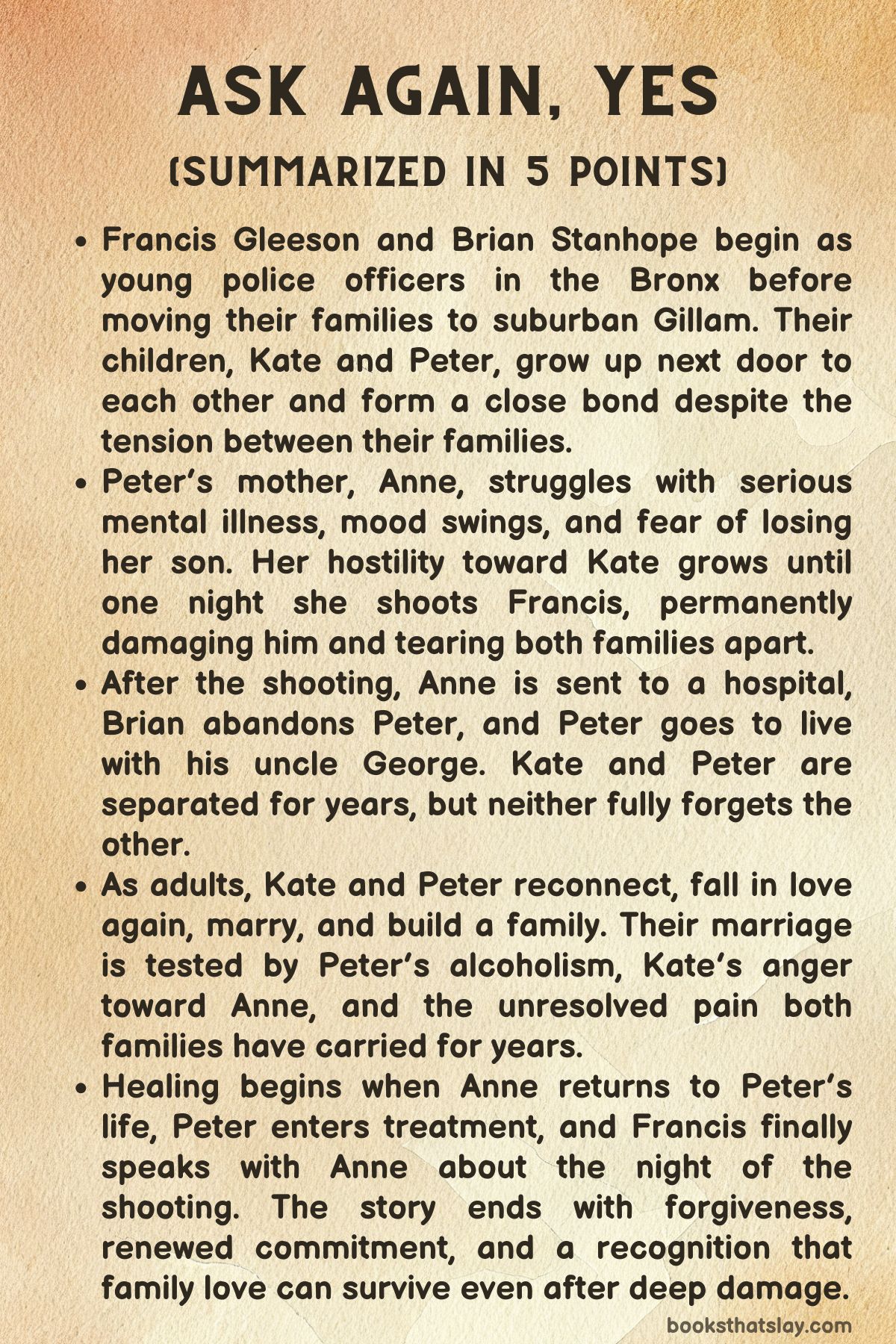
Characters
Kate Gleeson
Kate Gleeson is one of the emotional centers of Ask Again, Yes, and her character is shaped by love, loyalty, anger, and a strong need to understand what has happened to her family. As a child, Kate is open, affectionate, and deeply attached to Peter.
Their friendship gives both children a private world outside the confusion of their homes. After Anne shoots Francis, Kate’s innocence is damaged, but she does not simply become bitter.
She carries grief, confusion, and longing at the same time. Her inability to forget Peter shows how deeply her childhood bond with him has marked her.
Even when her family tells her to let him go, she continues to feel that their connection was real and unfinished. As an adult, Kate becomes practical and disciplined, choosing forensic science and building a career around evidence, facts, and careful analysis.
This fits her personality because she wants clear answers in a life shaped by emotional disorder. Yet the book shows that not everything can be solved through facts.
Her marriage to Peter tests her patience and strength, especially when his drinking threatens their family. Kate is not endlessly forgiving; she is angry at Anne, frightened by Peter’s addiction, and aware of the damage done to her father.
Still, she is also brave enough to reach out to Anne when she believes it may help Peter. Her growth lies in learning that love is not the same as denial.
She chooses Peter again not because the past has disappeared, but because she understands it more fully and still sees a future with him.
Peter Stanhope
Peter Stanhope is a deeply wounded character whose life is shaped by abandonment, fear, and a painful sense of responsibility. As a boy, he grows up in a home where his mother’s illness controls the atmosphere and his father fails to protect him.
Peter learns early to manage Anne’s moods, to keep quiet, and to feel responsible for her survival. His love for Kate offers him safety and normalcy, but it also becomes the thing Anne fears most.
After the shooting, Peter loses nearly everything: his home, his friendship with Kate, his father’s presence, and any simple idea of family. His loyalty to Anne is especially complex.
He continues visiting her even after she has harmed the Gleesons, not because he excuses her actions, but because he cannot fully detach himself from being her son. His later alcoholism is rooted in this unresolved pain.
Peter wants an ordinary life, yet once he has it, he feels trapped by the very stability he once desired. His drinking becomes a way to avoid memory, disappointment, and emotional responsibility.
His career as a police officer also reflects his need to prove that his parents’ history does not define him, though the institution reads his past as part of who he is. Peter’s recovery begins when he accepts that the past lives inside him whether he acknowledges it or not.
His move into teaching history is meaningful because it allows him to turn memory into understanding. By the end, Peter is not magically healed, but he becomes more honest, more present, and more capable of choosing family without hiding from pain.
Francis Gleeson
Francis Gleeson is defined by discipline, pride, endurance, and a hard belief in personal responsibility. At the beginning of the novel, he is a young immigrant trying to build a safe and respectable life.
His decision to move Lena to Gillam shows his desire for order and protection, especially after seeing violence in the Bronx. Francis wants distance from danger, but the irony of his life is that violence follows him into the quiet suburb he chose as a refuge.
After Anne shoots him, Francis becomes physically and emotionally altered. The loss of his eye and the disfigurement of his face damage not only his body but also his sense of masculinity and dignity.
He becomes dependent on Lena’s care, yet he resents the helplessness that care represents. His affair with Joan reveals his weakness and his longing to feel powerful, attractive, and separate from the injured man he has become.
This betrayal makes him morally flawed, not merely a victim. Still, Francis is not frozen in anger forever.
His later meeting with Anne is one of the book’s most important acts of emotional maturity. He recognizes that hatred has exhausted him and that Anne herself is no longer the monstrous figure he carried in his mind.
His forgiveness is not simple pardon; it is a release from the need to keep reliving the wound. Francis’s character shows how trauma can harden a person, but also how age, loss, and reflection can make room for mercy.
Lena Gleeson
Lena Gleeson is a character of quiet strength, domestic endurance, and painful emotional restraint. Early in the story, she gives up her city life and career after moving to Gillam and becoming a mother.
Her life becomes centered on her family, and she often tries to create warmth and connection where others resist it. Her attempts to befriend Anne show Lena’s instinct toward sympathy, especially because she understands that Anne has suffered.
Yet Lena also has limits, and when Kate becomes involved with Peter, her maternal protectiveness sharpens. After Francis is shot, Lena becomes the practical force holding the family together.
She nurses him, supports her daughters, and later takes work when money becomes tight. Her suffering is not dramatic in an outward sense, but it is constant.
She loses the marriage she once had and becomes more caretaker than wife. Francis’s affair wounds her deeply because it confirms that her sacrifices have not been fully honored.
Her response to him is one of the clearest moral moments in the novel: she tells him that she would never have done the same to him. Lena’s character represents the invisible labor that keeps damaged families functioning.
She is not flawless; she can be controlling and fearful, especially with Kate. But her fear comes from experience.
She has seen how one person’s instability can destroy a family’s peace, and she does not want her daughter to repeat a life of caretaking and pain.
Anne Stanhope
Anne Stanhope is one of the most difficult and tragic figures in the book. She commits the act that changes everyone’s life, yet the story refuses to reduce her to that act alone.
Anne is introduced as distant, cold, and unpredictable, a woman who resists Lena’s friendship and often treats Peter with emotional cruelty. Her mental illness creates fear inside her household, and her hostility toward Kate becomes dangerous.
She believes Kate threatens her bond with Peter, and that fear grows into violence when she shoots Francis. At the same time, Anne’s past reveals layers of suffering that help explain her instability.
Her mother’s suicide, the sexual abuse she endured as a child, and the trauma of delivering a stillborn baby all leave marks on her mind and body. These experiences do not excuse her actions, but they show how untreated pain can become destructive.
Anne’s years in institutional care force her into a long confrontation with herself. She wonders whether her diagnoses fully explain her behavior or whether some part of her was simply cruel.
That honesty makes her later transformation believable. When she returns to Peter’s life, she does not demand forgiveness as a right.
She watches from a distance, accepts rejection, and eventually helps when Kate reaches out. Anne’s apology to Francis is powerful because it comes without self-defense.
Her character suggests that accountability and compassion can exist together, even after terrible harm.
Brian Stanhope
Brian Stanhope is a passive and morally evasive character whose failures shape much of the tragedy. As a young police officer, he appears charming and familiar, but there are early signs of irresponsibility, such as taking a beer after the robbery scene.
In family life, his greatest flaw is avoidance. He sees Anne’s instability but does not respond with the seriousness it requires.
He allows problems to disappear into silence, and this silence becomes dangerous. The most damning part of his character is his role on the night of the shooting: he sees Anne take the gun and does nothing to stop her, then lies afterward.
His failure is not the same as Anne’s violence, but it is a form of abandonment and cowardice. He abandons Peter physically when he leaves for South Carolina, but he has already abandoned him emotionally long before that.
Brian’s actions suggest a man who cannot bear responsibility, so he escapes it. Yet the final envelope complicates him slightly.
The photos and prayer card show that he carried memories of his family, including Anne and Peter, for decades. This does not redeem him fully, because private sentiment cannot undo public failure or parental neglect.
Still, it shows that Brian was not empty of feeling. He was a man who loved weakly, remembered silently, and failed when action was required.
George Stanhope
George Stanhope functions as one of the steadier moral presences in the novel. He takes Peter in after Brian leaves and gives him the closest thing to a stable home after the shooting.
George is practical, blunt, and sometimes limited in what he can express emotionally, but his care for Peter is real. He does not try to replace Peter’s parents, and he does not pretend that the family history is clean.
Instead, he gives Peter truths that others have hidden, including Brian’s role in the shooting and Anne’s history of suffering. His statement that adults do not necessarily know what they are doing better than children captures one of the story’s central ideas.
George understands weakness because he has seen it in his own family. His warning to Peter about alcohol also shows that he recognizes inherited patterns before Peter does.
George’s affection for Kate is important because it helps bridge the divide between the families. Although he initially cannot understand Peter’s relationship with the daughter of the man Anne shot, he eventually sees Kate as a real person rather than a symbol of disaster.
George’s character brings balance to the book. He cannot erase Peter’s pain, but he offers shelter, honesty, and a model of imperfect but dependable love.
Joan Kavanaugh
Joan Kavanaugh is a smaller character, but she plays an important role in exposing Francis’s loneliness and moral weakness. She enters the story as a woman connected to the Gleesons’ social world, and her affair with Francis grows out of his need to feel alive, desired, and separate from his damaged body.
To Francis, Joan temporarily represents escape from pain, dependency, and the humiliating feeling of being nursed by Lena. However, Joan is not simply a temptation figure.
She is also a reminder that adult choices have consequences beyond the private moment. When Lena is diagnosed with cancer, Francis’s affair becomes impossible to frame as comfort or need.
His encounter with Joan near the hospital leaves him ashamed because he sees the selfishness of what he has done. Joan’s presence reveals how suffering can make a person self-pitying rather than noble.
Francis has been terribly harmed, but his injury does not prevent him from harming Lena. Through Joan, the novel shows that betrayal often comes from weakness, not grand passion.
Her role is brief, but it helps deepen Francis and Lena’s marriage by forcing its hidden damage into the open.
Kate and Peter’s Children
Kate and Peter’s children are not developed as deeply as the adults, but they are important because they represent the future that the older generation almost destroyed. Their presence forces Peter, Kate, Anne, and Francis to reconsider what family means.
For Anne, the grandchildren offer a chance to participate in family life without controlling it. She cannot undo what she did as a mother, but she can become gentle and useful as a grandmother.
For Kate, the children raise the stakes of Peter’s alcoholism. She may tolerate pain for herself, but she cannot allow instability to consume their home the way it consumed Peter’s childhood.
For Peter, the children make recovery urgent. He must decide whether he will repeat Brian’s abandonment or become a father who stays.
The children also soften Francis’s and Anne’s connection, because both are brought into the same family circle through them. They symbolize continuity, but not in a sentimental way.
Their safety depends on whether the adults can finally stop passing harm forward.
Themes
Trauma and Its Long Afterlife
Trauma in Ask Again, Yes does not end when the violent event is over. It continues through silence, habits, fear, marriage, parenting, and memory.
Francis’s shooting is the most visible wound, but the novel shows that many injuries came before it. Anne’s childhood abuse, her mother’s suicide, and the stillbirth of her first child all shape her mental state long before she raises the gun.
Peter grows up inside that damage and learns to measure the emotional temperature of a room before he learns how to understand himself. Kate is also shaped by the shooting, even though she is not physically harmed.
She loses Peter, loses the safety of childhood, and watches her family reorganize itself around Francis’s injury. The novel treats trauma as something that can be inherited through behavior.
Parents do not need to explain their pain for children to absorb it. Peter’s drinking later becomes one form of that inheritance, while Kate’s guarded strength becomes another.
Healing begins only when characters stop pretending the past is sealed away. Francis and Anne’s conversation matters because it gives language to what everyone avoided.
The book suggests that pain cannot be erased, but it can be faced honestly enough to reduce its power over the next generation.
Love as Choice, Not Escape
Love in the novel is not presented as a simple cure for suffering. Kate and Peter love each other deeply, but their love does not automatically repair their families, erase Anne’s violence, or stop Peter’s alcoholism.
In fact, their relationship often forces buried problems into the open. As children, their bond gives them comfort and freedom, but it also triggers Anne’s fear of losing Peter.
As adults, their marriage becomes a place where unresolved history returns. Kate wants to believe that choosing Peter means choosing the boy she once knew, yet she must also face the man he becomes: wounded, evasive, and addicted.
Peter wants ordinary family life, but he struggles under its demands because he has never learned how to live safely inside stability. The strength of their love lies not in perfection but in repeated choice.
Kate chooses to seek help rather than abandon him immediately. Peter chooses treatment and later a new career.
Their anniversary conversation is meaningful because Kate’s “yes” is not innocent anymore. It is informed by pain, knowledge, and disappointment.
The novel treats lasting love as an active decision made with open eyes. It asks whether two people can know the worst parts of each other’s histories and still build a life that is honest, responsible, and alive.
Silence, Secrecy, and the Cost of Avoidance
Many of the book’s tragedies grow worse because characters refuse to speak plainly. Brian hides Anne’s instability, lies about the gun, and then leaves rather than face the damage he helped create.
The police warning after Anne is found with the revolver becomes another buried moment, a chance to intervene that is allowed to vanish. The Gleesons also live with silence after Francis is shot.
His injury, Kate’s grief, Lena’s exhaustion, and the emotional distance inside the family are all present, but rarely discussed directly. This avoidance does not protect anyone.
It leaves Kate confused, Peter isolated, Lena resentful, and Francis trapped inside shame. Silence also shapes Peter’s adult life.
He does not fully speak about his unhappiness, so it comes out through drinking, absence, and anger. The novel shows that secrecy often begins as a form of protection.
Parents think they are sparing children, spouses think they are avoiding conflict, and damaged people think they are surviving by staying quiet. But the hidden truth continues to act on everyone.
Real change begins only when buried facts are named: Brian’s responsibility, Anne’s past, Francis’s betrayal, Peter’s addiction, Kate’s fear. Speech does not solve everything, but it gives the characters a chance to stop living under the control of what has been hidden.
Forgiveness, Accountability, and Starting Over
Forgiveness in the story is never easy, quick, or free of consequences. Anne’s apology to Francis does not undo the shooting, and Francis’s willingness to speak with her does not erase years of pain.
What makes the moment powerful is that both characters understand the limits of apology. Anne does not demand absolution, and Francis does not pretend the harm was small.
Their exchange allows both of them to recognize the confused human reality of that night without denying the damage it caused. Peter’s recovery follows a similar pattern.
He cannot simply declare himself changed; he must leave the police force, enter treatment, face relapse, and rebuild his daily life through different choices. Kate’s forgiveness of Peter is also conditional in a healthy way.
She loves him, but she makes clear that his drinking cannot continue to endanger their family. The book’s idea of starting over is therefore grounded in responsibility.
A new beginning is not a clean break from the past, but a different relationship to it. Anne becomes a grandmother, Peter becomes a teacher, Francis releases some of his hatred, and Kate chooses marriage with fuller knowledge.
None of them returns to innocence. Instead, they move forward with memory, regret, and a stronger understanding of what love requires.