Assassin’s Apprentice Summary, Characters and Themes
Assassin’s Apprentice by Robin Hobb is the opening novel in the Farseer story, following FitzChivalry Farseer, a royal child born outside marriage who is brought to Buckkeep and shaped by the needs of a dangerous court. Told by Fitz as an older man looking back, the novel combines political tension, personal loneliness, magic, and moral burden.
Fitz is trained to serve the throne in secret, yet he also longs for love, belonging, and a life of his own. The story is as much about survival and identity as it is about loyalty, power, and sacrifice.
Summary
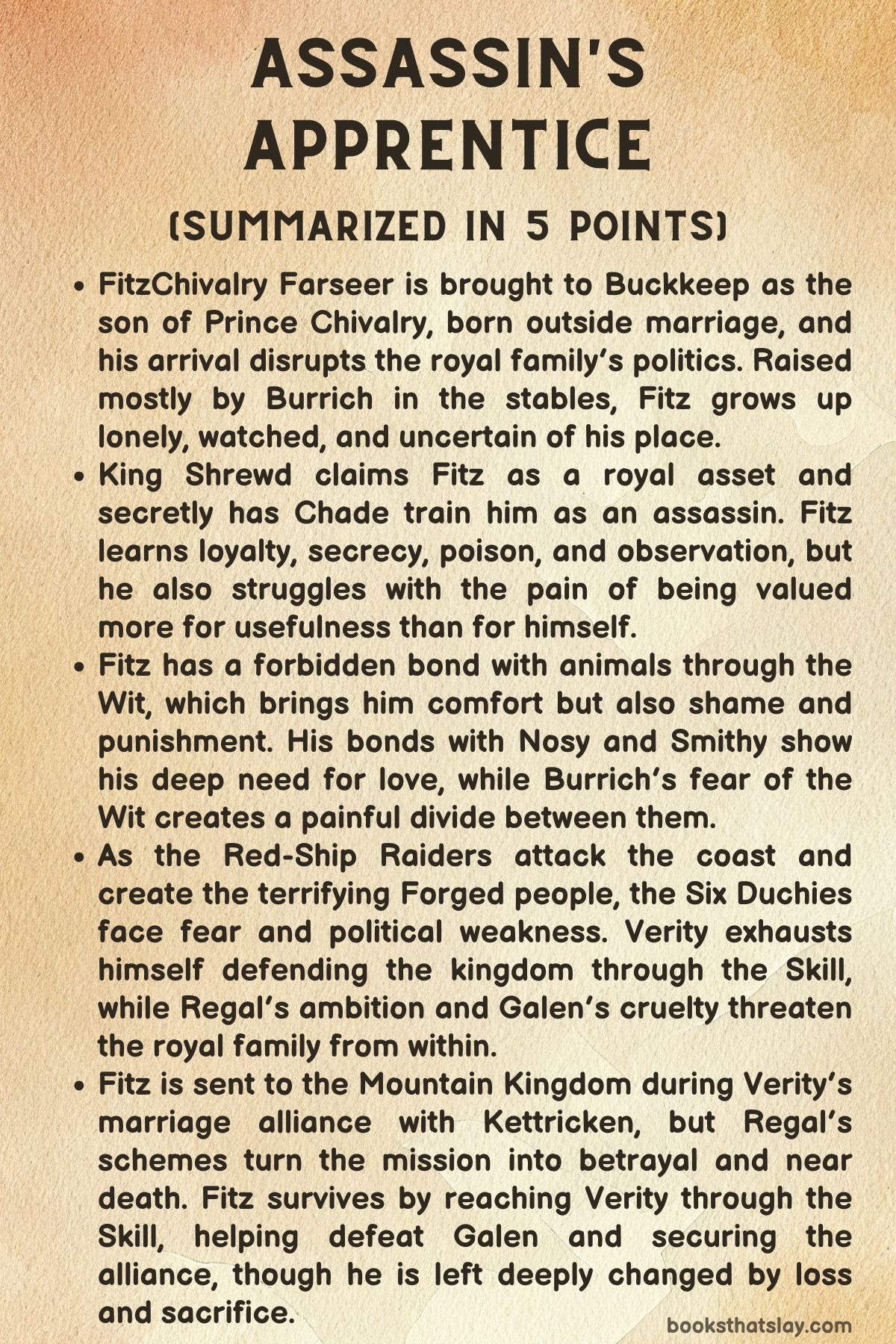
Assassin’s Apprentice follows FitzChivalry Farseer, the son of Prince Chivalry and a woman outside the royal marriage. When Fitz is six years old, his maternal grandfather brings him to the royal keep and leaves him there, refusing to care for him any longer.
Fitz is handed to Burrich, Prince Chivalry’s loyal stablemaster, who takes responsibility for him. Fitz is given shelter in the stables rather than the palace, and his earliest comfort comes from animals, especially a hound named Nosy.
Through Nosy, Fitz discovers the Wit, a forbidden mental bond with animals that comes naturally to him but is viewed with fear and disgust by many people.
Fitz’s arrival creates political trouble. Prince Chivalry has no lawful child, so Fitz’s existence threatens the smooth order of succession.
Chivalry abdicates and removes himself from court, leaving Fitz behind as a living reminder of scandal and lost possibility. King Shrewd, Chivalry’s father, understands that Fitz may become a danger if ignored.
Rather than cast him out, Shrewd claims him as a royal asset. Fitz is not treated as a prince, but he is also not allowed to be ordinary.
From the beginning, his life belongs to the throne.
Burrich becomes Fitz’s guardian, teacher, and harsh protector. He teaches Fitz stable work, discipline, riding, and the habits expected of someone linked to royalty.
Yet Burrich also fears the Wit. When he discovers Fitz’s bond with Nosy, he separates them.
Fitz believes Nosy has been killed, and this loss wounds him deeply. Burrich thinks he is saving Fitz from something shameful and dangerous, but Fitz experiences it as betrayal.
Their relationship remains marked by love, anger, misunderstanding, and silence.
At Buckkeep, Fitz is lonely. The royal household does not know what to do with him.
Queen Desire and Prince Regal resent him, while Prince Verity treats him with kindness. Fitz finds some freedom in Buckkeep Town, where he befriends Molly, a candlemaker’s daughter.
Molly is tough, practical, and often burdened by her father’s drinking and violence. Her friendship gives Fitz a connection to ordinary life, work, and affection beyond the cold rules of the keep.
King Shrewd eventually gives Fitz a secret purpose. Through Chade Fallstar, a scarred old man who lives hidden in a tower, Fitz begins training as an assassin.
Chade teaches him stealth, observation, patience, poisons, secrets, and the ways of political influence. Fitz is still a child, but he learns that the King intends to use him as a weapon.
Chade is demanding but also affectionate, becoming one of the few people who sees Fitz’s intelligence and loneliness. Fitz accepts the training partly because it gives him a place to belong, and partly because refusal would leave him vulnerable.
As Fitz grows older, he is pulled between several identities. Burrich wants him to honor Chivalry’s blood and act with dignity.
Chade teaches him to be unseen and obedient to the King. Patience, Chivalry’s widow, later arrives and insists that Fitz receive a better education.
She is eccentric, scattered, and socially awkward, but she also grieves the child she was never allowed to raise. Her affection unsettles Fitz, who is unused to being wanted simply because of who he is.
Through her, he receives gentler lessons in art, music, manners, and curiosity.
The kingdom itself begins to face a terrible threat from the Red-Ship Raiders. These Outislander enemies attack coastal towns, capture people, and return them changed.
The returned victims, called Forged, seem emptied of empathy and human connection. They can speak and move, but they no longer care for others, for memory, or even for their own dignity.
Their presence spreads horror through the Six Duchies, because no one knows how to heal them. The attacks expose weakness in the kingdom’s defenses and place heavy pressure on Prince Verity, who must respond as heir after Chivalry’s abdication and death.
Fitz is sent with Verity to investigate Lord Kelvar, a duke who has failed to defend his coast properly. Fitz is meant to observe and decide whether assassination is needed.
During the journey, Chade disguises himself as Lady Thyme, a foul-tempered noblewoman, and tests Fitz’s judgment. Fitz learns that Kelvar is not a traitor so much as a vain, aging man distracted by his young wife, Lady Grace.
Rather than kill him, Fitz influences Grace into encouraging her husband to staff the watchtowers. This shows Fitz’s instinct for solving problems without needless death, even though he has been trained for killing.
The horror of Forge changes the tone of Fitz’s world. He and Chade witness the returned victims firsthand, and Fitz senses the absence inside them.
The kingdom begins to lose confidence as raids continue and the Forged spread fear across the land. King Shrewd hesitates, Verity exhausts himself trying to protect the coast through the Skill, and Regal remains more concerned with ambition than duty.
Fitz sees that the royal family’s failure to act decisively damages the people’s hope.
Patience forces another change in Fitz’s life by insisting that he be trained in the Skill, the royal magic of mind-to-mind communication and influence. Fitz joins a group of royal students under Galen, the Skillmaster.
Galen is cruel, proud, and deeply hostile to Fitz because of his connection to Chivalry. His training is based on deprivation, humiliation, and fear.
He encourages the students to think of themselves as superior while making them dependent on his approval. Fitz suffers intensely under him and begins to believe the hateful ideas Galen forces into his mind.
Fitz’s bond with a puppy named Smithy becomes his secret comfort. Patience gives him the dog, and Fitz quickly loves him.
Smithy’s devotion helps Fitz survive Galen’s mental and physical abuse. When Galen attacks Fitz through the Skill and leaves him broken, Fitz nearly gives up on living, but Smithy’s love pulls him back.
Burrich later confronts Galen at the Witness Stones and beats him, forcing him to admit wrongdoing. Even so, Fitz’s Skill training is permanently damaged.
He has power, but fear and trauma make him guarded.
Galen’s final test sends the students away to find their way back using the Skill. Fitz is placed near Forge, without the same advantages given to the others.
During the trial, he senses Smithy being attacked at Buckkeep. The attacker is Cob, a stable worker connected to Regal’s schemes.
Fitz abandons the test and runs home, fighting through Forged people on the way. Smithy dies, and Fitz returns devastated.
Burrich, angry that Fitz used the Wit to experience Smithy’s death, rejects him again. Fitz falls into deep isolation, losing Burrich, drifting from Molly, and feeling abandoned by Chade and the Fool.
Chade eventually pulls Fitz back into service. Fitz begins bringing Verity teas and discovers that Verity is using the Skill constantly to defend the kingdom from raiders.
Verity is exhausted and slowly being consumed by his duty. He also recognizes that Fitz has real Skill ability and that Galen damaged him deliberately.
Verity gives Fitz something precious: his full name, FitzChivalry Farseer. This naming helps Fitz understand that he is not merely a shameful mistake or a tool.
He belongs to the royal bloodline, though his position remains dangerous.
The political crisis deepens when Verity is to marry Princess Kettricken of the Mountain Kingdom. Verity cannot leave Buckkeep because of the raids, so Regal leads the wedding party to Kettricken’s homeland.
King Shrewd gives Fitz a secret order: kill Kettricken’s older brother, Prince Rurisk, so Kettricken will inherit and strengthen the alliance. Fitz travels to the Mountain Kingdom burdened by this mission.
Before he leaves, Patience gives him an earring once connected to Chivalry, and the Fool warns him that he may be poisoned.
In Jhaampe, Fitz discovers that the Mountain people have a very different idea of royalty. Their rulers serve their people directly, even carrying visitors as an act of welcome.
Fitz meets Kettricken and Rurisk and finds them honorable. Rurisk is not sickly, as Fitz had been told, and Kettricken already knows Fitz may have come to kill her brother because Regal drunkenly revealed it.
Kettricken, frightened and trying to protect Rurisk, poisons Fitz first but regrets it when she learns more. Rurisk saves him, and Fitz realizes that killing Rurisk would destroy the alliance rather than protect it.
Regal then reveals his deeper treachery. He pressures Fitz to murder Rurisk, while hiding his own plan.
Fitz tries to expose the truth, but Regal uses poison, deception, and witnesses to frame him. Rurisk dies, Cob is killed by Fitz in the struggle, and Fitz is accused of assassination.
Regal beats and imprisons him, intending to have him executed or killed quietly. Through dreams and broken Skill contact, Fitz learns that Galen has been working with Regal and that their scheme reaches back to Buckkeep.
Burrich helps Fitz escape after Nosy, the hound Fitz once thought dead, frees him. Fitz learns that Burrich never killed Nosy; he had sent him away.
This truth reveals how much pain between them came from misunderstanding. Burrich still fears the Wit, but his loyalty to Fitz wins out when Fitz insists he must save Verity.
The climax comes when Regal attempts to leave Fitz to drown in a hot spring. As Fitz is dying, he reaches Verity through the Skill and warns him that Galen is attacking his mind.
Fitz gives Verity his strength, allowing Verity to defeat Galen. Verity kills Galen through the Skill and survives.
He also reaches Kettricken, forming a true bond with her and saving Fitz from death by returning life to him. Nosy pulls Fitz from the water but dies soon after.
In the aftermath, Fitz and Burrich recover from their injuries. Kettricken mourns Rurisk before going to Buckkeep to marry Verity.
Regal escapes serious punishment because the kingdom cannot afford open scandal, so the blame is shifted to servants. August, damaged by the force of Verity’s Skill, loses his ability.
The alliance with the Mountain Kingdom strengthens the Six Duchies, and new warships help the coastal defense. Fitz survives, but survival costs him innocence, trust, animals he loved, and any simple hope for an ordinary life.
By the end of Assassin’s Apprentice, Fitz has become what the court made him: a royal bastard, assassin, Skill-user, Wit-bonded boy, and reluctant servant of the throne. Yet he is also more than a tool.
He has loyalty, judgment, compassion, and a stubborn need to protect those he loves. His life remains painful and uncertain, but he has begun to understand his own worth, even in a world determined to use him.
Characters
FitzChivalry Farseer
The characters in Assassin’s Apprentice are shaped by questions of blood, duty, loyalty, and emotional survival, and FitzChivalry Farseer stands at the center of all of them. Fitz is introduced as a child who has no control over the meaning others attach to his existence.
To his mother’s family, he is a burden; to the Farseers, he is a political problem; to King Shrewd, he is a resource; to Burrich, he is both responsibility and painful reminder of Chivalry. His life begins with rejection, and much of his personality develops from the need to belong somewhere while being told, directly or indirectly, that he belongs nowhere.
He is sensitive, observant, and hungry for affection, but he learns early to hide his needs because vulnerability can be used against him. This makes him inwardly intense and outwardly cautious.
He often understands people better than they understand him, but he rarely believes that his own feelings deserve the same attention.
In Assassin’s Apprentice, Fitz’s growth is not a simple movement from weakness to strength. He becomes more capable, but he also becomes more wounded.
His training as an assassin gives him skills, purpose, and closeness with Chade, yet it also teaches him that his worth is tied to usefulness. His bond with animals through the Wit reveals his capacity for deep love and connection, but society’s hatred of that ability teaches him shame.
His Skill training under Galen leaves him damaged because Galen attacks not just his body but his sense of self. Fitz’s defining conflict is that he is constantly used by institutions while still trying to remain humane.
He kills, lies, spies, and obeys orders, yet he also resists needless cruelty, protects animals, cares for Verity, loves Molly, and wants to make choices that feel morally right. This tension makes him a deeply conflicted young protagonist: loyal to the throne, but not blind; trained as a weapon, but never fully emptied of conscience.
Burrich
Burrich is one of the most emotionally complicated figures in the book because his love is real, but his fear often damages the person he is trying to protect. As Chivalry’s loyal man, Burrich sees Fitz as both a duty left behind by his prince and a living link to the master he adored.
He raises Fitz with discipline, practical care, and fierce protectiveness, but he does not know how to offer tenderness without control. His worldview is built on order, loyalty, and restraint.
Anything that threatens those values frightens him, especially the Wit. Because Burrich secretly understands the Wit more than he admits, his hatred of it feels partly like self-denial.
He sees in Fitz a danger he has spent his own life trying to suppress.
Burrich’s greatest flaw is that he mistakes harshness for salvation. When he separates Fitz from Nosy and later rejects him after Smithy’s death, he believes he is defending Fitz’s humanity, but he instead deepens Fitz’s loneliness and shame.
Still, Burrich is not cruel in the way Galen or Regal is cruel. He acts from fear, grief, and a rigid moral code.
His care is visible in the way he trains Fitz, tends him when he is ill, defends him from Galen, and helps him in the Mountain Kingdom despite their fractured relationship. Burrich’s tragedy is that he loves Fitz like family but cannot easily say so, and his inability to accept all parts of Fitz makes that love painful.
He represents the damage that can come from protection when it is mixed with shame.
Chade Fallstar
Chade Fallstar is Fitz’s secret teacher, mentor, and one of the first people to make him feel chosen rather than merely tolerated. Hidden in the walls of Buckkeep, Chade exists outside ordinary court life, and that hidden existence mirrors the role he gives Fitz.
He teaches Fitz the work of poison, stealth, observation, and manipulation, turning the boy into the King’s secret servant. Yet Chade is not simply a cold instructor.
He is witty, lonely, affectionate, and deeply aware of how dangerous Fitz’s position is. He gives Fitz attention, food, conversation, and intellectual challenge, all of which Fitz desperately needs.
Chade’s moral position is uneasy. He knows that the work he teaches Fitz is ugly, and he sometimes warns him not to dress assassination in comforting language.
At the same time, he still trains a child for that work because he believes service to the kingdom demands it. He cares about Fitz but also participates in using him.
This contradiction gives Chade much of his depth. He is more humane than Shrewd but still loyal to Shrewd’s system.
He offers Fitz love, but the love comes inside a structure of obedience and secrecy. His relationship with Fitz is therefore both nurturing and compromising.
He helps Fitz survive, but he also helps shape the life that traps him.
King Shrewd
King Shrewd is a ruler who lives up to his name through calculation, patience, and political clarity. He understands power more deeply than most of the people around him, and he quickly sees that Fitz cannot be ignored.
A royal child born outside marriage can become a threat if left uncontrolled, so Shrewd claims him. His decision to mark Fitz as the King’s possession is both protection and ownership.
Fitz is safer because Shrewd values him, but he is also less free because that value is practical rather than personal.
Shrewd’s defining trait is his willingness to sacrifice individuals for the kingdom. He is not careless or foolish; he knows the cost of his choices.
That makes him more unsettling, not less. He can be patient with Fitz, even amused by him, but he never stops seeing him as a tool.
His order to send Fitz to the Mountain Kingdom with an assassination mission shows how completely he places political survival above personal innocence. Shrewd is not a simple villain because he genuinely wants to preserve the Six Duchies, and many of his fears are justified.
However, his rule reveals the moral danger of statecraft when human beings become pieces on a board. Through him, the book asks whether a kingdom can be protected without consuming the lives of those who serve it.
Prince Verity
Prince Verity is the moral and political opposite of Regal in many ways. He is dutiful, steady, honest, and deeply committed to the kingdom’s protection.
After Chivalry’s abdication, Verity carries responsibilities he did not seek, and the burden wears him down. His use of the Skill to defend the coast shows both his strength and his self-destructive sense of duty.
He gives so much of himself to the Six Duchies that his body and spirit begin to fail. Unlike Regal, Verity does not treat kingship as performance or privilege.
He understands it as service.
Verity’s relationship with Fitz is one of the most important sources of affirmation in the book. He treats Fitz with a direct kindness that few others offer, and later he recognizes the damage Galen has done to him.
By naming him FitzChivalry Farseer, Verity gives Fitz something he has long been denied: acknowledgment. Yet Verity is also capable of using Fitz, as seen when he draws strength from him through the Skill.
The difference is that Verity regrets harm when he understands it. He is not flawless, but he has a conscience that remains active under pressure.
His greatness lies in his willingness to bear pain for others, though the book also shows that such sacrifice can become dangerous when no one protects the person making it.
Prince Regal
Regal is ambitious, vain, resentful, and dangerous because he combines entitlement with insecurity. As the son of Queen Desire, he has been raised to believe he deserves a place above Verity, despite the rules of succession.
He resents Fitz not because Fitz is truly powerful at first, but because Fitz represents a threat to the clean royal image Regal wants to control. Regal’s cruelty is often disguised as elegance, rank, or political necessity, but underneath it is a deep fear of being denied what he thinks he deserves.
Regal’s villainy grows more serious as the story progresses. He is not merely rude or jealous; he is willing to endanger alliances, frame Fitz, manipulate Kettricken, and cooperate with Galen’s schemes to secure his own future.
His actions in the Mountain Kingdom show his lack of true political wisdom. He can plot, but he cannot understand honor, loyalty, or the deeper bonds that hold kingdoms together.
He treats people as disposable while imagining himself fit to rule them. Regal’s danger comes from the fact that he is close enough to power to do real damage and selfish enough to confuse personal advancement with national interest.
Lady Patience
Lady Patience is eccentric, impulsive, intelligent, and emotionally exposed. As Chivalry’s widow, she enters Fitz’s life with a strange mixture of grief, awkwardness, and fierce attachment.
She does not know how to mother him in any conventional way, and her lessons are often chaotic, but she gives Fitz something rare: the sense that he might have been wanted. Her pain comes from knowing that she was denied the chance to raise him and from seeing Chivalry’s likeness in him.
She is not polished or politically smooth, but her emotional honesty has power.
Patience matters because she challenges the way others define Fitz. To the court, he is a royal problem.
To Shrewd, he is an asset. To Chade, he is an apprentice.
To Burrich, he is a responsibility. To Patience, he is Chivalry’s son and a boy who deserves care, education, and dignity.
Her insistence that he receive broader training changes his place in the keep. She also gives him the earring that connects him more deeply to Chivalry and Burrich’s past.
Patience’s love is imperfect and sometimes overwhelming, but it is one of the few forms of affection in the book that is not based mainly on usefulness.
Molly Chandler
Molly Chandler represents the life Fitz might have had if he were not bound to the Farseers. She belongs to Buckkeep Town rather than the royal court, and her world is built around work, survival, trade, and daily hardship.
As a child, she is bold and independent, shaped by poverty and by her father’s violence. She learns to defend herself, earn money, and move through the town with practical intelligence.
Fitz admires her because she knows how to live in a way he does not. She has freedom of movement, a clear sense of work, and an identity not defined by royal blood.
Molly’s importance is emotional as well as social. She gives Fitz friendship before he has status, and later she becomes the focus of his romantic longing.
However, Fitz’s secrecy and divided loyalties prevent him from being honest with her. He wants closeness but cannot offer openness.
Molly is not simply a love interest; she is a measure of what Fitz loses as he becomes more deeply tied to the throne. Her frustration with him is understandable because he often disappears, withholds, or retreats when feeling becomes too direct.
Through Molly, the story shows that love cannot thrive on longing alone. It needs truth, presence, and courage, all of which Fitz struggles to give.
The Fool
The Fool is mysterious, sharp, unsettling, and quietly compassionate. At first, Fitz misunderstands him, seeing him as strange and perhaps simple, but the Fool soon proves far more aware than he appears.
His speech can seem cryptic, but it often carries warning or insight. He sees possible futures without always understanding them fully, and he recognizes Fitz as important to those possibilities.
This makes him one of the few characters who values Fitz not for rank or immediate usefulness, but for what his existence might make possible.
The Fool’s loneliness is central to his character. His strange body, uncertain origins, unclear gender, and prophetic awareness set him apart from others at court.
His room, filled with color and private creations, reveals an inner life Fitz has not imagined. The Fool can be mocking, but his mockery often protects seriousness.
He feeds Smithy when Fitz cannot, warns Fitz before danger, urges him to return to Skill training, and reaches toward him in moments of despair. His affection is subtle but real.
He is both witness and guide, someone who stands outside normal power structures while understanding their consequences better than many who live inside them.
Galen
Galen is one of the book’s most destructive characters because he attacks identity rather than only body. As Skillmaster, he is supposed to train young people in a royal magic based on mental contact, trust, and discipline.
Instead, he builds his teaching around humiliation, deprivation, favoritism, and fear. He uses cruelty to create dependence, convincing students that his approval is the only proof of worth.
His treatment of Fitz is especially vicious because Fitz reminds him of Chivalry, whom Galen both loved and resented.
Galen’s damage to Fitz is psychological and spiritual. He teaches Fitz to hate himself, and that lesson remains even after the physical wounds begin to heal.
His abuse of the Skill also corrupts the very gift he is meant to pass on. Rather than forming a healthy coterie, he produces students who are closed, proud, frightened, and poorly bonded.
Galen’s alliance with Regal later reveals that his cruelty is tied to political treachery as well as personal bitterness. He represents authority without wisdom: a teacher who cannot nurture, a servant of the crown who betrays it, and a man who uses pain to cover his own emptiness.
Kettricken
Kettricken begins as a figure Fitz is ordered to use politically, but she quickly emerges as one of the most honorable characters in the book. Raised in the Mountain Kingdom’s tradition of sacrifice and service, she understands royalty very differently from many in Buckkeep.
To her, a ruler exists for the people, not above them. This belief gives her dignity and strength, but it also makes her vulnerable to manipulation because she takes duty seriously enough to suffer for it.
Her attempted poisoning of Fitz is not an act of malice but of fear and political desperation. She believes she is protecting her brother and her people from an assassin.
When she learns more, her grief and regret show that she is guided by conscience. Her willingness to continue with the marriage after Rurisk’s death reflects not coldness but discipline.
Kettricken’s strength lies in her ability to place public duty above private pain without losing her moral center. She becomes a powerful contrast to Regal: both are royal, but only one understands service.
Prince Rurisk
Prince Rurisk is important because he overturns the false story Fitz has been given. Fitz expects a sickly obstacle whose death might serve politics, but Rurisk proves healthy, thoughtful, and honorable.
He knew Chivalry and treats Fitz with a warmth that complicates the assassination order. His kindness forces Fitz to face the moral ugliness of his mission.
Rurisk is not an abstract target; he is a person, a brother, a ruler, and a potential ally.
Rurisk’s death is tragic because it removes one of the clearest paths toward peace and trust. He understands that killing him would destabilize the alliance, and he tries to reason through the political situation with Fitz.
His ability to bond with Nosy also links him emotionally to Fitz’s childhood, deepening the sense of loss when he dies. Rurisk’s role is brief but meaningful.
He shows the kind of nobility that is based on steadiness and care rather than display, and his murder exposes the full recklessness of Regal’s ambition.
Prince Chivalry
Chivalry is absent for nearly the entire book, but his presence shapes almost everyone. Fitz is defined as his son, Burrich is defined by loyalty to him, Patience is defined by love and loss of him, Galen is warped by his feelings toward him, and Verity lives partly in the shadow of the role Chivalry left behind.
Because Fitz never truly knows him, Chivalry becomes both father and myth. Others describe his honor, skill, kindness, and political strength, but Fitz experiences mostly the consequences of his choices.
Chivalry’s abdication is one of the book’s central unseen acts. It may be honorable in one sense, because he accepts responsibility for the scandal of Fitz’s birth, but it also leaves others to bear the cost.
Fitz grows up abandoned, Verity inherits a burden too soon, and the kingdom loses the heir many trusted. Chivalry is therefore a complicated figure: admired by many, loved deeply by Burrich and Patience, yet responsible for wounds that continue after his death.
His absence teaches Fitz that blood connection does not guarantee care, while his legacy gives Fitz both a name to live up to and a burden he did not choose.
Queen Desire
Queen Desire is mostly seen through the consequences of her influence. She is Regal’s mother and Shrewd’s second wife, and her ambition for Regal disrupts the proper line of inheritance.
She represents courtly self-interest at its most corrosive, shaping Regal into someone who believes desire can override duty. Her preference for her own son feeds the political instability that later threatens the kingdom from within.
Her death through self-administered intoxicants also suggests a life marked by appetite, dissatisfaction, and decay. Though she is not active for much of the story, her influence remains alive in Regal’s entitlement and in the court divisions that weaken the Farseers.
She functions as a reminder that private ambition inside a ruling family can become a public danger. Her legacy is not policy or wisdom, but resentment planted in the next generation.
August
August is a royal relative and Skill student whose role shows the weakness of Galen’s training. He has status and some ability, but he lacks the depth, judgment, and resilience needed for true greatness.
During the journey to the Mountain Kingdom, he acts with arrogance toward the local customs, revealing how easily court privilege can become blindness. He expects respect but does not always recognize dignity in others.
His collapse after contact with Verity’s strength shows how unprepared he truly is. Galen’s methods have not created strong, trusting, capable Skill-users; they have created people who can perform certain tasks but cannot bear the full weight of real power.
August is not malicious in the same way Regal is, but he is limited, proud, and shaped by a flawed system. His damage becomes another sign of the kingdom’s internal weakness.
Cob
Cob begins as a stable figure from Fitz’s early life, but he becomes important as a sign of how betrayal can come from familiar places. His connection to Regal’s schemes and his attack on Burrich and Smithy make him personally devastating to Fitz.
Cob’s actions strike at Fitz’s emotional home: the stables, Burrich, and the animals Fitz loves. This makes his betrayal feel intimate rather than purely political.
Cob’s death at Fitz’s hands marks another loss of innocence. Fitz kills him in a desperate moment, and although the action is tied to survival and justice, it further pushes Fitz into the role others have prepared for him.
Cob is not as fully developed as Regal or Galen, but his function is significant. He shows how corruption spreads through service networks and how power can recruit ordinary people into acts of cruelty.
Nosy
Nosy is more than a childhood pet; he is Fitz’s first true bond after abandonment. Through Nosy, Fitz discovers the Wit as love, companionship, and shared experience rather than as something shameful.
Nosy gives Fitz comfort before any human relationship at Buckkeep fully does. Losing him, or believing he has lost him, becomes one of Fitz’s earliest emotional wounds.
The later revelation that Nosy lived changes Fitz’s understanding of Burrich and of his own past. It does not erase the pain, but it shows that years of bitterness were built on a misunderstanding.
Nosy’s final loyalty in helping save Fitz gives his role a full emotional arc. He begins as Fitz’s first companion and ends as a protector whose love reaches across time.
His presence emphasizes that animal bonds in the book are not lesser connections; for Fitz, they are among the purest forms of love he receives.
Smithy
Smithy represents unconditional devotion at a time when Fitz is being made to feel worthless. Given to him by Patience, Smithy becomes a secret source of joy and emotional stability.
Fitz’s connection with him is dangerous because of the social hatred of the Wit, but it is also healing. Smithy sees Fitz not as a royal problem, assassin, or failed student, but as the center of his world.
Smithy’s role during Fitz’s lowest moment is especially important. When Fitz is close to death by suicide, Smithy’s love pulls him back.
This moment shows that connection can save a life when argument, duty, or shame cannot. Smithy’s later death is therefore crushing.
It takes from Fitz one of the few beings who loved him without condition. His loss deepens Fitz’s grief and widens the divide between Fitz and Burrich, but it also proves how powerful Fitz’s capacity for attachment remains despite everything done to him.
Lady Grace
Lady Grace first appears as a young noblewoman surrounded by finery, seemingly part of Lord Kelvar’s irresponsibility. Yet Fitz sees that her position is more complicated.
She is newly elevated, uncomfortable in her role, and eager to be admired by her people. Her jewels and display are not simply vanity; they reveal insecurity and poor guidance.
Fitz’s handling of her shows his gift for reading emotional needs and using persuasion instead of violence.
By saving her dog and then shaping her view of leadership through a false dream, Fitz redirects her desire for admiration into public responsibility. Lady Grace matters because she helps prove that political problems do not always require killing.
Sometimes they require understanding what a person wants and guiding that desire toward something useful. She also reflects one of Fitz’s strengths as an assassin-apprentice: his best work often comes not from death, but from insight.
Lord Kelvar
Lord Kelvar is a weak steward rather than a direct traitor. His failure to maintain coastal defenses puts people in danger, but the failure comes from vanity, aging pride, and distraction rather than open rebellion.
He wants to appear vigorous, desirable, and noble, especially before his young wife. This makes him politically dangerous because personal insecurity leads him to neglect public duty.
Kelvar’s character shows how bad leadership can be ordinary rather than monstrous. He does not need Regal’s ambition or Galen’s cruelty to harm the kingdom.
His self-absorption is enough. The situation at Neatbay also teaches Fitz an important lesson about power: a ruler’s private weaknesses can become public disasters.
Kelvar’s eventual correction through Lady Grace suggests that shame is not always the best tool for reform. Pride can sometimes be redirected into responsibility.
Themes
Identity, Naming, and the Search for Worth
Fitz’s struggle with identity begins before he can understand it. He is defined by the circumstances of his birth, and the name given to him marks him as outside the lawful royal line.
That label follows him everywhere, shaping how servants, nobles, enemies, and even caretakers treat him. The pain of this identity is not only social but deeply personal.
Fitz wants a name given in love, not one assigned by politics or shame. His refusal to choose a crest or name for himself shows that he does not merely want status; he wants recognition that feels human.
Verity’s later act of naming him FitzChivalry Farseer is therefore powerful because it gives him a place in the family that has used and hidden him. Naming in the story is tied to power, inheritance, and emotional legitimacy.
Royal names are supposed to shape destiny, yet Fitz’s life shows that identity is made through suffering, choice, memory, and relationships as much as blood. His journey is a long fight against the idea that being born outside marriage makes him lesser.
He is repeatedly treated as a tool, but he keeps proving that his worth is not limited to usefulness.
Loyalty, Duty, and the Cost of Service
Loyalty in the book is never simple because almost every major bond asks for sacrifice. Fitz is loyal to King Shrewd, Verity, Burrich, Chade, Patience, Molly, and the animals he loves, but these loyalties often conflict.
Serving the King means hiding the truth from people who care for him. Serving Verity means offering his own strength and risking his life.
Loving Molly would require honesty he cannot safely give. Obeying Burrich would mean denying the Wit, one of the deepest parts of himself.
The result is a life where duty does not make Fitz whole; it divides him. Assassin’s Apprentice presents service as noble but also dangerous when those in power take loyalty for granted.
Verity’s loyalty to the kingdom nearly destroys him because he gives too much and receives too little protection in return. Burrich’s loyalty to Chivalry shapes his care for Fitz, but it also traps him in old grief.
Chade’s loyalty to Shrewd makes him train a child for assassination even while loving him. The story respects loyalty, but it also questions systems that demand devotion without giving equal care back.
Power, Manipulation, and Moral Compromise
Power in the novel rarely appears as open force alone. It often works through secrecy, training, naming, education, poison, prophecy, and emotional pressure.
King Shrewd controls Fitz by claiming him. Chade trains him through hidden knowledge.
Galen breaks students by controlling approval and shame. Regal uses status, lies, and political confusion to cover treachery.
Even Fitz, though young, learns to manipulate others through observation and carefully chosen words. This makes the book’s view of power morally complex.
Not all manipulation is shown as equally evil. Fitz’s influence over Lady Grace prevents harm, while Regal’s schemes cause death and instability.
The difference lies in motive, consequence, and respect for human life. Still, the book never lets Fitz fully escape the discomfort of what he is being trained to do.
He may prefer mercy, but he is still taught poisons and assassination. He may serve a larger good, but he is still asked to kill people whose full stories he may not know.
Through Fitz, the story examines how easily moral compromise can become normal when wrapped in duty. It asks whether survival in a dangerous court requires corruption, and whether a person trained for hidden violence can keep a conscience alive.
Love, Isolation, and the Need for Connection
Fitz’s life is marked by isolation, but the book also shows that connection is what keeps him human. He is separated from his mother, abandoned by Chivalry, kept apart from ordinary children, and trained in secrecy.
Nearly every relationship available to him has a barrier. Burrich loves him but fears part of him.
Chade mentors him but makes him an assassin. Patience wants to care for him but does not know how to do it gently.
Molly offers warmth, but Fitz’s secrets prevent true closeness. The Fool understands him in strange ways, yet remains mysterious and distant.
Against this loneliness, Fitz’s bonds with animals become especially important. Nosy and Smithy love without politics, shame, or conditions.
That purity is why their loss hurts so much. The Wit is feared by others because it crosses boundaries between human and animal, but for Fitz it offers the acceptance he rarely receives from people.
The story shows that isolation is not only physical; it is the condition of being unseen or only partly accepted. Fitz survives because some bonds, however fragile or painful, reach him before despair can fully claim him.