Assassination Vacation Summary and Analysis
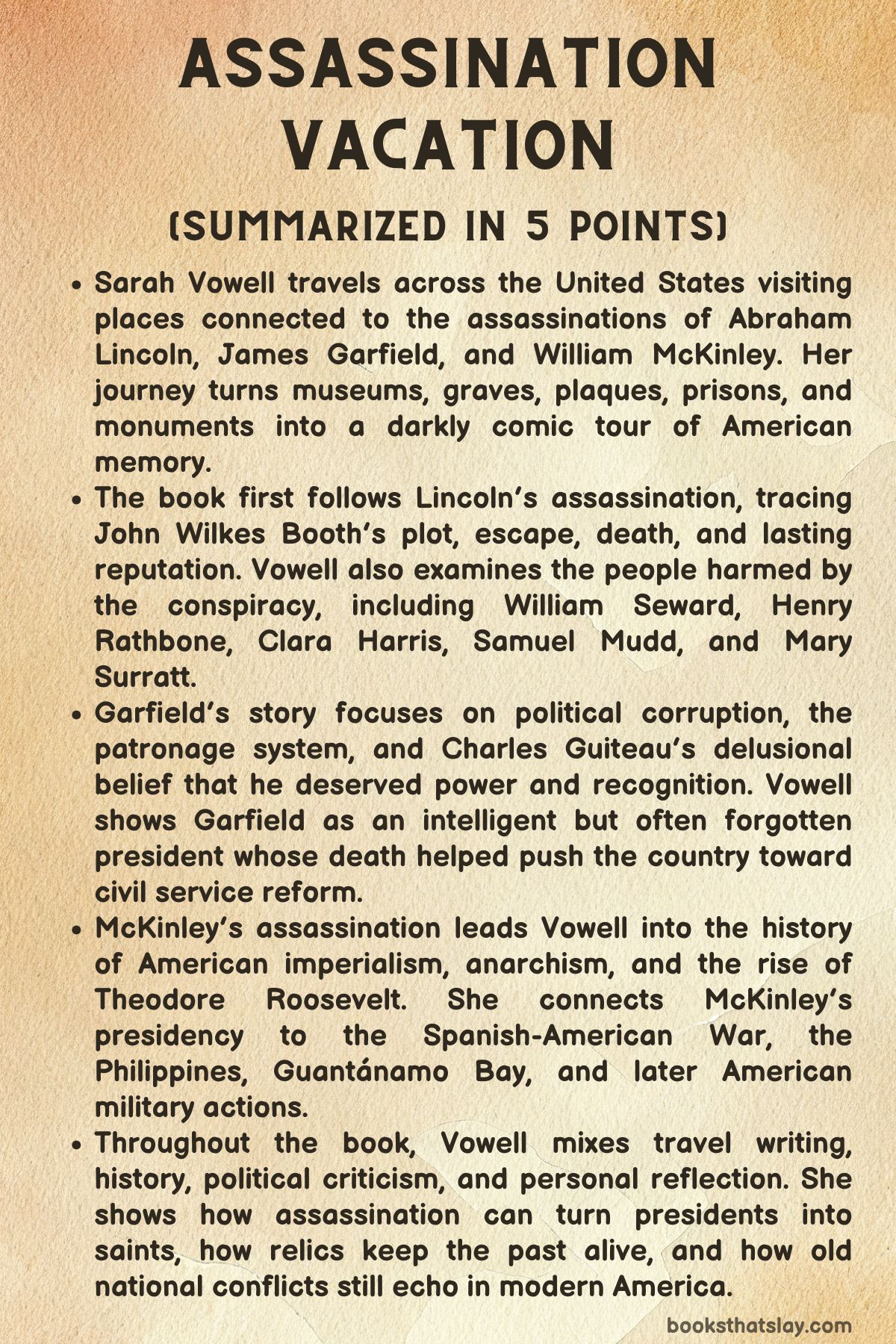
Assassination Vacation by Sarah Vowell is a strange, funny, and sharp travelogue about America’s history of presidential assassinations. Vowell visits museums, graves, monuments, homes, prisons, plaques, and forgotten corners tied to Abraham Lincoln, James Garfield, and William McKinley.
The book is not only about the murders themselves, but about memory: what the country chooses to honor, what it hides, and how violence can turn flawed leaders into national saints. Vowell mixes personal obsession, political criticism, historical research, and dark humor to show how the past remains alive in public spaces and private imagination.
Summary
Assassination Vacation begins with Sarah Vowell reflecting on her fascination with presidential assassinations. Her interest is sparked in part by Stephen Sondheim’s musical Assassins, which presents presidential killers as people driven by rage, disappointment, self-importance, and a warped sense of purpose.
Vowell admits that her own anger at President George W. Bush and the Iraq War makes her uneasy, because it helps her understand the emotional climate in which political hatred can become dangerous. She does not sympathize with assassins, but she is interested in the line between ordinary anger and violent self-importance.
She frames her travels as a kind of American pilgrimage. Instead of visiting saints’ relics, she visits relics of national trauma: bullets, bedsheets, skull fragments, plaques, execution sites, and monuments.
To her, these objects make American history feel physical and real. The Lincoln Memorial becomes almost sacred to her, though she also sees irony in the fact that Lincoln’s death helped create the saintly version of Lincoln that the memorial preserves.
Vowell first turns to Abraham Lincoln and John Wilkes Booth. She visits Ford’s Theatre, where Lincoln was shot while watching a comedy.
The theater has been restored to resemble the night of the assassination, and Vowell considers the bitter irony of seeing a musical about America’s founding in the same place where the Civil War’s greatest political murder occurred. Lincoln’s Second Inaugural Address, carved at the Lincoln Memorial, stands in contrast to Booth’s hatred.
Vowell wonders how Booth could murder a man capable of such moral clarity, while also noting that Lincoln faced constant death threats.
She follows the network of people and places tied to Booth’s plot. At the former site of Mary Surratt’s boardinghouse, now a Chinese restaurant, she recalls how Booth and his co-conspirators first planned to kidnap Lincoln and later shifted to assassination after the Confederacy’s defeat.
Booth wanted a coordinated attack that would also kill Vice President Andrew Johnson and Secretary of State William Seward. The attack on Johnson never happened, while Seward was badly stabbed but survived.
Vowell then traces the lives of people connected to that night. Henry Rathbone, who sat with Lincoln and tried to stop Booth, later descended into mental illness and murdered his wife, Clara Harris.
The tragedy of Lincoln’s assassination thus spreads beyond the president himself, damaging the people near him. Vowell also visits medical and historical sites where objects from Lincoln’s death remain preserved, including autopsy tools and the bullet that killed him.
Her travels continue along Booth’s escape route through Maryland and Virginia. She visits the Surratt House, the home of Dr. Samuel Mudd, and Fort Jefferson, where some of Booth’s co-conspirators were imprisoned.
Mudd treated Booth’s broken leg after the shooting, and his guilt has long been debated. Vowell believes Mudd likely knew more than his defenders admit, though she is moved by his descendants’ loyalty to him.
At Fort Jefferson, she reflects on harsh imprisonment and compares the site to modern detention practices during the War on Terror.
Booth, in Vowell’s account, saw himself as a heroic defender of the South. He admired John Brown’s dramatic violence, even though Brown fought against slavery and Booth supported it.
Booth imagined that his own act would win admiration, but instead he became a hated traitor. Vowell visits the site of Booth’s death and later his grave in Baltimore, while considering conspiracy theories claiming he escaped.
She treats such theories skeptically, but she understands the strange appeal of physical remains and unresolved stories.
The Lincoln section also leads Vowell into broader questions about memory. She examines Edwin Booth, John Wilkes Booth’s famous actor brother, who lived under the shame of the assassination.
She visits Lincoln’s home and tomb in Springfield, Illinois, and thinks about how preserved houses can feel less intimate than Lincoln’s own words. She also reflects on Frederick Douglass’s dedication speech for the Freedman’s Memorial, where Douglass honored Lincoln while honestly acknowledging that Lincoln’s first priority was saving the Union rather than ending slavery.
The book then turns to James A. Garfield, a president Vowell believes Americans have mostly forgotten. She argues that this forgetfulness is unfair because Garfield’s death was long and miserable.
Garfield emerged from a bitter Republican Party split between the Stalwarts, who supported machine politics and patronage, and the Half-Breeds, who supported civil service reform. Garfield became the compromise candidate in 1880, partly because he seemed steady and acceptable.
Vowell is drawn to Garfield’s intellect and love of books. At his home in Mentor, Ohio, she sees evidence of a thoughtful, serious man.
His assassin, Charles Guiteau, appears as a distorted version of Garfield: religious, ambitious, Midwestern, and convinced of his own importance. Guiteau had spent time in the Oneida Community, a religious utopian group in upstate New York known for unusual beliefs and sexual practices.
His failures there, along with his later failures in law, writing, politics, and preaching, fed his resentment and fantasies of greatness.
Guiteau believed he had helped Garfield win the presidency and deserved to be rewarded with a diplomatic post, preferably ambassador to France. When Garfield ignored him and sided against the Stalwart faction in a major patronage dispute, Guiteau convinced himself that God wanted him to remove the president.
He shot Garfield at a Washington train station.
Vowell emphasizes that Garfield might have survived the shooting if not for his doctors. They repeatedly probed his wound with unwashed hands and caused the infection that killed him.
She visits the places connected to the shooting, the missing or inadequate markers, the museum displays, the site where Guiteau bought his gun, and Long Branch, New Jersey, where Garfield was taken in hopes that sea air would save him. Local residents helped lay track so the president’s train could reach his cottage, an act Vowell treats as one of the more touching details in the story.
Garfield’s assassination also transformed Chester A. Arthur, the vice president who succeeded him. Arthur had been associated with the corrupt patronage system, but Garfield’s death helped push him toward civil service reform.
Vowell sees this as one of history’s strange turns: a murder committed in the name of patronage helped weaken the patronage system itself. Guiteau’s trial became a public spectacle.
Although his insanity defense had force, he was convicted and hanged, still convinced that he had acted under divine instruction.
The final major assassination story concerns William McKinley, who was shot by Leon Czolgosz in Buffalo in 1901. Vowell visits McKinley sites in Ohio and New York, including the simple marker where he was attacked during the Pan-American Exposition.
McKinley’s presidency leads her into the history of American empire. His administration oversaw the Spanish-American War, the seizure of the Philippines, Guam, and Puerto Rico, the annexation of Hawaii, and a new age of foreign intervention.
Vowell compares McKinley’s era to George W. Bush’s presidency, especially in the use of religious language to justify war and in the treatment of foreign peoples as subjects of American power. She also connects the Philippine-American War to later conflicts, noting the use of torture, occupation, and moral certainty.
For her, McKinley is not only an assassination victim; he is also a symbol of the United States becoming a global imperial force.
Czolgosz, unlike Booth or Guiteau, comes across as lonely and socially broken. He had worked harsh factory jobs from childhood, lost his mother, and became drawn to anarchism after a breakdown.
He admired Emma Goldman, though even anarchists suspected him of being unstable or a police spy. After shooting McKinley, he claimed he acted for the working class.
McKinley himself reportedly urged the crowd not to harm him.
The murder brought a crackdown on anarchists. Goldman was arrested and harassed, though no real evidence proved she had helped Czolgosz.
Later, anti-anarchist laws restricted immigration based on political belief, and Goldman was eventually deported. McKinley’s death also made Theodore Roosevelt president.
Roosevelt disliked gaining office through assassination, but he soon became one of the most forceful presidents in American history.
The book closes by returning to monuments and memory, especially the Lincoln Memorial. Vowell examines how Washington, DC’s public spaces were shaped by neoclassical ideals, with all their beauty and blindness.
She loves the Lincoln Memorial despite its flaws and blankness. She attends an Easter service there and connects Lincoln’s Good Friday assassination to religious imagery of sacrifice and resurrection.
Though she no longer believes in the Christianity of her childhood, she remains fascinated by coincidence, ritual, relics, and the human need to find order in violence and loss.
In the end, Assassination Vacation is less about death than about how America remembers death. Vowell’s journeys show that assassination sites are not dead places.
They hold arguments about race, empire, religion, fame, mental illness, reform, patriotism, and political anger. By visiting them, she reveals a country still haunted by its martyrs, its murderers, and the stories it tells to make sense of both.
Key Figures
Sarah Vowell
Sarah Vowell is the central consciousness of Assassination Vacation, and the book’s movement depends on her curiosity, skepticism, anger, humor, and habit of connecting public history with private feeling. She is not a neutral tour guide; she is openly obsessed with presidential assassinations and treats that obsession as both a joke and a serious moral problem.
Her travels reveal a mind drawn to relics, plaques, graveyards, museums, and overlooked buildings because these places make history feel physical. At the same time, she constantly questions why Americans preserve certain memories and ignore others.
Vowell’s voice is sharp, ironic, and politically alert. Her anger at George W. Bush and the Iraq War gives the book a modern frame, allowing her to compare older national violence with contemporary American power.
She is fascinated by assassins, but she never romanticizes them. Instead, she studies the ego, grievance, fantasy, and political confusion that can turn hatred into murder.
Through Vowell, the book becomes not just a record of assassination sites, but a meditation on how citizens inherit a violent past and continue to live among its symbols.
Abraham Lincoln
Abraham Lincoln appears in the book as both a historical man and a national symbol shaped by death. Vowell is deeply moved by his language, especially his capacity to speak about suffering, guilt, mercy, and national responsibility without making the Civil War sound simple.
Yet she also resists turning him into a flawless saint. Lincoln’s assassination made him larger than life, and Vowell is aware that public memory often cleans away human difficulty after a leader is murdered.
In the book, Lincoln represents moral seriousness, political pressure, and the terrible cost of holding a fractured nation together. He is surrounded by danger throughout his presidency, and his death seems almost inevitable because so many people hated what he represented.
Still, the power of Lincoln’s character lies in the contrast between his measured, sorrowful public vision and Booth’s theatrical hatred. Vowell admires Lincoln most when he seems human rather than untouchable: a tired president, a careful writer, a man whose words outlasted the violence meant to silence him.
John Wilkes Booth
John Wilkes Booth is presented as vain, racist, theatrical, and dangerously convinced of his own heroism. As a famous actor, he understood performance, symbolism, and dramatic timing, and his murder of Lincoln carries the disturbing quality of a staged scene.
Booth believed he was acting for the defeated South, yet the book shows how badly he misread the moral meaning of his own act. He expected admiration and instead became a national villain.
His support for slavery and his fury at Lincoln place him firmly on the side of reactionary violence, but Vowell also examines the strange way he admired John Brown’s boldness while rejecting Brown’s cause. Booth’s character is built from contradiction: he wanted to be seen as courageous, but his action was cowardly; he imagined himself a patriot, but he attacked the elected leader of a nation just emerging from war; he admired sacrifice, but he created suffering for others.
His legacy becomes a warning about ego disguised as principle.
Mary Surratt
Mary Surratt is important because her boardinghouse becomes one of the book’s most vivid examples of how ordinary spaces can hide violent history. Her home served as a meeting place for Booth and his fellow conspirators, making her a figure associated with secrecy, loyalty, and unresolved guilt.
Vowell does not treat Surratt simply as a symbol; she presents her as part of a social and political world where Confederate sympathies survived inside the Union’s capital. Surratt’s character raises questions about complicity.
Even when a person does not pull the trigger, she may still help create the conditions that allow violence to happen. The transformation of her boardinghouse site into a restaurant adds one of Vowell’s sharpest historical contrasts: people eat in a place where conspirators once planned a national crime.
Surratt’s role reminds readers that assassination is rarely the work of one person alone. It grows through networks of belief, resentment, silence, and practical assistance.
William H. Seward
William H. Seward appears as a survivor of the same conspiracy that killed Lincoln. As secretary of state, he was marked for death because Booth wanted to damage the federal government at several levels at once.
Seward’s survival gives his character a different function from Lincoln’s. He represents the unfinished violence of the assassination plot: the part that almost succeeded but did not.
The attack on him, carried out while he was already ill and physically vulnerable, shows the brutality of the conspirators’ plan. Seward is also connected to the larger map of American expansion through the purchase of Alaska, which allows Vowell to move from Washington violence to distant memorials and unexpected forms of remembrance.
His character is less emotionally central than Lincoln’s, but he is vital to the book’s understanding of how assassination attempts affect institutions, families, and national geography.
Lewis Powell
Lewis Powell is one of the most physically violent figures in the Lincoln assassination conspiracy. Assigned to kill Seward, he enters the book as a man of direct, close-range brutality.
His attack lacks Booth’s theatrical public stage, but it is just as revealing of the conspiracy’s cruelty. Powell’s violence against an already weakened Seward and the people trying to protect him shows how political murder spreads beyond its official target.
Vowell’s attention to Powell’s skull and burial also turns him into one of the book’s relic-like figures. His body becomes part of the strange afterlife of assassination history, preserved, moved, studied, and remembered in fragments.
Powell’s character shows how conspirators can become historical objects after death, reduced to bones, labels, and museum-like curiosity.
George Atzerodt
George Atzerodt is significant because he fails to carry out his assigned role in Booth’s plan. He was supposed to kill Vice President Andrew Johnson, but he could not force himself to act.
His failure makes him a study in cowardice, hesitation, and the limits of conspiracy. Atzerodt’s presence proves that violent plots depend on unstable people, not disciplined heroes.
Unlike Booth, who craved dramatic meaning, Atzerodt appears weak and overwhelmed by the reality of murder. Yet his failure does not make him innocent.
He still participated in a plan to destroy the leadership of the government. In the book, Atzerodt helps Vowell show that history is shaped not only by bold action but also by panic, incompetence, and collapse.
Andrew Johnson
Andrew Johnson appears mainly as the intended target who survived because Atzerodt failed. His role matters because his survival changed Reconstruction and the postwar direction of the United States.
The book does not center him as fully as Lincoln, Garfield, or McKinley, but his presence reminds readers that assassination can alter national policy not only through who dies, but through who remains. Johnson’s presidency followed Lincoln’s murder, and his survival became part of the country’s troubled aftermath.
He also appears in relation to conspiracy theories about Booth’s escape, showing how suspicion attaches itself to political succession. Johnson’s character therefore functions less as a developed personality and more as a reminder that political violence creates long shadows over legitimacy, governance, and public trust.
Henry Rathbone
Henry Rathbone is one of the book’s most tragic secondary figures. He sat with Lincoln on the night of the assassination and tried to stop Booth from escaping, only to be wounded himself.
His later life is marked by guilt, psychological collapse, and violence. The book presents Rathbone as a man destroyed by proximity to history.
He did not cause Lincoln’s death, yet he seemed unable to free himself from the belief that he should have prevented it. His eventual murder of Clara Harris makes his story a dark echo of the assassination itself.
Rathbone’s character shows how trauma can continue long after the public ceremony of mourning has ended. While Lincoln becomes a national martyr, Rathbone becomes a private casualty of the same event.
Clara Harris
Clara Harris is important as both witness and victim. She was present at Ford’s Theatre when Lincoln was shot, and she later married Henry Rathbone, whose mental decline led to her murder.
Her character reveals the often-overlooked human cost of historical events. Public history tends to focus on presidents, assassins, and major political consequences, but Clara’s life shows how people near the center of history can be consumed by it.
She is not remembered with the same grandeur as Lincoln or even the same notoriety as Booth, but her fate is one of the book’s clearest examples of assassination’s extended damage. Through Clara, the book shows that national trauma can enter domestic life and turn marriage, memory, and guilt into sources of danger.
Ulysses S. Grant
Ulysses S. Grant appears in two major contexts: first as the guest who might have accompanied Lincoln to the theater, and later as a political figure connected to Garfield’s nomination. His absence from Ford’s Theatre becomes one of those haunting historical accidents Vowell enjoys examining.
Grant’s life is associated with military victory, national fame, and Republican politics, but the book also shows him as a figure whose ambitions and disappointments shaped later events. During the Garfield story, Grant represents the old prestige of Civil War heroism and the Stalwart desire to return him to power.
His minimal support for Garfield after losing the nomination reveals political resentment, yet his later comfort toward Lucretia Garfield shows human decency. Grant’s character is therefore both grand and ordinary: a national hero still capable of bitterness, pride, and tenderness.
Charles Sabin Taft
Charles Sabin Taft, the surgeon who tried to help Lincoln after he was shot, represents the desperate human response to catastrophe. His role is brief but meaningful.
In the chaos after Booth’s attack, Taft moves from audience member to emergency doctor, trying to preserve a life that is already beyond saving. He stands in contrast to the assassins because his instinct is restorative rather than destructive.
In a book filled with relics of death, Taft’s presence reminds readers that moments of violence also produce acts of service. He cannot change the outcome, but his effort matters because it shows ordinary responsibility during a historic crisis.
Samuel Mudd
Samuel Mudd is one of the book’s most morally disputed figures. As the doctor who treated Booth’s broken leg, he occupies the uneasy space between professional duty and political complicity.
Vowell does not fully accept the defense of Mudd as an innocent physician who merely helped an injured stranger. She suggests that he likely understood more than his defenders admit.
Yet she is interested in why his descendants worked so hard to clear his name. Mudd’s character raises questions about family loyalty, historical evidence, and the desire to rescue ancestors from disgrace.
His later medical work during a yellow fever outbreak at Fort Jefferson complicates him further. He may have aided an assassin, but he also helped sick prisoners.
In the book, Mudd is neither a simple villain nor an innocent martyr. He is a figure whose reputation remains contested because his actions sit at the border of duty, sympathy, and betrayal.
Richard Mudd
Richard Mudd, Samuel Mudd’s grandson, matters because he represents the afterlife of family history. His efforts to redeem his grandfather’s reputation show how descendants can inherit shame and turn it into a mission.
Vowell is skeptical of the argument that Samuel Mudd was innocent, but she recognizes the emotional force behind Richard’s campaign. His character reveals that historical guilt does not end with death.
Families continue to argue with the record, protect names, and seek official correction. Richard Mudd’s presence also allows Vowell to reflect on her own family connection to pro-slavery violence, making him part of a larger meditation on what people owe to the truth when their ancestors were implicated in wrongdoing.
John Brown
John Brown appears as a radical opposite to Booth and yet also as one of Booth’s models of dramatic action. Brown fought violently against slavery, while Booth fought violently for the slaveholding South.
The disturbing connection is not moral agreement but method and myth. Booth admired Brown’s willingness to act boldly and die for a cause, even though he hated the cause itself.
In the book, Brown becomes a figure through whom Vowell studies the difference between moral courage, fanaticism, and theatrical violence. Brown’s execution and later fame influenced how Booth imagined his own place in history.
This makes Brown essential to understanding Booth’s delusion. Brown’s character also complicates any easy judgment about political violence, because he acted against a monstrous system while still using bloodshed as his instrument.
Robert Lincoln
Robert Lincoln is a strange figure of historical coincidence in the book. Vowell notes his nearness to multiple presidential assassination events, which makes him seem almost cursed by proximity.
He is not developed as deeply as the assassinated presidents, but his presence adds to the book’s interest in patterns, accidents, and eerie repetition. Robert’s life suggests that history can attach itself to a person in ways that feel almost supernatural, even when they are merely coincidence.
For Vowell, such details are not proof of destiny, but they reveal why people are tempted to see hidden order in public tragedy. Robert Lincoln’s character therefore supports one of the book’s recurring concerns: the human need to make meaning out of chaos.
James A. Garfield
James A. Garfield is presented as an overlooked president who deserves more memory than he receives. Vowell emphasizes his intelligence, seriousness, reading habits, and unlikely rise to power.
He was chosen as a compromise candidate in a divided Republican Party, yet he became central to the fight over civil service reform. Garfield’s character is appealing partly because he seems thoughtful rather than flashy.
His love of books and reflective nature make him more intimate to Vowell than his public obscurity would suggest. His death is especially frustrating because he might have survived if his doctors had not infected his wound while trying to find the bullet.
Garfield’s suffering turns him from a forgotten name into a deeply human figure. In Assassination Vacation, his story also shows how a president’s death can force political reform, since the outrage after his assassination helped weaken the patronage system that had helped inspire Guiteau’s rage.
Charles Guiteau
Charles Guiteau is one of the book’s most unsettling figures because he combines ambition, religious mania, loneliness, and absurd self-confidence. Vowell portrays him as Garfield’s distorted double: both men had religious interests, Midwestern roots, and political connections, but Garfield turned discipline and intellect into public service, while Guiteau turned failure into delusion.
Guiteau believed he had helped elect Garfield and deserved a diplomatic appointment. When he did not receive one, he convinced himself that killing the president was both politically necessary and divinely commanded.
His time with the Oneida Community adds another layer to his character. He wanted belonging but was rejected even in a community built around shared life.
His assassination of Garfield becomes an act of grotesque self-assertion by a man who could not bear insignificance. Vowell resists the simple label of disappointed office seeker and instead presents him as a frightening example of egotism dressed up as religious and political purpose.
Chester A. Arthur
Chester A. Arthur begins as a figure associated with the patronage system, yet Garfield’s assassination changes his historical role. Before becoming president, Arthur was tied to the same political machine culture that made federal offices rewards for loyalty rather than merit.
After Garfield’s death, however, he helped pass civil service reform. This transformation gives Arthur an unexpected moral arc.
He did not seek the presidency and was not initially seen as a reformer, but history pushed him into a position where he had to respond to the violence committed in the name of patronage. Vowell treats him with a certain sympathy because he seems burdened by an office he never wanted.
His character shows that people can act better than their reputations suggest when circumstances demand it.
Roscoe Conkling
Roscoe Conkling represents the arrogance and power of machine politics. As leader of the Stalwart faction, he is tied to the system of patronage that made government jobs into political currency.
His conflict with reformers, and especially with those who challenged his control over the New York Custom House, creates much of the political background to Garfield’s assassination. Conkling is not responsible for Guiteau’s madness, but the political world he helped shape gave Guiteau a language for his grievance.
In the book, Conkling stands for a style of politics based on personal loyalty, factional pride, and institutional corruption. His character helps explain why civil service reform became not merely an administrative issue but a matter of national urgency.
James G. Blaine
James G. Blaine appears as Conkling’s rival and as a representative of the Republican faction opposed to Stalwart control. His role in the book is mainly political, but it is important because the Garfield assassination cannot be understood without the party conflict surrounding appointments and reform.
Blaine represents ambition, factional rivalry, and the unstable balance within the Republican Party after the Civil War. Guiteau’s hatred of Garfield was linked to the belief that Garfield had betrayed the Stalwarts by siding with Blaine’s world.
In this sense, Blaine is less a personal character than a force within the political atmosphere. His presence helps Vowell show how assassination can grow out of petty structures of power as much as grand ideological conflict.
Rutherford B. Hayes
Rutherford B. Hayes is significant because his challenge to corruption in the New York Custom House helps set the stage for later factional conflict. By firing Chester Arthur from his customs position, Hayes struck at Roscoe Conkling’s machine and exposed the scale of patronage abuse.
His character represents reformist resistance to entrenched political corruption. Though he is not central emotionally, he is important structurally.
The tensions that run through Garfield’s presidency did not appear suddenly; they were part of a longer struggle over whether government service should belong to loyal party workers or qualified public servants. Hayes’s role helps Vowell trace Garfield’s assassination back through the political habits that made Guiteau’s expectations possible.
John Humphrey Noyes
John Humphrey Noyes, founder of the Oneida Community, appears as a religious visionary whose utopian ideals were mixed with disturbing control and sexual exploitation. His community promised a radical alternative to ordinary nineteenth-century domestic life, but Vowell also makes clear that its practices allowed Noyes to justify abusive relationships with young women.
Noyes matters because Guiteau passed through his world and absorbed some of its atmosphere of religious certainty and communal longing. The Oneida Community also broadens the Garfield story beyond politics into American religious experimentation.
Noyes’s character shows how movements promising perfection can conceal coercion, and how spiritual confidence can become a tool of power.
William McKinley
William McKinley is presented as gentle in manner but historically tied to a major expansion of American imperial power. Vowell does not reduce him to his death.
She connects his presidency to the Spanish-American War, the annexation of overseas territories, the occupation of Cuba, and the brutal conflict in the Philippines. This makes McKinley a complicated figure: personally dignified, publicly mourned, and yet responsible for policies that caused suffering abroad.
His final day at Niagara Falls gives him a human softness before the assassination, while his political decisions place him inside a larger history of American force. McKinley’s character allows Vowell to question how assassination can make a president seem innocent or saintly even when his administration deserves hard criticism.
His death produces sympathy, but the book refuses to let sympathy erase empire.
Leon Czolgosz
Leon Czolgosz is portrayed as isolated, damaged, and politically confused. His childhood labor, family losses, and social alienation help explain his bitterness, though they do not excuse his murder of McKinley.
Unlike Booth, he does not appear glamorous or theatrical. Unlike Guiteau, he does not seem comic in his self-importance.
He is sadder, lonelier, and more disconnected. His attraction to anarchism gives him a political vocabulary for his anger, but even anarchist circles distrusted him.
His admiration for Emma Goldman becomes part of his self-fashioning, though she did not direct his crime. Czolgosz’s claim that he acted for the working class reveals his desire to make personal despair sound historically meaningful.
In the book, he is frightening not because he is powerful, but because he is weak, resentful, and desperate to make his life matter through violence.
Emma Goldman
Emma Goldman is one of the strongest political personalities in the McKinley section. She represents radical speech, anarchist critique, and the danger of being blamed for another person’s violence.
Czolgosz admired her, but the book makes clear that admiration is not the same as conspiracy. Goldman’s arrest and harassment after McKinley’s assassination reveal how the state can use public fear to punish dissenting ideas.
Her later deportation shows how political speech, immigration, and national security became linked in repressive ways. Goldman’s character is important because she forces a distinction between radical criticism and murder.
Vowell treats her as a thinker and agitator whose ideas were threatening to authorities, but not as the mastermind others wanted her to be.
Theodore Roosevelt
Theodore Roosevelt enters the book through McKinley’s assassination and immediately brings energy, ambition, and contradiction. He becomes president because of another man’s death, a fact that troubles him, but he quickly grows into the office.
Roosevelt represents reform, masculinity, imperial confidence, and political modernity. He supported crackdowns on anarchists, yet he also backed reforms that improved conditions for workers.
This mixture makes him difficult to categorize. He was not simply a defender of capital or a champion of labor; he was both a reformer and an imperial nationalist.
His “night ride” to the presidency gives his rise a dramatic quality, while his later use of a ring containing Lincoln’s hair connects him to the book’s fascination with relics. Roosevelt’s character shows how assassination can unexpectedly elevate a new political force.
Mark Hanna
Mark Hanna appears as a political operator closely tied to McKinley’s rise. As McKinley’s campaign manager and an Ohio senator, he represents the organized, moneyed, strategic side of presidential politics.
His presence near the McKinley memorial landscape reminds readers that presidents are not made by personality alone. They are produced by parties, donors, managers, and political systems.
Hanna’s character helps place McKinley within the machinery of late nineteenth-century American power. He is not an assassin, victim, or witness, but he belongs to the world that made McKinley nationally significant.
Frederick Douglass
Frederick Douglass appears as a moral voice capable of honoring Lincoln without simplifying him. At the dedication of the Freedman’s Memorial, Douglass praised Lincoln while also stating that Lincoln had cared first about preserving the Union.
This honesty makes Douglass one of the book’s clearest examples of mature historical memory. He does not need Lincoln to be perfect in order to recognize his greatness.
His character challenges the sentimental version of national remembrance. Through Douglass, the book argues that true honor requires truth.
He shows that admiration and criticism can exist together, and that the people most affected by history often understand its complexity better than those who later turn it into myth.
Daniel Burnham
Daniel Burnham represents the architectural shaping of national memory. His plans for Washington, DC, especially the Mall, help create the grand civic space where monuments teach Americans how to see their past.
Burnham’s classical vision gives the capital beauty, order, and symbolic power, but Vowell also recognizes the artificial quality of that order. His character is important because he shows that memory is designed.
Monuments do not simply appear; they are planned by people with specific ideas about greatness, civilization, and national identity. Burnham’s influence helps explain why the Lincoln Memorial feels inevitable even though it is a constructed response to historical violence.
Daniel Chester French
Daniel Chester French matters because of his role in creating the visual language of American public memory. As a sculptor associated with major national monuments, he helps turn historical figures into icons.
Vowell admires the Lincoln Memorial while also criticizing the assumptions behind some neoclassical art, including racial and colonial imagery in other works. French’s character therefore embodies both artistic achievement and cultural limitation.
He helps create spaces that move people deeply, but his art also reflects the prejudices and blind spots of his time. Through him, the book considers whether beauty can be separated from the values embedded in its design.
Cass Gilbert
Cass Gilbert, like Burnham and French, belongs to the group of artists and architects who gave American power a monumental form. His work on public buildings helps Vowell think about how architecture expresses authority.
Gilbert’s character is less personally developed, but he is part of the book’s wider concern with the built environment. He represents the people who turn political history into stone, columns, halls, and facades.
In that sense, his role connects assassination history to civic design. The spaces Americans move through shape how they remember presidents, violence, empire, and national purpose.
Amy
Amy, Vowell’s sister, brings family intimacy into the book’s historical travel. Her presence keeps Vowell’s journeys from becoming purely academic or solitary.
When Amy accompanies Vowell to graves and assassination-related sites, the book gains a sense of shared curiosity and dry humor. Amy helps show that historical obsession is also a social activity: something discussed in cars, cemeteries, museums, and family outings.
She functions as a grounding presence, making Vowell’s morbid interests feel more human and less isolated.
Owen
Owen, Vowell’s nephew, adds youth and innocence to a book crowded with murder, relics, and political bitterness. His presence creates contrast.
When Vowell brings him to historical sites, the reader sees how national memory is passed to younger generations, sometimes in strange or unsettling forms. Owen also softens the tone of the travel narrative.
He reminds readers that history is not only preserved by experts and monuments; it is also transmitted through family stories, odd trips, and the curiosity of children who may not yet understand the full weight of what they are seeing.
Bennett
Bennett, Vowell’s friend, helps develop the book’s humor about historical tourism. His disappointment at a Seward plaque becomes a running sign of how anticlimactic historical pilgrimage can be.
Through Bennett, Vowell acknowledges that not every site produces awe. Sometimes the physical marker of a major event is small, dull, hidden, or emotionally flat.
Bennett’s reaction makes the book more honest about the gap between historical importance and tourist experience. His character also gives Vowell someone to bounce her observations against, strengthening the conversational quality of her travels.
Klem
Klem joins Vowell in following Booth’s escape route, serving as a companion in one of the book’s most important journeys. His role is practical and social, but he also helps emphasize the strange nature of assassination tourism.
Traveling with another person makes the route feel less like private obsession and more like shared investigation. Klem’s presence allows Vowell to observe, react, and interpret in motion.
He belongs to the book’s pattern of friends who help turn historical research into lived experience.
Matt
Matt accompanies Vowell to Mount Marcy, connecting him to the Roosevelt portion of the McKinley story. His presence helps shift the book from assassination site to landscape, from the place where McKinley was shot to the mountain where Roosevelt received news that he would soon become president.
Like Vowell’s other companions, Matt gives the travel scenes a casual, human quality. He helps show that history is often encountered through roads, hikes, conversations, and unexpected detours rather than only through formal monuments.
Mike the Park Ranger
Mike, the ranger at Fort Jefferson, represents the role of public historians and guides in shaping how visitors understand the past. His explanations about Samuel Mudd, imprisonment, and visitors who treat Mudd’s cell as a pilgrimage site give Vowell important material for reflection.
Mike’s character shows that historical sites are not silent. They are interpreted by people who decide what facts to emphasize and how to handle visitors’ beliefs.
Through him, the book shows the tension between evidence, legend, and emotional attachment.
Gretchen Worden
Gretchen Worden, the museum director Vowell interviews, gives one of the book’s most thoughtful perspectives on relics and human remains. Her comments about Booth and the public’s need for connection help Vowell think more deeply about why people value fragments of bodies and objects touched by death.
Worden does not simply sensationalize the macabre. She understands that remains can create a strange intimacy with the past.
Her character strengthens the book’s argument that relics are not only morbid curiosities; they are tools through which people try to make history feel close.
Tim Townsend
Tim Townsend, the historian at Lincoln’s Springfield home, represents careful public history. His remarks about the house and Mary Todd Lincoln’s influence on its decor help Vowell question what preserved spaces actually reveal.
A house may seem to bring visitors close to Lincoln, but Townsend’s comments show that such spaces are curated, selective, and shaped by domestic choices as much as political greatness. His character reminds readers that historical preservation always involves interpretation.
What is shown, hidden, softened, or omitted affects how visitors understand the dead.
Themes
Assassination and the Making of National Saints
Political murder changes the way a country remembers its leaders. Lincoln, Garfield, and McKinley were all controversial or imperfect in life, but death altered their public image.
Lincoln became the clearest example of this process: his assassination helped transform him into a near-sacred national figure, remembered through marble, speeches, pilgrimage, and ritual. Vowell does not deny Lincoln’s greatness, but she remains alert to how murder can simplify memory.
A dead president becomes easier to love because he can no longer make decisions, disappoint supporters, or offend enemies. Garfield’s case shows the opposite problem: even assassination did not secure lasting public attention for him.
McKinley’s death created sympathy, but Vowell insists that sympathy should not erase his role in American expansion and foreign war. Across these stories, the book shows that martyrdom is not just a historical fact; it is a cultural process.
The nation selects details, preserves objects, builds monuments, and turns political death into moral instruction. The danger is that mourning can replace judgment.
The dead leader becomes a symbol, and the symbol may hide the more complicated person underneath.
Relics, Monuments, and the Physical Presence of History
Vowell is fascinated by objects and places because they make the past feel touchable. A plaque, a bloodstained sheet, a bullet, a skull fragment, a preserved house, or a prison cell can make history seem less abstract than dates and speeches.
In Assassination Vacation, these relics work almost like secular religious objects. Vowell compares her travels to pilgrimage because she treats assassination sites as places where national belief, grief, and curiosity gather.
Yet the book also questions whether physical preservation always produces understanding. Some sites are powerful, while others are disappointing, commercialized, hidden, or strangely ordinary.
A restaurant may stand where conspirators once met; a small marker may be all that remains of a major assassination; a grand memorial may feel both moving and artificial. This tension gives the theme its force.
History is everywhere, but it does not always announce itself clearly. People must be taught how to see it.
The objects do not speak on their own; guides, museums, books, and visitors give them meaning. Vowell’s travels show that relics can connect people to the past, but they can also expose how selective and strange public memory can be.
Political Anger, Ego, and the Logic of Violence
The assassins in the book are not treated as identical, but they share a dangerous belief that personal grievance can be turned into historic action. Booth imagines himself as a heroic defender of the South.
Guiteau believes God and party politics have chosen him to remove Garfield. Czolgosz claims to act for the working class after absorbing anarchist ideas through loneliness and resentment.
In each case, the assassin takes a real political conflict and filters it through ego, fantasy, and self-importance. Vowell is especially interested in this movement from anger to violence because she begins the book by admitting her own political rage.
Her honesty matters because it separates ordinary anger from murderous delusion without pretending that hatred is harmless. The assassins are frightening not only because they kill, but because they convert private frustration into public destiny.
They imagine themselves as instruments of justice, history, God, or the people. The book rejects that self-image.
Their violence does not clarify politics; it damages families, institutions, and memory. This theme warns that political passion becomes dangerous when humility disappears and a person begins to treat murder as a meaningful form of speech.
America’s Past as a Mirror of Its Present
Vowell constantly connects nineteenth- and early twentieth-century events to the America of her own time. The book is not content to leave assassination history safely in the past.
Lincoln’s Civil War world leads to reflections on race, Confederate memory, and modern extremist symbols. Fort Jefferson leads to thoughts about Guantánamo Bay and the treatment of prisoners during the War on Terror.
McKinley’s war in the Philippines leads to comparisons with the Iraq War, especially in the use of moral certainty, religious language, occupation, and violence carried out in the name of national purpose. These comparisons do not claim that every era is the same, but they show that American history repeats certain habits of thought.
The country often tells itself noble stories while exercising power harshly. It mourns violence against presidents while forgetting violence committed by presidents or governments.
This theme gives the book much of its political sharpness. Vowell visits old sites, but she is always looking at the present through them.
Her point is that history is not finished simply because it has been turned into a monument. It remains active whenever old arguments about race, empire, patriotism, religion, and state power return in new forms.