Aspects of the Novel Summary and Analysis
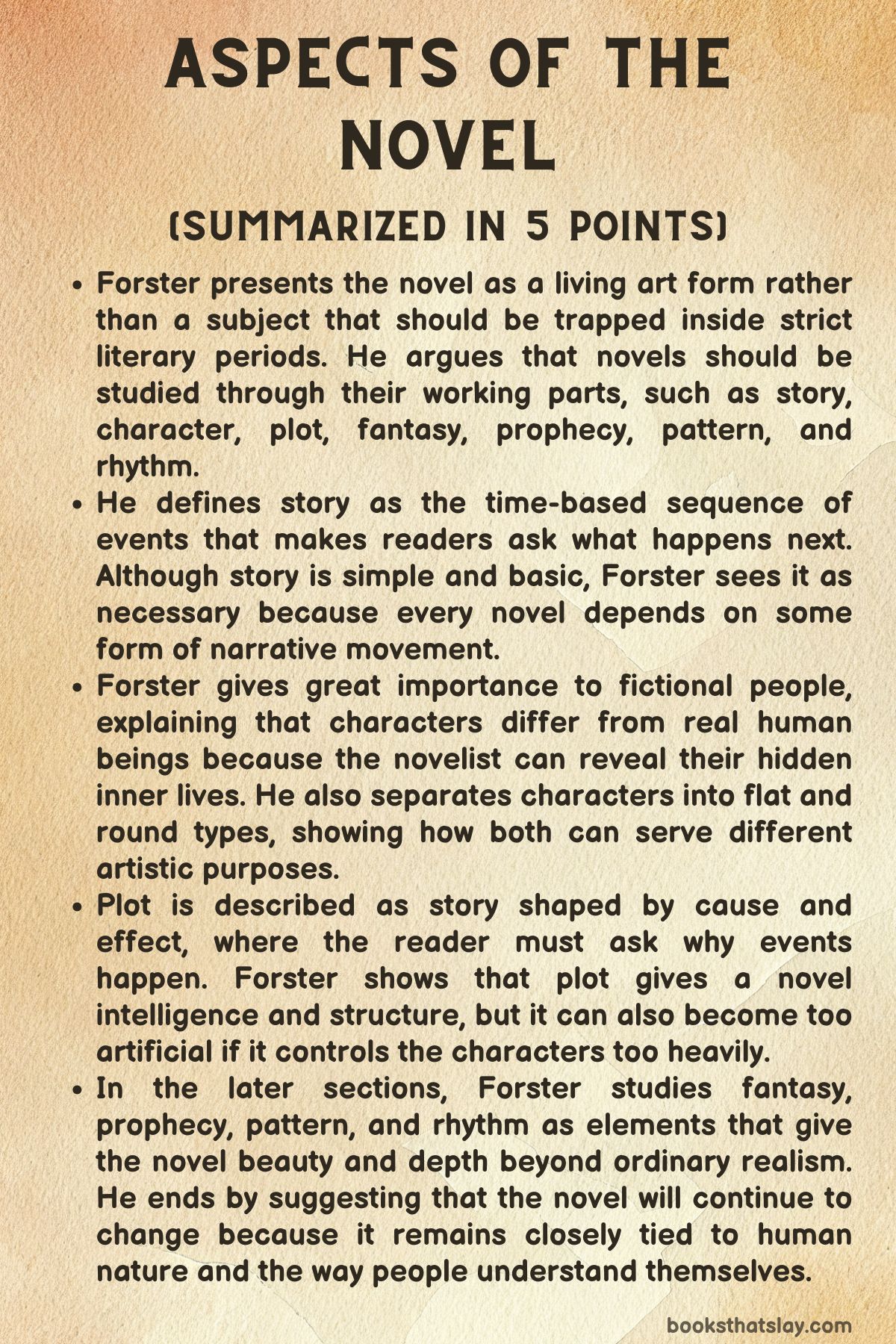
Aspects of the Novel is E.M. Forster’s classic study of how novels work. Based on lectures delivered at Cambridge in 1927, the book treats the novel less as a historical object and more as a living art form.
Forster sets aside strict chronology and looks instead at the main elements that shape fiction: story, characters, plot, fantasy, prophecy, pattern, and rhythm. His style is conversational, witty, and direct, making literary criticism feel like an active exchange between writer, reader, and book.
Summary
Aspects of the Novel begins with Forster explaining that the book grew out of a series of lectures, which accounts for its informal and conversational tone. Rather than presenting a rigid academic history of fiction, he chooses to examine the novel as an art form made from certain basic elements.
He first defines the novel broadly as a long prose fiction, then makes clear that his real interest is not in dates, schools, or literary periods. He argues that critics often become too attached to classification, while novelists themselves are usually concerned with the act of creation: paper, pen, imagination, and the people they invent.
Forster asks readers to imagine novelists from different centuries sitting in the same room, all writing at once. This image frees the novel from the usual timeline of literary history.
Samuel Richardson, Henry James, Dickens, Wells, Woolf, and Sterne may belong to different ages, but they often face similar artistic problems. Forster’s point is that fiction depends on human nature, not merely on history.
The novel changes with culture, but its central task remains the same: to represent human beings and their experiences in a form that readers can enter.
He begins his study with story, which he defines as a narrative arranged in time. Story answers the basic question of what happens next.
Forster treats this as the oldest and simplest appeal of fiction, linking it to the ancient pleasure of hearing a tale told aloud. A story succeeds when it creates curiosity; it fails when readers no longer care about the next event.
Yet Forster also sees story as a limited element. It depends too much on sequence and suspense, and if a novel has only story, it may feel shallow.
To explain this, Forster contrasts writers who handle time differently. Sir Walter Scott, for instance, can keep readers interested through incident and forward movement, but Forster finds his novels less rich in deeper value.
Arnold Bennett’s The Old Wives’ Tale gives time more weight by tracing lives from youth to age, yet its sense of time can feel too mechanical. Tolstoy’s War and Peace offers something greater because it presents time within a vast moral and spatial world.
Forster concludes that every novel must tell a story, but the best novels do more than move from one event to another.
He then turns to people, meaning the characters who inhabit fiction. Forster argues that characters are not the same as real human beings.
In life, we can never fully know another person’s inner world; we only guess from outward behavior. In fiction, however, the novelist can reveal a character’s hidden thoughts, motives, fears, and desires.
This gives fictional people a strange advantage over real people: they may be less physically real, but they can be more completely known.
Forster studies fictional people through basic facts of life: birth, food, sleep, love, and death. Birth and death are universal, yet mysterious, because no one can fully describe their own birth or final experience of death.
Fiction often passes quickly over birth but gives more attention to death, partly because death can provide a natural ending. Food often creates social scenes, bringing characters together.
Sleep and dreams may reveal hidden states of mind. Love receives the greatest emphasis in novels, especially romantic love, because it motivates action, shapes relationships, and often offers a convenient conclusion through marriage.
In discussing Moll Flanders, Forster shows how a character can become the entire reason for a novel’s existence. Moll does not merely appear in a story; the story exists because of who she is.
Yet Forster insists that even such a vivid figure is still not a real person. She is a created being whose inner life is controlled by the novelist.
This leads him to the larger problem of how characters function inside a novel’s structure.
Forster next distinguishes between flat and round characters. Flat characters are built around a single idea or quality.
They are easy to remember and often useful, especially in comedy. Dickens, in Forster’s view, is a master of giving flat characters vitality.
Such figures may not change much, but their clear and repeated traits make them memorable. Round characters, by contrast, are capable of surprise while remaining believable.
They possess depth, contradiction, and growth. Jane Austen’s characters often appear simple at first but reveal unexpected dimensions when tested.
Forster values this capacity for convincing surprise as the mark of a round character.
He also discusses point of view. A novelist may use an all-knowing narrator, a narrator limited to one or a few minds, or a first-person voice.
Forster is less interested in making rules than in showing the freedom of the novel. Unlike drama, fiction can move between minds and degrees of knowledge.
This shifting access resembles real life, where we know some people intimately and others only from the outside. However, Forster warns that excessive authorial commentary can weaken the illusion that characters exist in their own world.
The next major subject is plot. Forster famously separates story from plot by saying that story is a sequence of events, while plot adds causality.
Story asks what happened next; plot asks why it happened. Plot therefore requires memory and intelligence from the reader.
Events must not only follow one another but also connect through motive, consequence, and mystery. Suspense may keep readers waiting, but mystery makes them think.
Forster uses several examples to show how plot can both strengthen and threaten a novel. A writer may conceal information to create surprise, as George Meredith does in The Egoist, but this can also damage character if the concealment feels artificial.
Plot often demands planning and closure, and closure can force characters into positions that feel less alive than they once did. Forster sees this as a central tension in fiction: characters may want freedom, while plot requires order.
Some modern novelists loosen plot or even work against it, showing that the novel does not need to obey the dramatic pattern of complication, crisis, and solution.
After story, people, and plot, Forster turns to fantasy. Fantasy, for him, is not limited to magical events.
It includes any movement toward the impossible, the highly unlikely, the supernatural, or the strange. The reader must be willing to accept such departures from ordinary reality.
Some readers cannot do this, and Forster acknowledges that fantasy requires a special kind of cooperation. He discusses works that use magic openly, as well as works that achieve fantasy through parody, adaptation, or an unusual relation to reality.
A familiar story can be renewed when an author changes its setting, tone, or purpose.
Prophecy follows fantasy, but Forster does not mean prediction. Prophecy in fiction is a voice of depth and spiritual force.
It gives a novel a sense of large meaning beyond ordinary events. The prophetic novelist does not simply discuss religion or morality; the work seems to speak from a deeper level of human experience.
Forster contrasts George Eliot and Dostoevsky to explain this difference. Eliot may write about God and sin within a social and moral framework, but Dostoevsky’s great moments seem to carry a larger, more universal authority.
Forster finds prophecy also in Melville’s Moby Dick, where realistic detail and symbolic force combine. The whale is not merely an object or even a symbol of evil; it becomes part of a larger sound or song within the novel.
Forster sees similar prophetic power in D. H. Lawrence and Emily Brontë. In Wuthering Heights, the wild atmosphere of the moors becomes inseparable from the emotional force of Catherine and Heathcliff.
Prophecy, then, is not a technique that can be easily copied. It depends on the novelist’s voice and the reader’s willingness to receive it seriously.
The final major elements are pattern and rhythm. Pattern is the visual or structural shape of a novel.
A plot may resemble an hourglass, a chain, or another design that gives aesthetic pleasure. Forster admires the beauty such pattern can create, especially in highly controlled novels like Henry James’s The Ambassadors.
Yet he also warns that too much devotion to pattern can reduce life. If every character and event exists only to complete a design, the novel may lose warmth, variety, and freedom.
Rhythm offers another kind of beauty. Forster compares it to music, where a phrase returns and gains new meaning through repetition.
In Proust, a musical phrase recurs across the work, changing in emotional force as the characters and situations change. Rhythm is more flexible than pattern because it can grow organically rather than impose a fixed shape.
Forster wonders whether fiction might one day achieve something like the large rhythm of a symphony, though he is unsure whether the novel has yet done so fully.
In the conclusion, Forster returns to his image of all novelists writing together outside time. He adds future novelists to the room, suggesting that the form remains open.
Whatever changes occur in society, the novelist will still face the task of representing human nature. Yet Forster also imagines the possibility that human nature itself may change if people learn to see themselves differently.
The novel, because it is so closely tied to inner life, may help bring about that change.
Overall, Aspects of the Novel is not a plot-driven book but an argument about how fiction creates meaning. Forster moves from the simplest appeal of narrative to the more complex powers of character, causality, imagination, spiritual voice, structure, and rhythm.
His central belief is that the novel is valuable because it brings readers into contact with human beings, both ordinary and mysterious, shaped by art yet close to life.
Key Figures
E. M. Forster
Forster is the central guiding presence in Aspects of the Novel. His personality shapes the whole book: conversational, sharp, opinionated, humorous, and openly skeptical of dry academic systems.
He does not behave like a distant scholar who wants to classify literature into neat historical boxes. Instead, he speaks like a reader who cares about the living experience of fiction.
His role is to lead the reader through the major parts of the novel while constantly reminding them that fiction is not only a structure but also a human exchange between writer and reader. He values freedom over rigid rules, and this makes him both a critic and a defender of the novelist’s creative liberty.
His strongest quality is his ability to turn abstract literary ideas into memorable images, such as the idea of all novelists sitting in one room and writing together outside time. Through Forster, the book becomes less a formal textbook and more a personal conversation about why novels matter.
The Novelist
The novelist appears throughout the book as a creative figure who stands apart from the critic and the historian. Forster presents the novelist as someone concerned less with literary periods and more with the living act of making fiction.
The novelist’s world is made of paper, pen, imagination, memory, emotion, and invented people. This figure is powerful because they can do what ordinary human beings cannot: enter the secret inner lives of others.
In real life, people remain partly hidden from one another, but the novelist can create a character from within and reveal thoughts, fears, motives, and contradictions directly to the reader. At the same time, the novelist faces constant artistic pressure.
They must manage story, character, plot, fantasy, prophecy, pattern, and rhythm without allowing one element to damage another. Forster’s novelist is therefore both free and burdened: free to invent entire worlds, but burdened by the need to make those worlds convincing, meaningful, and alive.
The Reader
The reader is one of the most important presences in the book because Forster repeatedly defines the novel through the reader’s experience. The reader wants to know what happens next, but Forster expects more than simple curiosity.
A strong reader must also remember, question, compare, accept mystery, and respond to tone. When Forster discusses story, the reader is almost childlike, waiting for the next event.
When he discusses plot, the reader becomes more intelligent and active, asking why events happen and how earlier details connect with later ones. When he discusses fantasy, the reader must be willing to accept the impossible.
When he discusses prophecy, the reader must approach the book with seriousness and humility. This makes the reader not a passive consumer but a participant in the life of fiction.
Forster’s ideal reader is flexible, alert, and emotionally open, able to enjoy suspense while also recognizing deeper artistic design.
The Critic
The critic in the book is divided into two broad types: the genuine scholar and the pseudo-scholar. The pseudo-scholar is one of Forster’s main targets.
This figure is too attached to chronology, labels, categories, and literary movements. Instead of feeling the living force of a novel, the pseudo-scholar tries to place it in a system.
Forster does not reject scholarship entirely, but he distrusts any criticism that becomes more interested in classification than in the experience of reading. The genuine scholar, by contrast, has a wider vision.
This kind of critic can see literature steadily and as a whole, without reducing it to mechanical divisions. Through this contrast, Forster creates a quiet conflict between two ways of approaching books.
One approach turns fiction into a museum of periods and influences; the other treats fiction as a living art that still speaks directly to human beings.
The Storyteller
The storyteller represents the oldest and most basic power of fiction. Forster imagines storytelling as something that reaches back to primitive human life, with people gathered around a fire waiting to hear what happens next.
This figure does not need complex psychology or refined structure to hold attention. The storyteller survives through suspense, sequence, and the simple force of continuation.
In the book, this figure is both respected and limited. Forster knows that storytelling is essential because every novel must, in some way, tell a story.
Yet he also sees it as the lowest and simplest part of fiction when it stands alone. The storyteller can command attention, but without deeper values, character, and causality, the result may remain shallow.
This figure matters because it reminds readers that the novel begins in curiosity, even if it must grow beyond curiosity to become art.
Scheherazade
Scheherazade appears as Forster’s great example of suspense and survival through storytelling. Her power lies in her ability to make the listener desperate to know what happens next.
She represents the primitive but enduring force of narrative curiosity. In Forster’s treatment, Scheherazade is not analyzed as a psychologically complex person; she becomes a symbol of story itself.
Her art depends on delay, continuation, and the careful withholding of completion. Every unfinished tale protects her life because the listener’s curiosity becomes stronger than his power over her.
This makes her an ideal figure for Forster’s argument that story is rooted in suspense. She shows that storytelling can have an almost physical urgency: it can keep attention alive, postpone an ending, and turn time into a tool of control.
Moll Flanders
Moll Flanders is one of Forster’s most important examples of a character who dominates the book she belongs to. She matters not merely because many events happen to her, but because the book is built around the question of who she is.
Forster sees Moll as a character whose identity drives the entire work. She is vivid, energetic, morally complicated, and impossible to separate from the movement of her story.
Yet Forster also insists that she is not a real person. Her inner life exists because the novelist created it and made it available to the reader.
This is exactly what makes her useful to Forster’s argument about fictional people. Moll feels full and forceful, but her fullness is artistic rather than biological.
She demonstrates how a character can be more knowable than any actual person, because the novelist can expose the hidden chambers of her motives and desires.
Miss Bates
Miss Bates, from Jane Austen’s Emma, represents a very different kind of fictional person from Moll Flanders. She does not stand independently in the same way.
Her importance comes from her connection to the social and moral structure around her. Forster uses her to show that some characters are not designed to exist as isolated portraits; they function through their relation to the larger book.
Miss Bates is socially placed, tonally useful, and structurally necessary. Her talkativeness, vulnerability, and social position help reveal the manners, judgments, and moral failures of others.
She shows how a minor character can be artistically valuable without dominating the work. Through Miss Bates, Forster suggests that a character’s greatness is not always measured by individual depth alone.
Sometimes it lies in how perfectly that character belongs to the surrounding design.
Mr. Pickwick
Mr. Pickwick serves as Forster’s key example of a flat character who becomes memorable through vitality. A flat character, in Forster’s sense, is organized around one central idea or quality.
Mr. Pickwick does not possess the psychological range of a round character, but he has an unmistakable comic force. His consistency helps readers remember him, and his simplicity becomes a source of pleasure rather than weakness.
Forster does not treat flatness as automatic failure. In comedy especially, a flat character can be wonderfully effective because the reader enjoys returning to a stable, recognizable presence.
Mr. Pickwick shows how a character can remain limited and still feel alive on the page. His charm lies in the energy with which his defining traits are expressed.
Lady Bertram
Lady Bertram is used by Forster to explain how a character may appear flat but reveal unexpected depth. At first, she seems almost entirely defined by passivity and indolence.
She appears fixed, simple, and limited. Yet when a serious crisis occurs, she responds in a way that suggests more emotional substance than the reader may have expected.
This is why she is important to Forster’s idea of roundness. A round character does not need to be dramatic at every moment; the test is whether the character can surprise the reader convincingly.
Lady Bertram’s hidden capacity gives her more artistic life than a purely one-note figure. She demonstrates Austen’s skill in creating characters who seem socially familiar and even comic, but who can shift under pressure and reveal a fuller human presence.
Laetitia Dale
Laetitia Dale, from George Meredith’s The Egoist, is important because Forster uses her to examine the relationship between plot and character. Her hidden feelings create mystery in the book, and the revelation of those feelings produces surprise.
Forster is interested in how the novelist withholds her inner state in order to serve the plot. This makes Laetitia a useful but risky example.
On one hand, her concealment helps create dramatic force. On the other hand, it raises the danger that a character may be sacrificed to the machinery of plot.
Laetitia’s role shows how delicate the balance can be. If a novelist hides too much, the character may become a device rather than a living person.
If the concealment works, however, the plot gains intelligence and emotional impact.
Ishmael
Ishmael, from Moby Dick, matters in Forster’s discussion of prophecy and voice. He is more than a narrator reporting events at sea.
Through him, the book moves from realistic detail into a much larger meditation on evil, fate, friendship, fear, and the unknown. Ishmael’s presence allows ordinary descriptions of ships, sermons, whales, and sailors to take on a wider resonance.
Forster values the way Moby Dick uses concrete reality without being controlled by realism alone. Ishmael helps make that possible because his voice can move between observation and spiritual intensity.
He stands at the edge of experience, trying to describe something too large to be reduced to simple explanation. His importance lies in the way his narration carries the book toward prophetic force.
Queequeg
Queequeg is significant because he helps ground Moby Dick in human contact and emotional warmth. Forster pays attention to Ishmael’s friendship with Queequeg because it contributes to the larger prophetic sound of the work.
Queequeg is not merely an exotic companion or secondary sailor; he becomes part of the book’s moral and emotional structure. His bond with Ishmael creates intimacy inside a vast and threatening world.
Through him, the book briefly offers trust, loyalty, and human closeness against the larger darkness represented by the whale and the voyage. Forster’s interest in Queequeg shows how prophetic fiction still needs ordinary human feeling.
The grander meanings of a book become stronger when they are tied to recognizable relationships.
Billy Budd
Billy Budd represents innocence placed inside a harsh moral and social order. Forster discusses him in relation to Melville’s changing treatment of evil.
Unlike Moby Dick, where evil takes on a vast and almost cosmic form, Billy Budd presents evil within a more realistic framework. Billy himself becomes important because his goodness is direct, exposed, and vulnerable.
He is not a complex schemer or divided soul; his dramatic force comes from the collision between innocence and destructive authority. Forster’s use of Billy Budd helps show how the same author can treat evil in different artistic modes.
Billy’s tragedy belongs to a tighter moral world, where evil can be located in human action and institutional judgment rather than in a mysterious white whale.
Claggart
Claggart, from Billy Budd, functions as a personification of evil in Forster’s discussion of Melville. He is important because he gives evil a human form.
Unlike the whale in Moby Dick, which resists simple interpretation, Claggart is more clearly attached to malice, envy, and destructive intention. His presence allows Forster to compare realistic fiction with prophetic fiction.
In a realistic work, evil may be embodied in a single person whose actions can be judged. Claggart’s darkness is therefore more contained than the force represented by Moby Dick, but it is still powerful because it acts directly upon innocence.
He helps Forster trace the difference between moral conflict as human behavior and evil as a vast imaginative presence.
Catherine Earnshaw
Catherine Earnshaw, from Wuthering Heights, is important to Forster’s idea of prophecy because her emotional life cannot be reduced to ordinary realism. Her passion, restlessness, and identification with the wild atmosphere around her give the book a sound larger than social drama.
Forster connects the force of Wuthering Heights to the stormy wind of the moors, and Catherine is central to that force. She is not simply a romantic heroine.
She represents an intensity of feeling that strains against social limits, domestic order, and ordinary moral explanation. Her bond with Heathcliff feels elemental rather than merely personal.
Through Catherine, Forster shows how a character can help create the prophetic voice of a book, where emotion seems to speak from a deeper region of human nature.
Heathcliff
Heathcliff stands beside Catherine as one of the figures through whom Wuthering Heights gains its prophetic power. He is driven by passion, injury, revenge, and a fierce refusal to accept separation from Catherine.
Forster is less concerned with judging Heathcliff morally than with understanding the artistic force he brings to the book. Heathcliff’s emotions are extreme, but they are not merely melodramatic.
They belong to the atmosphere of the moors and to the larger sound of the novel. His presence turns personal suffering into something almost mythic.
Through Heathcliff, Forster shows how a character can exceed ordinary social realism and become part of a book’s deeper voice.
Chad
Chad, from Henry James’s The Ambassadors, is important because he helps create the hourglass pattern that Forster admires in the book. At first, he seems to be the young man who must be retrieved from Paris and returned to proper expectations.
Yet his transformation helps reverse the positions of the characters around him. Chad’s life in Paris becomes part of a larger structural design in which the person sent to rescue him begins to question his own values.
Chad matters less as an isolated psychological study than as part of the book’s pattern. Through him, Forster shows how character can serve form.
The danger, however, is that when pattern becomes too controlled, characters may feel less free.
Strether
Strether, also from The Ambassadors, is central to Forster’s discussion of pattern because his journey gives the book its hourglass shape. He begins as an emissary sent to bring Chad home, but his exposure to Paris changes his understanding of life.
He becomes the figure who crosses over, morally and emotionally, into a position different from the one he occupied at the start. Strether’s importance lies in the way his personal awakening supports the structure of the whole work.
Forster admires the beauty of this design but also sees its limitation. Strether’s development is elegant and carefully arranged, yet the very perfection of the pattern may reduce the wildness and unpredictability that Forster also values in fiction.
Themes
The Novel as a Living Art Form
Forster treats the novel as something alive, flexible, and resistant to rigid academic control. He is not interested in reducing fiction to a list of periods, movements, dates, or national traditions.
His argument depends on the idea that novels speak across time because they are rooted in human experience. This is why he imagines novelists from different centuries sitting in the same room, writing together.
The image removes them from historical sequence and places them in a shared creative space. In Aspects of the Novel, the novel becomes less a historical artifact and more a living conversation among writers, readers, and invented people.
This theme gives the book much of its energy. Forster respects scholarship, but he distrusts criticism that becomes too mechanical.
He wants readers to encounter fiction directly and freshly, without allowing labels to come between them and the work. The novel matters because it keeps returning to basic human realities: curiosity, love, memory, secrecy, fear, moral choice, and the need to understand others.
Forster’s approach insists that fiction remains active whenever a reader enters it with attention.
The Difference Between Real People and Fictional People
Forster’s analysis of character depends on a powerful distinction between people in life and people in books. Real human beings are never fully knowable.
We see gestures, hear speech, observe habits, and make guesses, but another person’s inner life remains partly hidden. Fiction changes this condition.
The novelist can enter a character’s mind, expose motives, reveal secret emotions, and give the reader access to thoughts that would be unavailable in real life. This does not make fictional people more real, but it can make them more completely knowable.
Forster sees this as one of the novel’s greatest powers. It creates a parallel human world where people are invented yet emotionally intelligible.
His distinction between flat and round characters grows from this idea. Some fictional people are useful because they are stable and memorable, while others are valuable because they surprise us in convincing ways.
The theme also explains why the novel differs from history, biography, and drama. Fiction can represent inwardness with unusual freedom, allowing readers to experience human beings not only from the outside but also from within.
Story, Plot, and the Search for Meaning
Forster separates story from plot in order to show how fiction moves from simple curiosity to deeper understanding. Story depends on time.
It keeps the reader asking what happens next. This is an ancient and necessary pleasure, and Forster does not dismiss it entirely.
Every novel must have some relation to sequence, even when it experiments with time. Plot, however, adds causality.
It asks why events happen, how they are connected, and what hidden motives or earlier actions explain later consequences. This shift from what next to why changes the reader’s role.
The reader is no longer merely waiting but thinking, remembering, and interpreting. Forster’s treatment of plot also reveals a tension at the heart of fiction.
Plot gives a novel shape and intelligence, but it can also become too controlling. Characters may be forced into artificial actions just to complete a design.
Endings, in particular, can expose the strain between life and structure. Through this theme, Forster shows that meaning in fiction comes not only from events but from the relationships among events, characters, memory, and motive.
Beauty Through Pattern, Rhythm, Fantasy, and Prophecy
Forster expands the idea of the novel beyond realism by giving serious attention to fantasy, prophecy, pattern, and rhythm. These elements show that fiction is not only a record of believable events or recognizable people.
Fantasy allows the impossible, the strange, and the highly unlikely to enter the book, provided the reader is willing to accept that imaginative condition. Prophecy gives fiction a larger voice, one that seems to speak with spiritual or universal force rather than ordinary social observation.
Pattern creates beauty through structure, giving a novel a visible shape, such as an hourglass or chain. Rhythm creates beauty through recurrence, echo, and development, closer to the movement of music than to the neatness of design.
Together, these ideas show Forster’s belief that the novel is a broad and elastic form. It can contain realism, but it should not be imprisoned by realism.
It can be shaped, but it should not become lifelessly decorative. The best fiction, in Forster’s view, balances human truth with artistic form, allowing beauty to arise without crushing the living force of the book.