Ask The Dust Summary, Characters and Themes
Ask The Dust by John Fante is a Los Angeles novel about hunger, pride, shame, desire, and the brutal hope of becoming an artist. Its narrator, Arturo Bandini, is a young Italian American writer living in poverty in Bunker Hill, convinced that fame is waiting for him if he can only find the right story.
His love for Camilla Lopez, a Mexican American waitress, exposes his insecurity, racism, religious guilt, and need to be admired. The book is raw, funny, cruel, and sad, showing a man chasing literary greatness while failing to understand the woman before him. It;s the 3rd book of The Saga of Arturo Bandini series.
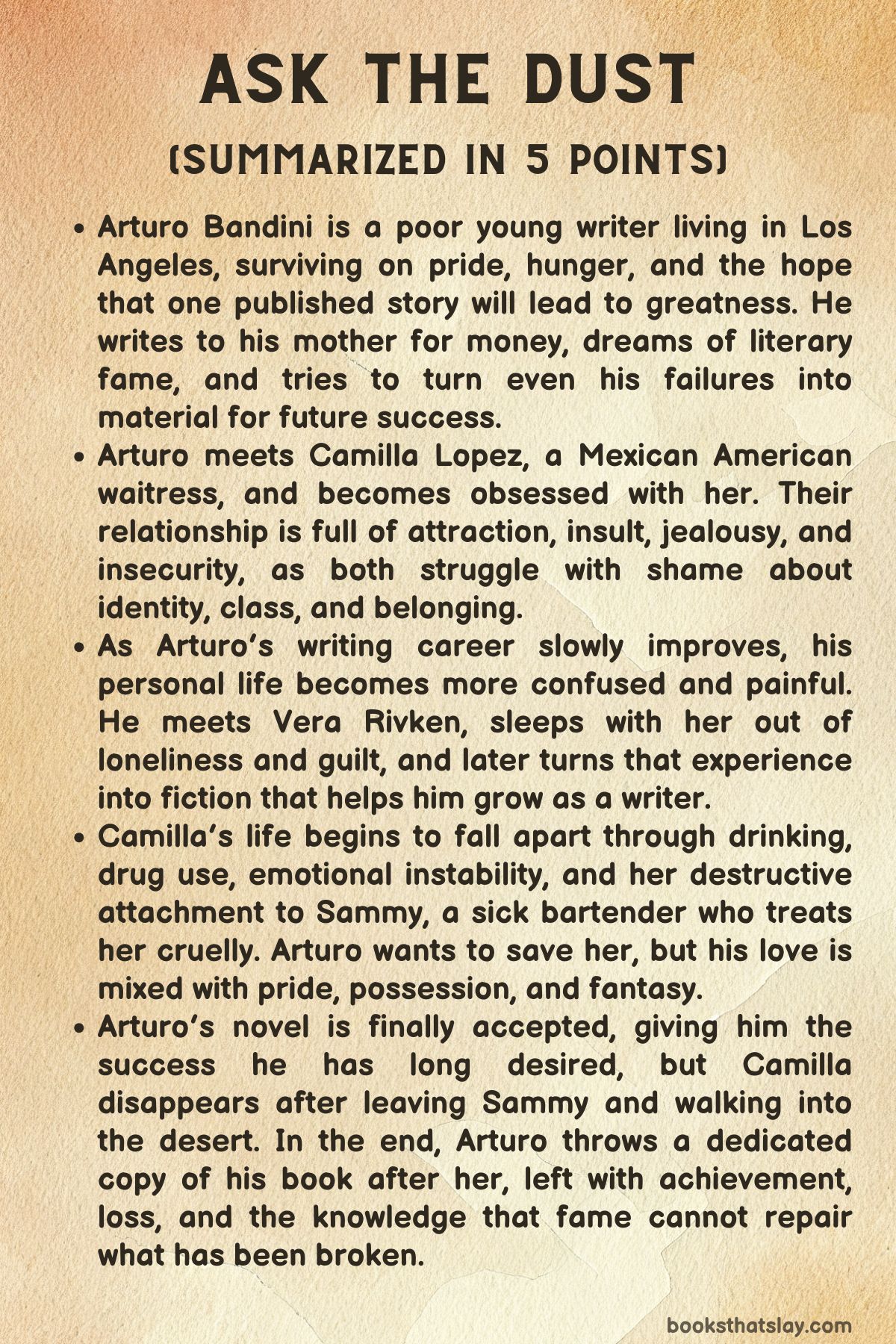
Summary
Arturo Bandini arrives in Los Angeles with almost nothing except ambition. He lives in the Alta Loma Hotel in Bunker Hill, a cheap place run by Mrs. Hargraves, who is tired of waiting for his overdue rent.
Arturo has published one short story, “The Little Dog Laughed,” and treats it as proof that he is destined for greatness. The story was accepted by the respected editor J. C. Hackmuth, and Arturo keeps returning to that achievement whenever hunger, loneliness, and fear threaten to crush him.
He is young, poor, proud, and desperate to believe that he is already on the edge of becoming a major writer.
His life is full of contradictions. He writes home to his Catholic mother in Colorado, telling her he still goes to mass and asking for money, even though he often claims he no longer believes.
He also writes long letters to Hackmuth about his writing troubles, his poverty, and his supposed experiences with women. Some of these claims are invented, because Arturo wants to appear worldly and experienced.
He thinks his lack of sexual experience limits him as a writer, so he decides he must learn more about life. After receiving money from his mother, he tries to seek out a prostitute, but guilt and disgust stop him from going through with anything.
Even when he pays a woman, he insists he only wants to talk because he is gathering material for a story.
Back at the hotel, Arturo’s poverty continues to humiliate him. His alcoholic neighbor, Hellfrick, owes him money and suggests stealing milk from a delivery truck.
Arturo first condemns the idea, but his hunger soon weakens his moral certainty. He imagines the theft as future literary material, turning even shame into a fantasy of fame.
When he finally steals the bottles, he discovers they contain buttermilk, which he hates. This mix of comedy, self-deception, and hardship defines much of his early life in Los Angeles.
Arturo’s attention soon fixes on Camilla Lopez, a waitress at the Columbia Buffet. Their first meeting is ugly.
He complains about the bad coffee and insults her shoes, which embarrasses and angers her. Yet he cannot stop thinking about her after he leaves.
He brings her a copy of his published story and writes insulting, showy inscriptions in it, trying to impress and wound her at the same time. Camilla responds with mockery and defiance.
When she later tears the pages from his magazine, Arturo is hurt, but his attraction only deepens.
The bond between Arturo and Camilla develops through cruelty, attraction, and mutual insecurity. Arturo insults her Mexican identity, calling her by racist names and mocking the huaraches she wears.
He knows, however, that his cruelty comes partly from his own wounds. As the son of Italian immigrants, he has been treated as an outsider himself.
Mrs. Hargraves once asked whether he was Mexican and told him the hotel did not allow Mexicans or Jews. Arturo wants badly to be accepted as American, and he projects that shame onto Camilla.
Camilla, too, resists being seen as Mexican and insists she is American. She sometimes uses the name Camilla Lombard instead of Lopez, showing her own desire to escape the prejudice attached to her background.
A turning point comes when Hackmuth accepts one of Arturo’s long letters as a story titled “The Long Lost Hills.” The sale brings Arturo money, and his confidence rises sharply. He pays his rent, buys clothes, and goes to the Columbia Buffet acting like a successful man.
Camilla notices the change and says she liked him better before. Their conversation reveals how closely both of them connect identity, class, and humiliation.
That night, Camilla drives Arturo to the beach. She pretends to drown, frightening him, then laughs at him.
Later she tries to be intimate with him, but he cannot respond. She is hurt, and Arturo is ashamed.
Once he returns to his room, desire returns, but it is too late.
Arturo’s love becomes increasingly theatrical and unstable. He sends Camilla a telegram declaring that he loves her and wants to marry her.
She laughs at it and shows it to others in the bar, humiliating him. He tries to turn his pain into literature and even plagiarizes a poem, sending it to her as another telegram.
She rips it up. Arturo then drifts through bars and dance halls, drinking and spending time with women he does not love.
He wants experience, but his actions mostly deepen his confusion.
During this period, Arturo meets Vera Rivken, a lonely, older woman who comes to his room after drinking. She attacks his writing, recites poetry, and demands affection.
Arturo first tries to escape her, but later feels pity for her. Vera is poor, wounded, and emotionally desperate.
She believes a mark or disfigurement on her body makes her unlovable. Arturo visits her in Long Beach, and they sleep together after she asks him to pretend she is Camilla.
When Arturo leaves, he feels deep guilt. Soon after, an earthquake strikes Long Beach, and his old Catholic fear returns.
He imagines divine punishment and worries that Camilla may have died. After the quake, he begins attending mass again and tries to reform himself.
Arturo eventually turns his experience with Vera into fiction. His work on this new project grows into a novel, and his professional life begins to improve.
At the same time, his relationship with Camilla becomes more tangled. She asks him to help Sammy, a bartender she loves, who is dying of tuberculosis and wants to publish a short story.
Arturo despises Sammy’s writing but agrees to read it for Camilla’s sake. He writes Sammy a harsh critical letter, but Sammy responds with thanks.
Sammy’s own views of Camilla are cruel and racist, and yet Camilla remains attached to him.
Camilla begins visiting Arturo’s room, and their meetings are marked by anger, jealousy, desire, and resentment. Arturo insults her again, and she insults his Italian background in return.
They struggle for power over each other. At times Camilla seeks affection, but Arturo’s pride and fear block him.
Later, after Sammy beats her for coming to see him in the desert, Camilla goes to Arturo injured and drunk. He tells her he loves her, and they finally sleep together.
But this does not bring peace. Camilla continues drinking heavily, becomes more erratic, and remains emotionally bound to Sammy.
Arturo sees Camilla’s life falling apart. She smokes marijuana, lives in a filthy apartment, and moves between neediness and rejection.
He wants to save her, but he also wants to possess her and make her fit the role he has imagined. They visit Sammy in the desert, where Sammy humiliates Camilla and treats her like a servant while discussing writing with Arturo.
Arturo sees the ugliness of the situation, but he cannot free her from Sammy’s hold. Later, Camilla takes Arturo to a nightclub where people are smoking marijuana, then to her apartment, where they get high together.
Afterward, Arturo feels guilt and sorrow, sensing how damaged and unstable her life has become.
Meanwhile, Arturo finishes his novel and sends it to Hackmuth. When Hackmuth accepts it and sends a contract and money, Arturo is overjoyed.
His dream of becoming a real author is finally coming true. He goes looking for Camilla to share the news, but she has stopped working at the Columbia Buffet.
He finds her in terrible condition at her apartment, tries to bring her food and clothing, and attempts to care for her. She rejects him, and the neighbors force him out.
Soon after, Camilla is taken away after a violent breakdown. Arturo tracks her to a mental institution by pretending to be a doctor, but he cannot see her.
His book moves toward publication, and Arturo buys a car. Still, his success feels hollow without Camilla.
He drives around Los Angeles at night, remembering her. When he learns she has escaped from the institution, he hopes she will come to him, but she does not.
Instead, she sends telegrams asking for money under another name. Arturo knows he should stop sending it, yet he keeps giving her what she asks for.
Camilla eventually returns to his room, hiding in his closet and smoking marijuana. Arturo responds with tenderness and desperation.
He dreams of taking her away to Laguna Beach, buying a house by the sea, and giving her rest. He buys her a dog named Willie and rents a place where he imagines they can begin again.
But while he returns to Los Angeles to settle his affairs, Camilla leaves with the dog. Arturo stays briefly in the rented house but cannot bear the emptiness.
After Ask The Dust reaches publication within the story’s world through Arturo’s novel, he receives word from Sammy that Camilla has been there. By the time Arturo arrives, Sammy says he has thrown her out and that she walked into the desert with Willie and a bottle of milk for the dog.
Arturo searches but realizes the desert gives him no clear path. Camilla could have gone anywhere, and he cannot recover her.
In the final gesture, he takes a copy of his newly published book, writes a dedication to Camilla, and throws it into the desert after her. Then he drives back to Los Angeles, left with success, loss, and the dust of a dream he could not save.
Characters
Arturo Bandini
Arturo Bandini is the central consciousness of Ask The Dust, and nearly every event in the book is filtered through his vanity, hunger, fear, shame, and longing. He is a young Italian American writer in Los Angeles, poor enough to fear eviction but proud enough to imagine himself as a future literary giant.
His published story gives him a fragile sense of importance, and he clings to it because it is the one visible proof that he may become the man he dreams of being. Arturo is often funny, dramatic, and self-aware, but he is also cruel, insecure, and emotionally immature.
He wants to be loved, admired, and recognized, yet he repeatedly damages the people who come close to him. His ambition is genuine, but so is his need to turn every experience into material for his future greatness.
Arturo’s biggest conflict is between who he is and who he wants to appear to be. He wants to be an American success story, but his background as the son of Italian immigrants makes him feel socially inferior.
This insecurity explains, though does not excuse, his cruelty toward Camilla. When he insults her Mexican identity, he is partly attacking the parts of himself that have also been mocked or rejected.
He wants distance from poverty, foreignness, Catholic guilt, sexual innocence, and social humiliation. His racism and arrogance often come from fear, but the damage he causes is real.
Arturo is not simply a misunderstood young artist; he is also a man who uses language as a weapon when he feels powerless.
His relationship with religion adds another layer to his character. He claims to be an atheist, but Catholic guilt still controls him in moments of fear, desire, or shame.
He prays when he wants success, feels sinful after sleeping with Vera, and interprets the earthquake as possible punishment. This unstable connection to faith shows that Arturo has not truly escaped the world that shaped him.
He wants freedom from religious rules, but he still carries their emotional force inside him. His guilt rarely makes him kinder for long; instead, it often turns into self-pity or another dramatic story about himself.
As a writer, Arturo is both gifted and ridiculous. He has talent, but he is obsessed with the image of being a writer.
He imagines future fame, interviews, literary glory, and admiration from people who once dismissed him. Yet his best writing seems to come when he stops performing and confronts pain directly, as with the story of Vera.
His eventual success is real, but the book refuses to present it as complete victory. By the end, Arturo has achieved the literary recognition he wanted, but he has failed to save Camilla or understand her fully.
His final act of throwing his book into the desert is both an offering and an admission of defeat. He can dedicate his success to her, but he cannot bring her back.
Camilla Lopez
Camilla Lopez is one of the most important and tragic figures in the book. She is a Mexican American waitress at the Columbia Buffet, and her relationship with Arturo reveals the emotional damage caused by racism, poverty, shame, and impossible desire.
Camilla is proud, sharp, mocking, and deeply vulnerable. She refuses to be treated as inferior, yet she has absorbed some of the same social prejudice that wounds her.
Her insistence that she is American is not only a statement of fact; it is also a defense against a society that keeps trying to reduce her to a racial category. Her use of the name Camilla Lombard shows how badly she wants a different social identity, one that might protect her from humiliation.
Camilla’s relationship with Arturo is volatile because both of them recognize something wounded in the other. Arturo insults her and desires her at the same time, while Camilla mocks him, challenges him, seeks his attention, and rejects him.
She is not passive in their exchanges; she fights back, humiliates him, and exposes his pretensions. When she tears up his story or laughs at his telegram, she cuts through the grand image he has built of himself.
Yet her strength does not protect her from emotional dependence. Her attachment to Sammy is especially painful because he treats her with contempt and violence, yet she continues to seek him out.
This shows how love, degradation, and self-punishment become confused in her life.
Camilla’s decline is one of the saddest movements in the novel. Her drinking, marijuana use, unstable behavior, and eventual institutionalization suggest a woman pushed beyond endurance.
The book does not reduce her suffering to one cause. Racism, poverty, abusive love, loneliness, addiction, and mental distress all contribute to her collapse.
Arturo wants to save her, but his love is mixed with possession, fantasy, and pride. He imagines a peaceful life with her in Laguna Beach, but this dream says as much about his desire to control the story as it does about her needs.
Camilla cannot be repaired by being placed into Arturo’s fantasy of domestic rescue.
By the end, Camilla becomes almost unreachable. Her walk into the desert is both literal and symbolic: she disappears into a space where Arturo’s ambition, language, and love cannot follow.
She is not merely a romantic object or a lesson for Arturo. She is a damaged, proud, restless woman whose life has been shaped by forces larger than one relationship.
Her absence at the end gives the story much of its power. Arturo can publish a book, buy a car, and call himself a writer, but Camilla remains beyond his control and beyond his final understanding.
Sammy
Sammy is the bartender whom Camilla loves, and his presence in the book creates a painful contrast with Arturo. He is physically ill, emotionally harsh, and artistically untalented, yet he has a hold over Camilla that Arturo cannot break.
Sammy’s tuberculosis gives him a sense of impending death, but it does not make him gentle. He treats Camilla cruelly, insults her, and even beats her.
His contempt toward her is direct and ugly, but Camilla continues to seek his approval. This makes Sammy an important figure in the book’s portrayal of destructive attachment.
Sammy also functions as Arturo’s rival, but not in a simple romantic sense. Arturo cannot understand why Camilla is drawn to him, especially because Sammy lacks the literary promise Arturo values so highly in himself.
When Camilla asks Arturo to read Sammy’s writing, Arturo responds with jealousy and superiority. He sees Sammy’s stories as worthless, and his criticism is harsh.
Yet Sammy’s grateful response unsettles the expected rivalry. Sammy may be cruel and limited, but he is not written as a flat villain.
He has his own desire to be seen as a writer, even if he lacks Arturo’s talent.
His treatment of Camilla reveals a brutal form of masculine power. He expects service, obedience, and submission.
When Arturo and Camilla visit him in the desert, Sammy allows Arturo inside but treats Camilla as someone who should cook, build a fire, and serve. His racism and misogyny are open, and they mirror the wider social contempt Camilla faces.
Yet Sammy’s weakness is also visible. He is sick, bitter, isolated, and dependent on the small authority he can still exercise over others.
His power over Camilla is emotional rather than noble, and the book shows how destructive such power can be.
Sammy’s final role is devastating. When he tells Arturo that Camilla has walked into the desert, he becomes the last person connected to her disappearance.
He does not rescue her, protect her, or even seem fully moved by what has happened. He simply reports her departure.
This coldness intensifies the tragedy because it confirms how little safety Camilla had in the lives of the men around her. Sammy is not the cause of every wound in Camilla’s life, but he represents one of its harshest forces.
Vera Rivken
Vera Rivken is a lonely, wounded woman whose brief presence has a major effect on Arturo’s emotional and artistic development. She enters the story suddenly, drunk and intense, criticizing Arturo’s writing and demanding love from him.
At first, she seems almost comic in her theatrical behavior, but the book gradually reveals her sadness. Vera is older than Arturo, poor, abandoned, and deeply ashamed of her body.
Her fear that her physical mark makes her unlovable shows how completely she has internalized rejection.
Vera’s loneliness is direct and painful. She does not hide her need well, and this makes Arturo uncomfortable.
He first tries to escape her because her desperation threatens his fantasy of himself as a confident man. Yet he also feels sympathy for her.
Unlike Camilla, Vera does not challenge Arturo with pride or mockery; she asks for reassurance. She wants him to tell her she is beautiful like other women.
This moment exposes Arturo to a form of suffering that is not glamorous or useful to his ego. Vera needs kindness, not performance.
When Arturo visits her in Long Beach, their sexual encounter is emotionally complicated. Vera asks him to pretend she is Camilla, and Arturo agrees.
Both characters use each other to reach someone or something absent. Vera wants to feel desired; Arturo wants experience, confidence, and perhaps a substitute for the woman who has humiliated him.
Afterward, he leaves money because he recognizes her poverty, but the gesture also shows his confusion. He does not know how to respond to intimacy without turning it into guilt, transaction, or literary material.
Vera becomes artistically important because Arturo later writes about her. His guilt and shame after their encounter eventually become the basis for more serious work.
In that sense, Vera helps him grow as a writer, but the moral cost remains uncomfortable. Arturo transforms her pain into fiction, and the book leaves readers aware of both the necessity and selfishness of that act.
Vera is not present for long, but she reveals Arturo’s fear of intimacy, his religious guilt, and his ability to turn human suffering into art.
J. C. Hackmuth
J. C. Hackmuth is Arturo’s editor and one of the most powerful unseen figures in the book. He represents literary approval, professional legitimacy, and the distant world of success that Arturo worships.
Arturo’s pride in being published by Hackmuth is enormous. The editor’s name becomes almost sacred to him, a sign that his dreams are not entirely foolish.
In a life marked by unpaid rent, hunger, and humiliation, Hackmuth’s recognition gives Arturo something solid to hold.
Hackmuth’s importance lies partly in his distance. He is not a close friend or mentor who appears regularly in Arturo’s daily life.
Instead, he exists through letters, checks, acceptances, and professional judgment. This makes him even more powerful in Arturo’s imagination.
Arturo writes to him with anxiety and self-display, hoping to be understood and validated. When Hackmuth turns one of Arturo’s letters into a publishable story, he confirms Arturo’s talent in a surprising way.
Arturo’s own uncontrolled confession becomes literature under Hackmuth’s editorial eye.
Hackmuth also helps reveal the difference between Arturo’s fantasy of authorship and the reality of writing. Arturo imagines fame in dramatic terms, but Hackmuth’s role is practical: he reads, edits, accepts, pays, and publishes.
His approval transforms Arturo’s poverty, at least temporarily, into confidence. The checks he sends change Arturo’s behavior immediately.
Arturo pays rent, buys clothes, spends money, and performs success before he has fully matured into it.
Although Hackmuth is a positive force in Arturo’s career, he cannot guide Arturo morally. He can recognize talent, but he cannot make Arturo kind, wise, or emotionally honest.
This distinction matters. Arturo’s professional rise does not solve his personal failures.
Hackmuth opens the door to literary success, but Arturo must still face the wreckage of his relationships and the limits of his self-knowledge.
Mrs. Hargraves
Mrs. Hargraves, the landlady of the Alta Loma Hotel, represents the ordinary social prejudice and small authority that shape Arturo’s world. She controls access to shelter, and because Arturo is poor, her opinion matters.
Her suspicion of him when he first arrives shows how quickly people in the book judge others by ethnicity, class, and appearance. She asks if he is Mexican and says the hotel does not allow Mexicans or Jews, revealing the casual cruelty built into everyday life.
Her treatment of Arturo also exposes his fragile identity. He insists that he is American, but her suspicion unsettles him.
She misplaces Boulder, Colorado, and forces him to alter the registry, a small comic moment that also shows her power. Arturo may dream of literary fame, but in the hotel lobby he is just another poor tenant who needs permission to stay.
Mrs. Hargraves reminds him that social acceptance is not granted by talent alone.
At the same time, she is not portrayed only as a monster. She is practical, watchful, and concerned with rent.
When Arturo receives money and pays what he owes, their relationship changes immediately. This shows how class and money affect dignity in the book.
Arturo’s sense of self rises when he can pay her; her treatment of him softens when he is no longer merely a debtor. Their interaction captures the economic pressure beneath the novel’s emotional drama.
Mrs. Hargraves is a minor character, but she helps define the environment Arturo inhabits. The Alta Loma Hotel is a place of loneliness, prejudice, poverty, and failed dreams.
Through her, the book shows that Arturo’s private insecurities are reinforced by the social world around him. He is not imagining rejection; he has experienced it.
The tragedy is that he responds by passing similar rejection onto others.
Hellfrick
Hellfrick is Arturo’s alcoholic neighbor at the hotel, and he brings a dark comic energy to the book. He is broke, shameless, and morally loose, often dragging Arturo toward petty wrongdoing.
His suggestion that Arturo steal milk from a truck is absurd and humiliating, but it also reveals the desperation of their lives. Hunger and poverty make moral certainty difficult.
Arturo wants to see himself as principled, yet he eventually joins in the theft.
Hellfrick’s character exposes Arturo’s hypocrisy. Arturo condemns him at first, but when desire or need presses hard enough, he behaves in similar ways.
The milk episode is funny because Arturo builds a grand literary fantasy around a petty crime, imagining himself as a famous author whose theft becomes artistic research. Hellfrick does not need such illusions.
He is more openly degraded, while Arturo tries to decorate degradation with imagination.
Later, Hellfrick becomes more disturbing when he kills a calf for meat. This episode pushes Arturo away from him.
What began as comic poverty becomes brutal survival. Hellfrick’s willingness to kill the animal shocks Arturo and makes him want to cut ties.
The scene suggests that Arturo’s bohemian poverty has limits; he can romanticize hunger, theft, and hardship, but raw violence repels him.
Hellfrick is important because he reflects one possible future for Arturo: a life of failure, dependency, and moral decay. He is not an artist, not a dreamer, and not particularly self-tormented.
He simply survives badly. Arturo’s fear of becoming ordinary or degraded gives Hellfrick symbolic weight.
He is the neighbor Arturo laughs at, uses, judges, and fears becoming.
Arturo’s Mother
Arturo’s mother does not appear directly in many scenes, but her influence is strong. She represents family, Catholic faith, immigrant struggle, and the life Arturo has tried to leave behind in Colorado.
His letters to her reveal both love and manipulation. He asks her for money while assuring her that he still attends mass and remains spiritually faithful.
These letters show Arturo’s dependence and dishonesty, but they also show that he still wants maternal approval.
Her Catholic faith continues to live inside Arturo even when he rejects it intellectually. His guilt over sex, his prayers for success, and his fear of divine punishment all connect back to the religious world she represents.
He may call himself an atheist, but he has not escaped the emotional structure of belief. His mother’s values remain active in his conscience, especially when he feels ashamed.
She also represents the poverty and immigrant background that Arturo both loves and resents. He wants to become rich and famous partly to prove himself to those who looked down on his family.
His ambition is therefore not only artistic; it is also social revenge. He wants to rise above the humiliation attached to being the child of poor immigrants.
Yet his mother’s sacrifices make that rise possible, because she sends money when he needs it.
Arturo’s mother is a quiet but essential presence. Through her, the book connects Arturo’s Los Angeles life to his past.
He is not a rootless young writer; he is a son shaped by family, religion, ethnicity, and class. His attempt to reinvent himself cannot erase where he came from.
Mrs. Palmer and Judy Palmer
Judy Palmer is a young girl at the hotel who admires Arturo’s story, and her brief appearance reveals Arturo’s hunger for praise. She is one of the few people around him who treats his writing with sincere admiration.
Arturo responds with delight, inviting her into his room and asking her to read the story aloud. The scene shows how badly he wants an audience, even if that audience is a fourteen-year-old girl.
Judy’s innocence matters because her admiration is not ironic or competitive. Unlike Camilla, she does not mock Arturo.
Unlike Mrs. Hargraves, she does not judge his ethnicity or poverty. She sees him as an author, which is exactly how he wants to be seen.
For a moment, Arturo receives the pure recognition he craves. Yet the scene also carries discomfort, because his need for validation is so intense that he becomes emotionally dependent on praise from a child.
Mrs. Palmer’s arrival changes the mood. She removes Judy from Arturo’s room, and by the next day both mother and daughter are gone from the hotel.
This sudden disappearance suggests suspicion, social caution, and the fragile nature of Arturo’s small triumph. The moment of admiration vanishes almost as soon as it appears.
Arturo is left again with his loneliness and his need to be recognized.
Together, Judy and Mrs. Palmer show how Arturo’s identity as a writer depends on readers. Without someone to read and admire him, his published story feels incomplete.
Judy’s role is minor, but she briefly gives Arturo the reflected image of greatness he seeks everywhere.
The Priest
The priest represents the religious authority Arturo both seeks and resists. When Arturo wants to speak about Camilla and his emotional confusion, he turns to the Church, even though he claims not to believe.
This shows that Catholicism remains one of his instinctive sources of order. In moments of distress, he returns to the institution he has rejected.
The meeting does not give Arturo comfort. Instead, the priest criticizes his published story as blasphemous and worthless.
This deeply wounds Arturo’s pride. He comes seeking guidance but cannot bear criticism of his art.
The scene shows that Arturo’s ego is stronger than his spiritual need. Rather than listening humbly, he reacts with resentment and later tries to write against the Church.
The priest’s role is brief but revealing. He does not function as a warm spiritual guide.
Instead, he becomes another authority figure whose judgment Arturo cannot accept. His criticism threatens the identity Arturo has built around being a writer.
Because Arturo wants both moral reassurance and artistic admiration, the priest’s disapproval feels like a double rejection.
This encounter also shows how Arturo turns emotional injury into performance. His wounded pride leads him toward literary revenge rather than self-examination.
The priest therefore helps expose one of Arturo’s central flaws: he seeks truth only until truth bruises his vanity.
The Prostitute
The prostitute Arturo visits early in the book is a minor character, but she plays an important role in revealing his sexual fear and moral confusion. Arturo seeks her out because he believes experience with women will make him a better writer.
He has turned sex into a literary requirement, imagining that he must gather material before he can write convincingly about life. Yet when he is actually faced with the woman, he becomes disgusted, anxious, and unable to participate.
His treatment of her shows his immaturity. He wants her to talk about her life as if she were research material, not a person.
He pays extra money but refuses the actual service she offers, trying instead to control the encounter in a way that protects him from vulnerability. His disgust says more about his fear than about her.
He wants experience without exposure, knowledge without intimacy, and art without moral risk.
The scene also shows Arturo’s tendency to transform awkwardness into fantasy. Before and after the encounter, he imagines how a famous version of himself might describe such an experience to reporters or use it in a great book.
The real event is uncomfortable and unsuccessful, but in his mind it becomes part of a grand artistic legend. This gap between life and fantasy is central to his character.
The prostitute remains unnamed and briefly seen, but her presence matters because she exposes Arturo’s false confidence. He wants to be a man of the world, but he is still ruled by shame, Catholic guilt, and fear of the body.
His failure with her prepares the reader to understand his later failures with Camilla and Vera.
Jean, Evelyn, and Vivian
Jean, Evelyn, and Vivian are women Arturo meets in bars and dance halls, and they represent his attempts to escape humiliation through temporary pleasure. After Camilla laughs at his telegram and wounds his pride, Arturo turns to these women not out of love, but out of loneliness, anger, and the desire to feel desirable.
They occupy the nightlife world of Los Angeles, where companionship can be bought and emotional connection remains thin.
Jean, the blond dancehall girl, appeals to Arturo partly because she contrasts with Camilla. After being humiliated by Camilla, he seeks a woman who will not challenge him in the same way.
Dancing with Jean allows him to perform confidence without emotional risk. Yet the comfort is shallow.
She does not solve his longing; she only distracts him from it.
Evelyn and Vivian, the sisters from Minnesota who have become prostitutes, add another layer to the book’s view of Los Angeles. The city is not only a place of artistic ambition; it is also a place where people arrive with hopes and end up worn down.
Their presence suggests failed migration, economic vulnerability, and the quiet sadness behind commercial pleasure. Arturo sees them during a period of drinking and emotional disorder, and their lives mirror the city’s power to consume the vulnerable.
These women are minor characters, but they help define Arturo’s world. They show the difference between physical proximity and emotional intimacy.
Arturo can pay to dance, drink, and pass time, but he cannot buy the recognition he truly wants. Their presence also widens the novel’s portrait of Los Angeles as a place where dreams, bodies, money, and loneliness meet.
Themes
Identity, Race, and the Desire to Belong
Arturo and Camilla are both shaped by the pressure to prove that they belong in America. Their conflict is not only romantic; it is also rooted in shame about ethnicity and social status.
Arturo, as the son of Italian immigrants, has experienced prejudice and carries the fear that he is not fully accepted as American. Camilla, as a Mexican American woman, faces even harsher racial judgment.
The tragedy is that both characters respond to this pain by hurting each other. Arturo attacks Camilla’s Mexican identity when he feels threatened, even though he understands what it means to be treated as an outsider.
Camilla rejects the label Mexican and insists on being American, while also using the name Lombard as a form of social protection. These acts reveal how racism does not only operate through open hatred; it also enters the private imagination and teaches people to hate parts of themselves.
Ask The Dust presents identity as something unstable, defended, performed, and wounded. The characters want dignity, but the society around them teaches them to measure dignity through whiteness, money, language, and social acceptance.
This makes love difficult because intimacy requires honesty, while both Arturo and Camilla are busy protecting themselves from humiliation.
Ambition, Art, and Self-Deception
Arturo’s dream of becoming a great writer is sincere, but it is also full of vanity and illusion. He does not simply want to write; he wants to be seen as a writer.
He imagines fame, praise, interviews, literary reputation, and revenge against those who once looked down on him. His ambition gives him energy and helps him survive poverty, but it also distorts his relationships.
He often treats life as material before he treats it as human experience. The prostitute, Vera, Camilla, and even his own hunger become possible scenes in the future legend of Arturo Bandini.
This makes him comic and troubling at the same time. The book does not deny Arturo’s talent.
In fact, his writing career progresses, and his novel is accepted. But artistic success does not automatically make him wise or compassionate.
His best work seems to come when he confronts guilt, shame, and suffering honestly, yet he often reaches that honesty through selfishness. The theme is powerful because it refuses a simple celebration of the artist.
Arturo’s imagination is both his gift and his excuse. It helps him turn pain into literature, but it also allows him to avoid responsibility while pretending that every failure is part of his development.
Love, Possession, and Emotional Cruelty
The relationship between Arturo and Camilla is driven by desire, but it is rarely tender for long. Both characters want to be loved, yet both defend themselves through insult, mockery, and rejection.
Arturo wants Camilla intensely, but he also wants power over her. He tries to impress her with his writing, money, telegrams, and fantasies of rescue.
When she resists him or humiliates him, he responds with cruelty. His love is mixed with racism, pride, jealousy, and the need to possess.
Camilla, in turn, wounds Arturo by laughing at his declarations, tearing his story, and choosing Sammy despite Sammy’s brutality. Their attraction is real, but it is trapped inside patterns of emotional punishment.
The book presents love not as a pure cure for loneliness, but as something easily corrupted by insecurity. Arturo’s dream of taking Camilla to Laguna Beach shows this clearly.
He imagines rest, domestic peace, and recovery, but he has not truly understood what Camilla needs or whether she can accept the life he imagines. He wants to save her, but saving her would also confirm his own importance.
This theme makes the story painful because love is present, but it is not enough to overcome shame, addiction, illness, pride, and social damage.
Poverty, Los Angeles, and the Failure of the Dream
Los Angeles appears as a city of promise, but the book shows its harsh underside. Arturo arrives with dreams of literary greatness, yet his daily life is shaped by unpaid rent, cheap rooms, bad coffee, hunger, and the fear of being nobody.
The city offers glamour at a distance, but most of the characters live close to desperation. The Alta Loma Hotel, the Columbia Buffet, bars, dance halls, poor apartments, and desert spaces create a world where people chase recognition, money, pleasure, or escape.
Poverty is not only a financial condition here; it affects dignity, morality, and imagination. Arturo’s hunger makes him consider stealing milk.
Hellfrick’s poverty becomes comic at first and then brutal. Camilla’s decline is worsened by unstable housing, addiction, and lack of protection.
Vera’s loneliness is tied to her poor living conditions and social abandonment. Los Angeles becomes a place where people reinvent themselves, but reinvention often fails.
Names can be changed, clothes can be bought, stories can be published, and cars can be purchased, yet deeper wounds remain. The dream of success is real enough to keep characters moving, but it does not rescue them equally.
Arturo rises professionally, while Camilla disappears into the desert, leaving the city’s promise exposed as partial and cruel.