Ask Not: The Kennedys and the Women They Destroyed Summary and Analysis
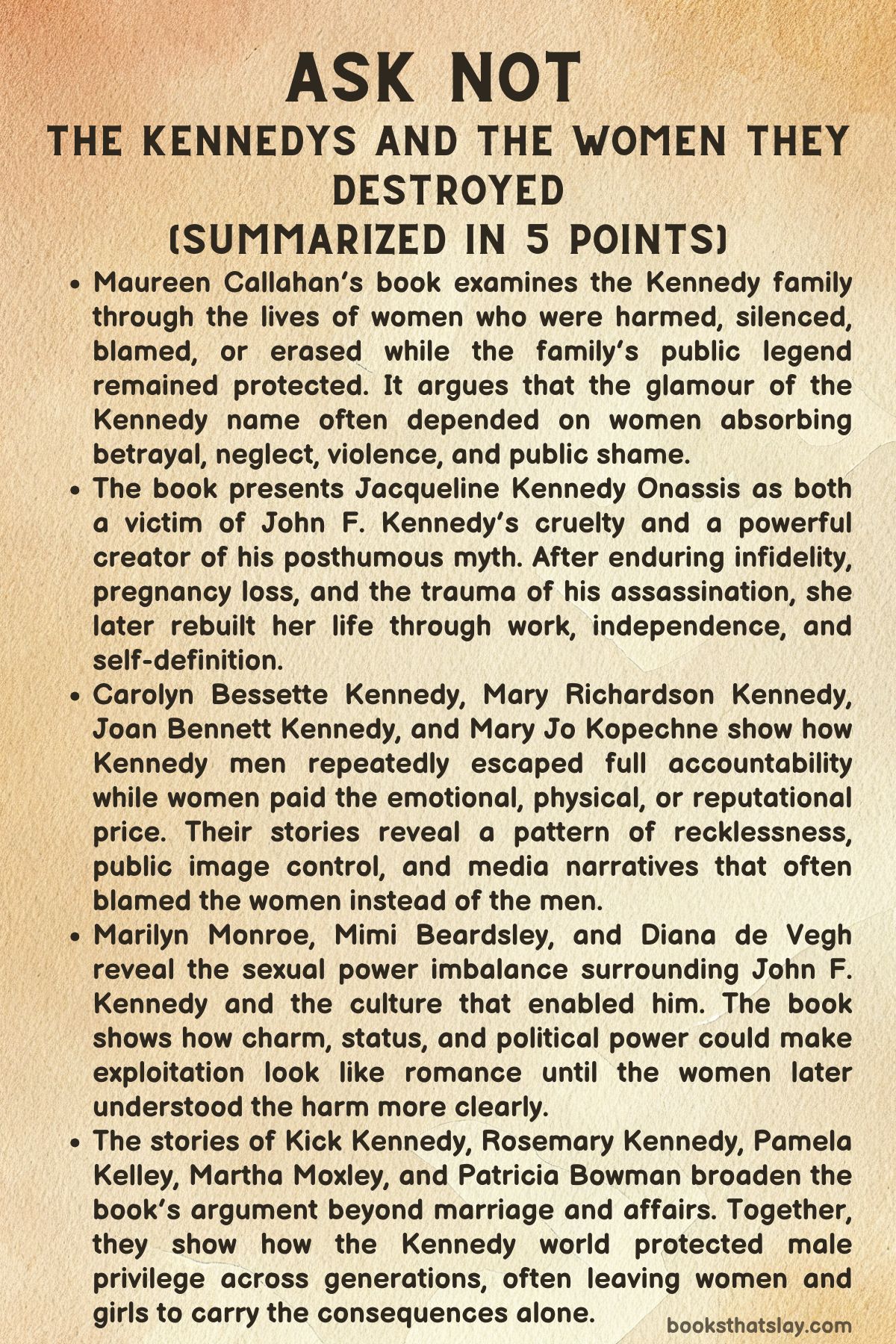
Ask Not: The Kennedys and the Women They Destroyed by Maureen Callahan is a nonfiction account of the Kennedy family told through the women who were hurt, controlled, blamed, or erased while the family’s public myth was protected. The book argues that the Kennedy legend was built not only on charisma, politics, and tragedy, but also on a long pattern of misogyny, entitlement, secrecy, and media complicity.
Callahan centers women such as Jackie Kennedy, Carolyn Bessette Kennedy, Marilyn Monroe, Mary Jo Kopechne, Rosemary Kennedy, and others, presenting their stories as essential to understanding the darker machinery behind one of America’s most famous dynasties.
Summary
Ask Not opens by challenging the familiar Kennedy legend: the image of a brilliant, glamorous American family touched by tragedy and public service. Maureen Callahan argues that this legend has always depended on silence, especially the silence of women.
The book presents the Kennedy story through women who were used, abandoned, blamed, or hidden whenever their suffering threatened the family’s power. It begins with Joseph P. Kennedy Sr., whose ambition, adultery, cruelty, and obsession with status shaped the household.
His sons learned that women could be charmed, managed, discarded, or shamed, while the family name remained protected.
Carolyn Bessette Kennedy’s story introduces this pattern in a modern setting. She married John F. Kennedy Jr., a man adored by the public as the heir to Camelot.
Carolyn was stylish, sharp, and independent, and John was drawn to the way she treated him like a real person rather than a prince. Yet their marriage was strained by fame, his immaturity, his risky behavior, and the impossible standards placed on her.
Carolyn had to be elegant, grateful, and flawless while John’s failures were forgiven as part of his charm. Their final flight became the clearest expression of that imbalance.
John, injured and underprepared, insisted on piloting a small plane despite warnings and poor conditions. The crash killed him, Carolyn, and her sister Lauren.
Even afterward, blame often shifted toward Carolyn rather than toward John’s choices.
Jackie Kennedy’s story shows another face of endurance. She married John F. Kennedy with love and hope, but their marriage was marked by betrayal, illness, loneliness, and public performance.
When she lost pregnancies, she received little care from John, who continued his travels and affairs. Yet Jackie stayed, partly because she understood the political cost of leaving him and partly because she had been trained to carry pain with dignity.
After John’s assassination in Dallas, Jackie refused to let others define the moment. Still wearing her bloodstained suit, she stood as a symbol of national grief and then carefully shaped the public memory of her husband’s presidency.
She helped create the Camelot myth, but the book suggests that this act of image-making also trapped her inside the very legend that had wounded her.
The book also examines the young women drawn into John F. Kennedy’s orbit during his presidency. Mimi Beardsley was a teenage White House intern when the president isolated her and began a sexual relationship with her.
At the time, she lacked the language and confidence to understand the power imbalance. Diana de Vegh, another young woman, also became involved with him, believing his attention meant she mattered.
Both women later recognized that they had been used by a man whose power turned consent, admiration, and fear into something deeply unequal. The people around Kennedy enabled this behavior, treating the women as disposable while preserving his image.
Marilyn Monroe’s place in the book is tied to her hunger for love, respect, and safety. Callahan presents her as far more than the sex symbol of popular memory.
Marilyn wanted to be taken seriously, and her relationships with powerful men often repeated the same wound: pursuit followed by contempt or abandonment. John F. Kennedy and Robert Kennedy offered attention that felt validating, but they also represented danger.
Marilyn’s longing made her vulnerable to men who had no intention of choosing her publicly. Her famous birthday performance for John Kennedy became a public spectacle, after which he withdrew.
Her connection with Robert Kennedy became another source of emotional strain. Her death remains officially tied to overdose, but Callahan highlights the suspicions, missing records, and lasting belief among some close to Marilyn that the Kennedys bore moral responsibility.
Mary Richardson Kennedy’s story moves the family’s pattern into a later generation. Married to Robert F. Kennedy Jr., Mary was beautiful, intelligent, and socially connected, but her marriage deteriorated as he had affairs and blamed her for the damage.
As her mental health worsened, he cut off financial support and allowed her to be portrayed as unstable. After she died by suicide, her family argued that his neglect and cruelty had contributed to her despair.
Robert presented himself as the one who had suffered through her illness, and even her burial became a final indignity when her body was moved away from the Kennedy family plot after the funeral.
Kathleen “Kick” Kennedy’s life reveals how the family punished women for choices that men made freely. Kick was lively, confident, and perhaps more politically gifted than many of her brothers, but her gender limited her future.
She fell in love with Billy Cavendish, a Protestant British aristocrat, and married him despite her Catholic family’s objections. After his death in war, she later loved another Protestant man who was married and seeking divorce.
Her mother threatened to cut her off, and Kick chose love anyway. She died in a plane crash before that future could begin, buried far from the family that had judged her.
Mary Jo Kopechne’s death at Chappaquiddick stands at the center of the book’s indictment of Kennedy privilege. Mary Jo was a capable political aide who had worked for Robert Kennedy and admired his ideals.
She did not share the same respect for Ted Kennedy, who was known for womanizing and carelessness. After a party, Ted drove off a bridge with Mary Jo in the car.
He escaped and failed to call for immediate help. Evidence suggested she may have survived for a time in an air pocket, waiting for rescue that never came.
The Kennedy response focused on saving Ted’s future. Media coverage reduced Mary Jo to rumor, innuendo, and scandal, while Ted went on to remain a powerful senator.
Joan Bennett Kennedy, Ted’s wife, was also sacrificed to protect him. After Chappaquiddick, while pregnant and under severe stress, she was expected to stand by Ted and help soften public anger.
She miscarried soon afterward. Over time, Ted used Joan’s alcoholism and emotional distress as a shield, allowing her struggles to distract from his own behavior.
Yet Joan later became a more independent public figure, especially during Ted’s failed presidential campaign, when women responded to her honesty and vulnerability more than to his evasions.
The book then turns to other women and girls harmed by Kennedy-adjacent power. Pamela Kelley was paralyzed in a Jeep accident caused by Joe Kennedy, yet the family’s early promises of support faded into neglect.
Martha Moxley, a teenage girl murdered in Connecticut, became another victim of privilege when suspicion fell on Michael Skakel, a Kennedy relative by marriage. Her mother fought for justice for decades while the community and media resisted holding the powerful accountable.
Rosemary Kennedy’s story reaches back to the family’s darkest private act. Born with intellectual disabilities, she was treated as an embarrassment and eventually subjected to a lobotomy approved by her father.
The procedure left her severely disabled, and she was hidden away for much of her life.
Rose Kennedy, the matriarch, appears as both victim and enforcer. She endured Joseph Kennedy’s humiliating affairs and taught the women around her that suffering silently was a virtue.
Her ideas about duty, Catholic womanhood, and family loyalty helped maintain the very system that harmed her daughters and daughters-in-law.
The final sections return to survival and self-definition. Jackie, after Aristotle Onassis’s death, built a meaningful life as an editor, preservationist, mother, and cultural figure.
She rejected the idea that her value depended only on marriage or widowhood. Mimi Beardsley and Diana de Vegh eventually told their stories and reframed their experiences through a clearer understanding of power and exploitation.
Joan Kennedy continued to live with the consequences of her marriage but also claimed causes of her own.
The book closes by insisting that the Kennedy myth cannot be understood without the women pushed aside to maintain it. Ask Not is less a traditional family history than a correction: a demand that the women once treated as footnotes be seen as central witnesses to the cost of power, entitlement, and silence.
Key Figures
Carolyn Bessette Kennedy
Carolyn Bessette Kennedy is presented as a woman caught between personal ambition, romantic desire, and the crushing expectations attached to marrying John F. Kennedy Jr. In the book, she is not treated merely as a glamorous wife or fashion icon, but as someone who tried to preserve her identity while being absorbed into a family image much larger than herself. Her appeal lies in her confidence and refusal to treat John Jr. as untouchable; she challenges him, sets boundaries, and sees him as a flawed man rather than a public fantasy.
Yet that same marriage slowly narrows her life. The public expects her to become a modern Jackie, while the Kennedy circle expects loyalty and perfection.
Her frustration grows because John’s recklessness is excused, while her moods, fears, and resistance are judged harshly. In Ask Not, Carolyn becomes a tragic example of how the Kennedy myth demanded that women appear elegant and grateful even when they were privately unhappy, frightened, or endangered.
John F. Kennedy Jr.
John F. Kennedy Jr. appears in the book as a man shaped by adoration, privilege, grief, and pressure. Publicly, he is “America’s Prince,” the handsome son of a murdered president and a living symbol of lost national glamour.
Privately, the book presents him as immature, impulsive, and protected from the full consequences of his failures. His business struggles, especially with George magazine, reveal a man who wants significance but lacks the discipline or judgment required to sustain it.
His relationships show the same pattern: charm and magnetism mixed with entitlement and emotional carelessness. With Carolyn, he wants devotion and admiration, but he also resents her independence and exposes her to danger.
His final decision to fly despite poor conditions and personal limitations becomes a devastating sign of overconfidence. The book treats him not as a villain in a simple sense, but as a privileged man whose inherited mythology allowed dangerous flaws to go unchecked.
Jacqueline Kennedy Onassis
Jacqueline Kennedy Onassis is one of the most complex figures in the book because she is both a victim of the Kennedy machine and one of the people who helped preserve its legend. As John F. Kennedy’s wife, she endures humiliation, infidelity, loneliness, pregnancy loss, and emotional neglect.
Yet she is never passive. After the assassination, she shows extraordinary control, refusing to let others define her husband’s death or her own public role.
Her bloodstained suit, funeral planning, and careful shaping of the Camelot image reveal her understanding of symbolism and power. At the same time, the book shows the personal cost of that control.
Jackie spends years being judged by the public for choices that men around her made freely. Her later life, especially her work in publishing and preservation, allows her to become more than a widow, wife, or national ornament.
She emerges as intelligent, strategic, wounded, proud, and determined to reclaim her life.
John F. Kennedy
John F. Kennedy is portrayed as charismatic, brilliant, charming, and deeply destructive in his treatment of women. The book does not deny his political magnetism or his ability to inspire devotion, but it places those qualities beside his entitlement, compulsive infidelity, and emotional cruelty.
His relationships with Jackie, Mimi Beardsley, Diana de Vegh, Marilyn Monroe, and others reveal a man who often turned female admiration into sexual access. He appears especially troubling because of the power imbalance surrounding him.
Women are drawn to his intelligence, glamour, and status, but he rarely treats them as equals. His affairs are not presented as romantic scandals alone; they become evidence of a larger disregard for women’s emotional safety and dignity.
In marriage, he relies on Jackie’s loyalty while repeatedly betraying her. In public life, he benefits from a culture willing to protect powerful men and shame the women they hurt.
Mimi Beardsley
Mimi Beardsley is one of the clearest examples in the book of how youth, admiration, and institutional power can be exploited. She begins as a young White House intern, inexperienced and overwhelmed by proximity to the president.
Her relationship with John F. Kennedy begins in a situation where his authority, fame, and age make genuine equality impossible. At the time, Mimi interprets his attention as proof that she is special, chosen, and important.
Later, she understands that this feeling was part of the trap. The book presents her growth as a painful reexamination of memory.
What once seemed like a secret romance becomes, with time and maturity, an experience marked by coercion, objectification, and humiliation. Mimi’s importance lies in her eventual refusal to let others define her story.
By speaking out, she challenges the old habit of blaming young women for the actions of powerful men.
Diana de Vegh
Diana de Vegh is presented as intelligent, idealistic, and vulnerable to the intoxicating force of political charisma. Her relationship with John F. Kennedy begins with admiration and the feeling that he values her mind and presence.
Like Mimi, she initially experiences his attention as a form of elevation. The book shows how that attention gradually reveals itself as conditional and self-serving.
Diana recognizes more quickly than Mimi that Kennedy’s life and ambitions will always come first. His calls, campaign concerns, and emotional distance remind her that she exists on the margins of his world, not at its center.
Her later reflections give her character particular strength. She becomes a woman who looks back not simply with regret, but with a sharper understanding of power, manipulation, and the silence that protects celebrated men.
Her story helps widen the book’s argument beyond one affair and toward a pattern of exploitation.
Marilyn Monroe
Marilyn Monroe is shown as a woman whose public image as a sex symbol concealed a deep need for love, respect, and emotional security. The book treats her not as a foolish celebrity destroyed by desire, but as a wounded and intelligent woman repeatedly underestimated by men.
Her marriages to Joe DiMaggio and Arthur Miller show different forms of control: physical abuse, contempt, jealousy, and intellectual dismissal. Her connection to John and Robert Kennedy gives her temporary validation because they seem to recognize both her sensuality and her intelligence.
Yet the attention she receives from them becomes another source of instability. Marilyn wants commitment and recognition, while the Kennedy men want secrecy and access.
Her death carries an atmosphere of suspicion, grief, and unresolved blame. In the book, Marilyn represents the cruelty of a culture that consumes female beauty, mocks female need, and then treats female suffering as spectacle.
Robert F. Kennedy
Robert F. Kennedy appears in several roles: political idealist, grieving brother, possible lover, protector of family power, and member of a culture that repeatedly shields Kennedy men. The book acknowledges the admiration many people felt for his civil rights work and moral seriousness, which makes his darker associations more disturbing.
In relation to Marilyn Monroe, he becomes part of a confusing and damaging emotional triangle in which affection, ambition, secrecy, and reputation collide. In relation to Jackie, he is presented as someone who may have offered comfort after John’s death, creating a bond shaped by shared grief.
Yet the book also places him within the same family system that protects male privilege. His image as the “better” Kennedy is complicated by the broader pattern of silence and damage around him.
He is not treated as purely corrupt, but his virtue is shown as incomplete when measured against the women harmed by the family’s needs.
Mary Richardson Kennedy
Mary Richardson Kennedy is one of the most painful figures in the book because her decline is portrayed as both personal and relational. She is beautiful, socially gifted, loyal, and initially well suited to life beside Robert F. Kennedy Jr. She knows his flaws, including addiction and instability, but believes in his potential and supports his public causes.
Over time, however, marriage becomes a place of abandonment rather than partnership. His affairs, emotional distance, and financial control worsen her distress.
The book does not present Mary as flawless; instead, it insists that her struggles do not justify her mistreatment. Her death by suicide becomes a terrible endpoint to years of neglect, humiliation, and isolation.
The handling of her funeral and burial adds another layer of cruelty, suggesting that even after death, her place within the Kennedy story could be controlled, revised, and physically moved.
Robert F. Kennedy Jr.
Robert F. Kennedy Jr. is portrayed as a modern inheritor of Kennedy privilege, benefiting from the family name while repeating many of its damaging patterns. In public, he is associated with activism, controversy, and political ambition.
In private, as presented in the book, he is a husband whose treatment of Mary Richardson Kennedy reveals selfishness, blame-shifting, and emotional cruelty. His writings and public comments cast Mary as unstable and difficult while minimizing his own role in her suffering.
The book positions him as someone skilled at using victimhood to protect himself. Even after Mary’s death, he appears more concerned with controlling the narrative than honoring the depth of her pain.
His character shows how the Kennedy myth survives across generations: the man remains publicly fascinating, while the woman hurt beside him is reduced to a problem, a scandal, or a footnote.
Kathleen “Kick” Kennedy
Kathleen “Kick” Kennedy is one of the most vibrant and independent women in the book. She is energetic, socially confident, athletic, stylish, and politically aware.
Her tragedy comes from being born into a family that recognizes her brilliance but limits her because she is female. Joseph Kennedy Sr. sees her talent, but the political future he imagines belongs to sons, not daughters.
Kick’s romantic choices expose the family’s religious and gendered double standards. Her brothers are allowed sexual freedom, but she is threatened with rejection for loving Protestant men and for choosing passion over obedience.
Her decision to marry Billy Cavendish and later pursue love again after widowhood shows courage and a refusal to let family doctrine dictate her life. Her early death in a plane crash turns her into one of the book’s sharpest examples of lost possibility: a woman with political gifts, emotional bravery, and no permitted public path equal to her abilities.
Mary Jo Kopechne
Mary Jo Kopechne is presented as intelligent, disciplined, principled, and politically committed. She is not merely the woman who died at Chappaquiddick; the book restores her identity as a capable aide whose loyalty belonged to Robert Kennedy’s ideals rather than to the Kennedy name itself.
Her death is one of the book’s central examples of how a woman’s life could be erased to protect a man’s future. After Ted Kennedy’s car went off the bridge, his failure to seek immediate help becomes morally defining.
The response afterward is almost as damaging as the accident itself. Mary Jo is reduced by the press to gossip, implication, and sexual suspicion, despite testimony from those who knew her character.
The book treats her as a victim not only of Ted’s actions, but of a public narrative that cared more about a senator’s career than a young woman’s terror, pain, and lost future.
Edward “Ted” Kennedy
Ted Kennedy is portrayed as careless, entitled, self-pitying, and repeatedly protected by the family’s influence. His conduct at Chappaquiddick defines him in the book, not only because Mary Jo Kopechne died, but because of his response after escaping the car.
His delay, inconsistent explanations, and later attempts to manage public perception show a man trained to think first about survival, reputation, and political consequence. His marriage to Joan Bennett Kennedy reveals another side of the same entitlement.
He relies on her charm and loyalty when useful, yet uses her alcoholism and emotional distress to draw sympathy toward himself. His political career continues despite the damage around him, which makes him a symbol of institutional forgiveness granted to powerful men.
The book does not present his public achievements as enough to erase the private wreckage attached to his life.
Joan Bennett Kennedy
Joan Bennett Kennedy is one of the book’s strongest examples of a woman used as public cover for male failure. She enters the Kennedy world as beautiful, admired, and socially gifted, but slowly realizes that Ted sees her partly as an asset to his ambitions.
Her warmth and relatability help his political career, especially when she campaigns for him after his plane crash. Yet her sacrifices are rarely honored.
After Chappaquiddick, she is pressured to stand beside him while pregnant and emotionally devastated. Her miscarriage and later alcoholism are connected to the unbearable strain of that role.
The book treats Joan with sympathy but not condescension. Her addiction is not framed as weakness alone; it is also a symptom of betrayal, public performance, and emotional abandonment.
Her later advocacy for women’s rights gives her a measure of independence, allowing her to become more than Ted Kennedy’s damaged wife.
Pamela Kelley
Pamela Kelley is a figure of long-term physical and emotional consequence. Her life changes when Joe Kennedy’s reckless driving leaves her paralyzed.
The book presents her as a young woman whose suffering is first acknowledged and then minimized once the immediate shock passes. The Kennedy response to her injury follows a familiar pattern: public concern, private retreat, and eventual neglect.
Pamela’s refusal to sue at first shows loyalty and trust, but that trust is not returned with adequate care. Her needs continue for decades, while the financial help she receives remains limited compared with the family’s resources.
Her story matters because it shows that harm in the Kennedy orbit is not always dramatic in a public, headline-making way. Sometimes it lasts quietly for years, in medical bills, lost mobility, isolation, and the knowledge that promises made after tragedy can fade when they become inconvenient.
Joe Kennedy
Joe Kennedy, connected to Pamela Kelley’s accident, represents the younger generation’s inheritance of recklessness without accountability. His dangerous driving causes life-altering harm, yet the legal and social consequences remain minimal.
In the book, his actions after the accident matter as much as the accident itself. He promises support, but the promise becomes thin and insufficient over time.
The contrast between his resources and Pamela’s needs exposes the moral failure at the heart of his character. He is not developed as deeply as some central figures, but he serves an important function: he shows that Kennedy privilege does not operate only in presidential politics or national scandals.
It also appears in local courtrooms, private arrangements, and decades of inadequate responsibility. His character helps show how family protection can make ordinary justice feel unreachable.
Martha Moxley
Martha Moxley is presented as lively, innocent, and brutally failed by the world around her. She is a teenager whose murder should have produced universal outrage, yet the social power surrounding the Skakel and Kennedy families slows and distorts the pursuit of justice.
The book emphasizes Martha’s youth, kindness, and ordinary desire to enjoy a night with friends, making the violence against her especially devastating. After her death, her character is further violated by attempts to sexualize or blame her.
The suggestion that she somehow invited danger becomes part of the same cultural pattern seen elsewhere in the book: a dead or wounded woman is made responsible for male violence. Martha’s importance lies in the contrast between her vulnerability and the power of those protected after her murder.
She becomes a symbol of how privilege can outlive even the most horrifying evidence.
Dorothy Moxley
Dorothy Moxley, Martha’s mother, is one of the book’s figures of endurance and moral clarity. After her daughter’s murder, she refuses to accept silence, social pressure, or polite avoidance.
Her grief becomes a long campaign for justice. The book shows how isolating that campaign is.
Other parents and community members prefer peace, reputation, and distance over truth, but Dorothy continues to seek accountability. Her character is important because she stands outside the Kennedy-protection system and refuses to obey its rules.
She does not have their money, influence, or media reach, but she has persistence. Dorothy’s pain is not sentimentalized; it is shown as active, disciplined, and exhausting.
Through her, the book honors the labor required of women who must fight to keep a victim’s name from being buried beneath the comfort of the powerful.
Michael Skakel
Michael Skakel is portrayed as deeply troubled and protected by association with Kennedy power. His connection to Martha Moxley’s murder places him in the book’s broader examination of male violence and social insulation.
The evidence and later legal developments make him a figure through whom the book explores how justice can be delayed, challenged, and weakened when the accused belongs to a protected circle. His character is disturbing not only because of the crime linked to him, but because of the narratives built around Martha after her death.
The attempt to present her as sexually manipulative or responsible for male jealousy helps redirect attention away from the brutality of her murder. Michael’s eventual conviction, release, and contested legal status show how even apparent accountability can remain unstable when powerful defenders continue to intervene.
Rosemary Kennedy
Rosemary Kennedy is among the most tragic figures in the book because her own family turns her vulnerability into a problem to be hidden. Born with cognitive disabilities, she struggles to meet the severe standards of achievement imposed by Joseph and Rose Kennedy.
She is capable of warmth, sociability, and growth when placed in supportive environments, but her parents judge her by how well she fits the family image. Her father’s decision to approve a lobotomy is presented as one of the family’s most horrifying acts.
The procedure destroys much of her ability to live independently, and afterward she is largely removed from public family life. Rosemary’s character reveals the cruelty behind the family’s obsession with perfection.
She is not dangerous to the Kennedys because of anything she does; she is dangerous because her existence disrupts their image of disciplined, superior success.
Rose Fitzgerald Kennedy
Rose Fitzgerald Kennedy is presented as both a sufferer and a guardian of the very values that harm the women around her. Her marriage to Joseph Kennedy Sr. teaches her to endure betrayal and humiliation as part of duty.
Rather than reject that lesson, she passes it forward, especially to daughters and daughters-in-law. Rose believes deeply in Catholic discipline, family loyalty, and emotional restraint.
These beliefs give her strength, but they also make her capable of coldness. Her treatment of Kick and her long failure to visit Rosemary after the lobotomy show how religious and social rules can become more important than compassion.
Yet the book does not make Rose a simple villain. She is a woman shaped by her era, her faith, her marriage, and her own survival strategies.
Her tragedy is that she mistakes endurance for virtue even when endurance protects cruelty.
Joseph P. Kennedy Sr.
Joseph P. Kennedy Sr. is the root of much of the damage traced through the book. Ambitious, controlling, and obsessed with dynasty, he builds his family as if it were a political machine.
His children are trained to compete, perform, win, and serve the larger family mission. His treatment of women sets the moral climate.
He humiliates Rose with open affairs, encourages sexual freedom in his sons, and restricts his daughters through rigid expectations. His handling of Rosemary is especially damning because it shows his willingness to sacrifice a child’s well-being to protect reputation and control.
Joseph’s character represents patriarchal power in its most direct form: money, sex, politics, secrecy, and authority fused into one system. In Ask Not, his influence does not end with his own life; it continues through the attitudes and actions of the men who come after him.
Patricia Bowman
Patricia Bowman is significant in the book as a woman whose accusation against William Kennedy Smith exposes the cruelty of public judgment toward women who report sexual assault. Her experience shows how the Kennedy defense pattern extends beyond marriage, affairs, and fatal accidents into the legal and media treatment of sexual violence.
Patricia is placed under scrutiny while the accused man receives sympathy and concern for his damaged reputation. The book uses her case to show how women are often asked to prove not only what happened to them, but also their worthiness as victims.
Her character stands as a survivor forced into a hostile public arena. She matters because her treatment demonstrates that the Kennedy name could shape not only private loyalty and press coverage, but also the emotional atmosphere around justice itself.
William Kennedy Smith
William Kennedy Smith appears as another Kennedy man whose alleged violence is filtered through family reputation and public defense. His acquittal does not remove his importance in the book’s moral argument, because the focus is on the machinery surrounding him.
The Kennedy circle’s response, including efforts to undermine Patricia Bowman, reflects a familiar instinct: protect the man, question the woman, preserve the name. William’s character is less individually developed than the major Kennedys, but he functions as evidence that the family pattern repeats across branches and generations.
He represents the ease with which male misconduct can become a public relations problem rather than a human crisis. His role in the book reinforces the idea that women who challenge powerful men often face a second injury through disbelief, humiliation, and reputational attack.
Aristotle Onassis
Aristotle Onassis is presented as Jackie’s attempted escape and another form of confinement. To the public, Jackie’s marriage to him looks like a betrayal of her national widowhood, but the book frames it as an effort to survive grief, fear, and the burden of being frozen as a symbol.
Aristotle offers money, distance, and protection, but not emotional safety. He treats Jackie as a possession and uses humiliation to assert control.
His infidelity and verbal cruelty reveal that her second marriage, though different from her first, repeats the pattern of a powerful man expecting a woman to absorb disrespect. His role is important because he helps push Jackie toward a later awakening.
Through life with him, she begins to understand her anger, her rights, and her need for work and self-definition beyond marriage.
Maurice Tempelsman
Maurice Tempelsman represents a calmer and more supportive presence in Jackie’s later life. Unlike the men who used Jackie as a political asset, social prize, or possession, he is associated with companionship during a period when she is rebuilding herself through work, motherhood, and cultural influence.
The book does not make him the source of Jackie’s renewal, which is important. Jackie’s growth comes from her own decisions: entering publishing, preserving historic spaces, developing intellectual purpose, and refusing to live only as an emblem of the past.
Maurice matters because he belongs to this later chapter of greater autonomy. His presence suggests that intimacy need not require the erasure of the woman beside the man.
In that sense, he helps mark the difference between Jackie’s life under male control and Jackie’s life on her own terms.
Themes
The Cost of Protecting a Dynasty
The Kennedy family’s public image depends on a repeated exchange: women absorb pain so men can keep power. Political promise, good looks, wealth, and national nostalgia make the men appear larger than their actions, while women are pressured to become silent witnesses, loyal wives, convenient lovers, or damaged outsiders.
Ask Not shows that the dynasty is not protected only by family members. Journalists, lawyers, advisers, friends, voters, and social circles also help maintain it.
When a scandal appears, attention often moves away from the act itself and toward the woman involved. Mary Jo Kopechne becomes a rumor instead of a victim.
Carolyn Bessette Kennedy becomes difficult instead of endangered. Joan Kennedy becomes unstable instead of betrayed.
Mary Richardson Kennedy becomes a burden instead of a woman harmed by neglect. This pattern reveals how reputation can become more valuable than truth.
The family’s survival requires emotional and moral rearrangement, where the public is encouraged to mourn Kennedy men, forgive Kennedy men, and remain suspicious of the women hurt beside them.
Misogyny as Family Inheritance
Misogyny in the book is not limited to individual cruelty; it is passed down like a family tradition. Joseph Kennedy Sr. models the pattern through his affairs, control, and treatment of daughters as less politically valuable than sons.
His sons inherit not only wealth and ambition but also the assumption that women exist to serve male needs, protect male reputations, and endure male betrayal. This inheritance appears in marriages, affairs, accidents, scandals, and legal defenses.
Women are expected to be beautiful, loyal, discreet, and forgiving, while men are allowed recklessness, lust, rage, and weakness. The double standard is especially visible in Kick Kennedy’s life.
Her brothers’ sexual freedom is tolerated, but her romantic choices are treated as moral rebellion. Rosemary Kennedy’s fate shows an even harsher version of the same logic: a daughter who does not fit the desired image is hidden and medically damaged.
The theme is powerful because it shows misogyny as something taught, rewarded, and protected, not merely something privately felt.
Silence, Shame, and the Control of Women’s Stories
Control over narrative is one of the book’s central forms of power. Again and again, women lose not only safety or dignity, but also the right to define what happened to them.
Mimi Beardsley and Diana de Vegh take decades to reinterpret experiences that were once framed through secrecy and glamour. Marilyn Monroe is reduced by public memory to seduction and instability, even though the book stresses her intelligence, ambition, and need for respect.
Mary Jo Kopechne’s character is distorted after death, as insinuations about sex and recklessness replace attention to Ted Kennedy’s choices. This control of story often depends on shame.
If a woman can be made to seem unstable, promiscuous, greedy, dramatic, or difficult, then the man’s responsibility becomes easier to blur. The book argues that reclaiming these stories matters because silence is never neutral.
Silence protects the powerful, isolates victims, and teaches later generations to confuse public charm with private goodness.
Survival and Self-Definition After Public Damage
Several women in the book are harmed by the Kennedy world but are not defined only by that harm. Jackie Kennedy Onassis is the clearest example.
After years of being treated as wife, widow, symbol, and scandal, she creates a working life in publishing and preservation. Her later career matters because it allows her intelligence to operate outside the roles assigned to her by marriage and national grief.
Joan Kennedy also becomes more than Ted Kennedy’s suffering wife, especially through her connection to women’s rights and public honesty about struggle. Mimi Beardsley and Diana de Vegh reclaim their voices by naming the imbalance that shaped their relationships with John F. Kennedy.
Even figures who do not survive, such as Mary Richardson Kennedy, Mary Jo Kopechne, and Marilyn Monroe, are granted fuller identities through the act of retelling. The theme is not simple triumph.
Many wounds remain permanent. Still, the book insists that women deserve to be seen in full: not as accessories to famous men, but as people with desires, intelligence, anger, talent, and histories of their own.