Ask Me No Questions Summary, Characters and Themes
Ask Me No Questions by Marina Budhos is a young adult novel about fear, belonging, family, and the cost of living unseen. Set in New York after 9/11, it follows Nadira Hossain, a Bangladeshi Muslim teenager whose undocumented family is pushed into crisis when immigration authorities detain her father.
Through Nadira’s quiet, observant voice, the book explores how public suspicion and private shame can reshape a family’s dreams. It is also a coming-of-age story about a girl who has always felt overshadowed, but learns that courage can begin with noticing what others miss.
Summary
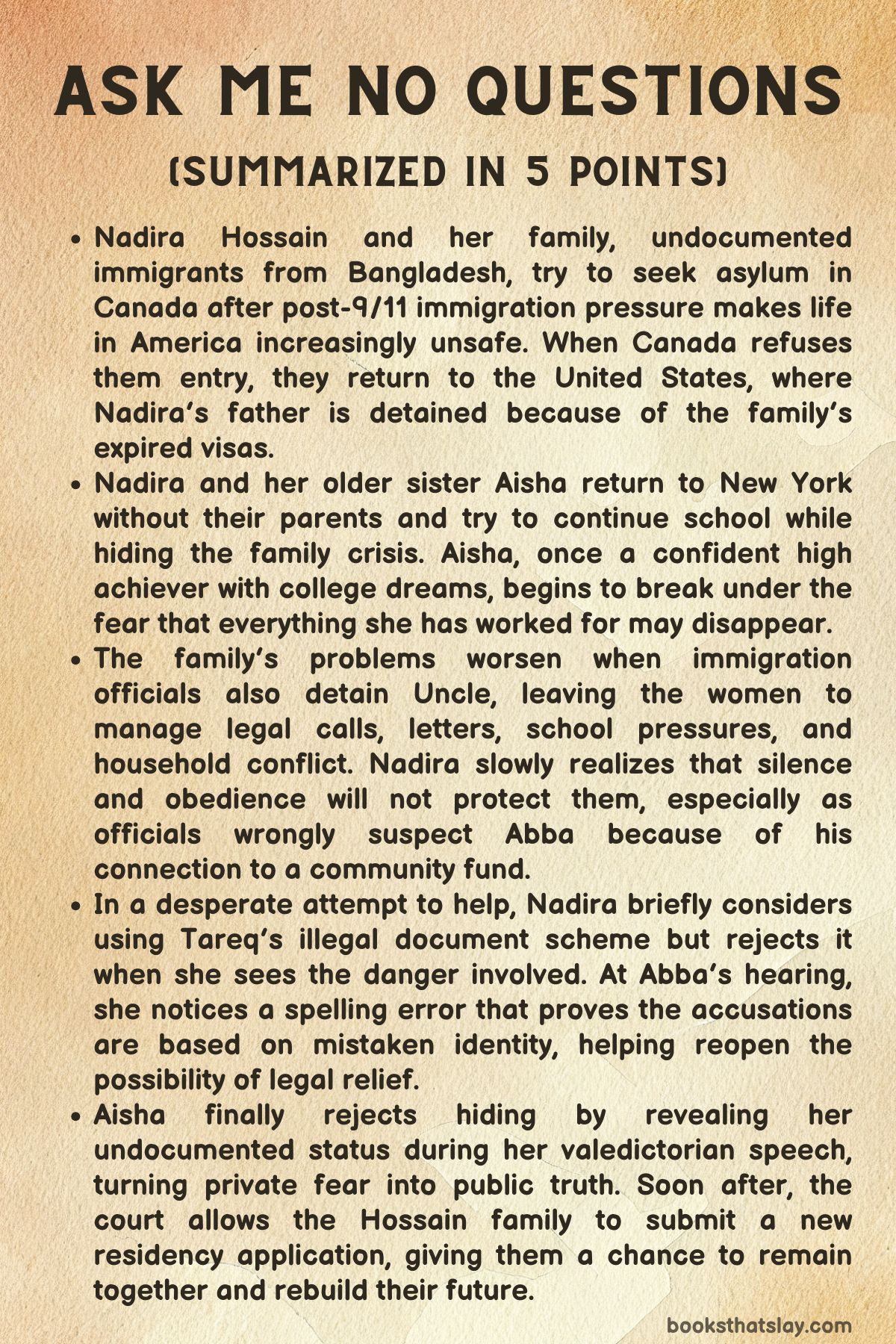
Nadira Hossain and her family are driving from New York toward the Canadian border, hoping to claim asylum. Her parents, Ma and Abba, sit in the front, while Nadira and her older sister Aisha sit in the back.
The trip is heavy with fear and disappointment. Aisha, the brilliant student everyone admires, cries as they pass Boston because the journey seems to end her dream of someday going to Harvard Medical School.
Nadira watches her sister and feels the familiar ache of being compared to her. Aisha is ambitious, polished, and praised; Nadira is quieter, less confident, and often treated as the one who trails behind.
The Hossains originally came from Dhaka, Bangladesh, when Nadira was seven. They entered the United States on tourist visas and stayed after those visas expired.
Their situation was always fragile, but after 9/11 it became far more dangerous. As Muslims and immigrants from South Asia, they live under a new level of suspicion.
Government policies, special registration rules, deportations, and community fear make daily life feel unsafe. Like other Bangladeshi families, the Hossains believe Canada may offer a chance to start over.
At the Canadian border, their hope collapses. The officer tells them Canada cannot take more asylum seekers.
Forced to turn back, they re-enter the United States, where officials notice their expired visas. Abba is detained, and deportation proceedings begin.
Before he is taken away, he tells Aisha to drive herself and Nadira back to New York, while Ma remains nearby in Vermont. The family is suddenly split apart, and Nadira and Aisha must return home without their parents.
On the drive back, the sisters sit inside a silence filled with anger, worry, and helplessness. Nadira thinks about the private truths of her family, including how hard Aisha works despite everyone assuming her achievements come easily.
Their relationship is strained by rivalry and resentment. At a buffet, Aisha makes a cruel comment about Nadira’s weight, deepening Nadira’s hurt.
Yet Aisha also reminds her that they are sisters and must stand together now that their parents are gone.
Back at school, the sisters resume their ordinary routines, though nothing feels ordinary. Their immigration status remains secret.
Other students at school are also undocumented, but no one speaks openly about it. Aisha continues to be seen as an ideal student: a math team star, a strong debater, and a serious candidate for college.
Her counselor tells her Barnard College is interested in her application and wants an interview. Nadira sees how much Aisha has to hide behind her success.
After school, Nadira visits Ali-Uncle, a family friend who runs a magazine shop. There she meets Tareq, a young man with a risky reputation.
He says he can help her get a fake green card, but Ali-Uncle warns her against trusting him. At home, tension rises within the extended family.
Nadira’s aunt, uncle, and cousin Taslima share their apartment. Taslima, a Queens College student, is dating Tim, a white law student who understands some of the immigration rules.
Abba had wanted to obey special registration requirements, while Uncle believes it is better to stay invisible. The family is divided between following the law, hiding from it, leaving the country, and trying to build a future anyway.
Nadira’s uncle becomes increasingly fearful and angry. He tells her about men in their community who have disappeared and recalls family trauma from the violent history of Bengal.
Nadira also thinks about Bangladesh’s past: colonial rule, famine, partition, religious violence, and the long shadow of displacement. The family’s present fear in America echoes older histories of borders, suspicion, and loss.
Aisha tries to keep control, but the pressure begins to crack her. When she shares that she has been nominated for valedictorian, Nadira lashes out and belittles her.
The moment gives Nadira a cruel sense of power, though it also reveals how deeply both sisters are hurting. Soon, Auntie and Tim tell them Abba’s bond has been denied.
Worse, officials are investigating him because of a problem on his application and possible political connections. Aisha breaks down, and Nadira does not know how to comfort her.
The sisters visit Mr. Rashid, a lawyer Aisha found after seeing him on television. They explain that Abba’s detention threatens not only the family’s safety but also Aisha’s college plans.
Mr. Rashid listens but warns that the case will be long and complicated. Aisha cannot bear the uncertainty and storms out.
Outside, she admits she is terrified for Abba. On the train home, Nadira sits close to her, offering quiet support.
Aisha and Nadira keep trying to find answers. At Dunkin’ Donuts, Aisha uses a friend’s phone to call the detention center, but the system gives her only delays and confusion.
They learn from Ma that Abba is being questioned about money he gave to Ali-Uncle. At the mosque, Ali-Uncle explains that Abba had contributed to a community fund used by Bangladeshi immigrants to help one another.
Abba had been saving for his daughters’ education, but officials now view the fund with suspicion. The sisters decide to write letters to immigration officials and their congressman, hoping someone will see their case clearly.
Then immigration officers come to the apartment and demand documentation from the family. Everyone is taken for questioning.
Tim joins them at the station, but the wait is frightening. They learn that Uncle has been taken to a jail facility in Manhattan.
Auntie is devastated. Aisha argues with the officers and later blames herself, wondering whether she could have stopped it.
With Abba and Uncle detained, the women are left to manage the crisis. They contact Mr. Rashid, wait outside detention centers, write letters, and try to keep the household functioning.
Aisha’s life begins to fall apart. While her friends talk about summer plans, she is consumed by fear.
She withdraws from school and friends. Taslima rebels against her parents, stays out late, fights with Auntie, and eventually cuts her hair.
Nadira reconnects with her friend Lily Yee and helps uncover Lily’s own family secret: her father has been living a double life with another woman and a baby. This reminds Nadira that many families hide painful truths.
Uncle is eventually released, but he has only thirty days to fix his immigration status. He returns weak and shaken.
Meanwhile, Aisha’s Barnard interview approaches. She is haunted by nightmares of police raids and wants to skip it, but Nadira urges her to go and promises to come with her.
At Barnard, Aisha is nervous and overwhelmed. While Aisha is inside, Nadira walks near the river and briefly imagines that college could be part of her own future.
That hope fades when she finds Aisha vomiting after the interview.
Soon Nadira learns that Aisha’s valedictorian nomination is at risk and that Barnard reported she skipped the interview. Aisha confesses that she no longer wants to stand out.
Being exceptional has become too painful because success seems useless if the family may be deported. Nadira hugs her, seeing that her perfect sister is breaking under a burden no teenager should carry.
When Ma sends word that Abba’s hearing is near, Nadira decides to act. She believes the letters she and Aisha wrote may help prove something important.
Desperate, she calls Tareq and agrees to pay him for help. She gets money from Ali-Uncle and meets Tareq, but when he shows her a gun and takes her to a house filled with dangerous men, Nadira realizes she cannot go through with the plan.
She runs away and takes a bus to Vermont.
At the hearing, Nadira barely recognizes Abba, who has been worn down by detention. Officials accuse him of links to suspicious organizations because of the community fund.
Nadira asks to speak and points out a key mistake: the name on the evidence is spelled differently. The contributions were connected to “Hossein,” not “Hossain.” Her observation exposes a case of mistaken identity.
The judge does not ignore the expired visa, but agrees that immigration should reconsider Abba’s appeal for residency. Nadira leaves with relief, proud that she found a truth others missed.
When the family returns home, more changes await. Taslima has moved in with Tim and married him, while Auntie and Uncle prepare to return to Bangladesh.
Abba learns that Aisha has been skipping school, and both father and daughter sink into silence. A letter about Abba’s final appeal arrives, and Aisha destroys her college acceptance letters, convinced there is no future for them in America.
Nadira finds her at a playground from their early days in Queens and challenges her. Nadira argues that hiding has not saved them.
She believes they must stop pretending and tell the truth publicly.
At graduation, Aisha stands before her school as valedictorian. Her family is present, along with a reporter named Cassie David, who has written about their case.
In her speech, Aisha reveals that she is undocumented. She tells the story of arriving on a tourist visa, trying to blend in, working hard, and then being treated as a threat after 9/11.
She refuses to disappear into silence anymore. Her speech becomes an act of self-recognition and public courage.
Two days later, the family goes to court for Abba’s appeal. They dress carefully and carry the documents they may need, including plans in case they must leave for Canada.
Cassie David is there too. The judge acknowledges Abba’s visa violation but also recognizes the extraordinary circumstances of the case.
She allows the family to submit a new residency application and assures them it will be accepted and processed. The family heads home with a future that is still uncertain, but no longer closed.
Ask Me No Questions ends with Nadira, Aisha, and their parents having chosen visibility over fear, and with Nadira understanding that her own voice has power.
Characters
Nadira Hossain
Nadira Hossain is the central voice of the book and the character through whom the reader understands the fear, shame, silence, and courage surrounding undocumented immigrant life. At the beginning, she sees herself as ordinary and overlooked, especially beside Aisha, whose academic brilliance makes Nadira feel smaller.
Nadira’s insecurity is not only about school or personality; it is also tied to how her family treats Aisha as the one with a future. Nadira is sensitive, observant, and often wounded by comments about her weight, her ability, and her place in the family.
Yet these same qualities make her unusually perceptive. She notices what others miss, whether it is Aisha’s hidden exhaustion, Abba’s quiet sacrifices, or the spelling error that changes the direction of their legal case.
In Ask Me No Questions, Nadira’s growth is not loud at first. She does not suddenly become fearless; instead, she slowly learns that being quiet does not mean being powerless.
Her decision to speak at Abba’s hearing marks a major shift in her identity. She moves from feeling like a burden to recognizing herself as someone capable of action, insight, and moral courage.
By the end, Nadira becomes the emotional force who pushes Aisha and the family away from hiding and toward visibility.
Aisha Hossain
Aisha Hossain is Nadira’s older sister and one of the most complex figures in the story. She is a high-achieving student, a debate team member, a math team star, and a strong candidate for prestigious colleges.
To teachers and classmates, she appears disciplined, gifted, and destined for success. Within the family, she represents hope: proof that their sacrifices in America might lead to a better life.
However, Aisha’s perfection is also a mask. She carries the pressure of being the successful daughter while hiding the truth of her undocumented status.
Her ambition depends on a fragile belief that if she works hard enough and stays unnoticed, the system will allow her to move forward. When Abba is detained and the family’s future becomes uncertain, that belief breaks.
Aisha’s collapse is painful because it reveals how much fear has been hidden beneath her achievements. She skips school, withdraws from friends, misses opportunities, and destroys her college letters because success feels meaningless without security.
Her valedictorian speech becomes her turning point. By publicly revealing her undocumented status, she rejects the idea that survival requires silence.
In Ask Me No Questions, Aisha represents both the promise and the emotional cost of immigrant ambition under constant threat.
Abba
Abba is the father of Nadira and Aisha, and his character is shaped by responsibility, dignity, and moral uncertainty. He wants to protect his family, but he lives in a world where every choice seems dangerous.
His decision to take the family to Canada comes from desperation, not recklessness. He believes that crossing the border may offer safety, but the failed attempt leads to his detention and exposes the family to greater danger.
Abba is principled, but America’s immigration system places him in situations where doing the “right” thing is never simple. His earlier desire to register under special immigration rules shows that he does not want to live dishonestly, yet the same system punishes him and treats him with suspicion.
His contributions to a community fund, meant to support education and mutual aid, are wrongly viewed as possible evidence of dangerous activity. Abba’s suffering in detention shows how quickly a caring father can be reduced to a case file.
He is not portrayed as perfect, since his decisions place the family at risk, but his actions are rooted in love and fear for their future. His release becomes possible partly because Nadira recognizes the mistaken identity at the center of the accusation against him.
Ma
Ma is a quieter but important presence in the book. At first, she seems defined by worry, motherhood, and dependence on the family structure around her.
When Abba is detained and she remains in Vermont, she is physically separated from her daughters, which changes how Nadira sees her. Ma’s time away from the apartment allows her to form connections with other people and adapt to an unfamiliar environment.
This surprises Nadira because she is used to seeing her mother mainly within the family’s domestic world. Ma’s character shows that strength does not always look dramatic.
She endures fear, separation, and uncertainty while continuing to hold the family together emotionally. Her transformation also suggests that immigrant women, often viewed only as mothers or wives, may have inner lives and resilience that their children do not immediately recognize.
Ma’s presence at the later court appearance matters because it shows the family returning as a unit, not fully healed but still together. She represents patience, endurance, and the quiet adjustments required when a family is forced to survive legal and emotional crisis.
Uncle
Uncle is a fearful, angry, and deeply wounded character whose behavior is shaped by history as much as by present danger. He distrusts the West and believes that trying to cooperate with immigration authorities is foolish.
Unlike Abba, who considers registration a possible duty, Uncle prefers invisibility. His fear is not baseless.
He has inherited stories of violence, displacement, and death from Bengal’s past, and these memories affect how he understands borders and governments. When he grabs Nadira and tells her about his grandmother’s murder while fleeing, his anger reveals trauma that has never truly disappeared.
His later detention confirms many of his fears and leaves him physically and emotionally broken. After his release, he has only a short time to resolve his immigration status, and he chooses to return to Bangladesh.
Uncle’s character shows how fear can harden into suspicion and how historical trauma can shape present decisions. He is not simply stubborn; he is a man whose life has taught him that authorities can destroy families without warning.
Auntie
Auntie is a practical and emotionally strained figure who carries much of the household’s burden after the men are detained. Her grief when Uncle is taken shows her deep dependence on the family structure that is suddenly falling apart.
She urges Nadira to comfort Aisha, which suggests that Auntie sees emotional responsibility as something the women must carry, even when they themselves are frightened. Her conflict with Taslima also reveals generational tension.
Auntie expects obedience, family loyalty, and cultural continuity, while Taslima wants independence and the right to make her own choices. Auntie’s pain is not only about immigration; it is also about losing control over her family.
Uncle’s detention, Taslima’s rebellion, and the possibility of returning to Bangladesh all threaten the life she has tried to maintain. She represents the older immigrant generation’s struggle to preserve stability when the world around them keeps changing.
Taslima
Taslima is Nadira and Aisha’s cousin, and she represents rebellion, independence, and the frustration of young immigrants caught between family duty and personal desire. As a Queens College student, she wants to continue her education and build a life in America.
Her relationship with Tim becomes a major source of conflict because it challenges her parents’ expectations and cultural boundaries. Taslima does not want to return to Bangladesh simply because the adults are afraid.
Her resistance grows stronger as the family crisis deepens. She stays out late, fights with Auntie, cuts her hair, and eventually moves in with Tim and marries him.
These actions can seem impulsive, but they also show her refusal to let fear decide her future. Taslima’s choices contrast with Aisha’s temporary collapse.
While Aisha responds to uncertainty by giving up on achievement, Taslima responds by claiming control over her personal life. Her character adds another view of immigrant youth: not only the obedient achiever or the quiet observer, but also the young woman who breaks rules to protect her sense of self.
Tim
Tim is Taslima’s boyfriend and later husband, and he functions as both an outsider and a partial ally. As a white law student, he has access to knowledge and social confidence that the Hossain family often lacks.
He explains legal matters, helps at the police station, and offers practical support during moments of crisis. However, his presence also creates tension.
To Taslima’s parents, he represents cultural distance and a threat to family tradition. His relationship with Taslima raises questions about assimilation, independence, and the limits of parental control.
Tim is not the emotional center of the book, but he plays an important role in showing how legal knowledge can become a form of power. While the family is frightened and uncertain, Tim can speak with more confidence because the system was not built to intimidate him in the same way.
His character highlights the unequal positions people occupy in moments of legal crisis.
Ali-Uncle
Ali-Uncle is a trusted family friend and community figure who shows the importance of mutual support among immigrants. His magazine shop is a place where Nadira encounters both comfort and danger, since it connects her to the Bengali community but also to Tareq.
Ali-Uncle warns Nadira against fake documents and tries to discourage reckless choices. His connection to the community fund is especially important.
What the government treats with suspicion is, in reality, a system of support among people who lack security and formal access. Abba’s money in the fund is meant for his daughters’ education, not for anything harmful.
Ali-Uncle therefore represents the gap between how immigrant communities understand themselves and how they are viewed by suspicious authorities. His disappearance later in the book adds to the sense that the community itself is being scattered by fear.
He is a reminder that when governments target vulnerable groups, they damage not only individuals but also the networks that help those people survive.
Tareq
Tareq is a risky and unsettling character who represents the dangerous paths that desperation can open. Known as “bagh’a,” or “tiger,” he carries an image of boldness and defiance.
To Nadira, he initially seems like someone who might offer a solution when official systems fail her family. He suggests fake documents and later agrees to help her for money.
However, the deeper Nadira goes into his world, the clearer it becomes that his help comes with serious danger. The gun in his car and the men gathered around another gun reveal that he is connected to criminal activity, not genuine safety.
Tareq’s role is important because he shows how vulnerable people can be pushed toward unsafe choices when legal routes feel impossible. Nadira’s decision to run away from him marks a moment of moral clarity.
She realizes that saving her family cannot mean surrendering herself to a world of fear, violence, and false identities.
Mr. Rashid
Mr. Rashid is the lawyer who helps the Hossain family understand the complexity of their immigration case. He is realistic rather than falsely comforting.
When Aisha and Nadira come to him, he listens, but he also makes clear that the legal process will be slow and difficult. His character represents the formal legal path, with all its delays, paperwork, uncertainty, and emotional strain.
For Aisha, his caution is devastating because she wants a clear solution. For Nadira, his presence helps clarify that the family’s situation cannot be fixed by hope alone.
Mr. Rashid is not portrayed as a savior, but his role matters because he gives structure to the family’s fight. Through him, the book shows that law can be both necessary and deeply frustrating.
It may offer protection, but only after families have already suffered through fear, detention, and confusion.
Lily Yee
Lily Yee is Nadira’s friend and serves as a mirror to Nadira’s own hidden family life. Nadira trusts Lily, but she still feels unable to tell her the full truth about Abba’s detention and the family’s undocumented status.
Lily has her own secret pain involving her father’s infidelity. When Nadira helps her uncover that he has another woman and a baby, the book shows that many families live behind carefully managed appearances.
Lily’s problems are different from Nadira’s, but both girls understand the loneliness of carrying private knowledge. Lily’s character also gives Nadira a connection outside the Bengali immigrant community.
Their friendship suggests that secrecy and shame are not limited to one culture or one kind of family crisis. However, Nadira’s inability to fully confide in Lily shows how undocumented status creates a special kind of isolation, even from people who care.
Cassie David
Cassie David is the reporter who follows the Hossain family’s story and helps bring public attention to their situation. Her role becomes important near the end, when Aisha’s graduation speech and the family’s legal case become visible beyond the private world of the apartment, school, and detention center.
Cassie represents the power of storytelling in public life. Once the family’s experience is reported, they are no longer only an anonymous undocumented family caught in the immigration system.
They become people with names, histories, daughters, dreams, and a specific injustice at the center of their case. Cassie’s presence also supports one of the book’s central movements: from silence to speech.
The family’s visibility does not erase their danger, but it helps challenge the false image placed upon them. Through her, the story suggests that public attention can sometimes interrupt systems that depend on people remaining unseen.
Themes
Visibility, Silence, and the Cost of Hiding
The pressure to remain invisible shapes nearly every major decision in Ask Me No Questions. The Hossain family survives for years by keeping quiet about their expired visas, and this silence becomes a habit that affects school, friendships, family conversations, and dreams for the future.
Aisha builds her success on the belief that if she works hard enough and does not draw the wrong kind of attention, she can earn a place in America. Nadira, meanwhile, has always felt unseen in a more personal way, overshadowed by Aisha and underestimated by her family.
The book connects these two forms of invisibility: the social invisibility of undocumented immigrants and the emotional invisibility of a younger sister who doubts her own worth. After Abba’s detention, hiding no longer protects the family.
It only increases their fear and isolation. Aisha’s public speech at graduation becomes powerful because it rejects the family’s old survival strategy.
She does not ask for pity; she asks to be recognized as someone who has lived, worked, studied, and belonged in the country that still treats her as removable. Visibility becomes risky, but it also becomes necessary.
Immigration, Fear, and the Fragility of Belonging
The book presents immigration not as an abstract political issue but as a daily condition of fear. The Hossains have built a life in New York: the daughters attend school, Abba saves for college, Ma maintains the family, and their community offers support.
Yet this life can be threatened in a single moment because their legal status remains unresolved. The failed attempt to seek asylum in Canada exposes how fragile their belonging is.
They have lived in America for years, but the system still treats them as temporary, suspicious, and disposable. After 9/11, this insecurity grows more intense because Muslim immigrant families face heightened surveillance and suspicion.
Abba’s detention shows how quickly a father can be separated from his family, while Uncle’s arrest shows that fear spreads through entire households and communities. The book also shows the emotional damage of living under uncertain status.
Aisha’s college dreams, Nadira’s friendships, Taslima’s education, and Ma’s sense of stability are all shaped by laws they cannot control. Belonging, in this story, is not only about where someone lives.
It is about whether that person is allowed to imagine a future without fear.
Family, Responsibility, and Emotional Burden
Family love in the book is powerful, but it is also heavy. Nadira, Aisha, Ma, Abba, Auntie, Uncle, and Taslima are bound together by loyalty, shared history, and practical need.
When Abba is detained, the family’s roles shift quickly. Aisha, once focused on school and achievement, tries to manage phone calls, legal letters, and adult responsibilities.
Nadira, who has often been treated as less capable, begins to see things others miss and eventually becomes central to helping Abba. Ma must endure separation from her children, while Auntie struggles to hold her household together after Uncle is taken.
Family responsibility becomes both a source of strength and a source of pressure. Aisha’s breakdown shows what happens when a young person is asked to carry too much for too long.
Taslima’s rebellion shows another response to the same pressure: she chooses personal freedom even when it hurts her parents. The book does not present family as simple comfort.
Instead, it shows family as a place where love, guilt, resentment, sacrifice, and expectation all exist at once. The characters hurt one another, but they also keep returning to one another in moments of crisis.
Identity, Stereotyping, and Being Misread
The Hossain family’s crisis is intensified by the way others misread them. After 9/11, their Muslim and Bangladeshi identities become targets for suspicion.
Ordinary parts of their community life, such as contributing to a mutual aid fund, are viewed through a lens of fear. Abba is not treated first as a father saving for his daughters’ education; he is treated as a possible threat because officials connect his name and community ties to suspicion.
The spelling error in his case becomes a sharp symbol of this larger problem. The government does not truly see him as an individual, and that failure nearly destroys his family.
Aisha also experiences misreading at school, though in a different form. Teachers see her as a model student without understanding the danger behind her silence.
Nadira is misread within her family as less capable than Aisha, when she is actually the one whose careful attention exposes the truth. The book shows that identity is often shaped by other people’s assumptions, but it also shows the importance of speaking back.
Nadira and Aisha both challenge the false versions of themselves that others have accepted.