Authentic Happiness Summary and Analysis
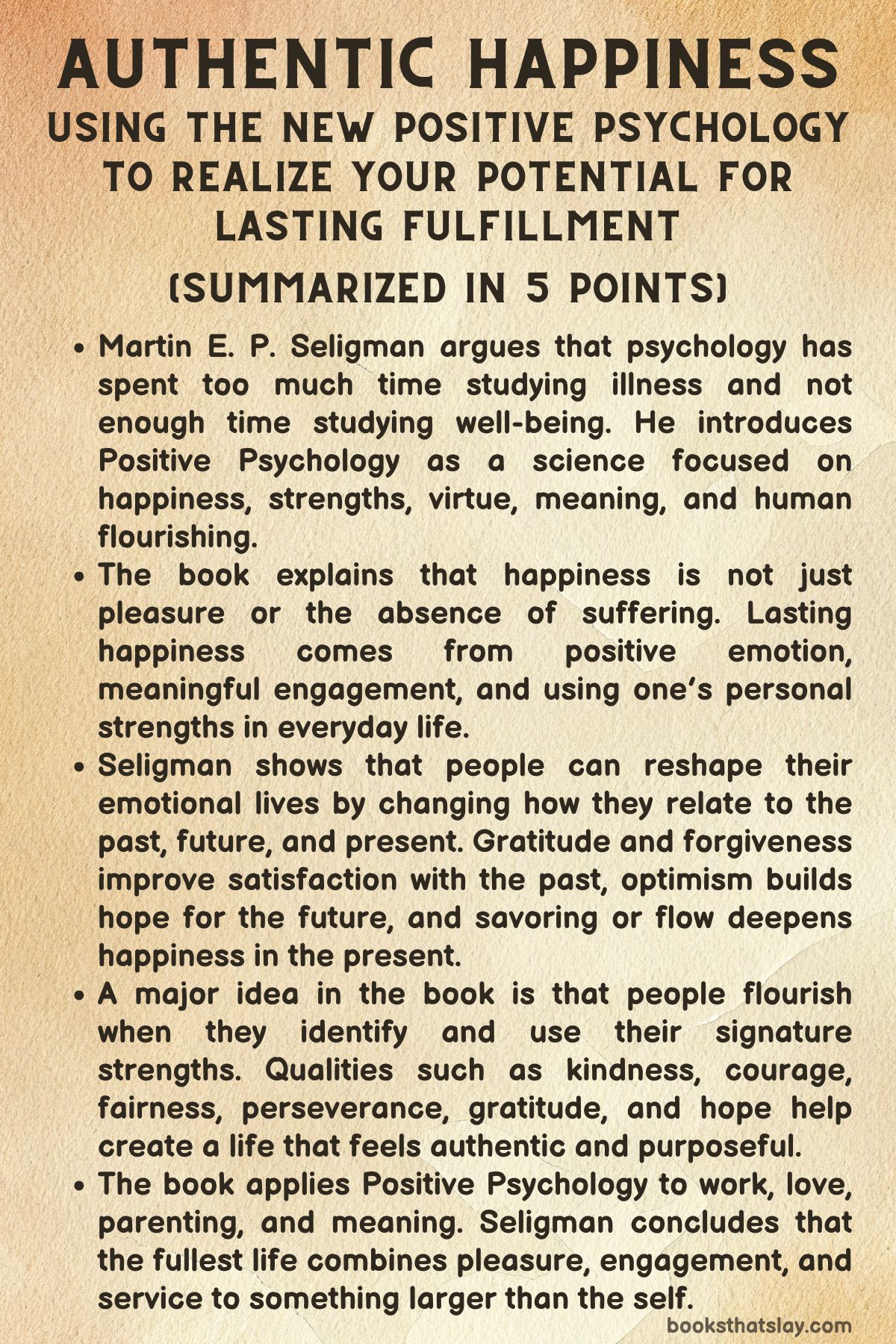
Authentic Happiness by Martin E. P. Seligman is a nonfiction work about Positive Psychology, a field that asks how people can build satisfying, meaningful lives rather than only reduce suffering. Seligman argues that happiness is not merely pleasure or the absence of mental illness.
It grows through positive emotion, character strengths, engagement, love, work, parenting, and service to something larger than the self. The book combines research, personal reflection, questionnaires, and practical exercises to show readers how well-being can be understood and strengthened through deliberate habits.
Summary
Authentic Happiness begins with Seligman’s dissatisfaction with the older focus of psychology. He argues that psychology made important progress in diagnosing and treating mental illness, but it also became too narrow.
For much of the twentieth century, the field concentrated on damage, disorder, trauma, and symptoms. Seligman does not dismiss that work; he recognizes its value.
His concern is that psychology forgot another major human need: the desire not only to survive, but to flourish. He introduces Positive Psychology as a science of what makes life worth living.
Instead of asking only how people can become less depressed, less anxious, or less distressed, Positive Psychology asks how they can become stronger, wiser, kinder, more hopeful, and more fulfilled.
The book first examines positive emotion. Seligman argues that happiness is not vague or sentimental; it can be studied through evidence.
He discusses research such as the Nun Study, in which written expressions of positive emotion were linked to longer life. He also refers to studies connecting optimism, smiling, and positive feeling with later success, health, and satisfaction.
These findings support one of his main claims: positive emotion has real consequences. Happiness can influence the way people think, relate, work, and respond to difficulty.
Yet Seligman is careful to say that authentic happiness is not the same as feeling cheerful all the time. Pleasant feelings matter, but they are only one part of a fuller life.
Seligman explains his own shift toward this new way of thinking. He describes how psychology, especially after World War II, became heavily shaped by the disease model.
Research funding, clinical training, and professional prestige were often tied to illness and treatment. As a result, psychologists became skilled at naming problems but less skilled at studying strength, virtue, purpose, and growth.
A personal moment with his daughter Nikki helped Seligman see this clearly. Her criticism of his grumpiness made him realize that change was not only about correcting weakness; it was also about building better habits of character.
This personal insight became connected to his professional mission as president of the American Psychological Association, where he promoted Positive Psychology as a needed expansion of the field.
Seligman then asks why happiness matters. Negative emotions such as fear, anger, and sadness clearly serve survival functions because they warn people of danger and prepare them for action.
Positive emotions, he argues, also have a purpose. Drawing on Barbara Fredrickson’s broaden-and-build theory, he explains that positive emotions expand attention, encourage exploration, support creativity, and help people form social bonds.
A happy person is often more open, flexible, and resilient. Over time, positive emotion helps build intellectual, emotional, social, and physical resources.
Happiness is therefore not a luxury or a distraction from serious life. It is one of the conditions that helps people meet life more effectively.
The book then turns to the question of whether people can become lastingly happier. Seligman introduces a formula: enduring happiness is shaped by a person’s set range, circumstances, and voluntary activity.
The set range refers to inherited tendencies that influence one’s usual level of happiness. Circumstances include factors such as money, marriage, health, education, and social environment.
Seligman argues that circumstances matter less than many people assume. Money, for example, improves well-being only to a certain point, and people often adapt quickly to better or worse conditions.
The most promising area is voluntary control: the thoughts, actions, habits, and interpretations that people can intentionally change.
Seligman organizes happiness across time: the past, the future, and the present. Happiness about the past depends heavily on interpretation.
People cannot change what happened, but they can change the emotional meaning they give to memory. Gratitude is one of the main tools he offers.
Remembering kindness, writing gratitude letters, and noticing good things can reshape one’s relationship with the past. Forgiveness is another key practice.
Seligman presents forgiveness not as excusing harm or restoring a relationship automatically, but as a way of freeing oneself from ongoing resentment. Because memory is flexible, people can learn to tell the story of their lives in ways that include resilience, appreciation, and growth.
For the future, Seligman focuses on optimism and hope. He explains that people develop habitual ways of interpreting events.
Optimists tend to see setbacks as temporary, limited, and caused by changeable factors. Pessimists often see setbacks as permanent, widespread, and personal.
This explanatory style shapes emotional health, motivation, and resilience. Seligman presents hope as the belief that goals can be reached and that there are multiple possible routes toward them.
He offers the ABCDE method as a way to challenge negative thoughts: identify adversity, notice the belief that follows, observe the consequence, dispute the belief, and experience the energy that comes from a more realistic interpretation. Optimism, in his view, is not blind positivity; it is a learnable habit of arguing against unnecessary defeat.
For the present, Seligman distinguishes between pleasures and gratifications. Pleasures are immediate, sensory, and emotional experiences such as good food, music, warmth, humor, or beauty.
They can be enjoyable, but they fade quickly because people become used to them. To make pleasures richer, Seligman recommends savoring, mindfulness, sharing, and close attention.
Gratifications are different. They involve effort, skill, and engagement.
A person may lose self-consciousness while solving a problem, creating something, helping someone, or doing work that demands focus. These experiences often produce flow.
Seligman argues that gratifications are more important for lasting fulfillment because they draw on a person’s strengths and connect the person to meaningful activity.
The second major part of the book develops the idea of strength and virtue. Seligman argues that older moral language once gave people a way to talk about good character, but modern psychology largely abandoned that language.
Influenced by figures such as Freud and Skinner, psychology became more interested in drives, conditioning, and pathology than in courage, wisdom, kindness, or responsibility. Positive Psychology tries to bring character back into scientific discussion without turning it into preaching.
Seligman and his colleagues identify six broad virtues found across many traditions: wisdom, courage, humanity, justice, temperance, and transcendence. These virtues are expressed through twenty-four measurable strengths, including curiosity, bravery, love, fairness, forgiveness, gratitude, hope, humor, and spirituality.
Seligman places special importance on signature strengths. These are the strengths that feel most natural, energizing, and authentic to a person.
They are not simply talents. A talent may be an ability, but a strength has moral meaning and can be cultivated.
A person’s path to authentic happiness lies in discovering these strengths and using them often. Rather than building a life around correcting weaknesses, Seligman encourages readers to build around what is best in them.
When people use their signature strengths at work, in relationships, in parenting, and in service, they experience deeper engagement and greater purpose.
The final part of the book applies Positive Psychology to major areas of life. In work, Seligman distinguishes between a job, a career, and a calling.
A job is mainly a paycheck; a career is a path of advancement; a calling is work experienced as meaningful in itself. He argues that people can find more satisfaction when they use their strengths in their work, even in roles that may not seem prestigious.
A hospital worker, for example, can transform ordinary duties into acts of care through kindness and social intelligence. Meaningful work depends less on status and more on alignment between daily action and inner strengths.
In love, Seligman challenges the idea that human beings are purely self-interested. Love often leads people to act with loyalty, care, sacrifice, and emotional commitment.
He discusses attachment styles, including secure, avoidant, and anxious patterns, and shows how early emotional habits can influence adult relationships. Still, love can be strengthened through empathy, gratitude, positive interpretation, listening, and forgiveness.
Seligman treats love as more than a feeling. It is also a practice shaped by character.
In parenting, Seligman argues that children’s happiness can be intentionally supported. Parents should not focus only on discipline, achievement, or correcting faults.
They should create positive emotion, warmth, play, routine, and respectful boundaries. They should also identify and nurture children’s strengths.
A child who is noticed for kindness, curiosity, perseverance, humor, or hope develops not only confidence but also a stronger sense of self.
The book closes by bringing together three forms of life: the Pleasant Life, the Good Life, and the Meaningful Life. The Pleasant Life cultivates positive emotion.
The Good Life uses signature strengths to create engagement. The Meaningful Life uses those strengths in service of something larger than the self.
Seligman argues that the richest form of happiness joins all three, with meaning as the deepest source of fulfillment. Happiness is not accidental.
It can be built through gratitude, optimism, forgiveness, engagement, love, virtue, and purpose.
Key Figures
Martin E. P. Seligman
Martin E. P. Seligman is the central voice and guiding figure of the book. Since Authentic Happiness is nonfiction, he functions less like a fictional character and more like a thinker, researcher, teacher, and personal witness.
His role is important because he does not present Positive Psychology only as an abstract academic movement. He connects it to his own professional frustration with psychology’s narrow focus on illness and to his personal need for change.
Seligman is intellectually ambitious, but he is also self-critical. His daughter’s comment about his grumpiness becomes a turning point because it forces him to see that knowledge alone does not create character.
He must practice the same growth he recommends to others. Throughout the book, he appears as someone trying to redirect an entire field while also examining his own habits as a father, psychologist, and human being.
His strongest quality is his ability to combine research with practical application, though his confidence in Positive Psychology sometimes leads him to understate the seriousness of social conditions and mental illness.
Nikki
Nikki, Seligman’s daughter, plays a small but decisive role in the book. She is not present as a fully developed biographical figure, but her importance is symbolic and emotional.
Her honest criticism of her father’s grumpiness gives Seligman one of the clearest personal examples of transformation. Nikki represents the moral clarity that children can sometimes bring into adult life.
She does not use technical language or psychological theory; she simply points out a pattern in her father’s behavior that affects their relationship. Her presence shows that positive change often begins not in formal research but in ordinary family life.
Nikki also helps Seligman understand that raising children is not mainly about correcting them. It is also about adults correcting themselves, creating positive emotion, and modeling better habits.
In the book, she becomes a catalyst for Seligman’s personal and professional reorientation.
The Catholic Nuns in the Nun Study
The Catholic nuns in the Nun Study serve as one of the book’s most memorable research examples. They are not individualized as separate personalities, but they matter as a group because their early autobiographical writings become evidence for the long-term power of positive emotion.
The nuns who expressed more joy, gratitude, hope, and warmth in their writings tended to live longer than those who expressed less positive emotion. Their lives help Seligman argue that happiness is not merely a private mood; it can have measurable effects on health and longevity.
The nuns also represent a disciplined and relatively controlled research population, which makes the study especially useful for Seligman’s argument. In the book, they stand for the idea that inner emotional style may shape the course of a life in ways that are quiet but profound.
Barbara Fredrickson
Barbara Fredrickson is an important intellectual presence because her broaden-and-build theory gives Seligman a scientific explanation for why positive emotions matter. Her work helps him move beyond the simple claim that happiness feels good.
Through her theory, positive emotions are shown to expand attention, encourage exploration, and help people build lasting resources. Fredrickson’s role in the book is that of a supporting scholar whose research strengthens Seligman’s central argument.
She helps explain why joy, interest, contentment, and love are adaptive. Her ideas balance the older psychological emphasis on negative emotion by showing that positive states also serve survival and growth.
In this way, Fredrickson becomes one of the figures who helps Positive Psychology claim scientific seriousness.
Abraham Lincoln
Abraham Lincoln appears as a historical and moral reference point, especially through the phrase “the better angels of our nature.” Seligman uses Lincoln to evoke an older language of character, virtue, and moral responsibility. Lincoln represents a time when public life could still speak openly about goodness, courage, restraint, and justice.
His presence helps Seligman argue that psychology lost something when it abandoned the study of virtue. Lincoln is not analyzed politically in the book; rather, he functions as a symbol of moral aspiration.
His example supports the idea that human beings are not only driven by wounds, instincts, or conditioning. They are also capable of choosing better conduct and cultivating nobler qualities.
Sigmund Freud
Sigmund Freud is presented as one of the major figures who shaped psychology’s turn toward pathology and hidden psychological conflict. In the book, Freud represents a tradition that searches beneath behavior for wounds, repression, drives, and unresolved pain.
Seligman does not treat Freud as irrelevant, but he places him within a larger critique of twentieth-century psychology’s tendency to explain human life mainly through damage. Freud’s role is therefore partly oppositional.
He stands for a powerful model of the mind that helped psychology understand suffering but also encouraged the field to look backward and downward more often than forward and upward. In contrast to Freud’s focus on psychic injury, Seligman wants a psychology that also studies strength, virtue, and flourishing.
B. F. Skinner
B. F. Skinner appears as another important figure in Seligman’s account of how psychology moved away from character. Skinner’s behaviorism emphasized conditioning, reinforcement, and observable behavior.
In Seligman’s interpretation, this approach weakened the language of personal virtue because it framed conduct as the result of external shaping rather than moral choice. Skinner represents the deterministic side of psychology, where human action is explained less by courage, wisdom, or kindness and more by environmental control.
His role in the book is not that of a villain, but of a thinker whose influence narrowed psychology’s vocabulary. By contrasting Positive Psychology with Skinnerian behaviorism, Seligman argues for restoring responsibility, intention, and strength to the study of human life.
Everett Worthington
Everett Worthington appears through his work on forgiveness. His contribution is practical and emotionally important because forgiveness is one of the major tools Seligman recommends for improving one’s relationship with the past.
Worthington’s model gives structure to a process that might otherwise seem vague or purely moral. In the book, forgiveness is not treated as pretending that harm did not occur.
It is a deliberate act of reducing resentment and freeing oneself from revenge. Worthington’s role is therefore that of a guide to emotional release.
His work helps Seligman show that Positive Psychology is not only about cheerful feelings. It also addresses pain, injury, memory, and the hard work of changing one’s inner response to the past.
John Bowlby
John Bowlby is important because his attachment theory helps Seligman explain love and adult relationships. Bowlby’s work shows that early bonds between children and caregivers can shape later patterns of intimacy, trust, anxiety, and emotional security.
In the book, Bowlby provides a bridge between developmental psychology and Positive Psychology. His ideas help Seligman argue that love is not random or purely romantic.
It is connected to learned emotional patterns, but it can also be understood and improved. Bowlby’s role is that of a foundational theorist whose work explains why some people find closeness easier while others struggle with fear or avoidance.
His presence gives the discussion of love a deeper psychological base.
Mary Ainsworth
Mary Ainsworth appears alongside Bowlby as a key figure in attachment research. Her work helps define secure, avoidant, and anxious attachment patterns, which Seligman uses to explain adult love.
Ainsworth’s role is especially important because she helps turn attachment from a broad theory into observable patterns of behavior. In the book, her contribution supports the idea that emotional habits formed early in life can influence later relationships.
At the same time, Seligman’s use of attachment theory suggests that awareness can create change. Ainsworth’s presence gives readers a way to recognize relational tendencies without treating them as permanent fate.
Mihaly Csikszentmihalyi
Mihaly Csikszentmihalyi is central to the book’s discussion of gratification and flow. His concept of flow describes a state of deep absorption in which a person is fully engaged in a challenging activity that matches their skills.
Seligman uses this idea to distinguish shallow pleasure from meaningful engagement. Csikszentmihalyi’s role is important because he helps explain why effortful activities can create more lasting satisfaction than passive enjoyment.
In the book, he represents the psychology of deep attention, skill, and immersion. His work supports Seligman’s claim that a good life is built not by chasing pleasant sensations alone, but by using strengths in activities that demand focus and bring a sense of mastery.
The Hospital Janitor
The hospital janitor is one of the book’s practical examples of how ordinary work can become meaningful. This figure matters because Seligman uses the janitor to show that a calling does not depend entirely on job title, salary, or prestige.
By bringing kindness, care, and social awareness into daily tasks, the janitor turns work into service. This example challenges the assumption that only glamorous or high-status careers can produce fulfillment.
In the book, the janitor represents strength-based work at its clearest. The person’s role may appear modest from the outside, but the inner orientation changes its meaning.
Through this example, Authentic Happiness argues that people can reshape work by applying their signature strengths.
Young Lawyers and Professionals
The young lawyers and professionals discussed in the book represent the dissatisfaction that can arise when external success is separated from inner meaning. They may have prestige, income, and career advancement, yet still feel burned out or empty.
Seligman uses them to show the limits of the career model when it is based only on status and reward. These figures are important because they reflect a broader cultural shift from a money-centered view of work to a satisfaction-centered one.
In the book, they stand for people who have achieved what society calls success but still lack engagement, purpose, or alignment with their strengths. Their struggle supports Seligman’s argument that meaningful work requires more than achievement.
Parents
Parents appear as a collective character group in the book’s discussion of raising children. Seligman addresses them not as authorities who must control children, but as guides who can nurture strengths, positive emotion, and resilience.
Parents are shown as powerful emotional architects of a child’s world. Their praise, discipline, routines, play, and attention help shape whether children see themselves as capable and valued.
In the book, parents represent both responsibility and possibility. They can create helplessness through harshness or inconsistency, but they can also create confidence through warmth, structure, and recognition of strengths.
Seligman’s view of parenting asks adults to look for what is best in children and help those qualities grow.
Children
Children appear as a group whose emotional lives are especially open to shaping through positive experience. Seligman sees children not as problems to be fixed but as developing people with identifiable strengths.
They need joy, affection, play, boundaries, encouragement, and meaningful recognition. In the book, children represent the future of Positive Psychology because their well-being can be built early.
Seligman’s child-strengths approach encourages adults to notice traits such as kindness, curiosity, perseverance, humor, hope, and social intelligence. Children are important because they show that happiness is not only an adult project.
It can be cultivated from the beginning through relationships that support confidence, meaning, and emotional resilience.
Optimists
Optimists appear as a psychological type rather than as individual characters. They are important because they demonstrate the power of explanatory style.
In the book, optimists tend to interpret setbacks as temporary, specific, and changeable. This habit protects them from helplessness and encourages action.
Seligman does not portray optimism as foolish denial. Instead, he treats it as a disciplined way of interpreting difficulty without surrendering to it.
Optimists represent one path toward future-oriented happiness because they believe effort matters and alternatives exist. Their importance lies in showing that hope can be learned, practiced, and strengthened.
Pessimists
Pessimists serve as the contrast to optimists. They tend to explain setbacks as permanent, widespread, and personal.
In the book, this explanatory style can lead to discouragement, passivity, and vulnerability to depression. Seligman does not present pessimists as weak or morally inferior.
Rather, he treats pessimism as a habit of thought that can be recognized and challenged. Pessimists matter because they show why interpretation is so central to well-being.
The same event can produce different emotional outcomes depending on the belief attached to it. Through the ABCDE method, Seligman suggests that pessimists can learn to dispute their automatic thoughts and build greater resilience.
The Reader
The reader becomes an active participant in the book rather than a passive observer. Seligman includes surveys, questionnaires, exercises, and reflective practices that ask readers to measure their happiness, identify strengths, examine explanatory style, practice gratitude, and rethink work and relationships.
The reader’s role is important because the book is designed as a practical guide, not only a theoretical argument. Seligman assumes that readers can change how they remember the past, imagine the future, experience the present, love others, raise children, and seek meaning.
The reader is therefore treated as a person with agency. The book asks them to become a subject of their own experiment in well-being.
Themes
Happiness as a Skill That Can Be Built
Happiness is presented not as luck, temperament, or constant pleasure, but as a condition shaped by practice. Seligman accepts that biology and life circumstances influence emotional life, yet he gives the greatest practical attention to voluntary activity.
People can learn gratitude, forgiveness, optimism, savoring, mindfulness, engagement, and strength-based action. This theme matters because it changes happiness from something people wait for into something they participate in creating.
The book repeatedly argues that external success, comfort, or pleasure cannot carry the full weight of well-being. A person may gain money, status, or pleasant experiences and still feel empty if their habits of thought and action remain unchanged.
Seligman’s approach gives readers responsibility without claiming total control. He recognizes limits, such as inherited emotional tendencies, but insists that people can still move their lives in a better direction.
The theme is practical and hopeful because it offers concrete methods rather than abstract encouragement. Happiness becomes a disciplined way of relating to the past, future, and present.
Strengths and Virtue as the Foundation of Fulfillment
Character is placed at the center of lasting well-being. Seligman argues that authentic happiness depends on identifying and using signature strengths, not simply reducing pain or increasing pleasure.
Strengths such as kindness, perseverance, fairness, gratitude, courage, curiosity, and hope give life structure and direction. This theme challenges the weakness-centered model of self-improvement.
Instead of asking people to build their lives around defects, the book asks them to recognize what is already strongest and most alive within them. Virtue is not treated as old-fashioned moral language; it is treated as something observable, measurable, and useful.
When people use their strengths in work, love, parenting, and service, they experience greater engagement because their actions feel connected to who they are. This is why the book’s idea of fulfillment is deeper than pleasure.
Pleasure can fade quickly, but strengths can be practiced repeatedly in new situations. In Authentic Happiness, virtue becomes both a moral resource and a psychological resource, giving people a more stable route to satisfaction.
Meaning Beyond the Self
Meaning comes from using personal strengths in service of something larger than private comfort. Seligman’s fullest version of happiness includes pleasure and engagement, but it reaches its deepest form when people connect their lives to family, community, knowledge, justice, faith, goodness, or another enduring purpose.
This theme is important because it prevents happiness from becoming self-absorption. The book does not reject personal joy, but it argues that joy alone is incomplete.
A life built only around pleasant feeling can become thin because pleasures fade and require constant renewal. Meaning gives continuity.
It allows people to see their actions as part of a larger story. Work becomes more than a paycheck when it serves others.
Love becomes more than emotion when it is practiced through loyalty and care. Parenting becomes more than management when it helps a child grow into strength.
Seligman’s idea of meaning is demanding because it asks people to look beyond immediate reward. It is also freeing because it suggests that fulfillment can be found wherever strengths meet contribution.
Reframing the Past, Future, and Present
The book organizes emotional life across time and shows that each dimension can be reshaped. The past can be transformed through gratitude and forgiveness.
The future can be strengthened through optimism, hope, and disputing pessimistic beliefs. The present can be enriched through savoring, mindfulness, pleasure, gratification, and flow.
This theme gives the book much of its practical structure. Seligman is not saying that people should deny pain, ignore difficulty, or force themselves to feel happy.
Instead, he argues that people can change their relationship to experience. A painful past does not have to be remembered only through resentment.
An uncertain future does not have to be imagined only through fear. An ordinary present does not have to be lived without attention or engagement.
The theme is powerful because it gives people several entry points into change. Someone burdened by memory can practice forgiveness.
Someone anxious about what lies ahead can work with explanatory style. Someone bored or restless can seek gratifications that use their strengths.
Happiness becomes a time-based practice of interpretation, attention, and action.