Autobiography of a Yogi Summary and Analysis
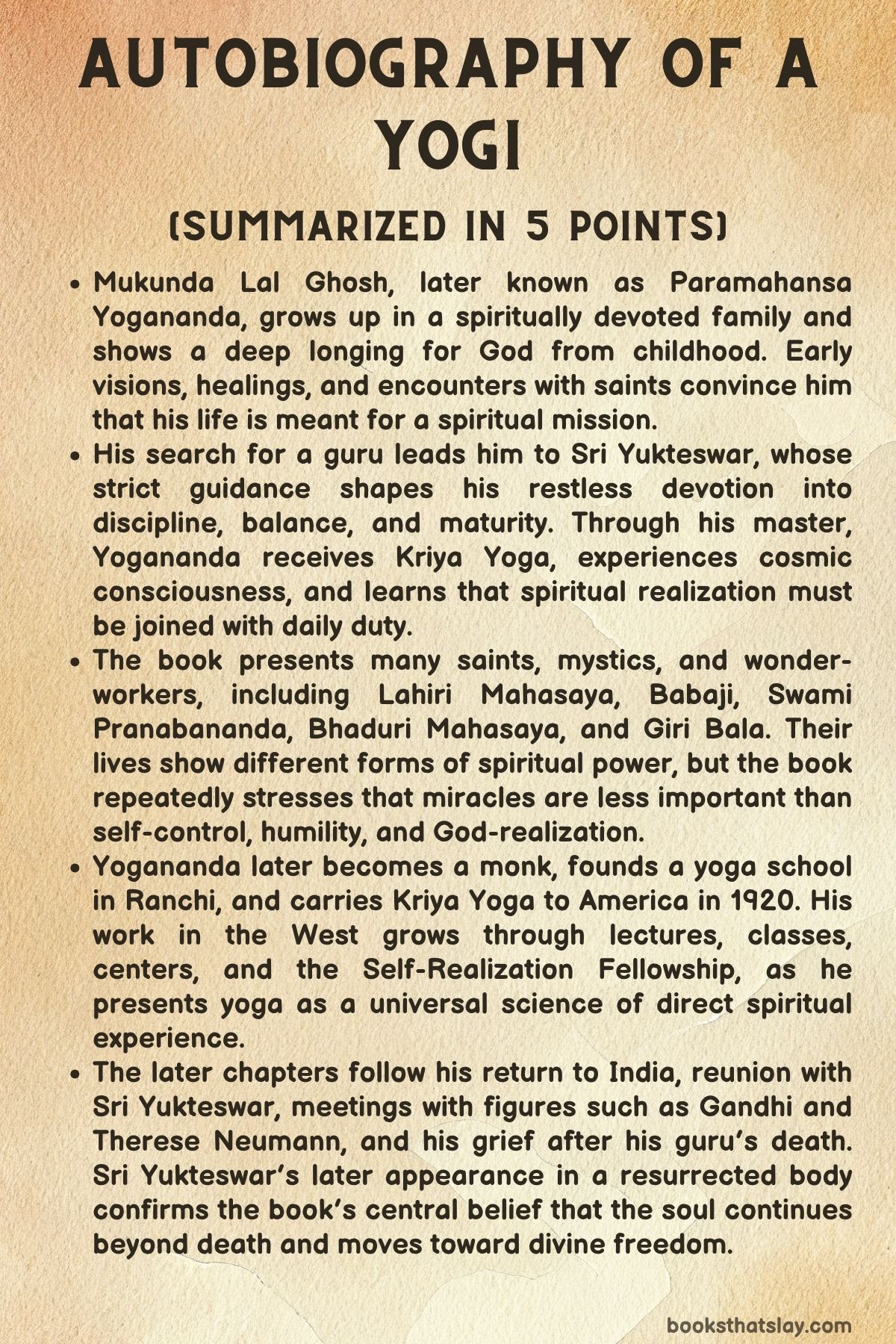
Autobiography of a Yogi is a spiritual autobiography by Paramahansa Yogananda, born Mukunda Lal Ghosh, tracing his journey from a spiritually sensitive child in India to an influential teacher of Kriya Yoga in the West. The book combines personal memory, accounts of saints and gurus, explanations of yogic philosophy, and encounters with figures such as Sri Yukteswar, Lahiri Mahasaya, Babaji, Mahatma Gandhi, Rabindranath Tagore, and Luther Burbank.
It presents spiritual life not as withdrawal from the world but as disciplined inner growth, service, and direct experience of God.
Summary
The book begins with the childhood of Mukunda Lal Ghosh, later known as Paramahansa Yogananda, in a devout Bengali family. His parents, Bhagabati Charan Ghosh and Gurru Ghosh, are disciples of Lahiri Mahasaya, and the atmosphere of his early life is shaped by faith, discipline, and reverence for saints.
Mukunda is not presented as an ordinary child who slowly becomes religious; from the start, he shows intense spiritual hunger. He is healed from cholera after praying before Lahiri Mahasaya’s photograph, receives visions of saints in the Himalayas, and experiences events that suggest his prayers have unusual force.
His mother’s death becomes one of the defining sorrows of his early life. Before dying, she leaves him a message through his brother Ananta.
The message reveals that Lahiri Mahasaya had predicted Mukunda’s future as a yogi and that a sacred silver amulet had been entrusted to her for him. This amulet later becomes a sign of divine guidance and disappears when its purpose has been fulfilled.
The loss of his mother deepens Mukunda’s longing for the Divine Mother and increases his desire to find his destined guru.
As a boy and young man, Mukunda meets many unusual saints. Swami Pranabananda, known as the saint with two bodies, demonstrates the ability to appear in more than one place.
Gandha Baba creates fragrances through yogic power, though Mukunda questions whether such powers are spiritually useful. The Tiger Swami tells of his former life fighting tigers and how a severe injury led him to renounce physical pride for spiritual discipline.
Bhaduri Mahasaya, the levitating saint, teaches Mukunda about yoga and even predicts that he will one day go to America.
Mukunda’s longing for the Himalayas leads him and his friends Amar and Jatinda to run away from home. Their attempt fails after Ananta sends word ahead, and they are detained before reaching their goal.
Yet even this failed escape strengthens Mukunda’s conviction that his life belongs to the spiritual path. His father tries to redirect him through education and Sanskrit lessons, but the teacher chosen for him, Swami Kebalananda, turns out to be another disciple of Lahiri Mahasaya and feeds Mukunda’s spiritual hunger through stories of the great master.
The central turning point occurs when Mukunda finally meets his guru, Sri Yukteswar Giri, in a marketplace in Banaras. He recognizes him at once as the face he has seen in many visions.
Their first meeting is filled with love, but it also contains discipline. Sri Yukteswar instructs him to return to his family, and Mukunda resists.
The guru’s sternness becomes a major force in Mukunda’s life. Sri Yukteswar is not sentimental; he teaches through correction, exactness, and the steady breaking down of ego.
Under him, Mukunda learns that spiritual life requires obedience, balance, humility, and practical responsibility.
Mukunda returns home and eventually begins spending much of his time at Sri Yukteswar’s hermitage in Serampore. He receives initiation into Kriya Yoga and gradually accepts that his education, family duties, and spiritual training must coexist.
He also sees his guru heal diseases, predict events, read minds, and guide disciples with extraordinary insight. Mukunda himself experiences cosmic consciousness when Sri Yukteswar touches him above the heart.
In that state, he perceives himself beyond the body and sees creation as light, joy, and divine unity. Yet Sri Yukteswar immediately instructs him to sweep the floor, teaching that spiritual realization must be joined to ordinary action.
Much of the book presents spiritual power through stories. Sri Yukteswar predicts illnesses and cures them, guides Mukunda through dangers, and explains astrology, karma, scripture, and the limits of book learning.
Mukunda meets Ram Gopal Muzumdar, the sleepless saint, who spends most of his time in divine union and heals Mukunda’s back pain. He learns about Afzal Khan, a wonder-worker who misused supernatural powers and later lost them, showing that power without moral development becomes dangerous.
He also sees how devotion can transform others, as in the case of his brother-in-law Satish, whose cynicism softens after a visit to the Kali temple.
Despite his weak interest in formal education, Mukunda completes his college degree with help from his friend Romesh and by the guidance of Sri Yukteswar. Soon afterward, he is initiated into the Swami Order and takes the name Yogananda, meaning bliss through divine union.
From this point, his life expands beyond personal seeking into teaching and service. He explains the meaning of Kriya Yoga as a scientific spiritual method, though he says its actual technique must be learned from an authorized teacher.
Yogananda founds a boys’ school that later moves to Ranchi. The school combines academic study, practical training, health exercises, moral education, meditation, and Kriya Yoga.
His educational vision is not merely to produce successful students but balanced human beings. He later compares ideas with Rabindranath Tagore, whose school emphasizes freedom, literature, music, and inner discovery.
Yogananda also meets the scientist Jagadi Chandra Bose and admires his work showing sensitivity in plant life, seeing in Bose’s science a bridge between Eastern insight and Western method.
The book then broadens into the lives of great masters in Yogananda’s spiritual lineage. Lahiri Mahasaya is shown as a householder saint who received Kriya Yoga from the immortal Babaji and passed it on to seekers from many backgrounds.
He does not reject family or work; instead, he proves that divine realization can exist within daily duties. Babaji appears as an immortal master who works quietly for humanity, guiding Lahiri Mahasaya, Sri Yukteswar, and eventually Yogananda’s mission to the West.
Sri Yukteswar reveals that Babaji had foretold Yogananda’s role in bringing yoga to America.
In 1920, Yogananda sails to America as a delegate to a religious congress in Boston. Nervous about speaking in English, he prays to his guru and successfully gives his first major lecture abroad.
Over the next years, he teaches widely, founds centers, attracts thousands of students, and eventually establishes headquarters in Los Angeles. His mission is to present yoga not as an exotic belief but as a universal science of direct God-realization.
He also forms meaningful bonds in America, especially with Luther Burbank, the botanist whom he regards as a saintly soul devoted to nature and human betterment.
After fifteen years in America, Yogananda returns to India in response to an inner call from Sri Yukteswar. On the way, he meets Therese Neumann, a Catholic mystic in Germany who bears the stigmata and reportedly lives with almost no food.
Back in India, he is reunited with his father, his guru, his school, and many seekers. He visits South India, meets sages such as Ramana Maharishi, and later spends time with Mahatma Gandhi, whom he initiates into Kriya Yoga.
Gandhi’s life of simplicity and nonviolence impresses Yogananda, who sees in him a spiritual force active in politics and public life.
The emotional climax comes with Sri Yukteswar’s death. Yogananda is devastated after performing the funeral rites, but months later, in Bombay, Sri Yukteswar appears to him in a resurrected body.
The guru explains the astral and causal worlds, the journey of the soul after physical death, and the long process by which beings work through karma toward liberation. This encounter removes Yogananda’s grief and confirms his faith in the continuity of life beyond death.
The later part of the book returns to Yogananda’s work in the West. His disciples build an ashram for him in Encinitas, California, and the Self-Realization Fellowship grows through churches, temples, retreats, and teachings.
He spends time interpreting Christian scripture, translating the Bhagavad Gita, teaching Kriya Yoga, and explaining that the purpose of life is self-realization: knowing the soul’s unity with God. The book ends not with a single worldly success but with the sense of an ongoing mission.
Yogananda’s life becomes a bridge between India and America, devotion and reason, ancient discipline and modern life.
Key Figures
Paramahansa Yogananda / Mukunda Lal Ghosh
Mukunda Lal Ghosh, later Paramahansa Yogananda, is the central figure of Autobiography of a Yogi and the consciousness through which the reader experiences the book. As a child, he is spiritually intense, emotional, restless, and drawn toward the Himalayas as the imagined home of divine masters.
His early miracles and visions mark him as unusual, but his character is not written as flawless. He is impulsive, often impatient with formal schooling, and quick to resist instructions that conflict with his desires.
His growth lies in learning that spiritual longing alone is not enough. Under Sri Yukteswar’s discipline, he becomes more balanced, obedient, and capable of combining meditation with duty.
As he matures into Yogananda, his role shifts from seeker to teacher. He carries Indian spiritual knowledge to America, builds institutions, and presents Kriya Yoga as a universal path.
His character is shaped by devotion, curiosity, humor, grief, wonder, and service.
Sri Yukteswar Giri
Sri Yukteswar is Yogananda’s guru and one of the most powerful presences in the book. He is stern, exacting, unsentimental, and deeply loving beneath his severity.
He does not flatter Mukunda or allow him to hide behind vague spiritual enthusiasm. His teaching style depends on precision: he corrects carelessness, exposes ego, discourages empty learning, and insists that divine realization must be joined with practical responsibility.
He also has extraordinary spiritual powers, including healing, prophecy, telepathic communication, and posthumous manifestation. Yet he rarely uses these powers for display.
His greatness lies in his ability to shape his disciple’s character. In Autobiography of a Yogi, he represents the guru as spiritual father, disciplinarian, philosopher, protector, and liberating force.
His resurrection after death completes his role as a teacher who breaks the disciple’s fear of mortality.
Lahiri Mahasaya
Lahiri Mahasaya stands as the great householder saint of the book. Unlike many renunciates, he lives within marriage, work, and family life while attaining high spiritual realization.
This makes him especially important to the book’s idea that God-realization is not limited to monks. He initiates seekers into Kriya Yoga across caste, class, and religious boundaries, showing a broad and inclusive spiritual vision.
His influence reaches Mukunda even before the boy is born, through his parents and through predictions about Mukunda’s future. He heals, appears to disciples, delays trains, revives Rama, and guides spiritual aspirants with quiet authority.
Lahiri Mahasaya’s character is marked by humility, accessibility, compassion, and spiritual mastery hidden within ordinary life. He becomes the link between Babaji’s ancient yogic power and modern seekers.
Mahavatar Babaji
Babaji is the most mysterious figure in the story. He is described as an immortal master who lives in the Himalayas and appears only when he chooses.
His character is not built through ordinary biography, since his birth, age, and history remain beyond normal verification. Instead, he is defined by spiritual function.
He revives Kriya Yoga for the modern age, initiates Lahiri Mahasaya, guides Sri Yukteswar, and blesses Yogananda’s mission to the West. Babaji combines tenderness with absolute command.
The stories about him raising a man from death, materializing a palace, and remaining in the body at Mataji’s request place him beyond normal human limits. Yet his actions are directed toward human uplift rather than spectacle.
He represents divine intervention working silently through history.
Bhagabati Charan Ghosh
Bhagabati Charan Ghosh, Yogananda’s father, is disciplined, rational, reserved, and morally upright. As a mathematician, logician, and executive, he brings order and seriousness into the household.
His love is not openly expressive in the same way as his wife’s, but it is steady and protective. He worries about Mukunda’s future and tries to guide him toward education and social responsibility.
At times, he appears as an obstacle to Mukunda’s renunciant dreams, yet the book treats him with respect. He is also a disciple of Lahiri Mahasaya, which means that beneath his practical exterior lies genuine devotion.
His relationship with Mukunda shows the tension between family duty and spiritual destiny, but it is not a conflict of good against evil. It is a father’s concern meeting a son’s calling.
Gurru Ghosh
Gurru Ghosh, Yogananda’s mother, is loving, devotional, and spiritually sensitive. Her death leaves a deep wound in Mukunda’s life, but her influence continues through the message she leaves behind and through the sacred amulet entrusted to him.
She understands before others that her son is destined for a spiritual life, and her faith in Lahiri Mahasaya shapes the atmosphere of Mukunda’s childhood. Her maternal love is not possessive; she accepts that her son belongs to God.
The message she leaves after death becomes a form of guidance, giving Mukunda courage to pursue his path. Her character represents motherly affection joined with spiritual surrender.
Ananta
Ananta, Mukunda’s older brother, often acts as a skeptical and practical counterforce to Mukunda’s spiritual enthusiasm. He tries to stop Mukunda’s attempted flight to the Himalayas and later devises the Brindaban test to challenge his belief that God will provide for him.
Yet Ananta is not merely a doubter. His skepticism is mixed with concern, family responsibility, and a desire to protect his younger brother from what he sees as impractical behavior.
When the Brindaban episode succeeds, he is moved enough to request initiation into Kriya Yoga. His character shows how doubt can soften when confronted by sincere faith and unexplained providence.
Uma
Uma, Mukunda’s sister, appears in childhood episodes that reveal both sibling teasing and spiritual wonder. When Mukunda predicts that a boil will appear on his arm and that hers will grow larger, she initially mocks him, but the prediction comes true.
Later, when the kites come toward Mukunda after his prayer to Kali, Uma’s skepticism is shaken again. Her role is small but useful.
She gives the early chapters a domestic setting and helps show Mukunda’s unusual powers through ordinary family interactions. Her reactions make the miraculous events feel grounded in the everyday world of siblings, play, doubt, and surprise.
Roma
Roma, Mukunda’s sister, is a devoted wife who worries about the spiritual condition of her husband, Satish Chandra Bose. She turns to Mukunda for help, hoping he can awaken Satish’s devotion.
Her role highlights the influence of quiet faith within family life. Roma does not dominate events, but her concern sets in motion the visit to the Kali temple, where Satish begins to change.
She represents a form of devotion that is practical and relational. Her love for her husband includes concern for his soul, not just his comfort.
Satish Chandra Bose
Satish begins as a worldly, skeptical, and sharp-tongued man who dismisses gurus and holy men. His cynicism is especially clear during the visit to the Kali temple, where he criticizes Mukunda for trusting the Divine Mother to provide food.
The unexpected arrival of the priest and the meal arranged without request unsettle his confidence in material explanations. His transformation is not presented as theatrical but as a softening of the heart.
Later, he pursues a spiritual life, proving that skepticism in the book is not permanent when grace and experience touch the person directly.
Nalini
Nalini, Yogananda’s younger sister, is physically frail but spiritually receptive. Her desire to gain weight and later her near-fatal typhoid illness reveal her dependence on faith, family, and yogic healing.
Yogananda’s guidance helps her regain health, and Sri Yukteswar’s instruction about the pearl completes her recovery from paralysis. Nalini’s character reflects the book’s recurring link between bodily condition, faith, karma, and spiritual intervention.
She is also an example of Yogananda’s care for his family even after becoming a monk.
Bishnu
Bishnu, Yogananda’s youngest brother, appears briefly when he confirms Ananta’s death after Yogananda returns from his travels. His role is limited, but he belongs to the family structure that keeps the narrative connected to ordinary human loss.
Through Bishnu, the news of death reaches Yogananda in a direct family context, reinforcing that spiritual insight does not remove the emotional reality of kinship.
Amar
Amar is one of Mukunda’s companions in the failed escape to the Himalayas. His role is that of a youthful accomplice in spiritual adventure.
He helps reveal Mukunda’s impatience to reach the mountains and find his master. Amar does not receive deep personal development, but he contributes to the energy of boyhood aspiration, friendship, secrecy, and rebellion against family control.
Jatinda
Jatinda joins Mukunda and Amar in the planned escape but disappears during the journey. His disappearance weakens the plan and adds humor and uncertainty to the episode.
As a character, he represents the difference between romantic enthusiasm and sustained commitment. The Himalayas may attract many young dreamers, but not all have Mukunda’s intensity or endurance.
Jitendra
Jitendra is Mukunda’s friend and companion in the move to the Banaras hermitage and later in the Brindaban test arranged by Ananta. He shares Mukunda’s experience of divine provision when strangers unexpectedly offer them food, shelter, and guidance.
Jitendra is less spiritually dominant than Mukunda, but his presence gives the events a witness outside Mukunda himself. His reactions help show that the Brindaban episode is not only an inward experience but an outward event affecting both boys.
Nantu
Nantu helps Mukunda prepare for his school examinations. His role may seem ordinary compared with saints and miracles, but he represents the practical help Mukunda repeatedly needs.
Mukunda’s spiritual destiny does not excuse him from exams, and Nantu’s coaching becomes part of the worldly support that allows him to move forward. He is a reminder that ordinary friends also serve divine purposes in the book.
Romesh
Romesh assists Mukunda in preparing for his college examinations. Like Nantu, he helps balance Mukunda’s spiritual life with worldly obligations.
His role is important because Mukunda’s degree becomes something Sri Yukteswar wants him to complete. Romesh therefore contributes to Yogananda’s formation not through mystical power but through academic support.
He represents friendship expressed as timely practical aid.
Kumar
Kumar is a young villager accepted into Sri Yukteswar’s ashram. At first, he shows promise, but after visiting his childhood home, he returns with habits that make him unfit for the discipline of hermitage life.
His departure shows the strictness of spiritual training. Good beginnings are not enough; the aspirant must remain inwardly firm.
Kumar’s story also reveals Sri Yukteswar’s sorrowful realism. The guru is compassionate, but he will not allow weakness to damage the ashram’s purpose.
Sasi
Sasi, Mukunda’s college friend, is warned by Sri Yukteswar that his disorderly life will lead to serious illness unless he reforms. He delays obedience and later returns with tuberculosis and three sapphires, exactly as the guru predicted.
His recovery through Sri Yukteswar’s grace shows both the danger of ignoring spiritual counsel and the saving power of a guru’s compassion. Sasi is morally weak at first, but not beyond help.
His story works as a warning against carelessness and a testimony to mercy.
Dr. Roy
Dr. Roy, the skeptical veterinary surgeon, is healed of diabetes by Sri Yukteswar but refuses to follow the guru’s advice about diet. His later death shows the limits of grace when the receiver does not cooperate.
Dr. Roy’s character is especially important because he is educated and skeptical, relying on professional knowledge while dismissing spiritual instruction. His fate reinforces the book’s idea that healing is not only a miracle granted from outside; it also requires obedience and change.
Dijen Babu
Dijen Babu is a college friend who doubts the existence of God. His experience with Sri Yukteswar’s telepathic message and later arrival by train challenges his skepticism.
Dijen is not mocked for doubt; instead, the book shows him as someone whose perception is limited because he lacks spiritual attunement. Once he witnesses the guru’s power, his sense of what matters changes sharply.
His remark that university seems like a kindergarten captures the book’s contrast between intellectual education and direct spiritual knowledge.
Swami Pranabananda
Swami Pranabananda is the saint known for appearing in two bodies. His meeting with Mukunda introduces the idea that advanced yogis can operate beyond ordinary physical limitations.
He is gentle and reassuring rather than theatrical. His explanation that barriers are not absolute points to the book’s larger metaphysical vision: unity underlies apparent separation.
His later passing and reported rebirth also support the book’s view of life as continuous across bodies.
Swami Kebalananda
Swami Kebalananda is Mukunda’s Sanskrit teacher and a disciple of Lahiri Mahasaya. Though appointed by Mukunda’s father to help him academically, he becomes a spiritual influence by sharing stories of Lahiri Mahasaya.
His character combines scholarship and devotion, but his most important role is as a transmitter of living memory. Through him, Mukunda gains a deeper understanding of the lineage he is destined to serve.
Gandha Baba
Gandha Baba, the Perfume Saint, demonstrates the ability to produce fragrances through yogic control of subtle forces. His character raises an important question about spiritual powers: are they valuable if they do not lead to God-realization?
Mukunda is unimpressed because the result seems trivial compared with the years required to master it. Gandha Baba therefore represents a branch of yogic attainment that can fascinate the senses but may not satisfy the soul’s highest aim.
Tiger Swami
The Tiger Swami begins as a figure of physical pride and public fame. His desire to fight tigers shows courage but also ego.
The severe wounds he receives and his long illness force him to reconsider the meaning of strength. When he becomes a monk, his battle shifts from animals to ignorance within the mind.
His character is one of transformation, moving from bodily power to spiritual discipline. He also warns against violence used for display.
Bhaduri Mahasaya
Bhaduri Mahasaya is the levitating saint who teaches Mukunda about yoga and the need for East and West to receive spiritual knowledge. He is calm, wise, and forward-looking.
His prediction that Mukunda will go to America connects the boy’s private quest to a future global mission. He represents a saintly intelligence that sees beyond national boundaries and recognizes yoga as a universal need.
Master Mahasaya
Master Mahasaya is a blissful devotee of the Divine Mother. His relationship with God is emotional, intimate, and filled with sweetness.
He helps Mukunda during a period of longing for his lost mother and separation from the Divine Mother. Through him, Mukunda experiences devotion not as doctrine but as living relationship.
Master Mahasaya’s ability to bring about spiritual visions shows that divine love can be as transformative as discipline.
Ram Gopal Muzumdar
Ram Gopal Muzumdar, the sleepless saint, is austere, direct, and inwardly absorbed. His lack of need for sleep comes from continuous union with God.
At first, he rebukes Mukunda for neglecting temple reverence, but he later receives him kindly and heals his back pain. His character teaches that spiritual attainment is not casual or ornamental.
It demands long discipline, reverence, and withdrawal from ordinary habits of body and mind.
Jagadi Chandra Bose
Jagadi Chandra Bose is the scientist whose work with plants fascinates Yogananda. He represents the meeting of scientific method and Eastern introspection.
His inventions show that plant life responds in measurable ways, and Yogananda sees this as evidence that life is more unified than ordinary thought assumes. Bose’s character is dignified, inventive, and generous, especially in his commitment to making discoveries publicly available.
He broadens the book’s spiritual argument by bringing science into conversation with subtle life.
Afzal Khan
Afzal Khan is an Islamic wonder-worker who misuses supernatural assistance for selfish ends. With the help of the spirit Hazrat, he steals, manifests objects, and manipulates situations.
His later repentance makes him more than a villain. He recognizes that power without humility made him morally drunk.
His character serves as a cautionary example: spiritual or occult abilities do not prove holiness. Without ethical development, power becomes a trap.
Hazrat
Hazrat is the disembodied spirit who carries out Afzal Khan’s commands. Though not developed as a psychological character, Hazrat is important as a sign of unseen forces that can be used without true spiritual wisdom.
The spirit’s role in Afzal’s wrongdoing shows that contact with subtle realms is not automatically divine. Discernment matters.
Kedar Nath Babu
Kedar Nath Babu is the man Mukunda is sent to meet through Swami Pranabananda. His arrival after being mysteriously contacted by the swami becomes evidence of the saint’s power to appear in two places.
Kedar’s role is mainly that of witness. His testimony gives the event external confirmation and helps Mukunda understand that the saint’s abilities are real.
Upendra Mohun Chowdhury
Upendra tells Mukunda about seeing Bhaduri Mahasaya levitate. His role is brief but useful.
He acts as a messenger who draws attention to a saint Mukunda already knows. Through him, the book shows how reports of saints circulate among seekers and lead to fresh encounters.
Chandi
Chandi accompanies Mukunda to visit the Tiger Swami. His role is that of a companion and witness.
Like several of Mukunda’s friends, he helps place extraordinary meetings in a social setting. Mukunda is not isolated from peers; he often encounters saints through shared curiosity and youthful exploration.
Abhoya
Abhoya is a female disciple of Lahiri Mahasaya who receives two major acts of grace. In one, a train is delayed so she and her husband can board it.
In another, her ninth child survives after Lahiri Mahasaya appears to ensure that a lamp remains burning. Abhoya’s character is marked by faith born from suffering.
Having lost many infants, she turns to her guru with desperate trust. Her story emphasizes maternal grief, obedience, and divine protection.
Srimati Kashi Moni
Srimati Kashi Moni, Lahiri Mahasaya’s wife, offers an intimate view of a saint within marriage. At first, she does not fully understand her husband’s spiritual stature.
Her recognition comes after witnessing him levitated in divine light. Her feelings of neglect are human and understandable, especially after Lahiri Mahasaya turns his life more fully toward disciples.
She is significant because she shows the emotional cost and adjustment required when a family member is also a great spiritual master.
Trailanga Swami
Trailanga Swami appears as a legendary saint of extraordinary bodily mastery. His ability to survive poison, remain under the Ganges, escape confinement, and heal by touch makes him a figure of awe.
Yet his character also challenges social norms, particularly through his nakedness and disregard for conventional embarrassment. He represents radical freedom from bodily identification and public opinion.
Rama
Rama is Sri Yukteswar’s friend who dies of cholera and is revived through Lahiri Mahasaya’s instruction. Though he is not explored deeply as an individual, his story is central to demonstrating the guru’s power over life and death.
Rama’s death and revival also teach Sri Yukteswar about faith. His role is therefore both personal and instructional.
Mataji
Mataji, Babaji’s sister, is an immortal female saint who persuades Babaji not to abandon his physical form. Her presence is brief but important because it shows a feminine spiritual authority equal to the highest male saints in the book.
She speaks with confidence and love, and her request affects Babaji’s decision. Mataji represents wisdom, continuity, and divine sisterhood.
Sanandan
Sanandan is an old friend who brings Yogananda news of Swami Pranabananda’s passing. He also receives the swami’s preparation before death.
His role is that of witness and messenger, helping Yogananda understand that advanced saints may leave the body consciously and without fear. Sanandan’s character reflects loyalty and spiritual receptivity.
Kashi
Kashi is a twelve-year-old student at Yogananda’s school whose early death and rebirth form one of the book’s most moving spiritual episodes. He asks Yogananda to find him again if he is reborn, showing deep trust in his teacher.
After his death from cholera, Yogananda senses his call and locates the family into which he will be reborn. Kashi’s character represents the continuity of discipleship beyond one lifetime.
His story also shows Yogananda’s protective love for his students.
Rabindranath Tagore
Rabindranath Tagore appears as a poet, educator, and Nobel laureate with a deep commitment to natural learning. His educational philosophy values creativity, song, literature, and the discovery of inner wisdom rather than mechanical schooling.
In conversation with Yogananda, he becomes a partner in educational reflection. Tagore’s character brings cultural breadth to the book and shows another model of spiritual education, one rooted more in art and freedom than yogic discipline.
Luther Burbank
Luther Burbank is portrayed as a saintly scientist whose love for plants and children reflects spiritual sensitivity. His work with hybrid crops shows patience, observation, and service to life.
Yogananda admires him because his science is not cold or exploitative; it is guided by reverence for nature. Burbank’s interest in Kriya Yoga and his friendship with Yogananda make him an important Western counterpart to the Indian sages.
He represents simplicity, kindness, and creative intelligence.
Therese Neumann
Therese Neumann is the Catholic stigmatist whom Yogananda visits in Germany. Her wounds, fasting, trances, and intense identification with Christ’s suffering place her within the Christian mystical tradition.
She is important because she expands the book’s spiritual map beyond Hinduism and yoga. Yogananda treats her with respect as evidence that divine realization appears in many religious forms.
Her character represents devotion expressed through bodily sacrifice and visionary participation in Christ’s Passion.
Richard Wright
Richard Wright, Yogananda’s secretary, accompanies him on travels in Europe, Palestine, Egypt, and India. His role is practical and observational.
He helps connect Yogananda’s public mission with the ordinary needs of travel, documentation, and organization. As a Western disciple present during the return to India, he also becomes a witness to the Indian roots of Yogananda’s work.
His character shows loyal service rather than dramatic spiritual display.
Mahatma Gandhi
Mahatma Gandhi appears as a political and spiritual leader whose simplicity, nonviolence, and discipline impress Yogananda. His day of silence, plain living, concern for India, and definition of nonviolence reveal a life shaped by moral restraint.
By receiving Kriya Yoga from Yogananda, Gandhi is shown not just as a nationalist leader but as a seeker. His character connects spirituality with public action.
He represents the possibility that inner discipline can become a force in social and political transformation.
Ananda Moyi Ma
Ananda Moyi Ma, the joy-filled mother, is a female saint who lives in constant awareness of the eternal. She does not identify with the temporary body and speaks as one established in divine consciousness from childhood.
Her presence is serene, free, and centered wholly on God. She also inspires social reform through her influence on disciples.
Her character brings a powerful feminine holiness into the book and shows that spiritual realization is not limited by gender, education, or institutional role.
Giri Bala
Giri Bala is the woman yogi who never eats. Her childhood appetite, her mother-in-law’s criticism, and her vow never to eat again give her story a human beginning before it becomes extraordinary.
After receiving a yogic technique from her guru, she lives for decades without food or drink while continuing family duties. Her character combines domestic ordinariness with extreme yogic accomplishment.
She represents mastery over bodily dependence, but she is not shown as proud. Her quiet life makes her achievement even more striking.
James J. Lynn
James J. Lynn is the American businessman and devoted follower who helps finance the Encinitas hermitage. His role shows the importance of lay disciples in sustaining spiritual institutions.
He is not presented mainly through speeches or miracles but through generosity and loyalty. By supporting Yogananda’s work, he becomes part of the practical foundation that allows the mission in America to grow.
Mr. Dickinson
Mr. Dickinson is a longtime devotee whose story connects Swami Vivekananda and Yogananda. As a boy, he believes Vivekananda saved him from drowning and later told him that his true teacher would come in the future and give him a silver cup.
When Yogananda gives him such a cup decades later, Dickinson recognizes the fulfillment of that prophecy. His character represents patience, faith, and the mysterious timing of the guru-disciple relationship.
Swami Vivekananda
Swami Vivekananda appears indirectly through Mr. Dickinson’s memory. His role is small but symbolically important.
He is a forerunner of Indian spirituality in America and prepares the way for later teachers. In Dickinson’s life, he acts as a guide who points beyond himself to the teacher who will come later.
His character therefore functions as a bridge between spiritual missions across generations.
Sri Ramana Maharishi
Sri Ramana Maharishi appears as one of the great sages Yogananda visits in South India. Though the summary gives limited detail, his presence matters because he represents another respected path of realization within India.
His ashram near Tiruvannamalai becomes part of Yogananda’s pilgrimage through the country’s living spiritual landscape. He stands for silent wisdom and the enduring authority of realized saints.
Sadasiva Brahman
Sadasiva Brahman is remembered through a shrine visited by Yogananda. He is associated with miracles and the saintly history of South India.
Though not active in the main narrative, his presence broadens the book’s sense of India as a land filled with spiritual memory. He represents the continuing influence of saints after death.
Swami Krishananda
Swami Krishananda is one of the saints encountered at the Kumbha Mela. His tame lioness, which eats rice and milk, makes him memorable.
The lioness suggests harmony between spiritual presence and animal nature. His role is brief but adds to the book’s gallery of unusual ascetics whose lives defy ordinary expectations.
Swami Keshabanda
Swami Keshabanda receives Yogananda in Brindaban and gives him a message from Babaji. His role is that of a trusted link in the chain of communication between Babaji and Yogananda.
He knows Yogananda will visit, which suggests spiritual insight, and his message reassures Yogananda that Babaji remains aware of him. Keshabanda represents continuity within the guru lineage.
The Divine Mother / Kali
The Divine Mother, often approached through Kali, is not a human character, but she is a central presence in the story. Mukunda seeks her love after his mother’s death, prays to her as a child, and later asks her to soften Satish’s heart.
She appears as comfort, power, tenderness, and divine response. The book presents her as the personal, motherly aspect of God, answering devotion in ways that are intimate and direct.
Themes
The Guru-Disciple Relationship
The bond between guru and disciple shapes the entire spiritual movement of the story. Mukunda’s longing is intense from childhood, but longing alone leaves him restless, impulsive, and sometimes careless.
Sri Yukteswar gives that longing form. His love does not always appear gentle; it often arrives as rebuke, discipline, delay, and correction.
This makes the relationship more serious than emotional attachment. The guru sees what the disciple cannot see in himself and works to remove weakness, pride, impatience, and dependence on visions alone.
Lahiri Mahasaya’s influence on Sri Yukteswar, Babaji’s guidance of Lahiri Mahasaya, and Yogananda’s later role as teacher all show a living chain of transmission. Knowledge is not treated as information only.
It must pass through character, obedience, practice, and direct realization. The guru protects, but he also demands maturity.
The disciple must learn trust not as passive dependence but as active transformation. In this way, spiritual authority becomes liberating rather than controlling.
Spiritual Experience and Practical Duty
Mystical experience in Autobiography of a Yogi is never allowed to become an excuse for neglecting ordinary responsibility. Mukunda has visions, receives healings, meets saints, and experiences cosmic consciousness, yet Sri Yukteswar immediately directs him toward simple duties such as sweeping a floor, attending college, and behaving with care.
This balance is one of the book’s strongest ideas. Divine realization does not mean escaping life’s structure; it means seeing life more truthfully while continuing to act within it.
Lahiri Mahasaya is the clearest example, since he attains greatness while remaining a householder, employee, husband, and father. Yogananda also has to learn that his mission requires institutions, lectures, travel, teaching, finances, and organization.
Even miracles are placed beside schedules, exams, illness, family responsibilities, and public service. The story rejects both dry worldliness and vague spirituality.
It suggests that inner freedom must be tested in daily conduct. A person’s realization becomes meaningful only when it improves action, discipline, compassion, and usefulness.
The Unity of Science and Spirituality
The book repeatedly tries to show that spiritual truth and scientific inquiry are not enemies. Yogananda’s admiration for Jagadi Chandra Bose is important because Bose uses instruments, measurement, and experiment to reveal sensitivity in plant life.
This supports Yogananda’s larger belief that creation is unified by subtle forces that ordinary senses do not fully perceive. His discussion of miracles also draws on modern physics, light, matter, energy, and the idea that the visible world is less solid than it appears.
Whether speaking of Kriya Yoga as a psychophysiological method or of saints who understand the laws behind matter, the book presents spirituality as lawful rather than irrational. It does not ask the reader to see miracles as random violations of nature.
Instead, it argues that advanced yogis operate through deeper laws not yet understood by ordinary minds. This theme also helps Yogananda address Western audiences.
He frames yoga as a practical science of consciousness, not as superstition or sectarian belief.
Death, Rebirth, and the Continuity of the Soul
Death appears many times in the story, but it is never treated as final extinction. Mukunda loses his mother, Ananta dies, Kashi dies and is later rediscovered through rebirth, Lahiri Mahasaya appears after death, and Sri Yukteswar returns in a resurrected body to explain the astral worlds.
These events build a steady argument that physical death is a transition in a longer journey of the soul. The book does not deny grief.
Yogananda mourns deeply, especially for his mother and guru. Yet grief is gradually transformed by experiences that reveal continuity beyond the body.
Rebirth is not presented as abstract doctrine but through personal encounters, promises, and recognitions. Karma gives shape to the soul’s progress, while divine grace and spiritual practice help free it from repeated limitation.
The theme gives the book its large scale: one human life matters, but it belongs to a much wider movement through many states of existence. Liberation means awakening beyond fear, attachment, and ignorance.