Autocracy, Inc. Summary and Analysis
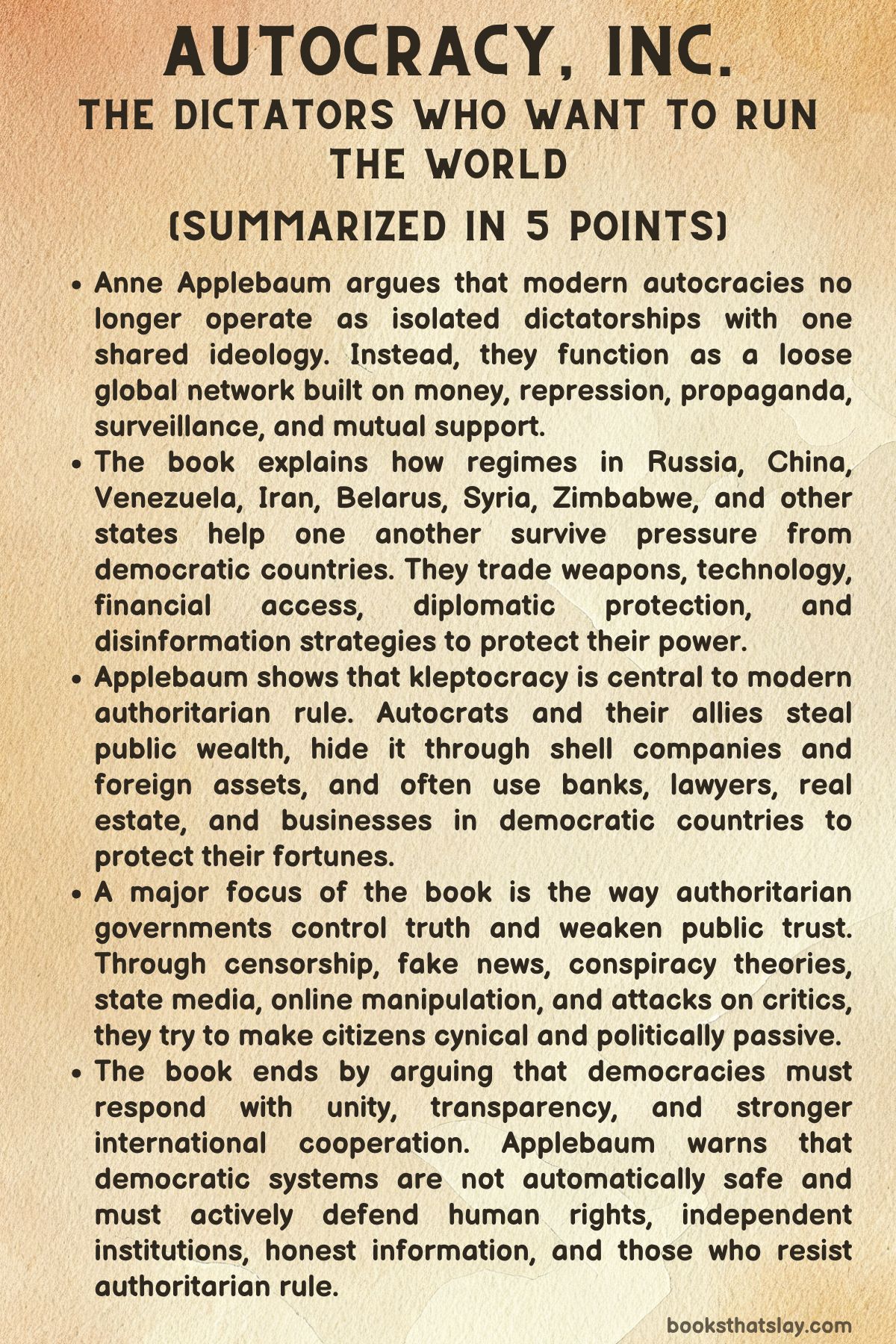
Autocracy, Inc. is Anne Applebaum’s argument that modern dictatorships no longer operate as isolated regimes ruled only by ideology.
They function as a practical global network, connected by money, surveillance tools, propaganda systems, corrupt business deals, security services, and shared hostility toward democratic accountability. Applebaum shows how leaders in Russia, China, Venezuela, Belarus, Syria, Iran, Zimbabwe, and elsewhere protect one another, evade sanctions, launder wealth, and weaken democratic norms. The book is not only about autocrats abroad; it is also a warning that democratic countries have helped sustain these systems through greed, complacency, and financial secrecy.
Summary
Anne Applebaum’s Autocracy, Inc. argues that the modern world’s authoritarian regimes should not be understood as separate dictatorships with identical ideologies.
Instead, they operate as a loose but powerful network, held together by shared interests: survival, wealth, repression, and the desire to weaken democratic systems. These governments may disagree on religion, history, nationalism, or economic policy, but they cooperate when their power is threatened.
They trade weapons, intelligence, technology, propaganda methods, financial services, and diplomatic cover. Their common enemy is not one country alone but the democratic idea itself: accountability, transparency, independent courts, free elections, free media, and the right of citizens to challenge power.
Applebaum begins by challenging an older image of dictatorship. In the past, people often imagined autocracies as closed states ruled by a single ideology.
The current reality is different. Many modern autocrats are pragmatic rather than doctrinal.
They may use nationalist slogans, anti-Western language, religious identity, socialist rhetoric, or claims of sovereignty, but these are often tools of power rather than firm beliefs. Their deeper commitment is to keeping control and protecting the fortunes of ruling elites.
This explains why very different governments can help one another. Russia, China, Iran, North Korea, Venezuela, Belarus, Syria, Zimbabwe, and other authoritarian systems can cooperate because they recognize that a victory for democratic protest in one country may inspire citizens in another.
Russia’s invasion of Ukraine becomes a key example of this global conflict. Vladimir Putin’s decision to attack Ukraine was not only a regional war; it was also an attack on the idea that countries can choose democratic futures for themselves.
Putin expected democratic countries to be divided, slow, and weak. Instead, many of them responded with sanctions, weapons, and support for Ukraine.
Yet Russia was not isolated. China, Iran, North Korea, and others provided forms of political, economic, or military support, while some states used the war for advantage.
The episode shows the central structure of Applebaum’s argument: democracies may see crises as separate events, but autocracies often see them as part of one wider struggle.
The book then turns to the economic roots of this system. Applebaum traces how Western Europe developed energy ties with the Soviet Union, especially through gas pipelines from Siberia.
Leaders such as Willy Brandt believed trade could reduce conflict and create stability. American presidents worried that energy dependence could give Moscow political leverage, but the belief that trade would soften authoritarian systems became powerful.
After the Cold War, many Western leaders thought globalization would gradually turn Russia and China toward liberal democracy. Francis Fukuyama’s idea that liberal democracy had become history’s winning model captured this optimism.
Applebaum argues that this confidence blinded democratic societies to the danger that money could move in the opposite direction: instead of trade transforming autocracy, autocratic wealth could corrupt democracies. Russia after the Soviet collapse is central to this point.
Many Russians hoped for democracy and reform. Yegor Gaidar and other reformers wanted Russia to join the democratic world.
Vladimir Putin initially presented himself in modernizing terms, but he built a system in which state resources, companies, and institutions were used to enrich insiders and punish critics. Western banks, lawyers, accountants, lobbyists, real estate firms, and corporations helped manage and hide this wealth.
They did not always support Putin politically, but their pursuit of profit made them useful to his system.
The case of Ukrainian oligarch Ihor Kolomoisky shows how kleptocracy reaches into democratic societies. Money allegedly stolen through PrivatBank was moved through shell companies and used to buy assets, including a steel plant in Ohio.
That plant eventually collapsed, leaving workers and a local community damaged by financial crimes that began far away. Applebaum uses this example to show that corruption is not abstract.
When dirty money moves through real estate, banks, tax havens, and failing companies, it harms ordinary people and weakens trust in democratic institutions.
Venezuela offers another version of the same pattern. Hugo Chávez came to power promising to fight corruption in an oil-rich country already damaged by elite theft.
Instead, his government reproduced and deepened corruption. Officials used state resources for personal gain, manipulated currency systems, and turned public institutions into tools of enrichment and control.
When the economy collapsed and sanctions increased pressure, the regime survived through illegal trade, smuggling, drug trafficking, gold networks, and foreign support. Russia, China, Cuba, Turkey, and Iran each helped in different ways.
Their support was not charity; it was part of the wider authoritarian habit of keeping friendly regimes alive.
Zimbabwe’s gold-smuggling scandals show how corruption adapts across borders. Uebert Angel, known first as a prosperity preacher and later as a diplomat, appears in Applebaum’s account as a figure who represents the fusion of religion, politics, diplomatic immunity, and illicit money.
The system around him connected Zimbabwe’s ruling elite with networks in Africa, the Middle East, and Dubai. It also showed how international finance can be used to evade sanctions and protect ruling parties.
Applebaum’s point is that kleptocracy has become mobile, creative, and global.
The next major element of the authoritarian system is control of information. Applebaum contrasts the fall of communist regimes in Eastern Europe in 1989 with China’s violent suppression of the Tiananmen Square protests.
China’s leaders learned that democratic ideas could threaten their rule, so they built systems to censor, monitor, and shape public opinion. The Great Firewall, digital surveillance, artificial intelligence, tracking systems, and repression in places like Xinjiang show how technology can serve political control.
Western companies helped create some of these tools before China developed its own systems.
Modern propaganda, Applebaum argues, often works differently from older propaganda. It does not always try to make people believe in a perfect future.
Instead, it trains people to distrust everyone and give up on politics. China promotes national pride and presents democracy as disorder.
Russia floods citizens and foreign audiences with contradictory stories, conspiracy theories, culture-war narratives, and anti-Western claims. The goal is not always to prove one official truth.
Often the goal is to make truth seem unknowable, so citizens become passive.
This propaganda travels globally. Russian and Chinese narratives about Ukraine, NATO, American power, secret biolabs, and Western hypocrisy circulate in Africa, Latin America, Asia, Europe, and the United States.
State media, fake websites, social media campaigns, content-sharing agreements, and sympathetic influencers repeat these messages in local languages and local contexts. The fabricated story about Chinese officials rescuing Taiwanese tourists after a typhoon in Japan shows the personal cost of disinformation.
The lie made Taiwan’s democratic government look weak, created public outrage, and contributed to a diplomat’s death by suicide.
Applebaum also examines how autocracies attack the international rules built after World War II. The Universal Declaration of Human Rights created a shared language of dignity, law, and universal protection.
Russia, China, and their allies now try to replace this language with terms such as sovereignty and multipolarity. In practice, this means rulers should be free from outside criticism, even when they jail opponents, murder dissidents, target civilians, or crush protests.
Organizations such as BRICS and the Shanghai Cooperation Organization help give this argument diplomatic weight.
The hijacking of a Ryanair flight by Belarus to arrest Roman Protasevich shows how far authoritarian rulers will go beyond their borders. This kind of transnational repression includes harassment, kidnapping, imprisonment, and assassination of dissidents abroad.
Syria offers an even more brutal case of lawlessness. Bashar al-Assad, backed by Russia and Iran, turned civil protest into mass violence.
Hospitals whose coordinates had been given to the UN for protection were targeted. The lesson is severe: autocratic alliances can turn international law itself into a weapon or a joke.
The book then focuses on democratic resistance and the authoritarian response to it. Gene Sharp’s writings on nonviolent protest influenced activists across the world.
His ideas helped movements use strikes, symbols, marches, colors, and public courage to challenge dictatorship. But regimes learned from these movements too.
They began smearing activists as foreign agents, criminals, terrorists, or traitors.
Evan Mawarire’s #ThisFlag movement in Zimbabwe shows how this works. A pastor’s protest against corruption became a national symbol, but the regime attacked him through propaganda, arrest, torture, and exile.
Similar methods are used elsewhere. Some dissidents, such as Jamal Khashoggi and Alexei Navalny, are killed.
Others are legally harassed, publicly humiliated, or buried under false accusations. These attacks create doubt even when people know the charges are dishonest.
They also spread cynicism: if every leader is corrupt, then why resist?
Applebaum ends by looking toward democratic solidarity. A gathering of activists in Vilnius shows an alternative network: people from different countries sharing strategies against repression.
She argues that democracies must stop treating authoritarian threats as separate problems. Financial secrecy, propaganda, surveillance, military aggression, and transnational repression are connected.
Fighting them requires cooperation among governments, journalists, lawyers, activists, businesses, and citizens. No democracy is automatically safe.
The survival of democratic life depends on recognizing the authoritarian network for what it is and building a stronger democratic answer.
Key Figures
Anne Applebaum
Anne Applebaum is the guiding voice of Autocracy, Inc., and her role in the book is not that of a detached observer. She writes as a historian, journalist, and political analyst who is trying to correct a dangerous misunderstanding about modern dictatorship.
Her central strength as the book’s narrator is her ability to connect events that may appear unrelated: a steel plant in Ohio, a protest in Zimbabwe, a war in Ukraine, a gold-smuggling network, a Chinese disinformation campaign, and a hijacked airplane in Belarus. Applebaum’s perspective is shaped by concern for democratic survival, but she does not present the democratic world as innocent.
She is especially sharp when explaining how Western banks, lawyers, corporations, and political leaders helped authoritarian money move through global systems. Her analysis makes her a moral critic of both autocracy and democratic complacency.
She is not simply warning readers about foreign dictators; she is asking democratic societies to examine their own greed, passivity, and failure to defend their principles.
Vladimir Putin
Vladimir Putin is presented as one of the central architects of the modern authoritarian model. In the book, he represents the transformation of post-Soviet Russia from a country with democratic possibility into a kleptocratic state organized around loyalty, wealth extraction, repression, and imperial ambition.
Putin’s importance lies not only in his control of Russia but in the model he offers to other autocrats: maintain elections as performance, control media, enrich insiders, use courts against opponents, exploit Western financial systems, and present aggression as national defense. His invasion of Ukraine reflects his fear of democratic example as much as his desire for territory.
A democratic Ukraine threatens his claim that Russians and neighboring peoples must accept strongman rule. Putin’s character in the book is coldly strategic, cynical, and skilled at using weakness in democratic societies against them.
He understands money, fear, propaganda, and historical resentment as tools of power.
Xi Jinping
Xi Jinping appears as the leader of a highly organized authoritarian system that combines party rule, technological surveillance, nationalism, censorship, and global ambition. In the book, China under Xi is not only repressive at home but also active in reshaping the international environment so that authoritarian rule faces less criticism.
Xi’s importance comes from the scale and sophistication of the Chinese state. Unlike some kleptocratic regimes that appear chaotic or openly criminal, China projects discipline, efficiency, and long-term planning.
Its control of the internet, use of surveillance, pressure on minority populations, and efforts to influence global media show a model of authoritarianism based on both fear and administrative capacity. Xi represents a form of power that wants not only to silence dissent but to make democratic language seem weak, foreign, and disorderly.
His role in the story is that of a ruler who sees information control as central to political survival.
Hugo Chávez
Hugo Chávez is portrayed as a leader who rose by condemning corruption but then reproduced corruption on a larger scale. His character in the book is important because he shows how anti-elite language can become a cover for a new elite’s theft.
Chávez understood the anger of Venezuelans who had suffered under an oil-based political system marked by inequality and dishonesty. Yet once in power, he did not build accountable institutions.
Instead, he protected loyalists, ignored warnings, and allowed state resources to be turned into instruments of political control and personal enrichment. His anti-American rhetoric helped him win admirers abroad, but Applebaum’s account emphasizes the domestic cost: economic collapse, poverty, repression, and dependence on other authoritarian partners.
Chávez represents the danger of confusing revolutionary language with justice. In the book, his legacy is a state where corruption became a governing method.
Jesús Urdaneta
Jesús Urdaneta appears as a revealing figure because he was close enough to Hugo Chávez’s system to see its corruption from within. As an intelligence chief and former ally, he warned Chávez about misconduct among top officials.
His role in the book shows that the Venezuelan regime’s corruption was not invisible, accidental, or merely the result of outside pressure. It was recognized early, and Chávez had a choice.
Urdaneta’s removal shows how authoritarian systems treat internal criticism: even loyal insiders become threats when they challenge the flow of money and privilege. He represents the road not taken, the possibility that the new government could have confronted corruption instead of protecting it.
His presence also shows how autocracies harden. At first, they may include people who believe in reform, but those people are pushed out once loyalty to the leader becomes more important than loyalty to the public.
Ihor Kolomoisky
Ihor Kolomoisky is one of the clearest examples of how corrupt wealth travels across borders and damages lives far from its origin. In the book, he is not only a Ukrainian oligarch but a symbol of the global systems that allow stolen or suspicious money to be hidden through shell companies, tax havens, banks, and real estate.
His purchase of Warren Steel in Ohio shows how kleptocratic finance can enter an ordinary American community and leave destruction behind. Workers lost jobs, safety failed, and a local industrial asset declined while money moved through obscure structures.
Kolomoisky’s character matters because he connects foreign corruption to domestic consequences in democratic countries. He shows that kleptocracy is not only a problem for the country where money is stolen.
It becomes a problem for every society that allows anonymous capital to buy influence, property, and legitimacy.
Willy Brandt
Willy Brandt appears as a democratic leader who believed economic engagement could reduce conflict with the Soviet Union. His policy of Ostpolitik is treated as historically significant because it helped normalize long-term trade between Western Europe and an authoritarian power, especially through energy deals.
Brandt’s character in the book is not presented as corrupt or foolish. Rather, he represents a hopeful democratic assumption: that trade can soften hostility, build stability, and make war less likely.
Applebaum’s wider argument complicates that assumption. Brandt’s approach may have made sense in its own moment, but its legacy included patterns of dependence that later became politically dangerous.
His role is therefore tragic in a restrained way. He stands for a diplomatic ideal that underestimated how authoritarian states could use economic relationships not as paths toward liberalization but as sources of leverage.
Richard Nixon
Richard Nixon appears as one of the American presidents who worried about the strategic consequences of deep economic ties between Europe and the Soviet Union. In the book, his role is not central as an individual personality, but he represents an early recognition that trade with authoritarian regimes could create political dependence.
Nixon’s concerns reflect a harder view of international relations than the optimism that later became common after the Cold War. He understood that energy, contracts, and infrastructure were not neutral when one side was controlled by an undemocratic state.
His presence in the book helps show that warnings existed before the full consequences became clear. Whether or not his own foreign policy was morally consistent, his skepticism about Soviet leverage stands as part of the debate Applebaum reconstructs between commercial optimism and political caution.
Jimmy Carter
Jimmy Carter is included among the American leaders who expressed concern about the risks of energy dependence and trade with the Soviet Union. His role in the book is significant because Carter is often associated with human rights in foreign policy, and that concern fits Applebaum’s broader argument about the need to connect economics with political values.
Carter’s position suggests that democratic states cannot separate trade from questions of freedom, law, and coercion. He represents a moral-political warning that was often overshadowed by commercial interests.
In the book’s larger framework, Carter’s concern looks more prescient after Russia’s later use of energy, money, and influence as tools of pressure. His character is therefore less a dramatic actor than a marker of a path democracies could have taken more seriously.
Ronald Reagan
Ronald Reagan appears in two related ways. On one hand, he was among those who worried about Europe becoming too dependent on Soviet energy.
On the other hand, he also shared the broader belief that freedom and markets could eventually defeat authoritarian systems. In the book, Reagan represents both caution and confidence.
He was alert to Soviet power, but his era also helped create the triumphalist democratic mood that later encouraged leaders to believe trade and capitalism would naturally produce liberal reform. This dual role makes him a useful figure in Applebaum’s argument.
He understood the Soviet Union as a political adversary, yet the post-Cold War world partly inherited a simplified version of his optimism: that economic opening and democratic values would move together. Applebaum shows that the relationship was far less automatic.
Bill Clinton
Bill Clinton represents the post-Cold War confidence that globalization would help bring China, Russia, and other authoritarian or semi-authoritarian states into a liberal international order. In the book, he stands for a generation of democratic leadership that believed engagement, trade, and institutional inclusion would encourage reform.
His role is important because this belief shaped major decisions about China’s integration into the world economy and the West’s relationship with post-Soviet Russia. Applebaum’s criticism is not that Clinton alone created the problem, but that the assumptions of his era were incomplete.
The democratic world focused on market access and growth while giving too little attention to corruption, political control, and the ability of autocracies to absorb capitalism without accepting freedom. Clinton’s character in the book is tied to the limits of liberal optimism.
Francis Fukuyama
Francis Fukuyama appears as the thinker whose argument about the apparent victory of liberal democracy captured a powerful mood after the Cold War. In the book, his importance lies less in his personal actions than in the influence of the idea associated with him: that liberal democracy had become the most successful and ultimately inevitable political model.
Applebaum uses this intellectual atmosphere to explain why many democratic leaders underestimated authoritarian resilience. Fukuyama represents a historical confidence that made sense to many observers in the 1990s, when communist regimes had fallen and market democracy seemed ascendant.
Yet the book challenges the comfort produced by that confidence. Autocracies did not disappear; they adapted.
Fukuyama’s role is therefore that of an emblem of an era whose hopes were genuine but whose expectations proved too simple.
Yegor Gaidar
Yegor Gaidar represents the reformist possibilities of post-Soviet Russia. In the book, he stands for those who believed Russia could rebuild itself through economic transformation, democratic institutions, and closer ties with the West.
His role is important because it reminds readers that Russia’s authoritarian turn was not inevitable. There were people within Russia who wanted a different future, and their ideas were serious.
Gaidar’s presence makes Putin’s later system appear not as the natural destiny of Russian politics but as the result of choices, failures, and power struggles. He also reflects the difficulty of reforming a state after the collapse of a command economy.
The urgency of economic change, the weakness of institutions, and the opportunities for theft created openings that authoritarian and oligarchic forces exploited.
Uebert Angel
Uebert Angel is one of the book’s most striking examples of how modern kleptocracy can wear unexpected costumes. Known as a prosperity gospel preacher and later appointed as Zimbabwe’s ambassador at large, he appears as a figure who links religion, spectacle, diplomacy, and money laundering.
His public image promised spiritual success and financial blessing, while the allegations around him point to gold-smuggling networks and the use of diplomatic status to move illicit wealth. Angel’s character shows how authoritarian corruption does not always look like a uniformed official giving orders.
It can appear through charismatic religious language, business confidence, and international respectability. In Applebaum’s account, he helps reveal how ruling parties and connected elites use informal networks to evade sanctions, enrich themselves, and keep power protected behind layers of performance.
Alexander Lukashenko
Alexander Lukashenko is presented as a ruler willing to violate international norms openly in order to capture an opponent. The forced diversion of a Ryanair flight to Minsk so that Roman Protasevich could be arrested shows his contempt for law beyond Belarus’s borders.
Lukashenko’s character in the book is blunt, coercive, and dependent on the wider authoritarian environment, especially Russian backing. He represents the movement from domestic repression to transnational repression.
His actions signal that autocrats no longer feel fully restrained by borders, treaties, or aviation norms when pursuing dissidents. Lukashenko also shows how smaller authoritarian regimes gain confidence from larger patrons.
Without the broader network of support and imitation, his ability to act so aggressively would be more limited.
Roman Protasevich
Roman Protasevich appears as the dissident whose capture exposes the reach of authoritarian power. His role is important because he is less a policy-maker than a target, a person whose life is reshaped by a regime’s need to punish dissent.
As a journalist and critic of the Belarusian dictatorship, he symbolizes the threat that independent information poses to autocrats. The extreme measures taken to arrest him show that authoritarian rulers fear words, reporting, and political organizing.
Protasevich’s character also demonstrates the vulnerability of exiles and activists who may believe they are safer once outside their home countries. In the book, his fate becomes evidence that modern autocracies do not always stop at national borders.
They carry fear outward.
Bashar al-Assad
Bashar al-Assad is presented as a ruler whose response to protest became mass violence and internationalized war. In the book, he represents the brutality of a regime that would rather destroy its own society than surrender power.
Assad’s survival depends heavily on outside authoritarian allies, especially Russia and Iran, which makes him a central example of the network Applebaum describes. His government’s targeting of civilians and hospitals shows the collapse of any meaningful respect for humanitarian norms.
Assad’s character is defined by ruthless endurance. He does not need to persuade most citizens or build legitimacy in a democratic sense; he needs enough military force, outside backing, fear, and propaganda to remain in place.
His role shows how autocratic solidarity can prolong suffering and block accountability.
Gene Sharp
Gene Sharp appears as a thinker of democratic resistance rather than a ruler or activist in the ordinary sense. His work on nonviolent struggle gave citizens practical ways to challenge dictatorship through strikes, protests, symbols, boycotts, and organized refusal.
In the book, Sharp represents the power of method. He understood that dictators depend on obedience, fear, and the cooperation of institutions.
If people withdraw that cooperation strategically, even strong regimes can become vulnerable. His ideas influenced movements across different countries, which made him threatening to autocrats even though he did not command an army or hold office.
Sharp’s character also shows why authoritarian regimes fear civil society. A pamphlet, a slogan, or a disciplined protest strategy can become dangerous when citizens begin to see power as something they can challenge.
Evan Mawarire
Evan Mawarire is one of the clearest examples of moral courage in Autocracy, Inc.. A pastor in Zimbabwe, he used the national flag to speak about corruption, betrayal, and the gap between patriotic symbols and lived reality.
His #ThisFlag movement gained force because it translated political anger into a simple public image that ordinary people could claim. Mawarire’s character matters because he shows how democratic resistance can begin with one person’s refusal to stay silent.
Yet his story also shows how quickly regimes adapt. The Zimbabwean government attacked him as foreign-backed, arrested him, tortured him, and forced him into exile.
In the book, he represents both the power and vulnerability of civic protest. He is not defeated because his message lacked truth, but because authoritarian systems know how to isolate truth-tellers.
Jamal Khashoggi
Jamal Khashoggi appears as an example of the extreme violence that can be used against dissidents and critics. His murder shows that authoritarian repression can reach beyond borders and target individuals who challenge ruling power through journalism or public criticism.
In the book, his role is part of Applebaum’s wider discussion of how regimes manage dissent. Sometimes they smear, arrest, or exhaust opponents; sometimes they kill them.
Khashoggi’s character represents the danger faced by writers and dissidents who expose or criticize authoritarian rulers from abroad. His killing also tests democratic governments.
When a dissident is murdered, the response of democratic states reveals whether they value human rights more than strategic convenience, arms deals, oil interests, or diplomatic caution.
Alexei Navalny
Alexei Navalny is presented as one of the most important democratic opponents of Putin’s Russia. His power came not only from electoral politics but from his ability to make corruption visible.
By exposing the wealth of Russian elites and connecting it to the hardships of ordinary citizens, he attacked the moral foundation of the regime. Navalny’s character in the book is defined by courage, investigative skill, and an understanding that kleptocracy must be shown in concrete terms.
Palaces, bank accounts, luxury goods, and hidden ownership matter because they turn abstract corruption into something citizens can understand. His death makes him part of the book’s account of the risks faced by those who challenge autocracy directly.
He represents the possibility of democratic accountability inside a system built to prevent it.
Denise Dresser
Denise Dresser appears as a journalist and public critic targeted by political attacks in Mexico. Her role broadens the book’s argument by showing that smear tactics are not confined to fully authoritarian states.
When elected leaders attack journalists, encourage online abuse, or present criticism as treason, they borrow methods associated with autocratic politics. Dresser’s character represents the vulnerability of independent voices in democracies experiencing institutional strain.
Her inclusion shows that the line between democracy and autocracy can be weakened gradually, through language, intimidation, and the normalization of personal attacks. She also illustrates the importance of public criticism in a healthy democracy.
Leaders who cannot tolerate scrutiny often reveal authoritarian habits even when they operate inside electoral systems.
Andrés Manuel López Obrador
Andrés Manuel López Obrador appears as an elected democratic leader whose attacks on critics show how autocratic tactics can enter democratic politics. In the book, he is not treated as identical to dictators such as Putin or Assad, but his behavior toward journalists such as Denise Dresser helps Applebaum show how smear campaigns travel.
His character represents a populist style of power that frames criticism as hostility to the people, the nation, or the leader’s political project. This matters because democracies can be damaged from within when leaders use public platforms to discredit independent institutions and individual critics.
López Obrador’s role is a warning that democratic legitimacy gained through elections does not give leaders the right to weaken the norms that make democracy meaningful.
Joe Biden
Joe Biden appears indirectly through references to disinformation about Ukraine and distrust of American policy. His role in the book is not as a deeply examined character but as a symbol of the democratic leadership targeted by Russian and Chinese propaganda after the invasion of Ukraine.
False claims about US-funded biolabs and related conspiracies were used to undermine confidence in American explanations and weaken support for Ukraine. Biden’s presence matters because the propaganda was not only about Ukraine; it was also about making democratic governments appear dishonest, reckless, and secretly criminal.
In that sense, he functions as a target within a larger information war. The attacks on his administration show how autocratic narratives aim to divide democratic publics from their own institutions.
Taiwanese Diplomat
The Taiwanese diplomat who died by suicide after a fabricated evacuation story became a public scandal is one of the most tragic figures in the book. His role shows the human cost of disinformation.
A false claim that Chinese officials had rescued citizens while Taiwanese representatives failed spread through social media and mainstream coverage, creating public anger and shame. Later investigations found that the story was fabricated and connected to Chinese influence efforts.
The diplomat’s character is important because he represents people caught in political warfare without being famous leaders or activists. His death shows that propaganda is not merely a battle of messages.
It can destroy reputations, create unbearable pressure, and turn lies into real-world harm.
African Students
The African students who repeat Russian claims about Ukraine represent the success of authoritarian messaging outside the countries where it begins. Their role is collective rather than individual, but it is still significant.
They show how narratives about NATO, Western hypocrisy, colonial memory, and American power can be shaped by Russian and Chinese media strategies. Applebaum does not present them as villains.
Instead, they are examples of audiences reached by targeted propaganda that adapts itself to local grievances and historical experiences. Their presence in the book shows that the information struggle is global.
Autocracies do not need everyone to love Russia or China; they often need only to create doubt about democracies, reduce sympathy for victims, and make aggression appear morally ambiguous.
Chinese Communist Party
The Chinese Communist Party functions almost as a collective character in the book. Its actions after Tiananmen Square reveal a deep fear of democratic ideals and public mobilization.
Rather than simply suppress one protest, it built a long-term system to prevent similar challenges from gaining force. The party’s character is defined by discipline, memory, control, and ideological insecurity.
It censors the past, manages the present, and tries to shape global discussion of China’s future. Its use of the Great Firewall, surveillance technology, propaganda, and international media influence shows a ruling organization that treats information as a battlefield.
The party is not only concerned with what Chinese citizens do; it is also concerned with what the world says about China, Taiwan, democracy, human rights, and power.
Russian State Media and Propaganda Networks
Russian state media and related propaganda networks act as collective agents of confusion. Their role in the book is to spread distrust, not necessarily to make audiences believe one stable doctrine.
They amplify conspiracy theories, culture-war stories, anti-Western narratives, and contradictory explanations of events. This method encourages people to assume that all governments lie and that truth is impossible to know.
As a character-like force, these networks are cynical, adaptive, and aggressive. They tailor messages to different audiences while keeping the same broad purpose: weaken democratic confidence and reduce resistance to Russian aims.
Their importance lies in the way they turn media into an instrument of psychological exhaustion. Citizens who stop believing in truth are less likely to organize, protest, or defend institutions.
Confucius Institutes
Confucius Institutes appear as part of China’s broader effort to shape international narratives. In the book, they represent soft power with political limits.
On the surface, they promote language and culture, but Applebaum places them within a wider strategy of influence that includes media investment, censorship pressure, and control over how China is discussed abroad. As a collective presence, they show that authoritarian influence is not always openly violent or obviously coercive.
It can work through education, cultural programming, institutional partnerships, and carefully managed speech. Their role is to make China appear attractive while discouraging criticism of the Chinese Communist Party’s conduct.
They show how cultural diplomacy can become political messaging when tied to an authoritarian state’s priorities.
Freedom House
Freedom House appears through its use of the term transnational repression. Its role in the book is not that of a person but of a democratic watchdog that gives language to a growing pattern of authoritarian behavior.
By naming the practice of regimes harassing, kidnapping, arresting, or killing dissidents beyond borders, Freedom House helps make the problem visible. Its character as an institution is tied to documentation and warning.
In Applebaum’s argument, naming matters because democracies often respond too slowly to threats they have not clearly defined. Freedom House represents the civil society and research organizations that help democracies understand authoritarian tactics before those tactics become normalized.
Universal Declaration of Human Rights Drafters
The drafters of the Universal Declaration of Human Rights appear as a diverse group whose work created a moral and legal language for the postwar world. Their role in the book is foundational.
They represent the belief that certain rights belong to all human beings, regardless of nationality, regime type, or political convenience. Applebaum contrasts their achievement with the current efforts of autocracies to weaken universal rights language and replace it with claims of sovereignty.
These drafters function as representatives of a democratic and humanist tradition that authoritarian states find threatening. Their character is collective, principled, and historically significant because they helped build the standards that modern autocrats now try to dismantle.
World Liberty Congress Activists
The democracy activists gathered in Vilnius for the World Liberty Congress serve as the book’s answer to authoritarian cooperation. They are not one character but a democratic network in formation.
Their importance lies in their shared recognition that struggles in different countries are connected. Activists from authoritarian contexts understand that dictators learn from one another, support one another, and copy tactics.
The gathering shows that democrats must do the same: share strategies, build solidarity, expose corruption, fight propaganda, and protect dissidents. Their character in the book is marked by modest resources but strong moral clarity.
They stand in contrast to the wealth and luxury of autocratic elites. They suggest that democratic resistance can also become international, practical, and disciplined.
Iran
Iran appears as an authoritarian state actor that supports other regimes and uses regional conflict to expand influence. In Syria, Iranian forces and proxies helped Bashar al-Assad survive, turning a domestic uprising into part of a wider geopolitical struggle.
In Venezuela, Iran helped with oil and economic cooperation in ways that allowed an isolated regime to endure. Iran’s character in the book is strategic, ideological in its anti-American posture, and practical in its alliances.
It is part of the authoritarian network not because it shares every belief with Russia, China, or Venezuela, but because it benefits from weakening democratic pressure and preserving allied regimes. Iran represents how regional ambitions and global authoritarian cooperation can reinforce each other.
Russia
Russia as a state is larger than Putin alone in the book. It functions as a hub of kleptocracy, military aggression, energy leverage, disinformation, and support for other authoritarian rulers.
Its character is revisionist and disruptive. Russia seeks to weaken democratic unity, challenge international law, and protect regimes that oppose Western influence.
Through Syria, Ukraine, Belarus, Venezuela, propaganda networks, and financial corruption, Russia appears as both a model and an active sponsor of modern autocratic behavior. The Russian state in the book is not merely defensive; it takes initiative in creating disorder because disorder benefits its rulers.
A confused, divided democratic world gives Russia more room to act.
China
China as a state is presented as the most technologically advanced and globally ambitious authoritarian power in the book. Its character differs from Russia’s in style.
Where Russia often creates chaos, China often emphasizes control, development, discipline, and long-term influence. It uses censorship, surveillance, economic power, media investment, and diplomatic language to reduce criticism and promote an authoritarian-friendly world order.
China’s role is especially important because it shows that modern autocracy can be efficient, wealthy, and internationally connected. It does not need to reject globalization; it can use globalization while resisting liberalization.
China represents the possibility that authoritarian capitalism can become a durable rival to democratic systems.
Cuba
Cuba appears as a key supporter of Venezuela’s authoritarian survival. Its role includes intelligence, security advice, and political assistance.
In the book, Cuba represents an older revolutionary dictatorship that has adapted to the modern authoritarian network by exporting expertise in control. Its character is disciplined, security-focused, and experienced in managing dissent.
Cuba’s relationship with Venezuela shows how smaller authoritarian states can remain influential by providing specialized services to allied regimes. It also demonstrates that autocratic cooperation does not always depend on vast wealth.
Knowledge of repression, intelligence organization, and political control can be just as valuable as money or weapons.
Turkey
Turkey appears in connection with Venezuela through gold and food exchanges that helped the regime survive economic pressure. Its role in the book reflects the complexity of states that may not fit neatly into a single ideological camp but still participate in systems that benefit authoritarian survival.
Turkey’s character here is transactional. It engages where profit, influence, or geopolitical opportunity exists.
This makes it useful to Applebaum’s broader argument: modern authoritarian cooperation is not always based on shared doctrine. It often works through deals.
Turkey’s place in the book shows how economic channels can help sanctioned or isolated regimes remain alive.
North Korea
North Korea appears as one of the states supporting Russia after the invasion of Ukraine. Its role is not deeply individualized, but it matters as an example of how even heavily isolated dictatorships can become useful within the authoritarian network.
North Korea’s character in the book is militarized, closed, and survival-driven. It has few reasons to support democratic norms and many reasons to align with powers that challenge the United States and its allies.
Its involvement shows that authoritarian cooperation can include weapons, diplomatic support, and shared hostility toward the democratic order. North Korea represents the hard edge of the network: a regime with little concern for international criticism and much to gain from disorder.
India
India appears in the book as a country that exploited the economic consequences of Russia’s war in Ukraine. Its role is more ambiguous than that of openly autocratic allies.
India is not presented in the same category as Russia, China, or Iran, but its behavior shows how large states may act according to national advantage even during a moral and geopolitical crisis. India’s character in this context is pragmatic and interest-driven.
Its inclusion complicates a simple democracies-versus-autocracies division. Applebaum’s argument suggests that the defense of democratic norms requires more than formal democratic identity; it requires choices that support accountability and resist aggression.
India’s role shows how economic opportunity can weaken unified pressure on authoritarian states.
BRICS
BRICS appears as a diplomatic grouping that gives authoritarian and non-Western powers a platform to challenge Western influence and promote alternative language about global order. In the book, its character is institutional and symbolic.
It allows Russia, China, and others to present their preferences as part of a broader demand for multipolarity. Applebaum is concerned with how such language can be used to weaken human rights norms by reframing external criticism as imperial interference.
BRICS is not described simply as an evil organization, but as a space where authoritarian arguments can gain legitimacy. Its role shows that the battle over democracy is also a battle over institutions, vocabulary, and diplomatic respectability.
Shanghai Cooperation Organization
The Shanghai Cooperation Organization appears as another institutional setting through which authoritarian-friendly ideas can gain international force. Its character in the book is tied to security, sovereignty, and the reduction of Western influence.
It helps normalize a view of international politics in which regimes should be protected from outside criticism, especially on human rights. The organization matters because it gives structure to cooperation among states that share concerns about dissent, separatism, protest, and Western pressure.
In Applebaum’s account, it contributes to the effort to change the operating system of global politics. Instead of universal rights, the emphasis shifts toward regime security.
United Nations
The United Nations appears in the book as both a symbol of the postwar rules-based order and an institution whose humanitarian mechanisms can be abused by authoritarian actors. The episode involving hospital coordinates in Syria is especially disturbing because information given for civilian protection was used in a context where hospitals were targeted.
The UN’s character here is vulnerable and constrained. It seeks to reduce harm, but its tools depend on some degree of good faith from states and armed actors.
When regimes act cynically, humanitarian systems can be manipulated. The UN therefore represents both the necessity and fragility of international norms.
Its presence shows why rules matter, but also why rules without enforcement can be exploited.
Western Banks, Lawyers, Companies, and Financial Professionals
Western financial and professional actors form one of the most important collective characters in the book. They are not autocrats, but they make autocracy easier.
Banks move money. Lawyers create structures.
Accountants legitimize transactions. Real estate firms accept anonymous buyers.
Lobbyists polish reputations. Corporations pursue profit while ignoring political risk.
Their character is marked less by ideological commitment than by moral carelessness. Applebaum’s criticism is powerful because these actors belong to democratic societies.
They often benefit from rule of law at home while helping kleptocrats hide wealth abroad. In the book, they show how autocracy is sustained not only by dictators and police forces but also by respectable professionals who choose fees over accountability.
Themes
Kleptocracy as a System of Power
Kleptocracy in Autocracy, Inc. is not simple theft by corrupt officials; it is a governing structure.
Leaders and insiders take public resources, hide the money through shell companies or foreign assets, and then use wealth to secure loyalty. This arrangement changes the nature of the state.
Courts, banks, ministries, police, tax systems, and state companies no longer serve the public first. They become tools for protecting the ruling circle.
The examples of Russia, Venezuela, Ukraine-linked money laundering, Zimbabwean gold networks, and Western real estate show how stolen wealth depends on both local power and international secrecy. The most disturbing part of this theme is the involvement of democratic systems.
Kleptocrats need places to store money, buy property, hire lawyers, educate children, and gain respectability. When democracies allow anonymous companies, weak financial oversight, and reputation laundering, they become part of the problem.
Applebaum’s argument turns corruption from a domestic issue into a global security threat. Kleptocracy weakens trust, damages communities, funds repression, and gives authoritarian elites the means to survive public anger.
Propaganda, Disinformation, and the Destruction of Truth
Modern authoritarian propaganda often does not ask citizens to believe in a grand dream. It asks them to stop believing in anything.
This is one of Applebaum’s sharpest observations. Russian and Chinese information strategies use different styles, but both aim to weaken democratic confidence and political action.
China censors, filters, monitors, and promotes national strength while presenting democracy as chaotic. Russia often spreads many conflicting claims at once, creating confusion rather than clarity.
The result is public exhaustion. When people hear enough lies, counter-lies, conspiracies, and accusations, they may conclude that all politics is fake and all leaders are equally corrupt.
This benefits rulers who fear organized resistance. Disinformation also travels across borders.
Stories about Ukraine, NATO, biolabs, Taiwan, Western hypocrisy, and social conflict are shaped for audiences in Africa, Asia, Europe, Latin America, and the United States. The goal is not always to make people love autocracy.
It is enough to make them distrust democracy, doubt victims, and question whether truth can be known.
The Weakening of International Law and Human Rights
Applebaum shows that authoritarian regimes are trying to change the moral language of international politics. After World War II, documents such as the Universal Declaration of Human Rights helped establish the idea that all people possess rights that states should not violate.
Modern autocracies challenge this by emphasizing sovereignty, multipolarity, and noninterference. These terms can sound reasonable, especially in countries with memories of colonialism or Western double standards.
Yet in authoritarian hands, they often mean that rulers should be free to imprison opponents, crush protests, target civilians, censor speech, and attack dissidents without outside criticism. Belarus’s forced landing of a passenger plane, Russia and Syria’s conduct in Syria, and the intimidation of exiles show how law is weakened when regimes face little consequence.
This theme matters because international law depends on shared seriousness. When powerful states treat treaties, humanitarian protections, and borders as obstacles to be gamed, the entire system becomes less safe.
Applebaum’s warning is that human rights can be eroded not only through open rejection but through new language that makes accountability seem illegitimate.
Democratic Resistance and the Need for Solidarity
The book’s final movement argues that democratic resistance must become as connected as authoritarian power already is. Autocrats learn from one another.
They copy smear campaigns, surveillance methods, legal harassment, propaganda narratives, and financial tricks. They support allies with weapons, money, diplomatic cover, and media amplification.
Democratic activists, governments, journalists, and citizens must respond with similar seriousness. Gene Sharp’s work on nonviolent resistance shows that dictators have weaknesses, especially when citizens withdraw cooperation.
Evan Mawarire’s #ThisFlag movement shows how a simple symbol can express public anger and create unity. Alexei Navalny’s investigations show how exposing elite wealth can connect corruption to ordinary suffering.
Yet these examples also show the cost of resistance: prison, exile, torture, assassination, and reputational attack. Solidarity cannot be sentimental; it must be practical.
Democracies need financial transparency, protection for dissidents, stronger responses to disinformation, cleaner institutions, and international cooperation. Applebaum’s closing argument is that no democracy is permanently safe by default.
It survives when citizens and institutions actively defend it.