Automating Inequality Summary and Analysis
Automating Inequality: How High-Tech Tools Profile, Police, and Punish the Poor by Virginia Eubanks is a nonfiction study of how technology, data systems, and automated decision-making reshape poverty management in the United States. The book argues that digital tools used in welfare, housing, and child protection often do not fix inequality; they make older forms of punishment, suspicion, and social control faster and harder to challenge.
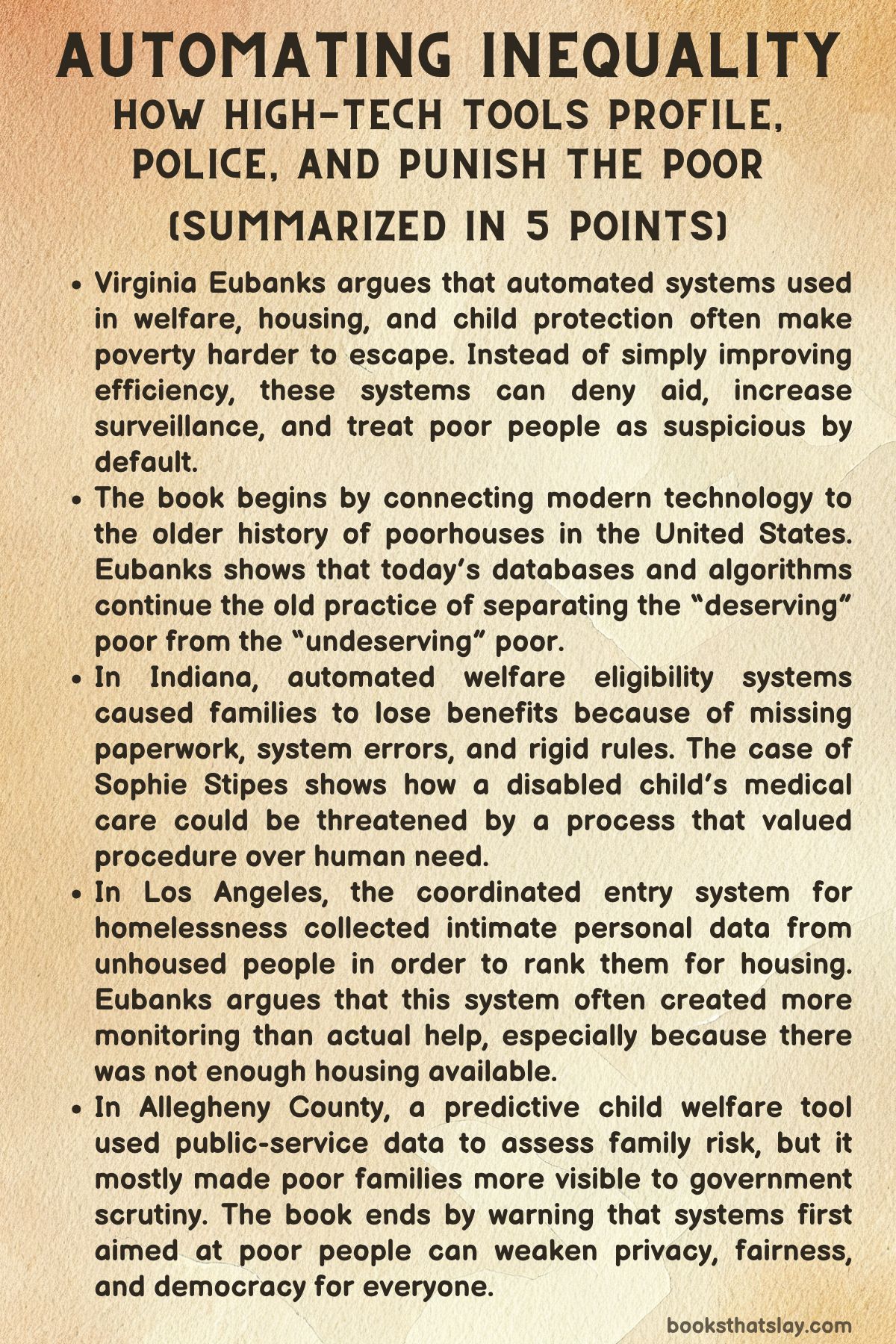
Through historical background and three modern case studies, Eubanks shows how poor and working-class people are monitored, classified, denied aid, and treated as risks rather than as citizens with rights. The book is both a warning about technology and a critique of poverty policy.
Summary
Automating Inequality begins with a personal crisis. Virginia Eubanks describes how her partner, Jason, was randomly attacked and needed urgent medical treatment.
What should have been a straightforward process of getting care became a frightening experience of paperwork, insurance confusion, debt notices, and bureaucratic mistakes. Eubanks’s family file was marked in a way that made help harder to access, and the stress of each official notice made her aware of how easily ordinary people can be trapped by administrative systems.
This experience becomes the starting point for a wider argument: data systems are not neutral when they are built inside unequal institutions.
Eubanks then turns from her own experience to the public treatment of poor families. She discusses how Maine governor Paul LePage used welfare data in a misleading way to suggest that families receiving Temporary Assistance to Needy Families were spending public benefits irresponsibly.
This political use of data strengthened damaging stereotypes about poor people and helped justify stricter welfare rules. Some of those rules, such as limits on out-of-state ATM access, were vague and difficult to follow.
Eubanks argues that such policies do not merely prevent fraud; they create traps. They allow the state to treat poor people as suspicious by default.
The book’s larger purpose is introduced through three case studies: Indiana’s automated welfare eligibility system, Los Angeles’s homelessness registry and coordinated entry system, and Allegheny County’s predictive model for child welfare investigations. Eubanks bases her research on extensive interviews with poor and working-class people, activists, officials, caseworkers, scholars, journalists, and others connected to these systems.
Her central claim is that automated poverty management damages the social safety net, criminalizes poor people, deepens discrimination, and weakens democratic values.
To explain why these modern systems matter, Eubanks begins with history. In the early United States, poorhouses were institutions where destitute, sick, disabled, or unemployed people were sent when they had nowhere else to go.
These places were intentionally harsh. Their purpose was not only to provide minimal shelter but also to discourage people from seeking aid.
Society divided poor people into the “deserving” and the “undeserving,” treating some as genuinely helpless and others as lazy or morally flawed. This distinction became one of the strongest ideas in American poverty policy.
Poorhouses also served economic and political purposes. They controlled vulnerable populations and reassured those with more money that poverty was being contained.
Later, during the rise of scientific charity, reformers claimed that poverty could be managed through investigation, records, and data. Caseworkers were trained to examine poor families closely and decide who deserved help.
These methods were shaped by racism, sexism, eugenics, and Jim Crow thinking. Eubanks shows that the desire to classify, monitor, and judge poor people did not begin with computers.
Digital systems inherited a long history of moral judgment.
The Great Depression strained older ideas about poverty because so many white middle-class families suddenly needed help. The New Deal saved many lives and created new forms of support, but it also reinforced unequal divisions.
Social insurance helped build a more stable white middle class, while public assistance remained more stigmatized and controlling. Later welfare programs often required poor people to surrender privacy, mobility, political power, bodily autonomy, and self-direction in exchange for small amounts of help.
Even later reforms, including those associated with Nixon, Rockefeller, and Clinton, continued this tradition of strict poverty management.
The first major case study focuses on Indiana. Eubanks tells the story of Kim and Kevin Stipes, whose daughter Sophie has cerebral palsy and other serious medical needs.
The family depended on Medicaid to cover extremely high medical costs. After a paperwork problem, Sophie’s benefits were cut off for supposed inaction, even though the family had not been properly informed about the required documents.
Only after public protest and media attention did the case receive serious attention. Sophie’s case shows the human cost of systems that treat missing paperwork as refusal rather than as a problem requiring help.
Indiana’s welfare system changed dramatically under Governor Mitch Daniels. His administration promoted automation and privatization as ways to increase efficiency and reduce fraud.
Large corporations, including IBM and ACS, became central to the new system. Public casework was reduced, and more welfare administration was handled through call centers, document processing centers, and automated workflows.
The state argued that old caseworkers had too much discretion and that personal relationships allowed fraud. Eubanks argues that this logic confused compassion with corruption.
The automated system broke the relationship between applicants and caseworkers. Instead of one worker understanding a family’s situation from beginning to end, tasks were split across many workers and locations.
Applicants had no clear person to contact when something went wrong. Documents were lost, requests were repeated, and small mistakes were treated as active failure to cooperate.
People who were sick, disabled, elderly, or overwhelmed by poverty were denied benefits because they could not satisfy rigid procedural demands.
Jane Porter Gresham, a longtime caseworker, represents the effect of this transformation on public workers. Before automation, she could use judgment, experience, and personal knowledge to help families complete their applications.
After the new system arrived, she lost control over cases and simply responded to tasks placed in a queue. Her professional role was reduced.
The system did not only harm applicants; it also stripped workers of the ability to act responsibly and humanely.
The Indiana system produced high error rates and serious public anger. At a town hall in Muncie, people described how the new process left them with no one to call and no practical way to fix mistakes.
The system was also difficult to hold accountable. When the state demanded improvements, IBM argued that its contract did not require certain corrective actions.
Even after legal conflict, IBM won money from the state. Eubanks uses this case to show how privatized automation can create suffering while shielding powerful companies from responsibility.
The second case study moves to Los Angeles and homelessness. The city’s coordinated entry system was designed to match unhoused people with housing resources through a centralized process.
On the surface, it appeared efficient and modern. It used a survey called the VI-SPDAT to assess a person’s vulnerability and determine priority for housing.
The data entered into the system was stored in the Homeless Management Information System and shared among many organizations, including service providers, government agencies, hospitals, religious groups, universities, and law enforcement.
Eubanks places this system within the history of Skid Row. Los Angeles once had more cheap housing, including hotels and small rooms where very poor people could survive indoors.
Over time, low-income housing was destroyed or reduced, while gentrification and public policy pushed unhoused people into visible street poverty. The rise of tent cities forced government action, but Eubanks argues that the response focused heavily on managing unhoused people through data rather than providing enough permanent housing.
The coordinated entry system is built around ideas of prioritization and “housing first.” Housing first recognizes that people need stable housing before they can address other challenges such as addiction, illness, unemployment, or trauma. In theory, this is a humane improvement over older systems that required people to prove they were ready for housing.
Yet the problem is scarcity. When there is not enough housing, ranking people by vulnerability can become a way to decide who receives help and who is left outside.
Gary Boatwright’s experience shows this failure. Though he had taken the vulnerability survey multiple times, he still had not received housing help.
His story reveals a painful contradiction: the system collects deeply personal information from unhoused people, but the collection of data does not guarantee aid. People must reveal trauma, survival strategies, health problems, fears, and personal histories, yet they may receive nothing in return.
Eubanks is especially concerned about privacy and policing. Because the data is shared widely and may be available to police, the boundary between social service and surveillance becomes weak.
Ordinary survival behaviors among people living in extreme poverty can become evidence against them. The system treats unhoused people as both clients and possible suspects.
Eubanks argues that this creates a digital version of the poorhouse: a system that contains and monitors poverty without solving its causes.
The third case study examines Allegheny County, Pennsylvania, where child welfare agencies use predictive analytics to assess the risk of child abuse or neglect. The county’s Office of Children, Youth and Families had long faced racial inequality, especially the overrepresentation of Black children in foster care.
Marc Cherna, who led the agency, supported better data sharing and accountability. Later, the county adopted the Allegheny Family Screen Tool, a predictive model created to help screen calls about child welfare concerns.
The AFST uses many variables to generate a risk score. It is meant to support human workers deciding whether a child protection referral should be investigated.
But Eubanks argues that such tools can shape human judgment rather than simply assist it. When an algorithm assigns a score, workers may treat that number as authority.
The system can quietly train people to trust machine output even when the data behind it is partial, biased, or misleading.
A key problem is that the county has far more data about poor families than about middle-class or wealthy families. Families who use public assistance, Medicaid, food stamps, or other public programs leave data trails in government systems.
Families who rely on private therapists, nannies, doctors, schools, and paid services are less visible. This means the algorithm is not truly comparing all families.
It is mainly examining poor families through data collected because they needed public help.
Eubanks calls this poverty profiling. Conditions connected to poverty, such as unstable housing, lack of food, missed medical care, or leaving a child alone while working, can be treated as signs of neglect.
The system risks confusing poverty with bad parenting. Because Black families and poor families are already overrepresented in child welfare systems, predictive tools can reinforce existing injustice while appearing objective.
The book then brings the three case studies together under the concept of the digital poorhouse. Indiana shows how automation can divert people away from public aid.
Los Angeles shows how data systems can create surveillance around poverty. Allegheny County shows how predictive analytics can mark poor families as risky and subject them to government scrutiny.
Together, these systems create a hidden institution that controls poor people through databases, algorithms, and administrative rules.
Eubanks argues that the digital poorhouse has several features. It lacks transparency, making it hard for people to understand how decisions are made or how to challenge them.
It expands quickly because digital tools can be rolled out across large systems. It becomes hard to remove once agencies depend on it.
It stores data for long periods, increasing the risk of misuse and denying people the chance to move beyond past hardship.
The book ends by connecting automated inequality to broader questions of justice, democracy, and empathy. Eubanks recalls Martin Luther King Jr.’s Poor People’s Campaign and argues that the United States failed to confront poverty and racism at their roots.
Instead, it built advanced systems that manage inequality rather than ending it. She supports storytelling, public accountability, stronger ethical standards, and policies that increase the agency of poor people.
Her proposed test for technology is simple: does it increase the self-determination of poor people, and would the same tool be accepted if aimed at the non-poor? The book’s final warning is that systems first used against the poor can later be expanded to others, so defending the rights of poor people is essential to defending democracy itself.
Key Figures
Virginia Eubanks
Virginia Eubanks is the author, researcher, narrator, and moral center of the book. She approaches Automating Inequality not as a distant observer but as someone who has personally experienced the fear and frustration of bureaucratic error.
Her partner’s medical crisis gives her argument emotional grounding, but she does not allow the book to remain personal. Instead, she uses that experience to build a larger investigation into welfare, housing, child protection, data systems, and public policy.
Eubanks is careful to connect individual suffering with institutional design. She listens to poor and working-class people, caseworkers, activists, administrators, scholars, and public officials, allowing the book to move between lived experience and structural analysis.
Her role is not only to criticize technology but to question the moral assumptions behind it. She repeatedly shows that the problem is not simply bad software; it is the decision to build systems that treat poor people as dishonest, risky, or disposable.
As a character in the book’s investigative journey, she is persistent, skeptical of official claims, and deeply concerned with dignity, privacy, and democratic rights.
Jason
Jason, Eubanks’s partner, appears at the beginning of the book through the traumatic event of a random attack that leads to urgent medical care. His role is brief but important because his experience reveals how quickly a family can become vulnerable to bureaucratic decisions.
He is not presented as poor in the same way as many of the people later studied in the book, but his medical emergency shows how fragile security can be when care, insurance, debt, and administrative systems collide. Jason’s situation helps Eubanks understand the emotional pressure of being marked by a system.
The anxiety caused by bills, notices, and insurance problems becomes a small but powerful example of what many poor people face constantly. His presence reminds readers that automated or bureaucratic harm is not abstract.
It enters homes, relationships, and daily life. Through Jason, the book begins with fear, confusion, and dependence on institutions that are supposed to help but often create more distress.
Paul LePage
Paul LePage, the former governor of Maine, represents the political use of data to support harsh attitudes toward welfare recipients. In the book, he is connected to claims that families receiving public benefits were using aid irresponsibly, particularly for alcohol and cigarettes.
Eubanks presents his interpretation of welfare data as misleading and damaging because it turned poor families into public targets. LePage’s significance lies in how he uses numbers to strengthen an old moral story: that poor people cannot be trusted.
His actions show how data can appear factual while being framed in a way that encourages punishment. The policies associated with this thinking do not simply regulate welfare use; they create confusing restrictions that make poor families easier to accuse and penalize.
LePage functions as an example of political authority using selective evidence to justify surveillance, restriction, and suspicion. His role shows that technology and data become dangerous when joined with contempt for the people being governed.
Kim Stipes
Kim Stipes is one of the most important figures in the Indiana case study because she shows the experience of a parent forced to fight a rigid welfare system on behalf of a medically vulnerable child. Her daughter Sophie needs expensive medical support, and the family depends on Medicaid to survive financially and medically.
When Sophie’s benefits are cut off because of a paperwork problem, Kim becomes a figure of determination and protective anger. She is not asking for special treatment; she is trying to preserve care that her child is entitled to receive.
Her struggle exposes the cruelty of a system that treats missing paperwork as a failure of character rather than as an administrative issue that can be corrected. Kim’s experience also shows how families must become public advocates to receive basic attention.
The fact that Sophie’s case is addressed only after protest and media coverage suggests that the system responds less to need than to pressure. Kim represents parents who must become fighters because ordinary channels fail them.
Kevin Stipes
Kevin Stipes shares the burden of protecting Sophie and navigating Indiana’s damaged welfare system. His role complements Kim’s by showing that the crisis affects the entire family, not only the person whose benefits are cut off.
The high cost of Sophie’s medical care places the family under extreme pressure, and the loss of Medicaid threatens their stability. Kevin’s presence in the book helps show how automation reaches into family life.
A decision made through paperwork, call centers, and disconnected offices becomes a direct threat to a child’s care and a family’s future. He represents the many relatives who must spend time, energy, and emotional strength correcting mistakes they did not create.
The system’s language may describe the case as inaction or noncooperation, but Kevin’s situation reveals the opposite: families are often acting constantly, calling, filing, explaining, protesting, and waiting, while the system remains difficult to reach.
Sophie Stipes
Sophie Stipes is among the clearest examples of the human stakes of automated welfare administration. She has cerebral palsy and other serious medical needs, and her care costs far more than most families could pay without assistance.
Sophie is not responsible for paperwork, deadlines, office errors, or privatized systems, yet she is the person most endangered when Medicaid is cut off. Her situation sharply challenges the claim that automation merely removes fraud or improves efficiency.
A system that can deny care to a disabled child because of administrative confusion cannot be judged only by speed or cost savings. Sophie’s role in the book is powerful because she exposes the moral failure hidden behind technical language.
Terms such as eligibility, modernization, and refusal to cooperate become deeply troubling when attached to a child who needs care to live safely. She represents the people most likely to be harmed when public assistance becomes rigid, remote, and punitive.
Mitch Daniels
Mitch Daniels, the former governor of Indiana, is presented as a central political figure behind the state’s welfare automation project. He promoted privatization and technological modernization as solutions to inefficiency and fraud, but Eubanks shows that the system he supported created widespread harm.
Daniels’s importance comes from his belief that caseworker discretion and personal relationships were weaknesses rather than strengths. By treating empathy as a doorway to fraud, his administration helped replace relationship-based public service with a fragmented task-based system.
Daniels represents a managerial style of governance that trusts corporations, contracts, and technical systems more than public workers and poor families. His reforms also show how anti-welfare ideology can be hidden inside the language of efficiency.
The result is not a neutral modernization project but a political choice to make aid harder to obtain. Daniels’s role in the book reveals how leaders can use technology to carry out older punitive ideas while presenting them as innovation.
Jane Porter Gresham
Jane Porter Gresham is a longtime Indiana caseworker whose experience reveals what automation does to public workers. Before the new system, she understood cases, knew families, and could use professional judgment to help applicants solve problems.
After automation, her work was broken into tasks assigned through a workflow system. She no longer had full ownership of cases or the same ability to guide people through the process.
Gresham is important because she challenges the idea that human workers were the problem. In her case, human discretion meant knowledge, responsibility, and care.
The automated system did not simply make her faster; it reduced her role and weakened her ability to serve the public. Through Gresham, the book shows that dehumanization affects both sides of the welfare desk.
Applicants lose advocates, while workers lose the professional purpose that once gave their jobs meaning. She stands for public service damaged by privatized technological control.
Gary Boatwright
Gary Boatwright appears in the Los Angeles homelessness case study and represents the painful gap between data collection and actual help. He has taken the vulnerability survey multiple times, yet he has not received housing assistance.
His experience shows that being counted is not the same as being housed. The system gathers intimate information from people like Gary, ranks their need, and stores their data, but scarcity means that many still remain outside.
Gary’s role is especially important because he shows how a system advertised as coordinated and rational can still feel random to the people subjected to it. His repeated participation also raises a serious ethical question: what does an unhoused person receive in exchange for giving up private information about trauma, illness, addiction, fear, and survival?
Gary’s life in the book exposes the limits of administrative reform when there is not enough housing. The system may sort people more carefully, but sorting does not solve homelessness.
Marc Cherna
Marc Cherna, the head of Allegheny County’s child welfare agency, is a complex institutional figure. He enters the book as someone trying to address serious problems in a child welfare system marked by racial disparity and poor coordination.
His support for data systems is not shown as simple cruelty or indifference. Rather, he appears to believe that data sharing can improve accountability, communication, and services.
This makes him important because the book does not argue that every person who supports technology has bad intentions. Cherna represents reform-minded leadership that still risks strengthening harmful systems when it relies too heavily on data.
Under his leadership, the county develops the infrastructure that later supports predictive child welfare screening. His role shows how tools created to solve real problems can reproduce inequality if they are built on biased data and unequal surveillance.
Cherna’s character highlights the danger of good intentions operating inside institutions that already monitor poor families more closely than wealthy ones.
Rhema Vaithianathan
Rhema Vaithianathan is the economist connected to the predictive model used in Allegheny County’s child welfare screening system. Her role represents the authority of academic and technical expertise in public decision-making.
The model associated with her work uses many variables to estimate risk, and it is presented as a tool for improving child protection decisions. Yet Eubanks raises concerns about accuracy, bias, and the use of historical data shaped by unequal systems.
Vaithianathan’s significance in the book lies in the tension between technical ambition and social reality. A predictive model may appear advanced, but it can only learn from the data it is given.
If that data reflects poverty, racism, overreporting, and unequal access to privacy, then the model may reproduce those patterns. Vaithianathan is not treated as a villain but as a symbol of how expert-designed tools can gain power in public agencies even when their assumptions and limits deserve much deeper scrutiny.
Nelson Rockefeller
Nelson Rockefeller appears in the historical discussion of welfare administration and technology. As governor of New York, he is linked to the creation of the Welfare Management System, an expensive technological project that failed to solve the deeper problems of poverty and access.
Rockefeller’s role in the book shows that the desire to manage welfare through large data systems did not begin in the twenty-first century. Earlier governments also invested in administrative technology while continuing to treat welfare as a problem of control.
His presence helps Eubanks build historical continuity between older welfare reforms and modern automated systems. Rockefeller represents a style of governance that seeks order through management, databases, and centralized systems.
Yet the results described in the book suggest that expensive technical infrastructure can coexist with declining access to assistance. His role shows that technology often promises rational improvement while leaving moral and political assumptions untouched.
Richard Nixon
Richard Nixon appears in relation to the Family Assistance Program, a welfare proposal from the late 1960s and early 1970s. His role in the book is historically significant because the program suggested a limited guaranteed income, yet it remained far below what families needed to escape poverty.
Nixon’s presence shows how even reforms that appear to expand aid can preserve the distinction between the deserving and undeserving poor. The Family Assistance Program did not fully reject punitive welfare thinking; it offered a narrow response shaped by political caution.
Nixon represents the limits of welfare reform when leaders are unwilling to guarantee true economic security. In Eubanks’s larger argument, his policy moment helps show that American poverty policy often moves between assistance and punishment without fully accepting poverty as a structural failure.
His role is less personal than symbolic, marking a period when welfare could have changed more deeply but did not.
Franklin D. Roosevelt
Franklin D. Roosevelt appears through the New Deal, which transformed American social policy during the Great Depression. In the book, Roosevelt’s role is double-edged.
On one hand, the New Deal saved lives and helped millions avoid destitution. On the other hand, it also strengthened a two-tier welfare state that favored certain workers and families while leaving others under more stigmatized public assistance systems.
Roosevelt represents a major turning point in the history of American welfare, but not a complete break from older judgments about poverty. The programs associated with his administration helped build a stable white middle class while many poor people, women, and people of color remained subject to more intrusive forms of aid.
His role helps Eubanks show that even celebrated reforms can carry exclusions. Roosevelt’s presence in the book complicates any simple story of progress by showing that social protection expanded unevenly.
Bill Clinton
Bill Clinton appears as a key figure in the later history of welfare reform. His claim to have ended welfare is presented by Eubanks as part of a longer pattern of punitive poverty management rather than as a clean break from the past.
Clinton’s role matters because his administration helped reshape public assistance around work requirements, time limits, and suspicion toward recipients. In the book’s historical argument, he represents the bipartisan acceptance of the idea that poor people must be disciplined, monitored, and pushed away from dependency.
His reforms helped normalize the belief that reducing welfare rolls was a sign of success, even if people’s actual hardship remained or worsened. Clinton’s place in the story shows how moral judgments about poverty survived across political parties.
He is important not because he invented harsh welfare policy, but because he helped modernize and legitimize it for a new era.
Martin Luther King Jr.
Martin Luther King Jr. appears near the end of the book through the Poor People’s Campaign, which called for the United States to confront racism and poverty together. His role offers a moral counterpoint to the systems Eubanks criticizes.
Where automated poverty management treats poor people as risks, cases, data points, or potential frauds, King’s campaign treated them as citizens entitled to dignity, economic security, and political power. His assassination and the weakening of the campaign mark a national failure.
Eubanks suggests that because the country did not answer King’s call to eradicate poverty, it later built technologies that manage and punish poverty instead. King’s role in Automating Inequality is therefore both historical and ethical.
He represents a path not taken: one based on solidarity, redistribution, and human rights rather than surveillance, suspicion, and digital control.
The Caseworkers
The caseworkers in the book are not all named, but they are essential to the story. They represent the human layer of welfare and social services that automation often tries to reduce or replace.
In older systems, caseworkers could be intrusive and judgmental, especially when shaped by scientific charity and racist welfare rules. Yet Eubanks also shows that caseworkers could provide guidance, flexibility, and practical help.
The Indiana case makes this especially clear. When the system breaks cases into disconnected tasks, workers lose the ability to understand the whole person or family.
Their role becomes mechanical, and their judgment is treated as a problem. The caseworkers reveal one of the book’s major tensions: human discretion can be biased, but removing it through rigid automation can create new forms of injustice.
The answer is not simply more humans or more machines, but more accountable, humane, and rights-based systems.
The Activists
The activists in the book include welfare rights organizers, housing advocates, community volunteers, and members of campaigns against poverty. They serve as a force of resistance against systems that isolate poor people and make them feel personally responsible for institutional harm.
Their role is important because Eubanks does not present poor people only as victims. Many of the people she interviews are already organizing, protesting, sharing information, and building collective power.
Activists challenge the shame attached to poverty by turning private suffering into public evidence. They also expose how automated systems fail in practice, often long before officials admit there is a problem.
In the book, activism becomes a way to restore voice and agency. It pushes back against databases that classify people without listening to them and against policies that claim efficiency while ignoring lived experience.
The Unhoused People of Los Angeles
The unhoused people of Los Angeles form a collective character in the book’s second case study. They are asked to give highly personal information to service providers in the hope of receiving housing, yet many remain without shelter because the system cannot make up for the lack of affordable homes.
Their role shows how poverty management can become a substitute for poverty reduction. They are surveyed, scored, ranked, and stored in databases, but the basic need remains housing.
Eubanks presents them as people whose privacy is treated as less valuable because they are poor. Their trauma, health conditions, relationships, fears, and survival strategies become data points shared across agencies.
They reveal the unequal bargain at the heart of many social service systems: poor people must surrender information and dignity for even a chance at help. Their presence makes the book’s argument about surveillance especially concrete.
Poor and Working-Class Families
Poor and working-class families are the central human subjects of the book. They include welfare applicants, disabled children, parents under child welfare scrutiny, families needing food assistance, and people who depend on public programs to survive.
Eubanks presents them as diverse, capable, and often knowledgeable about the systems that govern their lives. This challenges the stereotype that poor people are harmed by technology because they are technologically ignorant.
The deeper issue is that the systems are designed around suspicion and scarcity. Poor and working-class families must meet strict documentation demands, accept monitoring, and prove their worthiness repeatedly.
Their role in the book is to reveal how inequality is made administrative. A missed notice, a lost document, a risk score, or a database entry can change access to food, health care, housing, or family integrity.
They are the people most affected by decisions made in the language of efficiency.
Black Families
Black families occupy a crucial place in the book because Eubanks repeatedly shows how poverty systems are shaped by racial history. From scientific charity and Jim Crow to welfare restrictions and child welfare surveillance, Black families have often been treated as more suspicious, less deserving, and more in need of control.
In Indiana, automated eligibility systems still produce racially unequal effects even when tested in mostly white communities. In Allegheny County, Black children are overrepresented in foster care, and predictive systems risk reinforcing that pattern.
Black families in the book are not a separate issue from poverty; they reveal how poverty policy and racism have long worked together. Their role shows that data systems do not escape history.
When algorithms are trained on records produced by unequal institutions, they can continue the same harms while appearing neutral.
Poorhouse Residents
Poorhouse residents appear through Eubanks’s historical account, and they are essential to understanding the digital poorhouse. They include sick people, disabled people, unemployed workers, people accused of vagrancy, and others who had nowhere else to go.
Their lives show how American society has long managed poverty through confinement, shame, and labor rather than through genuine support. Poorhouse residents were divided into categories of deserving and undeserving, and their suffering was used as a warning to others not to seek aid.
Their role in the book is historical but not distant. Eubanks uses them to show that modern databases and algorithms continue the same logic in new form.
Instead of being physically confined in a poorhouse, poor people may now be trapped by records, risk scores, eligibility systems, and surveillance networks.
Themes
Technology as a Tool of Poverty Management
Technology in the book is not treated as automatically good or bad. Its danger comes from the social purpose it serves.
The automated systems Eubanks studies are introduced with promises of efficiency, fairness, coordination, and fraud reduction. Yet in practice, they often make help harder to obtain and make poor people easier to monitor.
Indiana’s welfare automation shows how a system can deny benefits through rigid procedures while calling the result modernization. Los Angeles’s homelessness system shows how data collection can expand faster than housing supply.
Allegheny County’s predictive child welfare tool shows how algorithms can turn poverty-related data into risk scores. In each case, the technology does not remove politics from public service.
It carries political choices inside software, forms, databases, and contracts. Automating Inequality argues that when tools are built within institutions that already distrust poor people, they can make that distrust faster, broader, and harder to challenge.
The issue is not simply technical error. The issue is that automated systems can hide moral judgment behind administrative language.
A denial becomes a process outcome. A family becomes a case.
A person becomes a score. Technology then helps the state manage poverty without confronting why poverty exists.
Surveillance and the Loss of Privacy
Privacy is distributed unequally throughout the book. Middle-class and wealthy people often receive privacy by default because their support systems are private: family money, paid care, private doctors, therapists, tutors, lawyers, or personal networks.
Poor people, by contrast, must often enter public systems to survive, and those systems demand information. They must report income, family structure, addresses, health needs, disabilities, trauma, food insecurity, housing instability, and parenting struggles.
In Los Angeles, unhoused people are asked to reveal deeply personal details to be ranked for housing, and that information may be shared across many organizations, including law enforcement. In Allegheny County, families using public benefits become visible to predictive systems in ways wealthier families do not.
This produces a society where poverty itself reduces the right to privacy. Surveillance is presented as care, coordination, or protection, but it also creates risk.
Information can be misunderstood, shared, stored, or used against the person who gave it. The book shows that privacy is not a luxury issue.
It is tied to dignity, freedom, and equal citizenship. When poor people must trade privacy for basic aid, the social safety net becomes a monitoring system.
The Old Poorhouse in Digital Form
The book’s historical argument is built around continuity. The poorhouse may seem like an institution from the past, but Eubanks argues that its logic survives in modern poverty systems.
The old poorhouse separated the deserving from the undeserving, made aid intentionally unpleasant, and reassured the non-poor that poverty was being controlled. Modern digital systems often perform similar functions without walls.
They sort people through eligibility rules, vulnerability scores, fraud detection systems, and predictive models. They discourage aid through complexity, collect information as a condition of help, and punish those who cannot meet strict administrative requirements.
This theme is especially powerful because it rejects the idea that new technology automatically means social progress. A database can carry the same moral assumptions as a nineteenth-century institution.
The language has changed from paupers and poorhouses to modernization, analytics, and service coordination, but the underlying question often remains the same: who deserves help, and how much suffering should people endure before receiving it? Eubanks shows that the digital poorhouse is not a single building.
It is a network of systems that marks, ranks, and regulates poor people while preserving the belief that poverty is a personal failure.
Democracy, Human Rights, and Collective Responsibility
The book insists that automated poverty systems are not only administrative problems; they are democratic problems. When public decisions are made through opaque software, private contracts, complex databases, and inaccessible procedures, people lose the ability to understand or contest decisions that shape their lives.
A family denied Medicaid, an unhoused person ranked too low for housing, or a parent flagged as risky by a child welfare tool may not know exactly how the decision was made. This weakens accountability.
It also creates a two-tier society in which poor people experience government as surveillance and punishment while others experience it as protection or service. Eubanks connects this to larger values such as liberty, equity, and inclusion.
Liberty is threatened when people cannot act freely because they are constantly monitored. Equity is threatened when public systems treat poor people as less trustworthy.
Inclusion is threatened when people are pushed out of full citizenship by systems that classify them as problems. The book calls for collective responsibility because these systems operate in the public’s name.
Ignoring them allows inequality to become normal. Challenging them requires empathy, political will, and the belief that poor people deserve agency, not management.