The Adventures of Augie March Summary, Characters and Themes
The Adventures of Augie March is Saul Bellow’s large, restless American novel about a boy from poor Chicago who grows into adulthood by moving through jobs, mentors, romances, scams, political circles, family crises, and war. Augie March is not a conventional hero with one clear aim.
He is curious, generous, easily influenced, and determined to remain free, even when other people try to shape him. The book follows his search for identity in a world of poverty, ambition, love, money, and moral compromise, turning one man’s life into a broad portrait of twentieth-century American experience.
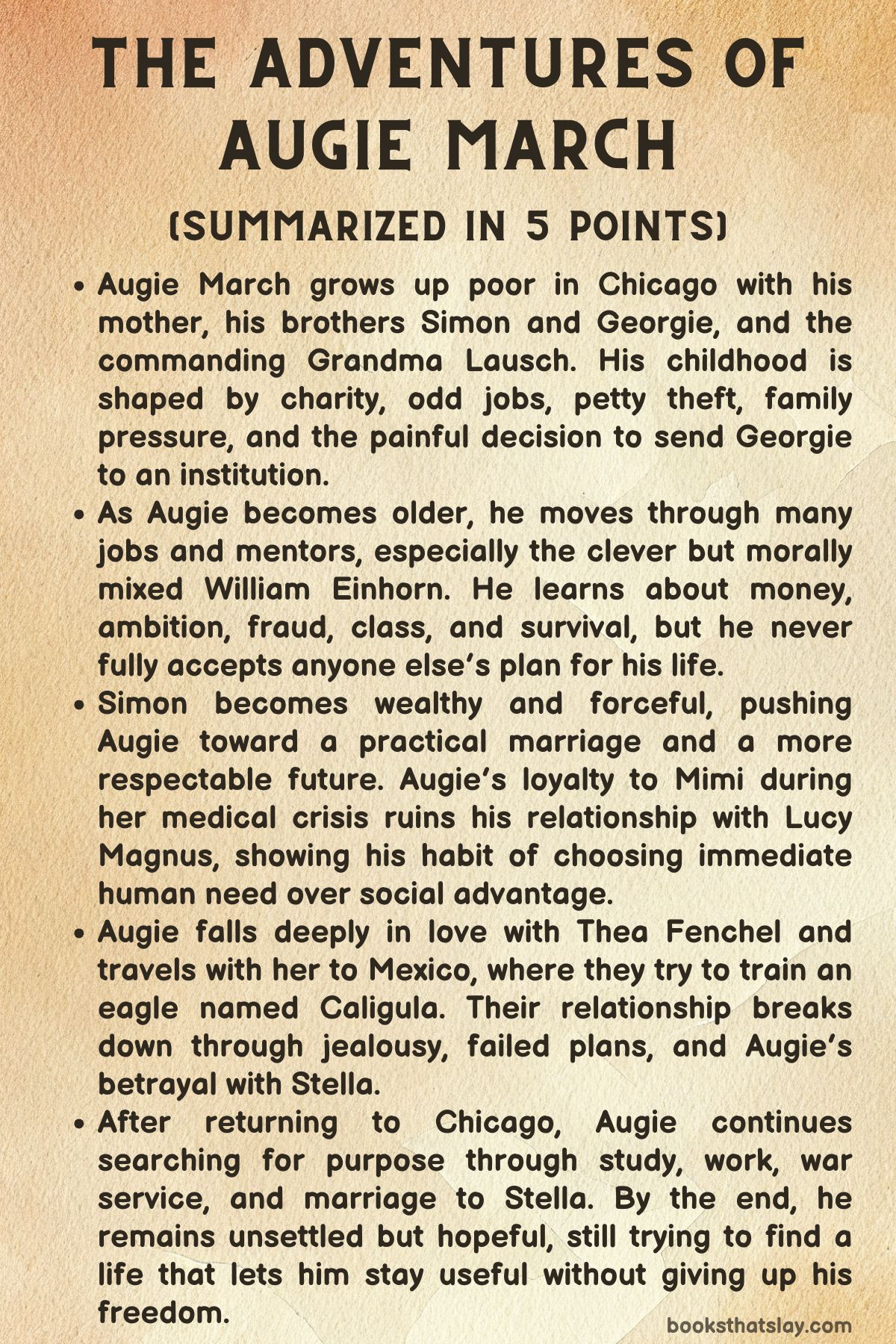
Summary
Augie March introduces himself as a Chicago-born American, and his life begins in a poor household shaped by absence, need, and strong personalities. His father has abandoned the family, leaving Augie, his older brother Simon, his younger brother Georgie, and their nearly blind mother under the rule of Grandma Lausch, an unrelated elderly boarder who has made herself the practical head of the house.
Grandma Lausch is clever, severe, superstitious, manipulative, and protective in her own way. She deals with caseworkers, charity representatives, neighbors, and benefactors, trying to keep the March family afloat.
Augie grows up watching adults bargain, deceive, endure humiliation, and invent small strategies for survival.
From childhood, Augie is pulled between affection and rebellion. He loves his mother and brothers, especially Georgie, whose disability makes him vulnerable in a society with little patience for difference.
Simon is more disciplined, sharper, and more ambitious than Augie. Grandma Lausch sees promise in Simon and uncertainty in Augie, who drifts into small thefts, odd jobs, and bad company.
Augie works distributing theater flyers, takes a newspaper route, lives for a time with the Colbin family, and observes a world larger than his own poor home. Anna Colbin tries to influence his religious and domestic future, while her family gives him a glimpse of better food, steadier money, and social possibility.
As Augie grows older, work becomes one of the main ways he encounters the world. He moves from job to job without settling into a fixed path.
Simon, meanwhile, begins to take charge of the family, pushing Grandma Lausch out of authority. The most painful break comes when Georgie is sent to an institution.
Augie and his mother suffer deeply during the separation, and Augie senses that Georgie had been one of the emotional bonds holding the household together. After Georgie leaves, the family’s unity weakens.
Grandma Lausch declines, Simon hardens, and Augie becomes increasingly exposed to outside influences.
One of Augie’s most important mentors is William Einhorn, a disabled businessman with intelligence, charm, ruthlessness, and deep knowledge of human weakness. Augie works for him, helps him physically, reads to him, assists in his businesses, and learns from his mixture of wisdom and fraud.
Einhorn is both teacher and warning. He encourages Augie’s ambition and imagination, but he also shows how talent can coexist with corruption.
The stock market crash damages Einhorn’s fortune, and his life narrows into harsher schemes and desperate attempts to rebuild. Augie admires him, but he also sees the limits of such worldly cleverness.
Augie repeatedly falls into criminal or morally questionable situations. He helps Joe Gorman in a robbery and later becomes involved in an attempted smuggling scheme.
He regrets these actions but is often drawn in by money, pressure, or confusion. His journey with Gorman collapses, leaving him stranded and forced to travel back to Chicago through trains, roads, and police encounters.
The experience reveals his vulnerability and lack of direction. When he returns home, he finds that Simon has sold the family apartment and their mother has been placed elsewhere.
Augie’s anger at Simon is mixed with dependence on him and sorrow over the family’s decline.
Simon’s life becomes a sharp contrast to Augie’s. He pursues money with fierce determination and marries Charlotte Magnus, a wealthy woman who loves him despite knowing that his motives are practical.
Simon wants Augie to marry into wealth too, especially by courting Lucy Magnus. Augie tries to follow this path, but he feels trapped by the expectations of Simon and the Magnus family.
His relationship with Lucy fails after he chooses to help Mimi Villars, a neighbor and friend who is suffering after an abortion attempt. Augie’s loyalty to Mimi destroys his prospects with Lucy, but it also shows one of his clearest moral qualities: he may be uncertain and weak in many ways, yet he is often kind when someone is in immediate need.
Mimi becomes one of Augie’s most vivid friends. She is frank, independent, wounded, and lively, moving through her own troubled romantic and financial life.
Through her, Augie enters circles of students, radicals, lovers, and strivers. He works with union organizers, takes New Deal employment, steals books, studies, listens to people’s confessions, and tries out different versions of adulthood.
He never fully belongs to any group. Communists, businessmen, criminals, intellectuals, lovers, and family members all try to define him, but Augie resists being permanently claimed.
Thea Fenchel becomes the great romantic force of Augie’s young life. She had once loved him from a distance while Augie was infatuated with her sister Esther.
Later, she reappears, and Augie falls deeply in love with her. Thea is forceful, jealous, adventurous, and determined to live by unusual plans.
She takes Augie to Mexico, where she hopes to train an eagle named Caligula for hunting and perhaps build a new life around writing, photography, or other ambitious schemes. Augie follows her, partly out of love and partly because he is always attracted to people with strong designs.
Mexico tests their relationship. Thea’s eagle project becomes exhausting and absurd, and Augie gradually sees the strain beneath her confidence.
Caligula refuses to become the noble hunting bird Thea imagines. The couple argues, travels, trains the bird, meets expatriates and writers, and enters a social world full of vanity, politics, and unstable desire.
Augie is injured during an attempt to train the eagle, and Thea nurses him, but their bond continues to weaken. He becomes involved with Stella, a beautiful young woman attached to the troubled Oliver.
When Stella asks Augie to help her escape Oliver’s situation, he does so, and their night together confirms Thea’s suspicions. Augie’s betrayal and Thea’s own past with Talavera end the relationship.
He tries to follow and reclaim her, but she rejects him.
After the collapse with Thea, Augie returns again to Chicago. He visits Georgie, who has been neglected for years, and sees his mother, whose blindness has worsened.
Simon is now a successful landlord, rich but bitter, enjoying the hatred of tenants and enemies. Augie also reconnects with Mimi, Einhorn, Sophie, and other figures from his past.
He takes work as a research assistant for Robey, a wealthy man trying to write a book about charity and the rich, but Augie loses interest in the project. He studies, considers teaching, imagines founding a home or school for poor children, and tries to picture a useful life.
World War II changes the direction of his plans. Augie attempts to enlist but is delayed by a hernia connected to his injury in Mexico.
During this period, Simon’s marriage is damaged by his affair with Renée, whose pregnancy and attempted suicide leave Simon emotionally exposed. Augie recognizes parallels between Simon’s divided life and his own romantic failures.
Eventually, Augie joins the Merchant Marines. Before shipping out, he reunites with Stella in New York.
Their earlier bond turns into romance, and they marry quickly before Augie leaves for sea.
At sea, Augie works as a druggist and bookkeeper aboard the Sam MacManus. His habit of listening to others makes crew members treat him like an adviser.
The ship is torpedoed, and Augie survives in a lifeboat with Basteshaw, a strange, self-important scientist who speaks of creating new life and wants to escape the war to continue his research. Basteshaw is dangerous and unstable, even tying Augie up to stop him from signaling for rescue.
Yet when Basteshaw becomes feverish, Augie helps him. They are eventually rescued, and Augie later reunites with Stella.
In the later stage of the story, Augie and Stella live in Europe, but their marriage is uneasy. Stella’s past debts and connection to Cumberland, a controlling ex-lover, strain their trust.
Augie works in business connected to Army surplus goods and spends time in Italy and Paris. Simon and Charlotte visit Paris, revealing that Simon still carries shame and domestic unrest.
Augie travels with Jacqueline, a young woman whose dream of Mexico reminds him of his own earlier failures and hopes. By the end, Augie remains unfinished as a person.
He has not become the fixed, successful man others wanted him to be, but he still keeps his appetite for life, possibility, and moral renewal.
Characters
Augie March
Augie March is the central figure of The Adventures of Augie March, and he is defined by openness, restlessness, sympathy, and a deep resistance to being owned by anyone else’s plan. He begins life poor, fatherless, and dependent on charity, yet he never sees himself only as a victim.
His main weakness is also one of his charms: he is too available to other people’s schemes. Grandma Lausch, Einhorn, Simon, Mrs. Renling, Thea, Stella, Robey, and many others try to turn him into something useful to them.
Augie often follows, but he rarely fully submits. His generosity is real, especially in his care for Georgie, his mother, Mimi, and even Basteshaw.
His moral life is inconsistent, since he steals, lies, drifts into crime, and betrays Thea, yet he also feels guilt and tries to protect the vulnerable. He is not a hero of achievement but of survival, perception, and continued hope.
Simon March
Simon is Augie’s older brother and one of the strongest forces in the book. He begins as the disciplined, promising son, then grows into a hard, ambitious man who believes money is the only reliable defense against humiliation.
Simon is practical where Augie is uncertain, but his practicality becomes cruel. He helps the family, yet he also sells the family apartment, hides their mother’s cane at his wedding, pushes Augie toward a wealthy marriage, and treats people as instruments.
His marriage to Charlotte gives him money and status, but it does not cure his hunger. His affair with Renée exposes the emotional disorder beneath his success.
Simon’s tragedy lies in the fact that he gains power without gaining peace.
Georgie March
Georgie is Augie’s younger brother, and his presence carries great emotional weight. He is intellectually disabled and deeply loved by Augie and their mother, but he is treated by the surrounding world as a burden to be managed.
His removal to an institution marks one of the saddest ruptures in the March family. For Augie, Georgie represents innocence, dependence, and the kind of love that is not based on usefulness.
The family’s decision to send him away shows how poverty and social pressure can force people into choices that wound them permanently. Georgie’s later neglect also exposes the limits of Augie and Simon’s family loyalty.
Augie’s Mother
Augie’s mother is gentle, nearly blind, poor, and emotionally worn down by abandonment and hardship. She does not control the household; Grandma Lausch and later Simon dominate practical decisions.
Yet she remains the emotional center of Augie’s earliest life. Her love for her sons, especially Georgie, is quiet but powerful.
Her blindness becomes both literal and symbolic, showing her vulnerability in a world run by stronger, sharper people. When she feels Augie’s face after his return from Mexico, the moment reveals her dependence on touch, memory, and maternal feeling.
She is one of the book’s clearest images of endurance without authority.
Augie’s Father
Augie’s father is absent for most of the story, and that absence shapes the March household. He occasionally sends money but does not provide real care, guidance, or protection.
Because he is rarely discussed, he becomes less a person than a missing structure. His absence helps explain why Grandma Lausch gains power, why Simon becomes eager to dominate, and why Augie is so susceptible to substitute father figures like Einhorn, Mr. Renling, Robey, and Mintouchian.
The father’s failure leaves the sons to invent manhood from whatever examples they can find.
Grandma Lausch
Grandma Lausch is not Augie’s biological grandmother, but she rules the March household with the force of one. She is domineering, theatrical, shrewd, and often harsh, yet she is not simply cruel.
She knows how to bargain with social workers, manipulate appearances, and stretch charity into survival. Her authority depends on intelligence and intimidation.
She sees promise in Simon and weakness in Augie, and her judgment wounds him. Her decision to support Georgie’s institutionalization makes her morally troubling, but it also reflects the hard logic of poverty.
As she declines and loses control, the March family loses one of its organizing powers.
Stashu Kopec
Stashu Kopec is Augie’s childhood friend and early companion in petty wrongdoing. His betrayal of Augie teaches Augie an early lesson about friendship, blame, and the instability of youthful alliances.
Stashu belongs to the rough neighborhood world that helps shape Augie’s sense of Chicago as a place where boys learn through risk, mischief, and punishment. Though he is not central later, he helps establish Augie’s early susceptibility to trouble.
Mr. Kreindl
Mr. Kreindl is a Hungarian neighbor who plays cards with Grandma Lausch and becomes part of the March family’s surrounding social network. He represents the immigrant neighborhood’s mixture of intimacy and opportunism, where everyone knows one another’s business and survival often depends on favors.
His later connection to Augie’s mother, who lives with the Kreindl family after Simon sells the apartment, shows how fragile the March family’s own home has become.
Sylvester
Sylvester first appears as a theater owner who gives young Augie work distributing flyers, and later he reappears as a communist connected to broader political movements. He is one of the many figures who link Augie to social worlds beyond family and work.
His political commitments set him apart from more money-minded characters like Simon. In Mexico, his connection to Trotsky places him near international history, reminding readers that Augie’s personal wandering takes place within a much larger political century.
Anna Colbin
Anna Colbin takes Augie into her home when he has a newspaper route and promises to treat him like her own son. She is warm, talkative, and domestic, but also controlling in her own way.
Her grief over her son Howard’s departure and her hope that Augie might marry Friedl show her desire to repair family absence through Augie. She gives him food, shelter, and religious instruction, but she also tries to fit him into her own household plans.
Like many adults around Augie, she offers care mixed with expectation.
Hyman Coblin
Hyman Coblin is Anna’s hardworking husband, a man of motion and practical labor. He represents a more stable model of work than many of the schemes Augie later encounters.
His household has more comfort than Augie’s own, and his industry gives Augie a glimpse of immigrant striving that is less glamorous than Simon’s ambition but more grounded. He is not a guiding mentor, yet his home contributes to Augie’s education in class, food, work, and family order.
Five Properties
Five Properties, Anna’s brother, is a comic yet socially revealing figure. His nickname suggests property, money, and small-scale success, and Grandma Lausch sees him as a possible source of matchmaking profit.
His marriage to Cissy later connects him indirectly to Simon’s romantic humiliation. At Simon’s wedding, his complaint about seating shows his sensitivity to status and insult.
He belongs to the book’s world of people who measure respect through arrangements, appearances, and social placement.
Howard Colbin
Howard is Anna Colbin’s son, who has run away to join the Marine Corps. Though he appears mainly through absence, he matters because Anna’s treatment of Augie is shaped by her loss of him.
Howard’s departure leaves a space that Augie partly fills. His absence also reflects one of the recurring patterns in the story: young men leave households, mothers grieve, and families try to replace what has gone missing.
Friedl Colbin
Friedl is Anna Colbin’s daughter and one of the early women adults imagine as a possible match for Augie. She matters less as a romantic figure than as a sign of how often Augie is treated as marriage material by others.
Anna’s wish that Augie marry Friedl reflects the social habit of planning young people’s futures through family strategy rather than personal desire.
Jimmy Klein
Jimmy Klein is Augie’s childhood friend and a key influence in his early movement toward theft and truancy. Grandma Lausch mistrusts him, and her suspicion is partly justified, since Jimmy encourages Augie’s wrongdoing.
Yet Jimmy is not merely a bad influence. When he later reappears as a store detective, trapped in an unhappy marriage and fatherhood, he helps Augie by offering money for Mimi.
His life shows how childhood mischief can harden into adult disappointment, but also how old loyalties can survive.
Uncle Tambow
Uncle Tambow gives Augie and Jimmy work distributing political leaflets and doing odd jobs. He represents one of Augie’s early entrances into the world of paid errands, politics, and adult arrangements.
Through him, Augie learns that work is not always noble or stable; it is often temporary, partisan, and tied to favors.
Clem Tambow
Clem Tambow is Augie’s acquaintance who questions why Augie keeps postponing his life. He is direct, earthy, and driven by desire, especially in his ambition to sleep with Mimi.
Clem’s role is partly comic, but his criticism of Augie is important. He sees that Augie has a habit of delay and drift.
His own business failures later show that decisive people are not necessarily more successful than Augie; they are simply trapped by different weaknesses.
Tom
Tom is one of Augie’s early companions who mocks him for his crush on Hilda. His presence belongs to the adolescent world where boys police one another through teasing and ridicule.
He helps show how Augie’s first romantic feelings are shaped by embarrassment and peer pressure.
Hilda
Hilda is Augie’s early crush, and she represents his first movement toward romantic longing. She is less developed as a full person than as an object of youthful feeling.
Augie’s attraction to her, and his friends’ teasing, show the awkwardness of his early emotional life before the more serious relationships with Thea, Lucy, Sophie, and Stella.
William Einhorn
William Einhorn is one of Augie’s most important mentors in The Adventures of Augie March. He is brilliant, disabled, manipulative, learned, sexually active, and morally compromised.
Augie admires his mind and energy, and Einhorn teaches him to think beyond narrow poverty. Yet Einhorn’s intelligence is tied to swindles, exploitation, and control.
After the market crash, his reduced fortune makes him harsher, revealing how much of his power depended on money. He offers Augie guidance, but he also takes him to a brothel and exposes him to a cynical education in adulthood.
He is both father figure and warning sign.
Dingbat
Dingbat, Einhorn’s brother, is rougher and less intellectual than William, but he has a protective side toward Augie. He helps Augie avoid petty criminals and hires him in connection with the boxer Nails.
Dingbat belongs to the lively, half-criminal, half-business world around the pool hall. He shows Augie a version of masculine loyalty based on toughness rather than moral refinement.
The Commissioner
The Commissioner is Einhorn’s father, and his decline and death mark a change in the Einhorn household. His papers, obituary, and financial remains reveal that the family’s security is weaker than expected.
Through him, Augie witnesses death, inheritance, and the collapse of older authority. The rituals after his death also show the mixture of Jewish custom, family habit, and practical anxiety in the Einhorn home.
Mrs. Tillie Einhorn
Tillie Einhorn is William Einhorn’s wife, and she endures his affairs and schemes with a complicated kind of acceptance. She is practical, observant, and used to humiliation.
Her tolerance of Mildred Stark and other women around Einhorn suggests a marriage shaped more by habit and arrangement than romance. She also helps Augie at times, such as when he leaves paint stock with her.
Tillie’s character shows how women in the book often survive by absorbing men’s selfishness without openly breaking the structure around them.
Lollie Fewter
Lollie Fewter works around the pool hall and becomes one of Einhorn’s romantic attachments. Augie is surprised and frustrated by her link to Einhorn, partly because it reveals his mentor’s sexual life and power over women.
Lollie helps expose the sensual, morally loose atmosphere surrounding Einhorn, where desire, business, and dependency blur.
Nails
Nails is the boxer Dingbat manages and Augie accompanies to Michigan. He is supposed to have championship potential but becomes seasick and loses his fight.
His failure turns the trip into hardship and comic disappointment. Nails represents one of the many grand promises around Augie that quickly collapse when tested by reality.
Nosey Mutchnik
Nosey Mutchnik is a local gangster tied to gambling, debt, and property schemes. He is connected to Simon’s losses and Einhorn’s manipulations.
Mutchnik represents organized criminal force in Chicago’s economic life, where business and crime are never far apart. His presence shows that Augie’s world is full of men who use money, fear, and reputation as tools of control.
Joe Gorman
Joe Gorman is a thief who draws Augie into serious crime. He first involves Augie in robbery and later in a plan to smuggle immigrants over the Canadian border.
Gorman is dangerous because he combines confidence, criminal skill, and lack of loyalty. When trouble comes, he protects himself and threatens Augie.
His role is crucial because he shows how easily Augie’s drifting can move from boyish mischief to real danger.
Molly Simms
Molly Simms is hired to help Augie’s mother but is dismissed after a sexual encounter with Simon. Her brief role reveals Simon’s appetite and carelessness, as well as the vulnerability of working women in domestic spaces.
She is treated as disposable once scandal threatens the household.
Sablonka
Sablonka is the old Polish woman hired after Molly Simms. She represents practical domestic labor and the family’s need for outside help as their mother’s condition worsens.
Her presence also shows how care work in the book is often handled by poor women who remain socially invisible.
Mr. Renling
Mr. Renling employs Augie at the sporting goods store and helps introduce him to a more refined social world. He is less emotionally invested in Augie than his wife, but he permits Augie’s transformation through better clothes, riding lessons, and customer-facing work.
He represents respectable commercial life and the possibility of upward mobility through polish and manners.
Mrs. Renling
Mrs. Renling is one of the adults who tries to remake Augie. Aristocratic, socially ambitious, and controlling, she wants to turn him into a cultured young man and even considers adopting him.
Her interest in Augie is affectionate but possessive. She gives him access to higher social circles, but she also wants gratitude and obedience.
When Augie refuses adoption, her anger reveals that her generosity has conditions. She is one of the clearest examples of how help can become a form of ownership.
Willa Steiner
Willa Steiner is a woman whose company displeases Mrs. Renling. Though she has a small role, she matters because she shows Mrs. Renling’s desire to supervise Augie’s social and romantic life.
Willa becomes a sign of Augie’s tendency to move outside the path chosen for him by patrons.
Esther Fenchel
Esther Fenchel is the young woman Augie admires during his time with Mrs. Renling. His infatuation with her is intense but one-sided.
Esther’s rejection humiliates him and indirectly opens the way for Thea’s confession of love. Esther represents romantic idealization: Augie wants her partly because she appears distant, desirable, and socially elevated.
Thea Fenchel
Thea Fenchel is one of the most powerful women in the book. She is bold, possessive, imaginative, jealous, and often severe.
Unlike Esther, she actively chooses Augie and asks him to love her. Her later relationship with him in Mexico is passionate but unstable.
Thea wants adventure, mastery, and independence, yet her schemes often reveal insecurity and frustration. Her project with Caligula reflects her desire to command nature and destiny, but the eagle’s failure mirrors the failure of her plans with Augie.
She sees Augie clearly when she accuses him of wanting to please everyone. Their breakup is painful because both are guilty, both are proud, and neither can fully trust the other.
Clarence Ruber
Clarence Ruber is Augie’s old college friend who connects him to the waterproof paint job. He represents one more temporary opening in Augie’s work life.
The job fails, but Ruber’s role shows how Augie’s path often changes through casual contacts rather than firm decisions.
Mildred Stark
Mildred Stark is Einhorn’s employee who falls in love with him. Her disability and affection for Einhorn complicate the emotional life of his office.
She reveals Einhorn’s power to attract devotion despite his selfishness. Her presence also shows how desire and dependency operate among people who are socially or physically vulnerable.
Stoney
Stoney is one of Augie’s companions during his rough journey back to Chicago after the failed Gorman episode. He belongs to the world of train hoppers, drifters, and unemployed men moving through Depression-era America.
His companionship offers temporary fellowship, but Augie eventually leaves him asleep on a train, which shows Augie’s pattern of brief alliances.
Wolfy
Wolfy joins Augie and Stoney during their travels and is later held by police for a previous crime. He represents the danger surrounding transient life.
In his presence, Augie is close to criminal suspicion, but he escapes being tied to Gorman. Wolfy shows how easily poverty, travel, and policing overlap in Augie’s world.
Cissy
Cissy is first Simon’s girlfriend and later marries Five Properties. Her engagement to another man wounds Simon’s pride and contributes to his violent humiliation.
At Simon’s wedding, she dismisses Five Properties’s complaints, suggesting that she has practical patience with male vanity. Cissy’s role is small but important in Simon’s emotional history.
Charlotte Magnus
Charlotte Magnus is Simon’s wealthy wife. She knows Simon is not marrying her purely for love, yet she loves him and accepts the bargain with clear eyes.
She is intelligent, business-minded, and useful to Simon’s success, but she also suffers under his aggression and infidelity. Her later bitterness in Paris shows the cost of living with a man who uses her wealth while failing to give her emotional security.
Charlotte is not naive; her tragedy is that understanding Simon does not protect her from him.
Lucy Magnus
Lucy Magnus is the wealthy young woman Simon wants Augie to court and marry. She is direct in her interest, but Augie never fully gives himself to the plan.
Lucy’s breakup with him after the Mimi crisis shows both social judgment and personal hurt. To the Magnus family, Augie’s involvement with Mimi’s abortion scandal marks him as unsuitable.
Lucy represents the respectable life Augie might have entered if he had chosen comfort over loyalty to a friend.
Mimi Villars
Mimi Villars is one of Augie’s most compelling friends. She is frank, sexually independent, witty, wounded, and morally serious in unexpected ways.
Her pregnancy and abortion crisis reveal the dangers women face when social shame, medical risk, and male irresponsibility converge. Augie’s care for her costs him Lucy, but Mimi’s survival strengthens one of the book’s most humane relationships.
She later loves Arthur Einhorn and struggles with his family’s disapproval and financial troubles. Mimi sees Augie clearly and often responds to his failures with humor rather than condemnation.
Hooker Frazer
Hooker Frazer is Mimi’s married lover and later a secretary to Trotsky. He is connected to the intellectual and political circles that pass through Augie’s life.
His relationship with Mimi leaves her pregnant and uncertain, which places him within the book’s larger pattern of men whose desires create consequences women must bear. His later political role shows how private irresponsibility can coexist with public seriousness.
Kayo Obermark
Kayo Obermark is Augie’s neighbor and later a teacher figure connected to Latin and algebra. He is intelligent, melancholy, and practical.
His advice that Augie marry reflects conventional wisdom, while the car transaction and poker game reveal a more compromised side. Kayo tries to swindle Augie after buying the damaged Buick, but Augie returns his losses, complicating the moral balance between them.
Kayo represents education mixed with ordinary human pettiness.
Kelly Weintraub
Kelly Weintraub is Lucy’s cousin, and his accidental sighting of Augie with Mimi at the abortion doctor helps destroy Augie’s standing with the Magnus family. Kelly’s role is small but decisive.
He represents the power of social observation, where one glimpse becomes enough to turn private crisis into public scandal.
Manny Padilla
Manny Padilla is Augie’s college friend, a book thief, and one of the more loyal people in Augie’s life. He steals books to support himself through college but is also intellectually alive and generous.
During Mimi’s crisis, he helps Augie and gives blood for her. Padilla is morally mixed, but his courage and practical compassion make him admirable.
He shows that illegal acts and real decency can exist in the same person.
Grammick
Grammick is the union organizer who hires Augie because Augie can speak to workers in their own language. He pulls Augie into labor politics and gives him a role in organizing hotel staff.
Grammick’s work exposes Augie to class struggle, procedure, persuasion, and the danger of speaking for workers whose anger can exceed official plans.
Sophie Geratis
Sophie Geratis is a hotel maid who becomes involved with Augie during his union work. She is engaged, passionate, and drawn to Augie’s attention.
Later, she wants to divorce her husband and imagines marriage with Augie, but he is not ready. Sophie’s repeated return shows Augie’s habit of accepting intimacy without offering certainty.
She is vulnerable not because she lacks strength, but because she expects commitment from a man who remains emotionally divided.
Arthur Einhorn
Arthur Einhorn, William Einhorn’s son, becomes Mimi’s lover. He is financially unstable and, in his father’s eyes, weakened by Mimi.
Arthur is less forceful than William and seems caught between family expectation and his own attachments. Through him, the Einhorn family’s decline continues into the next generation.
Caligula
Caligula is the eagle Thea buys in Mexico and tries to train for hunting. Though an animal, Caligula functions almost like a character because he becomes central to Thea and Augie’s shared project.
The eagle is powerful in appearance but disappointing in performance, especially when attacked by lizards. Thea’s anger at him exposes her intolerance for weakness.
Caligula symbolizes the failure of grand fantasies when they meet stubborn reality.
Talavera
Talavera is a wealthy Mexican man and Thea’s former lover. Augie dislikes him immediately, and his later presence with Thea in the mountains confirms Augie’s fear that Thea has turned away from him.
Talavera represents sexual rivalry, class confidence, and the part of Thea’s past that Augie cannot master.
Wiley Moulton
Wiley Moulton is a strange-story writer in Mexico and part of the expatriate circle around Thea, Stella, Oliver, and Iggy. He draws Augie into gambling and social distraction during the period when Augie’s relationship with Thea is weakening.
Moulton’s world is talkative, artistic, unstable, and morally loose, offering Augie escape at the exact moment he needs steadiness.
Oliver
Oliver is an elderly magazine editor attached to Stella. He is angry, unstable, and politically endangered because of the magazine he edits.
His plan to escape creates the situation in which Stella asks Augie for help. Oliver represents the older male controller from whom Stella wants freedom, and his presence turns Augie’s attraction to Stella into action.
Iggy Blaikie
Iggy Blaikie is another writer in the Mexican circle. He helps Augie after Thea leaves and listens to his despair.
Iggy’s suggestion that Augie may not truly love Thea irritates Augie, but it also cuts close to the truth that Augie’s love is mixed with pride, dependence, and fear of abandonment. Iggy is a minor but useful observer of Augie’s emotional confusion.
Stella
Stella becomes Augie’s lover and later his wife. In Mexico, she is beautiful, troubled, and trying to free herself from Oliver’s control.
Augie helps her escape and betrays Thea in the process. Later in New York, Stella and Augie reconnect, fall in love, and marry before his wartime service.
Stella is warm and romantic, but her secrecy about Cumberland and money damages their marriage. She is not simply deceptive; she is someone shaped by debt, dependence, and survival.
Her relationship with Augie repeats a central problem of the story: love cannot flourish without truth, but truth is often delayed by fear.
Leon Trotsky
Leon Trotsky appears as a historical figure in Mexico, seen at a distance by Augie. His presence places Augie’s private struggles beside world politics, exile, revolution, and danger.
Trotsky is not personally developed in the book, but his appearance broadens the scale of Augie’s world.
Paslavitch
Paslavitch is a Yugoslavian journalist introduced by Frazer in Mexico. He helps Augie financially when Augie needs to return to Chicago.
His brief role reflects the improvised networks Augie depends on when his plans collapse. He is one more temporary rescuer in a life full of temporary rescues.
Robey
Robey is a wealthy man who hires Augie to help research a book about rich people helping the poor. His project is self-flattering, and his conversations reveal vanity more than generosity.
Augie initially bargains for wages and begins the research, but he soon loses interest. Robey represents the upper-class desire to turn charity into moral reputation.
Renée
Renée is Simon’s lover, and her affair with him exposes the emotional chaos beneath his controlled public life. She wants the security and recognition Charlotte has, studies Charlotte intensely, becomes pregnant, and attempts suicide.
Renée is neither merely a seductress nor merely a victim. She is a desperate woman caught in an unequal relationship with a man who wants passion without consequences.
Agnes
Agnes is Mintouchian’s companion or wife, and her insurance fraud becomes part of Mintouchian’s lesson to Augie about secrecy and human contradiction. She already knows Mintouchian’s secrets, which suggests a relationship based on mutual exposure rather than innocence.
Agnes’s role helps prepare Augie to think about marriage as a place where hidden truths eventually matter.
Mintouchian
Mintouchian is an Armenian man connected to Stella, and he becomes a late adviser to Augie. In the Turkish bathhouse, he wounds Augie with a joke about commitment, then offers serious counsel about secrecy and being true to oneself.
Mintouchian’s wisdom is worldly but not cynical. He understands that people fail when they chase false ideals or hide too much from those closest to them.
He is one of the book’s calmer voices of mature reflection.
Basteshaw
Basteshaw is Augie’s fellow survivor after the ship is torpedoed. He is intelligent, arrogant, unstable, and dangerous.
His talk about scientific discovery and creating new life makes him both fascinating and repellent to Augie. When he ties Augie up to prevent rescue signals, his self-importance becomes threatening.
Yet Augie helps him when he is feverish, showing Augie’s stubborn humane instinct even toward someone who might have let him die. Basteshaw represents intellect without sympathy.
Cumberland
Cumberland is Stella’s ex-boyfriend, a controlling man who keeps influence over her through money and debt. Though he is not directly present for much of the action, his power over Stella’s possessions and secrecy affects her marriage to Augie.
Cumberland represents the past that follows people into new relationships, especially when money has been used as a tool of control.
Jacqueline
Jacqueline is a female employee who travels with Augie in Europe. Her dream of visiting Mexico reminds Augie of his own past and of the strange persistence of longing.
When their car breaks down and they walk through the cold, her singing and refusal to abandon her dream affect Augie. She becomes a late reminder that hope survives even in inconvenient, ordinary circumstances.
Themes
Freedom and the Fear of Being Defined
Augie’s life is shaped by a repeated struggle against other people’s definitions of him. Nearly every strong personality he meets has a plan for him.
Grandma Lausch wants him to be disciplined and useful, Simon wants him to become wealthy and socially strategic, Mrs. Renling wants to refine and adopt him, Thea wants him as a partner in her adventurous self-invention, Robey wants him as an assistant to a vanity project, and Stella wants him as a husband who can accept her past. Augie’s resistance is not always noble.
Sometimes he refuses definition because he lacks discipline, courage, or clarity. Yet his refusal also protects something essential in him.
He does not want to become a gangster, a social climber, a kept son, a political instrument, or a husband who lives by lies. The Adventures of Augie March treats freedom as both a gift and a burden.
Augie’s freedom keeps him morally alive, but it also leaves him unfinished, unstable, and often lonely.
Poverty, Ambition, and Moral Compromise
Money is never just money in the story. It decides where people live, who controls the household, whether Georgie stays with family, how Simon chooses a wife, how Augie finds work, and how Stella becomes trapped by Cumberland.
Poverty teaches ingenuity, but it also pushes characters toward deception, theft, social performance, and emotional bargaining. Grandma Lausch manipulates charity systems because the family needs help.
Augie steals books, joins criminal schemes, and takes jobs he dislikes. Simon’s hunger for wealth grows out of shame and insecurity, yet his success turns him harder and less free.
The book does not present ambition as evil; Simon’s energy and Augie’s desire for a better life are understandable. The danger lies in what people surrender to escape humiliation.
Simon gains status but loses tenderness. Einhorn gains influence but normalizes fraud.
Stella accepts support that later threatens her marriage. The story shows that material need can bend morality long before people admit they are making moral choices.
Love, Loyalty, and Betrayal
Love in the story is rarely simple or clean. Family love binds Augie to his mother and Georgie, but even that love is damaged by poverty, neglect, and distance.
Simon loves his family in a distorted way, providing help while also dominating and shaming them. Romantic love is even more unstable.
Augie is drawn to Esther, chosen by Thea, courted by Lucy, desired by Sophie, and finally married to Stella, but he often fails to match feeling with responsibility. His care for Mimi is one of his finest acts, yet it destroys his future with Lucy.
His attraction to Stella leads him to betray Thea, while Stella’s later secrecy wounds his trust. Thea’s jealousy is harsh, but her criticism of Augie often contains truth: he wants to please, rescue, and be loved without always accepting the cost.
The book understands betrayal not only as cruelty, but also as weakness, confusion, and the failure to decide who deserves one’s loyalty most.
Identity as a Lifelong Experiment
Augie never becomes one fixed thing. He is a poor boy, flyer distributor, newspaper worker, shop assistant, thief, student, union worker, lover, traveler, research assistant, would-be teacher, sailor, husband, and businessman abroad.
These roles do not form a neat ladder of progress. They are experiments, some comic, some dangerous, some humiliating, some morally revealing.
His identity grows not through steady achievement but through exposure. He learns from households, streets, workplaces, lovers, criminals, political organizers, intellectuals, and war.
The result is a self that remains open and alert rather than settled. This can be frustrating, because Augie often seems unable to choose a lasting purpose.
Yet the story suggests that identity may not be a single destination. It may be built through repeated contact with other people’s dreams, failures, and demands.
Augie’s final value lies in his continued willingness to notice life, absorb experience, and keep hoping for a form of usefulness that does not require surrendering his inner freedom.