The Adventures of Tom Sawyer Summary, Characters and Themes
The Adventures of Tom Sawyer is Mark Twain’s comic adventure novel about boyhood, mischief, conscience, and growing up in the small Mississippi River town of St. Petersburg. The story follows Tom Sawyer, a clever, restless boy who avoids work, chases excitement, falls in love, dreams of pirate glory, and finds himself caught in events far more serious than childish games.
Through Tom’s pranks, fears, friendships, and moral choices, Twain presents childhood as both funny and dangerous. The book mixes humor, social satire, mystery, and adventure while showing how a boy slowly learns responsibility without losing his imagination.
Summary
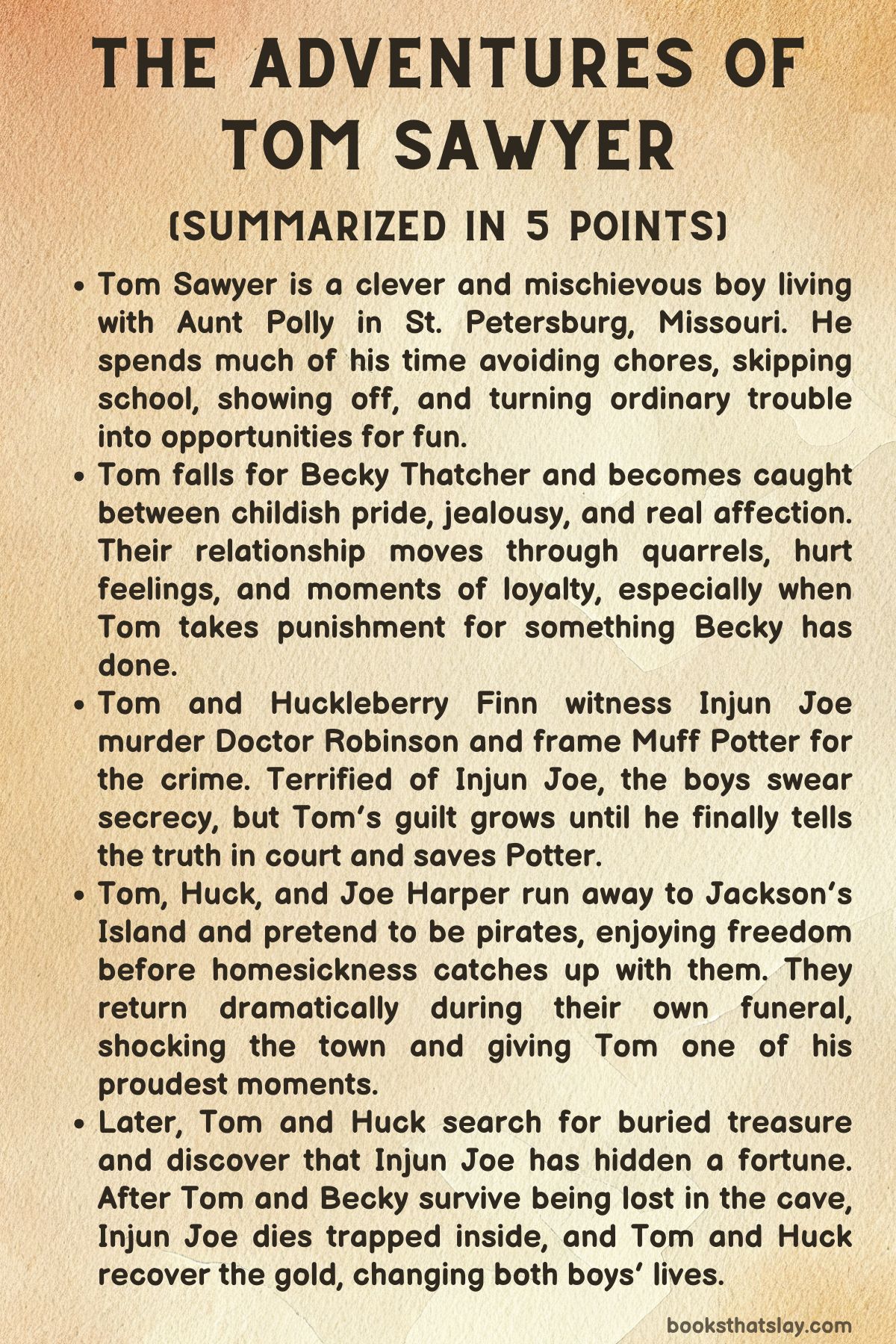
Tom Sawyer lives with his Aunt Polly, his half-brother Sid, and his cousin Mary in the village of St. Petersburg, Missouri. Tom is mischievous, quick-thinking, and almost always trying to escape work or punishment.
Aunt Polly loves him deeply because he is her dead sister’s child, but she struggles to discipline him. Tom often plays hooky, lies to avoid trouble, and slips away whenever he can.
His cleverness is shown early when he turns punishment into opportunity: ordered to whitewash a fence on a Saturday, he pretends the job is a rare pleasure. Other boys become curious, then jealous, and soon they trade their small treasures for the chance to do the work for him.
Tom finishes the task without effort and gains both freedom and profit.
Tom’s world is full of games, rivalries, and romantic fantasies. He leads imaginary battles among the local boys and quickly forgets his former sweetheart, Amy Lawrence, after seeing Becky Thatcher, a new girl in town.
At Sunday school, Tom trades for prize tickets earned by other children and presents them as if he has memorized enough Bible verses to win a Bible. His triumph turns embarrassing when he cannot answer a simple religious question correctly.
At church, his boredom leads to comic chaos when a beetle he has brought causes a dog to yelp and disrupt the sermon.
On Monday, Tom tries to avoid school by pretending to be ill, but Aunt Polly sees through him and sends him anyway after pulling his loose tooth. On the way, he meets Huckleberry Finn, the neglected son of the town drunkard.
Huck lives outside ordinary rules, and the village boys admire his freedom even while respectable adults disapprove of him. Huck carries a dead cat, believing it can cure warts if used in a graveyard ritual at midnight.
Tom agrees to join him. At school, Tom is punished for being late and placed beside Becky, which suits him perfectly.
He tries to impress her, teaches her to draw, and writes that he loves her. Their young romance begins, but it is quickly damaged when Tom reveals that he was once engaged to Amy Lawrence.
Becky is hurt and rejects him.
Humiliated and sad, Tom runs to the woods and imagines leaving home to become a pirate, soldier, or outlaw. That night, he and Huck go to the graveyard with the dead cat.
There they unexpectedly witness a crime. Muff Potter, Injun Joe, and Doctor Robinson arrive to dig up a corpse.
A quarrel breaks out over money. Robinson knocks Potter unconscious, and Injun Joe murders the doctor with Potter’s knife.
Tom and Huck run away in terror. Injun Joe then convinces the dazed Potter that Potter committed the murder while drunk.
The boys swear a blood oath never to tell anyone what they saw, fearing that Injun Joe will kill them.
The murder changes Tom. His conscience torments him, especially after Muff Potter is arrested.
Potter is a weak and flawed man, but he is not guilty. Tom secretly brings him small comforts in jail and suffers from nightmares and guilt.
Meanwhile, his relationship with Becky remains strained, and Aunt Polly worries about his gloom. When she gives him a harsh pain medicine, Tom secretly pours it away until the family cat drinks some and behaves wildly.
Aunt Polly realizes she has been mistreating Tom through misguided care.
Feeling unloved after Becky’s rejection and another scolding, Tom decides to run away. Joe Harper joins him after feeling unfairly punished by his own mother, and Huck joins them too.
The three boys travel to Jackson’s Island and pretend to be pirates. At first, they enjoy swimming, fishing, smoking, and living without adults.
Soon, however, homesickness settles over them. They realize that the village believes they have drowned.
Tom secretly returns home and hides under Aunt Polly’s bed, where he hears her grief and Joe’s mother’s sorrow. He is moved, but instead of revealing himself, he returns to the island with a plan.
The boys attend their own funeral, entering the church just as everyone mourns them. The scene becomes Tom’s greatest moment of glory.
Tom’s lie about having dreamed of Aunt Polly’s grief later hurts her when she learns he had actually been there. He feels sorry, and she softens when she finds a note he had written to comfort her but never delivered.
At school, Tom and Becky’s conflict continues. Becky accidentally tears a page in the schoolmaster’s private anatomy book.
When the teacher discovers the damage and begins questioning students, Tom takes the blame. He receives a whipping and detention, but Becky sees his sacrifice as noble, and their bond is repaired.
The school term ends with comic revenge against the strict teacher, whose bald head is exposed in public by a prank involving a cat. Summer follows, but Tom’s life is unsettled.
He joins a temperance group for the uniform, regrets its rules, falls ill with measles, and finds the town briefly absorbed in religious enthusiasm. The larger trouble returns with Muff Potter’s trial.
Tom can no longer bear the thought of an innocent man being condemned. Despite his fear, he testifies in court and tells the truth: Injun Joe murdered Doctor Robinson.
Injun Joe escapes through a window, and Tom becomes a public hero while privately living in fear of revenge.
After the trial, Tom’s imagination shifts toward buried treasure. He convinces Huck that robbers often hide gold and never return for it.
The boys dig in several places before deciding to search a haunted house. There they hide upstairs when two men enter below.
One of them is Injun Joe in disguise. The boys watch him bury a bag of money, then discover a larger box of gold already hidden in the house.
Injun Joe notices the boys’ tools and becomes suspicious, but a rotten staircase collapses when he tries to climb up. He leaves with the treasure, saying it will be hidden at “Number Two—under the cross.” Tom and Huck become determined to find it.
They investigate the town’s taverns and conclude that “Number Two” may refer to a locked room at the Temperance Tavern. Tom enters the room one night and finds Injun Joe asleep among whisky bottles, but he is too frightened to search properly.
At the same time, Becky returns to town, and a picnic is planned. Tom joins the outing and goes with Becky and the other children into McDougal’s Cave, a huge and confusing system of passages.
While Tom is away, Huck watches the tavern and follows Injun Joe and his companion, believing they are moving the treasure. Instead, he hears Injun Joe planning revenge against the Widow Douglas, whose late husband had once had him publicly punished.
Injun Joe intends to mutilate her. Huck remembers her kindness and runs for help.
He alerts Mr. Jones, a Welshman, who goes with his sons to protect the widow. The attackers escape, but Huck’s courage saves her.
Meanwhile, Tom and Becky get lost in the cave after straying from the group. Their candles run low, and Becky weakens from fear and exhaustion.
Tom tries to remain brave, rations their light, and searches passages using a kite string so he can return safely. During one search, he sees Injun Joe in the cave, but he hides this from Becky to avoid frightening her further.
Eventually, Tom finds daylight through a distant opening. He and Becky escape, exhausted, five miles from the main entrance.
The village celebrates their return after days of fear.
Judge Thatcher, alarmed by the danger, has the cave entrance sealed. Tom then reveals that Injun Joe is still inside.
When the door is opened, Injun Joe is found dead near the entrance, having tried desperately to escape. Tom realizes the treasure must be in the cave.
He takes Huck back through the opening he found and locates a cross marked in soot. Beneath it, they uncover the hidden gold, along with tools and weapons.
They carry the money away, intending to hide it.
Before they can do so, they are taken to a party at Widow Douglas’s house. There, Mr. Jones tells the gathered guests about Huck’s bravery.
The widow says she will give Huck a home and education. Tom then shocks everyone by revealing that Huck is already rich.
He pours out the treasure, more than twelve thousand dollars in gold. The boys become famous and financially secure.
The money changes their lives. Judge Thatcher manages it so that Tom and Huck each earn a daily income.
Tom enjoys his new status, and the judge begins to imagine him as a future lawyer, soldier, or educated gentleman. Huck, however, is miserable in respectable society.
The widow’s clean clothes, regular meals, manners, prayers, and rules feel like a prison to him. He runs away and returns to his old life.
Tom finds him and persuades him to go back by promising that he cannot join Tom’s planned robber gang unless he becomes respectable first. Huck reluctantly agrees to try civilization for a month, hoping that if he becomes a good enough robber, the widow will be proud of him.
The book closes by suggesting that Tom’s boyhood adventures are ending, and that adulthood would bring a more ordinary and less playful kind of story.
Characters
Tom Sawyer
Tom Sawyer is the central figure of the book, a boy defined by restless energy, imagination, pride, and a talent for turning ordinary life into performance. He dislikes work, school, church discipline, and adult expectations, yet he is not simply lazy or selfish.
His famous fence trick shows his sharp understanding of human nature: he knows that people desire what appears rare or forbidden, so he transforms punishment into privilege. Tom’s imagination constantly reshapes reality.
He sees himself as a general, pirate, outlaw, lover, martyr, hero, and treasure hunter, and these roles give him power over boredom. In The Adventures of Tom Sawyer, Tom’s growth is tied to the slow awakening of conscience.
He begins as a boy who lies to avoid punishment, but his silence after witnessing Doctor Robinson’s murder becomes unbearable. His decision to testify for Muff Potter marks a real moral step.
He remains theatrical and self-centered, but he learns that bravery is not only about being admired. His care for Becky in the cave also shows maturity.
He protects her from despair, hides the sight of Injun Joe from her, and keeps searching for a way out. Tom does not become a model child, and the book does not ask him to.
His charm lies in the fact that he changes without losing his mischievous spirit.
Huckleberry Finn
Huckleberry Finn represents freedom from social rules, but that freedom comes from neglect rather than comfort. The village boys envy him because he does not attend school regularly, wear proper clothes, obey parents, or follow polite customs.
Adults see him as dangerous company, yet Huck often shows clearer moral instincts than more respectable people. He is superstitious, rough, and used to hardship, but he is also loyal, observant, and deeply humane.
His friendship with Tom gives him access to games and adventure, but Huck is not merely Tom’s follower. He acts independently when he follows Injun Joe and his companion, discovers the plan against the Widow Douglas, and risks himself to save her.
That act is one of the most important moral moments in the book because Huck receives no promise of glory from it. He helps because he remembers kindness and cannot let cruelty happen.
In The Adventures of Tom Sawyer, Huck’s discomfort after becoming rich and being taken in by the widow reveals the cost of “respectability.” Clean clothes, schedules, manners, and religious instruction feel suffocating to him. Unlike Tom, Huck is not performing rebellion; he genuinely belongs outside the structures that other people call proper.
His character raises questions about whether society’s version of improvement always matches a child’s needs.
Aunt Polly
Aunt Polly is loving, anxious, religious, and often torn between affection and duty. She raises Tom because he is her dead sister’s child, and that grief shapes her relationship with him.
She believes she must discipline him for his own good, but she is also easily softened by his charm. Much of her frustration comes from the fear that failing to punish him will make her a bad guardian.
Her scoldings are real, but so is her tenderness. When Tom disappears to Jackson’s Island and she believes he is dead, her grief shows the depth of her love.
This makes Tom’s later deception especially painful, because he has enjoyed the emotional power of being mourned without fully considering her suffering. Aunt Polly is not portrayed as foolish, even though she sometimes falls for health fads or Tom’s tricks.
She is a comic figure at times, but she also represents the adult world’s mixture of care, control, guilt, and fear. Her treatment of Tom with the harsh pain medicine shows how good intentions can become harmful when guided by fashion rather than understanding.
When she realizes this, she softens, proving that she can learn too. Aunt Polly’s importance lies in the emotional home she gives Tom, even when he resists it.
Becky Thatcher
Becky Thatcher is Tom’s romantic ideal, but she is also a proud, sensitive, and active child with her own emotions and choices. When Tom first sees her, he turns her into an object of admiration, replacing Amy Lawrence almost instantly.
Yet Becky is not simply a prize in Tom’s imagination. She is curious, playful, easily wounded, and capable of retaliation.
Her hurt after learning about Amy shows her innocence and her desire to be treated as special. Her later attempt to make Tom jealous with Alfred Temple shows that she can be as proud and dramatic as Tom himself.
Becky’s most revealing moments come when she accidentally tears the schoolmaster’s book and when she is trapped in the cave. In the schoolroom, fear overwhelms her, and Tom’s decision to take the blame changes how she sees him.
In the cave, she becomes exhausted and frightened, but her vulnerability also brings out Tom’s courage. Becky functions as a mirror for Tom’s emotional growth.
Around her, he moves from vanity and showing off toward sacrifice and responsibility. In The Adventures of Tom Sawyer, her presence helps shift the story from comic mischief into situations where loyalty and courage matter.
Injun Joe
Injun Joe is the chief villain of the story, associated with violence, secrecy, revenge, and fear. He commits murder, frames Muff Potter, hides under disguise, pursues buried treasure, and plans a brutal attack on the Widow Douglas.
He is presented through the terrified eyes of children and the suspicious gaze of the town, so he becomes larger than life: a figure of nightmare as much as a human criminal. His most defining trait is revenge.
He does not simply want money or escape; he remembers humiliation and wants to repay it with cruelty. This makes him especially frightening because his violence is patient and personal.
At the same time, the portrayal of Injun Joe reflects the racial and cultural prejudices of Twain’s time, and modern readers should recognize that the character is shaped by harmful stereotypes attached to Indigenous identity. Within the story’s structure, however, he serves as the dark opposite of Tom’s fantasy world.
Tom plays at being an outlaw; Injun Joe shows what real lawlessness looks like. Tom imagines treasure as adventure; Injun Joe connects treasure with crime and danger.
His death in the cave closes the murder plot and transforms the cave from a place of terror into the place where Tom and Huck find wealth.
Muff Potter
Muff Potter is weak, poor, often drunk, and easily dismissed by the village, but he is also one of the book’s most sympathetic figures. His vulnerability makes him an easy victim for Injun Joe’s lie.
Because Potter already sees himself as degraded by drinking, he is ready to believe he may have committed a terrible act while unconscious. His shame becomes part of the trap.
The town also accepts his guilt too readily, showing how social reputation can shape justice before truth is known. Potter’s kindness toward Tom and Huck deepens the boys’ moral conflict.
When he thanks them for small gifts in jail and calls them his only friends, Tom’s conscience becomes harder to silence. Potter does not save himself through cleverness or strength.
He depends on Tom’s courage, and that dependence gives Tom’s testimony its emotional weight. Potter’s character shows how a flawed person can still be innocent and deserving of compassion.
He is not idealized, but he is humanized. Through him, the book criticizes a community that can condemn a powerless man while fearing a more dangerous one.
Sid
Sid is Tom’s half-brother and often serves as his domestic opposite. Where Tom is impulsive, imaginative, and rebellious, Sid is orderly, watchful, and eager to expose wrongdoing.
He tattles on Tom about the thread on his collar, later questions Tom’s so-called dream, and enjoys revealing information that damages Tom’s plans or pride. Sid’s obedience does not make him morally attractive.
Twain presents him as smug and cold, a child who follows rules in a way that lacks generosity. He often appears more interested in being right than being kind.
This contrast helps define Tom. Tom lies, fights, and shirks duty, yet he also has warmth, courage, and loyalty.
Sid behaves properly, but his correctness often feels petty. His role is small but important because he represents one version of respectable childhood: neat, cautious, and approved by adults, but emotionally narrow.
When Tom slaps him after he spoils the surprise about Huck’s bravery, the act is comic revenge, but it also reflects the reader’s likely frustration with Sid’s habit of making himself important at others’ expense.
Mary
Mary, Tom’s cousin, is gentle, patient, and morally sincere. She helps Tom memorize Scripture, encourages him, rewards him, and assists in making him presentable for church.
Unlike Sid, Mary’s goodness is not shown as irritating or self-serving. She genuinely wants Tom to improve, and she believes in kindness as much as discipline.
Her role in the book is quieter than Aunt Polly’s, but she adds warmth to Tom’s home life. She represents a form of religious and domestic virtue that is affectionate rather than harsh.
Tom may not share her discipline, but he accepts her care more easily than Sid’s correction because Mary does not use goodness as a weapon. Her presence also helps show that Twain is not mocking morality itself.
He mocks empty performance, social vanity, and rigid respectability, but Mary’s goodness is practical and loving. She wants Tom to do better, yet she does not seem to despise him for being difficult.
That distinction makes her one of the kinder figures in his household.
Joe Harper
Joe Harper is Tom’s close friend and fellow adventurer, especially during the island episode. Like Tom, he is dramatic, sensitive to punishment, and quick to imagine himself wronged.
His decision to run away comes after a domestic grievance, and his misery mirrors Tom’s own feelings of being misunderstood. As a pirate, Joe enjoys the fantasy at first, but he becomes homesick sooner and more openly than Tom.
His longing for his mother cuts through the boys’ performance of toughness and exposes how young they really are. Joe’s role is important because he makes Tom’s fantasies social.
Tom needs companions to make his imaginary worlds feel real, and Joe is willing to enter those games. Yet Joe also tests the limits of Tom’s leadership.
When he and Huck want to return home, Tom must produce a secret plan to keep them together. Joe is less complex than Tom or Huck, but he helps show the emotional pattern of boyhood in the book: pride, resentment, fantasy, homesickness, and the desire to be loved.
Judge Thatcher
Judge Thatcher represents public respectability, legal authority, and social status. His arrival at Sunday school causes the entire congregation to become self-conscious, and Tom’s false triumph with the Bible tickets is partly driven by the desire to impress figures like him.
As Becky’s father, Judge Thatcher also stands near Tom’s romantic life, but his larger role grows after Tom proves himself brave. He is deeply impressed by Tom’s testimony, by his protection of Becky, and by his willingness to take punishment for her earlier at school.
By the end, he imagines a successful future for Tom and wants him to receive elite training. Judge Thatcher’s admiration shows how society can absorb a mischievous boy once his daring is translated into heroism.
He also helps manage Tom and Huck’s treasure responsibly, turning adventure money into steady income. His character therefore connects childhood adventure with adult institutions: courts, property, education, and status.
Through him, the book suggests that Tom may one day be shaped into a respectable public man, though the closing tone makes that future seem less exciting than his boyhood.
Widow Douglas
Widow Douglas is kind, generous, and socially respected. Her earlier kindness to Huck becomes crucial when he risks himself to save her from Injun Joe.
She represents the best side of civilized society: protection, gratitude, charity, and care for neglected children. After Huck saves her, she offers him a home and education, hoping to improve his life.
Yet her kindness also creates tension because what she sees as rescue feels to Huck like confinement. She does not intend to hurt him, but her world of manners, cleanliness, prayer, and routine does not match his habits or desires.
This makes her character more interesting than a simple benefactor. She is good, but goodness in the book can still be complicated when it tries to reshape another person too quickly.
The widow’s relationship with Huck prepares for larger questions about freedom and civilization. She offers safety and affection, but Huck must struggle to decide whether he can survive within the life she offers.
Mr. Jones
Mr. Jones, the Welshman, is a practical and brave adult who responds immediately when Huck warns him about danger to Widow Douglas. He does not dismiss Huck because of his reputation, and this matters greatly.
In a town where Huck is often judged as an undesirable boy, Mr. Jones listens when he speaks. His decision to act helps save the widow and gives Huck’s courage public recognition.
At the party, he intends to reveal Huck’s role with dignity, though Sid spoils the surprise. Mr. Jones represents a form of adult authority that is direct, fair, and useful.
He does not dominate the story, but his actions show what responsible adulthood can look like: he hears a frightened child, trusts the warning, protects a neighbor, and later gives credit where it is due. His respect for Huck helps the community see the boy differently, even if Huck himself remains uneasy with attention.
Themes
Childhood as Imagination, Performance, and Escape
Tom’s childhood is powered by imagination. Ordinary spaces become battlefields, pirate islands, haunted houses, treasure sites, and stages for romance.
This imaginative habit is not only a source of comedy; it is how Tom gives shape to a life that would otherwise be controlled by chores, school, church, and adult correction. His games let him feel heroic when daily life makes him feel small.
Yet the book also shows the limits of fantasy. Playing pirate is exciting until the boys become hungry for home.
Pretending to be dead creates glory at church but causes real pain to Aunt Polly. Treasure hunting feels like a game until Injun Joe and actual danger enter the scene.
Childhood imagination is treated with affection, but not as something harmless in every case. It can inspire courage, cleverness, and joy, but it can also make Tom selfish when he values drama more than other people’s feelings.
The Adventures of Tom Sawyer presents childhood as a stage of invention where children rehearse adult roles before they understand their costs. Tom wants the honor of danger, the romance of suffering, and the applause of heroism.
By the end, he has experienced enough real fear to know that adventure is not only make-believe.
Conscience, Guilt, and Moral Courage
Tom’s moral growth begins when his usual tricks are no longer enough to protect him from himself. After witnessing Doctor Robinson’s murder, he and Huck swear to remain silent because they fear Injun Joe.
At first, this silence seems practical, even necessary. But Muff Potter’s arrest changes the meaning of their oath.
Tom’s fear of death must compete with his knowledge that an innocent man may be punished. His conscience appears through nightmares, anxiety, trembling, and secret visits to Potter in jail.
Twain makes guilt physical and persistent, showing that wrongdoing is not always an action; sometimes it is the refusal to act. Tom’s testimony in court becomes one of the book’s central moral moments because it requires him to risk himself without any guarantee of safety.
He is not showing off before schoolmates or acting out a heroic fantasy. He is naming a murderer in public.
This courage is different from the bravery of games because it has real consequences. Huck faces a similar test when he hears Injun Joe’s plan for Widow Douglas.
He could run away and protect himself, but instead he seeks help. Both boys remain imperfect, but each proves capable of choosing another person’s safety over fear.
Freedom and the Burden of Respectability
Huck’s life raises one of the book’s sharpest questions: what does freedom mean when it is born from neglect? To Tom and the other boys, Huck seems lucky because he escapes school, church clothes, manners, and family discipline.
He can smoke, wander, sleep where he likes, and answer to almost no one. But this freedom is not secure or nurturing.
Huck lacks protection, stability, and care. His father’s drunkenness and the town’s disapproval place him outside normal childhood.
The Widow Douglas offers him the opposite: food, shelter, education, religion, and social acceptance. Yet Huck experiences these gifts as a loss of self.
The book does not present an easy answer. Respectability brings safety, but it also demands obedience to rules that feel artificial and suffocating.
Tom can move between rebellion and respectability because he has a home and a place in society. Huck cannot make that movement so easily.
When Tom persuades him to return to the widow by linking respectability to membership in a robber gang, the comedy hides a serious truth: Huck must be bribed with fantasy to endure civilization. The theme remains unresolved because the book understands that care and control often arrive together.
Social Judgment, Reputation, and Justice
The village of St. Petersburg is quick to judge people according to reputation. Tom is known as troublesome, Sid as proper, Huck as bad company, Muff Potter as a drunken failure, and Injun Joe as dangerous.
These labels influence how characters are treated before truth is fully known. Muff Potter’s case is the clearest example.
Because he is poor, weak, and associated with drink, the town readily believes he could be guilty of murder. His own shame makes him believe it too.
Injun Joe, though feared, escapes accountability for a time because people are too afraid to confront him. Justice therefore depends not only on law but on courage, honesty, and the willingness to look beyond social assumptions.
The Sunday school scene also exposes reputation as performance. Tom gains public honor by presenting tickets he did not earn, while the adults are eager to stage a display of religious success before Judge Thatcher.
Respectability often becomes theater, and the village rewards appearances until reality breaks through. Huck’s later recognition reverses this pattern.
A boy dismissed as uncivilized becomes the person who saves Widow Douglas. Through these contrasts, the story shows that public opinion is often unreliable, and that moral worth may appear where society least expects it.