The Afghanistan Papers Summary and Analysis
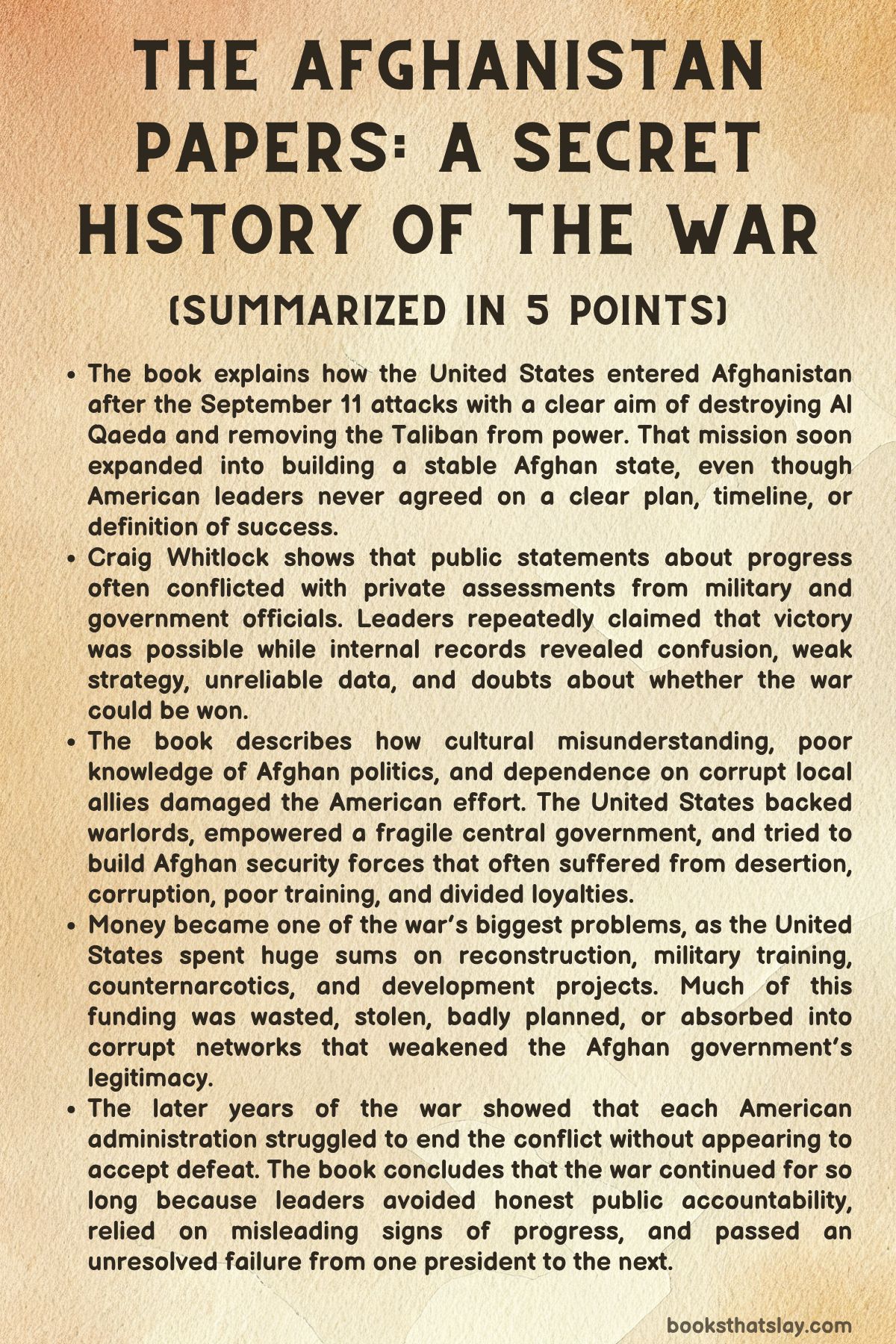
The Afghanistan Papers: A Secret History of the War by Craig Whitlock is a nonfiction account of the United States’ twenty-year war in Afghanistan, built from confidential interviews, official documents, memos, and investigations obtained through public-records requests. The book examines how American leaders repeatedly claimed progress while privately admitting confusion, failure, corruption, and strategic drift.
Rather than presenting a standard military history, it focuses on the gap between public optimism and internal doubt. Whitlock shows how unclear goals, cultural ignorance, bad alliances, wasted money, and political self-protection kept the war going long after officials knew victory was unlikely.
Summary
The Afghanistan Papers begins by placing the war in the immediate aftermath of the September 11 attacks. American anger and fear were intense, and the invasion of Afghanistan initially appeared to have a clear purpose: destroy Al Qaeda’s base, punish the Taliban regime that sheltered it, and prevent another attack on the United States.
The opening phase seemed successful. Al Qaeda fighters were scattered, the Taliban government collapsed quickly, and American casualties were low.
Yet this early success created a deeper problem. Once the enemy government had fallen, American officials did not have a settled answer for what came next.
They wanted to avoid a long occupation, but they also feared that leaving too soon would allow Afghanistan to become a terrorist sanctuary again.
The book shows that the mission began expanding almost immediately. What started as counterterrorism became a project of rebuilding Afghanistan into a stable state with a national army, democratic institutions, education systems, and a government strong enough to control the country.
Public statements made these goals sound achievable, but officials had little agreement about how to reach them, how long they would take, or what kind of commitment they required. The United States wanted stability without accepting the full burden of nation-building, and that contradiction shaped the war from the beginning.
A central problem was that American leaders did not understand Afghanistan’s political and social landscape. They treated Al Qaeda and the Taliban as if they were essentially the same enemy, even though their goals and structures were different.
Al Qaeda was a transnational terrorist network, while the Taliban was a local Afghan movement rooted in tribal, religious, and political conditions. By refusing early opportunities to separate Taliban factions or bring some members into the political process, the United States turned a defeated movement into a long-term insurgent enemy.
The escape of Osama bin Laden from the Tora Bora region also made withdrawal politically impossible, since the person most associated with 9/11 remained at large.
The book then follows the American turn toward nation-building. Afghanistan had suffered decades of war, poverty, and weak institutions, so the new government could not survive without outside help.
The United States backed Hamid Karzai and helped create a centralized political system, even though Afghanistan had long relied on local and tribal forms of authority. This made the government in Kabul seem distant and artificial to many Afghans.
Meanwhile, different American agencies had different priorities. The Pentagon focused on security and enemy fighters, the State Department wanted broader reconstruction, and allied countries followed their own rules and limits.
Instead of one coherent strategy, the war became a collection of overlapping projects.
The invasion of Iraq worsened everything. As Washington shifted attention, troops, intelligence, and political energy toward Iraq, Afghanistan became secondary.
Officials still spoke publicly of progress, but commanders on the ground faced growing violence, poor coordination, and limited resources. Taliban forces were regrouping, but the administration often described resistance as scattered or insignificant.
The book makes clear that the habit of public optimism became a political tool. Leaders did not want to admit that Afghanistan was slipping away, especially while Iraq was also in crisis.
One major American objective was to create Afghan security forces capable of replacing foreign troops. This project was deeply flawed.
The United States tried to build an Afghan army in the image of the American military, despite major differences in literacy, education, technology, culture, and loyalty. Training was rushed, standards were lowered, and soldiers often deserted, sold equipment, or showed little interest in long-term service.
The police force was even more troubled, becoming associated with corruption, abuse, and predation rather than public safety. Yet American leaders kept pointing to the size of the Afghan army and police as evidence of progress, even when those numbers hid weakness and fraud.
The book also highlights cultural ignorance as a major source of failure. American soldiers and officials often knew little about Afghan customs, religious practices, village politics, or local power structures.
Attempts to win public support sometimes backfired because they were based on shallow assumptions. Meetings with elders, relationships with tribal leaders, and attitudes toward Islam were often mishandled.
American forces also made compromises with abusive local allies because those men opposed the Taliban. These choices damaged the legitimacy of the Afghan government and made ordinary Afghans suspicious of foreign intentions.
Pakistan’s role further complicated the war. Pakistan cooperated with the United States against Al Qaeda in some ways, but elements of its military and intelligence services continued to tolerate or support the Taliban.
Pakistan saw the Taliban as a useful force for maintaining influence in Afghanistan and countering India. American leaders often downplayed this double game because they needed Pakistani cooperation.
As a result, the Taliban retained cross-border sanctuary while the United States tried to defeat it inside Afghanistan.
As violence increased, the gap between public statements and private assessments widened. Officials repeatedly claimed that the Taliban was weakening, that Afghan institutions were improving, and that victory was possible.
Internally, many recognized that the war lacked direction. Reports, interviews, and later investigations showed that officials often relied on misleading statistics.
Rising attacks could be described as evidence that the enemy was desperate. Failed projects could be counted as completed work.
Casualty figures, territorial control, and training numbers were massaged or concealed. The truth became less important than preserving the appearance of momentum.
The Obama years brought a promise of change but also a major escalation. Barack Obama entered office criticizing the war in Iraq and hoping to resolve Afghanistan.
He approved a troop surge while also setting a timeline for drawdown. This compromise reflected his divided position: he wanted to avoid defeat, but he also wanted to limit open-ended commitment.
General Stanley McChrystal pushed for a broad counterinsurgency strategy, arguing that protecting Afghan civilians and strengthening the government could defeat the Taliban. But the plan required time, money, cultural understanding, and Afghan institutions that did not really exist.
David Petraeus continued the counterinsurgency approach, and the United States poured huge sums into reconstruction.
That money became another source of damage. In the rush to show results, the United States funded roads, schools, dams, bridges, government buildings, and local projects with limited oversight.
Many projects were poorly planned, unnecessary, impossible to maintain, or easily exploited by corrupt officials and contractors. Sometimes the same projects benefited both American-backed contractors and Taliban-linked actors.
Rather than buying loyalty, money often intensified corruption and distorted the Afghan economy. The book portrays Afghanistan as overwhelmed by foreign funds that its institutions could not absorb.
Corruption became one of the book’s central subjects. The United States condemned Afghan corruption while also feeding it.
The CIA paid officials, military contracts enriched power brokers, and American dependence on local allies made accountability difficult. Karzai’s government became associated with fraud, bribery, patronage, and impunity.
The Kabul Bank scandal revealed corruption at the highest levels, but meaningful prosecution threatened the very government the United States was trying to support. American officials often chose stability over accountability, but that choice made the government less legitimate and helped the Taliban present itself as an alternative.
The war on opium also failed. Afghanistan’s rural economy depended heavily on poppy cultivation, and eradication campaigns angered farmers while sparing the wealthy and connected.
The Taliban benefited by protecting crops and taxing the trade. American agencies could not agree on a consistent policy, and counternarcotics efforts were undermined by corruption within the Afghan government.
Even expensive interdiction campaigns barely affected production. Over time, the drug economy became inseparable from the war economy.
The killing of Osama bin Laden in 2011 gave the United States a possible exit point, but officials still feared that withdrawal would undo everything. Publicly, they argued that the strategy was working.
Privately, many knew the Afghan state remained fragile and dependent. Attacks by Afghan soldiers and police on American and NATO troops revealed the depth of distrust inside the very security forces being built to take over the war.
Still, officials minimized these attacks as isolated incidents because acknowledging their significance would threaten the withdrawal plan.
By the end of formal NATO combat operations, the war had entered a stage of managed illusion. American leaders declared that Afghans were taking control, but Afghan forces still relied heavily on foreign airpower, logistics, intelligence, and funding.
The Taliban continued gaining ground. The rise of the Islamic State affiliate added another enemy.
Obama reduced the American role but could not fully end the war, passing the conflict to Donald Trump.
Trump criticized earlier failures and expressed frustration with the war, but he also approved continued military action and loosened rules for airstrikes. His administration made the war less visible by restricting public data on casualties, Afghan force strength, and territorial control.
Secrecy reduced political pressure without solving the underlying problem. The Taliban remained resilient, Afghan forces remained weak, and civilians continued to suffer.
The final part of the book turns toward negotiations. After years of refusing to treat the Taliban as a legitimate negotiating partner, the United States eventually held direct talks with Taliban representatives in Doha.
The Afghan government was sidelined, revealing how dependent it had always been on American power. The Trump administration agreed to withdraw American forces in exchange for Taliban assurances, and Joe Biden inherited that agreement.
Biden extended the deadline but accepted the basic decision to leave.
Overall, The Afghanistan Papers argues that the war endured because leaders across administrations avoided honest public accounting. They lacked clear goals, misunderstood the country, empowered corrupt allies, relied on false measures of progress, and repeatedly chose short-term political convenience over strategic truth.
The book’s force comes from its documentation of private candor against public confidence. It presents the Afghanistan War not simply as a battlefield failure, but as a failure of honesty, knowledge, planning, and accountability.
Key Figures
Craig Whitlock
Craig Whitlock is the investigative force behind The Afghanistan Papers, and his role in the book is not that of a distant narrator but of a reporter determined to uncover how official narratives were built and protected. His importance lies in his method: he uses interviews, internal documents, federal records, and court battles to reconstruct a war that was often explained to the public through slogans and selective data.
Whitlock’s presence is steady rather than dramatic. He does not try to make himself the center of the book; instead, he becomes the organizing intelligence that connects scattered admissions, memos, briefings, and contradictions.
His voice is skeptical, controlled, and evidence-driven. He shows how institutions can hide failure behind language, metrics, and patriotic pressure.
As a figure within the book, Whitlock represents the function of accountability. He is interested less in one shocking revelation than in a long pattern of evasion across administrations.
His work turns private doubts into a public record, giving readers a way to see the war as officials themselves saw it when they were not speaking for cameras.
Donald Rumsfeld
Donald Rumsfeld is one of the most important figures in the book because he embodies the early contradictions of the war. As secretary of defense, he wanted a light military footprint, limited costs, and quick results, yet he also understood that the United States could not simply topple the Taliban and leave behind disorder.
His memos reveal a man who asked sharp questions and often sensed that the mission lacked clarity, but his public statements contributed to the confidence that kept the war politically defensible. Rumsfeld’s character is marked by impatience, control, and resistance to open-ended commitments.
He did not want the military to become responsible for rebuilding Afghanistan, yet the collapse of Afghan institutions made that responsibility unavoidable. He pushed subordinates, challenged assumptions, and demanded answers, but the larger system under his authority still failed to produce a coherent strategy.
In The Afghanistan Papers, Rumsfeld becomes a symbol of a leadership style that could identify confusion without resolving it. His private unease and public certainty expose one of the book’s central tensions: officials often knew more than they admitted.
George W. Bush
George W. Bush appears as the president who launched the war with broad public support and then allowed its goals to expand beyond the original mission. His early objective was understandable and widely accepted: respond to 9/11 by striking Al Qaeda and the Taliban regime that sheltered it.
Yet his administration soon moved from counterterrorism to state-building while continuing to resist the language and full responsibility of nation-building. Bush’s character in the book is shaped by confidence, moral framing, and optimism.
He often spoke of freedom, democracy, and Afghan aspirations, but the machinery beneath those ideals was weak and divided. His focus on Iraq also changed the fate of Afghanistan, draining attention and resources at a critical time.
Bush is not portrayed simply as careless; rather, he is shown as a leader whose broad promises exceeded the planning behind them. His administration wanted to believe Afghanistan was improving, and that belief became politically useful.
In the story, Bush represents the moment when a limited military response became a long project without a defined end.
Barack Obama
Barack Obama enters the book as a president who inherited a failing war and wanted to correct it, but his choices show how difficult it had become to escape the conflict. He criticized open-ended war and wanted a timetable for withdrawal, yet he also approved a major troop surge.
This makes him one of the book’s most conflicted political figures. Obama’s character is defined by caution, calculation, and compromise.
He tried to balance military advice, public fatigue, counterterrorism fears, and his own desire not to passively accept defeat. The result was a strategy that sent more troops while announcing that they would begin leaving after a set period.
That decision gave the war a sense of urgency but also signaled limits to American commitment. In The Afghanistan Papers, Obama shows how even a leader skeptical of the war could become trapped by its assumptions.
His administration repeated many habits it had criticized: optimistic public messaging, dependence on flawed Afghan partners, and faith in measurable progress that concealed deeper weakness.
Donald Trump
Donald Trump appears as a president openly impatient with the war but unable to convert that impatience into an immediate exit. His character in the book is blunt, skeptical of expert assurances, and eager to separate himself from earlier presidents.
He criticized the generals, questioned the value of continued involvement, and recognized that the public was tired of Afghanistan. Yet his administration also continued the war, increased airstrikes, and accepted claims that a tougher approach could produce better results.
Trump’s leadership style adds a new form of opacity to the conflict. Rather than constantly selling detailed progress, his administration often reduced the information available to the public, making the war less visible.
In the book, Trump represents both disruption and continuity. His language differed from his predecessors, but the underlying pattern remained: American leaders still searched for a way to avoid the appearance of defeat while limiting political responsibility.
His eventual authorization of direct talks with the Taliban marked a major shift, but it also showed that the United States was negotiating with the same force it had spent years trying to destroy.
Joe Biden
Joe Biden’s role in the book is connected to the final decision to carry out withdrawal, but his significance begins earlier. As vice president under Obama, he was skeptical of expansive counterinsurgency and wary of deepening the American commitment.
In that sense, Biden serves as one of the figures who questioned whether the United States could remake Afghanistan through military force and state-building. When he became president, he inherited the agreement made with the Taliban and the burden of a war that had lasted two decades.
His character in the book reflects the hard endpoint of accumulated failure. He did not create the war’s original contradictions, but he faced the consequences of them.
Biden’s position shows how the conflict narrowed the choices of every later president. By the time he acted, the question was no longer whether the United States had achieved its broad ambitions, but whether continuing the war could be justified after years of evidence that those ambitions were unreachable.
His role brings the story toward its political conclusion.
Hamid Karzai
Hamid Karzai is one of the most complex Afghan figures in the book. He begins as the preferred leader of the new Afghanistan, backed by the United States because he seemed moderate, internationally acceptable, and connected to the country’s Pashtun majority.
Yet his authority was always fragile. He depended heavily on foreign support, and that dependence made him vulnerable to the charge that he was a puppet of outsiders.
Karzai’s relationship with the United States gradually deteriorated as civilian casualties, corruption investigations, political interference, and military decisions made him appear powerless before his own people. At the same time, his government became associated with fraud, patronage, and protection of corrupt allies.
Karzai is not merely a passive client; he is a political survivor who understood the limits of American patience and the realities of Afghan power. His character shows the dilemma of building a central government in a country where local loyalties, warlord influence, and foreign money shaped political life more than formal institutions.
Osama bin Laden
Osama bin Laden functions in the book as both a person and a strategic shadow. He is the architect of the 9/11 attacks and therefore the central reason the United States entered Afghanistan.
His escape from Tora Bora becomes one of the early turning points, because as long as he remained free, American leaders could not easily claim the mission was complete. Bin Laden’s presence is often indirect, but his influence is enormous.
He keeps the war politically tied to justice for 9/11 even as the mission expands far beyond capturing or killing him. His eventual death in Pakistan should have created a strong opportunity to end the war, yet by then the United States had attached so many additional goals to Afghanistan that his removal did not resolve the conflict.
In the story, bin Laden represents the difference between the original counterterrorism objective and the much larger war that followed. His role exposes how a mission can survive even after its clearest target is gone.
Stanley McChrystal
Stanley McChrystal is presented as a commander associated with energy, special operations experience, and belief in counterinsurgency. He came to Afghanistan with prestige from Iraq and argued that the war could be turned around by protecting civilians, gaining trust, and weakening the Taliban through a broader political-military approach.
His character reflects the confidence of military doctrine when transferred from one battlefield to another. McChrystal assumed that many Afghans would support the Kabul government if it could provide security and services, but the book shows that this assumption underestimated corruption, local loyalties, Pakistan’s role, and Afghan distrust of foreign forces.
He pushed for more troops and resources, believing that a narrow window remained for success. Yet his tenure also reveals the limits of even ambitious military leadership when the political foundation is weak.
His dismissal after comments made by his team to a magazine adds a personal and political rupture, but his larger importance lies in the way his strategy showed America’s continued belief that a revised method could still rescue the mission.
David Petraeus
David Petraeus appears as the general most closely linked to counterinsurgency doctrine and the hope that lessons from Iraq could be applied in Afghanistan. His reputation gave his approach great authority, and he treated civilian infrastructure, local security, and governance as essential parts of military success.
In the book, Petraeus represents the intellectual and institutional confidence behind the surge years. He believed that war could not be won by killing enemies alone; it required building systems that would make the Afghan government more attractive than the Taliban.
Yet the Afghan context resisted that model. Money moved too quickly, projects were poorly matched to local needs, corruption spread, and the government being defended lacked legitimacy in many areas.
Petraeus is not shown as ignorant or unserious. Rather, he is a capable figure whose doctrine depended on conditions that Afghanistan did not provide.
His role demonstrates how a sophisticated strategy can still fail when its assumptions are wrong and its local partners are compromised.
Robert Gates
Robert Gates is portrayed as a steadier and more restrained figure than Rumsfeld, but he also becomes part of the continuity that keeps the war going. As defense secretary under both Bush and Obama, Gates bridges administrations and reflects the belief that the war still needed better execution rather than abandonment.
He supported a more security-centered approach and helped oversee the transition into the Obama surge. Gates’s character is pragmatic, experienced, and institutionally cautious.
He understood that Afghanistan was troubled, but he remained committed to finding a workable path through military adjustment and improved strategy. His presence in both administrations shows how national security institutions can preserve policy momentum even when presidents change.
In the book, Gates is significant because he complicates any simple partisan reading of the war. The failures were not confined to one party or one administration.
His role shows that the war’s logic became embedded across the governing establishment, making withdrawal politically and strategically difficult.
Abdul Rashid Dostum
Abdul Rashid Dostum represents the moral cost of America’s reliance on warlords. Accused of extreme brutality, including abuses against prisoners, he was still treated as useful because he opposed the Taliban and commanded loyal fighters.
His character exposes the contradiction at the heart of the American-backed political order. The United States claimed to be helping build a lawful and democratic Afghanistan, yet it depended on men whose power came from militia violence, patronage, and fear.
Dostum’s usefulness made him hard to reject, even when his actions threatened the legitimacy of the very government America supported. He also shows how local strongmen could convert battlefield value into political survival.
The book uses figures like Dostum to show that the United States often chose short-term security over long-term justice. Those choices did not remain temporary.
They became part of the structure of the Afghan state, allowing violent power brokers to occupy formal political space while continuing to pursue personal and factional interests.
Themes
The Cost of Strategic Confusion
From the earliest phase of the war, American leaders struggled to define what success actually meant. Removing the Taliban from power and disrupting Al Qaeda were achievable military goals, but the mission soon expanded into building a stable, democratic, centralized Afghan state.
The problem was not only that the goal became larger; it was that officials kept changing how they described it. At different points, success meant killing terrorists, denying safe haven, training Afghan forces, protecting civilians, reducing opium, fighting corruption, improving women’s rights, or forcing the Taliban into talks.
Each aim could be defended individually, but together they produced a mission with no clear endpoint. This confusion made failure difficult to admit because there was always another measure by which officials could claim progress.
If violence increased, they could point to schools built. If corruption spread, they could point to trained soldiers.
If territory was lost, they could cite enemy casualties. Strategic confusion allowed the war to continue because no single standard could definitively prove that it had failed.
The result was a conflict where activity replaced achievement and endurance was often mistaken for progress.
Public Optimism and Private Doubt
The book repeatedly shows officials saying one thing in public while admitting something very different in private. Presidents, generals, diplomats, and defense officials often claimed that the United States was making progress, that Afghan forces were improving, and that the Taliban was weakening.
Internal interviews and records showed a much darker understanding: leaders knew the strategy was unclear, the data was unreliable, the Afghan government was corrupt, and the enemy remained resilient. This gap between public confidence and private doubt is one of the most damaging patterns in The Afghanistan Papers.
It did not always take the form of a single direct lie. More often, it appeared through selective statistics, vague language, optimistic briefings, and the refusal to explain the full scale of failure.
Such messaging protected careers and administrations in the short term, but it denied citizens the information needed to judge the war honestly. It also trapped later leaders, because admitting the truth would mean acknowledging that earlier claims had been misleading.
The war therefore became not only a military struggle but also a struggle over narrative, where maintaining public belief often mattered more than confronting reality.
Corruption as a System, Not a Side Problem
Corruption in the book is not treated as a flaw around the edges of the Afghan project. It is shown as one of the central forces shaping the war.
Afghan officials stole money, manipulated contracts, protected allies, interfered with investigations, and turned ministries into personal or factional power bases. Yet the United States was not merely an outside critic of this corruption.
It helped create the conditions for it by flooding a poor country with money, relying on abusive power brokers, paying officials for cooperation, and prioritizing short-term stability over accountability. The more Washington depended on Afghan elites, the harder it became to challenge them.
This created a destructive cycle: corruption weakened public trust in the government, weak public trust helped the Taliban, Taliban strength made the United States more dependent on corrupt allies, and that dependence further protected corruption. Ordinary Afghans often saw the government not as a source of justice or services, but as another predatory force.
In that context, corruption was not just wasteful. It was strategically disastrous because it attacked the legitimacy of the entire American-backed state.
The Limits of Power Without Understanding
The United States entered Afghanistan with overwhelming military strength, advanced technology, global alliances, and enormous financial resources. Yet the book shows that power without local understanding can produce failure on a massive scale.
American officials often misunderstood tribal politics, religious customs, rural economies, Pakistan’s motives, Taliban factions, local justice systems, and the practical needs of Afghan communities. They built institutions modeled on American expectations rather than Afghan realities.
They created security forces that looked strong in official counts but were hollowed out by desertion, illiteracy, corruption, and divided loyalties. They funded development projects that impressed outsiders but could not be maintained locally.
They treated opium as a criminal problem without fully facing its role in rural survival. Again and again, the United States mistook resources for comprehension.
The result was a war effort that could destroy targets, build facilities, and move money, but could not reliably produce legitimacy. The theme is not that Afghanistan was impossible to understand, but that American leaders repeatedly acted before understanding enough.
Their tools were powerful, but their assumptions were weak, and the gap between the two shaped the failure of the war.