A Crown of Stars Summary, Characters and Themes
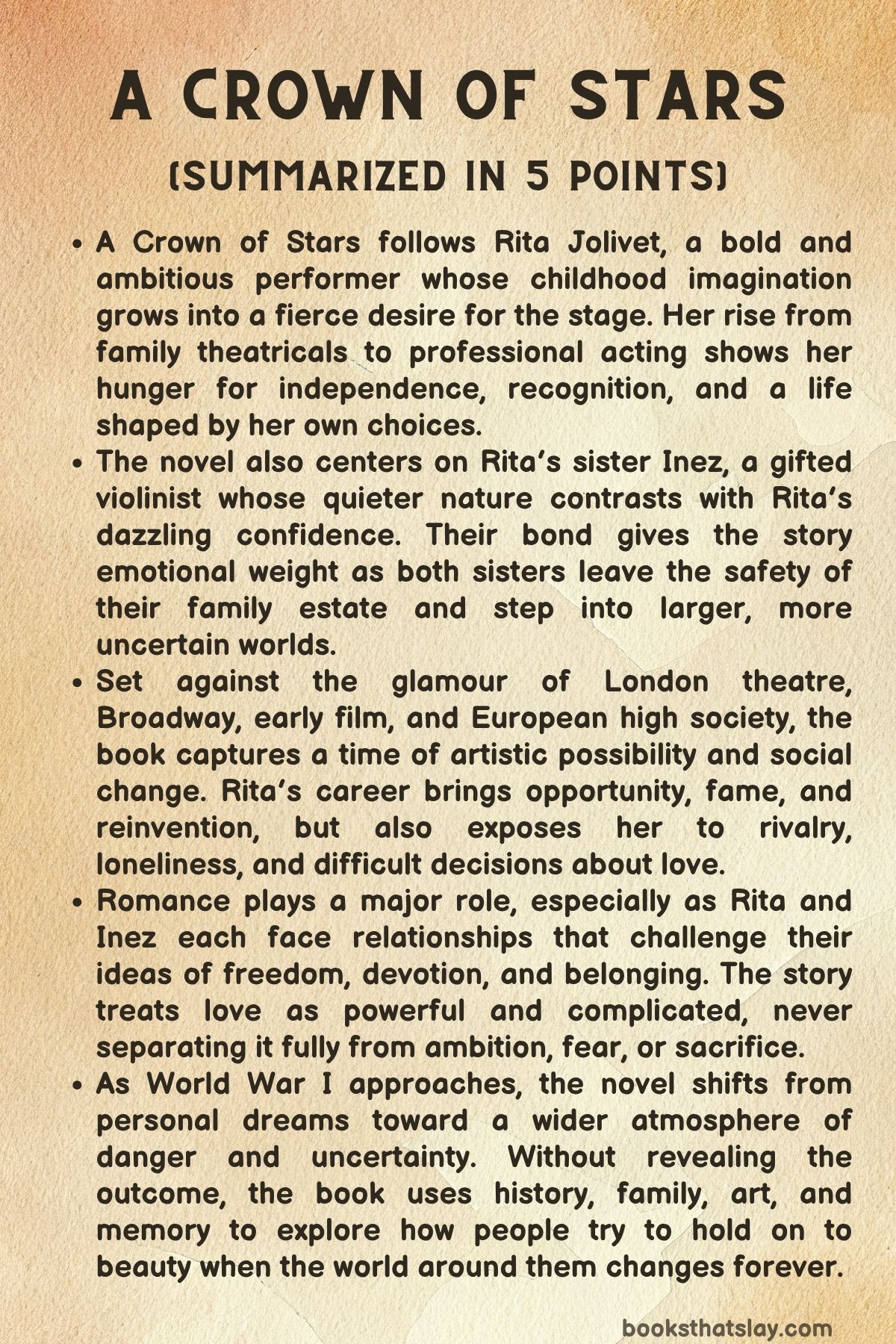
A Crown of Stars by Shana Abe is a historical novel about actress Rita Jolivet, her sister Inez, and the private losses behind one of the twentieth century’s most infamous maritime disasters. Moving from glittering English estates and London theatres to New York, Naples, Hollywood, and the doomed voyage of the Lusitania, the book follows two gifted sisters chasing art, love, and independence in a world sliding toward war.
At its center is Rita: ambitious, proud, wounded, and determined to turn survival into testimony. The novel blends family drama, romance, stage life, and historical tragedy into a story about memory, fame, grief, and endurance.
Summary
A Crown of Stars opens in 1917, with actress Rita Jolivet filming a drowning scene in the Hudson River for her movie Lest We Forget. The set is crowded with extras acting as drowning passengers, while Rita struggles through the water in heavy period clothing.
The moment is staged, but for her it feels dangerously close to memory. When the director calls cut, everyone rises, breathes, jokes, and survives.
Rita knows the real disaster was nothing like that. The people in the water on that day did not all come back.
The novel then returns to Rita’s childhood, when she is still Marguerite Jolivet, the eldest daughter of Charles and Pauline Jolivet. The family is wealthy, cosmopolitan, and rooted in several worlds: Paris, England, and New York.
Their English estate, Winter Queen, gives Marguerite, her sister Inez, and their brother Alfred a grand but sheltered childhood. Marguerite is the natural leader of the children, inventing plays and commanding attention.
Inez is quieter, more anxious, and musically talented, while Alfred is restless and adventurous.
Marguerite’s imagination is strong from childhood. She loves performance, glamour, and the idea of becoming someone larger than herself.
One evening, she sneaks from bed during a dinner party and meets an important older man alone in the library. She speaks to him with unusual confidence before learning that he is the Prince of Wales.
The encounter becomes one of her treasured memories, proof that life can turn theatrical without warning.
That childhood brightness is altered when Marguerite and Inez discover the drowned body of the gardener’s son in the koi pond. Marguerite protects Inez from seeing too much, but she herself absorbs the terrible sight.
Death becomes something she cannot unsee.
As Marguerite grows older, her hunger for the stage sharpens. Near eighteen, she announces that she wants to move to New York and perform on Broadway.
Her father refuses, but her mother offers a compromise: Marguerite and Inez may move to London. Marguerite can seek work in the West End, while Inez studies violin.
Inez fears leaving home, but Marguerite persuades her that they must make their own futures.
In London, the sisters live in Bloomsbury and begin reshaping themselves. Marguerite auditions for a role in a comedy called Good Girls Stay Home.
The audition is awkward and dismissive at first, but she uses nerve and invention to prove she can act. She gets the part and adopts the stage name Rita Jolivet.
Inez also chooses a public name, Leigh, for her music. Their move into adult life is marked by freedom, risk, and defiance, including Rita’s impulsive purchase of matching pistols for herself and Inez.
Rita’s first rehearsals are difficult. The theatre is shabby, the director is severe, and two actresses resent her.
When they begin stealing her things, Rita retaliates with castor oil in their brandy, making them sick during rehearsal. The production itself fails, but a harsh review singles Rita out as its one success.
Her family sees this praise as the start of her rise.
Inez, meanwhile, struggles with London society and her musical training. At a party, she meets George Vernon, an American concert singer with an air of secrecy.
He is kind to her, admires her talent, and unsettles her in ways she does not fully understand. Rita’s career also gains momentum when powerful producer Charles Frohman notices her.
He understands that talent needs publicity and arranges a feature that presents Rita as a rising international beauty. Though exaggerated, the article helps make her recognizable.
Rita is later cast as Hero in Much Ado About Nothing. Under demanding direction, she grows more disciplined and confident.
The role brings her months of work and her first real public recognition. A waitress asks for her autograph, and Rita begins to understand what fame feels like.
Inez has her own turning point when she is invited to Sandringham House to perform before royalty. Nervous and unsure of herself, she travels by royal train and tries to understand palace protocol.
There she unexpectedly meets George Vernon again. He encourages her before she plays for King Edward, Queen Alexandra, and members of the Russian imperial circle.
Inez performs Mozart, Vivaldi, and her own composition, “Map of the Sea,” earning a standing ovation. George later tells her that the tsarina was moved to tears.
By 1903, the sisters are living independently. Rita tours as Juliet in Romeo and Juliet, enduring uncomfortable lodgings, bad food, and worn costumes while discovering the camaraderie of the theatre.
She briefly falls for Freddy Stern, a stagehand who once protects her from assault. Gratitude, attraction, and fear confuse her into marriage, but the union proves disastrous.
Freddy is crude and unstable, and Rita eventually escapes through annulment and payment. The experience leaves her wary of marriage and of needing any man.
Inez’s romance with George moves quickly. He courts her with flowers, postcards, and unexpected visits.
He reveals that he is not only a singer but also involved in influence, information, and international connections. He remains mysterious, but Inez trusts him completely.
They marry in an elegant ceremony at Kew Gardens, surrounded by family, aristocrats, and tokens of royal favor. Inez believes she has found the life meant for her.
Years pass, and Rita becomes successful on Broadway and then in Italian films. In Naples, she is involved with Count Giuseppe de Cippico, a wealthy and honorable Italian nobleman connected to the film world.
Giuseppe loves Rita deeply and seems ready to marry her, but Rita is afraid of losing her independence. He encourages her to accept Charles Frohman’s offer to return to America for a film, warning that Europe is nearing war after the assassination of Austria’s archduke.
Rita leaves for America as war spreads across Europe.
In Los Angeles, Rita films The Unafraid for Cecil B. DeMille. Inez visits her, and the sisters share what becomes one of their last happy times together.
They speak about Giuseppe, George, Alfred’s desire to enlist, and Inez’s recent miscarriage. Inez urges Rita not to wait too long to accept love.
Rita remains uncertain, especially after learning that Giuseppe may have bought an engagement ring. Before leaving, Inez appears as an extra in Rita’s film and shines on camera, giving Rita a memory she will later treasure.
In 1915, Giuseppe comes to New York for the premiere of The Unafraid, traveling on the Lusitania despite the danger of German submarines. Rita expects a proposal, but when a photographer captures Giuseppe kneeling before her, she panics and quarrels with him.
They reconcile, but he leaves without asking again. Only after his departure does Rita fully admit to herself that she loves him.
Soon afterward, Rita learns that Alfred has enlisted and will soon leave for war. Determined to say goodbye, she books passage to England on the Lusitania, choosing speed over safety even after a German warning appears in New York newspapers.
On board, she finds Charles Frohman among the passengers and is welcomed into his circle. She also meets George Vernon, who is traveling to Winter Queen and hopes to move Inez to Russia for safety.
George and Rita agree on a meeting point in case disaster strikes.
The voyage begins with luxury and social ease, but unease gathers. Passengers discuss submarine warnings, rumors, and the ship’s supposed speed.
Lifeboats are prepared as the ship nears the war zone. Captain Turner assures everyone that the Lusitania cannot be caught.
On May 7, 1915, Rita is in her cabin after lunch when the ship is struck. A second explosion follows.
She grabs her lifebelt, pistol, and bag, then fights her way upward through panic. On deck she finds George, Charles Frohman, and others.
The ship is listing badly and still moving, making the boats nearly impossible to launch safely. George secures Rita’s lifebelt.
As the bow sinks, he asks Rita to tell Inez that love at first sight exists because Inez proved it to him. Charles remains calm before the water tears them apart.
Rita is dragged under, then surfaces near an overturned lifeboat. She clings to it for hours among survivors, bodies, wreckage, and cries for help.
She sees the ship vanish and later watches a German submarine surface near the wreckage. Exhausted, freezing, and burned by the sun, she begins to hallucinate before being rescued by sailors from the disguised British ship Westborough.
She is taken to Queenstown with other survivors.
In Queenstown, Rita searches desperately for George, Charles, and others. The town fills with survivors and the dead.
Bodies are laid out in temporary morgues. Rita finds Charles Frohman’s body.
Inez arrives, already sensing that George is gone, and the sisters continue searching until they find his body in an abandoned chandlery.
Rita and Inez return to Winter Queen. George is buried in Queenstown, and Giuseppe comes from Italy.
Rita accepts his love, and they become engaged. Inez, however, cannot recover.
She returns alone to New York to settle George’s affairs. Broken by grief, she dresses in black, puts on jewels George gave her, writes Rita a farewell letter, and kills herself with one of the pistols Rita once bought as a symbol of freedom.
Rita brings Inez’s body back across the Atlantic, furious, devastated, and unable to forgive the loss. During the voyage, she writes to her dead sister and decides to make a film about the Lusitania so the world will remember.
Two years later, she produces and stars in Lest We Forget, transforming trauma into public witness. The novel closes with the Jolivet family, Giuseppe, and Alfred gathered in Queenstown for Inez and George’s final service.
Their shared grave marks them as victims of the Lusitania crime, and Rita lays flowers for her sister while Giuseppe supports her through the weight of memory.
Characters
Rita Jolivet / Marguerite Jolivet
Rita Jolivet, born Marguerite Jolivet, is the central figure of A Crown of Stars and one of the most vividly developed characters in the book. She begins as a bold, imaginative child who naturally takes command of games, performances, and family life.
From an early age, she is theatrical not only in her ambitions but in the way she experiences the world: every place, person, and event becomes part of a larger drama in her mind. Her childhood at Winter Queen gives her privilege, beauty, and confidence, but it also exposes her to death when she discovers the drowned gardener’s son.
That moment quietly prepares the reader for the later trauma of the Lusitania, because Rita is a person who remembers images intensely and carries them forward.
As a young woman, Rita is ambitious, fearless, and often reckless. Her decision to pursue the stage shows her refusal to accept the passive life expected of wealthy daughters.
She is not naturally humble, and her confidence sometimes becomes deception or manipulation, as seen when she lies during her audition and later retaliates against hostile actresses. Yet these actions also reveal her survival instinct.
Rita understands that the world of theatre is not gentle, especially toward young women, and she learns to fight for space in it. Her stage name represents more than professional reinvention; it is a declaration that she intends to author her own identity.
Rita’s emotional life is shaped by her hunger for independence. She distrusts men partly because of the harassment she has endured and partly because she fears being controlled.
Her failed marriage to Freddy Stern deepens this fear. She mistakes rescue and attraction for love, then discovers how easily marriage can become a trap.
This experience explains her hesitation with Giuseppe. Even when she loves him, she resists the language of surrender, proposal, and dependence.
Her conflict is not that she cannot love, but that she fears love may cost her the freedom she has fought so hard to claim.
The sinking of the Lusitania transforms Rita from a performer into a witness. Until then, she has used art to create illusion, fame, and identity.
After the disaster, performance becomes an act of memory and accusation. Her survival leaves her with grief, guilt, and responsibility.
She searches for bodies, protects Inez as much as she can, and later turns trauma into film so the dead will not vanish into statistics. Rita’s strength lies not in being untouched by suffering but in refusing to let suffering silence her.
By the end of the story, she is still theatrical, passionate, and commanding, but her art has gained moral weight.
Inez Jolivet / Inez Leigh
Inez is Rita’s younger sister and emotional opposite in many ways. Where Rita is bold, Inez is shy; where Rita rushes toward stages and crowds, Inez retreats into music, privacy, and feeling.
Yet Inez is not weak. Her quietness hides a profound inner life and a rare artistic gift.
As a violinist, she expresses through music what she cannot easily say in conversation. Her playing reveals sensitivity, discipline, and spiritual depth, especially when she performs before royalty and moves listeners beyond polite admiration.
Inez’s childhood dependence on Winter Queen shows how deeply she values safety and familiarity. Moving to London terrifies her, but she follows Rita because she trusts their sisterly bond and because some part of her also longs for a larger destiny.
Her growth is quieter than Rita’s but equally important. She gradually steps into public life, first as a musician and later as George Vernon’s beloved.
Her encounter with George awakens a side of her that is romantic, decisive, and brave. Once she recognizes love, she does not hesitate in the way Rita does.
She believes in belonging, and marriage to George gives her a sense of chosen identity.
Inez’s tragedy lies in the intensity of that love. Her bond with George is presented as almost fated, and his death breaks not only her heart but her understanding of the world.
The miscarriage she suffers before the sinking already marks her with loss, and George’s death becomes unbearable because he is her emotional center. Her suicide is devastating because it emerges from a character who feels deeply but has few defenses against grief.
She cannot transform pain into public action as Rita does. Instead, she turns inward until grief becomes fatal.
Inez is one of the most tragic figures in the book because her innocence is not childish ignorance but emotional purity. She sees love as absolute, music as truth, and family as shelter.
The violence of history destroys those shelters one by one. Her death also changes Rita permanently, giving Rita’s later film not only political purpose but intimate grief.
Inez’s presence lingers after her death because she represents the private human cost behind public catastrophe.
George Vernon
George Vernon is mysterious, charming, and emotionally significant from the moment he enters Inez’s life. He appears first as a refined American singer, but rumors and hints suggest that his work extends into diplomacy, intelligence, influence, and secret government service.
This ambiguity makes him compelling. He moves comfortably among royalty, political figures, and international circles, yet with Inez he is gentle, attentive, and sincere.
His mystery never feels merely decorative; it reflects the unstable world before the war, where art, politics, espionage, and aristocratic society overlap.
George’s love for Inez is one of the most tender relationships in the story. He does not overwhelm her; instead, he draws her out patiently.
He notices her talent, respects her shyness, and treats her as someone extraordinary before she fully believes it herself. His courtship through flowers and postcards shows both romance and persistence.
He understands distance, travel, and secrecy, but he also wants Inez to feel remembered. When he asks to court her, he offers emotional certainty in a world increasingly defined by uncertainty.
On the Lusitania, George becomes a figure of courage and tragic foresight. His conversations with Rita reveal that he understands the war’s political stakes more clearly than most passengers.
He suspects that catastrophe may alter America’s position, which gives his character a chilling awareness of history. Yet when disaster comes, his attention turns not to politics but to love.
His message for Inez, asking Rita to tell her that love at first sight exists and that Inez proves it, captures his essence. He dies as both a man of secrets and a man of feeling.
George’s death is devastating because he represents the possibility of a beautiful life interrupted. He and Inez are not given enough time.
His body’s recovery in Queenstown gives the sisters a terrible form of closure, but it also confirms the finality Inez cannot survive. In the story, George stands at the intersection of romance, war, and sacrifice.
Giuseppe de Cippico
Count Giuseppe de Cippico is Rita’s lover and later fiancé, and he serves as a contrast to the men who have made Rita wary. He is wealthy, noble, and connected to the film world, but his most important qualities are patience and honor.
He does not treat Rita as a possession or conquest. Instead, he supports her work, visits her film sets, brings food for the crew, and recognizes the seriousness of her career.
His love is generous without being weak, passionate without being coercive.
Giuseppe understands Rita’s fear of marriage more clearly than she realizes. Rather than forcing a proposal at the wrong time, he challenges her to understand her own heart.
His warning about Europe sliding into war shows his realism. He is not merely a romantic nobleman; he is responsible for estates, people, and obligations.
His patriotism and sense of duty prevent him from abandoning Europe even when he wants Rita near him. This makes him a mature partner for her, because he also understands divided loyalties.
Rita’s conflict with Giuseppe reveals her deepest fear: that love will make her dependent. Giuseppe’s role is not to tame Rita but to wait until she can accept love without feeling conquered by it.
Their quarrel at the premiere shows how fragile their relationship is when public expectation intrudes. Rita panics at the appearance of a proposal because she still associates marriage with loss of control.
Giuseppe’s restraint afterward is painful but meaningful; he refuses to reduce love to pressure.
After the Lusitania disaster and Inez’s death, Giuseppe becomes a stabilizing presence. He does not erase Rita’s grief, but he steadies her physically and emotionally.
His love survives delay, distance, war, and trauma. By the end of the novel, he represents a form of devotion Rita can finally accept: not a cage, but companionship.
Inez and Rita as Sisters
Although Rita and Inez are separate characters, their sisterhood is one of the emotional foundations of the story. Rita is the protector, instigator, and public force, while Inez is the gentler, more inward spirit.
Their relationship begins in childhood performances and shared secrets, but it deepens through fear, ambition, romance, and grief. Rita leads Inez into London, and Inez often softens Rita’s fierceness.
They balance each other, even when they do not fully understand each other’s choices.
Their bond is especially moving because each sister sees something in the other that the world might miss. Rita sees Inez’s vulnerability and talent; Inez sees Rita’s loneliness beneath fame and bravado.
They can tease, argue, and challenge each other, but their love remains central. Inez urges Rita toward Giuseppe because she understands the cost of delaying happiness, while Rita worries over Inez’s swift marriage because she fears her sister may be hurt.
After George’s death, Rita tries to remain the protector she has always been, but she cannot save Inez from grief. That failure becomes one of Rita’s deepest wounds.
Inez’s suicide turns sisterly love into lifelong mourning. Rita’s later artistic mission is not only about the Lusitania as a public tragedy; it is also an attempt to speak to and for the sister she lost.
Charles Frohman
Charles Frohman is a powerful theatre producer and one of Rita’s most important mentors. He recognizes that talent alone is not enough; an actress must be seen, named, photographed, and placed before the public imagination.
His role in arranging Rita’s feature in The Sketch shows his understanding of fame as construction. He helps transform Rita from a promising performer into a recognizable figure.
Frohman is also warm, sociable, and generous. He moves through elite theatrical circles with authority, but he does not treat Rita merely as a commodity.
He includes her in his world, encourages her ambitions, and later welcomes her into his circle aboard the Lusitania. His presence on the ship connects Rita’s theatrical life to the historical disaster that reshapes her future.
His calmness during the sinking makes him one of the most memorable figures in the final disaster sequence. His statement about death as an adventure reveals dignity, faith, and perhaps theatrical grandeur.
It is a line suited to a man who spent his life shaping drama, yet in that moment it becomes painfully real. Rita’s discovery of his body in Queenstown marks one of the story’s most brutal collisions between public legend and human mortality.
Alfred Jolivet
Alfred Jolivet, Rita and Inez’s brother, represents youth, adventure, and the pull of wartime duty. As a child, he is stubborn and energetic, part of the imaginative world Rita commands at Winter Queen.
Compared with his sisters, he receives less attention, but his presence is important because he anchors the Jolivet family as a broader unit rather than only a sisterly pair.
His desire to enlist once he is old enough shows the pressure placed on young men during the war. Alfred’s decision becomes one of the reasons Rita boards the Lusitania: she wants to reach England to say farewell before he deploys.
In that sense, Alfred indirectly sets the final tragedy in motion. He is not responsible for what happens, but his enlistment embodies the larger historical force pulling private families into global violence.
By the epilogue, Alfred’s presence at the final service reinforces the family’s survival amid loss. He represents the generation shaped by war, even if the book focuses more closely on Rita and Inez.
His character reminds the reader that the Jolivet family’s tragedy is both intimate and historical.
Charles Jolivet
Charles Jolivet, the father of Rita, Inez, and Alfred, is a wealthy, protective patriarch who values respectability and family stability. His initial refusal to let Marguerite go to New York reflects conventional expectations for daughters of his class.
He is not cruel, but he does not immediately understand the seriousness of Rita’s ambition. To him, the stage may seem unstable, improper, or dangerous.
Yet Charles is not a flat obstacle. When Rita receives praise in a brutal review, he reads it aloud, and the family celebrates her promise.
This moment shows that he can take pride in his daughter’s talent once it receives public validation. His authority softens when achievement becomes undeniable.
He represents the older world of family permission, reputation, and guarded privilege that Rita must negotiate but not entirely reject.
Charles’s role in the story is also emotional. He belongs to the home Rita and Inez repeatedly leave and return to.
Winter Queen, under his household, is both shelter and limitation. Through him, the book shows how parental love can coexist with social conservatism.
Pauline Jolivet
Pauline Jolivet is the mother whose diplomacy makes Rita and Inez’s first step into independence possible. When Charles refuses Rita’s wish to go to New York, Pauline proposes London as a compromise.
This decision is crucial because it allows both daughters to pursue their gifts while preserving a form of social acceptability. Pauline understands ambition more flexibly than her husband does, and she knows how to work within family power structures.
She is practical, elegant, and quietly influential. Her solution reveals maternal intelligence: Rita needs a stage, Inez needs musical training, and both girls need each other.
Pauline does not simply indulge them; she shapes a path that lets them grow. Later, when Rita faces the hardships of touring, Pauline sends experienced cousins to solve the costume crisis, showing that her care is often expressed through efficient action.
Pauline represents the kind of maternal support that does not dominate the story but makes many of its turning points possible. She belongs to the world of wealth and propriety, yet she helps her daughters step beyond it.
Freddy Stern
Freddy Stern is a significant figure in Rita’s emotional history because he teaches her the difference between rescue, desire, and lasting love. As a carpenter in the acting company, he first appears connected to Rita’s touring life, which is full of excitement, discomfort, freedom, and temptation.
When he rescues her from an assault, Rita’s gratitude and attraction become tangled with romantic fantasy.
Their brief marriage reveals Rita’s vulnerability beneath her confidence. She is worldly in some ways but inexperienced in others, especially when it comes to distinguishing passion from compatibility.
Freddy turns out to be coarse, drunken, and unsuitable, and the marriage quickly becomes something Rita must escape. The annulment hardens her fear of being trapped by men and institutions.
Freddy’s importance lies less in who he is than in what he changes in Rita. After him, she becomes more guarded.
Her later hesitation with Giuseppe cannot be understood without Freddy. He is the shadow behind her fear that marriage may begin as romance and end as captivity.
William Poel
William Poel is the demanding theatre director who helps Rita become a more disciplined actress. His rehearsals are fast, rigorous, and challenging, but they sharpen her talent.
He recognizes her potential and gives her the role of Hero, then later offers her Juliet. These opportunities mark important stages in Rita’s artistic development.
Poel’s function in the story is professional rather than emotional. He represents the seriousness of theatre as craft.
Rita may have natural charisma, but Poel’s direction forces her to work, adapt, and endure. Through him, the book shows that fame is not only glamour and publicity; it is also repetition, criticism, and technical growth.
Ansel Lurie
Ansel Lurie is the harsh director of Good Girls Stay Home, and he belongs to Rita’s early theatrical struggle. His rehearsal room is unpleasant, shabby, and competitive, far from the romantic dream of the stage.
He helps expose Rita to the cruelty and pettiness of theatrical life before success protects her.
Ansel’s role is to test Rita’s resilience. He does not nurture her in the way Charles Frohman later does or refine her in the way Poel does.
Instead, he places her in an environment where she must defend herself. Rita’s response to that environment, including her retaliation against Callie and Mayme, shows that she is not passive when humiliated.
Callie and Mayme
Callie and Mayme are Rita’s fellow actresses in her early stage career, and they represent jealousy, insecurity, and rivalry within the theatre. They resent Rita, take her belongings, and try to make her feel unwelcome.
Their hostility shows that the stage is not a sisterhood of artists but a competitive world where small cruelties can become daily weapons.
Rita’s revenge against them is morally questionable but revealing. She does not appeal helplessly to authority; she strikes back in a theatrical and humiliating way.
Callie and Mayme therefore help illuminate Rita’s combative side. She can be charming and talented, but she can also be ruthless when cornered.
Mademoiselle Thenaud
Mademoiselle Thenaud, the palm reader, brings an atmosphere of prophecy and unease into the story. Her prediction about angels, demons, and violent interruption hovers over Rita’s life even though Rita does not believe in such things.
The importance of the scene lies in its emotional foreshadowing. Rita’s later hallucination of angels after the sinking gives the earlier prediction a haunting resonance.
The palm reader also observes Inez and George, silently marking a relationship that will become central and tragic. She is a minor character, but she deepens the sense that the characters are moving toward destinies they cannot fully see.
Her presence adds a mystical undertone to a story otherwise grounded in performance, society, war, and historical disaster.
Fräulein Wietrowetz
Fräulein Wietrowetz is Inez’s final violin tutor, and her importance lies in her recognition of Inez’s genius. By telling Inez she is a prodigy with the capacity for greatness, she gives voice to what Inez cannot claim confidently for herself.
This validation matters because Inez is deeply uncertain in public life.
Although she appears briefly, Fräulein Wietrowetz helps prepare Inez for her royal performance. Her role is that of the stern or serious teacher whose approval carries weight.
She confirms that Inez’s music is not merely a genteel accomplishment but a true artistic gift. Through her, the book frames Inez as an artist of genuine promise, making her later death feel even more wasteful.
Lady Allan
Lady Allan is one of the survivors Rita encounters after the Lusitania sinks. Her backward life jacket, missing daughters, and shared suffering make her a powerful figure of maternal tragedy.
She is not simply another survivor; she embodies the agony of living when one’s children are lost.
Her presence beside Rita on the overturned lifeboat creates a bond formed by terror, cold, exhaustion, and grief. The later news that one daughter’s body is recovered while the other is never found extends the horror beyond the moment of sinking.
Lady Allan’s survival is therefore not relief but a different form of torment. Through her, the story shows that survival can be its own burden.
Charles Frohman, George, and Lady Allan as Disaster Figures
The Lusitania sequence gathers several characters into a shared moral landscape. Charles Frohman represents dignity before death, George represents love and farewell, and Lady Allan represents the grief of survival.
Rita’s interaction with each of them shapes how she remembers the disaster. They are not background figures; they become part of the emotional evidence she carries into her later film.
Together, these characters help transform the sinking from a historical event into a human catastrophe. The reader experiences the disaster not only through numbers or political consequences but through last words, missing children, recovered bodies, and the unbearable randomness of who lives and who dies.
Captain Turner
Captain Turner is the commander of the Lusitania and represents confidence, authority, and tragic miscalculation. He reassures passengers that the ship cannot be caught by a submarine, reflecting both institutional confidence and the assumptions of a world not yet fully adapted to modern warfare.
His belief in the ship’s speed and strength becomes painfully ironic once the vessel is struck.
Turner’s character is important because he stands for the official voice of safety. Passengers trust systems: captains, companies, escorts, naval procedures, and public assurances.
When those systems fail, the disaster feels not only violent but betrayed. Turner is not portrayed simply as villainous; rather, he embodies the limitations of authority in a new and brutal kind of war.
Captain Scott
Captain Scott appears during the sinking and provides Rita with grim confirmation of what has happened. He tells her the ship has been struck by a torpedo and helps secure life jackets.
In the chaos, his presence offers a moment of practical clarity.
His role is brief but important because disaster strips away illusion. Unlike the reassurances before the attack, Captain Scott speaks to the immediate reality of danger.
He represents duty under impossible conditions. His actions cannot save everyone, but they show human decency and discipline amid panic.
Eleanor
Eleanor, Rita’s stewardess aboard the Lusitania, is a minor but meaningful character. She represents the working people who make the luxury of first-class travel possible.
Through her, the ship becomes not just a grand vessel of famous passengers but a place staffed by individuals with duties, routines, and vulnerability.
Her presence also helps ground Rita’s shipboard experience in ordinary human contact before catastrophe. The disaster does not distinguish morally between celebrity, crew, wealth, and obscurity.
Eleanor’s role reminds the reader that the sinking consumes an entire floating society.
Alfred Vanderbilt
Alfred Vanderbilt is part of the Lusitania’s elite social world, appearing at dinners and amusements with Rita and Charles Frohman. His presence emphasizes the glamour and privilege aboard the ship before disaster strikes.
Rita’s gesture of giving him her prize pin for his children humanizes him, shifting him from famous millionaire to father.
Vanderbilt’s role also heightens the contrast between luxury and vulnerability. Wealth, fame, and social position mean little once the ship is attacked.
Through him and others in the first-class circle, the story shows how quickly elegance collapses into terror.
Josephine Brandell
Josephine Brandell appears in the Lusitania social circle, especially around the captain’s dinner. As a passenger among prominent figures, she helps create the atmosphere of conversation, rumor, and uneasy sophistication before the sinking.
Characters like Josephine show how people try to maintain normal social rituals even as danger approaches.
Her role is minor, but she contributes to the sense of a community suspended between denial and fear. The passengers speak of warnings, submarines, and omens, yet meals and manners continue.
Josephine belongs to that fragile last performance of normality.
Jenny
Jenny is another member of Rita’s shipboard circle. Like Josephine, she helps fill out the social world of the Lusitania before the attack.
Through Rita’s time with Jenny, Vanderbilt, George, and Charles, the voyage briefly resembles a floating house party rather than a journey through a war zone.
Jenny’s importance lies in atmosphere. She helps show how companionship, games, meals, and conversation soften fear until fear becomes unavoidable.
Minor characters like Jenny make the later chaos feel more personal because the ship has already become socially alive.
Mrs. Cornwallis-West
Mrs. Cornwallis-West is the hostess at the party where Inez meets George Vernon. Her social gathering creates the setting for one of the story’s most important relationships.
As a hostess, she represents the power of society to arrange accidental destinies. In drawing people together, her world becomes the stage on which private lives change.
Her role is minor but structurally important. Without that social environment, Inez and George’s romance might not begin.
The character also reflects the book’s interest in elite networks, where artists, nobles, politicians, and mysterious agents move through the same rooms.
Mrs. Corbyn
Mrs. Corbyn is connected to the sisters’ London life and serves as a witness to Inez’s certainty about George. When Inez returns from her evening with him and declares that he will be calling often because she intends to marry him, Mrs. Corbyn becomes part of a domestic moment that reveals Inez’s transformation.
Her role is small, but she helps frame the sisters’ independent life in Bloomsbury. The flat is not merely a place of lodging; it is the space where Rita and Inez begin becoming adult women.
Mrs. Corbyn’s presence gives that life social texture and a sense of household reality.
King Edward and Queen Alexandra
King Edward and Queen Alexandra appear during Inez’s visit to Sandringham, where she performs as a musical guest. Their importance lies less in personal development and more in what their presence reveals about Inez.
Performing before royalty tests her courage and confirms the value of her gift.
The royal household also expands the scope of the story. Rita seeks fame through theatre, while Inez enters high society through music.
The king and queen’s presence places Inez’s art within a formal world of ceremony, rank, and cultural prestige.
The Tsar and Tsarina of Russia
The tsar and tsarina are significant because they connect George’s mysterious life to international politics and because the tsarina’s emotional response to Inez’s music validates Inez at the highest social level. Their presence at Sandringham makes Inez’s performance feel historically and emotionally charged.
They also foreshadow the unstable political world into which the characters are moving. Their connection to George hints that his life extends far beyond music.
In a story increasingly shaped by war and empire, their appearance adds depth to the atmosphere of approaching upheaval.
Themes
Ambition and Self-Creation
In A Crown of Stars, Rita’s rise begins with a refusal to accept the life chosen for her by family, class, or gender. From childhood, she imagines performance as a way to command attention and shape reality, and that desire follows her from private family theatricals to the professional stage.
Her ambition is not shown as simple vanity; it is tied to hunger, discipline, risk, and the courage to reinvent herself. By changing her name, lying boldly in an audition, surviving harsh rehearsals, and learning from failure, she turns identity into something active rather than inherited.
Fame gives her recognition, but it also exposes the cost of public life: loneliness, exhaustion, and the pressure to keep becoming more impressive. Her career shows that success is built through talent, strategy, resilience, and sometimes deception.
The theme becomes especially powerful because acting allows Rita to master staged danger, while real catastrophe later strips away all control. Her ambition survives even grief, changing from personal advancement into remembrance through film.
Love, Dependence, and Freedom
Rita and Inez experience love in sharply different ways, and their choices reveal the tension between devotion and independence. Inez’s love for George is immediate, total, and certain; she sees marriage not as a loss of self but as the place where her true life begins.
Rita, by contrast, fears being trapped by love because her first marriage taught her how easily desire, gratitude, and social pressure can become a cage. Even with Giuseppe, who is patient and honorable, she resists the idea that needing another person might make her weaker.
Her conflict is not lack of love but fear that love will demand surrender. The novel treats romantic attachment as both beautiful and dangerous: it can steady people, enlarge their lives, and give them courage, but it can also make loss unbearable.
Inez’s grief after George’s death shows the devastating side of a love that has become the center of existence. Rita’s later acceptance of Giuseppe suggests that freedom and love can coexist, but only when love does not erase the self.
Trauma, Memory, and Witness
Death enters Rita’s life early, when she sees the drowned boy at Winter Queen, and that childhood image prepares the emotional ground for the later disaster. The sinking does not arrive as an isolated event; it becomes the terrible fulfillment of images, fears, and warnings that have gathered around her life.
After surviving the ocean, Rita is not merely haunted by what happened. She becomes a witness burdened with the duty to remember those who cannot speak.
The staged drowning scene in A Crown of Stars shows how memory can be transformed into performance, but it also shows the limits of art: actors can rise when the director calls cut, while the real dead cannot return. Rita’s film work becomes an act of testimony, anger, and mourning.
She uses cinema to fight forgetting, turning private horror into public record. This theme gives the story its moral force because survival is not presented as escape from suffering.
Survival means carrying the dead forward and forcing the world to look.
War and the Collapse of Innocence
The movement from theatres, estates, royal rooms, concerts, and parties into war shows how quickly a graceful world can be broken by history. Before the sinking, danger often appears distant, softened by wealth, travel, manners, and social confidence.
Passengers trust speed, status, official reassurances, and the rituals of comfort aboard the ship. Yet war destroys those illusions in minutes.
The disaster exposes the weakness of privilege against violence: first-class cabins, famous names, elegant clothes, and powerful connections offer no protection in the water. The theme is not only about military conflict but about the collapse of trust in civilization itself.
Polite society keeps insisting that rules still matter, while the torpedo proves that modern war has crossed into civilian life. The deaths of George, Charles, children, strangers, and Inez’s final despair show how one act of violence spreads far beyond the moment of attack.
The war does not remain a political background; it enters families, bodies, art, memory, and love, permanently dividing life into before and after.