And The Ancestors Sing Summary, Characters and Themes
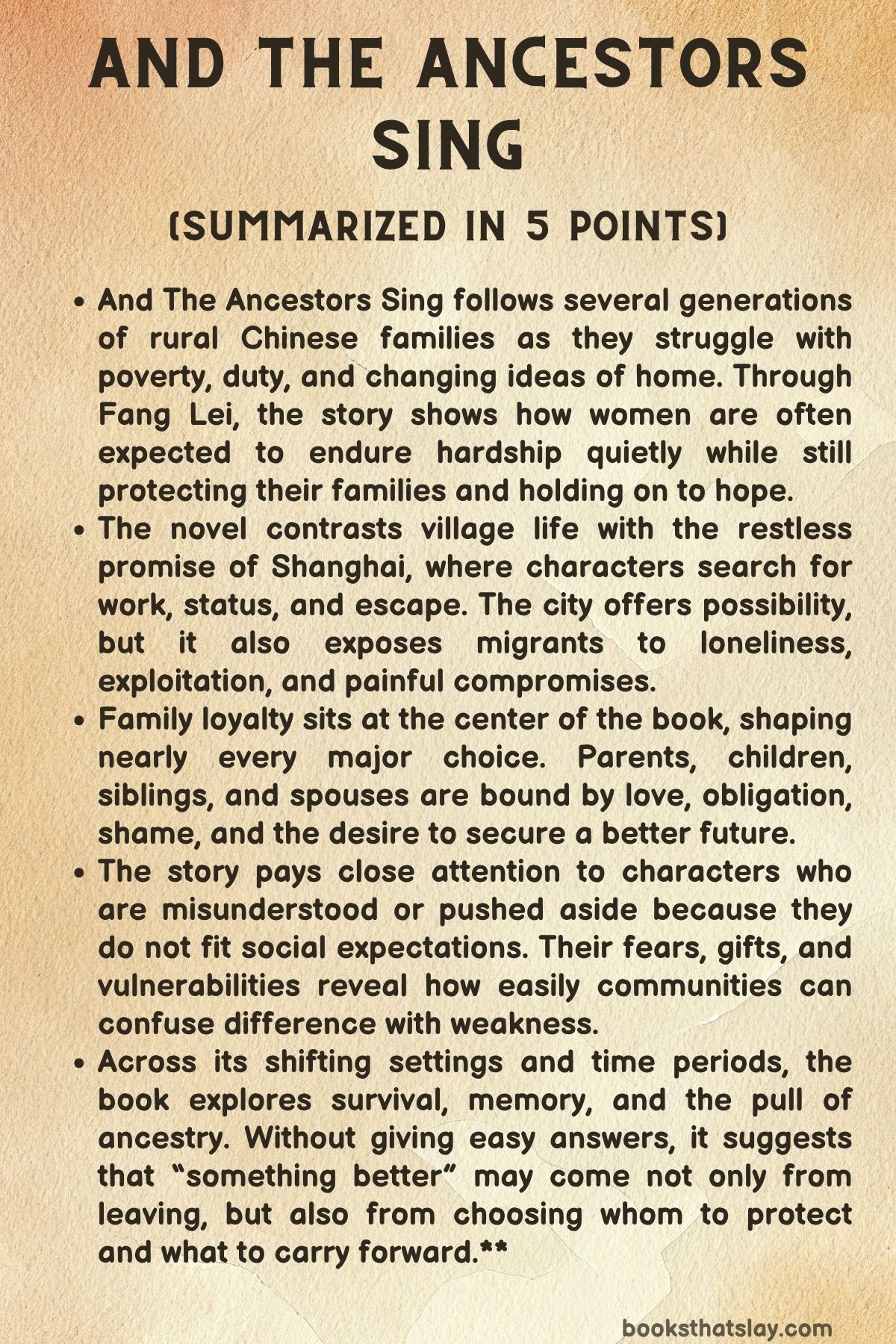
And The Ancestors Sing by Radha Lin Chaddah is a multi-generational novel about poverty, migration, family duty, trauma, and survival in a changing China. Moving from a rice-growing village to Shanghai and back again, the book follows women and families who are shaped by class, gender, tradition, disability, and the harsh demands of social change.
At its center are Lei, LuLu, Yan, LiLi, Jiang, and others who try to protect the people they love while carrying burdens passed down through family and history. The novel presents ancestry not as something distant, but as a living force that guides, wounds, and sometimes saves.
Summary
And The Ancestors Sing begins in a poor rice-farming village in China, where survival depends on rain, labor, and the power of the Farmer Master. Fang Lei, newly married to Fang Bo, works beside him in the wet rice fields.
Bo is resentful, thin, and bitter, especially toward the stronger and more prosperous brothers Pang and Shu. He criticizes Lei even when she carries the same heavy workload.
Lei, still homesick for her mother and childhood home, watches her husband closely, hoping to discover gentleness beneath his anger.
Life in Bo’s household is unequal and cold. Lei lives with Bo, his mother Fang MaMa, and his beautiful sister MeiLin.
She fetches washing water for Bo, receives little food, and sees how much preference is given to him and MeiLin. Fang MaMa gives Bo the best portion at dinner, including an egg, while Lei receives only a small piece.
Bo’s attention to MeiLin wounds Lei, who briefly mistakes his small gesture toward her as affection. Bo’s mind is fixed on improving his family’s status, saving money, and using Lei as both laborer and future mother.
The village is ruled by Farmer Master Wang, who watches the workers from his large house. He inherited wealth and authority from a father who used political power to his advantage.
Wang controls land leases, taxes, and wages, and he enjoys the villagers’ fear. He dreams of building a paved road and charging people to use it.
His son Jiang is unusual, gifted with numbers but troubled by seizures, sensory distress, and social isolation. During a village weigh-in, Jiang enters with his goat, Small Snow, begins counting frantically, claims he smells fire, and collapses.
Lei tries to help, but Bo pulls her back harshly. Jiang is treated by Old Doctor, who advises calm, cooling remedies, and a halt to study.
As Lei’s pregnancy advances, Pang begins visiting the Fang home, bringing gifts that are clearly meant for MeiLin. Fang MaMa encourages the match because Pang has money and strength.
Bo grows jealous and angry, while Lei observes MeiLin’s longing for safety and attention. During one rainy workday, Lei arrives at weigh-in covered in leeches.
She panics, but Jiang gently removes them one by one. The moment changes how Lei sees him.
She understands that Jiang, like her, knows fear and exclusion. Later, bedridden with swollen legs, she sings to her unborn child and promises never to abandon it.
The story then moves to Shanghai, where LuLu, a sixteen-year-old migrant girl, works as a prostitute from a barbershop run by Lao Fu. Her family believes she has a factory job.
She sends money home and keeps drawings of her parents and baby sister LiLi in a notebook. LuLu’s friend YuZhen tries to find dignity in their work, arguing that money gives them power, while LuLu feels shame and loss.
After visiting a blind fortune teller, Master Du, LuLu receives a message suggesting that her future may break beyond the walls of her present life. She cannot believe it.
LuLu tries to reclaim respectability by going to a factory where girls from her home province work. Their clothes, voices, and laughter remind her of the life she might have had.
But the gate guard insults her, the girls look at her with disgust, and the factory boss rejects her cruelly. When she returns to the barbershop, Lao Fu beats her.
YuZhen comforts her, and LuLu tears apart the blue shirt that represented her hope of becoming acceptable again.
Back in Da Long, China’s changes begin reaching the village. Wang has built his road but feels trapped outside the new prosperity.
Jiang resumes lessons with Teacher Zhou, who recognizes his brilliance but cannot make him “normal” in the way Wang desires. During the Lunar New Year market, Bo has rotten teeth pulled, Lei shops for fruit and secretly buys dried mango, and villagers move through a world balanced between hardship and small pleasures.
Da Long is later destroyed, and Lei urges Bo to leave for Shanghai so they can earn money and rebuild. Bo resists because the village is his ancestral home.
Lei confronts him for clinging to the past while neglecting the living needs of their children, Yan and Long. Bo nearly gives in to despair, but Lei stops him by reminding him of their children.
They leave Yan and Long with Pang and MeiLin and travel to Shanghai, where Shu meets them at the station. At the same station, LuLu waits for Wang, one of her regular clients.
Wang sees Shanghai as his true ancestral home and speaks with LuLu about family duty, especially his hopes and fears for Jiang.
Years later, Da Long has become New Da Long, while the old village lies under a lake turned into a tourist attraction. Yan, now seventeen, studies with Teacher Zhou and Jiang while preparing for the gaokao.
She once feared Jiang but came to see his kindness after he helped her during a humiliating childhood moment. Yan is hardworking and bright, but her brother Long begins suffering from frightening visions and voices.
Yan calms him with Lei’s song, yet she knows his condition is worsening.
In Shanghai, Lei and Bo live under a bridge among migrants. Lei cleans offices at night, and Bo washes buses.
Lei sends money and photographs home, while Bo remains angry and refuses to accept the name New Da Long. LuLu marries Lao Fu to obtain a Shanghai hukou, using her new legal status to help YuZhen, who is dying from the “Love Disease.” LuLu feeds, cleans, and comforts her friend until the end.
Yan and Jiang win top gaokao honors and scholarships, but Jiang becomes overwhelmed during the ceremony. Wang silences him by destroying the microphone wire, showing his continuing shame and control.
Yan later tells Lei she wants to leave to study medicine and help Long. Lei gives her blessing.
LuLu returns to her ancestral home after learning her father is dying, only to find the death banner already hanging. Later, Yan studies in Shanghai and falls in love with ZhiChao, while thinking about whether love can also become a form of purpose.
In New Da Long, LuLu’s younger sister LiLi has married Jiang but is frightened, childish, and unable to accept him. Wang wants an heir and watches her closely.
After taking too much sedative, he mistakes LiLi for LuLu and rapes her.
LiLi becomes pregnant but falls into silence, illness, and neglect. A gift box from LuLu, containing baby clothes and a golden glass snake, revives her.
LiLi believes LuLu is calling her to Shanghai and begins dreaming of escape with her baby. Jiang senses the importance of the snake and paints snake images around the study.
For a brief time, the household relaxes.
Wang overhears LiLi planning to tell LuLu everything and leave after the birth. Terrified of exposure, he watches her more closely.
One night LiLi sees him, panics, and runs into the rice terraces while heavily pregnant. Wang follows.
She slips, bleeds, and struggles to escape. During the struggle, both fall.
LiLi dies from blood loss, though her baby, AiGuo, survives. Wang is haunted by guilt and by visions of LiLi.
He bricks up his window but cannot shut out what he has done.
LuLu comes for AiGuo’s one-hundred-day celebration and learns LiLi is dead. Broken by grief, she returns to Shanghai with only fragments of the truth.
Yan, meanwhile, chooses not to go abroad with ZhiChao. Instead, she stays near her family.
With help, Long is moved from prison to a hospital where he can receive treatment, and Yan begins an apprenticeship there. In the hospital garden, she sits with Bo, Lei, and Long, realizing that her better future is not escape, but staying close enough to heal what she can.
Characters
Fang Lei
Fang Lei is one of the emotional centers of And The Ancestors Sing. She begins the book as a young wife trying to understand the harsh world into which marriage has placed her.
Her life is marked by labor, obedience, poverty, and loneliness, yet she is never passive in spirit. In the rice fields, she works as hard as Bo, even while being scolded and diminished by him.
Her silence is not emptiness; it is observation. She studies Bo, Fang MaMa, MeiLin, Pang, and the village around her because she is trying to survive in a household where affection is unevenly given and respect must be earned through endurance.
Lei’s deepest strength is her capacity for empathy. She notices Jiang’s fear when others only see strangeness, and she recognizes in him the pain of being set apart.
Her reaction to the leech incident shows her vulnerability, but Jiang’s help also awakens a powerful understanding in her: fear can connect people who seem different from each other. As a mother, Lei becomes even more determined.
Her song to her unborn child reveals her longing to give her children a tenderness she herself rarely receives. Later, after Da Long is destroyed, she becomes the practical force pushing the family toward survival.
She challenges Bo’s obsession with the ancestral past and insists that their living children matter more than the ruins of the old village. Lei’s love is not sentimental; it is active, difficult, and brave.
By the end of the story, she represents endurance transformed into moral clarity.
Fang Bo
Fang Bo is a bitter, wounded, and deeply conflicted figure in the book. At first, he appears harsh and selfish: he scolds Lei, accepts the largest portions of food, treats his wife as a worker, and measures his worth against other men.
His resentment toward Pang and Shu reveals a man trapped in old family grievances and social envy. Bo is not simply cruel for the sake of cruelty; he is shaped by poverty, masculine insecurity, and the feeling that others have been given advantages denied to him.
Still, the story does not excuse the pain he causes. His treatment of Lei, his possessiveness over MeiLin, and his inability to offer tenderness expose the emotional damage created by pride and deprivation.
Bo’s tragedy becomes clearer after the destruction of Da Long. His identity is bound to land, ancestry, and place, so the loss of the village breaks something inside him.
He cannot accept New Da Long because the word “New” feels like an insult to what was buried. In Shanghai, he continues to live with bitterness, unable to fully adapt to migrant life.
Yet Bo is not without love. His near-collapse at the mountain edge shows despair rather than simple stubbornness, and Lei’s invocation of Yan and Long pulls him back toward responsibility.
His character shows how attachment to ancestry can be both grounding and imprisoning. He loves his family, but often fails them because he does not know how to loosen his grip on loss.
Fang MaMa
Fang MaMa represents the authority of the older household order. She controls food, attention, and judgment within the Fang family, and her favoritism toward Bo reflects the patriarchal values that shape the domestic world of the story.
She gives Bo the largest portion and treats his needs as superior, while Lei’s hunger and exhaustion are treated as ordinary facts of married life. Fang MaMa’s behavior shows how women can become enforcers of the very systems that have restricted them.
At the same time, Fang MaMa is practical and socially alert. She understands the value of Pang’s gifts, the importance of marriage prospects, and the fragile economics of village life.
Her encouragement of MeiLin’s connection with Pang is not only romantic matchmaking; it is a survival calculation. Fang MaMa’s character is important because she shows how poverty turns family relationships into negotiations of usefulness, status, and security.
She is stern, often unfair, and emotionally limited, but she is also a product of a world where softness can seem dangerous.
MeiLin
MeiLin is associated with beauty, desire, and the possibility of escape. In Bo’s household, she receives tenderness from him in a way Lei does not, and this creates emotional tension.
MeiLin’s beauty gives her a kind of social value, but it also makes her future something to be managed by others. Pang’s attention to her offers the promise of a more secure life, and her attraction to him suggests that she wants more than the narrow future available inside the Fang hut.
MeiLin is not developed through long speeches, but her presence shapes the choices and resentments of those around her. To Bo, she is precious and almost symbolic of family pride.
To Fang MaMa, she is a daughter whose marriage can improve the household’s position. To Lei, she is both a rival for affection and another young woman seeking safety in a harsh world.
MeiLin’s character reflects how women’s beauty can become a form of power, but also a burden, because others attach their ambitions and anxieties to it.
Pang
Pang is strong, confident, and socially advantaged in comparison with Bo. His family’s better fortune makes him a target of Bo’s resentment, yet Pang himself often appears generous and capable.
He helps with rice bundles, brings gifts to the Fang household, and clearly shows interest in MeiLin. His motorized scooter is more than a possession; it marks him as someone moving into a newer, more prosperous world while Bo remains stuck in envy.
Pang’s importance grows because he becomes part of the extended support system around Lei and Bo’s children. When Lei and Bo leave for Shanghai, Yan and Long are left with Pang and MeiLin, suggesting that Pang’s role is not merely romantic but familial.
He represents a version of masculinity different from Bo’s: more open, materially secure, and less consumed by grievance. Still, his advantage also exposes the unequal conditions of village life, where one man’s confidence can deepen another man’s humiliation.
Shu
Shu is less central than Pang, but he functions as a practical and stabilizing presence. He is associated with the stronger, more prosperous family that Bo resents, and he is also the person who later receives Lei and Bo when they arrive in Shanghai.
This makes Shu a bridge between village and city life. Unlike Bo, who experiences movement as humiliation, Shu seems better able to navigate change.
Shu’s character matters because he helps widen the story beyond one household. Through him, the reader sees that migration, labor, and adaptation are not experienced in only one way.
He is not presented as emotionally dramatic, but his reliability gives him weight. In a book filled with characters damaged by pride, fear, or longing, Shu’s usefulness and steadiness become meaningful qualities.
Hong
Hong is one of the unmarried village sisters who mock Lei early in the story. Her teasing and crude remarks reveal the social cruelty of village life, especially among women who are themselves vulnerable to judgment.
Hong’s mockery of Lei is not simply personal meanness; it reflects a world where women measure one another through marriage, bodies, desirability, and status because those are the terms by which they are judged.
Later, Hong’s market scenes with Min show another side of her. She is lively, restless, and caught between curiosity and frustration.
Her conversations about Teacher Zhou, city girls, marriage, and desire suggest that she wants more than the narrow possibilities available to village women. Hong’s character adds texture to the social world of the novel.
She can be unkind, but she is also young, constrained, and hungry for a future that may not be available to her.
Min
Min, like Hong, reflects the pressures placed on unmarried village women. She participates in teasing Lei, but her later scenes show her as part of a sisterly pair navigating desire, gossip, and social limits.
Her arguments with Hong reveal how village girls are expected to think constantly about marriage, reputation, and the difference between rural and city women.
Min’s role is important because she helps show that cruelty often comes from insecurity. Her judgments of others are shaped by fear of being judged herself.
Through Min, the story captures the restless energy of young women who see possibilities around them but have limited control over their own futures. She is not a major plot-driving character, but she helps make the village feel socially alive and emotionally sharp-edged.
Farmer Master Wang
Farmer Master Wang is one of the most morally complex and destructive figures in And The Ancestors Sing. He begins as a man who inherits power from his father and uses it to dominate the village.
His authority rests on land leases, wages, taxes, fear, and inherited political cunning. He watches the villagers from above, both literally and socially, and enjoys the distance between himself and those who depend on him.
His dream of paving the road and charging others to use it reveals his opportunistic mind. He wants progress, but mainly when it increases his own control.
Wang’s relationship with his family exposes deeper contradictions. He worries about Jiang and wants a future for him, but his love is tangled with ambition, shame, and obsession with inheritance.
His desire for an heir becomes monstrous in LiLi’s storyline. The assault on LiLi is the darkest revelation of his character: he turns patriarchal entitlement, hallucination, and power into violence.
After LiLi’s death, Wang is haunted not because he becomes innocent, but because guilt finally breaks through the walls of denial he has built. His bricking up of the Eagle’s Eye window is symbolic of his attempt to seal away truth, memory, and responsibility.
Wang embodies corrupted authority, failed fatherhood, and the terrible cost of treating people as instruments of legacy.
AnRan
AnRan is Wang’s wife and Jiang’s mother, and much of her character is shaped by worry, guilt, and restrained endurance. She sees Jiang’s difference more intimately than Wang does and blames herself for his condition.
Her motherhood is anxious and protective, but she lives within a household where Wang’s authority limits what she can openly challenge. Her care for Jiang shows tenderness, but also helplessness, because she cannot fully shield him from his father’s expectations or from society’s judgment.
AnRan’s silence around LiLi’s suffering is painful and important. She senses that something is wrong, but the household’s power structure and the unspeakable nature of Wang’s violence trap her.
Her character shows how complicity can arise not from cruelty alone, but from fear, dependence, and years of learning not to confront male power directly. AnRan is sympathetic, but not wholly absolved.
She represents the sorrow of women who recognize suffering yet lack, or fail to find, the force to stop it.
Jiang
Jiang is one of the most distinctive and misunderstood characters in the story. As a child, he is treated as strange because of his counting, seizures, sensory distress, and emotional difference.
The villagers fear or ridicule what they do not understand. Yet Jiang’s actions repeatedly reveal compassion and perception.
When Lei is covered in leeches, he calmly helps her while others panic or stare. When Yan wets herself in fear, he cleans up without cruelty.
These moments show that Jiang’s difference does not mean absence of feeling. In many ways, he understands fear more honestly than the people who call him strange.
As he grows older, Jiang’s brilliance becomes undeniable. He has extraordinary gifts in mathematics and memory, and Teacher Zhou recognizes his intellectual power.
But the expectations placed on him remain narrow. His family wants him to become “normal,” marry, produce an heir, and fulfill the role of a farmer master’s son.
Jiang’s marriage to LiLi is tragic because both are vulnerable in different ways and neither is prepared for the emotional demands forced upon them. His painting of snakes after receiving LuLu’s gift shows that he senses meaning deeply, even when he cannot express it conventionally.
Jiang’s character challenges the reader to separate difference from deficiency. He is not broken in the simple way others imagine; he is sensitive, gifted, frightened, and repeatedly failed by the world around him.
Small Snow
Small Snow, Jiang’s white goat, functions almost like an emotional companion within the book. For Jiang, the goat offers comfort, order, and safety in a world that overwhelms him.
Small Snow’s presence during moments of distress helps reveal Jiang’s need for grounding and connection. The goat also softens scenes that might otherwise be defined only by fear or judgment.
Although Small Snow is not human, the animal has symbolic importance. The goat represents innocence, attachment, and the nonverbal forms of comfort that matter deeply to Jiang.
In a story where many people fail to understand one another through speech, Small Snow becomes a reminder that care can exist quietly, physically, and without explanation.
Old Doctor
Old Doctor is a figure of traditional authority, practical knowledge, and limited intervention. When Jiang collapses, Old Doctor interprets his condition through the language of heat, fright, energy, cooling remedies, and calm.
His treatment reflects the medical understanding available within the village world, combining care with limitation. He does not mock Jiang, but he also cannot fully transform Jiang’s circumstances.
Later, Old Doctor becomes important in LiLi’s pregnancy and death. His suggestion that LiLi may need her mother or sister shows that he senses an emotional wound beneath the physical problem.
However, he cannot force the truth into the open. During LiLi’s final crisis, he becomes the site where Wang’s priorities are exposed: Wang demands the baby be saved while Ayi cries for LiLi.
Old Doctor’s role is therefore both healing and tragic. He stands near suffering, but cannot always prevent it.
Teacher Zhou
Teacher Zhou represents education, patience, and the possibility of being seen clearly. He recognizes Jiang’s brilliance while also understanding the impossibility of making him into the “normal” son Wang wants.
This makes Teacher Zhou one of the more perceptive adults in the story. He values Jiang’s mind without pretending that intelligence alone solves emotional or social difficulty.
Teacher Zhou also shapes Yan’s future. Through lessons and exam preparation, he becomes part of the pathway that allows her to imagine life beyond village expectations.
His character is not dramatic in the same way as Wang or Bo, but his influence is profound. He represents a quieter kind of power: the power to notice talent, cultivate discipline, and give young people access to a larger world.
Ayi
Ayi is a servant in Wang’s household, but emotionally she is much more than that. She is nurturing, observant, and deeply attached to the vulnerable people around her, especially Jiang, Yan, LiLi, and later AiGuo.
Her care often fills the spaces left empty by more powerful adults. She indulges LiLi with sweets, comforts her, and tries to coax her through fear, showing a maternal tenderness that LiLi does not receive from the household structure itself.
Ayi’s tragedy lies in her limited power. She sees LiLi’s suffering and responds with love, but she cannot fully protect her from Wang.
Her scream when LiLi falls and her grief at Old Doctor’s home make her one of the few characters who responds to LiLi primarily as a person rather than as a vessel for an heir. Ayi represents domestic care, but also the pain of being close enough to suffering to understand it and too powerless to stop it.
LuLu
LuLu is one of the most heartbreaking and resilient figures in And The Ancestors Sing. As a sixteen-year-old migrant in Shanghai, she lives a life built on secrecy, exploitation, and sacrifice.
Her family believes she works in a factory, while in reality she works as a prostitute under Lao Fu’s control. Her shame is intense, but so is her devotion.
She sends money home, remembers her baby sister LiLi, keeps drawings and small objects, and tries to preserve an inner self that the city keeps threatening to erase.
LuLu’s conflict is rooted in the gap between survival and dignity. She wants respectability, which is why the factory girls affect her so deeply.
When the factory boss rejects her as already “picked over,” it destroys the fragile hope that she can step back into a socially acceptable life. Yet LuLu continues to care fiercely.
Her relationship with YuZhen shows loyalty and tenderness, especially when YuZhen becomes ill. Her marriage to Lao Fu is not romantic but strategic; she uses the Shanghai hukou to obtain medicine and practical protection.
Her grief over LiLi’s death is devastating because so much of her life has been organized around protecting that younger sister from suffering. LuLu’s character shows how exploitation can wound a person without destroying her capacity for love.
YuZhen
YuZhen is LuLu’s friend, protector, and emotional counterpoint. She is more outwardly practical than LuLu and argues that respect comes from being paid.
Her view of prostitution is not simple pride; it is a survival philosophy. She refuses to let LuLu believe that factory girls are automatically more respectable, because she sees exploitation in many forms.
YuZhen understands the hypocrisy of a society that condemns some women while quietly abusing others.
Her dream of marrying Rong and selling scallion pancakes and soy milk reveals a longing for ordinary happiness. She wants domestic stability, motherhood, and a return to village life, even though the reader senses that this dream may be fragile.
Her illness from the “Love Disease” turns her into one of the story’s most tragic characters. LuLu’s care for her in sickness reveals how deeply YuZhen is loved, even if the world has treated her as disposable.
YuZhen represents defiance, wounded hope, and the desperate human need to believe in a future.
Lao Fu
Lao Fu is exploitative, controlling, and morally ugly, but he is also socially useful to LuLu in a limited and disturbing way. As the barbershop operator and pimp, he profits from young women’s vulnerability.
He mocks Master Du, strikes LuLu, and treats the women under him as sources of income rather than full human beings. His violence is casual, which makes it especially chilling.
LuLu’s later marriage to Lao Fu is one of the clearest examples of survival through compromise. She does not marry him out of love; she marries him for a Shanghai hukou.
Through him, she gains access to legal status that she can use to help YuZhen. This does not redeem Lao Fu, but it complicates his role in the plot.
He represents the predatory systems around migrant women, while also showing how even oppressive arrangements can be manipulated by the desperate for small forms of power.
Master Du
Master Du, the blind fortune teller, introduces a spiritual and ancestral dimension to LuLu’s life. While Lao Fu mocks him, YuZhen takes him seriously, and LuLu’s encounter with him unsettles her.
When he calms the crowd and receives her yellow paper bird, he becomes associated with stillness, prophecy, and the possibility of seeing beyond immediate suffering.
His message to LuLu, urging her to look beyond her present walls, is important because LuLu herself cannot imagine escape. Master Du does not rescue her, but he gives symbolic language to a hope she cannot yet hold.
His blindness also contrasts with the moral blindness of many sighted characters. He seems able to perceive the pressure of destiny, memory, and longing in a way others cannot.
Rong
Rong is significant mainly through YuZhen’s hopes for him. To YuZhen, he represents love, acceptance, and the chance to return home with dignity.
She believes he will marry her because he knows what she does and remains with her anyway. This belief reveals YuZhen’s hunger for loyalty in a life defined by transaction.
LuLu’s suspicion about the puncture marks on Rong’s arm complicates him. He may not be the stable future YuZhen imagines.
His character therefore functions as both a person and a projection. He is the vessel for YuZhen’s dream of ordinary life, but the signs around him suggest that the dream may be built on denial.
Rong’s importance lies in the emotional risk YuZhen takes by believing in him.
LiLi
LiLi begins as an innocent figure in LuLu’s imagination: the baby sister for whom LuLu sacrifices her youth, safety, and dignity. For much of the story, LiLi exists as the reason LuLu continues.
She is the child who must be educated, protected, and spared from the life LuLu has endured. This makes LiLi’s later suffering especially devastating.
As Jiang’s wife, LiLi is childish, frightened, and displaced. She does not understand or accept her role in Wang’s household, and her attachment to Ayi shows how badly she needs mothering.
Her fear of Jiang is tragic because Jiang himself is not the true danger; the real threat is Wang. After Wang assaults her, LiLi’s withdrawal, filthiness, silence, and refusal to eat show trauma that the household refuses to name.
LuLu’s golden snake revives her because it gives her a story of rescue. She believes her sister is calling her to Shanghai, and this hope briefly restores her will to live.
LiLi’s death is one of the most brutal consequences of patriarchal violence in the story. She is treated by Wang as a means to an heir, but the narrative insists on her terror, hope, and humanity.
Yan
Yan is the child who grows into possibility. As Lei and Bo’s daughter, she inherits the burdens of displacement, poverty, and family responsibility, but she also gains access to education and ambition.
Her closeness to Teacher Zhou, Jiang, Ayi, and AnRan shapes her into someone intellectually disciplined and emotionally observant. She is initially afraid of Jiang, but after he responds to her humiliation with kindness, she learns to see him beyond the village label of “The Strange One.”
Yan’s success in the gaokao marks her as a figure of transformation. She has the chance to leave, study, become a doctor, and build a life beyond the limits that shaped her parents.
Yet her final choice is not simple escape. Instead of going abroad with ZhiChao, she chooses to stay close enough to help Long.
This decision does not mean she rejects ambition; it means she redefines it. For Yan, “something better” becomes not distance from family, but the ability to use knowledge, love, and opportunity to heal what has been broken.
She represents the next generation’s attempt to turn suffering into purpose.
Long
Long is Yan’s brother and one of the story’s most vulnerable characters. As a child, he is part of the family Lei leaves behind when she and Bo go to Shanghai, and his quiet reaching for his mother captures the pain of separation.
As he grows older, his frightening visions and voices become more severe. His misperception of Wei and Tao as talking mice and goblins shows how unstable and terrifying his inner world has become.
Long’s condition echoes Jiang’s earlier difference, but with its own darker intensity. The family’s struggle to understand and help him reveals the limits of village explanations for mental illness.
Yan’s devotion to him becomes one of the major forces shaping her future. By the end of the story, Long’s transfer from prison to Provincial Number Six Hospital offers a fragile but meaningful hope.
His character shows how easily vulnerable people can be punished when they need treatment, and how love must sometimes become advocacy.
ZhiChao
ZhiChao represents love, modernity, and the wider world available to Yan in Shanghai. Through him, Yan discovers the city’s many layers, from temples and parks to hospitals and migrant settlements.
He helps her see Shanghai not only as a place of ambition, but as a living, complicated world filled with history, suffering, and possibility.
His relationship with Yan is passionate, but the story does not reduce it to romance alone. Yan wonders whether love can become purpose, echoing Bo’s idea of marriage as a relationship of purpose but reshaping it into something freer and more emotionally alive.
ZhiChao is also connected to opportunity through his father and the Doctor Professor, whose help makes Long’s transfer possible. Still, Yan’s decision not to go abroad with him shows that he is not her entire future.
He expands her world, but she chooses her own path within it.
Wei and Tao
Wei and Tao are minor characters, but they are important in revealing Long’s deteriorating mental state. When Long misperceives them as frightening creatures, the scene shows how ordinary family life can become terrifying through his eyes.
Their presence helps dramatize the gap between what others see and what Long experiences.
As cousins, Wei and Tao also remind the reader that Yan and Long live within an extended family network. They are part of the everyday domestic world that continues around illness, fear, and responsibility.
Their role is brief, but it helps expose the urgency of Long’s need for care.
AiGuo
AiGuo, LiLi’s surviving baby, is born from violence, secrecy, and death, which makes the child’s existence emotionally complicated. To Wang, AiGuo represents the heir he desperately wanted.
To Ayi, the baby is connected to the loss of LiLi. To LuLu, AiGuo becomes another portrait beside the dead and beloved, a living reminder of the sister she failed to save despite all her sacrifices.
AiGuo’s name, meaning love of country, carries public and symbolic weight, but the child’s private story is full of grief. AiGuo represents continuity, but not an innocent or uncomplicated continuity.
The baby survives, yet that survival comes at the cost of LiLi’s life. Through AiGuo, the story asks whether family legacy can ever be separated from the suffering used to produce it.
Doctor Professor
The Doctor Professor is a minor but meaningful figure in Yan’s final movement toward purpose. Through his connection to ZhiChao’s father, he helps make Long’s transfer to Provincial Number Six Hospital possible.
His role represents institutional knowledge and medical authority, the kind of help Long needs but has long been denied.
Although he is not deeply explored as a personal character, his presence matters because he helps shift Long’s story from punishment toward treatment. He is part of the wider world Yan enters through education and medical training.
In that sense, he represents the practical power of expertise when it is used compassionately.
Themes
Poverty, Power, and Social Control
Poverty shapes nearly every choice the characters make, not only because they lack money, but because they live under systems that keep them dependent. In the village, laborers survive through rice work, yet their wages, land, and future remain controlled by Farmer Master Wang.
His power is not shown as simple wealth; it comes from owning the rules by which others must live. The workers bend before him because hunger makes resistance dangerous.
This imbalance also affects family life. Bo’s bitterness toward Pang and Shu grows from humiliation and comparison, while Lei’s value in the household is measured through work, childbirth, and obedience.
Later, migration to Shanghai promises escape, but it creates a different kind of poverty: crowded shelters, dirty jobs, prostitution, false respectability, and the constant fear of being unwanted. And The Ancestors Sing shows that poverty is not only material suffering; it is also the loss of dignity, safety, and control over one’s own body and future.
Women, Silence, and Survival
Women in the story endure judgment, labor, violence, and sacrifice, yet they are not presented as passive figures. Lei begins as a young wife trying to understand a cold household, but hardship gradually gives her a stronger moral voice.
She sees what Bo refuses to face and pushes him toward survival when grief nearly destroys him. LuLu’s life in Shanghai exposes another form of female suffering: she earns money through work that brings shame, danger, and emotional damage, while still sending gifts and lies home to protect her family.
LiLi’s tragedy shows the most brutal version of silence, where abuse is hidden beneath family duty, reputation, and the desire for an heir. Even Ayi and AnRan sense the truth but struggle to name it openly.
Across these lives, survival often means swallowing pain, protecting others, and finding small acts of care when justice is absent. The women’s strength lies in their ability to keep loving, working, and remembering even when society denies them full protection.
Family, Duty, and Sacrifice
Family duty is both a source of love and a heavy burden. Characters repeatedly act for their families, but those actions often demand painful compromise.
Lei leaves Yan and Long behind so she and Bo can earn money in Shanghai, a decision made from necessity rather than lack of love. LuLu sacrifices her youth and dignity to support LiLi’s education, building a false story of factory success because truth would wound her family.
Wang also claims to act for family, especially Jiang and the future of his line, but his idea of duty becomes corrupted by control, pride, and obsession with inheritance. Bo’s attachment to ancestral land shows another side of family obligation: memory can give identity, but it can also trap people in grief.
Yan eventually redefines sacrifice by choosing not personal escape, but purposeful closeness. She gives up a more glamorous future in order to help Long receive care.
In And The Ancestors Sing, duty becomes meaningful only when it protects life rather than reputation, property, or pride.
Change, Memory, and the Search for Belonging
The characters live through huge social and personal change: villages become tourist sites, old homes sink beneath water, migrants crowd into Shanghai, and education offers new paths. Yet progress never fully erases memory.
New Da Long is physically rebuilt, but Bo cannot accept its name because the old village still defines him. Wang wants to join modern prosperity, but he remains haunted by the damage caused by his own power.
LuLu tries to reinvent herself through city status, marriage, and money, yet her notebooks, gifts, and family memories keep pulling her back to the girl she once was. Yan’s journey gives the clearest answer to the question of belonging.
She succeeds academically and could move farther away, but she discovers that a better life does not have to mean abandoning family. Belonging is not fixed in one village, one city, or one past.
It is created through responsibility, memory, and the courage to choose where one is most needed.