Fireflies in Winter Summary, Characters and Themes
Fireflies in Winter by Eleanor Shearer is a historical novel about exile,
survival, freedom, and the difficult choices people make when their lives are shaped by violence and displacement. Set mainly in Nova Scotia after the forced removal of Jamaican Maroons, the book follows Cora, a young woman trying to understand where she belongs after losing Jamaica, her family history, and the people she trusted most.
Through Cora’s bond with Agnes, a woman living hidden in the forest, the novel explores love, identity, betrayal, and the cost of freedom in a world built on slavery and broken promises.
Summary
Fireflies in Winter opens in a Halifax courtroom in January 1798, where a young woman sits among the public benches as another woman is brought before the court. Their eyes meet, and it is clear that the trial carries deep personal stakes.
The story then returns to the winter of 1796–97, when Cora, a Maroon woman from Jamaica, is living in Nova Scotia after her people have been forced from their homeland.
Cora’s life in Nova Scotia is harsh and uncertain. The cold is severe, food is scarce, and the Maroons live in crowded conditions far from the warmth and familiarity of Jamaica.
While searching for flour in Halifax, Cora is stopped by a white man who demands to see her papers. She insists that she is a free Maroon from Jamaica, but the encounter shows how fragile freedom can be in this place.
On her way back to Preston, she loses her way in the snowy woods and sees what looks like a dark figure moving across a frozen lake. Frightened, she runs and crashes into an ox, where she meets Thursday, a Black indentured man working for Farmer Nash.
Thursday guides her toward Preston and warns her that the woods have a strange and frightening reputation.
In Preston, Cora lives with Leah, the woman who raised her; Captain Silas Heath; and Silas’s young son Benjamin. Cora is close to Benjamin and still mourns Elsy, Benjamin’s mother and Silas’s wife, who died during the conflict in Jamaica.
Cora carries guilt over Elsy’s death because she found her dead beside Benjamin after leaving her alone while searching for food. Benjamin sometimes says he sees his dead mother in the trees, which disturbs Cora and deepens her sense that the past has followed them into this frozen land.
The Maroons are under pressure from colonial authorities, including Governor Wentworth and Colonel Montague James, who bring provisions but also remind them that their freedom is limited by British control. Cora remembers Jamaica, the war against the British, the surrender, and the painful journey into exile.
In Nova Scotia, those memories mix with fear of the woods. She sees shadows, animal-like shapes, and signs that seem to point toward spirits or danger.
When a young boy named Godwin disappears and is later found frozen near the village, fear spreads among the Maroons. Some believe something supernatural is haunting the forest.
Cora turns to Thursday for answers. He tells her about Black Loyalists who came to Nova Scotia after fighting for the British in the American war, only to face broken promises, poverty, and exploitation.
He also shares his own story: he and his mother escaped slavery, but in Nova Scotia they were tricked into a twenty-year labor contract. When there was a chance for his mother to sail to Sierra Leone, Thursday took over her contract so she could leave before she died in Nova Scotia.
His story helps Cora see that freedom in the British world is often conditional, unstable, and unevenly given.
While following tracks in the forest, Cora discovers that the mysterious figure she feared is not a ghost but a young woman named Agnes. Agnes lives hidden in the woods with her dog, Patience.
At first, Agnes is hostile and threatens Cora with a bow, but Cora keeps returning. Slowly, Agnes allows her closer.
She teaches Cora how to read the forest, find food, move through the land, and survive outside settlement life. She takes Cora out in a birchbark boat and shows her whales.
Cora becomes fascinated by Agnes’s independence and begins to feel something for her that is different from friendship.
At home, Silas becomes increasingly threatening. He drinks heavily, watches Cora, and behaves as if he has a right to her future.
After a dance at Governor Wentworth’s house, he insults both Cora and Leah. When Cora tells him she will never marry him, he strikes her.
Cora runs to Agnes in the forest and spends the night there. Her trust in the settlement begins to weaken as the forest, once frightening, starts to feel like a place of possibility.
Benjamin later follows Cora and discovers Agnes. Cora persuades Agnes not to run away, and eventually Benjamin visits her too.
For a brief time, Cora, Agnes, and Benjamin share quiet days near the shore. But their peace is broken when Benjamin falls from a tree and is badly hurt.
Thursday helps carry him back to Preston, and Silas brings a doctor, who says Benjamin will live.
After the accident, Silas lashes out at Cora and reveals a devastating truth. Leah has lied to Cora about her mother.
Leah admits that Cora’s mother was not a Maroon woman who died in childbirth, as Cora had always believed, but a runaway enslaved woman. Leah, while serving on patrol, returned Cora’s mother to slavery and kept the baby.
Cora realizes that the freedom of the Maroons was partly protected by actions that harmed other Black people seeking freedom. Leah says she did what she had to do to survive and remain free, but Cora is shattered.
She leaves Preston and goes to Agnes.
Agnes is preparing to leave because Thursday has seen her, but she lets Cora stay. By morning, Cora has chosen to follow Agnes into the wilderness.
Together they hide Agnes’s boat, go once more onto the sea, and see whales. Cora grieves the life she is leaving behind, including Benjamin, Leah, and the mother she never knew.
Agnes reminds her that she can still return, but Cora stays.
Life in the forest is difficult. Cora learns that survival requires constant labor: collecting wood, finding water, repairing shelters, setting traps, avoiding danger, and treating even small injuries with care.
Agnes tells Cora more about her past, including her time living with her father among Mi’kmaq people and receiving Patience after her father died. Cora finally tells Agnes the truth about Leah and her mother.
Agnes responds that there are no perfect choices, a thought that helps Cora begin to understand survival without fully forgiving betrayal.
As autumn turns toward winter, Cora and Agnes grow closer. Cora realizes she loves Agnes, and Agnes reveals that she has long known she could love women.
After a bear attacks and Patience is injured, Cora saves Agnes by driving the bear away. In the fear and relief that follows, Cora and Agnes kiss.
Their relationship becomes romantic, and they begin sharing a life as partners.
Winter tests them severely. Cora, afraid of being a burden, goes alone with Patience to check a distant snare.
She makes mistakes, waits too long, and is caught in a snowstorm. When she tries to cross a frozen lake, the ice breaks and she nearly drowns.
Patience pulls her from the water, but Cora wanders half-frozen and collapses. Patience leads Agnes to her, and Agnes carries Cora home.
Realizing Cora needs a doctor, Agnes drags her by sled to Shelburne, where Thursday helps get medical care.
But Agnes is captured by soldiers who believe she is a runaway slave claimed by the Dalton family. Patience attacks the men and is shot dead.
Thursday petitions the court to prove Agnes is free, and Cora, still recovering, attends the trial in Halifax. Henry Dalton claims Agnes belonged to his family and accuses her family of poisoning his sister years earlier.
Agnes later tells Cora that she mixed poison for her mother to use against their master, though her mother must have accidentally killed Dalton’s sister instead. Cora forgives her, repeating Agnes’s belief that there are no perfect choices.
At the next hearing, Leah appears and testifies that Agnes is not Dalton’s slave but one of the Jamaican Maroons who came to Nova Scotia by ship. Dalton’s evidence is weak, and the judge declares Agnes free.
Outside court, Leah explains that Silas’s rumors helped lead to Agnes’s capture and that her testimony was an attempt to repair some of the harm she had caused. Leah asks Cora to return to Preston, but Cora chooses Agnes and the forest.
Two years later, Cora and Agnes are still living together in the wilderness with a new dog named Faith. Thursday visits and tells Cora that Farmer Nash has died, meaning he is free at last.
He plans to seek work on a ship. He also brings news that Leah and the Maroons are leaving Nova Scotia for Sierra Leone.
Cora returns to Preston one last time, partly reconciles with Leah, and says goodbye to Benjamin and the others. Still, she refuses to leave Agnes.
In August 1800, Cora and Agnes watch the ships carrying the Maroons away. Whales rise in the water behind them, and Cora imagines Leah and Benjamin seeing them too.
When the ships disappear, Cora and Agnes remain on the cliffs. They have lost much, but they have chosen each other and the difficult freedom of the life they have made together.
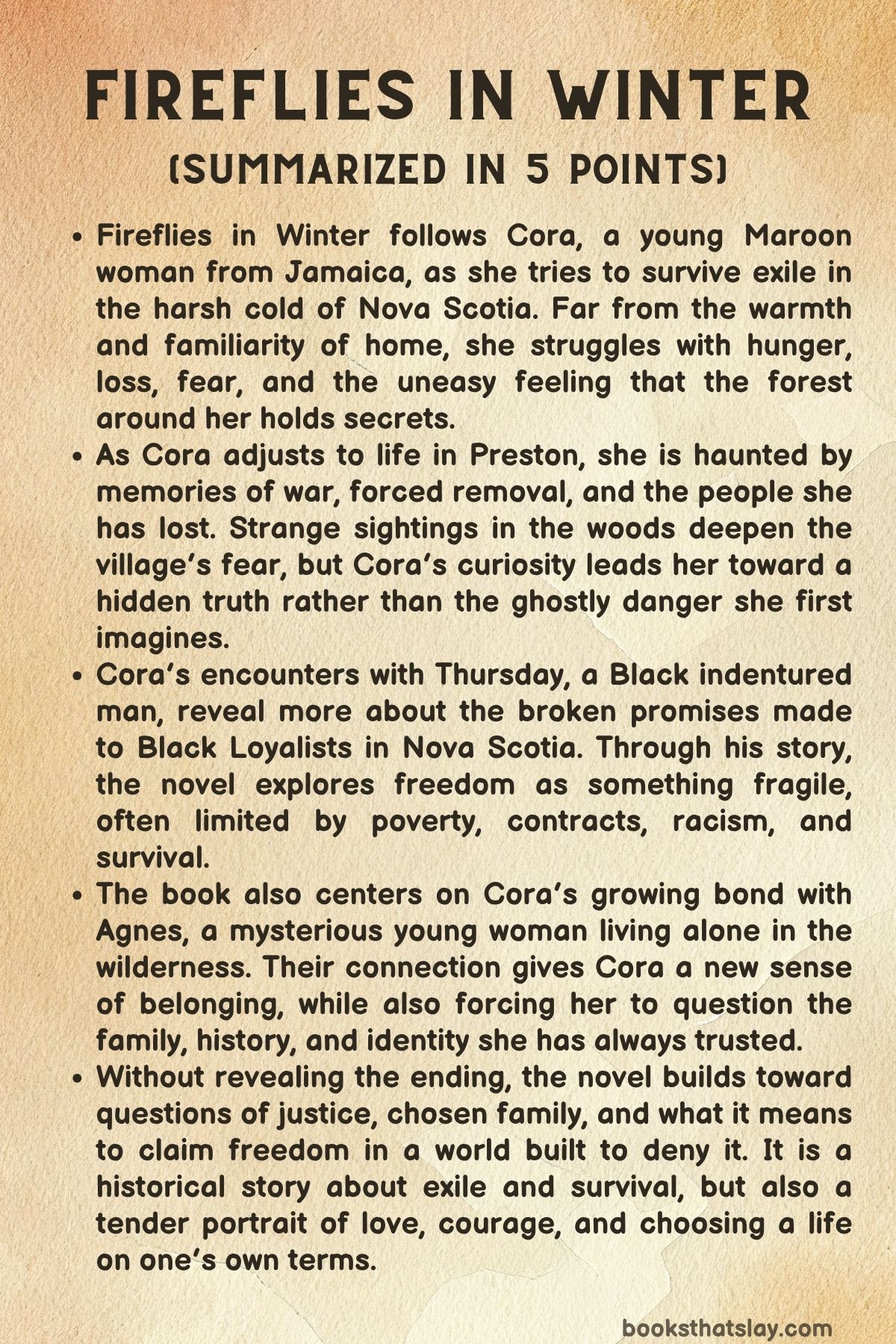
Characters
Cora
Cora is the emotional center of Fireflies in Winter, and her journey gives the book its strongest sense of movement, pain, and self-discovery. She begins as a young Maroon woman displaced from Jamaica and forced into the freezing unfamiliarity of Nova Scotia, carrying not only physical hardship but also the grief of exile.
Her longing for Jamaica is more than homesickness; it represents her longing for identity, belonging, warmth, memory, and the life that was violently taken from her people. In Nova Scotia, she is caught between two worlds: the Maroon community that raised her and the truth about her birth that has been hidden from her.
This makes her character deeply layered because she is both part of the Maroons and, through her mother, connected to those whom the Maroons once helped return to slavery.
Cora’s strength lies in her refusal to accept easy explanations. At first, she clings to the beliefs she has been given: that Leah is her true protector, that her mother died in childbirth, and that the Maroon struggle for freedom is morally clean.
As the story unfolds, these beliefs collapse. The revelation that Leah returned her mother to slavery is devastating because it forces Cora to understand that the people who loved her also betrayed someone who should have been protected.
This does not make Cora cold or unforgiving; instead, it pushes her into a painful maturity. She learns that survival under slavery and colonial power often creates impossible choices, but she also refuses to excuse harm simply because it was done under pressure.
Her relationship with Agnes is central to her transformation. Through Agnes, Cora discovers a different kind of freedom, one not granted by governors, contracts, settlements, or community approval.
Agnes teaches her how to survive in the forest, but more importantly, she helps Cora imagine a life outside the expectations placed on her by Silas, Leah, and the Maroon settlement. Cora’s love for Agnes becomes a form of self-recognition.
It allows her to understand that she does not have to marry, obey, or belong in the ways others demand. By the end of the story, Cora is no longer simply running away from pain; she is choosing a life that reflects her truth, even though that life remains difficult and uncertain.
Agnes
Agnes is one of the most mysterious and powerful figures in the book because she first appears almost like a ghost or spirit before becoming fully human in Cora’s eyes. Her hidden life in the forest makes her seem frightening at first, especially because the Maroons already fear the woods and the unknown presences within them.
Yet Agnes is not a monster or supernatural force; she is a survivor who has made herself almost invisible in order to remain free. Her character challenges the boundary between fear and misunderstanding, showing how people who live outside society are often turned into legends by those who do not know their stories.
Agnes’s past is marked by slavery, loss, secrecy, and self-protection. She carries knowledge from different worlds: plantation life, the forest, Mi’kmaq survival practices, and memories of her parents.
Her ability to live in the wilderness is not romanticized as effortless freedom. She knows how fragile survival is and how quickly injury, hunger, weather, or discovery can destroy a life.
This makes her both brave and cautious. She is not fearless; she has simply learned to act despite fear.
Her bond with Patience also reveals her tenderness, because the dog is not merely a companion but a living connection to trust, family, and survival.
Agnes’s moral complexity becomes clearest when she admits her role in preparing poison for her mother. This confession does not reduce her to guilt.
Instead, it reveals the terrible pressures of enslavement, where resistance could take desperate forms and where even attempts at justice could lead to unintended harm. Her phrase about there being no perfect choices becomes one of the book’s central moral ideas.
Agnes understands that people trapped by brutal systems may be forced into actions that cannot be judged simply. Her love for Cora is gentle but also grounded in realism.
She gives Cora the freedom to return to Preston if she chooses, which proves that Agnes does not want possession; she wants love that is freely chosen.
Leah
Leah is one of the most complicated characters in Fireflies in Winter because she is both a mother figure and a betrayer. She raises Cora, protects her, and gives her a place within the Maroon community, yet the foundation of that relationship is built on a terrible lie.
Leah’s decision to return Cora’s mother to slavery while keeping the baby exposes the painful contradictions of a community trying to protect its own freedom while participating in the oppression of others. She is not written as purely cruel, but neither is she innocent.
Her love for Cora is real, but it cannot erase the violence of what she did.
Leah represents the moral compromises created by systems of slavery and colonial control. She insists that she acted as she had to in order to remain free, and this explanation shows how fear shaped her choices.
However, the book does not let her justification become a full excuse. Cora’s devastation matters because Leah’s act stole a mother from her child and helped return a woman to bondage.
Leah’s character therefore forces the reader to confront how survival can become entangled with betrayal, especially when oppressed people are pushed into serving the interests of those who hold power.
Her later testimony in Agnes’s trial is an attempt at repair, though not a complete redemption. Leah cannot undo what she did to Cora’s mother, but she can prevent another woman from being taken into slavery.
Her appearance in court shows courage, especially because it means standing against the forces and rumors that helped endanger Agnes. By the end, Leah and Cora do not return to the simple closeness they once had, but they reach a partial reconciliation.
Leah remains important because she embodies the painful truth that love and harm can exist in the same person.
Thursday
Thursday is a deeply sympathetic character whose quiet strength contrasts with the harshness of his circumstances. As a Black indentured man working for Farmer Nash, he understands the false promises that followed Black Loyalists to Nova Scotia.
His story broadens the book beyond the Maroons by showing another form of Black displacement and exploitation. He and his mother escaped slavery during the American war, but their arrival in Nova Scotia did not bring true freedom.
Instead, they were trapped by deception, poverty, and long labor contracts that resembled bondage in another form.
Thursday’s sacrifice for his mother reveals the depth of his love and moral courage. By taking over her contract so she could leave for Sierra Leone, he gives up years of his own life for her chance at survival and dignity.
This act defines him as someone who understands freedom not only as an individual desire but as something one may fight to secure for another person. His kindness toward Cora is steady and practical.
He helps her when she is lost, tells her stories that help her understand the land, and later plays a crucial role in saving Agnes through the legal petition.
His relationship with Cora is warm but not possessive. Unlike Silas, Thursday does not try to control her.
His presence gives Cora an example of male friendship that is based on respect rather than expectation. By the end, when Farmer Nash dies and Thursday becomes free, his decision to seek work on a ship suggests that he too is moving toward a self-directed life.
Thursday’s freedom feels earned through endurance, sacrifice, and patience, making him one of the book’s most quietly heroic figures.
Silas Heath
Silas Heath is a disturbing and important character because he shows how wounded authority can become cruelty. As a Maroon captain and father to Benjamin, he carries grief from the war and from Elsy’s death, but his pain does not make him gentle.
Instead, he becomes increasingly controlling, resentful, and dangerous, especially toward Cora. He expects her obedience and appears to believe that she belongs within the future he imagines for himself.
His desire to marry or control her is not presented as love; it is possession disguised as social expectation.
Silas’s violence toward Cora marks a turning point in the story. When he strikes her after she refuses him, the private tension in the household becomes open abuse.
This moment reveals how little safety Cora has within the home that is supposed to shelter her. Silas also weaponizes truth when he reveals that Leah lied about Cora’s mother.
Although the truth matters, Silas uses it not to heal Cora but to hurt her and assert power over her. His cruelty lies not only in what he says but in why and how he says it.
At the same time, Silas is not simply a villain detached from history. He is shaped by war, exile, grief, and humiliation under colonial rule.
However, the book makes clear that suffering does not excuse his treatment of Cora. His rumors later help lead to Agnes’s capture, extending his harm beyond the household.
Silas represents the danger of a man who has been denied power by the world yet tries to reclaim it by dominating those more vulnerable than himself.
Benjamin
Benjamin is an innocent and emotionally significant child whose presence connects Cora to both love and guilt. As Silas and Elsy’s son, he carries the memory of the war and of Elsy’s death, even though he is too young to fully understand them.
Cora’s bond with him is tender and protective, but it is also burdened by her guilt over Elsy’s death. Because Cora found Elsy dead beside Benjamin after leaving her alone to search for food, Benjamin becomes a living reminder of loss, responsibility, and the impossible choices made during wartime.
His claim that he sees his mother in the trees gives the story an atmosphere of haunting. Whether these visions are childish imagination, grief, or something more symbolic, they unsettle Cora because she is already haunted by Elsy herself.
Benjamin’s openness to Agnes is also important. When he discovers her, he does not respond with the same fear and suspicion that adults might.
His acceptance helps create a brief period of peace among Cora, Agnes, and himself, suggesting a world in which love and difference might be met with curiosity rather than judgment.
Benjamin’s injury is one of the story’s most painful turning points. His fall from the tree triggers Silas’s rage and leads to the revelation about Cora’s mother.
In this way, Benjamin unintentionally becomes connected to the collapse of Cora’s old life. Yet he is never blamed by the narrative.
By the end, Cora’s goodbye to Benjamin is one of the clearest signs of what she sacrifices by choosing Agnes and the forest. She loves him, but she cannot remain in a life that denies her truth.
Elsy
Elsy is dead before much of the main action, yet she remains one of the book’s strongest presences. As Silas’s wife, Benjamin’s mother, and Cora’s friend, she represents the life that was lost in Jamaica and the emotional wounds that the characters carry into Nova Scotia.
Her death during the war haunts Cora intensely because Cora believes she failed her by leaving her alone while searching for food. This guilt shapes Cora’s fears, her protectiveness toward Benjamin, and her sensitivity to the idea of ghosts in the woods.
Elsy functions almost like a spiritual absence. Benjamin’s claims that he sees her in the trees blur the line between memory and haunting, while Cora’s own fear of strange figures in the forest is partly rooted in unresolved grief.
Elsy’s importance lies not in direct action but in emotional influence. She reminds the reader that the war did not end when the Maroons left Jamaica; its losses continued to live inside the survivors.
Through Elsy, the story explores how the dead remain part of the lives of the living. Cora’s memories of her are not simple or peaceful.
They are filled with love, guilt, fear, and longing. Elsy’s absence also contributes to Silas’s bitterness and Benjamin’s vulnerability, making her death a wound shared by several characters.
She is a reminder that exile is not only geographical but emotional: the characters carry their dead with them into every new place.
Cora’s Mother
Cora’s mother is one of the most important hidden figures in the book, even though she does not appear directly in the present action. For much of Cora’s life, she exists only as a false story: a Maroon woman who supposedly died in childbirth.
When the truth emerges, she becomes the key to Cora’s identity. She was a runaway enslaved woman, and Leah returned her to slavery while keeping Cora.
This revelation changes Cora’s understanding of herself, her community, and the meaning of freedom.
Her character represents the erased victims behind official or communal stories of survival. Because Leah’s lie removed her from Cora’s life, Cora’s mother was denied not only freedom but also memory.
Cora never knew her voice, face, choices, or fate. This absence is devastating because it shows how slavery destroys family bonds even beyond the immediate act of enslavement.
The theft of Cora’s mother becomes a second kind of death, one created by silence.
Cora’s grief for the mother she never knew is one of the most powerful emotional shifts in the story. She must mourn someone who had already been taken from her before she could remember her.
This makes Cora’s later choice of Agnes and the forest even more meaningful, because she is also choosing to honor the part of herself that was hidden and denied. Cora’s mother stands for the truth that cannot remain buried forever.
Agnes’s Mother
Agnes’s mother is a tragic and morally complex figure shaped by the brutality of plantation life. Her life under slavery is associated with labor, loss, fear, and resistance.
She is important not only because she is Agnes’s mother but because her choices help reveal the desperate conditions from which Agnes comes. Her involvement in the poisoning story shows how enslaved people sometimes had to imagine resistance through dangerous and imperfect means when all lawful paths to justice were closed to them.
The accidental death of Dalton’s sister complicates the moral weight of her actions. Agnes believes her mother intended to poison their master, but the wrong person died.
This does not make the act simple to judge. Instead, it exposes the horror of a system in which enslaved people were forced into situations where even resistance could lead to unbearable consequences.
Agnes’s mother becomes a symbol of both defiance and tragedy.
Her acceptance of Agnes’s love for women adds another tender layer to her character. By telling Agnes that such love had existed in Africa too, she gives her daughter a form of emotional inheritance that survives slavery.
This moment matters because it gives Agnes a language of belonging rather than shame. Through Agnes’s memories, her mother becomes a source of both pain and affirmation.
Agnes’s Father
Agnes’s father is a quieter but still meaningful presence in the story. After the loss of Agnes’s mother, he lives with Agnes among Mi’kmaq people, giving her access to knowledge and ways of survival that later shape her life in the forest.
His character is connected to movement, adaptation, and care. Though he does not dominate the plot, his influence survives in Agnes’s ability to live beyond plantation society and outside colonial control.
His death leaves Agnes alone, but not helpless. The survival skills and relationships connected to him help make her independent life possible.
Through him, the book suggests that freedom is not only escape from slavery but also the learning of how to live differently. His connection to Mi’kmaq people broadens Agnes’s world and gives her a life not entirely defined by enslavement.
Agnes’s father also represents fragile protection. He cannot shield Agnes forever, but the life he helps create for her gives her tools that remain after he is gone.
His importance lies in the way his care becomes part of Agnes’s strength. Even in absence, he helps shape the woman Cora comes to love.
Patience
Patience is more than an animal companion; she is a vital part of Agnes’s world. As Agnes’s dog, she represents loyalty, protection, and emotional connection in a life marked by isolation.
Patience helps Agnes survive in the forest, but she also gives warmth to a life that might otherwise seem unbearably solitary. Her presence makes Agnes’s hidden existence feel less like pure exile and more like a chosen, living home.
Patience’s bond with Cora develops as Cora becomes part of Agnes’s life. The dog’s role in pulling Cora from the freezing water is one of the most important acts of rescue in the story.
Without Patience, Cora would likely die after falling through the ice. This moment makes Patience not just a symbol of loyalty but an active protector whose instincts preserve the future Cora and Agnes might have together.
Her death during Agnes’s capture is brutal and emotionally significant. When Patience attacks the soldiers, she acts out of devotion, defending Agnes from being taken.
Her killing shows the violence of the forces pursuing Agnes and makes the capture even more painful. Patience’s loss marks the end of one phase of Agnes’s life, and her memory remains tied to sacrifice, love, and protection.
Faith
Faith appears near the end of the story as Cora and Agnes’s new dog, and although her role is smaller than Patience’s, her symbolic importance is clear. Her name suggests renewal after grief.
After Patience’s death, Faith represents the possibility of continuing to live, love, and build a home even after devastating loss. She is part of the new life Cora and Agnes have chosen together in the wilderness.
Faith also shows that Cora and Agnes’s life has endured. Two years have passed, and they are still surviving together.
The presence of a new dog suggests stability, companionship, and a future that has not been destroyed by the violence of the trial and capture. She helps mark the difference between escape and settlement.
Cora and Agnes are not merely hiding anymore; they have made a life.
Henry Dalton
Henry Dalton is the clearest representative of slaveholding power in the later part of the book. His claim that Agnes belongs to his family exposes how the institution of slavery reaches across time and place, following Black people even into spaces where they might hope to be free.
He treats Agnes not as a person with a life, history, and identity, but as property to be recovered. This makes him a direct threat to Agnes’s freedom and to the life she has built with Cora.
His accusation about the poisoning of his sister adds another layer to his role. He presents himself and his family as victims, but his claim exists within the larger violence of slavery.
The fact that his bill of sale applies only to Agnes’s mother reveals the weakness of his legal claim, but the danger lies in the fact that his word is taken seriously at all. His childhood memory nearly becomes enough to end a woman’s freedom.
Dalton’s character shows how law can be used as a weapon by those with power. The trial is not just about Agnes; it is about whether a Black woman’s freedom can survive against the claims of a white man backed by documents, memory, and social authority.
His defeat in court is therefore one of the story’s most important victories, though the danger he represents does not disappear from the world.
Governor Wentworth
Governor Wentworth represents colonial authority and the British power structure that controls the lives of the Maroons in Nova Scotia. His visits to Preston, along with the offering of provisions, reveal the unequal relationship between the Maroons and the government.
The supplies may seem helpful, but they are tied to surveillance, dependence, and pressure. Wentworth’s authority reminds the reader that the Maroons’ freedom is limited by the conditions imposed on them.
His character is not explored with the same intimacy as Cora or Agnes, but his role is important because he embodies the distant power that shapes their lives. The Maroons are not simply struggling against cold and hunger; they are struggling within a colonial system that relocated them, manages them, and expects obedience.
Wentworth’s presence makes this system visible.
He also helps show the contrast between official language and lived experience. Authorities may speak of settlement, order, or provision, but the people in Preston experience overcrowding, hunger, cold, and uncertainty.
Through Wentworth, the book criticizes the way colonial power presents control as care.
Colonel Montague James
Colonel Montague James is another figure of authority connected to the Maroon community’s displacement and supervision. His presence alongside Governor Wentworth reinforces the military and political pressure surrounding the Maroons.
He represents the chain of command that follows them from Jamaica to Nova Scotia, showing that exile does not free them from British control.
His role matters because the Maroons’ past as fighters and negotiators with the British remains central to their identity. Montague James’s authority reminds them of surrender, relocation, and the conditions placed upon their survival.
Even when he appears in scenes of administration rather than battle, the history of conflict surrounds him.
As a character, he helps deepen the political background of Fireflies in Winter. He is less emotionally developed than the central figures, but he is important as part of the machinery that shapes their lives.
Through him, the story shows how individuals like Cora are affected by decisions made by men who hold institutional power.
Farmer Nash
Farmer Nash is significant because he represents another form of exploitation in Nova Scotia. As the man Thursday works for under an indenture contract, he benefits from a system that traps Black workers in long periods of labor after they have already survived slavery and displacement.
His farm becomes a place where the promise of freedom is exposed as incomplete.
Although Farmer Nash is not presented in as much detail as Thursday, his presence is essential to understanding Thursday’s lack of freedom. The twenty-year contract is not slavery in name, but in practice it severely limits Thursday’s choices.
Nash’s control over Thursday’s labor shows how legal agreements can reproduce inequality while appearing legitimate.
His death near the end allows Thursday to become free, which gives Nash’s character a structural role in Thursday’s arc. He stands as the obstacle that keeps Thursday bound.
When he dies, Thursday’s future opens, though the uncertainty of that future also shows that freedom does not automatically bring security.
Godwin
Godwin is a small but important character whose disappearance and death intensify the fear in Preston. As a little boy found frozen near the village, he becomes a symbol of the deadly environment surrounding the Maroons.
His death shows that Nova Scotia is not merely uncomfortable or unfamiliar; it is actively dangerous, especially for a displaced community unprepared for its winters.
The fear surrounding Godwin’s disappearance also feeds the rumors about spirits and monsters in the woods. His death strengthens the atmosphere of dread that surrounds Cora’s early experiences in the forest.
The community’s grief and fear reveal how quickly hardship can turn into superstition when people are living under pressure and uncertainty.
Godwin’s role is brief, but it matters because it shows the vulnerability of children in this world. Like Benjamin, he reminds the reader that the consequences of exile fall not only on warriors, leaders, or adults but also on the youngest members of the community.
His death deepens the book’s sense of danger and loss.
Dalton’s Sister
Dalton’s sister is important mainly through the story of the poisoning. Her accidental death becomes the event Henry Dalton uses to accuse Agnes and her family.
Though she is not developed as a full character in the present action, her death carries legal and emotional consequences years later. She becomes part of the past that threatens Agnes’s future.
Her role is complicated because she was not the intended target of the poison, according to Agnes’s confession. This makes her death tragic, but the book places that tragedy within the larger brutality of slavery.
Her death cannot be separated from the plantation system that created the conditions for desperate resistance in the first place.
As a figure, Dalton’s sister shows how the violence of slavery spreads beyond its intended lines. The enslaved suffer most directly, but the entire household is poisoned by the system’s cruelty, fear, and domination.
Her death becomes another example of how slavery creates situations in which innocence, guilt, resistance, and suffering become painfully entangled.
The Maroon Community
The Maroon community functions almost like a collective character in the story. Its members carry pride, trauma, resilience, and contradiction.
They are survivors of war in Jamaica, but in Nova Scotia they are reduced to struggling settlers under British supervision. Their shared longing for Jamaica gives the story much of its emotional force.
The cold, hunger, and overcrowding of Preston make their exile feel like a second punishment after surrender.
At the same time, the community is not portrayed as morally simple. The revelation about Cora’s mother exposes the fact that Maroon freedom sometimes depended on cooperation with systems that harmed other Black people, especially runaway enslaved people.
This does not erase the Maroons’ suffering or bravery, but it complicates the meaning of their freedom. The community becomes a place of both belonging and exclusion, protection and silence.
Their eventual departure for Sierra Leone gives the story a wider historical and emotional ending. For Leah, Benjamin, and the others, leaving Nova Scotia offers another chance at a future.
For Cora, however, that future is not hers. Her decision to stay with Agnes shows that identity is not only inherited through community; it is also chosen through love, truth, and self-knowledge.
Themes
Freedom and the Cost of Survival
Freedom in Fireflies in Winter is never shown as simple safety or comfort. Cora is legally free, yet her life in Nova Scotia is shaped by hunger, suspicion, exile, male control, and the constant need to prove who she is.
Thursday’s story deepens this idea because his escape from slavery only leads him into an unfair contract that binds him for years. Agnes, too, survives outside society, but her freedom demands isolation, danger, and loss.
The story shows that freedom can exist in law while still being denied in daily life through poverty, racism, gendered power, and fear. Leah’s past also makes the theme morally difficult: she protects her own freedom by returning Cora’s mother to slavery.
Through this, the narrative refuses to present survival as pure or innocent. It shows people making painful choices inside violent systems, where staying alive often means carrying guilt.
Exile, Belonging, and Home
Cora’s sense of home is divided between memory, community, and choice. Jamaica remains emotionally alive for her through grief, warmth, language, and the people she has lost, while Nova Scotia feels harsh, cold, and temporary.
Preston gives her shelter, but it does not give her full belonging, especially once Silas rejects her and Leah’s lie breaks her trust. Agnes offers a different kind of home, one not based on blood, nation, or community approval, but on shared survival and love.
The forest is dangerous, yet it becomes a place where Cora can build an identity outside the expectations placed on her. By the end, when the Maroons leave for Sierra Leone, Cora’s decision to stay shows that home is not only where one comes from or where one’s people go.
It can also be the life one chooses after loss.
Memory, Guilt, and Hidden Truths
The past constantly presses on the present in Fireflies in Winter. Cora is haunted by Elsy’s death, by the war in Jamaica, and by the belief that her mother died in childbirth.
These memories shape her fear, her loyalty, and her sense of self. When the truth about her mother is revealed, Cora’s personal history changes completely.
Leah becomes both the woman who raised her and the person who betrayed her mother. Agnes also carries hidden guilt connected to poison, slavery, and her mother’s desperate attempt to resist abuse.
The repeated idea that there are “no perfect choices” does not excuse harm, but it helps explain how violence forces people into decisions that leave wounds behind. The theme shows that healing cannot begin through denial.
Cora can only move forward when the buried truth is spoken, judged, and slowly faced.
Love, Identity, and Chosen Life
Cora’s relationship with Agnes becomes a path toward self-knowledge. At first, Agnes represents mystery and escape, but gradually she becomes someone with whom Cora can imagine a future.
Their love grows through practical care: teaching, feeding, sheltering, rescuing, listening, and forgiving. This makes their bond feel grounded rather than idealized.
Cora’s feelings also help her understand that identity is not fixed by what others expect from her. Silas assumes he can claim her, Leah assumes she will remain tied to Preston, and the Maroons assume she belongs with them, but Cora chooses differently.
Agnes’s acceptance of love between women gives Cora language and courage for feelings she has not fully understood before. Their final life together does not erase hardship, grief, or danger, but it affirms that love can create a chosen future even after betrayal and exile.