Highland Hideaway Summary, Characters and Themes
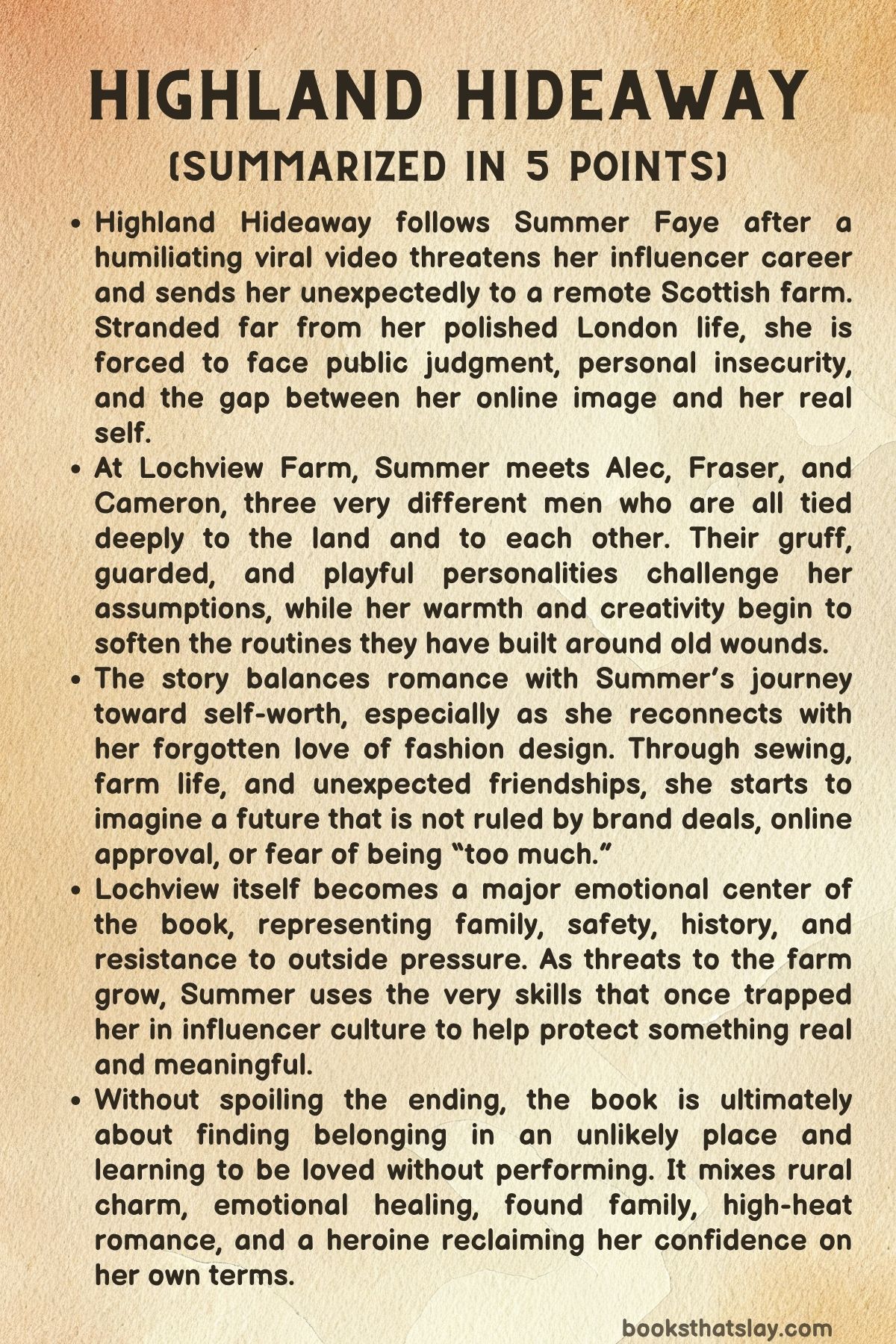
Highland Hideaway by Lily Gold is a contemporary reverse-harem romance set on a remote Scottish sheep farm. The book follows Summer Faye, a glamorous influencer whose public image collapses after an embarrassing viral video makes her the target of online cruelty.
When her luxury spa trip is cancelled, she ends up staying at Lochview Farm, where three very different men challenge the version of herself she has been performing for the internet. The story mixes rural life, emotional recovery, found family, desire, and self-reinvention as Summer learns that being “too much” may be her greatest strength.
Summary
Summer Faye is a London influencer whose life revolves around image, sponsorships, and staying visible online. After a wild influencer party, she wakes up to a nightmare: a video of her drunk and crying on a bathroom floor over a broken limited-edition lipstick has gone viral.
The clip makes her look spoiled and ridiculous, and strangers flood the internet with insults. Her best friend and manager, Lulu, urges her to stay calm and continue with a planned sponsored trip to a luxury Scottish spa, hoping the scandal will fade.
Summer travels to the Highlands while constantly checking the rising view count. When she reaches the resort, she learns that the spa has cancelled their partnership and given away her room because of the controversy.
With nowhere else to go, she books the only nearby place available: a rustic off-grid cabin on Lochview Farm. The farm is run by Alec Gray, with the help of Cameron and Fraser.
Cameron, a huge, blunt farmer with a damaged knee, is the first to meet her. He is annoyed by her late arrival, impractical clothes, and city habits, but when her heels sink in the mud, he carries her to the cabin.
Summer soon discovers that life at Lochview is not designed for influencers. Her cabin has poor internet, the farm is muddy and isolated, and Alec does not want guests wandering through his farmhouse.
She hides the truth about being an influencer, saying she is a travel blogger, because she is ashamed of the viral video. As the scandal grows and brands begin cancelling deals, she becomes too embarrassed to return to London and asks to extend her stay.
Cameron reluctantly allows it.
Lochview itself is under pressure. Alec is fighting the local council, which wants to survey the land for a tourism development.
The farm has belonged to his family for generations, and he is determined not to lose it. He is hardworking, controlled, and exhausted, often treating everything and everyone as his responsibility.
His protectiveness strains his relationships with Cameron, whose old knee injury Alec cannot stop worrying about, and Fraser, who fears Alec is isolating himself.
Fraser is warmer and more openly flirtatious than the other two men. He gives Summer a tour of the farm, where she bonds with a weak runt lamb she names Crumpet.
The lamb responds to her in a way that surprises everyone. As Summer spends more time on the farm, she starts seeing the men beyond their rough first impressions.
Cameron quietly installs a weak Wi-Fi router for her, brings food after she accidentally starts a pan fire, and protects her in small practical ways. Fraser comforts her about the online backlash and encourages her to see that one embarrassing moment does not define her.
Summer’s secret is exposed when Lulu forwards boxes of PR packages to Lochview. A delivery van blocks farm work, and the boxes turn out to contain lingerie and sex toys.
Mortified, Summer admits she is an influencer whose spa deal was cancelled because she is being mocked online. Alec is angry that she lied and wants her gone, but Fraser defends her.
Alec finally lets her stay, though trust between them remains fragile.
Summer begins to connect more deeply with the farm and the village. In Dalbrae, she visits a charity shop and finds vintage clothes, including a damaged wedding dress with beautiful old lace.
The discovery reminds her of the dream she had before influencing: designing clothes. She also meets Isla, a friendly local woman planning her wedding, and offers to help with makeup and styling.
Summer’s confidence with fashion and beauty helps Isla feel seen, showing that Summer’s skills are not shallow when used with care.
Her relationships with the men grow more complicated. Fraser kisses her first and becomes her most open source of comfort.
Cameron kisses her during a tense moment after bringing her safely home in a storm, then withdraws because tenderness scares him. Alec, stern and overprotective, is drawn to her but fights the attraction because he fears she will distract the men and add another burden to the farm.
During a storm, he panics about her safety and brings her to the farmhouse, where she begins spending more time with all three men.
The attraction among Summer, Fraser, and Cameron becomes physical, and eventually Alec is pulled into the emotional orbit as well. Summer admits she likes both Fraser and Cameron, and the men confront their jealousy, history, and loyalty to each other.
Over time, she learns that Cameron and Fraser came to Lochview as teenagers to protect Alec from his abusive father. Alec grew up under cruelty and control, and the farm, though beloved, also carries the weight of his painful past.
This helps Summer understand why he works himself into exhaustion and struggles to accept help.
As days pass, Summer settles into Lochview. She swims in the loch, helps with chores, feeds Crumpet, eats with the men, and spends long afternoons sewing on Alec’s old Singer machine.
She transforms secondhand clothes into original outfits and rediscovers the joy of making things by hand. Her presence changes the household.
Alec begins to rest more. Cameron and Alec fight less.
Fraser remains playful and affectionate. Summer feels safer than she has in years.
Still, each character carries old wounds. Cameron struggles with chronic pain from his injured leg and hates Alec’s attempts to fix him.
Summer reveals that she has ADHD shutdown days and often treats her need for rest as failure. Cameron helps her see that her limits deserve care, not shame.
He later researches her mother, Caroline Faye, and realizes how deeply Summer has been hurt by a parent who saw her as inconvenient and excessive. Wanting to make her happy, he arranges a shopping trip, a manicure, and cake pops.
During the outing, Summer chooses clothes she truly loves rather than pieces meant to please followers. The men encourage her to return to design and stop forcing herself into a career that makes her miserable.
A conflict separates them when Alec, frightened by his feelings and the pressure of the farm, pushes Summer away. She returns to London hurt and unsure whether she can trust him.
But when she learns the council is trying to seize part of Lochview through a compulsory purchase order for a resort development, she decides to return and help save the farm. Using her influencer knowledge, she launches a social media campaign showing the beauty of Lochview, the threat to local heritage, the animals, and the three farmers.
Lulu helps from London, and the campaign becomes a major success. Public support grows rapidly, drawing attention from locals, influencers, and journalists.
The pressure works. The council cancels the order, and Lochview is saved.
Summer thinks Alec has been avoiding her because he no longer wants her, but she discovers he has been renovating the old guest cabin into a pink studio designed especially for her. It has sewing space, dress forms, soft lighting, blackout shutters, soundproofing, blankets, and ADHD-friendly details.
Alec tells her he wants her to know the farm is hers too. He admits he loves her more than the land.
Fraser and Cameron also declare their love, and Summer chooses to stay with all three men at Lochview.
One month later, Summer has been sewing constantly. Lulu brings news of possible influencer deals, but Summer realizes she no longer wants to return to the old version of her career.
She wants to build her own fashion label and use her platform for her designs. When her mother arrives and cruelly criticizes her relationship, choices, and personality, Summer finally stands up to her and asks her to leave.
Supported by Alec, Fraser, and Cameron, she decides to name her brand Too Much?, turning an insult into a statement of pride.
Six years later, Summer’s ethical boutique fashion brand is successful. She lives at Lochview with Alec, Fraser, and Cameron in a loving, stable family.
The farm has grown stronger, Alec has learned to delegate, Cameron has found peace in farm life, and Fraser remains devoted and full of humor. During a trip to Skye, Summer confirms she is pregnant.
The men are overjoyed, and Cameron proposes with a pink sapphire ring while Alec and Fraser join him in a private promise of lifelong commitment. Summer accepts, ending the story surrounded by love, safety, and the family she chose.
Characters
Summer Faye
Summer Faye is the emotional center of Highland Hideaway, and her character arc moves from public humiliation and self-protection toward honesty, creativity, and belonging. At the beginning of the book, Summer appears to be the kind of person the internet wants to reduce to a stereotype: glamorous, dramatic, privileged, and overly attached to beauty products and social media attention.
However, the story gradually reveals that her polished influencer persona is not shallow vanity but a survival strategy. She has learned to perform confidence because she has often been made to feel inconvenient, excessive, strange, or difficult.
Her viral scandal wounds her so deeply because it confirms her worst fear: that people will see one messy, vulnerable moment and decide it represents her entire worth.
Summer’s relationship with fashion is one of the most important parts of her character. She does not simply like clothes because they are pretty or expensive; clothing is her language of self-expression.
Her early history of altering charity-shop pieces shows that she has always been imaginative, resourceful, and artistic. Becoming an influencer gives her visibility and success, but it also pulls her away from the more personal dream of designing.
At Lochview, when she begins sewing again, she reconnects with the part of herself that existed before algorithms, brand deals, and public judgment. Her eventual decision to create Too Much?
is powerful because she stops trying to make herself smaller and instead turns the insult often used against her into a declaration of identity.
Summer is also deeply shaped by emotional neglect. Her mother’s coldness has taught her to hide pain, apologize for her needs, and doubt her right to take up space.
This explains why she often masks discomfort with politeness, whether facing online abuse, unwanted attention, or personal disappointment. Her ADHD-related shutdowns add further complexity, because Summer is not lazy or careless; she is someone whose mind and body sometimes become overwhelmed.
The book treats this not as a flaw to be fixed but as part of the support she needs and deserves. Her growth comes from learning that rest, softness, glitter, desire, and ambition can all coexist without shame.
Romantically, Summer is not merely rescued by Alec, Fraser, and Cameron. She changes them as much as they change her.
Her presence brings warmth into a household stiffened by guilt, trauma, and routine. She makes Fraser feel seen in his playfulness, draws tenderness out of Cameron, and challenges Alec’s need to control everything alone.
By the end of the story, Summer’s happiness does not come from escaping glamour or becoming a completely different person. It comes from finding a place where her dramatic, creative, emotional, loving self is not tolerated reluctantly but cherished fully.
Alec Gray
Alec Gray is one of the most burdened characters in the book, defined by responsibility, control, and unresolved trauma. As the owner of Lochview Farm, he carries the weight of family history, financial pressure, local politics, and the emotional safety of the people he loves.
His first impression is stern and distant. He appears polished, authoritative, and disapproving, especially toward Summer, whose arrival feels chaotic and disruptive.
Yet beneath that hardness is a man who has spent most of his life believing that if he relaxes, delegates, or lets anyone too close, disaster will follow.
Alec’s controlling nature is rooted in his childhood with Mr Gray. His father’s abuse taught him that the farm was not simply a home but a place of fear, punishment, and obligation.
Even after his father is gone, Alec continues to live as if survival depends on constant vigilance. He works himself to exhaustion, refuses help from the village, and treats every problem as something he alone must solve.
This makes him admirable in his loyalty but damaging in his rigidity. His love for the land is sincere, but for much of the story, it is tangled with pain and duty.
His relationships with Cameron and Fraser reveal both the best and worst parts of him. Alec loves them fiercely and feels responsible for their suffering, especially Cameron’s injury and Fraser’s past crisis.
However, his guilt often expresses itself as overprotection. He tries to manage Cameron’s health instead of trusting his autonomy, and he sometimes treats Fraser’s emotional insight as interference.
His protectiveness is loving, but it can become suffocating. This same pattern appears with Summer when he pushes her away because he fears she is another responsibility he cannot safely hold.
Alec’s growth depends on learning that love is not the same as control. His most meaningful transformation comes when he accepts help: from the village, from Lulu’s campaign support, from Summer’s social media skills, and from the men who have always stood beside him.
The pink studio he builds for Summer is significant because it shows he has finally begun to love in a way that gives space rather than takes it away. He does not simply ask her to fit into Lochview; he reshapes part of Lochview so she can belong there as herself.
By the end, Alec becomes softer without becoming weak, proving that leadership can include trust, vulnerability, and shared responsibility.
Fraser
Fraser is the warmth, humor, and emotional openness of the central relationship. From his first interactions with Summer, he is charming, flirtatious, and easygoing, but his lightness should not be mistaken for shallowness.
Fraser is often the person who notices what others are refusing to say. He sees Alec’s isolation, Cameron’s fear, and Summer’s wounded confidence with unusual clarity.
His playful nature makes him approachable, but his emotional intelligence makes him essential.
Fraser’s kindness is one of his defining qualities. He is the first of the men to respond to Summer’s scandal with genuine sympathy rather than judgment.
When she admits the truth about being an influencer and being “cancelled,” he recognizes the cruelty she is facing instead of reducing her to the viral video. His comfort after the delivery van incident is especially important because he allows Summer to explain herself without making her feel foolish.
Through him, the book shows how powerful it can be when someone responds to humiliation with gentleness instead of mockery.
His relationship with Alec and Cameron is also central to his character. Fraser has a long history with them, and his loyalty is active rather than passive.
He helped protect Alec from his father, worries about Cameron’s future, and repeatedly challenges Alec when Alec becomes too controlling. Fraser is not afraid to confront the people he loves, but he usually does so with affection and humor.
He understands that families are not built only through protection; they also require honesty, patience, and the willingness to let others change.
In his relationship with Summer, Fraser offers safety through delight. He encourages her creativity, flirts with her openly, and helps her feel desirable without pressure.
He is also the character most comfortable with the unconventional structure of their love. Rather than reacting with possessiveness, he often acts as a bridge between Summer, Cameron, and Alec.
His acceptance helps the household move from tension into openness. By the end of the story, Fraser remains playful and devoted, but his role is deeper than comic relief.
He is the emotional connector who helps everyone admit what they want and believe they are allowed to have it.
Cameron
Cameron is one of the most guarded and tender characters in Highland Hideaway. At first, he appears gruff, intimidating, and impatient, especially when Summer arrives at the cabin in impractical clothes and bad weather.
His size, bluntness, and rough manners make him seem almost hostile. Yet his actions repeatedly reveal care before his words do.
He carries Summer through the mud, installs lights around her cabin, brings her food after the fire, worries about her safety, and follows her social media in secret. Cameron’s affection is often disguised as irritation because softness frightens him.
His injured knee is a major part of his character, not simply as a physical condition but as an emotional wound. The accident has changed how he sees himself and his place on the farm.
He depends on routine and physical competence, so pain flare-ups make him feel trapped, useless, and watched. Alec’s attempts to fix him intensify this insecurity because Cameron wants support, not to be treated as a problem.
His anger after his leg gives out is painful because it comes from fear: fear that he cannot remain useful, fear that he may have to leave, and fear that the family he depends on might see him as broken.
Cameron’s childhood history explains why belonging matters so much to him. Being sent to the Highlands and eventually becoming part of Alec and Fraser’s world gave him a family when he needed one.
Lochview is not merely a workplace for him; it is the structure that made him feel safe. This is why Summer unsettles him.
She threatens his emotional simplicity, not because she is harmful, but because wanting her forces him to confront needs he has tried to suppress. His panic after tenderness shows how unused he is to emotional exposure.
His relationship with Summer develops through practical care and blunt honesty. He is the one who challenges her most directly about the pain of influencing and the false self she has been forced to perform.
He also recognizes the damage caused by her mother and tries to give her the kind of joy she has been denied, planning the shopping trip, manicure, and cake pops. Cameron’s love is protective but increasingly respectful.
By the end, his proposal with the pink sapphire ring feels especially meaningful because he has moved from fearing emotional dependence to openly choosing family, permanence, and vulnerability.
Lulu
Lulu is Summer’s best friend and social media manager, which places her in a complicated position throughout the story. She genuinely loves Summer, but she is also part of the influencer machine that keeps Summer performing even when she is emotionally exhausted.
At the beginning, Lulu responds to the viral scandal as a crisis to be managed. She is practical, fast-thinking, and professionally capable, but her instinct to keep Summer moving forward shows how easy it is for care and career pressure to become tangled.
Lulu is not a villain. She is loyal, energetic, and deeply invested in Summer’s success.
However, she initially struggles to see how badly the influencer lifestyle is hurting Summer because both of them have become used to treating public exposure as normal. Her decision to send the PR packages to Lochview is funny and chaotic, but it also symbolizes the way Summer’s old life invades the quiet space where she is beginning to heal.
Lulu’s world is full of products, campaigns, damage control, and visibility, while Lochview offers Summer privacy, creativity, and real connection.
Her later support during the campaign to save the farm shows her strengths in a healthier form. Lulu’s professional skills become valuable when they serve a cause Summer truly believes in rather than a persona Summer feels trapped inside.
She helps coordinate attention, amplify the farm’s story, and transform Summer’s online knowledge into collective action. This shift matters because it shows that social media itself is not the enemy; the problem is when it demands dishonesty and self-erasure.
By the end, Lulu’s friendship with Summer becomes more honest. Their apologies to each other suggest a relationship that can survive change.
Lulu brings news of major influencer opportunities, but she also accepts Summer’s decision to move toward fashion design instead. Her role in the book is important because she represents the life Summer came from without being reduced to a symbol of superficiality.
She is part of Summer’s past, but also part of her future once their bond is no longer built around constant performance.
Caroline Faye
Caroline Faye, Summer’s mother, is one of the most emotionally damaging figures in the story despite appearing only in limited direct scenes. Her influence over Summer is enormous.
Caroline is successful, controlled, and critical, and she has taught Summer to associate love with judgment. Her public comments about pregnancy as an obstacle reveal a chilling emotional distance, suggesting that Summer grew up feeling less like a cherished child and more like an inconvenience.
Caroline’s cruelty is not loud in the same way as online abuse, but it is deeply formative. She dismisses Summer’s dreams, throws away her Lookbook, and treats her creativity as childish or embarrassing.
This explains why Summer is so hungry for approval and so vulnerable to public rejection. The internet’s mockery hurts because it repeats what her mother has already made her believe: that she is too much, too dramatic, too needy, and not worthy of being taken seriously.
Her arrival near the end of the story functions as a final test of Summer’s growth. Caroline attacks Summer’s relationship, career choices, and character, expecting the old pattern of shame and submission to continue.
Instead, Summer finally asks her to leave. This is one of Summer’s most important victories because it is not about becoming cruel in return; it is about refusing to keep accepting emotional harm as normal.
Caroline also helps clarify why Alec, Fraser, and Cameron’s love matters so much. They do not make Summer valuable; she was already valuable.
But their support helps her see the contrast between love that diminishes and love that protects. Cameron’s blunt defense of Summer is satisfying because it states what Caroline has failed to understand: Summer’s brightness, sensitivity, and extravagance are not defects.
Caroline’s role is therefore painful but necessary, because overcoming her judgment allows Summer to fully claim her future.
Isla
Isla is a warm and grounding secondary character who connects Lochview to the wider village community. She is friendly to Summer when others might easily judge her, and her presence at the Dewdrop helps Summer experience local life in a less hostile way.
Isla’s upcoming wedding gives Summer a chance to use her beauty and styling knowledge in a generous, personal setting rather than as part of a sponsored performance.
Her conversation with Summer about makeup is revealing for both women. Isla admits insecurity and inexperience, while Summer responds not with superiority but with encouragement.
This moment shows Summer at her best: enthusiastic, skilled, emotionally perceptive, and eager to help another woman feel beautiful. Through Isla, the book demonstrates that Summer’s expertise in fashion and beauty is meaningful when it is rooted in connection rather than online validation.
Isla also plays an important role in Alec’s arc. She has known him for years, and her disappointment over his neglect exposes how isolated he has become.
Alec’s guilt when he realizes he has ignored her engagement shows that his devotion to the farm has cost him real human relationships. Isla does not simply comfort him; she confronts him.
She urges him to rally the village against the resort development, showing more faith in community than Alec initially does.
As a character, Isla represents the life surrounding Lochview that Alec has forgotten to trust. She is part of the village network that eventually helps save the farm, and her friendship with Summer helps integrate Summer into that community.
Her role is gentle but significant because she helps move the story beyond private romance into a broader sense of belonging.
Mr Gray
Mr Gray is the shadow hanging over Alec, Cameron, Fraser, and Lochview itself. Though he is not present as an active character in the main timeline, his abuse has shaped the emotional structure of the farm.
He represents cruelty disguised as authority and family legacy turned into imprisonment. His treatment of Alec, including locking him in a shed and denying him simple freedoms like reading, explains why Alec grows into a man who equates survival with control.
His importance lies in the long-term damage he causes. Alec inherits not just the farm but the emotional burden of proving he can endure what his father forced upon him.
This makes Lochview both beloved and painful. Alec’s devotion to the land is sincere, but Mr Gray’s legacy turns that devotion into self-punishment.
The farm must be saved not only from the council but also from the old belief that love requires suffering alone.
Mr Gray also indirectly strengthens the bond between Alec, Fraser, and Cameron. Their teenage efforts to protect Alec show how chosen family formed in response to danger.
Fraser and Cameron’s loyalty did not begin as casual friendship; it began as active resistance to abuse. This history explains the depth of their attachment and the intensity of Alec’s guilt toward them.
As a character, Mr Gray functions as the embodiment of the past that must be overcome. He does not need many scenes because his influence is visible in Alec’s exhaustion, Cameron and Fraser’s protectiveness, and the emotional atmosphere of Lochview before Summer’s arrival.
The happy ending matters partly because it breaks his legacy. The farm becomes not a place of fear and obligation, but a home built on consent, care, creativity, and shared love.
Crumpet
Crumpet, the runt lamb, is a small but symbolically important character in the book. Her bond with Summer reveals Summer’s instinctive tenderness and capacity for care.
When Crumpet responds to Summer and begins feeding for her, the moment suggests that Summer’s softness is not weakness. She has a calming, life-giving presence, even before she fully believes in her own worth.
Crumpet also helps connect Summer to farm life in a way that is emotional rather than decorative. Summer does not simply admire Lochview as a pretty countryside escape; through Crumpet, she becomes involved in its daily vulnerabilities.
The lamb’s fragility mirrors Summer’s own hidden fragility. Both are underestimated, both need patience, and both become stronger when handled with gentleness rather than judgment.
For Alec, Crumpet’s response to Summer is also revealing. He is forced to recognize that Summer is not merely a distraction or a city girl out of place.
She has something real to offer the farm, even if it does not look like traditional labor at first. Crumpet becomes one of the earliest signs that Summer belongs at Lochview in ways no one expected.
As a symbolic presence, Crumpet represents the healing power of attention. Summer notices her, names her, and believes in her.
This reflects one of the story’s central emotional patterns: people grow when someone sees them clearly and refuses to dismiss them as too broken, too small, or too much.
Hamish
Hamish is a minor but useful character because he exposes the everyday discomfort women often manage quietly. His drunken behavior toward Summer at the Dewdrop is not the central conflict of the story, but it gives Cameron an important opportunity to notice how Summer responds to threat.
Summer smiles politely despite being uncomfortable, revealing how deeply she has been trained to avoid causing trouble even when someone else is behaving badly.
Cameron’s reaction to Hamish shows both his protectiveness and his frustration with Summer’s self-minimizing habits. He does not understand why she would soften herself for someone making her uneasy.
This moment helps open a larger conversation about Summer’s tendency to hide pain, including the story of her childhood wrist injury. Hamish therefore functions less as a developed individual and more as a trigger for revealing Summer’s learned emotional patterns.
His presence also contrasts with the safety Summer gradually finds with the three men. Around Hamish, politeness is a shield.
Around Alec, Fraser, and Cameron at their best, honesty becomes possible. That contrast helps the reader understand why Lochview becomes so important to her: it is one of the first places where her discomfort is noticed and taken seriously.
Themes
Public Shame and the Search for a Truer Self
Summer’s viral humiliation becomes the force that exposes how fragile her carefully managed image has become. Online, she is reduced to a single embarrassing moment: a drunk, crying influencer mocked as spoiled and shallow.
Yet the scandal does not simply damage her career; it forces her to confront the distance between the person she performs for followers and the person she has buried under branding, sponsorships, and fear of judgment. At Lochview, the lack of constant internet access feels terrifying at first because her identity depends on being seen, approved, and commercially useful.
Gradually, the farm gives her space to exist without posing. Her connection with Crumpet, her sewing, her honest conversations with Fraser, Cameron, and Alec, and her later decision to use social media for the farm show her reclaiming control over visibility.
Highland Hideaway treats shame not as an ending, but as the painful beginning of self-recognition, where Summer learns that being known honestly matters more than being liked by strangers.
Chosen Family and Emotional Safety
Lochview is more than a farm; it becomes a place where damaged people slowly learn to trust care without treating it as a weakness. Alec, Fraser, and Cameron are already a family shaped by survival, loyalty, and shared history.
Their bond comes from protecting one another from Alec’s abusive father, Cameron’s injury, Fraser’s past struggles, and the heavy burden of keeping the farm alive. Summer enters as an outsider, but her presence changes the emotional rhythm of the household.
She softens Alec’s isolation, draws out Cameron’s tenderness, and receives Fraser’s warmth without being made to feel foolish or excessive. The relationship that forms between the four of them is not only romantic; it is built on practical care, emotional repair, and mutual defense.
They feed one another, notice fear, protect boundaries, and create space for each person’s needs. The theme is powerful because safety is shown through repeated actions, not promises alone.
Healing from Neglect, Control, and Self-Blame
Several characters carry wounds caused by people who taught them to see love as conditional. Summer’s mother dismissed her creativity, framed her as inconvenient, and made her feel that needing support was a burden.
Alec’s father treated the farm as a tool of control, leaving Alec trapped in guilt and responsibility. Cameron struggles with his injured leg because accepting limits feels like failure, while Alec’s attempts to protect him often become another form of pressure.
The story’s healing comes when the characters stop repeating those old patterns. Cameron helps Summer understand that mental exhaustion is not laziness, just as physical pain is not weakness.
Summer helps Alec see that devotion to the land should not require loneliness. Fraser often acts as the emotional bridge, naming truths others avoid.
In Highland Hideaway, healing is not sudden forgiveness of the past. It is the gradual replacement of shame with care, rest, honesty, and chosen belonging.
Creativity, Work, and Owning “Too Muchness”
Summer’s love of fashion is central to her transformation because it reveals what existed before the influencer persona took over. Her first dream was not to sell a polished lifestyle but to design clothes, alter fabrics, and create beauty from overlooked things.
The charity-shop finds, the old lace dress, Alec’s sewing machine, and the pink studio all symbolize a return to creative ownership. Summer’s style is dramatic, glittery, feminine, and attention-grabbing, but the story refuses to treat that as shallow.
Instead, her taste becomes an expression of intelligence, skill, and joy. The title of her future label, “Too Much?”, turns an insult into a declaration of identity.
What others once criticized as excessive becomes the foundation of her art and career. This theme also challenges the idea that work must destroy the worker.
Summer does not abandon ambition; she reshapes it into something ethical, personal, and sustainable, choosing creation over performance.