Hooked by Caitlin Rother Summary, Characters and Themes
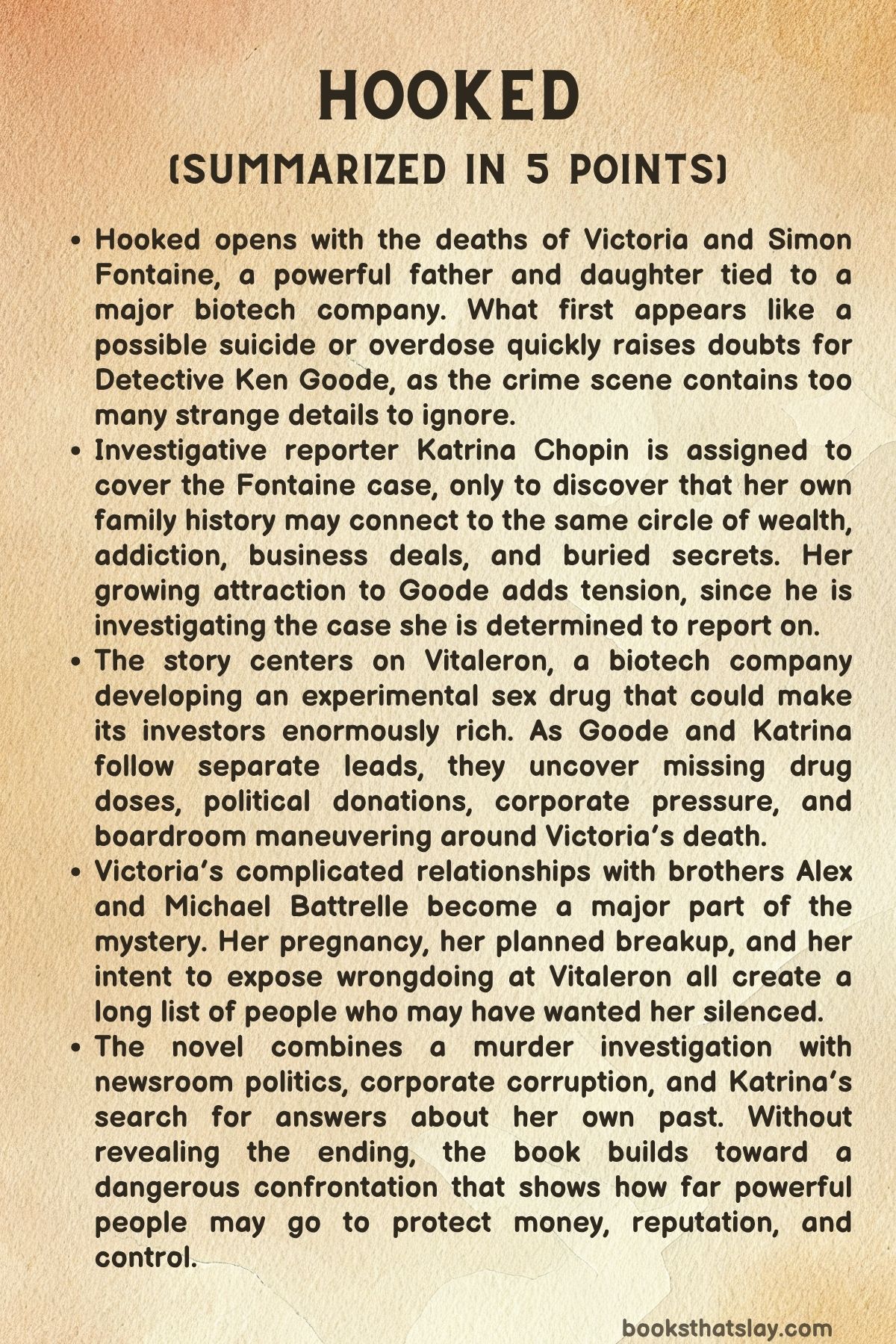
Hooked by Caitlin Rother is a crime thriller centered on murder, corruption, addiction, ambition, and buried family history. The story opens with the shocking deaths of Victoria Fontaine and her father, Simon, then follows Detective Ken Goode and journalist Katrina Chopin as they work from different sides of the same case.
What first appears to be a possible overdose, suicide, or family tragedy soon points toward staged murder and a larger conspiracy involving biotech company Vitaleron, political influence, hidden money, and powerful families. The novel mixes police investigation with newsroom pressure, personal loss, and dangerous secrets. It’s the first book in the Katrina & Goode series.
Summary
Victoria Fontaine wakes after a night with Alex Battrelle, the man she has loved for years since meeting him in rehab. Alex finally admits that he loves her, and his text messages make it seem as if they have reached a turning point.
Yet Victoria’s happiness is shadowed by fear and uncertainty. She has recently discovered that she is pregnant, but she does not know whether the father is Alex or his younger brother, Michael Battrelle, whom she has been dating for several months.
She plans to end things with Michael but has not yet decided how to tell him about the baby or about Alex.
At the same time, Victoria is under heavy pressure at Vitaleron, the biotech company founded by her father, Simon Fontaine. She has uncovered troubling activity inside the company and is preparing to bring accusations to the board if her demands are ignored.
Within hours, both Victoria and Simon are dead.
Detective Ken Goode returns to San Diego from a surfing trip and meets investigative reporter Katrina Chopin at dinner. They connect quickly because both carry pain from family deaths: Goode’s mother died by suicide when he was a child, while Katrina still doubts the official explanations surrounding her brother’s death and her parents’ murders.
Their conversation is cut short when Goode is called to a suspicious death scene at Simon Fontaine’s mansion in La Jolla Farms.
At the estate, Goode finds Simon outside with a gunshot wound to the head and a pistol nearby. The position of the body, the poor bleeding from the wound, and other details suggest the shooting may have happened after Simon was already dead.
Upstairs, Victoria lies dead in her bedroom. Prescription pills, food, her phone, and a positive pregnancy test are nearby.
Goode notices injection marks, old self-harm scars, and fresh injuries. The scene has been arranged to suggest overdose, suicide, murder-suicide, or double suicide, but too many details feel wrong.
Katrina is assigned to report on the Fontaine deaths because Simon was powerful and Vitaleron was developing an experimental sex drug with enormous financial potential. The paper’s owner, Vincent Battrelle, is also tied to the company, as is his son Michael.
Katrina soon realizes that reporting on the case will be difficult because Goode is the lead detective and because her own family history may be connected to the people involved.
Goode’s investigation uncovers evidence that Victoria was caught between Alex and Michael. Her phone contains loving messages from Alex after their night together, along with worried messages from Michael after she broke things off with him.
Her notes show that she feared relapse, knew she was pregnant, and planned to expose misconduct at Vitaleron. Simon’s phone contains an ominous message about women “killing” him and unanswered texts from his girlfriend, Lucinda Robinson, who confirms Victoria’s relationships with both Battrelle brothers.
The medical examiner finds oxycodone lodged in Victoria’s throat in a way that suggests the pills may have been placed there after she was unconscious or dead. Simon also has an injection mark, and later testing confirms he was shot after death.
Goode begins to believe both deaths were staged.
Katrina visits Vincent Battrelle, who tells her he once knew her mother and asks her to privately find Alex, who is supposedly missing. Katrina refuses to work for him, but the request unsettles her.
She investigates Alex’s house and finds signs that someone has been there recently. Her research shows that Alex once served on Vitaleron’s board before being replaced by Michael.
She also learns that Simon and Vincent were major stockholders and that Victoria’s death could help others gain power inside the company.
Goode questions people connected to Vitaleron. Warren Russell, Simon’s surgical partner, says his nurse Esperanza handles drug supplies but has called in sick.
Michael Battrelle admits Victoria ended their relationship and mentioned someone else. He also says Alex became unstable after Victoria once aborted Alex’s baby.
Dallas Fairchild, Vitaleron’s lab director and another former partner of Victoria’s, reveals that doses of the company’s experimental male and female sex-drug formulas have gone missing. He also admits he lent Victoria a 9mm gun because she felt unsafe.
Katrina faces pressure from editors who do not want her to focus too closely on the Battrelles or their ties to Vitaleron. She keeps investigating anyway.
At a news conference, police reveal Victoria was three months pregnant but withhold the cause of death. Vitaleron then announces that Darren McMurphy will become chairman and Michael Battrelle will replace Victoria as CFO.
Katrina sees that the deaths have created clear advantages for certain people.
Goode learns that Katrina’s father, Peter Chopin, was once connected to Vitaleron and to the building that houses its headquarters. This links the Fontaine, Battrelle, and Chopin families in ways neither Goode nor Katrina fully understands.
When Katrina receives a threat and her car window is smashed, the danger becomes personal.
The FBI tells Goode that Alex has been under investigation for hiding money in the Cayman Islands for wealthy men. Goode still wants Alex questioned about the deaths because Alex spent the night with Victoria shortly before she died and left town soon afterward.
Through Alex’s lawyer, Goode tries to get him to return voluntarily.
Katrina’s reporting leads her to campaign donations tied to Congressman Brandon Winchester, who has influence over matters relevant to Vitaleron’s drug approval. A political action committee has received millions from people connected to Vitaleron, then routed support toward Winchester.
Katrina also discovers more connections between Vitaleron and her own family, making her suspect her brother’s and parents’ deaths may not have been isolated tragedies.
Goode finds Victoria’s draft memo to the Vitaleron board. It names stolen drug doses, possibly falsified test results, unauthorized political donations, Cayman money, compromising photos from a company retreat, and conflicts involving powerful investors.
The memo gives many people motives to silence her.
Katrina obtains preliminary investigative reports confirming the suspicious details from the crime scene. Goode asks her not to publish everything yet because the police are trying to find a fake officer and a missing nurse.
Katrina holds back and follows another lead: Vitaleron, Winchester, and the stolen drug.
Darla Johansen, Vitaleron’s receptionist and Winchester’s secret fiancée, invites Katrina to meet her and the congressman at the Hotel Del. Goode and Stone set up surveillance with FBI help.
Winchester tries to control the meeting and later lures Katrina toward his hotel room, but she avoids drinking anything and leaves when Stone appears. Soon after, Esperanza Cepeda approaches Katrina and says Darren McMurphy killed the Fontaines.
Esperanza tells Katrina what happened. Darren used Esperanza to drug Victoria with Xanax under the excuse of retrieving paperwork.
Once Victoria was asleep, Darren arrived dressed as a police officer and injected her with succinylcholine, killing her. When Simon unexpectedly returned and found Victoria dead, Darren killed him too, then staged the scene.
He wanted to protect Vitaleron, its investors, hidden financial schemes, and political arrangements that Victoria had discovered.
Before Katrina can escape, Darren attacks her and injects her with succinylcholine. She becomes paralyzed and unable to breathe.
Goode hears her urgent voicemails and rushes to the room, where he finds her barely alive. He gives her mouth-to-mouth until paramedics arrive, saving her.
Esperanza later uses the remaining drug on Darren in the lobby and is arrested, but she cooperates.
The arrests widen into a larger corruption case. Winchester is taken by the FBI.
Esperanza gives a statement and receives immunity. Darla offers more information, claiming Patrick McMurphy led a secret group of wealthy men who used Vitaleron, political influence, hidden money, and development deals for power.
Darren eventually implicates his father, and searches produce evidence. Patrick denies everything, but the conspiracy begins to collapse.
Katrina recovers in the hospital and prepares to return to work. Goode gives her enough on-the-record information to report the story.
They discuss the arrests, Victoria’s unborn child, and possible links to Katrina’s family tragedy. With the main suspects in custody, Goode finally returns to the ocean at dawn.
As he surfs near a dolphin, he feels a quiet connection to his late mother and thinks about Katrina, wondering whether a new love may be beginning.
Characters
Victoria Fontaine
Victoria Fontaine is the emotional center of Hooked, even though she dies at the beginning of the book. Her death drives the mystery, but her character is much more than a victim.
She is shown as a woman trapped between love, addiction, fear, and corporate danger. Her relationships with Alex and Michael Battrelle reveal her deep need for affection, stability, and emotional rescue, but they also expose how vulnerable she is to being pulled into destructive patterns.
Her pregnancy adds another layer of tragedy because it represents both possibility and uncertainty. Victoria does not know whether Alex or Michael is the father, and this uncertainty reflects the larger confusion in her life.
Victoria is also important because she is not passive in the events leading to her death. She is preparing to expose misconduct at Vitaleron, and this makes her dangerous to powerful people.
Her draft memo shows that she has discovered serious corruption involving stolen drug doses, falsified test results, political donations, hidden money, and compromising photographs. This proves that Victoria is intelligent, observant, and morally troubled by what is happening around her.
Although she has a history of addiction, self-harm, and emotional instability, the book does not reduce her to those struggles. Instead, it shows that others exploit those weaknesses to make her death look like a relapse or suicide.
Victoria becomes one of the most tragic figures in the story because she is trying to take control of her life just as others decide she must be silenced.
Detective Ken Goode
Detective Ken Goode is one of the main moral anchors of the book. He is careful, observant, and unwilling to accept easy explanations when the crime scene does not make sense.
From the beginning, he notices that Simon’s body position, the strange gunshot wound, Victoria’s pills, and the injection marks do not fit a simple murder-suicide or overdose theory. His strength as a detective comes from his patience with details.
He reads bodies, rooms, messages, and silences with the same attention, gradually building the truth from contradictions.
Goode is also emotionally complex. His mother’s suicide when he was a child still shapes him, giving him a personal connection to cases involving death, grief, and unanswered questions.
This past does not make him weak; instead, it makes him sensitive to staged scenes and false stories about suicide. His relationship with Katrina Chopin complicates his role because he is both attracted to her and professionally tied to a case she is reporting on.
Goode often struggles between duty and feeling, especially when he shares information with Katrina or quietly protects her. His decision to watch over her apartment shows his protective instincts, but it also reveals how deeply the case has become personal for him.
By the end, Goode emerges as a determined investigator who solves the crime not through force, but through persistence, empathy, and the refusal to ignore what does not fit.
Katrina Chopin
Katrina Chopin is one of the strongest and most active characters in the book. As an investigative reporter, she is curious, brave, stubborn, and willing to challenge powerful people even when her editors try to limit her.
She enters the Fontaine case as a journalist, but her personal history quickly connects her to the larger web of Vitaleron, the Battrelles, the Fontaines, and past deaths in her own family. Her brother Franny’s suspicious death and her parents’ murders make her more than a reporter looking for a story.
She is also a woman searching for truth in her own life.
Katrina’s courage often pushes her into danger. She visits Alex’s empty house, confronts Vincent Battrelle, questions Michael, investigates political donations, and agrees to meet Congressman Winchester even when the situation feels unsafe.
Her greatest strength is that she refuses to be intimidated, whether by threats, newsroom pressure, wealthy families, or corrupt officials. At the same time, her determination can become risky because she sometimes goes too far without enough protection, as seen when she follows Esperanza and is nearly killed by Darren.
Katrina is a compelling character because her flaws are tied to her virtues. Her bravery, grief, ambition, and hunger for truth all come from the same place.
By the end, she survives not only a physical attack but also a deeper confrontation with the corruption surrounding her family’s past.
Simon Fontaine
Simon Fontaine is a powerful and complicated figure whose death opens the central investigation. He is a famous plastic surgeon, a Vitaleron executive, Victoria’s father, and a man deeply connected to wealthy social and corporate circles.
At first, his death appears as though it might be suicide, but the staged nature of the scene quickly suggests that Simon was also a victim of someone else’s plan. His character is important because he represents authority, wealth, and control, yet he is ultimately powerless against the conspiracy forming around him.
Simon’s relationship with Victoria seems troubled but significant. He prescribes her medication, knows parts of her painful history, and is connected to the same company where she discovers dangerous secrets.
His text about “these women” suggests frustration and pressure in his personal life, but his sudden return home on Halloween becomes crucial because he appears to interrupt the murder plan after Victoria has already been killed. Simon’s death shows how the killers are willing to eliminate anyone who threatens the staged version of events.
He is not portrayed as purely innocent or purely corrupt; rather, he belongs to a world where ambition, medicine, money, and influence overlap. His death helps expose the rotten structure beneath that world.
Alex Battrelle
Alex Battrelle is one of the most mysterious figures in the book. He is absent for much of the action, yet his presence affects nearly every major character.
His history with Victoria is intense, romantic, damaged, and painful. They met through rehab circles, and their relationship carries the weight of addiction, longing, relapse, and unresolved love.
His texts to Victoria after their night together show genuine affection, but his disappearance and financial activities make him suspicious.
Alex is also tied to Vitaleron and the wider corruption plot. He once served on the company board before being replaced by Michael, and he is under investigation for hiding money in the Cayman Islands.
This makes him morally ambiguous. He may not be the killer, but he is certainly not innocent in the broader world of secrets surrounding the case.
His instability after Victoria’s abortion, his hidden movements, and his connection to wealthy men’s money make him a character who blurs the line between victim, suspect, and accomplice. Alex functions as a symbol of damaged privilege: someone born into wealth and power, but emotionally broken and legally compromised.
Michael Battrelle
Michael Battrelle is Alex’s younger brother and Victoria’s more recent lover. His role is important because he is emotionally close to the victim and financially positioned to benefit after her death.
Michael appears nervous, grieving, and evasive when questioned by Goode. He claims that Victoria broke up with him and mentioned someone else, which points directly toward the love triangle involving Alex.
His relationship with Victoria seems secretive and unstable, especially because she had loved Alex for years before becoming involved with him.
Michael is not presented as the mastermind, but he is still part of the privileged Battrelle world that benefits from the deaths. After Victoria is gone, he replaces her as Vitaleron’s CFO, which raises suspicion even if he is not directly responsible for the murders.
His character shows how personal relationships and corporate ambition become dangerously entangled. Michael may genuinely care for Victoria, but he is also shaped by family loyalty, secrecy, and self-preservation.
He represents a softer, more anxious form of complicity: not necessarily the person who commits violence, but someone who benefits from systems built around silence.
Vincent Battrelle
Vincent Battrelle is one of the most powerful and manipulative characters in the book. As the newspaper owner, a Vitaleron board member, and the father of Alex and Michael, he occupies several positions of influence at once.
He is able to affect the media, business decisions, and personal relationships. His attempt to privately hire Katrina to find Alex while asking her to sign an NDA shows how he tries to control information and people.
He rarely acts openly; instead, he works through pressure, charm, money, and selective disclosure.
Vincent’s connection to Katrina’s mother and father makes him even more unsettling. He carries secrets from the past, including links to Peter Chopin, Simon Fontaine, and the Lexicon building deal.
His reaction when Goode asks about Peter suggests that he knows more than he is willing to say. Vincent is not portrayed as the direct killer, but he is deeply embedded in the corrupt network surrounding Vitaleron.
His character represents old wealth and institutional power, especially the kind that protects itself by shaping what others are allowed to know.
Darren McMurphy
Darren McMurphy becomes the central murderer and one of the darkest figures in the book. At first, he appears as a corporate player who benefits from the Fontaine deaths by becoming Vitaleron’s chairman.
As the investigation progresses, he is revealed as far more dangerous: a calculating killer who uses Esperanza, disguises himself as a police officer, and murders Victoria and Simon with succinylcholine. His actions are cold, planned, and practical.
He does not kill out of passion; he kills to protect money, power, and a corporate conspiracy.
Darren’s evil lies in his ability to make murder look like something else. He knows how to exploit Victoria’s addiction history, Simon’s public pressure, and the availability of drugs to stage a false story.
His willingness to kill Katrina later proves that he has no moral limit when threatened. Darren is also significant because he is not acting only for himself.
He is protecting Vitaleron, wealthy investors, and his father Patrick’s interests. This makes him both an individual villain and a representative of a larger corrupt system.
He is dangerous because he combines ambition, access, intelligence, and complete moral emptiness.
Patrick McMurphy
Patrick McMurphy is a shadowy figure whose influence becomes clearer near the end. He is Darren’s father and one of the wealthy men connected to the secret cabal using Vitaleron, political donations, and business influence for private gain.
Patrick denies wrongdoing, but the evidence found during searches suggests that he is deeply involved. His role is important because he represents the older generation of power behind the visible crimes.
Patrick is not as physically present as Darren, but he helps explain the scale of the conspiracy. The crimes are not only about one company or one family; they are about wealthy men using politics, medicine, finance, and development deals to increase their control.
Patrick’s character gives the story a broader sense of corruption. He is the kind of person who may never need to touch a syringe or stand at a crime scene, yet still benefits from the violence committed to protect his interests.
Esperanza Cepeda
Esperanza Cepeda is one of the most morally conflicted characters in the book. As Simon’s surgical nurse, she has access to drugs, medical knowledge, and the trust of people around the Fontaine family.
Her involvement in the murders begins through Darren, who persuades her to help drug Victoria under false pretenses. Esperanza is not innocent, because her actions help create the conditions for Victoria’s death.
However, she is also manipulated, frightened, and eventually horrified by what Darren has done.
Her confession to Katrina is one of the most important turning points in the story. Esperanza reveals the truth about Darren’s plan, the use of succinylcholine, the fake police disguise, and the reasons Victoria and Simon were killed.
Her later decision to inject Darren in the lobby is both an act of revenge and survival. She believes the drug was meant for her, and her action shows that she has finally turned against the man who used her.
Esperanza is tragic because she is guilty but also useful to justice. Her immunity in exchange for testimony reflects the complicated moral space she occupies: she is neither a pure victim nor a pure villain.
Dallas Fairchild
Dallas Fairchild is Vitaleron’s lab director and one of the characters who helps reveal the company’s scientific and ethical problems. He explains the experimental sex drug and admits that doses of both the male and female formulas have gone missing.
His past relationship with Victoria adds another personal connection to the case, while his knowledge of the lab makes him important to the investigation. Dallas also gave Victoria a 9mm gun because she felt unsafe, which briefly makes him suspicious because Simon is later shot with a 9mm weapon.
Dallas represents the scientific side of Vitaleron, but he is not simply a neutral researcher. He knows enough to understand that something is wrong, and his emails with Victoria about security measures show that he was aware of the stolen doses.
His character helps show how corporate science can become dangerous when ambition and secrecy replace ethics. Dallas is not the main villain, but he belongs to an environment where professional responsibility has been compromised by money, pressure, and fear.
Warren Russell
Dr. Warren Russell is Simon Fontaine’s surgical partner and Vitaleron’s medical adviser. He is part of the professional circle surrounding both the medical practice and the company.
When Goode interviews him, Warren directs attention toward Esperanza’s role in drug inventory, which becomes important later. His position gives him access to the medical world that makes the murders possible, especially because controlled substances and syringes are central to the staged crime scene.
Warren functions as a secondary suspect and a connector between the surgery office and Vitaleron. He reflects the book’s larger concern with respectability hiding corruption.
Like several other characters, he occupies a respected professional role, but his proximity to dangerous information makes the reader question how much he knows. His character adds to the atmosphere of suspicion because nearly everyone around Vitaleron has some access, motive, or secret.
Lucinda Robinson
Lucinda Robinson is Simon Fontaine’s girlfriend, and her role is mainly to reveal information about Simon’s personal life and Victoria’s relationships. Her ignored messages to Simon show that something was wrong on the day of the murders, and her later conversation with Goode helps expose Victoria’s involvement with both Battrelle brothers.
Lucinda is not central to the conspiracy, but she helps deepen the emotional and domestic background around Simon and Victoria.
Her character also shows how the people closest to powerful men are often left outside the full truth. She cares enough to contact Simon, but she does not seem to understand the danger surrounding him until after his death.
Lucinda’s importance lies in the way she confirms that the Fontaine family was under emotional strain before the murders. She helps Goode understand that the case is not only corporate but also deeply personal.
Rusty Stone
Sergeant Rusty Stone is Goode’s supervisor, longtime friend, and investigative partner. He brings steadiness and authority to the police side of the story.
Stone is practical, loyal, and experienced, often working beside Goode as the case expands from a suspicious death scene into a major conspiracy. He helps organize interviews, warrants, and the later hotel sting involving Katrina, Winchester, Darla, and the FBI.
Stone’s character is important because he gives Goode professional support without overshadowing him. He also helps balance Goode’s emotional involvement with Katrina.
While Goode becomes personally invested, Stone remains grounded in procedure and safety. His arrival outside Winchester’s hotel room helps Katrina escape a dangerous situation, showing that he is not just a background officer but an active protector within the investigation.
Linda Kelley
Linda Kelley begins as Katrina’s editor and initially appears to be part of the pressure limiting the newspaper’s coverage of the Battrelles and Vitaleron. She warns Katrina away from certain angles and seems influenced by the paper’s ownership and internal conflicts.
This makes her look compromised, especially because Vincent Battrelle owns the newspaper and has direct ties to the case.
However, Linda becomes more layered when she eventually recognizes the seriousness of the conflicts around the story. After Katrina exposes the connections involving John Palmer, Vincent, and others, Linda backs away from controlling the coverage and places Joanne in charge.
This shift suggests that Linda may be cautious and politically pressured rather than fully corrupt. Her character shows how journalism can be threatened not only by external danger but also by ownership, hierarchy, and fear of powerful interests.
Joanne
Joanne is one of Katrina’s strongest allies in the newsroom. Unlike Linda and John Palmer, she supports Katrina’s instincts and understands that Michael Battrelle, Vitaleron, and the campaign donations are legitimate investigative targets.
Her meeting with Katrina in Balboa Park becomes important because it gives Katrina the encouragement she needs after being threatened and pressured.
Joanne represents the ethical side of journalism in the book. She values the truth more than institutional comfort and is willing to let Katrina follow the evidence.
When she becomes responsible for the story, it marks a turning point for the newspaper’s coverage. Her character may not be as dramatic as Katrina’s, but she plays a crucial role by protecting the investigation from being buried.
John Palmer
John Palmer represents compromised newsroom power. As one of the people pressuring Katrina not to focus too heavily on the Battrelles, Vitaleron investments, or political ties, he becomes part of the machinery trying to control the public narrative.
His connection to the campaign donation network makes his editorial interference especially troubling.
John’s character shows how corruption does not always appear through direct criminal action. Sometimes it appears through silence, omission, and pressure placed on people who are trying to tell the truth.
He is important because he reveals that the conspiracy reaches into the media itself. Through him, the book shows that controlling a story can be almost as valuable as controlling evidence.
Congressman Brandon Winchester
Congressman Brandon Winchester is a corrupt political figure connected to Vitaleron’s attempt to gain influence over FDA approval. His campaign receives major support through donations routed by a PAC, and his committees make him valuable to the people behind the company.
Winchester presents himself as respectable and legalistic, but his behavior with Katrina at the Hotel Del reveals arrogance, entitlement, and a desire to control the situation.
His attempt to move Katrina into a private hotel room shows how he uses power socially as well as politically. He tries to intimidate, charm, isolate, and manipulate her.
Winchester is not the killer of Victoria and Simon, but he is part of the corrupt structure that made their deaths necessary to others. His arrest by the FBI confirms that the case has grown beyond murder into political corruption.
He represents the political face of the conspiracy: polished, public, and deeply compromised.
Darla Johansen
Darla Johansen is Vitaleron’s receptionist and Congressman Winchester’s secret fiancée. At first, she seems like a minor figure, but her connection to Winchester places her near the center of the political corruption angle.
Her invitation to Katrina to meet at the Hotel Del becomes the setup for one of the book’s most dangerous sequences. Darla’s drinking and unstable behavior suggest that she is caught in a situation larger than she can control.
By the end, Darla becomes more useful to the investigation when she contacts the FBI and offers information. Her claim that Patrick McMurphy led a secret cabal helps widen the case and expose the deeper conspiracy.
Darla is morally ambiguous because she is connected to corrupt people but eventually helps reveal the truth. Her character shows how secondary participants in a conspiracy may become witnesses when the danger becomes too great.
Walter
Walter is Congressman Winchester’s bodyguard, and his role is brief but threatening. He stands guard while Winchester isolates Katrina in the hotel room, making the scene feel more dangerous and controlled.
Walter does not need much dialogue to be effective as a character because his physical presence communicates intimidation.
He represents the protective wall around corrupt power. Men like Winchester do not operate alone; they are surrounded by people who enforce boundaries, restrict access, and make others feel vulnerable.
Walter’s character helps create the atmosphere of menace around Katrina’s meeting with Winchester.
William Fontaine
William Fontaine, Simon’s brother, plays an important role in challenging the idea that Simon killed himself. He insists that Simon would not have committed suicide and provides Katrina with details about the crime scene, including Simon’s wound, Victoria’s injection marks, and the pills nearby.
His information helps push Katrina’s reporting forward and confirms that the official surface explanation is suspicious.
William also reveals important background about Victoria, Alex, and Simon. He discusses Victoria’s past abortion, the messy relationships with the Battrelle brothers, the possible drugging and photographing at the Hawaii retreat, and Simon’s talk of campaign donations.
Through William, the reader sees more of the Fontaine family’s private pain and public pressure. He is a grieving relative, but he is also a source of truth in a world where many people are hiding facts.
Peter Chopin
Peter Chopin, Katrina’s father, is dead before the main events, but his presence is felt through Katrina’s investigation. He was connected to Vitaleron and the Lexicon building deal with Simon Fontaine and Vincent Battrelle, which makes his death seem potentially tied to the same network of corruption.
Katrina’s belief that her parents’ murders were not fully explained gives Peter’s character a haunting importance.
Peter represents the unfinished past. His connection to Vincent, Simon, and business dealings suggests that the current murders may be linked to older secrets.
Although he does not appear directly, he shapes Katrina’s emotional motivation and broadens the mystery beyond Victoria and Simon. His character reminds the reader that corruption has a history, and that past crimes can remain buried until new deaths expose them.
Katrina’s Mother
Katrina’s mother is another important absent character. Vincent once dated her, and Peter apparently withdrew after believing there had been an affair between her and Vincent.
This emotional history unsettles Katrina because it links her family to Vincent Battrelle in a personal and possibly dangerous way. Her murder, along with Peter’s, remains part of the larger mystery Katrina wants to understand.
She represents the personal cost of secrets. The uncertainty around her relationship with Vincent and the circumstances of her death give Katrina’s investigation emotional urgency.
Katrina is not simply uncovering corruption for professional reasons; she is also trying to understand what happened to her own family. Her mother’s memory deepens the book’s themes of betrayal, hidden relationships, and inherited trauma.
Franny Chopin
Franny Chopin is Katrina’s brother, whose alleged overdose continues to trouble her. His death is officially treated one way, but Katrina suspects there is more to it.
Franny’s connection to rehab circles involving Alex, Victoria, and Vincent makes him part of the same social web surrounding the main case. His possible involvement in land or development matters tied to the broader conspiracy makes his death even more suspicious.
Franny’s character is important because he parallels Victoria in several ways. Both are associated with addiction, both die under circumstances that can be explained away too easily, and both may have been inconvenient to powerful people.
Through Franny, the book questions how often vulnerable people are dismissed as addicts or casualties of their own behavior when something more deliberate may have happened to them.
Martin Watts
Agent Martin Watts brings the FBI into the investigation and expands the case beyond local murder. He explains that Alex has been under federal investigation for financial crimes involving hidden money in the Cayman Islands.
His presence confirms that Vitaleron and the Battrelles are part of a larger financial and legal problem.
Watts is important because he represents outside authority. While local forces are vulnerable to pressure from the mayor, police chief, and wealthy business figures, the FBI has a broader view of the corruption.
His cooperation with Goode helps connect the murder case to financial crimes, political influence, and federal investigations. He is not emotionally central, but he helps widen the scope of justice.
Milton Biggs
Milton Biggs is Alex Battrelle’s lawyer and functions as a barrier between the police and the Battrelle family. He resists Goode and Stone’s efforts to question Alex, and later blocks access to Vitaleron’s experimental drug.
His role is to protect his clients and limit exposure, but in the context of the book, that protection contributes to the atmosphere of obstruction.
Biggs represents legal power used defensively by the wealthy. He is not necessarily a villain in the same way as Darren or Patrick, but he makes it harder for investigators to reach the truth.
His character shows that corruption can be protected not only by violence but also by legal strategy, delay, and controlled communication.
Chief Baxter
Chief Baxter is the police chief who becomes part of the pressure campaign against Goode’s investigation and Katrina’s reporting. His involvement with the donation network and his pressure on the newspaper suggest that he is compromised by the same political and financial system surrounding Vitaleron.
Instead of standing clearly for justice, he becomes one more authority figure whose loyalties are questionable.
His character is important because he shows that Goode is not only fighting suspects outside the department. He is also facing institutional pressure from above.
Baxter represents the danger of law enforcement leadership becoming entangled with politics and money. His presence raises the stakes because the investigation can be slowed or redirected by people who should be supporting it.
Mayor
The mayor is not deeply developed as an individual, but the character’s role in the book is significant. The mayor’s office pressures the police chief to stop Goode from pursuing a warrant related to Vitaleron’s experimental drug.
The mayor is also tied to the campaign donation network, which suggests political investment in keeping certain truths hidden.
The mayor represents civic authority corrupted by private interests. Through this character, the story shows that the conspiracy is not limited to a company or a family.
It reaches into public office and affects the way justice is allowed to proceed. The mayor’s importance lies in the power to influence institutions without appearing directly at the center of the crime.
Brandon Winchester’s FDA Connection
The unnamed FDA-related figure connected to Darren McMurphy, Congressman Winchester, and Vitaleron is important because this character represents regulatory corruption. Victoria’s memo suggests an improper arrangement involving political influence and the drug approval process.
Even without a large personal role, this figure helps explain why Vitaleron’s experimental sex drug is so valuable and why the company’s leaders are desperate to protect it.
This character’s function is symbolic as well as practical. The FDA connection shows that the conspiracy depends on bending systems that are supposed to protect the public.
The threat is not only murder but also the possibility of a dangerous or falsified drug approval process shaped by money and influence.
Artie
Artie works at the medical examiner’s office and assists with testing the green capsules Goode retrieves from Simon’s medical bag. Though his role is small, he contributes to the scientific side of the investigation.
His work helps rule out one possible cause of death and keeps Goode moving toward the truth.
Artie represents the quiet importance of forensic support. In a case filled with lies, staged evidence, and powerful suspects, careful testing matters.
His character shows that solving the crime depends not only on dramatic confrontations but also on methodical work done by people in laboratories and medical offices.
Daisy McMurphy
Daisy McMurphy, Darren’s ex-wife, helps Katrina gather information about the McMurphy family and its connections. Her role is small, but she contributes to the investigative process by giving Katrina another angle on Darren and the people around him.
As an ex-wife, she likely has insight into Darren’s character and the family’s dynamics that outsiders would not easily see.
Daisy’s character matters because she reflects the way Katrina builds the truth from many partial voices. Not every source has the whole answer, but each one adds pressure to the false version of events.
Daisy helps widen the reader’s view of Darren beyond his corporate role, suggesting that his personal life may also contain signs of control, ambition, or moral failure.
Regina Russell
Regina Russell is another secondary character who helps Katrina understand the social and professional world around Vitaleron. Her connection to Warren Russell places her near the medical and corporate circles tied to Simon, Victoria, and the experimental drug.
Like Daisy, she functions as a source who helps fill in background and relationships.
Regina’s importance lies in the way she contributes to the web of knowledge surrounding the main crime. The book depends on characters like her to show that the truth is scattered among many people.
She may not drive the plot directly, but she helps create the sense of a community full of gossip, secrets, and half-known facts.
Pablo
Pablo is a minor but useful character who helps Katrina during her neighborhood investigation. He directs her toward the woman known as the Gossip Queen, helping Katrina continue her search for the anonymous 911 caller and the truth about the Fontaine neighborhood.
His role is brief, but it supports Katrina’s method of reporting: asking questions, following small leads, and treating ordinary people as potential sources of important information.
Pablo’s character matters because he shows that truth can come from outside official channels. While powerful people hide evidence and pressure institutions, neighborhood witnesses and local voices help keep the investigation alive.
He is part of the broader network of small but meaningful contributors who help Katrina move closer to the truth.
Walter the Bodyguard
Walter’s second importance lies in how he shapes the hotel scene’s tension. By standing outside Winchester’s room, he turns a conversation into a trap.
Katrina’s phone is taken, the door is locked, and Walter’s presence makes escape feel more difficult. He does not need to commit direct violence to be threatening.
As a character, Walter represents the muscle behind political corruption. Powerful men like Winchester rely not only on money and influence but also on physical intimidation.
Walter’s role reminds the reader that corruption is protected by layers of people who help isolate, silence, or frighten anyone who asks too many questions.
Themes
Power, Corruption, and Institutional Protection
Power in Hooked is shown as something that protects the guilty long before it protects the innocent. Vitaleron is not just a biotech company; it becomes the center of a system where money, politics, media influence, police pressure, and personal ambition all serve the same purpose: keeping dangerous secrets hidden.
The deaths of Victoria and Simon expose how easily truth can be buried when powerful people control access to evidence, public narrative, and official action. The campaign donations, the PAC money, the pressure from the mayor’s office, and the newspaper’s hesitation to expose the Battrelles all show corruption working through respectable institutions rather than obvious criminal spaces.
This makes the danger more disturbing because it is not limited to one villain. The crime is supported by people who benefit from silence, delay, or confusion.
The theme suggests that corruption survives because many people choose convenience, loyalty, fear, or profit over moral courage.
Truth, Journalism, and Moral Risk
Katrina’s investigation shows that truth is not simply discovered; it is fought for under pressure. She faces threats, editorial resistance, conflicts of interest, and emotional connections to the case, yet she continues to follow evidence even when it puts her in danger.
Her role as a reporter becomes morally complex because she must decide what to publish, what to hold back, and when public interest must be balanced against an active murder investigation. Her relationship with Goode adds another layer because both want the truth, but they operate under different responsibilities.
Goode must protect evidence and build a case, while Katrina must expose wrongdoing before powerful people can bury it. This tension makes journalism appear both necessary and dangerous.
Katrina’s work proves that the press can challenge corruption, but only when reporters resist being controlled by owners, editors, sources, or fear. Truth becomes an act of courage, not just information.
Addiction, Vulnerability, and Exploitation
Addiction and recovery shape many of the characters’ lives, but the story does not treat vulnerability as weakness alone. Victoria, Alex, Franny, and others are connected through rehab histories, relapse fears, emotional dependency, and unresolved trauma.
These struggles make them human, but they also make them easier for others to manipulate. Victoria’s past suicide attempts and drug history allow her killers to stage her death as an overdose, relying on the assumption that people will believe the easiest explanation.
Alex’s instability and disappearance make him a convenient suspect. Katrina’s family trauma makes her personally invested in exposing patterns others dismiss.
The theme is powerful because it shows how society often misreads people with addiction histories, treating their pain as proof against them. In Hooked, vulnerability becomes something predators exploit, especially when victims already carry reputations that make official suspicion easier and public sympathy harder.
Love, Betrayal, and Complicated Loyalty
Love in the story is rarely simple or safe. Victoria’s relationships with Alex and Michael create emotional confusion, secrecy, jealousy, and motive, while her pregnancy raises the stakes of every hidden attachment.
Her desire to choose one man and end things with the other is interrupted by larger forces that treat her as a threat rather than a person. Goode and Katrina’s growing connection also develops under difficult conditions because attraction is mixed with professional boundaries, grief, danger, and distrust.
Family loyalty is equally unstable. The Battrelle brothers, Vincent’s secrets, Simon’s control, and the McMurphy family’s corruption all show that family ties can protect, damage, or deceive.
Betrayal often comes from people who appear close, respectable, or helpful. This theme gives the mystery emotional weight because the murders are not only about money or corporate power.
They also grow from broken trust, possessiveness, hidden histories, and love used selfishly.