The Art of Hearing Heartbeats Summary, Characters and Themes
The Art of Hearing Heartbeats is a lyrical love story about memory, loss, and the hidden lives parents carry inside them. Jan-Philipp Sendker frames the novel through Julia Win, a New York lawyer who travels to Burma after finding an old love letter written by her vanished father, Tin Win.
What begins as a search for a missing man becomes an encounter with a past no one in Julia’s family truly understood. The book moves between New York and Kalaw, showing how love can survive distance, silence, disability, and time, while also challenging Julia’s assumptions about her father and herself.
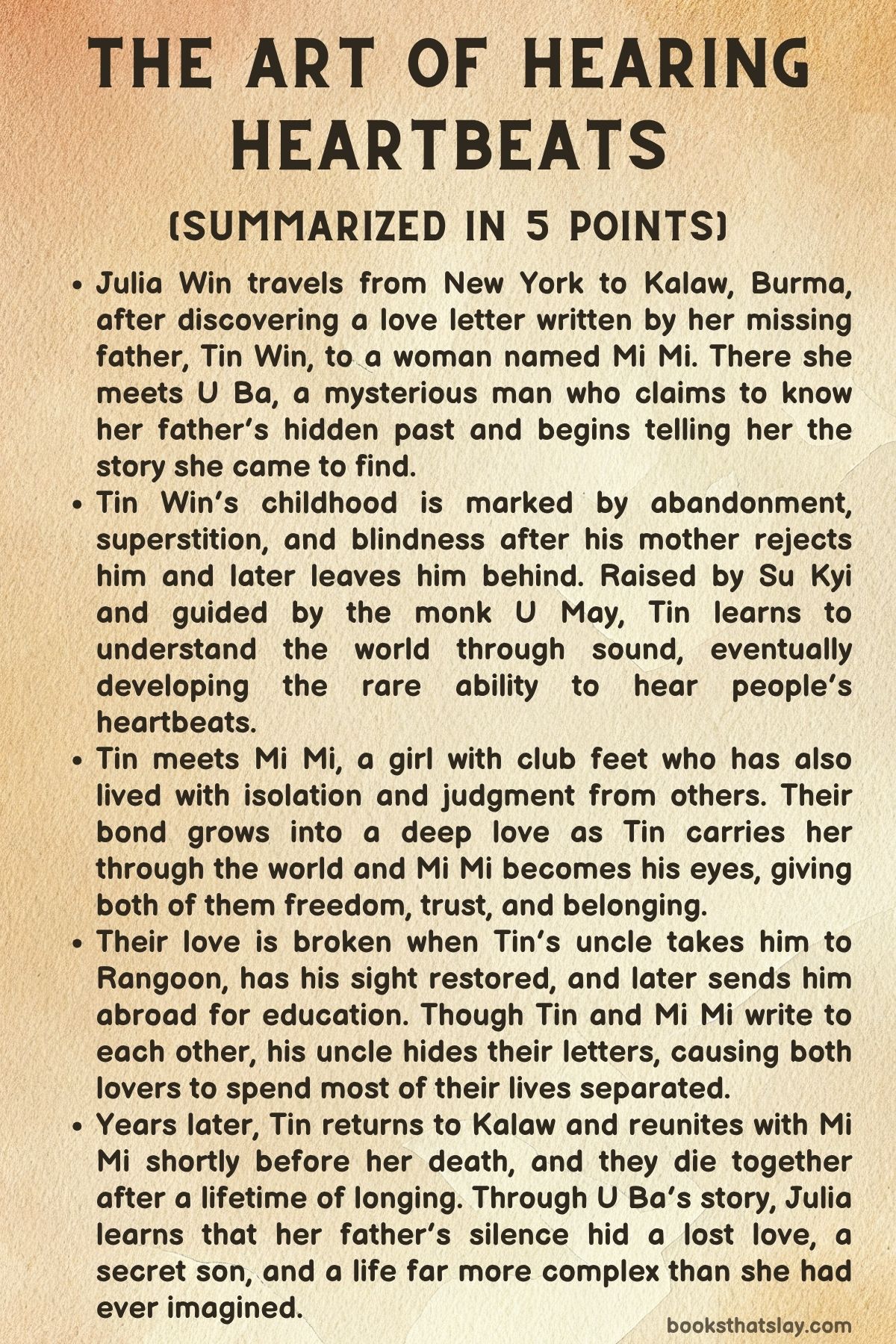
Summary
Julia Win arrives in Kalaw, a remote town in Burma, searching for answers about her missing father, Tin Win. Four years earlier, Tin had disappeared after leaving New York for what seemed like an ordinary business trip.
He never arrived at his appointment, and the trail led through Los Angeles, Hong Kong, and Bangkok before vanishing. Julia had known him as a successful, controlled, emotionally distant lawyer, a man who seemed to have built his American life through discipline and silence.
Yet a letter found among his old belongings changes everything. Addressed to a woman named Mi Mi in Kalaw, it reveals a passionate side of him that Julia had never seen.
In a small tearoom, Julia meets U Ba, an elderly Burmese man who seems to know her before she introduces herself. He tells her he has been waiting for her and that Tin entrusted him with a story meant only for her.
Julia is suspicious, uncomfortable, and impatient, but the mystery of her father’s past keeps her from leaving. U Ba begins with Tin’s birth in a poor household in Kalaw.
His mother, Mya Mya, already shaped by fear and superstition, believes her son is cursed because of the day on which he is born. When an astrologer predicts that Tin will bring sorrow to his parents, she accepts the warning as truth.
Tin’s childhood is marked by rejection. His father dies suddenly after being struck by a golf ball, and Mya Mya blames the boy for the tragedy.
She abandons him, telling him to wait for her return. Tin waits for days until a widow named Su Kyi finds him unconscious and takes him in.
Su Kyi becomes the first person to give him steady care. She does not erase his pain, but she gives him shelter, patience, and stories.
As Tin grows, he slowly loses his sight. By the age of ten, he is blind, and his world becomes narrow, uncertain, and frightening.
Su Kyi takes Tin to U May, an old monk whose own life has been marked by lost love. U May accepts Tin into the monastery and teaches him to live with discipline rather than despair.
Tin becomes an exceptional student, gifted in thought and memory. More importantly, blindness sharpens his listening until sound becomes the center of his world.
He hears leaves, insects, distant voices, and eventually the beat of human hearts. One day he hears a sound unlike any other and discovers Mi Mi, a girl with club feet who moves by crawling.
Her heartbeat becomes the most beautiful sound he knows.
Mi Mi has lived with her own form of isolation. Though her mother, Yadana, adores her and recognizes her beauty, many people see her disability as a mark of shame or punishment.
Mi Mi is strong, observant, and proud, but her body has limited her movement and made her dependent on others. Tin and Mi Mi quickly recognize in each other a loneliness that no one else has fully understood.
Together, they become whole in a way neither can be alone. Tin carries Mi Mi on his back, and Mi Mi guides him with her eyes.
He gives her movement; she gives him sight.
Their friendship becomes a deep love. On market days and in hidden places around Kalaw, they explore the world together.
Tin listens to heartbeats, insects, animals, and tiny sounds that others cannot hear, while Mi Mi identifies what he senses. Their bond expands both of their lives.
They swim, talk, travel across the village, and come to depend on one another with complete trust. When Mi Mi disappears briefly during a family trip, Tin is overcome by the old terror of abandonment, but she returns and reassures him that they are part of each other.
Their love becomes the force that answers the fear U May once told Tin he would overcome.
For several years, Tin and Mi Mi remain inseparable. Yadana notices their bond and quietly hopes they will marry.
But Tin’s uncle, U Saw, sends men to bring him to Rangoon. U Saw is wealthy and self-interested; an astrologer has warned him to help a relative to avoid financial misfortune.
Tin is taken away from the only home and the only person he loves. Before he leaves, he and Mi Mi spend one final night together.
Their separation is sudden, cruel, and permanent in all practical ways, though neither stops loving the other.
In Rangoon, Tin’s life changes again. Doctors determine that his blindness is caused by cataracts, and surgery restores his sight.
Vision overwhelms him at first, not as a simple blessing but as an intrusion into the sound-based world he has built. Still, he keeps his ability to hear heartbeats and to sense feeling through sound.
U Saw sends him to school, then arranges for him to study abroad. Tin writes letters to Mi Mi, and Mi Mi writes back, but U Saw intercepts them.
He treats love as a sickness that will pass if starved of contact. Tin believes Mi Mi has not answered him, while Mi Mi is led to believe Tin has gone to America and should not be contacted again.
Tin travels to the United States, studies law, and builds the life Julia has always known from the outside. He marries Judith, Julia’s mother, but his marriage lacks emotional openness.
Judith loves his appearance and presence at first, but she suffers from his refusal to reveal his early life. Tin remains kind in some ways, but distant.
He has never truly belonged to America, to New York, or to his marriage. The first part of his life remains sealed away, and the silence creates distance inside his family.
Julia grows up with a father she loves but does not understand.
Meanwhile, Mi Mi remains in Kalaw. She never marries, though many men are drawn to her beauty and presence.
She supports herself by rolling cheroots and continues to live with the memory of Tin. Unknown to Julia, Tin and Mi Mi had a son, U Ba.
He grows up in Burma and spends decades caring for Mi Mi. When Tin finally returns to Kalaw after many years, he tells U Ba the story of his life and asks him to pass it on to Julia.
Then Tin goes to Mi Mi’s house. She is old and near death.
Tin recognizes her at once, joins her in bed, and lies beside her as he had longed to do for a lifetime.
The next morning, Tin and Mi Mi are found dead together. Mi Mi’s death is expected, but Tin’s remains a mystery to those who do not know the depth of their bond.
Their funeral becomes a public celebration of love, grief, and release. Later, U Ba tells Julia that the smoke from their separate funeral pyres rose and joined in the sky, echoing a Burmese tale Tin had told Julia as a child about two lovers separated by a dangerous river.
Julia stays with U Ba and slowly absorbs what she has learned. She sees the houses, the village, the places where Tin and Mi Mi lived, suffered, and loved.
She learns that U Ba is not simply a storyteller but her half-brother, the child of Tin and Mi Mi. The discovery forces her to rethink her father not as a cold man who abandoned his family without feeling, but as someone whose heart had been shaped long before she knew him.
The trip does not give Julia a simple answer to every question, but it gives her a fuller truth: her father’s silence hid not emptiness, but an old love, an old wound, and a life divided between duty and desire.
Characters
Julia Win
Julia Win is the reader’s entry point into the world of The Art of Hearing Heartbeats, and her emotional journey gives the story its frame. At the beginning, she is practical, skeptical, and shaped by the rational habits of her New York life.
Her father’s disappearance has disturbed her, but she has also protected herself by assuming that his absence did not fully change her. When she reaches Kalaw, she is impatient with uncertainty and distrustful of U Ba’s strange confidence.
Yet Julia is not closed-minded so much as emotionally guarded. As she listens, her certainty begins to loosen.
She starts to recognize how little she knew about Tin Win and how narrow her idea of truth has been. Her growth comes through listening rather than action.
By accepting a story that challenges her worldview, she becomes more open to mystery, love, and pain. Julia’s importance in the book lies in her gradual movement from suspicion to humility, and from wounded daughter to someone capable of seeing her father as a complete human being.
Tin Win
Tin Win is the central hidden figure of The Art of Hearing Heartbeats, a man whose American identity covers a much older and more vulnerable self. As a child, he is treated as cursed before he can understand the word, and his mother’s rejection leaves a deep wound that shapes his fear of abandonment.
Blindness first appears to narrow his life, but it also opens another form of perception. Tin learns to hear the world with extraordinary sensitivity, especially the emotional truth contained in heartbeats and voices.
His love for Mi Mi is not sentimental escape; it is the first relationship in which he is fully known and fully needed. When he is taken away, his later success cannot repair the fracture.
As an adult, Tin becomes disciplined, accomplished, and outwardly controlled, yet his silence is less a lack of feeling than the result of a life split in two. In the book, he represents the cost of separation and the way buried love can define a person even when no one around him understands it.
Mi Mi
Mi Mi is one of the most radiant and emotionally powerful figures in the novel. Born with club feet, she lives under the gaze of a society that often treats disability as punishment, yet she never becomes merely an object of pity.
Her dignity, beauty, intelligence, and strength give her a quiet authority. She knows the limits placed on her body, but she also understands people deeply, and her bond with Tin allows her to experience freedom in a way she had long been denied.
When Tin carries her, the gesture is not one-sided dependence; she guides him, protects him, and helps him interpret the visible world. Their partnership is built on mutual need and mutual respect.
Mi Mi’s love is patient, unwavering, and self-possessed. After Tin is taken away, she does not replace him or surrender her inner life to bitterness.
In the story, Mi Mi embodies constancy, grace, and the idea that physical limitation does not reduce emotional power or personal worth.
U Ba
U Ba is the keeper of memory in The Art of Hearing Heartbeats, and his role is far more intimate than it first appears. At first, he seems like a mysterious stranger who knows too much about Julia and her father.
His calm manner, patience, and gentle refusal to rush the story make him both guide and guardian. As the tale unfolds, it becomes clear that he is not simply recounting events; he is preserving the emotional history of his parents.
His life has been shaped by devotion, especially his long care for Mi Mi. Unlike Julia, who measures success through career, independence, and forward motion, U Ba carries a different understanding of fulfillment.
He does not see his life as wasted because he stayed in Kalaw. His choices reveal a worldview based on duty, affection, and acceptance rather than ambition.
As Julia’s half-brother, he also becomes the living bridge between Tin’s two lives. Through him, the book shows that family truth may arrive through patience, not confrontation.
Su Kyi
Su Kyi is the quiet rescuer of Tin’s childhood, and her goodness is practical rather than dramatic. When Tin’s mother abandons him, Su Kyi steps in without demanding gratitude or recognition.
She becomes his shelter, caregiver, and emotional anchor. Her promise to stay until his mother returns is both tender and painful because it protects the child while acknowledging the wound he cannot yet face.
Su Kyi understands that direct explanations cannot mend Tin’s suffering, so she uses stories, routines, and steady presence to keep him connected to life. Her reaction to his blindness shows how deeply she loves him, and her decision to take him to U May reflects her humility; she knows when she cannot help him alone.
Su Kyi’s character matters because she represents chosen love. She is not Tin’s biological mother, but she gives him the maternal care Mya Mya withholds.
In a story shaped by abandonment, Su Kyi proves that compassion can interrupt damage before it destroys a child completely.
Mya Mya
Mya Mya is a tragic figure because her cruelty grows out of fear, grief, and superstition, yet the damage she causes is undeniable. From Tin’s birth, she allows omens and the astrologer’s warning to define her relationship with her son.
Instead of seeing a helpless child, she sees a threat. Her inability to nurse him, her horror at ordinary misfortunes, and her later blame after her husband’s death all deepen the emotional distance between them.
Mya Mya’s abandonment of Tin is one of the defining injuries of his life. Still, she is not written as simply evil.
She is a woman trapped by belief systems, personal weakness, and a mind that converts sorrow into accusation. Her failure as a mother shows how fear can become self-fulfilling: by treating Tin as a source of sorrow, she creates the very suffering she dreads.
In the novel, Mya Mya stands as a warning about what happens when superstition overpowers tenderness.
U May
U May is Tin’s spiritual teacher, but he is also a man whose wisdom is rooted in personal loss. Before becoming a monk, he experienced a devastating separation from the woman he loved and from the child he never had the chance to raise.
This sorrow does not make him bitter; instead, it shapes his compassion. When Tin arrives at the monastery, U May gives him structure, education, and a way to live beyond fear.
His teachings do not deny suffering. They ask Tin to endure it, observe it, and discover the force stronger than fear without chasing it directly.
U May’s death is one of the calmest and most meaningful moments in the book because he meets it with the acceptance he has spent his life teaching. He gives Tin an example of how to face loss without being ruled by terror.
Through U May, the story presents wisdom as something earned through pain and made useful through kindness.
U Saw
U Saw is a selfish, calculating force in Tin’s life, and his actions change the fate of several people. He takes Tin to Rangoon not out of love but because an astrologer has warned him to do good by a relative.
Even when Tin proves intelligent and capable, U Saw sees him largely as a useful investment. His decision to intercept the letters between Tin and Mi Mi is one of the most destructive acts in the book.
He assumes love is a childish illness and believes separation will cure it. In doing so, he displays a profound emotional ignorance.
U Saw’s wealth and social status give him power, but not wisdom. His plans for Tin are practical, ambitious, and cold.
He helps create Tin’s future success, yet he also robs him of the life he wanted most. U Saw represents the harm caused by control disguised as responsibility and by adults who believe they understand the hearts of younger people better than the lovers themselves.
Judith
Judith is Tin Win’s American wife and Julia’s mother, and her presence reveals the sadness inside Tin’s later life. She enters marriage attracted to Tin’s beauty, intelligence, and difference, but she is gradually wounded by his refusal to share his past.
Her bitterness is understandable because she spends years beside a man who withholds the central truth of himself. At the same time, Judith responds to secrecy with secrecy, and the marriage becomes a long emotional retreat.
Her pain is sharpened by the racial prejudice of her parents, who never forgive her for marrying a man of color, but that rebellion does not lead to lasting closeness with Tin. Judith’s statement that Tin’s past no longer interests her is less indifference than exhaustion.
She has stopped asking because the unanswered questions have already damaged her. In the story, Judith is not the great love of Tin’s life, but she is still a person injured by his silence, and her disappointment gives Julia another view of what hidden grief can do to a family.
Yadana
Yadana, Mi Mi’s mother, offers a powerful contrast to Mya Mya. Where Mya Mya sees her child through fear, Yadana sees Mi Mi through love.
She recognizes her daughter’s beauty and worth even when others judge her body cruelly. Her devotion helps Mi Mi grow with dignity rather than shame.
Yadana does not deny the practical hardship of Mi Mi’s condition, but she refuses to let disability define the whole of her daughter’s identity. She also understands the love between Mi Mi and Tin with a generosity that many adults in the story lack.
Her quiet hope that they might marry shows her sensitivity to Mi Mi’s happiness and her respect for Tin’s character. Yadana’s importance lies in the emotional atmosphere she creates around Mi Mi.
Because Mi Mi is loved well at home, she can meet Tin not as someone begging to be saved, but as someone capable of giving love with strength and confidence.
Themes
Love as Recognition
In The Art of Hearing Heartbeats, love is presented not as attraction alone, but as the rare experience of being truly recognized. Tin and Mi Mi do not fall in love because they complete a romantic ideal; they love each other because each sees the other without the distortions imposed by society.
Tin is not merely the blind boy abandoned by his mother, and Mi Mi is not merely the girl with club feet. Together, they become people with abilities, desires, humor, courage, and deep inner lives.
Their partnership is physical and emotional in equal measure: he carries her through the world, while she guides him through spaces he cannot see. This balance gives their bond its power.
Julia’s journey also depends on recognition. She must learn to see her father beyond the role he played in her life.
Once she hears the story of Tin and Mi Mi, she recognizes that his silence was not emptiness. It was the mark of a life shaped by a love that began before she existed and endured beyond ordinary separation.
The Damage Caused by Silence
Silence in the story is rarely neutral. It protects pain for a time, but it also spreads confusion and loneliness.
Tin’s refusal to tell Judith about his past creates a marriage in which both partners live beside each other without true intimacy. Judith reacts by building her own walls, and Julia grows up with only fragments of her father.
The silence around Tin’s childhood also harms him. Mya Mya never explains her fear in a way a child can understand; she simply withdraws and then abandons him.
U Saw’s silence is more deliberate and cruel. By hiding Tin’s letters from Mi Mi and Mi Mi’s letters from Tin, he changes the course of their lives while pretending that time will solve what honesty might have healed.
Yet the book also suggests that silence can be broken through careful listening. U Ba does not give Julia facts in a cold report.
He restores the missing emotional truth of her family. His storytelling turns silence into memory, and memory into understanding.
Disability, Perception, and Human Worth
The story repeatedly challenges the idea that physical ability determines a person’s value or the fullness of a person’s life. Tin’s blindness is first treated as tragedy, curse, and limitation, especially by those who fear what they do not understand.
Yet blindness also becomes the condition through which he develops his extraordinary hearing. He learns to read the world through sound, emotion, rhythm, and vibration.
Mi Mi’s club feet similarly limit her movement, but they do not limit her intelligence, beauty, or force of character. The strongest scenes between Tin and Mi Mi reverse ordinary assumptions about dependence.
Tin carries Mi Mi, but she guides him. He hears what others miss, and she sees what he cannot.
Neither is reduced to weakness; each possesses something the other needs. The book’s treatment of disability is not about turning pain into a simple gift.
Both characters suffer real exclusion. Still, their lives show that human worth exists beyond physical norms, and that different forms of perception can reveal truths others overlook.
Fate, Choice, and the Stories People Believe
Belief shapes lives throughout the novel, sometimes with comfort and sometimes with harm. Mya Mya believes the astrologer’s warning and allows that belief to poison her bond with Tin.
U Saw also acts under astrological advice, but he turns it into a selfish bargain, helping Tin only because he thinks it will protect his fortune. These choices raise an important question: are people ruled by fate, or do they use fate as an excuse for their own fears and desires?
The story does not fully reject mystery, omens, or spiritual signs. Tin’s hearing, the joined funeral smoke, the fairy tale echoes, and U Ba’s patient certainty all suggest that reality may contain more than Julia’s rational worldview can explain.
Yet the novel is also clear that belief carries responsibility. A prophecy can become harmful when it replaces love, and practical ambition can be cruel when it refuses to listen to the heart.
The most humane characters are those who hold mystery gently rather than using it to control others.