The Art of Racing in the Rain Summary, Characters and Themes
The Art of Racing in the Rain by Garth Stein is a novel about love, loyalty, endurance, and the will to keep moving through loss. Told through Enzo, an aging dog who believes he will one day return as a human, the book follows race car driver Denny Swift as he faces family illness, grief, legal battles, and separation from his daughter.
Enzo’s voice gives the story warmth, humor, and sharp observation, while racing becomes the language through which the book explains patience, control, faith, and survival.
Summary
Enzo, an elderly dog, begins the story near the end of his life. He is frustrated by the limits of his body and by the fact that he cannot speak, even though he understands far more than humans think he does.
He belongs to Denny Swift, an auto mechanic and race car driver. Enzo worships Denny not only as his master but as the model of everything he hopes to become when he is reborn as a human.
He believes that dogs who are ready can return in human form after death, and he feels prepared for that change. His old age, weakness, and accidents in the house make him feel like a burden, but Denny treats him with care, washes him, comforts him, and watches racing videos with him.
Enzo remembers his earliest days on a farm, where he was one of several puppies and did not feel especially loved or chosen. Denny comes to the farm and selects him, beginning a bond that becomes the center of Enzo’s life.
Denny teaches him about racing, especially the skill of driving in rain. To Denny, racing is not only speed.
It requires calm hands, patience, foresight, and the ability to look where one wants the car to go. Enzo absorbs these lessons and later applies them to human life.
For a while, Denny and Enzo live in close companionship. Their routine changes when Denny begins dating Eve.
Enzo first sees Eve as a rival for Denny’s attention. He resents her human advantages, her influence over Denny, and the way she shifts the household balance.
Over time, however, Enzo’s feelings change. When Eve becomes pregnant, he begins to respect her strength.
During Denny’s absence at a race, Eve gives birth to Zoe at home, and Enzo is allowed to stay nearby. Eve asks him to protect the baby, giving him a new purpose in the family.
Denny’s responsibilities grow after Zoe’s birth. He works longer hours as a mechanic and driving instructor while trying to keep his racing career alive.
Enzo is often left alone, with television as his main companion. Through television, he builds his private ideas about humanity, souls, evolution, and destiny.
He believes dogs are closer to humans than people admit and that he himself is almost human already, except for his paws and his silence.
As Zoe grows, Enzo becomes her protector. He also senses something wrong with Eve before anyone else fully understands it.
He smells illness in her head and feels helpless because he cannot warn the family. Eve begins having severe headaches and sickness.
During one of Denny’s racing trips, she becomes so ill that she takes Zoe and leaves Enzo alone in the house for days. Hungry, thirsty, and afraid, Enzo hallucinates that Zoe’s stuffed zebra comes alive and destroys the other toys.
This zebra later becomes, in Enzo’s mind, a symbol of chaos and self-destruction.
Denny returns to find Enzo neglected and the house damaged. Tension rises between Denny and Eve, made worse by his long absences and her illness.
Eve’s parents, Maxwell and Trish, become more involved. They are wealthy, critical, and distrustful of Denny.
Enzo calls them the Twins because of their united opposition to Denny and their shared sense of superiority. They believe Denny is irresponsible, especially because racing takes him away from home.
Eve’s condition worsens after she injures her head during a family hike. Doctors discover a mass in her brain.
As her illness progresses, she moves into her parents’ home, where they arrange care for her. Zoe also spends more time there.
Denny is pushed further away, though he tries to remain hopeful. Enzo senses that Maxwell and Trish are slowly preparing to take Zoe from Denny.
Eve, aware of death approaching, asks Enzo to stay with her one night and protect her. He keeps watch beside her, giving her the comfort he cannot express in words.
After surviving longer than expected, Eve finally dies. Denny is devastated.
He wants to rebuild life with Zoe, but Maxwell and Trish begin a custody fight. They accuse Denny of being unfit and blame him for Eve’s death because he did not force her into medical care sooner.
The situation becomes far worse when Denny is accused of sexually assaulting Annika, a teenage girl from Eve’s extended circle. The accusation comes after Annika once stayed overnight at Denny’s home during a storm and behaved inappropriately toward him while he was exhausted.
Enzo had barked to stop the situation, but his testimony is impossible because he is only a dog.
The legal cases stretch over years. Denny is separated from Zoe by court orders and can see her only under limited conditions.
He struggles with grief, shame, debt, and the fear of losing his daughter forever. His lawyer, Mark Fein, first believes he can win, but the mounting costs become overwhelming.
Denny sells his house and moves into a small apartment. Maxwell and Trish continue to pressure him, and at one point it seems that giving up custody might make the criminal charges disappear.
Denny nearly accepts defeat.
Enzo, despite his own declining health, refuses to give up on Denny. He develops arthritis and hip problems and later is hit by a car, but he survives because he believes he still has work to do.
When Denny is about to sign a settlement that would surrender his fight for Zoe, Enzo notices that the pen has a zebra on it. He realizes that the zebra is not a real enemy outside them, but the force inside people that makes them destroy themselves.
He grabs the document, runs away with it, and urinates on it. Denny and his friends laugh, but they also understand the message.
Denny does not sign.
A new chance appears when Denny meets Luca, a representative connected with Ferrari. Luca recognizes Denny’s skill after seeing him drive and offers him a future job in Italy once his legal troubles are over.
This hope gives Denny something to aim toward. Denny’s estranged parents also return and help him financially, trying to repair the pain caused by years of distance.
At last, Annika withdraws her accusation. The criminal case collapses, and Maxwell and Trish drop the custody fight.
Denny wins back his daughter and accepts Luca’s offer to work with Ferrari in Italy. Enzo, now very old and weak, feels that his purpose has been fulfilled.
He is not afraid of death because he believes he will return as a man. In his final moments, Denny comforts him and releases him toward open fields in his imagination.
Years later, Denny is in Italy as a successful racing figure. A young boy named Enzo approaches him with his father.
The boy is a racing fan and seems unusually connected to Denny. When he repeats one of Enzo the dog’s old sayings about the car going where the eyes go, Denny recognizes the mystery and beauty of the moment.
He gives the boy his contact information and promises to help him learn racing, suggesting that Enzo’s belief in return may have come true.
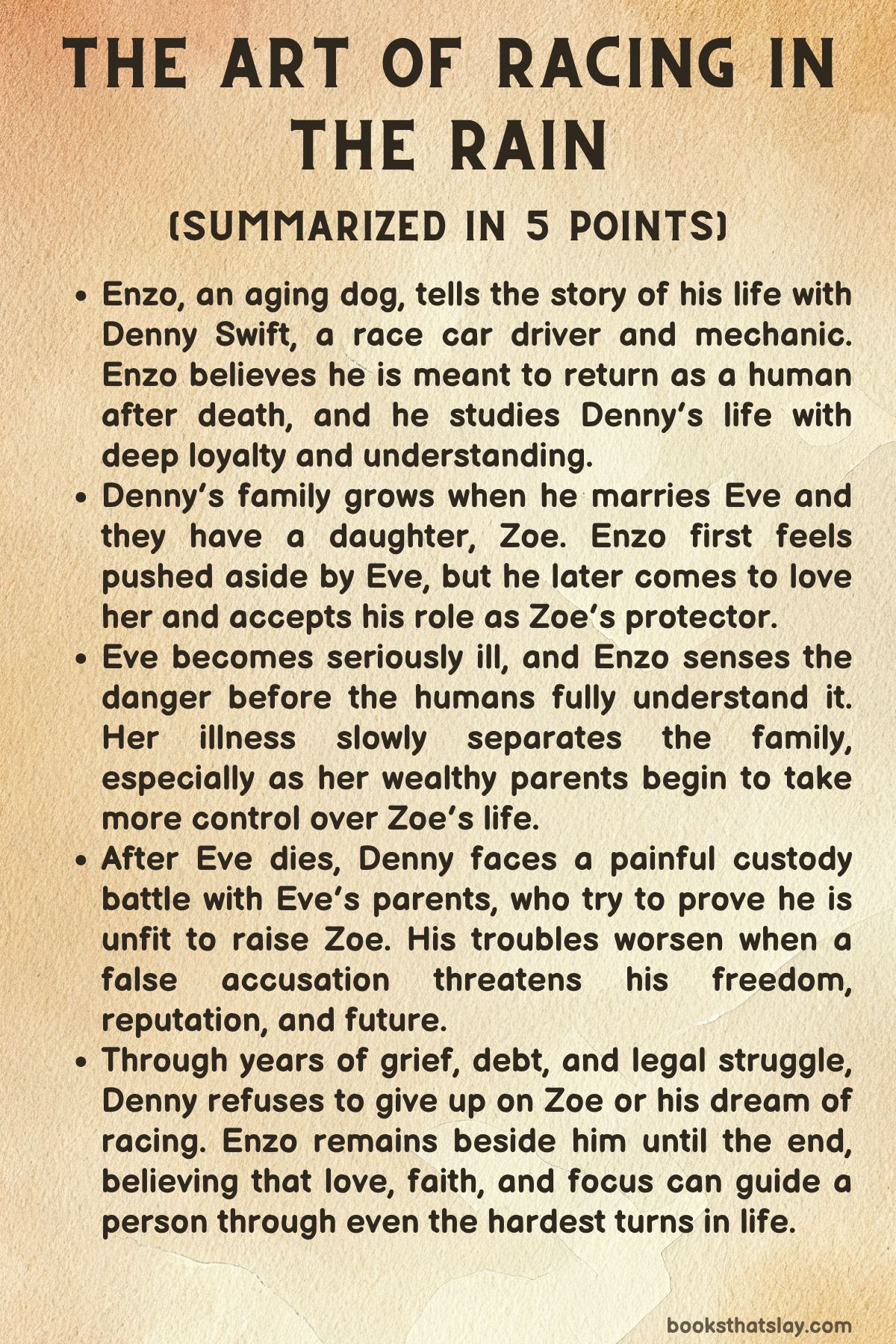
Characters
Enzo
In The Art of Racing in the Rain, Enzo is the narrator, emotional center, and moral witness of the book. He is a dog, but he sees himself as a human spirit trapped in a canine body, and this belief shapes the way he interprets everything around him.
His frustration with silence is central to his character. He understands illness, danger, manipulation, loyalty, and grief, but he cannot explain what he knows in human language.
This makes him both powerful and powerless. Enzo’s devotion to Denny is absolute, yet it is not simple obedience.
He studies Denny, admires his discipline, and adopts his racing philosophy as a guide for living. Enzo also grows across the story.
He begins by resenting Eve because she changes his place in Denny’s life, but he learns to respect and love her. His care for Zoe reveals his protective instincts, while his fear of the zebra shows his struggle to understand evil and self-destruction.
By the end, Enzo accepts death with unusual calm because he believes he has completed his duty. His final hope of becoming human gives his life a sense of purpose and makes him one of the most memorable voices in the book.
Denny Swift
Denny Swift carries much of the emotional weight of The Art of Racing in the Rain. He is a race car driver and mechanic whose life is defined by patience, discipline, and endurance.
On the track, he understands that panic causes mistakes and that a driver must look ahead rather than stare at danger. In life, however, he is tested far beyond ordinary limits.
He loses his wife, faces accusations that damage his name, is separated from his daughter, and is pushed into financial ruin. Denny’s greatest strength is that he keeps choosing dignity even when others try to break him.
He does not become cruel in response to cruelty, and he does not abandon Zoe even when giving up would make his life easier. His flaws also matter.
His racing career keeps him away from home at painful moments, and his commitment to his dream sometimes leaves Eve isolated. Yet the book presents him as a man who learns through suffering.
He survives because he refuses to let fear decide the direction of his life.
Eve
Eve is one of the most important emotional forces in The Art of Racing in the Rain because her presence changes both Enzo and Denny. At first, she appears through Enzo’s jealous eyes as an intruder, someone who takes space that once belonged only to him.
As the story develops, Eve becomes much more than that first impression. She is intelligent, independent, loving, and quietly strong.
Her pregnancy and Zoe’s birth reveal a side of her that Enzo comes to admire deeply. Her illness also exposes the limits of human control.
Eve senses her own decline and tries to preserve dignity by keeping Denny from seeing her at her weakest. Her relationship with Enzo becomes especially moving because she trusts him in ways others do not.
When she asks him to protect her through the night, she recognizes his loyalty and spiritual sensitivity. Eve’s death breaks the family structure, but her love for Denny and Zoe continues to shape their fight for survival.
Zoe Swift
Zoe is the child at the center of the family conflict, but she is never only a prize to be won. She is observant, sensitive, and deeply affected by the adults around her.
As a young child, she trusts Enzo completely, and their bond gives the book some of its gentlest moments. Her habit of placing stuffed animals around him shows her kindness and her desire to comfort others even when she herself is confused.
Zoe also absorbs the pressure of her mother’s illness and her grandparents’ influence. She senses more than adults admit, including the possibility that her life might be taken away from Denny.
Her growth is important because she carries parts of both parents: Eve’s independence and Denny’s instinctive feel for racing. When she later races go-karts with Denny, she shows courage, intelligence, and natural skill.
Zoe represents the future Denny fights for, but she also represents the love that keeps him from surrendering.
Maxwell
Maxwell is the main human obstacle in Denny’s life after Eve’s illness and death. He is wealthy, controlling, and convinced that his judgment is superior to Denny’s.
His dislike of Denny comes partly from class prejudice. To him, Denny is not stable or respectable enough for Eve and Zoe because he works as a mechanic and chases a racing career.
Maxwell’s grief over Eve hardens into blame, and he uses legal power to try to take Zoe away. His actions are cruel because they target Denny at his weakest moment, when he is mourning, broke, and publicly accused.
Maxwell may believe he is protecting Zoe, but his protection is possessive. He does not fully respect Zoe’s bond with her father.
His role in the book shows how love can become destructive when mixed with pride, fear, and the desire to control outcomes.
Trish
Trish is more conflicted than Maxwell, though she still participates in the campaign against Denny. She shares her husband’s class assumptions and helps create the environment in which Denny is treated as unworthy.
At the same time, she shows moments of doubt that make her less rigid than Maxwell. She suspects that Annika may not be entirely innocent and appears to feel some pity for Denny.
These moments suggest that Trish has a conscience, even if she does not act on it strongly enough when it matters most. Her weakness is not open cruelty as much as complicity.
She allows Maxwell’s anger and strategy to guide her, and by doing so, she helps prolong Denny and Zoe’s suffering. Trish represents the kind of person who sees the truth partially but lacks the courage to oppose the stronger voice beside her.
Annika
Annika is a troubling character because her actions create enormous damage while also revealing her immaturity. She is a teenager who becomes infatuated with Denny and misreads his kindness, exhaustion, and vulnerability.
Her behavior during the overnight stay is inappropriate and dangerous, especially because Denny is an adult and she is a minor. Afterward, the accusation against Denny becomes a weapon in the larger custody battle.
Annika’s eventual decision to withdraw the charge is crucial because it frees Denny from the criminal case, but it does not erase the years of pain caused by the accusation. She is not written as a simple villain.
She is young, emotional, and perhaps influenced by adults and circumstances around her. Still, the book makes clear that false or distorted claims can destroy lives, especially when they are absorbed into existing conflicts.
Mike
Mike is one of Denny’s loyal friends from the garage, and his importance lies in his steadiness. He helps with practical needs, supports Denny during moments of crisis, and remains present when others step away.
Mike is not a grand heroic figure, but the book values his kind of friendship because it is useful, grounded, and sincere. He takes care of details, shows up when Denny needs him, and offers advice even when the situation is painful.
His presence also gives Enzo a sense that Denny is not entirely alone. Mike’s ordinary loyalty contrasts sharply with the calculated hostility of Maxwell and Trish.
Tony
Tony, like Mike, belongs to Denny’s working world and represents friendship outside the family conflict. His role is smaller, but he contributes to the support system that helps Denny continue.
Tony is present during conversations about Denny’s choices, including the painful question of whether he should keep fighting or accept a settlement. He does not have the power to solve Denny’s problems, but he stands near him when the pressure becomes overwhelming.
This matters because isolation is one of Denny’s greatest enemies. Tony’s character shows that survival often depends not only on dramatic rescues but on people who remain available during long stretches of hardship.
Mark Fein
Mark Fein is Denny’s first lawyer, and he brings energy, intelligence, and confidence to the early legal battle. He believes Denny can win, but he also represents the expensive and exhausting nature of justice.
His services cost more than Denny can comfortably pay, and the legal system becomes another endurance race with no easy finish line. Mark is somewhat comic in his personal quirks, especially his interest in the barista, but he is serious about Denny’s case.
His eventual move into a judgeship leaves Denny with uncertainty, showing how even helpful people cannot always stay for the entire fight. Mark’s character reflects both hope and the limits of professional help.
Mr. Lawrence
Mr. Lawrence replaces Mark Fein and at first seems less impressive. He lacks Mark’s spark, which makes Denny’s situation feel even more uncertain.
Yet he proves more capable than expected when the legal case reaches its turning point. His role is important because he shows that quiet competence can matter as much as visible confidence.
The book uses him to challenge first impressions. Enzo and Denny may not feel the same immediate trust in him that they felt with Mark, but Mr. Lawrence still helps carry the case through a decisive stage.
His success reminds the reader that endurance sometimes requires accepting help in forms that do not look inspiring at first.
Luca
Luca represents opportunity, renewal, and the larger racing world that Denny has always wanted to enter. He sees Denny’s talent clearly and offers him a future with Ferrari after the legal battles end.
Luca’s offer is not random kindness. He understands loss because he has experienced it himself, and he chooses to help Denny because someone once helped him during his own grief.
This makes him a figure of generosity passed from one life to another. Luca’s role gives Denny a road forward after years of being trapped by courts, debt, and sorrow.
He helps restore the idea that Denny’s dream is not foolish; it has simply been delayed.
Denny’s Parents
Denny’s parents appear late in the book, but their arrival changes the emotional meaning of his past. Their relationship with him has been strained for years because they resented his decision to leave the family farm and pursue racing.
Their absence from earlier family moments shows the depth of that break. When they return and help finance his legal fight, their action becomes an attempt at repair.
Denny’s mother’s blindness and her reliance on Denny’s father add sadness and distance to their presence, but their support still matters. They cannot erase the years of silence, yet they choose to stand with their son when he needs them most.
Their return suggests that reconciliation is possible even after long resentment.
The Zebra
The zebra is not a human character, but it functions like a dark symbolic presence in Enzo’s imagination. At first, Enzo believes the stuffed zebra is possessed by a destructive force that attacks the other toys.
Later, he realizes that the zebra represents something inside living beings: the impulse toward fear, damage, surrender, and self-sabotage. This realization is one of Enzo’s most important insights.
The zebra helps him understand that evil is not always an outside enemy. Sometimes it appears as despair, panic, or the temptation to give up.
When Enzo destroys the settlement papers after seeing the zebra pen, he is not just stopping Denny from signing a document. He is fighting the inner force that wants Denny to abandon himself and Zoe.
Themes
Loyalty as Active Love
Loyalty in The Art of Racing in the Rain is not passive devotion; it is action, attention, and endurance. Enzo’s loyalty to Denny is shown through his constant watching, listening, and interpreting.
Because he cannot speak, his love must appear through presence. He guards Zoe, comforts Eve, interrupts danger with barking, and even destroys the settlement papers when he senses that Denny is about to surrender.
Denny’s loyalty is tested in a different way. He must remain committed to Zoe even when the legal system, financial pressure, public shame, and grief make surrender seem easier.
The book treats loyalty as something that becomes meaningful only under pressure. It is simple to love when life is stable, but Denny and Enzo prove their devotion when stability is gone.
Eve also shows loyalty by trusting Enzo and by trying to protect Denny from the worst image of her illness, even if that choice causes distance. Loyalty here is not always perfect or painless.
It can be messy, silent, and misunderstood. Still, it becomes the force that holds the family together when institutions and relatives threaten to separate them.
Control, Patience, and the Discipline of Racing
Racing provides the book’s clearest language for understanding life. Denny’s lessons about driving in rain are really lessons about fear, patience, and control.
A driver who panics, overcorrects, or stares at the danger ahead can lose the car. The same idea applies to Denny’s personal trials.
He cannot control Eve’s illness, Maxwell and Trish’s hostility, Annika’s accusation, or the slow movement of the courts. What he can control is his response.
The racing belief that the car goes where the eyes go becomes a moral principle: people move toward what they focus on. If Denny fixes his attention only on loss, he risks becoming trapped by it.
If he keeps looking toward Zoe, truth, and his future, he can continue. Enzo adopts this philosophy as his own.
He interprets family conflict, death, and legal pressure through racing strategy because it gives him a way to understand chaos. The theme suggests that survival is not about having total command over events.
It is about calm movement through difficult conditions, knowing when to hold position, when to wait, and when to keep faith with the road ahead.
Grief, Mortality, and Spiritual Continuity
Death is present from the beginning because Enzo is old and aware that his life is nearing its end. Instead of making death only frightening, the book connects it to transformation.
Enzo believes he will return as a human, and this belief gives him courage. Eve’s illness brings a more painful form of mortality because it strikes a young mother and leaves a child behind.
Her decline forces every character to confront helplessness. Denny cannot save her.
Enzo can smell the illness but cannot warn anyone. Zoe can sense the coming loss but cannot fully understand it.
Eve’s response to death is marked by dignity and acceptance. She does not want to be reduced only to sickness, and her final trust in Enzo gives her passing a quiet spiritual weight.
Grief in the book does not end with death; it changes shape. Denny’s grief becomes a custody fight, financial struggle, and private despair.
Enzo’s grief becomes rage, dreams of crows, and renewed commitment to Denny. The ending offers comfort without denying pain.
Enzo’s possible return as a boy suggests that love may continue beyond one form of life, even when the original bond has ended.
Family, Power, and the Fight for Belonging
Family in the story is not defined only by blood or legal authority. It is defined by care, trust, and the willingness to remain responsible for one another.
Denny, Eve, Zoe, and Enzo form a family through daily life, shared love, and mutual dependence. Maxwell and Trish challenge that family by using wealth, status, and legal pressure to claim that they know what is best for Zoe.
Their actions raise a difficult question: who has the right to decide where a child belongs? The book clearly shows that power can disguise itself as protection.
Maxwell and Trish may believe they are saving Zoe from instability, but their campaign also punishes Denny and ignores Zoe’s deep bond with her father. The custody battle turns family into a contest of money, influence, and reputation.
Against that, Denny’s love appears quieter but stronger. He cannot offer luxury, and he cannot always control circumstances, but he offers commitment.
Enzo’s place in the family also expands the theme. Though he is not human, his care is real.
The story argues that belonging is created through faithful presence, not simply through social rank, biology, or control.