The American Roommate Experiment Summary, Characters and Themes
The American Roommate Experiment by Elena Armas is a contemporary romance about Rosie Graham, a former engineer trying to build a new life as a romance writer, and Lucas Martín, a Spanish surfer whose future has been shaken by injury. The story begins with an awkward accidental meeting in a borrowed apartment and grows into a tender roommate arrangement, a fake dating experiment, and a real emotional bond.
At its center, the book is about taking risks, admitting fear, and learning that love cannot be built on perfection. It is warm, funny, emotionally direct, and strongly rooted in everyday acts of care. It’s the 2nd book of the Love Deception series.
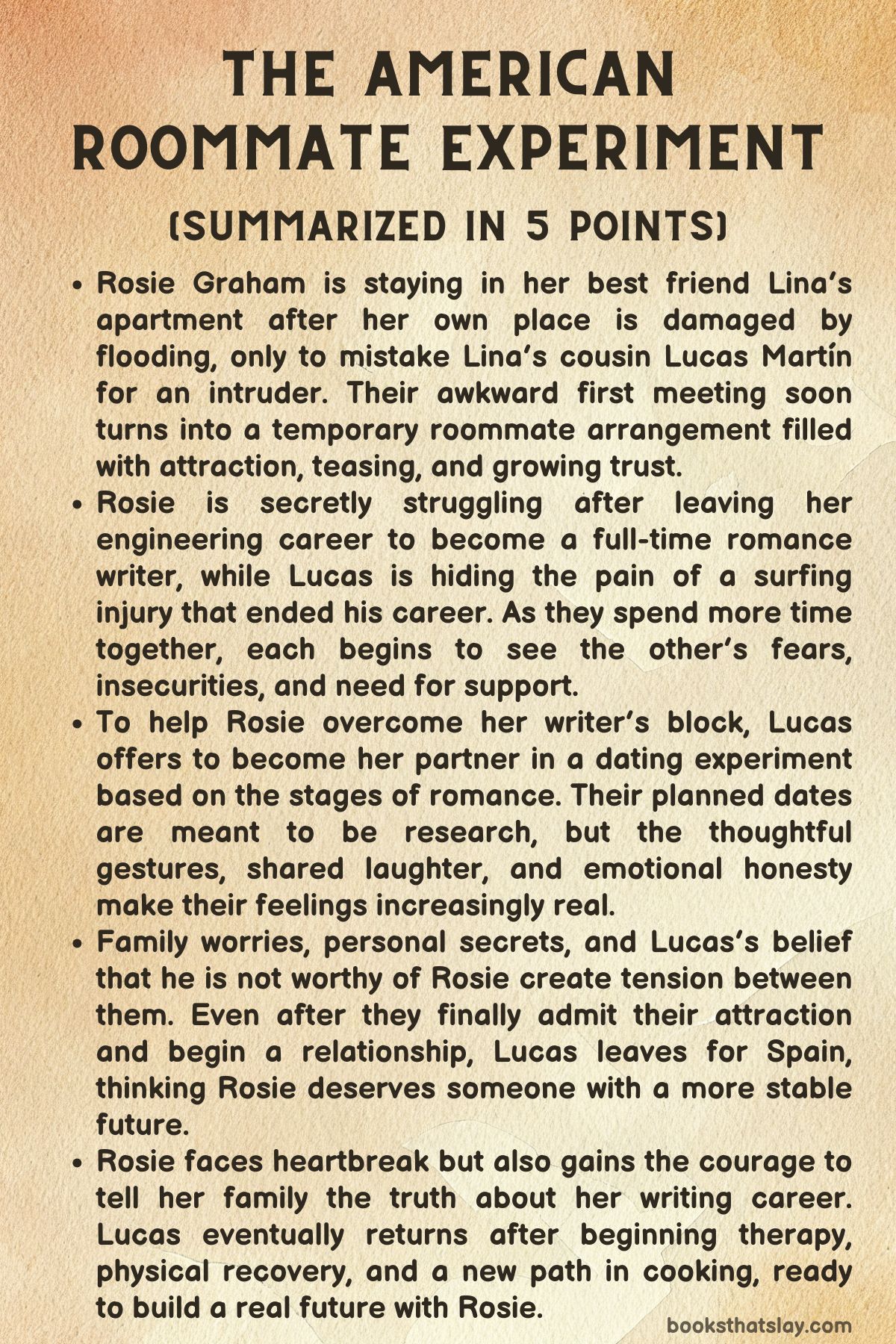
Summary
Rosie Graham is living in her best friend Lina’s New York apartment because her own place has been badly damaged by flooding. Lina is away on her honeymoon with Aaron, and Rosie has not yet managed to tell her everything about the situation.
One night, Rosie hears someone trying to get into the apartment and panics, believing she is facing a break-in. She calls emergency services, only to discover that the supposed intruder is Lucas Martín, Lina’s Spanish cousin, who has arrived in New York with a key and no idea Rosie is staying there.
The encounter is deeply embarrassing for Rosie because she already knows who Lucas is. She has followed him online for months and has a quiet crush on him.
Lucas is handsome, charming, and warmer than she expected, which makes the awkward situation even harder for her to handle. Rosie plans to leave for a hotel, but Lucas has his own problems: he has misplaced his credit card and ends up sleeping in a diner.
When Rosie finds him there the next morning, concern replaces embarrassment, and the two begin to talk more honestly.
Rosie is carrying several secrets. She has left her stable engineering job to become a full-time romance writer, but she has not told her father or her younger brother, Olly.
Her first book was successful, yet her second book is not going well. She is stuck, afraid of failing, and ashamed that she may disappoint the people who were proud of her engineering career.
Lucas learns this before most people in her life do, and instead of judging her, he encourages her. His confidence in her writing becomes one of the first signs that he sees Rosie clearly.
Lucas also has secrets. He was once a professional surfer, but a serious accident injured his leg and damaged his sense of identity.
He has come to New York while avoiding the full truth of what happened to him and what it means for his future. He suffers from nightmares and panic, misses his dog Taco, and feels unworthy of the life he once imagined.
At first, Rosie only sees hints of his pain: his difficulty moving, his evasive answers, and the sadness beneath his humor.
Because Rosie’s apartment remains unlivable and Lucas has nowhere else to stay, they agree to share Lina’s apartment. Lucas offers Rosie the bed and takes the couch, setting boundaries even though both of them feel an obvious attraction.
Their roommate arrangement soon becomes intimate in quiet, domestic ways. Lucas cooks for her, watches television with her, listens when she is anxious, and helps her when she breaks down over her blocked writing.
Rosie, who is used to supporting others, begins to experience what it feels like to be cared for.
Their connection deepens through daily life. They help Adele, an elderly neighbor who struggles with memory loss and mistakes Lucas for her late husband, Mateo.
Lucas’s kindness toward Adele reveals his patience and compassion, especially because his own grandfather had Alzheimer’s disease. Rosie is moved by his gentleness, while Lucas is drawn to Rosie’s empathy and emotional honesty.
These small acts build trust between them long before either of them admits what is happening.
Rosie’s writing crisis leads to the idea that shapes much of the story. Lina suggests that Rosie treat dating as research for her romance novel.
Lucas overhears enough to understand Rosie’s problem and offers to become her partner in a dating experiment. The plan is for them to go on staged dates that follow the emotional phases of romance, giving Rosie material for her book.
Lucas promises he will not fall in love with her, a promise that hurts Rosie because she already wants something real.
Their first experimental date begins with Lucas arriving as if he is formally picking Rosie up. He takes her to a record store, where she chooses ABBA’s “Dancing Queen” as their soundtrack.
Back at the apartment, he surprises her with a record player and a dance. The date is playful and sweet, but it also shows how well Lucas listens.
He remembers small details, turns them into gestures, and creates moments that feel personal rather than artificial. Their chemistry becomes harder to ignore.
The second date takes place at Rosie’s favorite pizzeria, which Lucas has arranged to use privately. He plans a cooking date, complete with candles and homemade pizza.
During the evening, Rosie learns more about Lucas’s injury and the loss of his surfing career. She refuses to let him reduce himself to what he has lost, telling him he has more to offer than his former profession.
The date nearly leads to a kiss, but their pizzas burn, interrupting the moment and leaving Lucas frustrated with himself.
Lina eventually returns from her honeymoon and discovers Rosie and Lucas sharing the apartment. She reacts strongly, partly because she knows Lucas’s history with women and does not want Rosie to be hurt.
Rosie explains the flooding, while Lucas protects her by taking responsibility for keeping the arrangement secret. Lina warns Lucas in Spanish that Rosie is one of the best people she knows, and Lucas interprets this as proof that he is not good enough for her.
Still, Aaron quietly sees that Lucas’s feelings are serious.
Rosie and Lucas attend a Halloween masquerade ball with Lina and Aaron, dressed as characters from their favorite vampire drama. The evening heightens their attraction, especially when a spilled drink forces Rosie and Lucas into a private bathroom situation.
Lucas helps her with her dress, and the tension between them almost becomes physical. Lina interrupts before anything can happen, but the moment makes it clear that their experiment is no longer pretend.
As Rosie’s apartment repairs near completion, she becomes upset at the thought of leaving Lucas. A contractor named Aiden asks her out, and Lucas’s jealousy shows before he can hide it.
Rosie suggests that the experiment may no longer be necessary, but Lucas still struggles to believe he deserves a real relationship. Then Rosie surprises him by arranging for his dog Taco to come to New York with his sister Charo.
The gesture overwhelms Lucas because it proves Rosie has been paying attention to his deepest needs.
The fourth and final date is the most romantic. Lucas takes Rosie to Alexia’s restaurant, Zarato, and then to the rooftop, where he has created the version of Lina and Aaron’s wedding that they never shared.
He hangs lights, bakes a cake, and shows wedding photos so they can imagine meeting there for the first time. Rosie realizes she is fully in love with him.
In the rain, she confesses that she wants to care for him as deeply as he has cared for her. Lucas, terrified and overwhelmed, hesitates, but when Rosie asks him to kiss her, he does.
Their moment is interrupted by a call from Olly, who is in trouble at the adult club where he works. Rosie rushes to help him, and Lucas goes with her despite his injured leg.
The situation becomes dangerous when one of the club owners threatens them and injures Lucas further. Rosie gets Lucas and Olly back safely, but she feels guilty for putting Lucas at risk.
Olly explains that he took the job because of a girl and got into trouble trying to protect her. Rosie recognizes her own hypocrisy in demanding honesty from Olly while hiding her own truth.
After this crisis, Rosie and Lucas become even closer. Lucas finally tells her more about his surfing accident, his nightmares, and his panic.
Rosie comforts him and insists that he has not become less valuable because his life changed. Their physical relationship begins soon after, but time works against them.
Lucas is scheduled to return to Spain, and neither of them knows how to build a future from such uncertain ground.
Rosie moves back into her repaired apartment, and the separation makes both of them realize how much they want each other. Lucas comes to her apartment, and they finally stop pretending that their bond is only research.
They spend his last days in New York together as a couple. Rosie finishes her book, and Lucas’s support means more to her than any outside approval.
Still, the coming goodbye shadows their happiness.
At the airport, Lucas decides to leave without waking Rosie because he thinks staying in her life would be selfish. Rosie comes after him and confesses her love, including the fact that she had admired him online before they met.
She even offers to go to Spain with him, but Lucas refuses. He believes he has no stable life to offer her and leaves her heartbroken.
Rosie goes to Philadelphia and finally tells her father and Olly the truth about leaving engineering to write romance. Her father supports her, giving Rosie the relief of being honest at last.
Lina also supports her as Rosie grieves Lucas’s departure. Rosie knows the dating experiment did not create false feelings; it simply revealed what had already grown between them.
In Spain, Lucas avoids Lina until she forces him to face the damage he caused. She tells him Rosie’s new book proves how deeply he influenced her.
Weeks later, at a New Year’s Eve party, Lucas returns. He admits he left because he felt unworthy, but he has begun working on himself.
He is seeking therapy, resuming physical therapy, and considering culinary school in New York. He asks Rosie for real dates, a real home, and a real future.
Rosie accepts. A year later, Lucas returns to New York for good, surprising Rosie at her apartment and bringing their long-distance chapter to an end.
Characters
Rosie Graham
Rosie Graham is the emotional center of The American Roommate Experiment, a woman caught between the life that once made sense and the creative life she now wants badly enough to risk everything for it. Her decision to leave engineering and become a full-time romance writer shows courage, but her secrecy reveals how much she fears disappointing the people she loves.
Rosie is capable, organized, and deeply caring, yet she often measures her worth by how well she supports others and how little trouble she causes. Her flooded apartment becomes more than a practical problem; it pushes her into a space where she can no longer control every part of her life.
Living with Lucas forces her to accept help, express fear, and admit desire. Her writer’s block reflects her larger emotional block: she cannot write convincingly about love while denying her own need for it.
Rosie’s growth comes through honesty. She learns to tell her family the truth, pursue Lucas instead of waiting passively, and accept that choosing happiness does not make her selfish.
By the end, she becomes more confident not because every fear disappears, but because she stops hiding from the life she has chosen.
Lucas Martín
Lucas Martín is charming, generous, and outwardly easygoing, but the book gradually reveals a man whose confidence has been badly shaken. As a former professional surfer, Lucas built much of his identity around movement, skill, freedom, and physical ability.
His injury does not only endanger his career; it makes him question what value he has without surfing. This is why he often presents himself as temporary, unsuitable, or incomplete.
His humor and flirtation protect him from admitting how frightened he is. Yet his actions show his real character more clearly than his self-judgment does.
He cooks for Rosie, protects her from her landlord, cares for Adele, supports Olly in a dangerous moment, and creates dates filled with personal detail. Lucas is not careless with love; he is afraid of failing at it.
His mistake is deciding for Rosie what she deserves instead of trusting her choice. His return at New Year’s matters because he does not come back with empty promises.
He comes back having begun therapy, physical recovery, and a new professional path through cooking. In The American Roommate Experiment, Lucas’s journey is not about becoming the man he was before the accident, but accepting that the man he is now can still love and be loved.
Lina Martín-Blackford
Lina Martín-Blackford plays an important supporting role as Rosie’s best friend and Lucas’s cousin. Her presence connects Rosie and Lucas before they officially meet, and her apartment becomes the setting that allows their relationship to begin.
Lina is protective, loyal, and direct, sometimes to the point of being overwhelming. When she discovers Rosie and Lucas living together, her anger is not simply about secrecy; it comes from fear that two people she loves might hurt each other and leave her emotionally divided.
Lina knows Lucas’s past reputation and worries that Rosie, who is generous and emotionally vulnerable beneath her competence, may be the one left wounded. At the same time, Lina’s protectiveness can make her slow to recognize that Rosie is not merely infatuated and Lucas is not merely flirting.
Her later apology and support show that she can revise her judgment when she sees the truth. Lina also acts as a bridge between the couple when Lucas leaves, pushing him to face the consequences of his fear.
She is not just a comic or protective friend; she is a person whose love for both characters makes her demand honesty from them.
Aaron Blackford
Aaron Blackford is a quieter figure in the story, but his steadiness gives him importance. As Lina’s husband, he appears mostly in relation to her and to Rosie’s existing circle, yet he often notices emotional truths before others name them.
When Lina reacts fiercely to finding Lucas with Rosie, Aaron restrains her without dismissing her feelings. His calmness contrasts with Lina’s intensity, creating a balance that allows the situation to settle.
Aaron also understands loyalty. He makes it clear to Lucas that Rosie matters to him too, but he does not attack Lucas unfairly.
Instead, he seems to recognize that Lucas’s feelings are genuine. His assistance with the rooftop date further shows that he quietly supports romance when he believes it is sincere.
Aaron functions as a model of secure love in the book. His relationship with Lina gives Rosie something to admire and envy, and it helps define what Rosie longs for: not drama for its own sake, but devotion that is open, steady, and chosen every day.
Olly Graham
Olly Graham, Rosie’s younger brother, reflects the story’s concern with secrecy, independence, and family worry. At nineteen, he wants to be treated as an adult, but his evasiveness causes Rosie to fear the worst.
His job at an adult entertainment club shocks her, partly because it proves he has been hiding a major part of his life, and partly because it mirrors her own dishonesty about her career. Olly is not portrayed as simply irresponsible.
His poor choices are mixed with loyalty, embarrassment, and a desire to prove himself. When he gets involved in danger because he tried to protect someone, the story shows that his instincts are not entirely selfish, even if his judgment is flawed.
Through Olly, Rosie is forced to recognize that love cannot be based on control. She wants honesty from him while denying it to her father and to herself.
His later move toward building trades suggests that, like Rosie and Lucas, he needs room to find a path that fits him rather than one that satisfies other people’s expectations.
Rosie’s Father
Rosie’s father represents family pride, emotional pressure, and unconditional love. Much of Rosie’s anxiety comes from the belief that he values her engineering career so deeply that he will be disappointed by her decision to leave it.
His admiration for her professional success is sincere, but Rosie misreads that pride as a fixed expectation. This misunderstanding keeps her trapped in secrecy.
He also worries about Olly, and his concern for his children gives Rosie another reason to delay telling him the truth. When she finally admits that she has changed careers, his support becomes a turning point.
He proves that Rosie’s fear, while understandable, was not the whole truth of their relationship. His character shows how children can carry imagined versions of parental disappointment long after they have become adults.
He loves Rosie not because she is an engineer, but because she is his daughter. That realization helps Rosie fully claim her writing life.
Adele
Adele is an elderly neighbor whose memory problems bring tenderness and sadness into the story. She enters the plot through a practical moment, trying to move furniture, but her role quickly becomes more meaningful.
Her confusion, especially when she calls Lucas by the name Mateo, reveals the depth of her attachment to the past and the pain of cognitive decline. Adele’s bond with Lucas is touching because it is built on recognition that is both mistaken and emotionally true.
Lucas resembles someone she loved, and his patience with her shows a gentle side of him that Rosie deeply admires. Adele also connects Lucas’s present to his own family history, since his grandfather suffered from Alzheimer’s disease.
Through her, the book explores care as something that does not always require grand declarations. Sometimes it is moving furniture, checking in, cooking, or allowing someone dignity in a moment of confusion.
Alexia
Alexia, Adele’s daughter, brings clarity and opportunity into Lucas’s life. She is grateful for Lucas’s kindness toward her mother, but she is also perceptive enough to recognize something in him that he has not fully accepted: his talent and joy in cooking.
As a successful chef, Alexia’s opinion carries weight, and her suggestion that Lucas consider culinary school plants an important seed. Lucas has been defining himself by the career he lost, while Alexia helps point him toward a future based on something he still loves.
Her restaurant, Zarato, also becomes the setting for the final experimental date, making her indirectly important to Rosie and Lucas’s romantic turning point. Alexia’s role is not large, but it is precise.
She helps transform Lucas’s cooking from a comforting hobby into a possible vocation, giving him a path forward that is not dependent on returning to his old life.
Charo
Charo, Lucas’s sister, brings family warmth, humor, and pressure into the story. She appears through video calls and later arrives with Taco, making Lucas’s Spanish family feel present even when he is far from home.
Charo is talkative and observant, the kind of person who notices details and draws conclusions quickly. Her affection for Lucas is obvious, but so is her concern.
She knows he is hiding the full truth about his condition and his future, even if she cannot force him to open up. Her love for Rosie’s writing also helps Lucas see Rosie in a new light when he learns that Rosie writes under the name Rosalyn Sage.
Charo’s presence reminds Lucas that he is not as alone as he feels. She also brings Taco to him, helping restore a source of emotional support that Lucas badly needs.
Taco
Taco, Lucas’s dog, may not be human, but he has real emotional importance in The American Roommate Experiment. Taco represents comfort, grounding, and the kind of support Lucas struggles to ask for directly.
Because Taco has emotional support training, his presence is tied to Lucas’s panic and recovery. When Rosie arranges for Taco to come to New York, the gesture reveals how deeply she understands Lucas.
She does not only want his charming side; she wants to support the frightened and wounded parts of him too. Taco’s arrival also marks a shift in Lucas’s feelings, because Rosie’s care becomes impossible for him to dismiss as casual kindness.
Through Taco, the story shows that healing often depends on accepting support in practical, embodied ways. Love is not only spoken; sometimes it arrives as the one presence that helps a person breathe again.
Aiden Castillo
Aiden Castillo appears briefly, but his role is useful because he creates contrast and pressure. As the contractor involved in repairing Rosie’s apartment, he represents the return of Rosie’s ordinary life outside Lina’s apartment.
When he tells Rosie her apartment will soon be habitable, her disappointment reveals how emotionally attached she has become to living with Lucas. Aiden’s interest in Rosie also exposes Lucas’s jealousy.
Until that moment, Lucas can hide behind the idea that the dating experiment is temporary and controlled. Seeing another man ask Rosie out forces him to confront the fact that he wants her for himself.
Aiden is not a villain or a serious romantic rival; he is a catalyst. His presence helps Rosie and Lucas recognize that the safe, undefined space of their arrangement cannot last forever.
Nora
Nora, Rosie’s father’s neighbor, has a small but revealing role. Her gentle interest in Rosie’s father suggests that he has a life beyond his children’s worries, and it gives Rosie a glimpse of adult companionship outside her own romantic crisis.
Nora’s mention of how proudly Rosie’s father talks about her engineering career increases Rosie’s guilt, but it also highlights the misunderstanding at the heart of Rosie’s fear. The pride is real, yet Rosie assumes it leaves no room for change.
Nora’s presence subtly reminds Rosie that people are more emotionally flexible than she believes. Her father can be proud of who Rosie was and still support who she is becoming.
Themes
Love as Care in Daily Action
Romance in The American Roommate Experiment grows through repeated acts of attention rather than dramatic speeches alone. Lucas cooks for Rosie, brings her Cronuts, remembers the music she loves, protects her from a hostile landlord, and designs dates around details she has shared almost casually.
Rosie, in turn, notices what Lucas tries to hide. She sees his pain, worries about his leg, arranges for Taco to come to New York, and refuses to let him define himself by his injury.
Their love becomes convincing because it is practical. It appears in food, shelter, rides, phone calls, shared couches, and the willingness to show up during family emergencies.
This theme challenges the idea that romance is only about attraction or grand gestures. The rooftop date matters because it is built from attention, not expense.
Lucas creates a version of the wedding they missed because he understands Rosie’s longing, while Rosie’s care for Lucas becomes visible when she wants to protect the parts of him he considers broken. The story suggests that love is proven by seeing someone accurately and responding with steadiness.
Desire may begin the relationship, but care gives it shape, trust, and staying power.
Reinvention After Loss
Lucas and Rosie are both trying to become new versions of themselves, though their circumstances differ. Rosie leaves engineering for romance writing, a choice that should feel freeing but instead fills her with fear because it threatens the identity her family celebrates.
Lucas loses surfing, not by choice, and the injury leaves him unsure of who he is without the career that gave him purpose. Their struggles mirror each other: Rosie fears she has no right to claim her new life, while Lucas fears he has nothing left to offer after losing his old one.
The story treats reinvention as messy rather than instantly empowering. Rosie faces writer’s block, secrecy, and self-doubt.
Lucas avoids therapy, neglects physical recovery, and hides behind charm. Their progress comes when they stop treating change as proof of failure.
Rosie’s father’s acceptance helps her understand that her worth was never tied to engineering. Lucas’s decision to pursue therapy, physical rehabilitation, and culinary school shows that a changed life can still be meaningful.
Reinvention here is not about erasing grief or fear. It is about accepting that identity can survive disruption and expand into something different.
Honesty and the Cost of Secrecy
Secrecy drives much of the emotional tension in the story. Rosie hides her career change from her father and Olly, hides her living arrangement from Lina, and initially hides how deeply she already admires Lucas.
Lucas hides the full impact of his injury, his panic, and the depth of his feelings for Rosie. Olly also keeps his job secret, creating fear and danger for his family.
These secrets are understandable because each character is trying to avoid judgment, worry, or rejection. Yet the book shows that secrecy rarely protects relationships for long.
Instead, it creates distance and leaves loved ones reacting to partial truths. Rosie’s frustration with Olly becomes a mirror of her own behavior, forcing her to see that demanding honesty while withholding it is unfair.
Lucas’s secrecy is more internal, rooted in shame, but it still hurts Rosie when he makes decisions based on what he thinks she deserves instead of what she actually wants. The story argues that honesty is not only confession; it is also allowing others to choose with full knowledge.
Love becomes stronger when Rosie tells her family the truth and when Lucas finally admits his fear, his unworthiness, and his desire to build a future.
Worthiness, Vulnerability, and Being Chosen
Lucas’s central conflict is his belief that he is no longer worthy of Rosie because he has lost his former career and confidence. Rosie’s conflict is quieter but similar: she fears she has not earned her new identity as a writer and worries that needing help makes her weak.
Their romance develops because each sees worth in the other before that person can fully see it in themselves. Rosie tells Lucas that he has changed, not disappeared.
Lucas tells Rosie that her courage in choosing writing is admirable. These moments matter because they challenge private shame.
Still, the story does not suggest that love alone can fix insecurity. Lucas’s airport rejection shows the damage caused when vulnerability is replaced by self-protective sacrifice.
He thinks he is sparing Rosie, but he is actually denying her agency. His return is meaningful because he has begun to take responsibility for his healing.
He does not ask Rosie to save him; he asks for the chance to stand beside her while doing the work himself. Vulnerability in the story is not weakness or emotional display for its own sake.
It is the willingness to be seen honestly, to be chosen with full knowledge, and to believe that love does not require perfection.