The Apothecary Summary, Characters and Themes
The Apothecary by Maile Meloy is a historical fantasy adventure set during the Cold War, when fear of communism, nuclear weapons, and secret intelligence shapes the lives of ordinary families. The story follows Janie Scott, an American girl whose move to London leads her into a hidden world of apothecaries, alchemy, espionage, and moral danger.
What begins as a lonely adjustment to a gray new city becomes a race to stop destruction on a global scale. The book blends coming-of-age emotions with political tension, magical science, and questions about courage, memory, and responsibility.
Summary
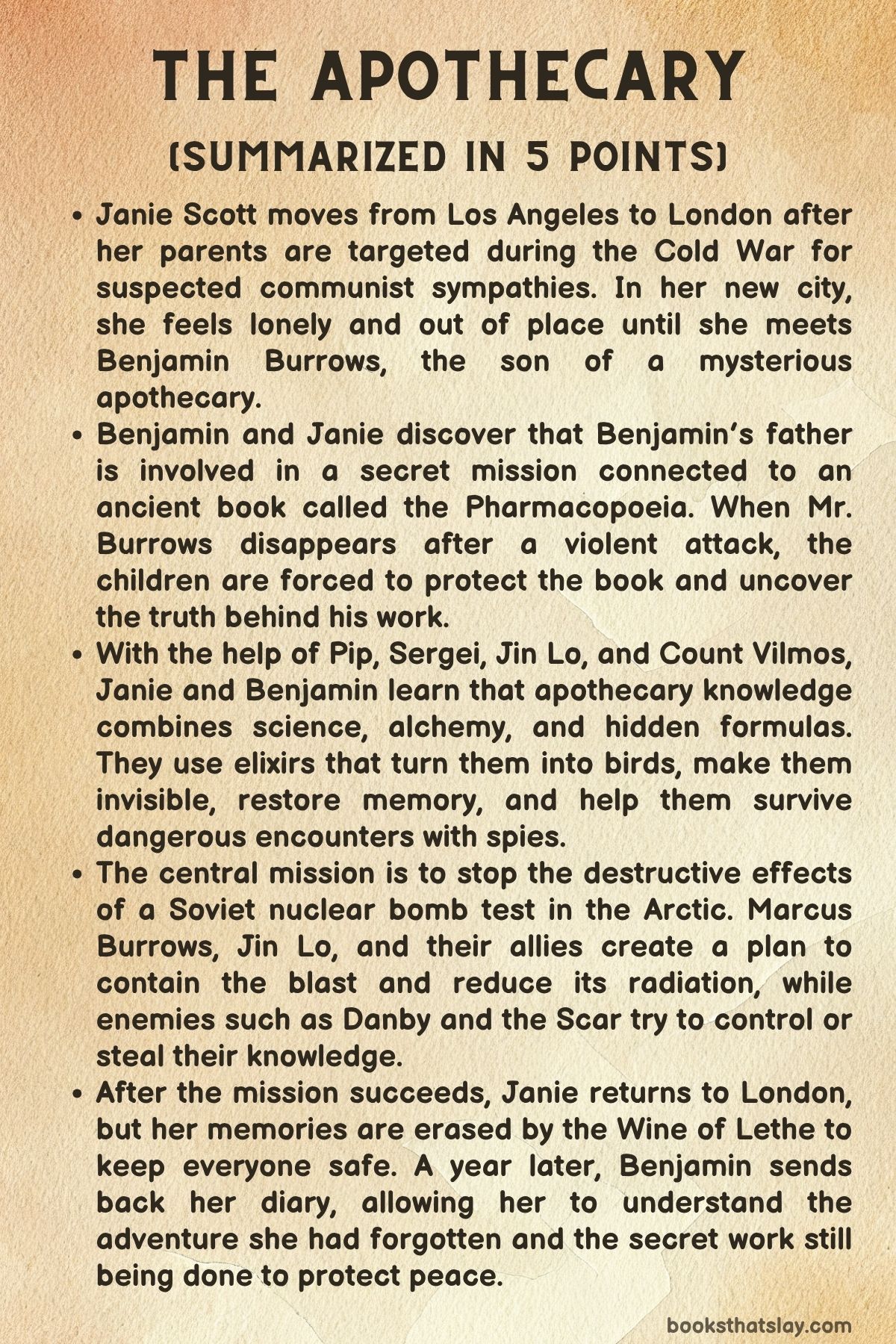
Janie Scott grows up in Los Angeles after World War II, in a home filled with wit, conversation, and the warmth of her parents’ work in the entertainment world. For a while, her childhood feels safe, bright, and secure.
That safety begins to change as the Cold War intensifies. Schools teach children what to do if an atomic bomb falls, and fear of communism reaches into homes, workplaces, and friendships.
Janie first feels this fear in a personal way when she notices that she is being followed by men in a black car. Soon after, her parents tell her that they must leave America because they are suspected of communist sympathies and may be forced to testify against friends.
Janie is angry and frightened, not fully understanding the politics involved but knowing that her life has been overturned.
The family moves to London, where everything feels colder and darker than California. Bomb damage from the war still marks the city, and Janie feels out of place in her new surroundings.
Her parents begin writing for the BBC under assumed names, while Janie tries to adjust to school and daily life. Near their flat is an apothecary shop run by Marcus Burrows, a kind and mysterious man who gives Janie powders to help with her homesickness.
At school, she meets Sarah Pennington, a beautiful and confident girl, and Benjamin Burrows, the apothecary’s son. Benjamin is sharp, restless, and eager for adventure.
He does not want to follow his father’s profession; instead, he dreams of working in intelligence.
Benjamin pulls Janie into his world by inviting her to watch suspicious activity in Hyde Park. He believes that Leonid Shiskin, the father of a schoolmate named Sergei, is passing secret messages through a newspaper.
Janie, at first unsure, becomes drawn into the observation. When Benjamin’s father is seen taking a message from Shiskin, the children follow him back to the apothecary shop.
There they discover that Mr. Burrows is involved in something far more serious than ordinary medicine. Before he can explain much, armed men break into the shop.
He gives Benjamin an ancient book called the Pharmacopoeia and orders him to protect it. The children hide while the shop is attacked, and when they emerge, Mr. Burrows has vanished.
The Pharmacopoeia becomes the center of the mystery. It is an old family text filled with strange formulas and alchemical knowledge.
Benjamin and Janie take it to Janie’s flat, where Benjamin stays overnight under false pretenses. The book bears a symbol that leads them to the Chelsea Physic Garden, a hidden green space connected to the work of apothecaries.
There, an elderly gardener recognizes Benjamin and explains that the symbol relates to alchemy. He speaks of transformative elixirs, truth-inducing plants, and possibilities that Benjamin has been too skeptical to accept.
He also tells them about Jin Lo, a Chinese chemist whose name appeared in the warning message that Mr. Burrows received.
Janie and Benjamin test one of the garden’s plants, veritas, which forces people to tell the truth when they smell it. Their experiment embarrasses Janie when she admits she likes Benjamin, while he admits he likes Sarah.
Still, the test proves that the book’s knowledge works. The children then use the plant to confront Shiskin in his home.
The plan goes wrong, but Shiskin reveals crucial information: Mr. Burrows is expected to meet him on a ship at the Port of London, and the scarred man who helped abduct him is connected to East German secret police. Shiskin then takes a pill that prevents him from speaking, cutting off further answers.
The danger grows when Janie and Benjamin return to the physic garden and find the gardener dying from a violent attack. Before he dies, he warns them not to trust the police and tells them to find a hidden bottle.
The bottle contains the avian elixir, which can turn people into birds. Benjamin still struggles to believe in this kind of alchemy, but events force him to accept that his father’s world is real.
Janie tries to seek help from Mr. Danby, her Latin teacher, because part of the Pharmacopoeia is written in Latin. Danby seems kind and capable, but this trust proves dangerous.
Soon, Janie and Benjamin are taken by the police and questioned. Danby arrives and appears to rescue them, but when they see that his driver is the scarred man, they realize he is not the ally they hoped he was.
With the help of Pip, a clever young pickpocket they meet in detention, Janie and Benjamin escape. Cornered on a roof, they use the avian elixir.
Benjamin becomes a skylark, Pip becomes a swallow, and Janie becomes a robin. In bird form, they follow Danby and the Scar to a secret bunker.
After returning to human form, they decide they need the Pharmacopoeia again to become invisible and enter the bunker safely. Sergei returns the book to them, and Pip’s street skills become invaluable.
Using Janie’s gold earrings, they create an invisibility potion, submerge themselves in it, and sneak into the bunker.
Inside, they discover that the prisoner is not Benjamin’s father but Jin Lo, the Chinese chemist. She has been captured because of her work on a plan to contain the damage caused by a nuclear bomb.
Jin Lo can see the invisible children and helps them escape using her own chemical skill. Together they return to the apothecary shop, where she uses a memory-restoring oil to help Janie and Benjamin recall a detail from the night Mr. Burrows disappeared.
They realize that he has been transformed into a pile of salt and hidden in an old shelter. Jin Lo gathers every grain and uses another formula to restore him to human form.
Once rescued, Mr. Burrows explains the larger plan. Apothecaries and scientists from different countries have been secretly working to stop the catastrophic effects of nuclear weapons.
Jin Lo has created a polymer net that can contain the force of an explosion, while Mr. Burrows has developed a substance called the Quintessence, drawn from the flower of a rare jaival tree, to absorb radiation. Count Vilmos, a Hungarian physicist, has the ability to manipulate time.
Together they hope to stop or contain a Soviet bomb test in the Arctic. This mission is not about helping one nation defeat another; it is about protecting the world from the consequences of the arms race.
The children are ordered to stay behind, but they refuse to remain passive. Benjamin, Janie, and Pip plan to sneak onto the ship.
Sarah helps by giving them warm clothing and, unknowingly, materials for more invisibility elixir. At the port, they meet Count Vilmos and Captain Norberg, and they deliver the Pharmacopoeia to Mr. Burrows.
Even after being told to leave, Janie and Benjamin sneak aboard while Pip distracts the police. They soon learn that Shiskin is also on the ship and has been forced by Soviet agents to betray the mission because his wife and daughter are being threatened.
This complicates the moral boundaries of loyalty and betrayal, because Shiskin is not simply evil; he is a desperate father.
The ship is disguised and renamed the Anniken so it can continue north. The crew chooses to support the mission despite the danger.
Shiskin is tricked into radioing the Soviets that he has been captured and will be executed, though the group does not actually plan to kill him. As they travel into Arctic waters, Janie witnesses Jin Lo’s skill, Count Vilmos’s knowledge, and the seriousness of the work they are all attempting.
Benjamin, who once rejected his father’s profession, begins to understand that apothecary work can be as brave and dangerous as espionage. During the voyage, he also admits that he no longer likes Sarah and that his feelings are now for Janie.
They share a kiss, deepening the personal stakes of their journey.
When a Soviet patrol vessel appears, the group leaves the ship in bird form and flies toward the testing site. Janie hides the Pharmacopoeia for safety before leaving.
On the island, they see Danby, the Scar, and the young scientist Andrei Sakharov near the bomb. Janie, small enough in robin form to enter the building where the bomb is kept, is caught by the Scar and taken back to the Soviet ship.
She pretends that the others died during the flight, hoping to protect them. Danby leaves her exposed on deck, believing that the bomb’s radiation will kill her.
From the ship, Janie watches the bomb detonate. Instead of spreading destruction as expected, the explosion is contained.
The clouds expand, stop, and contract, suggesting that the team’s plan has worked. However, the Dark Force released from the jaival tree earlier now appears as a threatening black cloud.
Janie is taken back to the island with Danby, the Scar, and Sakharov. When Benjamin falls from the sky into the freezing sea, Janie persuades Danby to rescue him by claiming that Benjamin knows the apothecary’s secrets.
As the Dark Force overtakes the helicopter, Janie and Benjamin fall into the water. They are saved by a man named Hirra, who later brings them back to the Anniken.
Janie is eventually reunited with Mr. Burrows and returned to London with Benjamin.
Back in London, Janie’s parents are overwhelmed with relief. But the victory does not end with open celebration.
Mr. Burrows knows that he and Benjamin are no longer safe, and he decides they must disappear. At a train station, he gives Janie, her parents, Pip, and Detective Montclair a drink containing the Wine of Lethe, which erases their memories of the past three weeks.
Benjamin asks Janie for her diary, knowing it holds the only written record of what happened. Janie and her father try to follow Benjamin and his father, but their memories fade before they can understand what they are doing.
Afterward, Janie’s family pieces life together from small clues. Janie returns to school but does not remember the events that changed her.
Pip attends St. Beden’s, Sarah still speaks of him, and Sergei later writes from Florida, but Janie cannot connect these fragments. A year later, Janie receives her red diary in the mail with a note from Benjamin.
As she reads it, the lost truth returns through writing rather than memory. She understands at last why she has felt haunted by absence and why Benjamin and his father had to vanish.
The story ends with Janie recognizing that they are still out in the world, working to protect peace in secret.
Characters
Janie Scott
Janie Scott is the emotional center of the book, and her growth gives the adventure its personal shape. At the beginning, she is a displaced American girl who feels angry at her parents and resentful about leaving Los Angeles.
London seems gray, strange, and unfriendly to her, and her homesickness makes her feel isolated. Yet Janie is never passive for long.
Her curiosity, courage, and willingness to act draw her into Benjamin’s investigation, and once the danger becomes real, she repeatedly proves more open-minded than he is. In The Apothecary, Janie’s strength comes from a combination of practical intelligence and emotional honesty.
She is frightened often, but fear does not stop her from taking risks when someone needs help. She gives up her grandmother’s earrings to make the invisibility elixir, lies to protect Benjamin, confronts danger in the bunker, and later risks herself to save him in the Arctic.
Her diary is also essential to her character because it preserves truth when memory fails. Even after the Wine of Lethe erases her experiences, her written words restore her connection to the past.
Janie’s journey is not only about adventure; it is about learning that moral courage often begins before a person feels ready.
Benjamin Burrows
Benjamin Burrows begins the story as a boy who wants to escape the life prepared for him. He sees his father’s apothecary work as dull and old-fashioned, while intelligence work seems exciting and heroic.
This view changes as the book reveals that the apothecary tradition is not ordinary pharmacy but a secret practice involving science, alchemy, healing, and global responsibility. Benjamin is clever, stubborn, and sometimes proud.
He wants to be brave, but he also resists facts that do not fit his idea of the world. His disbelief in the Pharmacopoeia’s power makes him slower than Janie to accept the truth, even though the ancient book belongs to his own family.
Within The Apothecary, Benjamin’s character arc depends on accepting inheritance without surrendering independence. He does not simply become his father; he learns why his father’s work matters.
His bond with Janie also changes him. At first, he admires Sarah’s beauty, but his experiences with Janie show him the value of loyalty, nerve, intelligence, and trust.
His anger at Shiskin after Janie is threatened shows how deeply he feels, but it also reveals his need to control rage before it turns into cruelty. By the end, Benjamin is more mature, more aware of danger, and more willing to carry the burden of secrecy.
Marcus Burrows
Marcus Burrows is both a father and a guardian of dangerous knowledge. At first, he appears to be a friendly neighborhood apothecary who offers Janie simple remedies for homesickness.
Later, he is revealed as a figure connected to a centuries-old tradition, a secret network of apothecaries, and an urgent mission to reduce the harm caused by nuclear weapons. His character is marked by responsibility.
He does not seek glory, and he does not explain himself easily, partly because secrecy protects others. His decision to hide the Pharmacopoeia and order Benjamin to protect it shows his trust in his son, even though Benjamin has not yet accepted the family calling.
As a father, Marcus is loving but not overprotective in a simple way. He understands that keeping Benjamin physically safe is not enough if the wider world is moving toward destruction.
His speech to the crew makes this clear: protecting children also means trying to create a future in which they can live. His transformation into salt and restoration by Jin Lo also symbolize the vulnerability of even the most knowledgeable adults in the story.
He is powerful, but he depends on others. Marcus represents inherited wisdom, sacrifice, and the idea that science and magic must serve life rather than power.
Jin Lo
Jin Lo is one of the most capable and impressive figures in the story. She is introduced first as a name in a warning, then as a prisoner, but when she finally appears, she immediately changes the balance of power.
She is disciplined, brilliant, and calm under pressure. Her background as a chemist from Shanghai gives her knowledge that complements Marcus Burrows’s apothecary tradition and Count Vilmos’s physics.
Jin Lo is not treated as a side helper; she is central to the mission. Her polymer net is one of the key inventions needed to contain the bomb’s force, and her quick thinking enables the escape from the bunker.
She can create smoke, restore memory, reverse the salt transformation, and respond to danger with speed. Jin Lo also carries emotional depth beneath her composure.
When the memory oil causes her to recall painful experiences from her own past, the reader sees that her strength has been shaped by suffering and discipline. She is practical rather than sentimental, but she is not cold.
Her work is directed toward saving lives, and her presence expands the book’s moral world beyond national boundaries. She stands for intelligence in service of peace, and she shows that courage can be quiet, exact, and unsentimental.
Pip
Pip brings street knowledge, humor, and quick practical skill into the story. He enters as a young pickpocket and housebreaker, someone who has survived by cleverness rather than social privilege.
At first, he might seem like a comic addition, but he quickly becomes essential. He can pick locks, read rooms, improvise lies, distract adults, and understand danger in ways Janie and Benjamin cannot.
Pip’s talents are not polished or respectable, but the book treats them as valuable. His presence challenges simple ideas about goodness and class.
Though he has committed crimes, he is loyal, brave, and generous when it matters. His instant admiration for Sarah adds comedy, but it also reveals his longing for beauty, acceptance, and a life beyond the margins.
Pip’s chess ability is another important detail. He hides his intelligence behind rough manners and low expectations, then surprises others by outplaying them.
He is especially important because he chooses to help even when the mission is not his family legacy or his political duty. By joining Janie and Benjamin, Pip becomes part of a moral community built not on status but on action.
In that way, he becomes one of the book’s strongest examples of unexpected heroism.
Mr. Danby
Mr. Danby is one of the book’s most unsettling characters because he first appears trustworthy. He is young, handsome, intelligent, and respectful toward Janie.
As a teacher, he seems to notice her as a person rather than treating her like a child, which makes her decision to confide in him understandable. This early warmth makes his betrayal more disturbing.
Danby is not a simple villain motivated only by greed or cruelty. The moral world of The Apothecary makes him dangerous because he believes his choices are justified by political ideals.
He admires Soviet strength and thinks it can balance American power, but his beliefs lead him to deception, threats, and collaboration with violent people. Danby shows how charm and education do not guarantee moral clarity.
He knows how to sound reasonable, and he can present himself as a protector, yet he repeatedly uses children and prisoners as tools. His role also complicates Janie’s coming-of-age.
She must learn that adults who seem kind may still be dangerous, and that authority figures can misuse trust. Danby’s character works as a warning about ideology without conscience.
He wants to influence world events, but he loses sight of individual lives.
Leonid Shiskin
Leonid Shiskin is a morally conflicted character whose actions are shaped by coercion, fear, and love for his family. At first, Benjamin sees him as a suspicious Soviet agent passing messages in Hyde Park, and the children treat him as a target of investigation.
As more is revealed, Shiskin becomes harder to judge. He is connected to secret work and deception, but he is also being pressured because his wife and daughter are in danger.
His betrayal of Marcus Burrows and the mission is serious, yet it comes from desperation rather than pure malice. This makes him one of the book’s more complex adult figures.
He is capable of threatening Janie and acting violently, especially when cornered, but he is also a father trapped by a ruthless system. The wooden leg, the muting pills, and his coded messages all suggest a life shaped by secrecy and survival.
Shiskin forces the reader to consider how fear can corrupt loyalty and how political systems exploit family love. He is not excused by the story, but he is given context.
His character shows that in wartime and Cold War conflict, betrayal often grows from pressure placed on ordinary human attachments.
Sergei Shiskin
Sergei Shiskin is quieter than many of the other young characters, but his role is important. He is the son of Leonid Shiskin and a student at St. Beden’s, and he becomes connected to the adventure because of his father’s secret activities.
Sergei is intelligent, observant, and eager to belong. When Benjamin and Janie first visit his home under the excuse of a science experiment, Sergei appears lonely, especially because his mother and sister are in Russia.
His family situation gives the larger Cold War conflict a child’s face. He is not responsible for his father’s choices, yet he lives with their consequences.
Sergei also proves trustworthy when he protects the Pharmacopoeia after Benjamin and Janie are seized by the police. That action is quiet but crucial.
Without it, the children might lose access to the knowledge that allows them to rescue Jin Lo and continue the mission. Sergei wants to help more directly, but others try to keep him out of danger.
His later move to Florida suggests that he, too, has been displaced by politics. Through Sergei, the book shows how children are pulled into adult conflicts even when they have little power over them.
Sarah Pennington
Sarah Pennington is introduced through Janie’s eyes as beautiful, wealthy, healthy, and socially secure. At first, she seems to represent everything Janie is not in London: settled, admired, and comfortable.
Benjamin’s early attraction to Sarah adds tension for Janie, who feels embarrassed by her own feelings. Yet Sarah is not only a symbol of beauty or privilege.
She becomes useful to the mission in practical ways, even if she does not fully understand what is happening. She provides warm clothing for the Arctic journey and gives up her gold necklace after Pip persuades her that it is needed for a science project.
Her privileged household, complete with servants and resources, contrasts sharply with Pip’s background and with Janie’s unstable life as a political exile. Sarah’s attraction to Pip also adds a light but revealing reversal: she is drawn not to polished respectability but to his confidence and boldness.
Sarah does not undergo the same level of transformation as Janie or Benjamin, but she helps show the social world of St. Beden’s and the different forms of innocence in the story. She remains somewhat outside the central danger, yet her choices still help the children move forward.
Janie’s Parents
Marjorie and Davis Scott are loving, witty, politically pressured parents whose choices set the story in motion. Their move to London is not an adventure for them but a forced escape from suspicion in America.
They work in entertainment, and their fear of being compelled to testify about friends reflects the climate of anti-communist suspicion. To Janie, their decision first feels selfish and humiliating; she blames them for uprooting her life.
Over time, however, the reader can see that they are trying to protect both their family and their integrity. They treat Janie with unusual respect, often including her in adult conversation and trusting her intelligence.
This openness helps make Janie brave, even though they cannot protect her from the dangers she encounters. Their anguish when she disappears shows the depth of their love, while their memory loss after the Wine of Lethe adds sadness to the ending.
They have lived through a terrifying absence and then lose the truth of it. Marjorie and Davis represent the ordinary family life that political fear disrupts, and they show how public suspicion can invade private homes.
Count Vilmos
Count Vilmos is a Hungarian physicist whose scientific brilliance adds another dimension to the secret peace mission. He is connected to the same international effort as Marcus Burrows and Jin Lo, and his ability to freeze or slow time makes him both mysterious and essential.
Vili is passionate, intelligent, and sometimes emotionally intense, especially when discussing the Soviet bomb and the scientist involved in its creation. His admiration for genius does not blind him to danger, but it does reveal his deep respect for scientific achievement.
Vili also helps explain the consequences of tampering with natural laws, especially when Janie asks about the Dark Force. His perspective gives the story a serious ethical layer: discovery is powerful, but it is never free from consequence.
During Shiskin’s confrontation with Janie, Vili’s power saves her life by allowing him to move while time is frozen. This moment shows that his gifts are not abstract; they matter in immediate human terms.
Count Vilmos represents science as both wonder and responsibility. Like Jin Lo and Marcus, he works across national lines, suggesting that the defense of life must be larger than political allegiance.
The Scar
The Scar is a figure of menace throughout the book. He is identified by the long scar on his face and connected to East German secret police, which makes him an immediate sign of violence and state power.
Unlike Danby or Shiskin, he is not given much moral complexity. His function is to threaten, pursue, capture, and enforce the will of more politically motivated figures.
This makes him frightening in a direct physical way. He appears during the attack on the apothecary shop, drives Danby, helps intimidate prisoners, and later catches Janie in bird form.
His presence reminds the reader that behind ideology and espionage there are people willing to use force without hesitation. The Scar also gives shape to Janie’s fear.
He is not an abstract political danger but a person who can reach for her, trap her, and carry her into enemy control. His lack of inner explanation is part of his effect.
He represents the brutal machinery of surveillance and coercion, the kind of person who makes secret police systems terrifying not through speeches but through action.
Themes
Memory, Loss, and the Written Record
Memory in The Apothecary is fragile, valuable, and politically dangerous. Janie begins by explaining that she lost her memory of the central events, not through ordinary forgetfulness but through a deeper erasure.
This makes the diary more than a private notebook; it becomes a witness. The Wine of Lethe removes lived experience from Janie, her parents, Pip, and Detective Montclair, but it cannot erase the written record once Benjamin returns it.
The book treats memory as part of identity, because Janie’s forgotten experiences still leave traces in her emotions. She feels absence, confusion, and strange connections before she understands why.
The memory oil works in the opposite direction, restoring hidden truth and allowing Janie and Benjamin to remember that Marcus Burrows is hidden as salt. These two substances, one restoring and one erasing, create a clear moral contrast.
Forgetting can protect people, but it also steals grief, love, responsibility, and understanding. Writing becomes the answer to that theft.
Janie’s diary preserves what power tries to remove, and when she reads it again, she regains not only facts but a fuller version of herself.
Science, Magic, and Moral Responsibility
The story refuses to draw a simple line between science and magic. The Pharmacopoeia contains formulas that seem impossible, yet they operate with rules, ingredients, risks, and consequences.
Jin Lo’s chemistry, Count Vilmos’s physics, and Marcus Burrows’s apothecary knowledge all belong to the same larger question: what should powerful knowledge be used for? The avian elixir, invisibility potion, memory oil, and Quintessence are wondrous, but none of them are treated as toys.
Each discovery creates danger as well as possibility. The jaival tree’s Dark Force makes this especially clear.
Even an act meant to save lives can disturb nature and release harm. This theme becomes most urgent in relation to nuclear weapons.
The bomb is the destructive side of human intelligence, while the apothecaries’ mission is an attempt to answer destruction with protection. The book does not reject science; instead, it asks for science guided by conscience.
Knowledge becomes honorable only when it serves life rather than domination. Characters are judged not by how much they know, but by what they are willing to protect with that knowledge.
Childhood Courage in an Adult Conflict
Janie, Benjamin, Pip, Sergei, and Sarah are all children living inside conflicts created by adults: war, political suspicion, espionage, and the nuclear arms race. They do not control governments or armies, yet they are repeatedly forced to make serious choices.
Janie must decide whom to trust, whether to lie to her parents, whether to risk herself for Benjamin, and whether to keep moving when adults fail her. Benjamin must decide whether to reject or accept his father’s legacy.
Pip, who has little social power, uses the skills he has gained through hardship to help save others. Sergei is caught in his father’s dangerous world, while Sarah’s resources unexpectedly aid the mission.
The children’s courage is not presented as simple fearlessness. They are scared, jealous, embarrassed, confused, and sometimes wrong.
Their bravery comes from acting despite those feelings. The adults in the book often underestimate them, but the mission repeatedly depends on their choices.
This theme gives the story much of its energy: young people may not have official authority, but they can still recognize danger, protect truth, and take moral action when the adult world becomes compromised.
Loyalty, Betrayal, and Divided Allegiance
Loyalty in the story is rarely simple. Characters must choose between family, country, ideology, friendship, and the safety of the world.
Janie’s parents leave America because they refuse to betray friends under political pressure, yet Janie initially experiences that choice as a betrayal of her own stable childhood. Shiskin betrays the mission, but he does so because his wife and daughter are threatened.
Danby betrays his students and his country because he believes Soviet power can balance American influence. Benjamin feels torn between his desire for independence and his loyalty to his father’s calling.
These conflicts show that betrayal often begins when one loyalty is used to crush another. The book is especially interested in the difference between loyalty to a nation and loyalty to humanity.
Marcus Burrows, Jin Lo, Count Vilmos, and Captain Norberg’s crew work across national lines because nuclear destruction would not respect borders. Their allegiance is to peace rather than political victory.
The strongest loyalty in the story is therefore not blind obedience. It is the willingness to protect life, even when doing so requires secrecy, sacrifice, exile, or being misunderstood.