Racing Hearts Summary, Characters and Themes | Ann Adams
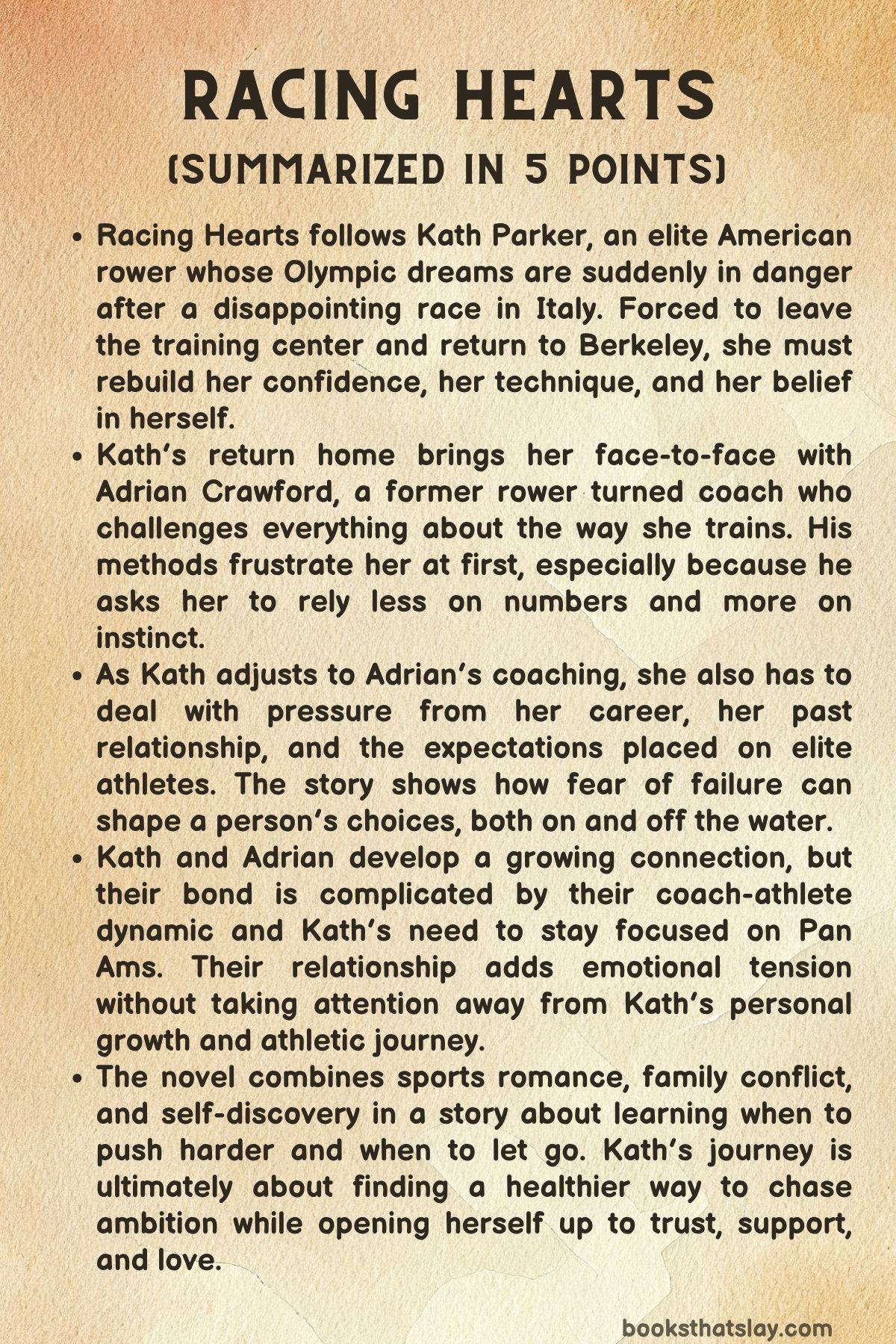
Racing Hearts by Ann Adams is a contemporary sports romance about ambition, failure, trust, and the hard work of learning to let go. The story follows Kath Parker, an elite American rower whose Olympic dream is at risk after a string of poor races.
Sent back to Berkeley to rebuild her training, she is forced to work with Adrian Crawford, a coach whose relaxed, instinctive approach challenges everything she believes about success. As Kath fights to reclaim her place in rowing, she also faces a growing attraction that could change her plans, her career, and her understanding of herself.
Summary
Kath Parker is an elite American single sculler in Italy for what may be the most important World Cup race of her career. Her recent results have been disappointing, and she knows another weak finish could damage her chance of reaching the Olympics.
The night before the final, she is anxious and desperate to hold on to one of her most trusted pre-race rituals: eating a lemon bar. Her boyfriend, Maxwell, has thrown away the last one because he says it is unhealthy, leaving Kath furious and unsettled.
With her best friend Sofi beside her, she searches Varese for a bakery that might still have one.
At the bakery, Kath finds that the last lemon bar has already been bought by a handsome stranger. She explains that she needs it for her race, while he says lemon bars remind him of his late father.
Instead of simply giving it up, he agrees to settle the matter with an arm-wrestling match. Kath wins, claims the lemon bar, and leaves with another strange, charged memory from an already stressful night.
The next morning, Maxwell appears at the dock just before Kath’s race. Instead of supporting her, he breaks up with her.
He tells her their relationship has been failing and suggests she is likely to perform poorly anyway. Kath is stunned, angry, and shaken.
She rows the final in a storm of emotion and finishes last. The result confirms her worst fear.
After the race, her coach Carla summons her to a meeting and delivers hard news: Kath’s recent failures have cost her not only a place at Worlds but also her residency at the Olympic Training Center. If she wants to get back on track, she must leave the center, train elsewhere, and prove herself at Pan Ams.
Carla sends Kath back to Berkeley to train with Adrian Crawford at the youth rowing club where Kath once rowed. Kath hates the plan.
She does not want to train around teenagers, and she is even less excited about moving back into her childhood home with her lively, unpredictable mother, Mimi. Before she leaves Italy, Kath attends an athletes’ party with Sofi and runs into the lemon-bar stranger again.
They talk honestly about failure, drink, dance, and nearly kiss. When he pauses and asks whether she is sure, Kath feels embarrassed and runs away.
Back in Berkeley, Kath discovers that the stranger is Adrian Crawford, the coach Carla has assigned to rebuild her training. Their working relationship starts badly.
Adrian believes Kath is exhausted and overtrained, so he orders her to rest. Kath sees rest as weakness and tries to sneak in workouts, even using club equipment without permission.
Carla later gives her a clear bargain: if Kath commits fully to Adrian’s program, evaluates him for a possible junior national team coaching job, and finishes in the top two at Pan Ams, Carla may be able to argue for her return to the training center.
Kath agrees because she has no better option, but she struggles with Adrian’s methods. He removes her phone, watch, and StrokeCoach during practice so she has to row by feel rather than by numbers.
Kath resents being cut off from data, yet she rows one of her fastest intervals when she stops checking metrics. Adrian’s coaching is flexible, intuitive, and grounded in trust, which frustrates Kath because she has built her career on control, discipline, and measurement.
At the same time, her attraction to Adrian becomes harder to ignore. After an encounter connected to Mimi’s yoga studio, they kiss with real heat, but Kath quickly insists that nothing can happen between them.
She needs to focus on Pan Ams, and she is supposed to evaluate him for Carla. She tries to make their relationship strictly professional, using Carla’s standards as a guide for what she can and cannot say.
Kath’s pressure grows when she learns that Camila Gomes, a Brazilian rower who recently moved from the eight to the single, has become a major threat. To regain her place, Kath may need to beat either Camila or the dominant Canadian sculler.
Sofi points out that Kath has been following Adrian’s orders without truly believing in the program. Kath realizes that doing the work halfheartedly will not be enough.
With her residency, career, and Olympic future at stake, she chooses to fully commit to Adrian’s approach.
As they spend more time together, Adrian opens up about his own painful history with rowing. He once had a Georgetown athletic scholarship, but he gave it up under the weight of pressure from his father, who demanded perfection and trained him harshly.
Adrian still carries the pain of never earning his father’s approval before his father died. Kath comforts him and tells him he is a good coach and a good man, no matter what his father believed.
Their connection turns romantic again, and they kiss. Their desire grows, but Adrian stops before they go further because he wants their relationship to have a future, not just a single impulsive night.
Kath spends the night at Adrian’s apartment. He cooks for her and tells her the race that made him quit competing.
In a high-pressure U-23 event arranged by his father, Adrian caught a crab, caused his boat to be disqualified, and felt he had humiliated them both. Kath helps him see that leaving racing did not mean he abandoned rowing.
He returned to the sport as a coach, which proves that rowing still matters to him.
Kath later trains with Peter, one of Adrian’s young athletes, and they have a strong session. Peter admits he is afraid of failing at Youth Nationals.
Kath, who is used to handling fear by working harder, struggles to comfort him. After talking with Mimi, she begins to understand that she cannot control every outcome.
Her mother encourages her to be present and enjoy what the summer offers instead of trying to force the future into a plan.
Kath asks Adrian for a casual relationship that will last only until Pan Ams. Adrian agrees, but he refuses to let her reduce their time together to a schedule.
Their relationship becomes physical and emotionally close. Kath realizes Adrian understands parts of her that other people, including Maxwell, never did.
Meanwhile, her rowing continues to improve because she is learning to trust her body, her instincts, and Adrian’s coaching.
A setback hits when Peter breaks his arm while skateboarding, ending his chance to compete at Youth Nationals. At the hospital, Adrian handles the situation with calm support.
Kath shares her own story of missing Junior Worlds after breaking her ankle, and her honesty gives Peter comfort. Afterward, she helps Adrian choose a replacement for Peter in the quad.
She suggests Rohan, a funny and energetic rower whose personality could help hold the team together.
Rohan is unsure he belongs in the boat and worries that moving up will make rowing stop being fun. Kath and Adrian help him understand that his humor, videos, and enthusiasm are not distractions but strengths the crew needs.
Rohan accepts the spot. Later, Adrian takes Kath on a difficult open-water row to Angel Island.
When rough water causes her to panic, he guides her through breathing and body awareness until she regains control. Kath rows strongly through the waves, and the experience becomes another step in her growth.
Kath also encourages Adrian to see his own value as a coach and to believe he deserves the junior development job in Florida. Adrian resists because he connects the opportunity to his unresolved need for his father’s approval.
Sofi visits and warns Kath that dating Adrian while evaluating him is unethical. Kath knows she must tell Carla the truth.
She also argues with Mimi after learning her mother is dating Rob, then realizes she is being unfair. Her own supposedly casual relationship with Adrian is not casual at all, and ending it will hurt.
Adrian asks Kath to consider a long-distance relationship, but Kath cannot give him an answer. Maxwell returns and wants to restart their relationship, but Kath rejects him, finally seeing how little he supported her.
She later reads Adrian the strong recommendation letter she wrote for him, hoping it will help him believe in himself. When he closes himself off, she leaves.
At Pan Ams in Toronto, Kath tells Carla the truth about her relationship with Adrian. She races well, proving that she has improved, but she still loses the spot she needed.
She also learns that Adrian has accepted the Florida coaching job after his athletes encouraged him. Kath is crushed and calls Mimi in tears.
In the end, Kath and Adrian find a way forward. USRowing decides their relationship is acceptable because Adrian will coach men while Kath rows on the women’s side.
Eight months later, Kath is training again with Sofi, Adrian is doing well in his new coaching role, Peter is back on the water, and Kath and Adrian are together. Kath has not simply recovered her career; she has learned that success does not require constant control.
She can still chase the Olympics while allowing room for love, trust, failure, and a future she does not have to plan alone.
Characters
Katherine (Kath) Parker
Kath Parker is the central figure of Racing Hearts, and her character is shaped by pressure, discipline, fear, and a deep hunger to prove that she still belongs at the highest level of rowing. As an elite American single sculler, she has built her life around performance, routines, and measurable success, which is why her pre-race lemon bar ritual matters so much to her.
It is not just a craving; it represents control in a world where one bad race can threaten everything she has worked for. Kath begins the story emotionally brittle, already frightened by poor results and then pushed further off balance by Maxwell’s cold breakup right before her race.
Her dead-last finish becomes more than an athletic failure; it exposes how fragile her confidence has become.
Kath’s journey in the book is about learning that control is not the same as strength. She initially resists Adrian’s coaching because his methods force her away from data, constant measurement, and self-punishing effort.
She wants to believe that harder work and stricter discipline will save her career, but Adrian gradually shows her that she has become disconnected from her body, her instincts, and her love for rowing. Her development is visible in the way she moves from sneaking workouts and clinging to metrics toward trusting rhythm, awareness, rest, and emotional honesty.
This makes her growth both athletic and personal.
Kath is also emotionally guarded. Her relationship with Adrian frightens her because it threatens the boundaries she believes she needs in order to succeed.
She tries to define their connection as casual and temporary, but the depth of their understanding makes that impossible. Her struggle is not simply whether she loves Adrian, but whether she can accept a future that is not perfectly planned.
By the end, Kath becomes more open, more self-aware, and more capable of separating failure from worth. She does not become fearless, but she becomes stronger because she learns to live without controlling every outcome.
Adrian Crawford
Adrian Crawford is one of the most emotionally layered characters in the story. At first, he appears as the charming stranger who competes with Kath over the last lemon bar, but he soon becomes far more important as her temporary coach and eventual love interest.
His warmth, patience, and unconventional approach to training contrast sharply with Kath’s anxiety-driven discipline. Adrian believes in intuition, rest, body awareness, and trust, which makes him exactly the kind of coach Kath needs, even though she resists him at first.
Adrian’s own relationship with rowing is complicated by pain. His father’s harsh expectations made the sport feel like a test of worth rather than a source of joy.
Giving up his Georgetown athletic scholarship and quitting competitive racing were not signs of laziness or weakness; they were the result of emotional exhaustion and a deep wound caused by never feeling good enough. The memory of catching a crab in a major race and humiliating himself in front of his father still shapes how he sees himself.
He carries the belief that he failed not only as an athlete but also as a son.
What makes Adrian compelling is that he has transformed his pain into compassion. As a coach, he gives young rowers the emotional support he never received.
He is calm with Peter after the injury, encouraging with Rohan when he doubts himself, and patient with Kath when her fear makes her stubborn. His romance with Kath is tender because both of them understand failure intimately.
Adrian does not push Kath to abandon ambition; instead, he teaches her to pursue it without destroying herself. His acceptance of the Florida coaching job shows that he, too, learns to step beyond his father’s shadow and claim his own value.
Sofi
Sofi is Kath’s best friend and one of the most important voices of honesty in the book. She supports Kath emotionally, but she is not merely a comforting side character.
Sofi has the courage to challenge Kath when Kath is avoiding uncomfortable truths. From the beginning, Sofi questions Maxwell’s behavior and recognizes that his concern for Kath’s career may be more selfish than loving.
Her friendship is protective without being controlling, and she often sees Kath’s emotional reality more clearly than Kath does herself.
Sofi’s role becomes especially important when Kath starts training with Adrian. She understands Kath’s ambition and pressure, but she also notices when Kath is pretending that obedience is the same as commitment.
Her observation that Kath is following Adrian’s instructions without fully believing in them helps push Kath toward a deeper change. Sofi’s insight is practical and emotional at once; she knows that Kath cannot rebuild herself through half-measures.
Sofi also represents moral clarity. When she tells Kath that dating Adrian while evaluating him is unethical, she forces Kath to confront the conflict she has been trying to manage privately.
This moment matters because Sofi does not simply encourage Kath’s happiness at any cost. She cares about Kath’s integrity, career, and future.
Her friendship is honest enough to create discomfort, which makes it stronger and more realistic. Sofi’s presence helps Kath become more accountable, not just more comforted.
Maxwell
Maxwell is Kath’s ex-boyfriend and functions as a symbol of conditional support. He appears to care about Kath’s health and success, but his actions reveal that his concern is often controlling and self-serving.
Throwing away her lemon bar may seem like a small act, but within the story it reveals a larger pattern: he does not respect the rituals and emotional needs that help Kath feel grounded. He assumes he knows what is best for her, even when his choices undermine her.
His breakup with Kath at the dock just before her race is especially cruel. The timing shows a lack of empathy and reveals how little he understands the emotional stakes of her athletic life.
By implying that she is likely to perform badly anyway, he attacks the very confidence she needs most. Maxwell’s presence in the book highlights how damaging it can be when love becomes tied to performance, image, or convenience.
When Maxwell later returns and wants to resume the relationship, Kath’s rejection of him becomes an important sign of growth. Earlier, she might have been vulnerable to his approval because she was already afraid of losing her place in rowing.
By refusing him, she chooses self-respect over familiarity. Maxwell therefore serves as a contrast to Adrian: where Adrian helps Kath reconnect with herself, Maxwell makes her feel smaller and less secure.
Carla
Carla is Kath’s coach and one of the main forces of professional pressure in the novel. She is direct, demanding, and practical, and her decisions are shaped by the brutal reality of elite sport.
When Kath performs poorly, Carla does not soften the consequences. She tells Kath that her results have cost her major opportunities and that she must leave the Olympic Training Center.
This makes Carla seem harsh, but she is not presented as careless. She understands the system Kath is trying to survive, and she knows that sentiment alone cannot protect an athlete’s career.
Carla’s character represents the institutional side of rowing. She is concerned with results, rankings, board decisions, and future selection.
Her deal with Kath shows that she has not completely given up on her, but it also makes clear that Kath must earn her way back. Carla sends Kath to Adrian not as a punishment alone, but because Kath needs something different from the environment that has been breaking her down.
Carla also becomes important in Kath’s ethical development. Because Kath is supposed to evaluate Adrian for a possible job, Carla’s trust matters.
Kath’s eventual decision to tell Carla the truth about her relationship with Adrian shows that Kath has grown. Carla’s role is not warm in the same way as Sofi’s or Mimi’s, but she is essential because she forces Kath to face consequences, standards, and responsibility.
Mimi
Mimi, Kath’s mother, brings warmth, eccentricity, and emotional wisdom into Racing Hearts. Her chaotic home and yoga-centered life are very different from Kath’s rigid athletic world, which initially makes returning to Berkeley feel like a step backward for Kath.
Mimi’s presence reminds Kath of the life she has tried to keep at a distance: messy, unpredictable, affectionate, and impossible to control.
Mimi’s wisdom is gentle but important. When Kath talks to her about Adrian, Mimi encourages her to be present and enjoy the summer rather than trying to control the future.
This advice goes directly against Kath’s usual way of living. Kath wants plans, schedules, outcomes, and guarantees, but Mimi understands that some experiences cannot be made safe through control.
Her guidance helps Kath take emotional risks, even though Kath still struggles to accept uncertainty.
Mimi also mirrors Kath’s romantic conflict through her relationship with Rob. Kath initially reacts badly when she discovers that Mimi is dating him, but this reaction exposes Kath’s own fear of emotional attachment.
She criticizes her mother while also trying to convince herself that her relationship with Adrian can remain casual and painless. Through Mimi, the story shows that love can be inconvenient, surprising, and still worthwhile.
Peter
Peter is one of Adrian’s young athletes, and his character helps Kath understand coaching, failure, and empathy in a new way. As a junior rower, he is talented but anxious, afraid that failure at Youth Nationals will define him.
His fear reflects Kath’s own internal struggle, which is why her early inability to comfort him is revealing. She recognizes his pain but does not yet know how to respond with the kind of reassurance he needs.
Peter’s injury becomes a turning point for both him and Kath. When he breaks his arm skateboarding and loses his chance to race, he faces the kind of sudden disappointment that Kath knows well from her own past.
Kath’s decision to share her story of missing Junior Worlds after breaking her ankle allows her to connect with him honestly. Instead of giving him a shallow motivational speech, she offers him proof that an athletic setback can hurt deeply without ending a person’s future.
Peter also reveals Adrian’s strength as a coach. Adrian supports him calmly rather than shaming him, which contrasts with the harsh pressure Adrian experienced from his father.
Through Peter, the book shows how young athletes need guidance that protects their confidence, not just training that improves their performance. Peter’s return to the water later suggests recovery, resilience, and the possibility of continuing after disappointment.
Rohan
Rohan is a junior rower whose humor, energy, and insecurity make him an important part of the youth rowing group. When Peter’s injury creates an opening in the quad, Rohan becomes the suggested replacement, but he initially doubts whether he belongs there.
His hesitation is not just about skill; it is also about fear that taking rowing more seriously will change his relationship with the sport. He worries that advancement might take away the fun and freedom that make rowing meaningful to him.
Rohan’s character adds a lighter energy to the story, but he is not simply comic relief. His videos, jokes, and enthusiasm are part of what make him valuable.
Kath recognizes that the boat needs not only technical ability but also emotional chemistry, and Rohan’s personality can help hold the group together. This shows Kath’s growth as well, because she begins to see athletes as whole people rather than just performers.
Rohan’s decision to accept the opportunity reflects a quieter kind of courage. He does not suddenly become fearless or overly serious; instead, he learns that his natural personality is not a weakness.
His fun-loving spirit can belong in a competitive boat. Through Rohan, the story suggests that success does not require everyone to become intense in the same way.
Camila Gomes
Camila Gomes is a Brazilian rower who becomes a major threat to Kath’s competitive future. Although she does not dominate the emotional center of the story, her presence is crucial because she raises the stakes for Kath.
Camila’s switch from the eight to the single changes the competitive landscape and forces Kath to realize that her path back to the top will be harder than expected.
Camila represents the unpredictability of elite sport. Kath is already worried about the dominant Canadian, but Camila’s sudden rise means Kath cannot rely on old assumptions about who her real rivals are.
This intensifies Kath’s anxiety and pushes her to confront the fact that half-commitment to Adrian’s program will not be enough. Camila’s role is therefore less about personal interaction and more about pressure, urgency, and the reality that other athletes are always improving.
In the book, Camila also helps sharpen Kath’s understanding of commitment. It is not enough for Kath to want her old status back; she has to change the way she trains and thinks.
Camila’s emergence forces Kath to stop treating Adrian’s methods as temporary inconveniences and start engaging with them seriously.
Rob
Rob is a smaller but meaningful character because of his connection to Mimi and the emotional reaction he provokes in Kath. His relationship with Mimi unsettles Kath, partly because it reminds her that her mother has an emotional life beyond being Kath’s parent.
Kath’s discomfort reveals her tendency to resist change in the people and places she associates with stability.
Rob’s presence also indirectly reflects Kath’s own romantic situation. Kath judges Mimi’s relationship while trying to keep her own relationship with Adrian safely labeled as casual.
This contrast exposes Kath’s fear of vulnerability. She wants to believe she can avoid pain by controlling the terms of attachment, but Mimi and Rob’s relationship forces her to see that love does not always fit neatly into plans.
Though Rob is not deeply developed, he serves an important narrative purpose. He helps bring Kath’s emotional contradictions to the surface.
Through her reaction to him, Kath begins to understand that her resistance to her mother’s happiness is connected to her own fear of needing someone.
Themes
Ambition, Pressure, and the Cost of Perfection
Kath’s athletic life is shaped by the fear that one weak performance can erase years of discipline, sacrifice, and identity. Her rowing career is not simply a passion; it has become the measure through which she judges her worth.
This pressure makes every race feel like a final test, and when Maxwell breaks up with her right before the final, her emotional stability collapses under the weight of everything already at stake. Adrian’s past reflects the same theme from another angle.
His father’s demand for perfection turns rowing from something joyful into something punishing, leaving Adrian with shame long after he stops competing. Racing Hearts shows that ambition can be powerful, but when success becomes the only acceptable outcome, it damages confidence, relationships, and self-belief.
Kath and Adrian both have to learn that excellence cannot come from fear alone. Real growth begins when they stop treating failure as proof of personal failure and start seeing it as part of becoming stronger.
Learning to Trust Beyond Control
Kath is used to controlling everything: her rituals, her training data, her schedule, her emotions, and even the terms of her relationship with Adrian. Her lemon bar ritual, her constant checking of metrics, and her resistance to rest all show how deeply she depends on control to feel safe.
Adrian’s coaching challenges this habit by taking away the devices and routines she hides behind. At first, this makes Kath anxious because rowing without numbers forces her to listen to her body rather than rely on external proof.
Her fastest interval becomes important because it shows that trust can produce results where control has failed. This theme also appears in her personal life.
She tries to define her relationship with Adrian as temporary and manageable, but feelings refuse to fit into a neat plan. Her journey suggests that control may create the illusion of safety, but trust creates real strength.
Kath improves only when she accepts uncertainty instead of fighting it.
Healing Through Vulnerability
The emotional heart of the story lies in the way Kath and Adrian help each other face wounds they usually keep hidden. Kath begins as someone who struggles to admit fear, grief, or uncertainty because she believes vulnerability will weaken her focus.
Adrian carries shame from his failed race and unresolved pain over his father’s death, believing that he was never good enough. Their connection grows because they do not only admire each other; they see the parts of each other shaped by failure and still respond with care.
Kath comforts Adrian by separating his worth from his father’s approval, while Adrian teaches Kath that rest, fear, and emotional honesty are not signs of weakness. Kath’s later conversation with Peter also shows her growth.
At first, she cannot comfort him well, but eventually she shares her own painful experience, giving him hope through honesty. In Racing Hearts, healing does not come from pretending to be unbreakable.
It comes from being known, accepted, and still encouraged to keep going.
Redefining Success and Belonging
Kath begins the story believing success means reclaiming her residency, proving herself at Pan Ams, and staying on the Olympic path exactly as planned. Losing her place feels like losing her identity, because the training center represents status, security, and proof that she belongs among elite athletes.
Yet her return to Berkeley forces her into a different kind of environment, one filled with young rowers, family messiness, and a coach whose methods challenge everything she values. Through this change, Kath begins to see that belonging is not limited to official rankings or institutional approval.
Adrian also redefines success when he moves from being a former athlete haunted by failure to a coach capable of changing lives. Even when Kath races well and still loses her spot, the loss does not destroy her future.
It becomes part of a wider life that includes love, renewed training, stronger self-knowledge, and a healthier relationship with the sport. Success becomes less about one result and more about resilience, purpose, and continuing forward.