Saoirse by Charleen Hurtubise Summary, Characters and Themes
Saoirse by Charleen Hurtubise is a novel about identity, survival, art, motherhood, and the heavy cost of buried truth. At its center is Saoirse Byrne, an artist in Ireland whose public success threatens to reveal the painful life she escaped in America.
The book moves between her settled present in Donegal and the dangerous past that forced her to steal a name, flee across the ocean, and rebuild herself. Through family, love, trauma, and creative expression, Saoirse explores how freedom can be both a destination and a lifelong struggle.
Summary
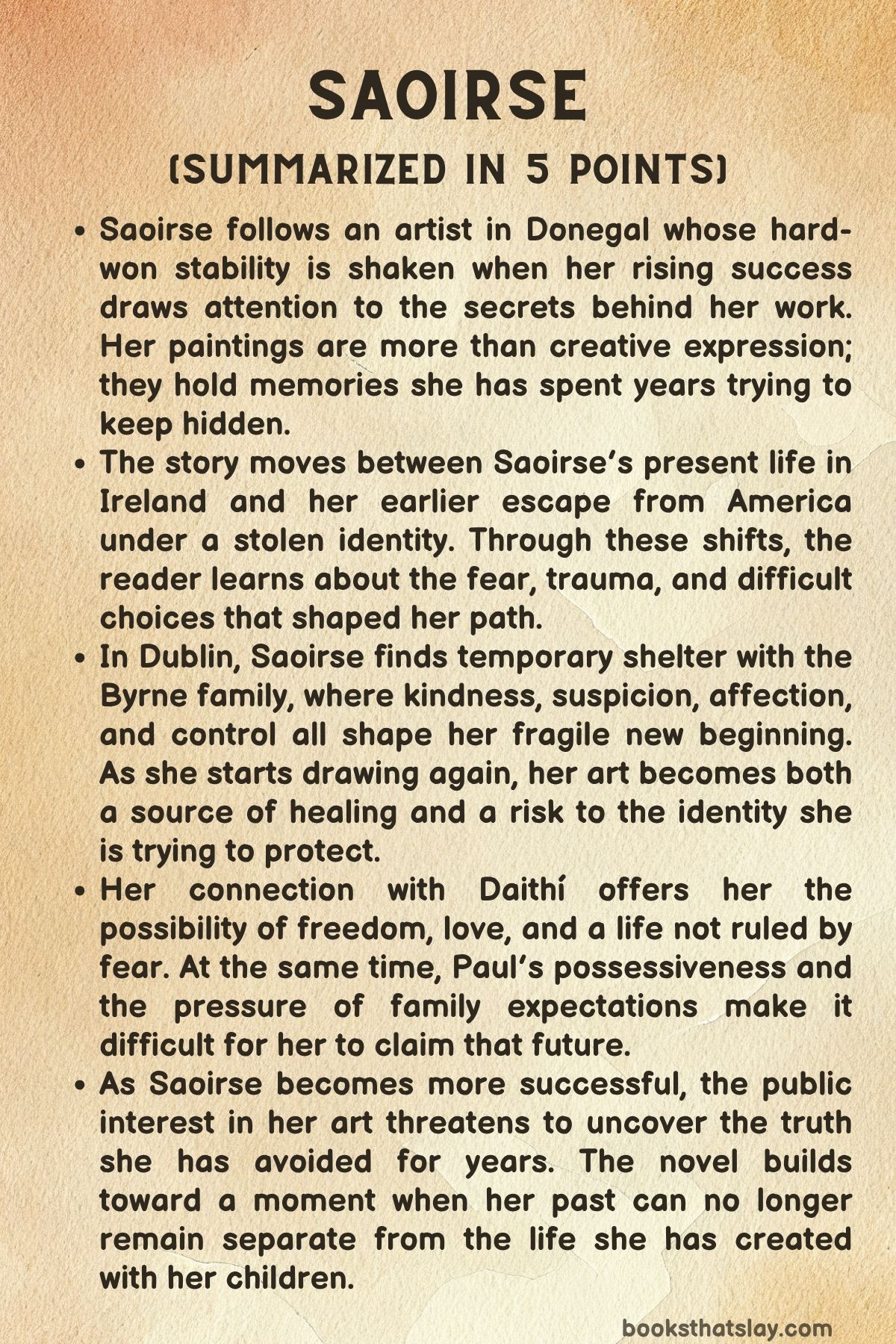
In 1999, Saoirse Byrne appears to have built the life she once could only imagine. She lives in Donegal with Daithí, the man she loves, and their two daughters, Leah and Eloise.
Her career as an artist is rising quickly. She is preparing for a major Dublin exhibition called Lost Was Found and has won a prestigious art prize worth £50,000.
To the outside world, she looks successful, loved, and secure. Yet the praise around her work fills her with fear rather than joy.
Her paintings are not simply images. They carry memories, secrets, and fragments of a past she has spent years hiding.
The story returns to 1990, when Saoirse is still known as Sarah. She leaves America using a stolen Irish passport that belongs to her friend Sarah Walsh, whom she calls Sasa.
On the flight to Dublin, she meets Paul Byrne, an Irish medical student whose own life is in disarray after professional disappointment and a broken engagement. Sarah is terrified of being caught at passport control, but Paul helps her pass through.
Dublin is crowded, and when she cannot find a place to stay, Paul brings her to his parents’ home in Sandymount.
At first, the Byrne household gives Sarah a temporary shelter. Joseph, Paul’s father, treats her with kindness.
Nuala, Paul’s mother, remains wary and senses that something about Sarah is not right. Paul becomes increasingly drawn to her, while Sarah tries to stay quiet and avoid questions.
As she begins to settle into the house, her past comes through in memories connected to her art. She remembers her unstable mother, Fleur; her violent stepfather, Lou; and her baby sister, Léa, whom she loves and tries to protect.
Lou had used Sarah for criminal errands and forced her into situations no child should face.
Other memories reveal Sarah’s teenage years, including her relationship with Eddie and the discovery of her talent. At school, an unusual art teacher encourages her to draw and helps her see that her work has power.
Art becomes one of the few places where Sarah can tell the truth without saying it aloud. But her life grows more dangerous when Lou sends her to Florida as part of a criminal deal.
There she is assaulted by a man named Kenny, who also threatens Léa. After this, Sarah arranges for Léa to be taken away safely by her grandparents.
With her sister protected, Sarah disappears.
In Dublin, Sarah slowly begins making art again. Joseph gives her an old easel, and the act of drawing returns some part of herself to her.
She also meets Daithí, the carpenter working on the Byrne family’s garden studio. Their connection is immediate, quiet, and unlike anything she has felt with Paul.
Paul’s family and friends notice the attraction, and Paul becomes uneasy. During a camping trip on the Wicklow coast, Sarah and Daithí grow closer while Paul becomes possessive and uncomfortable.
Daithí gives her the Irish name Saoirse, meaning freedom. When they kiss by the sea, she feels seen in a way that both comforts and frightens her.
After the trip, Paul’s behavior worsens. His affection turns controlling, and he eventually slaps her.
Sarah knows she cannot remain with him. On her eighteenth birthday, she travels to Donegal to see Daithí.
Their reunion confirms their love, but she realizes during the visit that she is pregnant from an earlier encounter with Paul. The news devastates her.
She leaves Daithí without fully explaining, unable to see a future that will not hurt him.
Back in Dublin, she tries to find a way to end the pregnancy. Mags, Joseph’s German secretary, helps her plan a trip to Liverpool, but Sarah’s stolen passport has expired.
Without valid documents, she is trapped. Paul discovers the pregnancy test and insists that she has no real choice.
As the pregnancy continues, Saoirse becomes more isolated. Paul’s control tightens, and he begins using what he knows about her false identity against her.
He hints that he knows her real surname and understands that she has nowhere safe to turn.
In late spring 1991, overwhelmed by fear and despair, Saoirse walks to Poolbeg Lighthouse intending to end her life. A woman named Catherine finds her and speaks to her gently until the danger passes.
Catherine’s presence becomes an important lifeline. Saoirse later gives birth to Leah.
Paul claims the role of father and keeps Saoirse tied to the Byrne family. Although trapped, Saoirse survives.
She continues painting, raises Leah, and slowly becomes known as Saoirse Byrne.
Over the following years, Saoirse attends art college with support from Joseph and Nuala, though Paul dismisses her ambitions. He resents her growing independence and belittles the talent others begin to recognize.
Memories of Daithí remain a source of private strength, even though she believes that part of her life is lost. Her tutors and classmates respond to her distinct style.
She wins praise at an end-of-year show, and Catherine helps arrange her first solo exhibition.
Success, however, makes Paul more dangerous. When Catherine visits to celebrate the exhibition, Paul attacks Saoirse in the studio because she did not tell him first.
Saoirse understands more clearly that she must escape him. At the same time, memories reveal more about how she fled America.
After sending Léa away, she had called Eddie, only to suspect that he was involved with Lou’s criminal world. Eddie had a gun from Lou and urged her to run.
Sensing danger, Sarah tricked him, escaped through a truck stop, and hid in a camper heading east.
As Saoirse’s art gains attention, the risk of exposure grows. Catherine helps select work for another exhibition, but a journalist named Edel begins asking questions and wants to photograph her.
Saoirse panics because some paintings are based on real memories from Boston, including her friendship with Sasa, the Irish nanny whose passport allowed Sarah to enter Ireland. The more people look at the paintings, the more Saoirse fears that her hidden life is being placed in public view.
In 1997, Catherine drives Saoirse to an exhibition in Donegal. Saoirse has sold all the paintings before the opening, yet she is anxious about publicity and about Daithí’s return from Kenya.
Catherine urges her to leave Paul and asks directly whether he hurts her. Saoirse admits that he does, though he avoids leaving marks where others can see.
Later, after Daithí is mentioned at dinner with Liam and Emily, Paul threatens and assaults her again. That same night, news breaks of Princess Diana’s crash, and Joseph Byrne collapses.
Joseph dies soon after.
Joseph’s funeral becomes a turning point. Saoirse and Leah are treated as outsiders by the Byrne family.
In the church, Daithí appears behind Saoirse and gives her quiet strength. After the funeral, Catherine takes Saoirse and Leah to Greystones, and Saoirse does not return to live with Paul.
In 1998, Daithí finds Saoirse at the Greystones train station. They reconnect, and he explains that he returned for her after time in Kenya and after confronting parts of his own family history.
Saoirse tells him only pieces of her past, including that she had a sister, but she promises to tell him everything someday. They begin building a life together.
Saoirse and Leah move with him to his restored house in Donegal. Paul and the Byrnes agree to a custody arrangement, and Leah spends weekends in Dublin.
Saoirse later becomes pregnant and gives birth to Eloise. With Daithí and the girls, she experiences real happiness, though her stolen identity remains a constant fear.
By late 1999, Saoirse’s artistic success brings more public attention. The prize money, the Dublin exhibition, interviews, and even Daithí’s plan to make a website for her work all make her feel exposed.
On New Year’s Eve, as Ireland celebrates the millennium, Saoirse senses that the life she has protected is under threat. She tells Daithí she has something to confess but asks for more time.
Soon after, Mary mentions a newspaper story about Sarah “Sasa” Walsh, who has returned from America. The article says her identity appears to have been stolen.
Saoirse realizes Sasa is back in Ireland, has had a child, and that the authorities are investigating. On January 6, 2000, as Saoirse prepares to take Leah to Dublin, Edel arrives at her door.
The journalist has connected Saoirse to Sarah Walsh and says the guards have traced the stolen identity to a woman in Donegal with two dependents.
Saoirse forces Edel out and slams the door, but the damage is done. Leah and Eloise see her panic.
In that moment, Saoirse understands that the past she buried has reached the home she fought so hard to create. The truth she once escaped has found her, and she can no longer protect her family by silence alone.
Characters
Saoirse Byrne / Sarah Roy
Saoirse is the emotional center of Saoirse, and her character is shaped by survival, secrecy, art, trauma, and the long search for freedom. Born Sarah Roy, she enters Ireland under a stolen identity, carrying with her not only the practical danger of being discovered but also the emotional weight of everything she has fled.
Her new name, Saoirse, becomes more than a disguise; it becomes a vision of the life she wants but cannot fully claim. She is vulnerable because of her youth, her lack of documents, her pregnancy, and her dependence on others, yet she is never passive.
Even when trapped by Paul, haunted by Lou, and terrified of exposure, she keeps making choices that protect herself and the people she loves.
Her art is the most honest part of her identity. Because she cannot speak openly about her past, her paintings and sketchbooks become the place where memory survives.
The exhibition, the prize, and the public attention around her work should represent triumph, but for Saoirse they are also frightening because they threaten to reveal the truth hidden beneath her success. This makes her a deeply conflicted character: she wants recognition, independence, and a stable life, but visibility is also dangerous for someone who has survived by disappearing.
Her creativity is not just talent; it is a form of testimony.
Saoirse’s motherhood adds another powerful layer to her character. Leah is born out of fear, coercion, and entrapment, yet Saoirse loves her fiercely.
Later, with Daithí and Eloise, she experiences a kind of domestic happiness that once seemed impossible. Still, even in that happiness, her past remains alive.
Her panic when Edel arrives shows that her deepest fear is not merely punishment but the possibility that her buried life will harm her daughters. Saoirse is therefore one of the most complex figures in the book: a survivor who has built beauty out of damage, but whose freedom remains fragile because it rests on a hidden truth.
Daithí
Daithí represents tenderness, patience, emotional safety, and the possibility of a life beyond fear. From his first connection with Saoirse, he sees something in her that others either miss or try to control.
He does not define her by helplessness, nor does he try to possess her. His giving her the Irish name Saoirse is symbolically important because he names what she is seeking: freedom.
Unlike Paul, whose attachment becomes ownership, Daithí’s love allows space, trust, and renewal.
Daithí is also connected to place, craft, and restoration. As a carpenter and later as the restorer of a home in Donegal, he is associated with building rather than destroying.
This makes him a natural contrast to the men who have damaged Saoirse’s life. His love does not erase her trauma, but it gives her a setting in which she can begin to live without constant threat.
His return from Kenya and reunion with Saoirse show his steadiness; he has changed, travelled, searched, and still comes back to her without demanding that she immediately give him every secret.
His limitation is that he does not fully know the life Saoirse has hidden from him. Their happiness is sincere, but it is built around partial confession.
This does not make Daithí weak; rather, it shows the difficulty of loving someone whose past is buried under danger and shame. He is one of the book’s clearest symbols of healing, but the story does not present healing as simple.
Daithí can offer love, home, and loyalty, but Saoirse must still face the truth herself.
Paul Byrne
Paul is one of the most disturbing characters in the story because he begins as helpful and sympathetic but gradually reveals himself as possessive, entitled, and controlling. When Sarah first arrives in Dublin, Paul seems like a rescuer.
He helps her through passport control, offers her shelter, and brings her into his family home. At first, his attention may appear protective, especially because Sarah is frightened, undocumented, and alone.
However, this protection slowly changes into power.
Paul’s emotional neediness becomes dangerous because he treats Saoirse’s vulnerability as something he can own. His jealousy of Daithí, his anger at her independence, and his resentment of her art reveal that he does not truly want her to become free.
He wants to be central to her life and becomes cruel whenever she moves beyond his control. His violence, including slapping and later attacking her, shows that his love is not love in any healthy sense; it is domination disguised as concern.
His role after Leah’s birth is especially important. By presenting himself as the father and pressuring Saoirse into remaining within the Byrne family structure, he traps her socially and emotionally.
His knowledge of her hidden identity makes him even more threatening because he understands that her past can be used against her. Paul is not simply a jealous partner; he is a character who exposes how dependence, secrecy, and social respectability can become tools of abuse.
Leah
Leah is central to Saoirse’s life because she embodies both pain and love. Her birth is tied to Saoirse’s entrapment with Paul, but Leah herself is never treated as a burden in Saoirse’s emotional world.
Instead, she becomes one of the strongest reasons Saoirse continues to survive. Through Leah, the story explores the complicated reality that something beautiful can come from circumstances filled with fear and coercion.
Leah also represents the future Saoirse wants to protect. As a child moving between Saoirse, Daithí, Donegal, and the Byrne family in Dublin, she stands at the intersection of many unresolved adult conflicts.
She is innocent, but the choices made by adults shape her world. Saoirse’s terror when Edel arrives is intensified because Leah sees it.
That moment matters because Saoirse realizes that secrecy is no longer contained inside her own mind; it has entered the emotional space of her children.
Leah’s presence also deepens the contrast between Paul and Daithí. Paul uses family structure and fatherhood as a means of control, while Daithí becomes part of a more loving and stable home.
Leah’s role in the book is therefore not only that of a daughter but also that of a moral measure: the adults around her are judged by whether they protect, possess, neglect, or truly love her.
Eloise
Eloise represents the happiness Saoirse eventually finds with Daithí, but she also reveals how incomplete that happiness remains while the past is unresolved. Unlike Leah, whose birth is tied to fear and coercion, Eloise is born into love, restoration, and the new family Saoirse builds in Donegal.
Her arrival suggests renewal and the possibility that Saoirse’s life can become more than survival.
At the same time, Eloise’s presence raises the stakes of Saoirse’s hidden identity. By the time Edel arrives, Saoirse is not only protecting herself or Leah; she is protecting a second daughter and an entire home.
Eloise’s fear during Saoirse’s panic shows how the past can reach even the children born after the worst events have supposedly ended. She is part of the book’s emotional argument that buried trauma does not disappear simply because a person has created a happier life.
Eloise is not developed through major independent action, but her symbolic importance is strong. She represents innocence, new beginnings, and the family Saoirse desperately wants to keep safe.
Through her, the story shows how the consequences of secrecy can affect even those who had no part in the original events.
Catherine
Catherine is one of the most important supportive figures in the book because she appears at moments when Saoirse is close to collapse. Her rescue of Saoirse at Poolbeg Lighthouse is not dramatic in a forceful way; it is gentle, attentive, and humane.
She does not save Saoirse by controlling her. She saves her by seeing her pain and staying with her through it.
This makes Catherine a powerful contrast to characters who respond to Saoirse’s vulnerability with suspicion, possession, or exploitation.
Catherine also becomes essential to Saoirse’s artistic growth. She helps arrange exhibitions, encourages her work, and understands that Saoirse’s paintings matter.
Unlike Paul, who sees Saoirse’s success as a threat, Catherine sees it as liberation. Her role in Saoirse’s career is not merely practical; she helps Saoirse step into public identity as an artist, even though that public identity also carries danger.
Her emotional intelligence is especially visible when she asks whether Paul hurts Saoirse. Catherine senses what others ignore or avoid naming.
She does not reduce Saoirse to victimhood, but she also refuses to pretend that everything is fine. By taking Saoirse and Leah to Greystones after Joseph’s funeral, Catherine helps create the physical and emotional distance Saoirse needs to leave Paul.
She is a figure of intervention, compassion, and chosen family.
Joseph Byrne
Joseph is a kind and stabilizing presence in the Byrne household. When Sarah arrives in Dublin, he helps make the home feel less hostile and more human.
His gift of the old easel is especially meaningful because it allows Saoirse to reconnect with her art. In a life where so many adults have endangered or controlled her, Joseph offers encouragement without demanding too much in return.
His character is important because he complicates the Byrne family. The household is not simply abusive or suspicious; it contains warmth as well as danger.
Joseph’s kindness makes it possible for Saoirse to remain there, study, paint, and survive. Yet his goodness also exists inside a family structure that ultimately fails to protect her from Paul.
This makes him a sympathetic but limited figure.
Joseph’s death becomes a turning point. His funeral exposes Saoirse’s uncertain place within the Byrne family, especially when she and Leah are excluded.
In life, he offered her some protection; in death, that protection disappears. His absence helps reveal how unsafe and conditional her position has always been.
Joseph is therefore both a source of tenderness and a reminder that kindness alone cannot undo systems of control.
Nuala Byrne
Nuala is suspicious, guarded, and difficult, especially when Sarah first enters the Byrne home. Her distrust is not entirely irrational, because Sarah is indeed hiding things, but Nuala’s suspicion often makes Saoirse feel more isolated.
She represents the social and familial judgment that surrounds a young woman with no clear past, no documents, and no secure place in the world.
At the same time, Nuala is not a flat villain. She supports Saoirse’s art college involvement, and this shows that her character contains contradictions.
She may distrust Saoirse personally while still participating in the structures that allow Saoirse to develop her talent. This complexity makes her believable: she can be cold and suspicious, yet not entirely without care or responsibility.
Nuala’s role after Joseph’s death becomes more painful because the Byrne family’s acceptance of Saoirse appears conditional. When Saoirse and Leah are pushed to the margins, Nuala becomes part of a family order that protects its own respectability more than Saoirse’s dignity.
Her character reflects the way families can offer shelter while also enforcing silence, hierarchy, and exclusion.
Fleur
Fleur, Saoirse’s mother, is one of the major figures behind the damage of Saoirse’s childhood. She is unstable and unable to provide the safety her daughters need.
Her failure is not just personal weakness; it creates the space in which Lou gains power over the family. Because Fleur cannot protect Sarah and Léa, Sarah is forced into adult responsibility far too early.
Fleur’s presence in the story helps explain why Saoirse learns to survive through secrecy and self-reliance. A child who cannot trust her mother to protect her must become watchful, practical, and emotionally guarded.
This affects Saoirse’s later relationships because dependence feels dangerous to her, even when love is genuine. Fleur’s instability becomes one of the roots of Saoirse’s fear of being trapped.
Although Fleur is not as actively threatening as Lou, her failure matters deeply. The absence of reliable maternal protection is one of the conditions that shapes Sarah’s entire life.
Fleur’s character shows that harm can come not only from direct cruelty but also from neglect, weakness, and the inability to act when children are in danger.
Lou
Lou is one of the book’s clearest forces of danger. As Sarah’s stepfather, he brings criminality, coercion, and violence into her childhood.
He forces Sarah into criminal errands, exposes her to predatory situations, and uses threats against Léa to control her. His power depends on fear, and he understands exactly how to use Sarah’s love for her sister against her.
Lou’s role is important because he helps explain the extremity of Sarah’s escape. Her decision to flee America, steal an identity, and disappear is not impulsive rebellion; it is a survival response to a life where remaining visible means remaining in danger.
Lou turns home into a place of threat, which is why the idea of home later becomes so emotionally charged for Saoirse.
He also represents the kind of masculine violence that echoes later through Paul, though in a different form. Lou is openly criminal and predatory, while Paul operates inside respectability and family life.
Together, they show that danger can exist both outside and inside socially accepted structures. Lou’s shadow follows Saoirse long after she escapes him because the fear he created becomes part of the way she understands the world.
Léa
Léa, Saoirse’s baby sister, is one of the most important emotional figures from Sarah’s past. She represents innocence and the person Sarah most urgently wants to protect.
Many of Sarah’s decisions are shaped by fear for Léa’s safety, especially after Kenny’s assault and threats. Sending Léa away to her grandparents is one of Sarah’s bravest acts because it requires planning, sacrifice, and separation.
Léa also reveals Sarah’s early maturity. While still young herself, Sarah takes on the role of protector because the adults around her have failed.
This helps explain why Saoirse later becomes such a fierce mother. Her protective instinct does not begin with Leah; it begins with Léa.
The repetition of the names also creates a powerful emotional link between the sister Sarah loses and the daughter Saoirse raises.
Léa’s absence is as important as her presence. Once Sarah escapes, the separation from Léa becomes part of the grief buried inside her new life.
When Saoirse later admits to Daithí that she had a sister, the wording suggests loss, guilt, and unresolved pain. Léa is therefore a symbol of innocence rescued but also of the family bond Saoirse had to abandon in order to survive.
Eddie
Eddie is a complicated figure because he belongs to Sarah’s youth, her first intense romantic experience, and her artistic awakening, but he also becomes connected to danger. At school, he is part of a passionate period in Sarah’s life, a time when she is discovering desire, identity, and creativity.
His relationship with her appears meaningful, especially because it exists before her escape and before her life in Ireland.
However, Eddie’s later connection to Lou’s criminal world changes the way Sarah sees him. When she calls him after sending Léa away, she discovers that he may not be a safe refuge.
The gun Lou gave him and his insistence that she flee create a tense uncertainty around his motives. Whether he is trying to help, protect himself, or remain tied to Lou’s world, Sarah senses enough danger to trick him and escape.
Eddie’s character reflects one of the painful lessons Sarah learns: love and danger can become intertwined. He is not presented as simply monstrous like Lou, but he is not fully trustworthy either.
His ambiguity makes him important. He belongs to the life Sarah must leave behind, and escaping him becomes part of her final break from America.
Sasa / Sarah Walsh
Sasa, whose real name is Sarah Walsh, is crucial because her identity becomes the doorway through which Sarah Roy enters Ireland and becomes Saoirse Byrne. As an Irish nanny in Boston, Sasa represents a chance encounter that later becomes central to the entire structure of Saoirse’s life.
The stolen passport is not just a document; it is the foundation of Saoirse’s new existence.
Sasa’s importance grows later when she returns to Ireland and the stolen identity comes to light. Until then, Saoirse’s secret feels buried in the past, dangerous but distant.
Sasa’s reappearance makes that secret active again. The newspaper story transforms Saoirse’s hidden history into a public investigation, bringing the threat directly into her home.
Sasa is also morally significant because Saoirse’s survival has come at the cost of another woman’s identity. The story does not allow this act to remain abstract.
Sasa has her own life, her own return, and her own connection to the truth. Through her, Saoirse shows that survival can involve morally complicated choices, even when those choices are made under desperate pressure.
Kenny
Kenny is a predatory figure whose actions mark one of the darkest parts of Sarah’s past. The assault in Florida is not only physical violence; it is also a moment of psychological terror because he threatens Léa.
This threat makes the trauma larger than Sarah’s own suffering. He uses Sarah’s love for her sister as a weapon, making her feel responsible for preventing further harm.
Kenny’s role in the book is brief compared with characters like Paul or Daithí, but his impact is enormous. After the assault, Sarah makes the decisive choice to get Léa to safety and disappear.
In that sense, Kenny becomes one of the catalysts for Sarah’s escape. His violence forces her to understand that there is no safe future if she remains within Lou’s reach.
He also contributes to Saoirse’s later fear of exposure. The memories tied to Kenny, Lou, and Florida are not merely painful; they are dangerous because they connect her false identity to the reasons she fled.
Kenny represents the kind of male violence that the book refuses to soften or excuse.
Mags
Mags, Joseph’s German secretary, is a practical and sympathetic figure who helps Saoirse during one of her most desperate moments. When Saoirse tries to arrange an abortion in Liverpool, Mags becomes someone she can turn to for assistance.
This matters because Saoirse has so few people she can trust with the truth of her situation.
Mags represents a form of adult support that is grounded in action rather than judgment. She does not appear to control Saoirse or shame her; instead, she helps her explore a choice.
The failure of the plan is not Mags’s fault but the result of Saoirse’s false and expired documents. This reinforces one of the book’s central traps: Saoirse’s stolen identity gives her a life, but it also blocks her from freedom when she needs it most.
Her role also highlights the isolation surrounding reproductive choice and female desperation. Saoirse’s pregnancy is not treated as a simple private matter; it is shaped by borders, documents, secrecy, male pressure, and social control.
Mags stands out because she briefly offers Saoirse practical solidarity in a world that often denies her agency.
Edel
Edel is a threatening figure because she represents exposure, publicity, and the power of narrative from the outside. As a journalist, she is interested in Saoirse’s art and story, but her curiosity becomes dangerous because Saoirse’s paintings contain real memories.
Edel’s desire to photograph, investigate, and connect details turns public success into personal risk.
By the time Edel arrives at Saoirse’s door in 2000, she has become the embodiment of the past catching up. She has connected Saoirse to Sarah Walsh and understands that the stolen identity has been traced to a woman in Donegal with two dependents.
This makes her more than a reporter; she becomes the messenger of consequences. Her arrival collapses the distance between Saoirse’s hidden American past and her Irish family life.
Edel is not necessarily evil in the same way Paul or Lou is, but she is dangerous because she pursues truth without fully understanding the human cost of exposure. In the book, she represents the frightening side of visibility.
For an artist like Saoirse, being seen is both a dream and a threat.
Mary
Mary plays a smaller but important role because she casually brings the newspaper story about Sarah Walsh into Saoirse’s life. Her mention of the article appears ordinary, but it becomes a moment of enormous consequence.
Through Mary, the outside world enters Saoirse’s domestic space before Edel physically arrives.
Mary’s function is partly to show how secrets can be exposed through everyday conversation. The revelation does not arrive through a dramatic confession at first; it arrives through casual news, the kind of comment another person might make without understanding its significance.
This makes the moment feel especially realistic and frightening.
Although Mary is not central to the emotional conflicts of the story, her role helps trigger Saoirse’s final panic. She becomes part of the chain of events that proves Saoirse can no longer keep the past separated from the present.
Liam
Liam is connected to the social world around Paul and the Byrne family, and his presence at dinner helps reveal the tension beneath Saoirse’s outwardly respectable life. The dinner with Liam and Emily becomes significant because Daithí is mentioned, and Paul’s reaction afterward exposes his jealousy and violence once again.
Liam’s role is therefore less about his own development and more about the way ordinary social settings intensify Paul’s control over Saoirse.
His character helps show that abuse often exists behind public appearances. Around friends and family, Paul can still belong to a normal social world, while Saoirse carries the fear of what will happen afterward.
Liam’s presence in that setting sharpens the contrast between what others see and what Saoirse endures privately.
Emily
Emily, like Liam, belongs to the social environment that surrounds Paul and Saoirse. Her presence during the dinner scene matters because it places Saoirse within a public, socially acceptable gathering while her private life is becoming increasingly unbearable.
The mention of Daithí and Paul’s later assault show how fragile Saoirse’s safety is, even after apparently ordinary interactions.
Emily’s role also helps reveal Saoirse’s isolation. Other people may be near her, eating with her, speaking with her, and participating in normal life, but they do not necessarily understand the danger she faces once the doors close.
Emily therefore contributes to the book’s portrayal of hidden abuse and the gap between appearances and reality.
Themes
Freedom and the Cost of Reinvention
Freedom is never presented as a simple escape from one place to another. Sarah’s move from America to Ireland gives her distance from Lou, Fleur, Eddie, and the criminal world that shaped her early life, but it does not free her from fear.
Her new name, Saoirse, becomes a promise of independence, yet it also rests on a stolen passport and a buried identity. This makes freedom fragile, because every step toward happiness carries the threat of exposure.
Her life with Daithí and her daughters shows what freedom can look like when it is rooted in love, safety, and belonging, but even that peace is shadowed by the false life she had to build in order to survive. Saoirse suggests that reinvention can be both necessary and painful.
Sarah must become someone else to live, but the cost is constant vigilance, secrecy, and guilt. True freedom only begins to seem possible when she moves toward honesty, because survival alone cannot give her the peace she wants.
Trauma, Memory, and Art
Art becomes the place where buried memories return before Saoirse is able to speak them aloud. Her paintings are not only creative achievements; they are records of fear, loss, violence, desire, and survival.
The public praises her work without fully understanding that its emotional force comes from experiences she has spent years trying to hide. This creates a deep tension between recognition and danger.
Success should bring confidence, money, and respect, but for Saoirse it also threatens to expose the hidden truth behind the images. Her sketchbooks and paintings show that trauma does not disappear simply because she has changed countries or names.
It remains inside her body and imagination, resurfacing through colour, form, and subject. At the same time, art is not shown as only painful.
It gives her a language when ordinary confession feels impossible. It helps her rebuild a sense of self beyond abuse, control, and fear.
Through art, she turns memory into evidence of survival.
Control, Possession, and Domestic Abuse
Paul’s relationship with Saoirse reveals how control can grow behind the appearance of respectability. At first, he seems helpful, even protective, guiding her through passport control and offering shelter through his family.
Gradually, his kindness becomes possession. He treats her dependence on him as a claim over her life, her body, her pregnancy, and her future.
His violence is not limited to physical attacks; it also appears in jealousy, emotional pressure, threats, and the use of her secret identity as a weapon. Because he knows enough about her past to frighten her, he keeps her trapped in a life that others may mistake for stability.
The Byrne household also complicates this theme, since Joseph and Nuala provide forms of support while Paul becomes increasingly dangerous. The abuse is especially painful because Saoirse is trying to protect Leah and preserve some normality.
Her eventual departure shows that escape from abuse is rarely sudden or easy; it requires support, timing, courage, and a belief that life can exist beyond fear.
Motherhood, Protection, and Survival
Motherhood is tied to both terror and strength. Saoirse’s earliest protective act is toward Léa, whose safety becomes more important than her own security.
Sending her sister away shows that, even as a teenager surrounded by danger, she understands love as responsibility. Later, Leah’s birth traps her further within Paul’s control, yet it also gives her a reason to keep living after despair nearly destroys her.
Her motherhood is not idealised as effortless happiness. It is marked by fear, poverty of choice, emotional isolation, and the constant pressure of protecting a child while carrying unhealed trauma.
Still, Leah and later Eloise become anchors in her life. They connect her to the future and force her to confront the limits of secrecy.
By the end of Saoirse, the sight of her daughters frightened by her panic becomes a moment of recognition. She understands that silence, once a survival strategy, may now harm the children she wants to protect.
Motherhood pushes her toward truth because real safety cannot be built on concealment forever.