The Glowing Hours Summary, Characters and Themes
The Glowing Hours by Leila Siddiqui is a gothic historical novel built around the famous summer of 1816, when Mary Shelley, Percy Shelley, Lord Byron, Claire Clairmont, and John Polidori stayed near Lake Geneva. The story reimagines that season through Mehrunissa Begum Hammersmith, an Indian woman whose presence may have shaped Mary Shelley’s creation of Safie in Frankenstein.
Blending literary history, colonial displacement, grief, desire, and supernatural terror, The Glowing Hours explores how stories are born from memory, fear, and buried longing. It is a novel about women pushed to the margins, and about the strange power of houses, books, and unfinished lives.
Summary
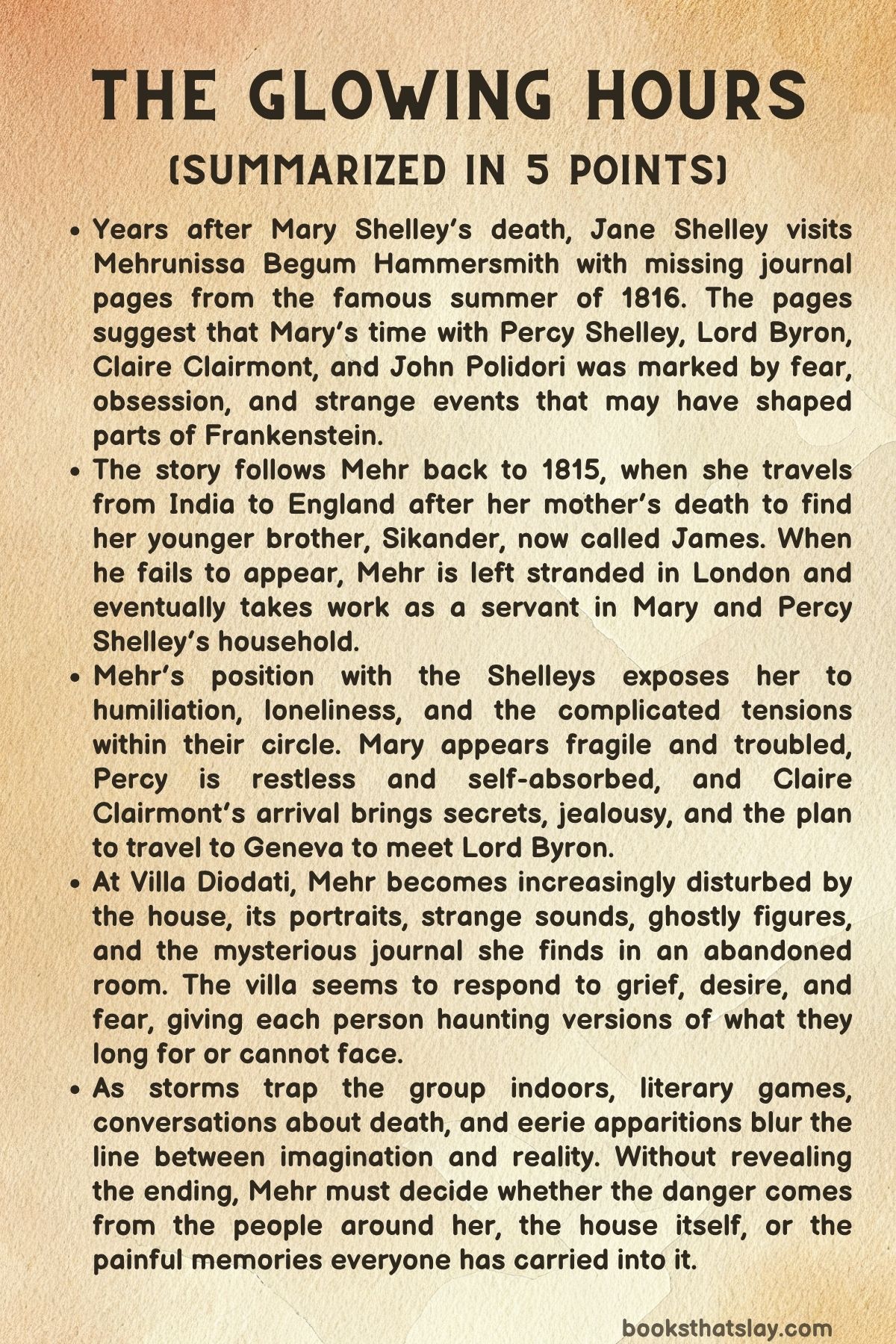
Years after Mary Shelley’s death, Jane Shelley visits Mehrunissa Begum Hammersmith, now an elderly woman, with a troubling discovery. Jane has found Mary’s journals, including pages from the famous summer of 1816 spent with Percy Shelley, Lord Byron, Claire Clairmont, and Dr. John Polidori.
The pages describe obsession, hallucination, desire, terror, and madness. Jane has removed them because she fears what they reveal, and she believes they belong to Mehr.
She also shows Mehr sections of Frankenstein that describe Safie, suggesting Mary may have drawn from Mehr’s appearance, singing, beauty, and braided hair. Mehr refuses to speak about that summer and gives the book back, but the visit opens the past.
The story returns to 1815, when Mehrunissa Begum leaves India after her mother’s death. Born to an Indian noblewoman and a British officer, Mehr travels to London carrying an inheritance letter meant for her younger brother Sikander, now called James.
Their father had taken him to England years earlier. On the ship, Mehr befriends a boy named Anand, but he accidentally destroys the page of her sketchbook that contains her father’s address.
When she reaches London, James is not there to meet her. Instead, she is collected by Miss Christy, who runs a home for stranded Indian ayahs.
Miss Christy claims James will come soon, but weeks pass with no answer.
Mehr learns that her own former ayah died in service in England, a discovery that deepens her loneliness. With no money and no reliable way back to India, she accepts the need to work.
Miss Christy trains her as a housemaid and places her with Mary and Percy Shelley. Mehr arrives at their country house, where she meets Mary, Percy, their baby William, the servant Lucy, and the cook Agnes.
The work humiliates her, and she is forced to sleep in the cellar. From the beginning, the house unsettles her.
She senses strange things in the dark and notices that Mary is fragile, distracted, and given to sleepwalking. Percy is ill, self-absorbed, and distant.
Their marriage already feels strained by sorrow and secrets.
Claire Clairmont, Mary’s stepsister, soon arrives and adds tension to the household. Mehr discovers Claire’s passionate letters to Lord Byron.
Percy becomes determined to travel to Geneva to meet Byron, though Mary is reluctant to bring her baby. Agnes is dismissed, and Mehr is kept on for the journey.
As they travel through France and Switzerland, Mehr learns more from Lucy: Mary and Percy ran away together while Percy was still married to Harriet; Mary lost her first baby; Claire has been close to Percy; and the Shelleys live under scandal and emotional strain.
In Geneva, the Shelleys meet Byron and his doctor, John Polidori. Byron’s charm and arrogance command the group, while Claire longs desperately for his attention.
Mehr is drawn to Polidori, who treats her with curiosity and seriousness. The Shelleys rent a chalet near Byron’s Villa Diodati, but the villa immediately frightens Mehr.
She feels as though it is watching her, and her mother’s taweez grows strangely warm.
Heavy rain traps everyone at Diodati. Mehr hears mysterious singing in the vineyard and finds the house oppressive.
In her room, she discovers a journal. At dinner, Byron dominates the conversation, mocks Percy’s beliefs, tempts Mary into eating meat, and speaks of ghosts.
Mary tells Mehr that she has dreamed of her and her mother. Later, Mehr follows Mary sleepwalking through the villa and into the rain.
Outside, she sees a ghostly pregnant woman leading Mary toward the lake. A horrifying figure attacks Mehr, and she loses consciousness.
When Mehr wakes, she cannot tell whether the event was real. Diodati continues to disturb her.
Insects appear in unnatural ways, the rooms seem alive, and Lucy and Robert behave suspiciously. In the vineyard, Mehr sings a song from home.
Mary hears it and is deeply moved, giving Mehr grapes in thanks. The small gift becomes precious to Mehr because it feels like one of the first sincere acts of kindness she has received in a long time.
Mehr later retreats to an abandoned room, where she eats alone and speaks to the portrait of a mysterious woman. The room grows more unsettling.
Tea moves after she stops touching it, the portrait’s gaze seems to shift, and the workers outside move in a trance while humming a sound she has heard before. Lucy brings Mehr to the library, where Byron, Percy, Mary, Claire, and Polidori are gathered.
Byron pulls Mehr into their literary conversation, mocking and testing her, but she gives Percy a line for his poem that impresses him. Mary speaks about dreams of her dead mother and wonders whether the dead can return.
Polidori explains galvanism, horrifying Mehr with the idea of corpses being revived. The conversation turns cruel, especially around love, death, and marriage.
Later, Mehr sees paintings transform into copies of the abandoned room’s portrait, and a skeletal woman appears before vanishing.
In her room, Mehr removes the taweez, thinking it may be causing her visions. She then finds a journal with a sketch of the vineyard from the same viewpoint as the abandoned room.
She realizes the vineyard once belonged to the woman in the portrait. The next day, Byron continues to torment Polidori, flirt cruelly with Claire, and hint that he knows about Mehr’s troubled sleep.
Mehr sees Mary by the lake, apparently speaking to someone invisible. In the abandoned room, Mehr asks the portrait if the journal belongs to her and hears knocking inside the walls.
A soothing presence surrounds her, suggesting the painted woman may be trying to communicate.
While doing laundry, Mehr sees Byron force Percy into a violent sparring match. Percy is bloodied, and Mehr sees blood spread across clean sheets before vanishing.
She also sees Mary at a window beside the pregnant ghost. When Mehr nearly faints, Byron catches her, then leaves her shaken.
The taweez has somehow returned to her neck. Terrified, she tears it off and buries it.
Mehr wants Mary to translate the journal, but Mary has grown cold and distant. Mary suggests Byron may be interested in Mehr and reminds her that she is still a servant.
Later, Byron insists Mehr dine with them as a guest, only to humiliate and exoticize her. He asks about Sikander, and Mehr says her brother is “in hell.” During the stormy evening, Mary appears transformed, beautiful and detached.
Byron proposes that everyone write macabre tales. In the library, Polidori reads from The Necromancer, and Byron turns the reading into a cruel mock ritual to summon Mehr’s dead mother.
When he demands her mother’s name, she refuses. Thunder shakes the villa, windows burst open, and the ritual collapses.
Mary later says Mehr should have given the name, because her mother might have returned.
The next morning, the woman has vanished from the portrait and appears instead as a tiny painted figure fleeing toward the lake. Then Harriet, Percy’s wife, appears from the fog with his two children.
She says she will give up the legal fight and leave the children with Percy. The children are perfect, silent, and lifeless.
Polidori examines them and finds no heartbeat, suggesting they are dead things remade by the villa. More false visitors appear: Byron’s former lovers, unnaturally polished and unreal.
Mary receives the apparition of her dead mother, who comforts her and discusses the story she is beginning about a man of science who creates life.
Mehr tries to escape, following what she thinks is the lesson of the portrait, but every attempt throws her into the sensation of drowning. Each time, she returns to Diodati’s front door coughing water.
She understands the villa will not release them. The house begins giving everyone what they secretly want or fear.
Mary accepts her mother, Percy clings to the children, Byron enjoys his artificial lovers, Claire takes comfort in Mary’s renewed affection, and Polidori is haunted by dead patients. Lucy sees her maimed father.
Polidori thinks the house may be replaying memories and suspects Byron may be drugging them, but Mehr believes Diodati itself is alive.
Desperate, Mehr gives Mary the journal, hoping she will translate it and help her understand the painted woman. Mary refuses, saying she does not feel trapped.
Byron then confronts Mehr, claiming she came to him the previous night. He kisses her, then becomes confused, as though the villa has manipulated him too.
Disturbed by her own desire and fear, Mehr runs to Polidori and kisses him. As she does, she sees him change first into Mary and then into Byron.
The villa has begun using not only grief and memory, but also hidden longing, turning each person’s private hunger against them.
Characters
Mehrunissa Begum Hammersmith
Mehrunissa Begum Hammersmith is the emotional and moral center of The Glowing Hours. She enters the book as someone already divided between worlds: Indian and British, noble and servant, protected daughter and abandoned young woman, remembered past and uncertain future.
Her journey to England begins with duty and hope, because she believes she can deliver an inheritance letter to her brother and perhaps recover some part of the family that was taken from her. Yet almost immediately, the book places her in a position of loss.
The address is destroyed, her brother does not appear, her former ayah is dead, and she is forced into domestic service. This makes Mehr’s character deeply shaped by displacement.
She is not merely lonely; she is trapped in a society that constantly misreads her, reduces her, or uses her.
Mehr’s strength lies in her ability to observe what others refuse to see. As a servant, she is expected to remain invisible, but in truth she becomes the clearest witness to the emotional sickness of the Shelley-Byron circle and the supernatural corruption of the villa.
Her sensitivity is not weakness; it is a form of perception. She notices Mary’s sleepwalking, Percy’s self-absorption, Claire’s desperation, Byron’s cruelty, Polidori’s unease, and the villa’s strange appetite before most others admit anything is wrong.
Her taweez, memories of her mother, songs from home, and connection to the mysterious portrait all suggest that Mehr carries a spiritual inheritance that the English characters do not understand.
At the same time, Mehr is not written as a flawless victim. She is proud, resentful, frightened, curious, and vulnerable to desire.
Her humiliation as a servant wounds her deeply because she remembers a different status and a different life. Her attraction to Polidori, her confused response to Byron’s attention, and her fear that the house can manipulate her desires make her psychologically rich.
The villa does not simply frighten her with ghosts; it exposes feelings she would rather keep hidden. This makes Mehr one of the most complex figures in the book, because her struggle is both external and internal.
She is fighting a living house, but she is also fighting loneliness, grief, anger, memory, and the painful need to belong somewhere.
Jane Shelley
Jane Shelley serves as the frame through which the buried events of the past are reopened. Her role is brief but important because she represents inheritance, secrecy, and literary memory.
By visiting the elderly Mehr with Mary Shelley’s journals, Jane becomes the character who admits that history has been edited. She has removed pages from Mary’s account because they contain disturbing material, which immediately establishes that the famous summer of 1816 was not only a moment of literary creation but also a moment of fear, obsession, and moral danger.
Jane’s attitude toward Mehr is complicated. On one hand, she gives the pages to Mehr because she believes they belong to her, which suggests a desire for justice or restoration.
On the other hand, she also arrives with the authority of the Shelley legacy and with Mary’s published work in hand, showing Mehr passages that seem to transform her into inspiration for Safie. Jane therefore stands between respect and intrusion.
She recognizes Mehr’s importance, but she also risks treating her as evidence inside Mary Shelley’s story. Her presence reminds the reader that the lives of marginalized people are often absorbed into the fame of others, and that recovering their voices requires more than simply finding old papers.
Mary Shelley
Mary Shelley is one of the most psychologically fragile and artistically significant characters in the book. She appears as a young woman burdened by grief, motherhood, scandal, illness, and the pressure of living among forceful personalities.
Mary is not presented as merely a future literary genius; she is shown as someone haunted by death long before her imagination produces a story about creating life. Her dead baby, her longing for her mother, her strained relationship with Percy, and her vulnerability inside the villa all create the emotional conditions from which her creative vision emerges.
Mary’s relationship with Mehr is especially important. At times, Mary seems unusually open to Mehr, almost as if she recognizes something in her that the others do not.
Her dream of Mehr and Mehr’s mother suggests a psychic or emotional connection between them. When she hears Mehr singing, she is deeply moved, and the gift of grapes becomes a small but powerful moment of recognition.
Yet Mary also fails Mehr. She reminds Mehr that she is still a servant, refuses to translate the journal when help is desperately needed, and becomes increasingly seduced by the villa’s gift of her dead mother.
This makes Mary sympathetic but morally uncertain. She understands grief so deeply that the villa can exploit it.
Mary’s character is built around the temptation to bring back the dead. She is horrified and fascinated by galvanism, dreams of her dead mother, and gradually accepts the impossible when it gives her comfort.
Her imagination is powerful, but it is also dangerous because it makes her receptive to unnatural restoration. In The Glowing Hours, Mary’s creativity is not separated from fear; it grows out of the same emotional darkness that threatens to consume everyone at Diodati.
Percy Shelley
Percy Shelley is portrayed as brilliant, idealistic, physically fragile, and emotionally careless. He speaks and lives as though he belongs to a world of poetry, philosophy, and rebellion, but the book repeatedly shows the damage left behind by his ideals.
His elopement with Mary, his abandoned wife Harriet, his complicated closeness with Claire, and his self-absorption all suggest a man who wants freedom without fully accepting responsibility. Percy’s imagination makes him attractive to others, but his moral weakness makes him dangerous.
Percy’s treatment by Byron also reveals his insecurity. Byron’s mockery of his vegetarianism and the violent sparring match expose Percy’s desire to prove himself before stronger personalities.
He is not simply Byron’s equal; he is often drawn into Byron’s orbit and humiliated by it. His relationship with Mary is similarly strained.
Though he is her partner, he does not seem fully able to protect her from grief, illness, or the emotional pressures around them.
The appearance of Harriet and the children reveals Percy’s deepest guilt. When the villa gives him the children, he accepts them even though they are unnatural and lifeless.
This is one of the clearest signs of Percy’s moral evasiveness. Rather than face the living consequences of his actions, he clings to a false version of what he has lost.
His character shows how idealism can become selfish when it is detached from human duty.
Lord Byron
Lord Byron is the most openly domineering figure in the story. He enters as a force of charisma, cruelty, appetite, and theatrical power.
Nearly everyone is affected by him. Claire longs for his attention, Percy competes with him, Polidori resents and depends on him, Mary is unsettled by him, and Mehr becomes one of his targets.
Byron’s intelligence is sharp, but he uses it to provoke, humiliate, and control. He enjoys turning conversation into performance, and performance into domination.
Byron’s treatment of Mehr exposes his exoticizing and predatory nature. He draws her into conversations not out of respect but because he enjoys testing her boundaries.
At dinner, he asks about her brother, forces her into emotional exposure, and treats her difference as spectacle. His mock ritual to summon Mehr’s mother is one of his cruelest acts because it turns her grief into entertainment.
Byron understands the emotional weaknesses of others and presses on them for amusement.
Yet Byron is not merely a human villain. His enjoyment of the villa’s artificial lovers suggests that he is especially compatible with Diodati’s corruption.
While others are frightened by what the house creates, Byron is fascinated and pleased. He does not resist illusion because illusion flatters his vanity and appetite.
In that sense, Byron becomes almost a human extension of the villa itself: seductive, theatrical, hungry, and morally empty.
Claire Clairmont
Claire Clairmont is driven by longing, insecurity, and the desperate need to be chosen. Her passion for Byron shapes much of her behavior, but the book does not reduce her to romantic foolishness.
Instead, Claire appears as a young woman trapped in the emotional economy of powerful men. She wants Byron’s love, Percy’s attention, and Mary’s affection, but she rarely receives any of them securely.
Her desperation makes her vulnerable, and the people around her often exploit or dismiss that vulnerability.
Claire also intensifies the tension within the Shelley household. Her letters to Byron, her closeness with Percy, and her dependence on Mary create emotional instability even before the group reaches Geneva.
She is both a source of conflict and a victim of it. Byron’s cruelty toward her is especially revealing because he knows she wants him and uses that knowledge to degrade her.
When the villa begins granting people what they want, Claire is comforted by Mary’s revived affection. This shows that beneath her pursuit of Byron lies a deeper hunger for emotional safety.
Claire wants to be loved without being mocked, used, or abandoned. Her tragedy is that she seeks tenderness among people who are too selfish, wounded, or vain to give it honestly.
Dr. John Polidori
Dr. John Polidori is one of the most conflicted characters in the book. As Byron’s physician, he occupies a socially awkward position: educated and perceptive, yet dependent on a man who belittles him.
Byron’s mockery of Polidori’s writing and intellect wounds him because Polidori wants recognition. He is not content to remain a servant to genius; he wants to be seen as a writer and thinker in his own right.
Polidori’s relationship with Mehr gives him greater emotional depth. He is intrigued by her, listens to her fears more seriously than most others, and becomes one of the first people to admit that the villa’s horrors may be real.
His medical knowledge makes him rational, but his experiences inside Diodati force him beyond rational explanation. When he discovers that Percy’s children have no heartbeats, he becomes a crucial interpreter of the unnatural.
His willingness to investigate gives him courage, even though he is also frightened.
However, Polidori is not entirely safe. The villa turns Mehr’s attraction to him into something unstable, causing him to appear as Mary and then Byron.
This moment suggests that desire inside Diodati cannot remain pure; the house contaminates intimacy by mixing it with fear, confusion, and hidden longing. Polidori’s character therefore stands between reason and nightmare, sympathy and ambition, human tenderness and supernatural distortion.
Lucy
Lucy is a servant whose role reveals the hidden knowledge of the household. Unlike the famous literary figures, she understands much of the practical and social reality surrounding Mary and Percy.
Through Lucy, Mehr learns about the scandalous elopement, Harriet, Mary’s dead baby, and Claire’s closeness with Percy. Lucy’s position as a servant gives her access to truths that polite conversation conceals.
Lucy also becomes important because she is not untouched by the villa’s power. Her suspicious behavior with Robert in Claire’s room suggests that she has her own secrets or vulnerabilities.
Later, when she sees the apparition of her maimed father, the book shows that the villa does not only prey on the wealthy and famous. Servants, too, have memories, griefs, and fears that can be used against them.
Lucy’s character broadens the emotional world of the story by showing that trauma exists below stairs as well as above.
Agnes
Agnes, the cook in the Shelley household, represents the ordinary domestic structure that exists before the journey into deeper disorder. Her presence helps establish the working environment into which Mehr is placed.
Though she does not dominate the story, her dismissal is important because it leaves Mehr more exposed. Once Agnes is gone and Mehr is kept on for the summer journey, Mehr becomes more directly entangled with the Shelley circle and later with the horrors of Diodati.
Agnes also helps show how servants are treated as replaceable. Her removal is not framed as a major emotional event for the household, but it changes Mehr’s fate.
In this way, Agnes’s character quietly reflects the instability of domestic labor and the vulnerability of women who depend on employers for survival.
Miss Christy
Miss Christy is a practical and morally ambiguous figure. She runs a home for stranded Indian ayahs, which suggests that she is connected to the forgotten afterlife of empire: women brought to England in service and then abandoned.
When she receives Mehr, she initially seems like a rescuer, but her help quickly becomes a form of containment. She tells Mehr that James will come, but as weeks pass, Mehr is pushed toward servant training.
Miss Christy’s character reflects the limited choices available to women like Mehr in England. She may not be cruel in the same way Byron is cruel, but she is part of a system that converts displacement into labor.
Her home appears charitable, yet it also prepares vulnerable women to accept diminished lives. Through Miss Christy, the book shows how survival can be shaped by institutions that offer shelter while also enforcing social descent.
Anand
Anand is a small but meaningful character because his childish accident changes the course of Mehr’s life. By tearing out the page of her sketchbook containing her father’s address and throwing it into the sea, he destroys Mehr’s most practical link to her brother.
He does not act maliciously, which makes the incident more tragic. A careless act by a child becomes the beginning of Mehr’s abandonment in England.
Anand also briefly represents innocence and companionship during the voyage. Mehr’s friendship with him shows her capacity for tenderness even while she is grieving and uncertain.
His mistake emphasizes how fragile Mehr’s hopes are. Her future depends on a single page, a single address, a single promise of reunion, and all of it can vanish into the sea.
Sikander / James
Sikander, now called James, is central to Mehr’s emotional mission even though he remains mostly absent. He represents the family that was taken from her, the brother transformed by England, and the hope that her journey might restore what colonial separation destroyed.
His changed name is significant because it suggests assimilation and erasure. Sikander belongs to Mehr’s past, while James belongs to the English life that has swallowed him.
His failure to meet Mehr creates one of the deepest wounds in the story. Whether through neglect, ignorance, or circumstances beyond his control, his absence leaves her stranded.
When Byron asks about him and Mehr says Sikander is “in hell,” the line reveals more than anger. It shows that, to Mehr, her brother has become both lost and morally unreachable.
He is alive in memory but dead to her in reality. His character functions as a painful absence, shaping Mehr’s loneliness without needing to appear often.
Mehr’s Mother
Mehr’s mother is one of the most powerful absent presences in the book. Her death sends Mehr toward England, but her influence continues through memory, song, inheritance, and the taweez.
She represents home, protection, and identity. The warmth of the taweez suggests that Mehr’s connection to her mother is not merely sentimental; it may have spiritual force.
Because Mehr’s grief for her mother is so deep, the villa and Byron both try to exploit it. Byron’s mock ritual is especially cruel because he treats the mother’s name as a tool for spectacle.
Mary’s comment that the name might have brought her back shows how grief can distort judgment. Mehr’s refusal to give the name is therefore an act of resistance.
She protects her mother from being consumed by the villa’s hunger and by Byron’s performance.
Mehr’s mother also links Mehr to a world of feminine inheritance that contrasts sharply with the male-dominated literary circle. While Byron and Percy perform power through language, poetry, and philosophy, Mehr’s mother survives through memory, protective objects, and songs.
Her presence gives Mehr strength, even when it also makes her vulnerable to longing.
Mehr’s Father
Mehr’s father is important because he represents abandonment, colonial authority, and the fracture of family. As a British officer who took Sikander to England, he is responsible for the division that shapes Mehr’s life.
Even before the supernatural events begin, his choices have created a haunting absence. Mehr’s search for his address is also a search for accountability and connection.
The loss of the address at sea symbolizes how unreachable he has become. He is not simply a missing parent; he is part of the imperial structure that moves people across continents, renames them, and leaves others behind.
His character matters less as an active individual than as a cause of damage. Through him, the book connects personal grief to political history.
Harriet Shelley
Harriet Shelley appears as the living embodiment of Percy’s guilt. Her arrival from the fog with Percy’s children is one of the most unsettling moments because it offers Percy a version of the responsibility he has avoided.
She says she will give up the suit and leave the children with him, which sounds like surrender, but the unnatural atmosphere makes the scene feel less like reconciliation and more like accusation.
Harriet’s character is tragic because she has been displaced by Percy’s pursuit of freedom and Mary’s love. Even when she appears, she does not seem fully restored as a living person with her own future.
Instead, the villa uses her as a figure from Percy’s past. She exposes the selfishness beneath his romantic ideals.
Her presence forces the story to remember the woman harmed by the famous couple’s scandal, making her a moral counterweight to Percy’s poetic self-image.
Percy’s Children
Percy’s children are among the most disturbing figures because they appear innocent yet lifeless. Their unnatural perfection makes them frightening.
When Polidori discovers that they have no heartbeats, the book turns them into signs of false restoration. They are not truly rescued children; they are imitations created to satisfy Percy’s guilt and longing.
Their role also deepens the theme of corrupted resurrection. Like Mary’s mother, Byron’s lovers, and the other apparitions, the children show that the villa can manufacture what people desire, but only as a hollow version of life.
They reveal Percy’s weakness because he accepts them despite the signs that something is terribly wrong. As characters, they are less psychologically developed than symbolic, but their symbolism is powerful: they represent the danger of choosing comforting illusion over painful truth.
William
William, Mary and Percy’s baby, represents ordinary vulnerability amid extraordinary horror. His presence makes Mary’s situation more fragile because she is not only a grieving daughter and writer but also a mother responsible for a living child.
Her reluctance to bring the baby on the journey shows that part of her recognizes the danger and instability surrounding them.
William’s role also sharpens the book’s interest in motherhood, death, and creation. Against the villa’s false children and reanimated figures, William is genuinely alive and therefore genuinely at risk.
He reminds the reader that the desire to bring back the dead can endanger the living when grief becomes stronger than care.
Robert
Robert is a minor but unsettling figure because of his suspicious behavior with Lucy in Claire’s room. His presence adds to the atmosphere of secrecy among the servants and suggests that the villa’s corruption is not limited to the central literary group.
Even characters at the edge of the narrative become part of the pattern of watching, hiding, and acting under unclear influence.
Because Robert is not developed in the same depth as Mehr, Mary, or Polidori, his importance lies mainly in atmosphere. He helps create the sense that Diodati has infected the whole household.
No room feels private, and no person feels entirely reliable.
Lady Caroline
Lady Caroline appears as one of Byron’s former lovers and one of the artificial figures produced or summoned by the villa. Her polished, lifeless quality makes her disturbing because she seems both recognizable and unreal.
She represents Byron’s past returning not as honest memory but as theatrical repetition. Like the other created visitors, she is too perfect, too controlled, and too empty to be fully human.
Her statement that they will draw out Mehr’s demons makes her especially threatening. She does not merely haunt Byron; she turns toward Mehr and participates in the villa’s invasion of the self.
Lady Caroline therefore becomes part of the house’s psychological machinery. She suggests that Diodati does not only show people what they want; it also forces hidden fears and desires into the open.
Villa Diodati
Villa Diodati functions almost as a character rather than a setting. It watches, traps, tempts, and feeds.
From Mehr’s first sense that the villa is looking at her, the house behaves as though it has consciousness. It absorbs blood, produces humming sounds, alters paintings, summons apparitions, creates lifeless visitors, and prevents escape by forcing Mehr into the sensation of drowning whenever she tries to leave.
Its power is not random; it is intimate. It studies people and gives them versions of what they desire or fear most.
The villa’s cruelty lies in its ability to disguise imprisonment as fulfillment. Mary receives her mother, Percy receives his children, Byron receives his lovers, Claire receives affection, Polidori receives accusing dead patients, Lucy sees her father, and Mehr is forced to confront desire, grief, and memory.
The house does not simply attack bodies; it invades emotional truth. In The Glowing Hours, Diodati becomes the dark engine of the story, turning human longing into supernatural captivity.
Themes
Desire as a Dangerous Force
Desire in The Glowing Hours is shown as something that can comfort, expose, and destroy. Nearly every character carries a private longing that becomes dangerous once the villa begins responding to it.
Mary wants her dead mother back and is tempted by the idea that life can be restored. Percy wants escape from responsibility and later clings to the impossible return of his children.
Claire wants Byron’s love so badly that she keeps accepting humiliation. Byron wants control, admiration, and pleasure, and he treats others as objects meant to entertain him.
Mehr’s desires are more complicated because they include belonging, safety, love, recognition, and freedom from grief. The villa uses these hidden wants against them, offering visions that feel like gifts but are really traps.
By making desire visible, the story shows how people can become prisoners of what they refuse to face. Wanting itself is not condemned, but selfish, denied, or obsessive desire becomes a doorway to manipulation.
Grief and the Temptation to Restore the Dead
Grief shapes the emotional and supernatural world of the novel. Mary is haunted by the loss of her baby and by the absence of her mother, so the promise of reunion becomes almost impossible for her to resist.
Mehr also carries the pain of her mother’s death, her separation from Sikander, and the loss of her former life in India. These wounds make the villa’s apparitions powerful because they do not simply frighten the characters; they offer them what grief has made them crave.
The dead return in forms that seem comforting at first, but their lifeless perfection reveals that restoration is not the same as healing. Percy’s children, Byron’s former lovers, and Mary’s mother all suggest that the past can be copied but not truly recovered.
The story’s horror comes from this emotional truth: grief can make people accept false comfort when reality feels unbearable. The dead are not only ghosts here; they are unfinished sorrows taking shape.
Power, Class, and Racial Exoticism
Mehr’s position exposes the cruelty of social hierarchy. She begins as the daughter of an Indian noblewoman, but in England she is treated as dependent, foreign, and disposable.
Her loss of money, address, family protection, and status forces her into service, where she must obey people who are often weaker than her in courage or moral sense. The humiliation of sleeping in the cellar and being trained as a housemaid shows how quickly society reduces her worth once she lacks visible power.
Byron’s behavior makes this theme sharper because he turns Mehr’s background into performance, questioning and displaying her in front of others as though her pain and identity exist for his amusement. Even Mary, who sometimes seems sympathetic, reminds Mehr that she is still her mistress.
The Glowing Hours uses Mehr’s perspective to challenge the famous literary circle around her, showing that brilliance and cruelty can exist together. The supernatural oppression of the villa mirrors the human systems that already trap her.
Storytelling, Memory, and Ownership of the Past
The novel treats stories as powerful but unstable things. Jane’s removal of Mary’s journal pages shows that history is often edited by those who fear what the truth might reveal.
Mehr’s possible connection to Safie raises questions about who gets remembered, who gets borrowed from, and who is reduced into a character inside someone else’s art. Mary’s writing is not presented as separate from life; it grows out of grief, fear, guilt, and the strange events around her.
At the same time, Mehr’s own experiences risk being absorbed into another person’s legend. Her journal, the portrait, the missing pages, and the translated memories all suggest that the past survives through fragments, but those fragments can be controlled, hidden, or misread.
The story asks whether recording someone’s pain preserves them or takes possession of them. Mehr’s silence in old age is therefore meaningful: refusing to explain everything becomes a way of protecting what still belongs to her.