The Hotshot Summary, Characters and Themes
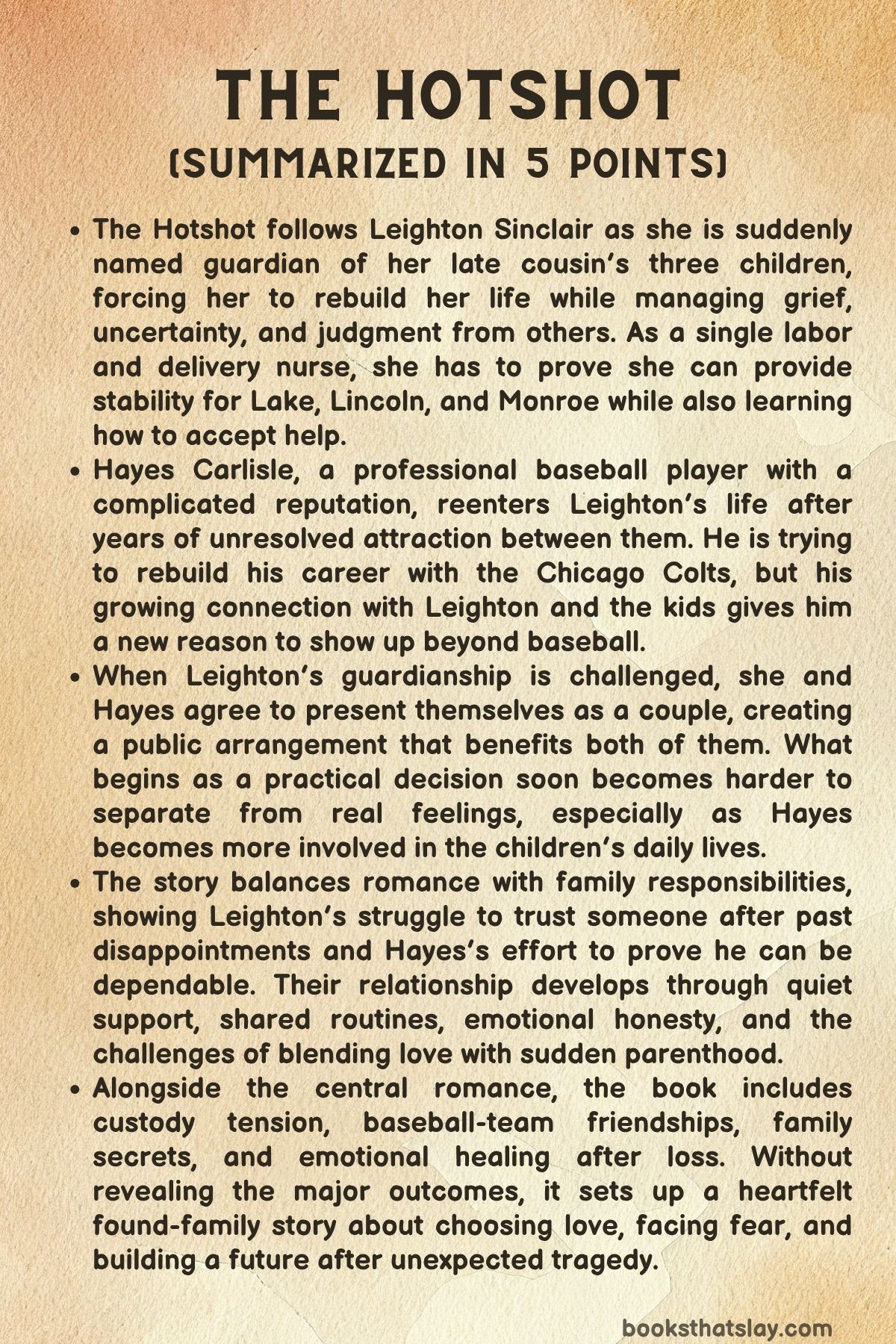
The Hotshot by Piper Rayne is a contemporary romance about grief, family, trust, and the messy comfort of being loved when life becomes too heavy to carry alone. The story follows Leighton Sinclair, a labor and delivery nurse who suddenly becomes guardian to her late cousin’s three children, and Hayes Carlisle, a professional baseball player trying to repair his career and reputation.
What begins as emotional support turns into a fake relationship, then something real. At its center, The Hotshot is about choosing family, learning to depend on others, and finding love in the middle of loss, fear, and unexpected responsibility. It’s the 1st book of the Dugout series by the author.
Summary
Leighton Sinclair’s life changes overnight after the sudden deaths of her cousin Skylar and Skylar’s husband Patrick in a hiking accident. Their deaths leave behind three grieving children: Lake, Lincoln, and Monroe.
At the funeral reception, Leighton is surrounded by sorrow, whispers, and judgment. Guests question whether she, a single labor and delivery nurse with long hours and no parenting experience, can really raise three children on her own.
The pressure becomes too much, and she escapes upstairs to Skylar and Patrick’s bedroom, still stunned by the news that they named her guardian of their kids.
Her best friend Callie finds her there and tries to comfort her. Leighton is heartbroken, scared, and unsure how to even begin handling the responsibility placed on her.
Their conversation is interrupted by little Monroe, who wants food for her doll, Cookie, a small reminder that the children still need care even while everyone is grieving. Downstairs, Callie tries to shift attention away from Leighton by calling in her brother, Hayes Carlisle, a professional baseball player who has recently joined the Chicago Colts.
Hayes and Leighton already have history. Years earlier, they shared a kiss, but Leighton ran away before anything could happen.
At the reception, the air between them is awkward but warm. Hayes brings her a Twix, remembering it is her favorite, and the gesture softens her.
Outside, they talk, joke, and reconnect. Hayes tells her that if he had to bet on anyone being able to take care of the children, he would bet on her.
His confidence gives Leighton a rare moment of comfort. Callie notices their closeness and warns Hayes not to make Leighton’s life harder when she is already carrying so much.
Hayes is also under pressure. His agent, Jagger, warns him to clean up his image, avoid trouble, stay away from partying, and focus on baseball.
Hayes’s previous season damaged his confidence and reputation, and he needs his time with the Colts to prove that he is still the player everyone once believed he could be. While Hayes works to rebuild his career, Leighton faces the legal reality of guardianship.
Lawyer Mark Notting explains that being named guardian in Skylar and Patrick’s will does not automatically give her permanent custody. She must petition the court, and relatives can object.
Leighton immediately worries about Patrick’s brother Art and his controlling wife Julianna.
A month later, Hayes has a major win for the Colts with a game-winning hit. After the game, Callie calls him from her podcast tour and asks him to check on Leighton, who is exhausted after a long shift.
When Hayes arrives at the house, he finds chaos. Lake is angry about a sleepover, Lincoln is struggling with homework, and Monroe is focused on her National Days calendar.
Hayes steps in naturally. He orders pizza, helps Lincoln with homework, talks with Monroe about her activities, and agrees to help with Nail Day.
Leighton is grateful, but she is also uneasy. Depending on Hayes feels risky, especially because she does not know whether he can be a steady presence.
Hayes continues showing up. He takes Monroe, Lincoln, and his teammates Easton and Decker on errands for Nail Day and groceries, then helps prepare dinner.
When Leighton comes home and sees the children happy, she begins to understand how easily Hayes fits into their lives. They all go out for ice cream, but fans recognize Hayes and the other players.
The crowd becomes too much, and Hayes, Decker, and Easton protect Leighton and the kids from the attention. The incident reminds Leighton that Hayes’s life is public, unpredictable, and complicated.
The guardianship situation worsens when Mark calls with bad news: Art and Julianna have contested Leighton’s petition. At court, Leighton is terrified, though she has support from her parents, Aunt Iris, her lawyer Viv, and, unexpectedly, Hayes.
Art and Julianna’s lawyer argues that Leighton is single, overworked, and does not have enough support to raise three children. In a sudden move, Hayes stands and claims that he and Leighton are in a committed relationship.
His statement changes the mood in the courtroom. The judge allows the children to remain with Leighton temporarily, noting the importance of stability and the wishes expressed in the will, but also orders an investigation and grants Art and Julianna two weekends with the kids.
After court, Hayes and Leighton agree to continue pretending to be in a relationship. The arrangement can help her custody case and improve his public image.
Jagger insists on meeting Leighton and setting rules. At Peeper’s Alley, the bar beneath Hayes’s building, Leighton meets Ruby, Easton, Decker, and Jagger.
Jagger warns everyone that the fake relationship must remain secret. Even the children cannot know the truth.
In public, Hayes and Leighton must act like a real couple, including holding hands, touching, kissing, and attending a Children’s Hospital charity gala together.
The fake relationship quickly becomes emotionally complicated. Hayes invites Leighton to his condo, where their flirtation grows stronger.
He takes her to the rooftop overlooking the baseball field and opens up about his struggles. He talks about not winning a Gold Glove, the old wounds left by a coach who doubted him, and the way his mother’s cancer diagnosis sent him into a spiral.
Leighton comforts him, and she finally explains why she ran after their kiss years ago. She had a boyfriend then, and because her father’s cheating had hurt her family badly, she could not handle the guilt.
They also realize that Callie had misunderstood something from that night, meaning Hayes had not moved on the way Leighton thought he had.
Hayes admits he likes her, but he promises to respect her boundaries. Even so, their feelings become harder to deny.
On the rooftop, a hug turns into a passionate kiss, interrupted by Easton. Soon after, Leighton prepares for a social worker’s visit and finds a strange bag in the guest-room closet containing perfume and red lingerie.
The discovery suggests that Skylar and Patrick’s marriage may have had secrets. When Hayes comes over, they tell Lake, Lincoln, and Monroe that they are dating.
Lincoln is thrilled, Monroe asks practical questions about sleepovers, and Lake is wary. She warns Hayes not to hurt Leighton.
Leighton also becomes involved in Lincoln’s baseball team, stepping in as coach. An overbearing father named Mike challenges her authority because he wanted the position himself.
Hayes, Easton, and Decker show up, and Hayes publicly identifies Leighton as his girlfriend, shutting Mike down. Meanwhile, Hayes receives good news when his mother’s scans come back cancer-free.
During a hospital cafeteria celebration, he sees Leighton laughing with her colleague Elias and becomes jealous. The confrontation that follows pushes Hayes and Leighton to stop pretending their attraction is only part of an arrangement.
They admit that what is happening between them is real, though Leighton wants to tell Callie in person before everyone knows.
Hayes becomes a steady part of Leighton’s home life. He attends games with them, helps with everyday routines, and builds bonds with the children.
At the same time, Foster Davis is traded to the Colts, reuniting Hayes with his best friend but causing tension because Foster and Decker, his twin brother, have unresolved issues. Leighton continues dealing with the emotional weight of Skylar and Patrick’s death.
She starts opening their closed-off bedroom and finds Patrick’s second phone along with signs that he hired a private investigator.
At Lake’s birthday party, Hayes is late after a bad game. A fight between Foster and Decker causes his phone to fall into a storm drain, so he cannot explain.
Leighton panics, shaped by her fear of being disappointed and abandoned. When Hayes finally arrives, she pushes him away.
Hayes argues that she is expecting him to be perfect and asks her to choose their relationship instead of running from it. Leighton asks for time.
During their separation, Leighton faces her grief more honestly and keeps looking into Patrick’s secrets. She discovers that Art was connected to the betrayal Patrick had been investigating.
This truth changes the guardianship fight and reveals why Art should not have control over the children. Leighton and Hayes eventually reconcile.
They confess their love, and Hayes agrees to move in, choosing not only Leighton but also the family they are building with Lake, Lincoln, and Monroe.
Four months later, the season has ended, and Hayes and Leighton have settled into life as a family. Art drops his petition, and Leighton receives permanent guardianship of the children.
In the epilogue, their circle gathers at Peeper’s Alley for Decker and Foster’s birthday. Hayes and Leighton are happy together, the children are safe and settled, and Callie admits she had been quietly pushing them toward each other all along.
Then Callie privately tells Leighton she is pregnant and that the father is one of the men in their circle, opening the door to the next story.
Characters
Leighton Sinclair
Leighton Sinclair is the emotional center of The Hotshot, and her character is shaped by grief, responsibility, fear, and fierce love. At the beginning of the book, she is overwhelmed by the sudden deaths of Skylar and Patrick and by the shocking realization that they chose her to raise Lake, Lincoln, and Monroe.
She is not presented as someone who immediately feels confident or prepared; instead, her strength comes from continuing even when she is terrified. Her work as a labor and delivery nurse shows her nurturing nature, but becoming guardian to three grieving children forces her into a much deeper kind of caretaking.
Leighton’s love is practical and protective. She worries about homework, meals, emotional stability, court hearings, social worker visits, and whether the children feel safe.
Her fear that Art and Julianna could take the children away makes her desperation understandable, because the children are not just a duty to her; they are family.
Leighton’s emotional conflict also comes from her history of being disappointed by people she trusted. Her father’s cheating left her cautious about relationships, and that old wound explains why she ran from Hayes years earlier after their kiss.
She does not want to become someone who betrays or hurts others, and she also fears being hurt herself. With Hayes, she is drawn to warmth, humor, steadiness, and desire, but she keeps questioning whether depending on him is wise.
This makes her romance with him more meaningful because it is not just about attraction; it is about learning to trust someone during the most unstable period of her life. Her panic at Lake’s birthday party shows that she still expects abandonment when things go wrong, but her later reconciliation with Hayes proves growth.
By the end, Leighton becomes more secure, not because every fear disappears, but because she chooses love and family instead of letting fear make every decision for her.
Hayes Carlisle
Hayes Carlisle is one of the most layered characters in the book because he combines charm, public confidence, private insecurity, and emotional loyalty. As a professional baseball player, he is used to pressure, attention, and public judgment, but his reputation has been damaged by a difficult previous season.
His agent’s warnings show that Hayes is at a career crossroads: he needs discipline, focus, and a clean public image. Yet his character is not defined only by fame or athletic talent.
His most revealing moments come when he steps into Leighton’s chaotic household and quietly helps. He orders pizza, calms the children, assists with homework, listens to Monroe’s National Days plans, supports Lincoln’s baseball dreams, and protects the family in public when fans crowd them.
These actions show that his caring nature is instinctive rather than performative.
Hayes also carries emotional wounds. His disappointment over his career, the lasting effect of a coach who doubted him, and his mother’s cancer diagnosis all contribute to his fear of failure.
Baseball gives him status, but it also exposes his insecurity because he constantly feels the need to prove himself. His relationship with Leighton allows him to be vulnerable in a way he usually cannot be in public.
When he impulsively claims they are in a committed relationship at court, the act begins as a reckless attempt to protect her, but it also reveals his instinct to stand beside her when she feels alone. Hayes’s growth lies in becoming more than the charming athlete or fake boyfriend.
He becomes a dependable partner and a father-like presence for the children. By the end of The Hotshot, he has found a family structure that gives him emotional grounding beyond his career.
Lake
Lake is the oldest of the three children and is written as a guarded, observant, and emotionally wounded child. Her grief often appears as suspicion and anger rather than open vulnerability.
Because she is old enough to understand the permanence of her parents’ deaths, she carries a sharper awareness of what has been lost. Her reaction to Leighton and Hayes’s relationship shows this clearly.
While Lincoln is excited and Monroe is curious, Lake is cautious and protective. Her warning to Hayes not to hurt Leighton reveals that she has taken on an emotional role beyond her age.
She is not only grieving her parents; she is also watching the adults around her to see who might leave, fail, or cause more pain.
Lake’s birthday party becomes an especially important moment for understanding her place in the story. Hayes’s lateness after the bad game and the phone accident triggers Leighton’s fears, but it also reflects the fragile emotional environment surrounding Lake.
For a child who has already lost too much, disappointment carries extra weight. Lake’s character helps show that grief in children is not simple or uniform.
She does not always express need directly, but her protectiveness, suspicion, and emotional distance reveal how deeply she wants stability. As Leighton and Hayes become steadier, Lake’s guardedness begins to make sense as a survival response rather than mere attitude.
Lincoln
Lincoln is a grieving child who looks for structure, encouragement, and male guidance after Patrick’s death. His struggles with homework and his desire for someone to coach his baseball team show that he is dealing with both ordinary childhood needs and extraordinary loss.
Baseball becomes especially important for him because Patrick was supposed to coach his team before he died. When Lincoln asks whether Hayes can coach, the request carries emotional weight.
He is not simply asking for athletic help; he is reaching toward continuity, mentorship, and comfort.
Lincoln’s response to Hayes and Leighton dating is more openly positive than Lake’s. His excitement shows his desire for connection and perhaps his hope that the broken family structure can be repaired in some way.
He accepts Hayes more readily because Hayes meets him through attention and action. Hayes helps with homework, shows interest in his baseball life, and becomes a reliable adult presence.
Lincoln’s character highlights how children often process grief through routines, hobbies, and the adults who show up consistently. Through him, the book explores the importance of dependability in a child’s healing.
Monroe
Monroe is the youngest child, and her character brings tenderness, innocence, and moments of lightness into a story shaped by grief. Her attachment to her doll Cookie and her obsession with National Days activities show how she clings to imagination, routine, and small joys.
Because she is younger, she does not process loss in the same guarded way as Lake or the same searching way as Lincoln. Instead, her grief is filtered through childlike needs: food for her doll, nail activities, sleepover questions, and excitement over family routines.
These details make her feel emotionally believable because young children often seek comfort through repetition and play.
Monroe also helps reveal the softer sides of the adults around her. Hayes’s willingness to participate in Nail Day and take her interests seriously shows that he is not merely trying to impress Leighton.
He genuinely adapts to the children’s world. Leighton’s care for Monroe also shows the depth of her new role, because she must meet emotional needs that are small on the surface but deeply important to a child seeking security.
Monroe’s presence keeps the family dynamic from being only heavy. She brings humor, innocence, and warmth, reminding the reader that healing happens not only through serious conversations but also through ordinary moments of care.
Skylar
Skylar is absent for most of the present action, but her influence is central to the book. As Leighton’s cousin and the mother of Lake, Lincoln, and Monroe, she leaves behind both love and unanswered questions.
Her decision, along with Patrick’s, to name Leighton as guardian reveals deep trust. She believed Leighton had the heart and strength to raise the children, even if Leighton herself initially doubts it.
Skylar’s death creates the emotional crisis that begins the story, but her memory also becomes a guiding force for Leighton as she learns how to parent the children.
Skylar’s character becomes more complicated through the hints surrounding her marriage. The mysterious bag containing perfume and red lingerie suggests that her relationship with Patrick may not have been as simple or perfect as others assumed.
This does not erase her role as a loving mother, but it adds emotional texture to her absence. Skylar represents the way people can leave behind both love and mystery.
For Leighton, grieving Skylar means not only missing her cousin but also discovering that the life Skylar left behind contains secrets, responsibilities, and choices that must now be faced.
Patrick
Patrick is another absent but important figure whose death shapes the entire family. As Skylar’s husband and the children’s father, he represents the life that was suddenly taken from Lake, Lincoln, and Monroe.
His promise to coach Lincoln’s baseball team becomes especially meaningful because it shows how his absence disrupts even the children’s everyday expectations. Patrick’s role as a father continues through the gaps he leaves behind, and those gaps are what Hayes gradually helps fill without replacing him.
Patrick also becomes a source of mystery as Leighton begins uncovering his secrets. The second phone and evidence that he hired a private investigator suggest that he knew something was wrong and was trying to uncover the truth.
This makes Patrick more than a tragic memory. He becomes connected to the hidden conflict involving Art and betrayal.
His character represents the unseen complications beneath the surface of family life. Even after death, his choices influence the custody conflict, Leighton’s understanding of Skylar’s marriage, and the eventual exposure of wrongdoing.
Callie Carlisle
Callie is Leighton’s best friend and Hayes’s sister, which places her in a unique position between the two central characters. She is supportive, protective, meddlesome, and emotionally perceptive.
At the funeral reception, she finds Leighton when Leighton is overwhelmed, and calling Hayes to distract the guests shows Callie’s practical instinct. She does not always solve problems directly, but she creates openings for people to help each other.
Her warning to Hayes not to complicate Leighton’s life also shows that her loyalty to Leighton is serious. She knows Leighton is vulnerable and does not want her brother to become another source of pain.
Callie’s role grows more playful and strategic as the romance develops. By the end, her confession that she has been quietly nudging Hayes and Leighton together reveals that she understood their connection before they fully admitted it.
Yet Callie is not only a matchmaking side character. Her pregnancy revelation introduces a new emotional complication and suggests that she has her own private story unfolding beneath her confident exterior.
She is lively and humorous, but she also functions as a connector between family, friendship, romance, and future conflict.
Jagger
Jagger, Hayes’s agent, represents the pressure of public image and professional survival. His role is practical and often stern.
He warns Hayes to avoid trouble, stay away from bad influences, and focus on rebuilding his reputation with the Colts. When the fake relationship begins, Jagger immediately understands the risk.
His rules about public affection, secrecy, and the charity gala show that he sees relationships through the lens of reputation management. To him, the fake relationship is not romantic or emotional; it is a strategy that could either help Hayes or damage him badly.
Despite his controlling approach, Jagger is not simply an antagonist. His concerns are grounded in the reality of Hayes’s career.
Hayes’s public image affects contracts, media attention, team trust, and future opportunities. Jagger’s presence adds tension because it forces Hayes and Leighton to perform their relationship before they have fully understood it themselves.
He also highlights one of Hayes’s central conflicts: the difference between the life managed for public approval and the life Hayes actually wants.
Art
Art is one of the major antagonistic forces in the story. As Patrick’s brother, he might seem like a natural family connection for the children, but his decision to contest Leighton’s guardianship places him in direct opposition to their stability.
His challenge is especially painful because Leighton is already grieving and trying to keep the children’s lives intact. By questioning her suitability as a single, overworked guardian, Art becomes part of a system that judges Leighton’s life from the outside without fully recognizing her love or effort.
Art’s later connection to betrayal and Patrick’s investigation makes him more morally troubling. He is not merely a relative with a different opinion about custody; he becomes linked to deeper family secrets and wrongdoing.
His eventual decision to drop the petition marks a turning point because it allows Leighton and the children to gain legal permanence. Art’s character shows how family can become threatening when control, self-interest, or hidden guilt outweigh genuine concern for children’s welfare.
Julianna
Julianna is Art’s controlling wife, and her presence strengthens the threat against Leighton’s guardianship. She is not shown as a nurturing alternative for the children but as part of a rigid, judgmental force trying to remove them from the home Skylar and Patrick chose for them.
Her control-oriented personality makes her especially unsettling because custody, in her hands, feels less like love and more like possession or status. She contributes to Leighton’s fear that the children could be taken not by strangers, but by relatives who believe they have the right to override the parents’ wishes.
Julianna’s role also emphasizes the social judgment Leighton faces. As a single working woman suddenly raising three children, Leighton is vulnerable to criticism from people who measure family stability in narrow ways.
Julianna benefits from that judgment and helps weaponize it. Through her, the story explores how appearances can be used against someone who is actually doing the emotional labor of caring for grieving children.
Viv
Viv, Leighton’s lawyer, serves as a stabilizing figure during the custody battle. Her presence gives Leighton legal support at a time when emotion alone is not enough to protect the children.
Viv’s importance lies in how she helps translate Leighton’s love and commitment into something that can stand in court. The legal conflict is frightening because Leighton learns that being named guardian in a will does not automatically guarantee custody, and Viv becomes one of the people helping her navigate that uncertainty.
Viv’s character also reinforces the seriousness of the guardianship plot. The court case is not a simple misunderstanding; it is a real threat with consequences for three children’s future.
Viv helps ground the story in practical stakes. Her presence allows Leighton to face Art and Julianna with more than fear, even though Leighton remains emotionally shaken throughout the process.
Mark Notting
Mark Notting is the lawyer who first explains the difficult reality of Leighton’s guardianship situation. His role is important because he delivers the news that changes Leighton’s understanding of her position.
She may have been chosen by Skylar and Patrick, but the court still has to approve custody, and other relatives can object. This information deepens the conflict and makes Leighton’s fear more urgent.
Mark functions as a messenger of legal reality rather than an emotional support figure. When he later tells Leighton that Art and Julianna have contested the guardianship, he becomes the person through whom the external threat enters her life.
His character helps move the plot from grief and adjustment into legal danger. He represents the impersonal systems that grieving families often have to face while they are still emotionally fragile.
Ruby
Ruby is part of Hayes’s social and professional circle, and her presence at Peeper’s Alley helps introduce Leighton into the world surrounding Hayes. She contributes to the sense that Hayes has a found-family network beyond baseball, made up of teammates, friends, and people who know his everyday life.
When Leighton meets Ruby during the fake relationship arrangement, Ruby becomes part of the small group trusted with the truth.
Ruby’s role is supportive rather than central, but she helps create the atmosphere around Hayes’s building and Peeper’s Alley. Her inclusion in the secret shows that the fake relationship cannot exist in isolation.
It needs witnesses, coordination, and people who will protect the lie. Ruby helps broaden the social world of the story and gives Leighton another point of contact outside her grief-filled home.
Decker
Decker is one of Hayes’s teammates and friends, and he brings humor, loyalty, and emotional tension into the wider baseball circle. His willingness to help with Monroe, Lincoln, Easton, groceries, dinner, and public outings shows that Hayes’s support system can extend to Leighton and the children.
Decker is part of the group that makes Hayes’s involvement feel less isolated. The children are not only receiving attention from Hayes but are gradually being folded into a wider circle of care.
Decker also has a deeper personal conflict through his unresolved tension with Foster, his twin brother. Their fight at Lake’s birthday party becomes important because it indirectly causes Hayes’s phone to fall into a storm drain, which then contributes to Leighton’s fear and the temporary break between her and Hayes.
Decker’s conflict with Foster therefore affects the main romance even though it belongs to a separate emotional thread. He represents how unresolved family issues can spill into other relationships and create consequences beyond the people directly involved.
Easton
Easton is another member of Hayes’s baseball circle and serves as both comic interruption and loyal friend. He appears during moments that blend romance, friendship, and found-family energy, such as when he interrupts Hayes and Leighton’s rooftop kiss.
His timing adds humor, but it also reminds the reader that Hayes lives in a close-knit social world where private emotions often collide with public or communal spaces.
Easton’s involvement with the children and with the fake relationship arrangement shows that he is dependable in his own casual way. He helps normalize Leighton’s entrance into Hayes’s life and contributes to the sense that Hayes’s teammates are more than background figures.
Easton’s character adds lightness and movement to the story, balancing the heavier themes of grief, custody, and fear of abandonment.
Foster Davis
Foster Davis enters the story as Hayes’s best friend and as a newly traded player to the Colts. His arrival should be a happy development for Hayes, but it also brings tension because of his unresolved conflict with Decker.
As Decker’s twin brother, Foster carries emotional baggage that affects the team circle and eventually impacts Leighton’s family life during Lake’s birthday party. His presence shows that the baseball world has its own complicated relationships and histories.
Foster also helps expand the emotional universe beyond Hayes and Leighton. His friendship with Hayes gives Hayes another personal anchor, while his conflict with Decker introduces themes of brotherhood, resentment, and unresolved pain.
The fact that Callie later reveals the father of her baby is one of the men in their circle makes Foster one of the characters surrounded by future uncertainty. His role suggests that the wider friend group contains more secrets and emotional complications than first appears.
Elias
Elias is Leighton’s colleague, and his main function is to trigger Hayes’s jealousy. When Hayes sees Leighton laughing with him in the hospital cafeteria, he reacts emotionally because his feelings for Leighton have become real.
Elias does not need to be a villain or rival in a major sense; his importance lies in what he reveals about Hayes. Hayes’s jealousy forces the romantic tension into the open and pushes him and Leighton toward honesty.
Elias also represents the part of Leighton’s life that exists outside Hayes and the children. She is a nurse, a coworker, and a woman with relationships beyond the emergency of guardianship.
Hayes seeing her in that environment reminds him that he does not control every part of her world. Through Elias, the story exposes Hayes’s vulnerability and helps move the relationship from pretending and resisting into genuine commitment.
Mike
Mike is the overbearing father who undermines Leighton when she begins coaching Lincoln’s baseball team. His character represents everyday sexism and entitlement.
He wanted the coaching position and resents Leighton occupying that role, so he challenges her authority and creates chaos. His behavior adds pressure to Leighton at a time when she is already trying to prove herself in court, at home, and in her own mind.
Hayes publicly calling Leighton his girlfriend in front of Mike serves several purposes. It shuts Mike down, supports Leighton, and makes the fake relationship more visible.
However, Mike’s role also shows why Leighton needs respect beyond simply being attached to Hayes. She is capable and committed, but people like Mike question her authority because she does not match their assumptions about who should lead.
Mike is a minor character, but he highlights the external judgment Leighton faces in ordinary community spaces.
Aunt Iris
Aunt Iris is part of Leighton’s family support system during the custody hearing. Her presence matters because the opposing side tries to paint Leighton as unsupported and overburdened.
Aunt Iris helps contradict that image simply by being there. She represents extended family loyalty and emotional backing at a moment when Leighton feels exposed and judged.
Although Aunt Iris does not dominate the plot, she contributes to the sense that Leighton is not truly alone. The court conflict depends heavily on the question of whether Leighton has enough support to raise three children, and Aunt Iris’s presence helps show that family support can exist outside a traditional household structure.
She strengthens the emotional foundation around Leighton and the children.
Themes
Grief and the Burden of Sudden Responsibility
Grief in The Hotshot is not shown as a quiet, private feeling but as something that immediately changes the shape of Leighton’s life. She is not only mourning Skylar and Patrick; she is also forced to step into the role they left for her before she has had time to understand the loss.
The funeral reception captures this pressure sharply because people are already judging her ability to raise Lake, Lincoln, and Monroe while she is still trying to breathe through shock. Her grief becomes tied to responsibility, making every ordinary task feel heavier: feeding the children, managing routines, handling legal threats, and keeping their home emotionally stable.
The children’s needs prevent her from falling apart completely, but they also deny her the space to grieve freely. This theme shows that loss does not pause life; instead, it often demands action when a person feels least prepared to act.
Leighton’s growth comes from learning that strength is not the absence of pain but the decision to keep showing up despite it.
Found Family and Emotional Safety
Family in the story is defined less by blood and more by who provides steadiness, love, and protection when life becomes uncertain. Leighton’s guardianship is challenged by relatives who believe biology gives them a stronger claim, but the emotional truth of the children’s lives proves otherwise.
Lake, Lincoln, and Monroe need someone who knows their rhythms, honors their parents’ wishes, and treats their grief with patience. Hayes gradually becomes part of this family not through grand promises but through repeated acts of care: helping with homework, supporting Monroe’s routines, showing up for Lincoln’s baseball, and standing beside Leighton when she feels judged.
His teammates and friends also widen the children’s support system, creating a home that is not limited to one overwhelmed guardian. The contrast between legal claims and emotional belonging makes the theme powerful.
The children’s stability comes from the people who stay, listen, protect, and adapt. By the end, family becomes a chosen structure built through loyalty, daily effort, and trust.
Trust, Vulnerability, and the Fear of Being Let Down
Leighton’s hesitation with Hayes is rooted in more than romantic uncertainty; it comes from a history of betrayal, disappointment, and the fear that depending on someone will only make the eventual hurt worse. Her father’s cheating shaped her understanding of relationships, while the sudden deaths of Skylar and Patrick taught her how quickly safety can vanish.
Hayes also carries his own wounds, especially from professional failure, public pressure, and his mother’s illness. Their relationship grows because both of them begin to show the parts of themselves they usually hide.
The fake relationship forces closeness, but emotional honesty turns it real. Still, trust is tested when Hayes misses Lake’s birthday party and Leighton reacts from old fear rather than the full truth.
That conflict reveals how love can be damaged when perfection is expected from someone already trying. In The Hotshot, vulnerability becomes the bridge between attraction and lasting commitment.
The relationship succeeds because they stop protecting themselves through distance and begin choosing honesty instead.
Identity, Public Image, and Private Truth
Hayes lives under constant public judgment as a professional athlete trying to repair his reputation, while Leighton is judged in court and by family members as a single woman trying to raise three children. Both characters are measured by outside appearances that fail to capture who they really are.
Hayes’s agent sees the fake relationship as a tool to improve public perception, while Leighton’s custody battle turns her private life into evidence for others to inspect. This pressure creates tension between performance and authenticity.
At first, Hayes and Leighton agree to act like a couple for practical reasons, but the act exposes real feelings they can no longer dismiss. The public version of their relationship becomes complicated because it begins as strategy and then becomes truth.
The theme also shows how damaging surface-level judgments can be: Leighton is reduced to her relationship status and workload, while Hayes is reduced to headlines and past mistakes. Their growth depends on rejecting these narrow images and claiming the fuller truth of who they are.