The Sun and the Starmaker Summary, Characters and Themes
The Sun and the Starmaker by Rachel Griffin is a romantic fantasy about duty, sacrifice, and the cost of keeping a world alive. Set in Reverie, a mountain village cut off from true sunlight, the story follows Aurora Finch, a young woman whose life changes when she learns she carries the magic of the next Starmaker.
What begins as a desperate bargain to save her sister becomes a journey into power, loneliness, love, and loss. The book blends fairy-tale atmosphere with emotional stakes, showing how courage can grow from fear and how love can survive even when fate seems cruel.
Summary
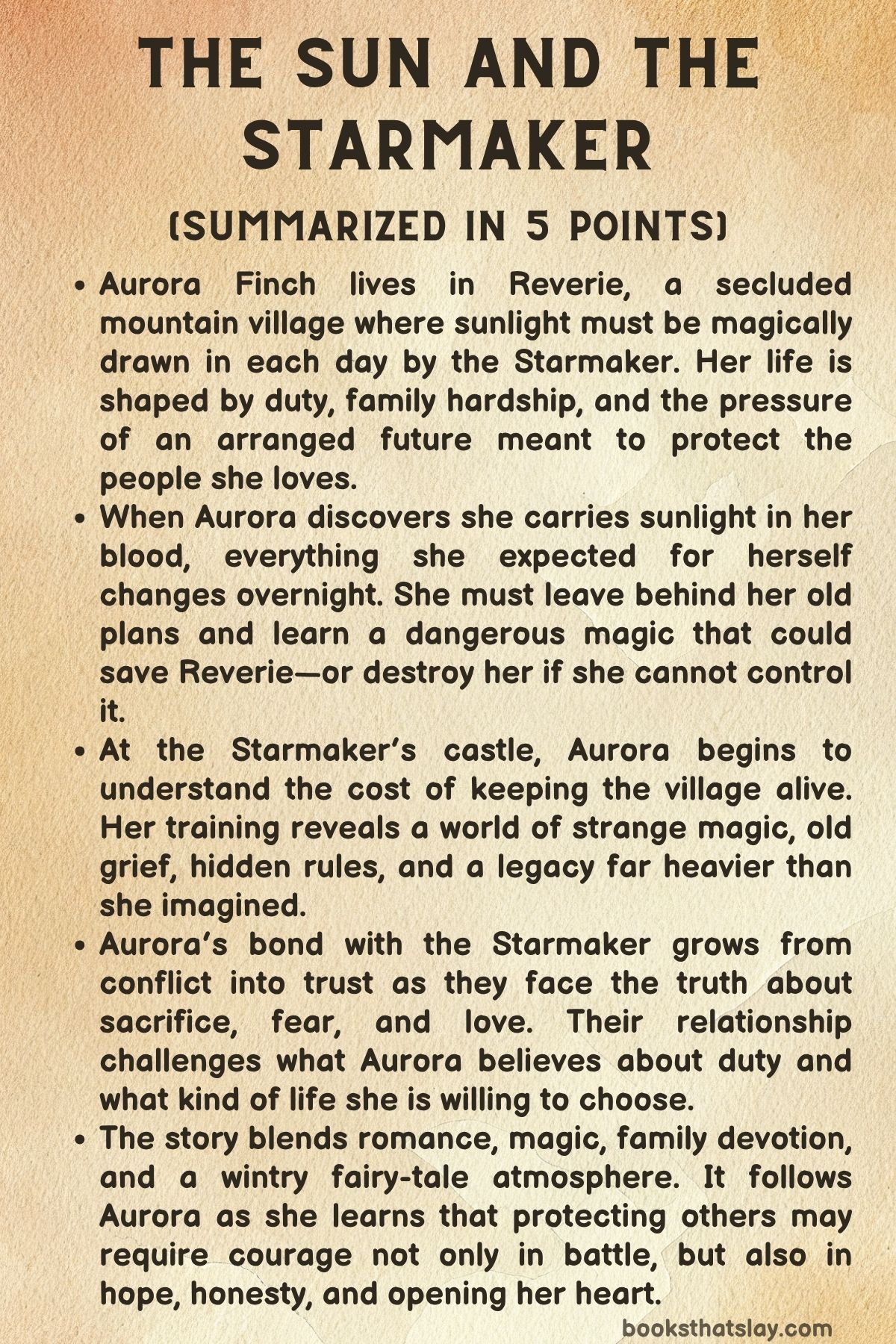
Aurora Finch lives in Reverie, a secluded mountain village surrounded by jagged peaks and trapped away from natural sunlight. The village survives because of the Starmaker, a magical figure who draws light from the Sun and sends it into Reverie each day.
The people of Reverie believe the first Starmaker was created long ago when the Sun came to earth in human form, fell in love with a man, and filled him with her light so he could protect the village from the deadly Frost.
Aurora grows up in one of the darkest parts of Reverie. Her family’s land receives little light, so she builds and arranges mirrors to guide sunlight toward their cottage and crops.
Her younger sister, Elsie, has been badly affected by the Frost, and Aurora is desperate for her to recover. Aurora is also preparing to marry Farren Glenn, a match that will do more than unite two families.
Their marriage is expected to form a magical glare line, which would help shield Aurora’s family home and strengthen their land.
Before the wedding, Aurora visits the grave of the first Starmaker and begs for Elsie’s healing. She promises she would give anything if her sister could be saved.
Soon after, while gathering winterberry in the woods, Aurora sees a white snow stag and tries to shoot it, even though hunting such creatures is forbidden. A mysterious man stops the arrow.
When Aurora touches him, golden light appears beneath her skin. He reveals that he is the current Starmaker and tells Aurora that sunlight lives in her blood.
She is his successor.
Aurora refuses to accept this at first. She has a family, a fiancé, and a life she understands.
The Starmaker tells her that her magic cannot be ignored, because if she does not learn to control it, it will kill her. When he follows her home and explains the truth to her family, Aurora realizes she has little choice.
Still, she sets conditions before agreeing to go with him. He must heal Elsie, and he must marry Aurora so that a new glare line can protect her family in place of the one she would have created with Farren.
The Starmaker agrees. Aurora tells Farren what has happened, and he begs her to leave with him instead.
She refuses, knowing that Elsie’s life and the safety of Reverie matter more than her old plans. The next morning, the Starmaker heals Elsie and takes Aurora to his frozen castle.
During the journey, the Frost nearly overcomes her, but his warmth protects her.
At the castle, Aurora meets Ina, Frederick, and Constance, an immortal rabbit. She learns that the Starmaker’s existence is not grand in the way people imagine.
He is powerful, but he is also lonely. He has lived for centuries, lost everyone he once loved, and knows that once Aurora fully inherits his magic, his own life will end.
Aurora begins training with him, helping pull sunlight into Reverie each morning. The work is painful and difficult, and she struggles to understand the magic inside her.
Aurora and the Starmaker clash often. She resents the life that has been forced on her, while he is guarded and stern because he understands what her future will demand.
Yet as they spend time together, Aurora begins to see his hidden kindness and sorrow. He teaches her about the Sun, the Frost, the lamppost that holds daylight, magical burial places, and the strange beings created by old magic.
They retrieve Tilly, a living snow angel who is still searching for the human girl she once was. Aurora’s compassion toward Tilly helps the Starmaker see her strength in a new way.
Their arranged wedding becomes a public event, but Aurora grows angry when invitations are sent before she has properly spoken to Farren. On the wedding day, the Starmaker arranges for Elsie to visit, giving Aurora a brief moment of comfort.
During the ceremony, Aurora realizes that the marriage being performed in front of the village feels false. It is based on duty and performance, not truth.
She runs from the altar, shocking everyone.
Farren later sneaks into her room, thinking she rejected the Starmaker because she still wants him. Aurora tells him that the life they planned no longer fits who she is becoming.
That night, she and the Starmaker share food, wine, honesty, and laughter, and their bond begins to change. Aurora later visits her family with him and shows him the mirrors she built to bring light to their home.
On the ride back, she panics after understanding what immortality will mean. She will outlive everyone she loves.
The Starmaker steadies her and reminds her that her life will hold meaning through the mountain, the flowers, the stars, and the sunlight within her.
Aurora keeps training, but her progress stalls. She realizes part of her is afraid to grow stronger because every step forward weakens the Starmaker.
They face a magical problem in the village when a singing streetlamp puts people to sleep, and Aurora solves it by singing the lullaby back to the lamp. She also gives Tilly a mirror, helping the snow angel recognize herself and accept what she has become.
During one lesson, the Sun sends a dangerous surge of light into Aurora. She collapses, and both she and the Starmaker are injured.
Farren, who has been watching from the woods, takes Aurora to an old ice cave instead of returning her to the castle. When she wakes days later, he says he is protecting her, but Aurora realizes he also wants her to create a glare line for his own family’s failing land and newspaper.
She refuses. The Starmaker arrives with seven white wolves and rescues her, warning Farren never to come near her again.
Back at the castle, Aurora worries the Starmaker may have caused the surge on purpose, but he denies it. He believes the Sun has decided Aurora is ready for more power.
He also admits that his fear during her injury was not only fear for Reverie, but fear for her. Their feelings become undeniable, and they kiss.
Still, he pulls away because he believes loving him will only make Aurora’s immortal life more painful after he dies.
Aurora’s mother later visits and tells her that loving Aurora’s father was worth the pain of losing him. This helps Aurora accept that love can still matter even when grief is certain.
The Starmaker builds a mirror system to send more light toward Aurora’s family cottage. Aurora whispers that she might love him, and he hears her.
In his greenhouse, Aurora realizes he has been preparing not just for mortality, but for death. She searches for answers and learns the truth: when she fully receives his magic and can carry the Sun alone, he will die.
She confronts him, and he confirms it. Their grief breaks open the distance between them.
He tells her his name, Caspian, and they marry in a private midnight ceremony. Their happiness is brief, but it is real.
The Frost grows worse, and Caspian explains that after his death, the remaining magic in his body must be buried in the mountain to strengthen Reverie. Aurora finally pulls the full light by herself.
Caspian’s magic completes its transfer, and he dies peacefully. Reverie marks a Day of Darkness, but Aurora refuses to believe his death must be final.
As the new Starmaker, Aurora searches old books and village lore for a way to bring Caspian back. Elsie comes to the castle and helps her rest, while Aurora begins to connect clues about the Sun, memory, love, and the mountain’s magic.
She buries Caspian, but she also creates a daring plan. Using mirrors and a magical vertical sled, she reflects the statue of the Sun and the first Starmaker into the sky and retells their love story to the Sun.
The northern lights appear, suggesting the Sun has listened. At Caspian’s burial, Aurora cuts her palm and lets her blood fall into the earth.
The Sun answers. Caspian wakes in his casket, alive again.
Aurora and Caspian are reunited, no longer separated by the cruel ending they feared.
Later, Aurora begins writing for Eternal Reverie, choosing to speak directly to the people she protects. She accepts her role as Starmaker, not as a prison, but as a life she can shape.
With Caspian beside her, Aurora carries the Sun’s light into Reverie and begins a future built from duty, love, and hope.
Characters
Aurora Finch
Aurora Finch is the central character of The Sun and the Starmaker, and her journey is built around sacrifice, fear, love, and self-discovery. At the beginning of the book, she is deeply tied to her family and to the practical responsibilities of survival in Reverie.
Her mirrors show her resourcefulness and determination, because she refuses to accept darkness as permanent for her family. Aurora’s first major conflict comes from being forced to choose between the life she expected and the life Reverie needs from her.
She does not immediately embrace her role as the next Starmaker, which makes her feel human and believable. Her refusal is not selfishness; it comes from fear, loyalty, and the pain of losing control over her future.
Aurora’s character becomes more complex as she begins training with the Starmaker. She is stubborn, emotional, and often angry, but these qualities also make her strong.
She questions the traditions around her instead of quietly accepting them, especially when the public wedding begins to feel dishonest. Her decision to run from the altar shows that she is not willing to live inside a false story simply because the village expects it.
As she learns more about the Frost, the Sun, and the cost of becoming immortal, Aurora changes from someone trying to protect only her family into someone who understands the burden of protecting all of Reverie.
Her emotional growth is most visible in her relationship with Caspian. At first, she sees him as distant, controlling, and almost inhuman, but she gradually recognizes his loneliness and pain.
Her fear of becoming stronger because it means he will weaken reveals her capacity for love and moral conflict. Aurora’s final acts show her full transformation.
She becomes Starmaker, accepts the responsibility of carrying sunlight, but still refuses to let love be erased by duty. By bringing Caspian back and later writing for Eternal Reverie, Aurora proves that leadership does not have to mean emotional isolation.
She becomes powerful not because she stops loving people, but because she allows love to guide the way she uses her power.
Caspian, the Starmaker
Caspian is one of the most tragic and emotionally layered figures in the book. When he first appears, he seems mysterious, powerful, and severe.
He carries the authority of the Starmaker, but that authority is shaped by centuries of loneliness. His role has forced him to outlive everyone he has loved, making him guarded and emotionally distant.
He understands the beauty of sunlight and the importance of his duty, but he also understands that the magic keeping Reverie alive demands an unbearable personal cost. His coldness is not cruelty; it is a defense built from grief.
As Aurora comes to know him, Caspian becomes less like a legend and more like a wounded person trapped inside one. His preserved childhood room, his careful knowledge of magic, and his quiet acts of kindness reveal that he has never fully escaped the boy he once was.
He trains Aurora because he must, but his feelings for her complicate everything. He wants her to survive and become strong, yet her growth brings him closer to death.
This makes his love for her painfully selfless. He pulls away after their kiss not because he does not care, but because he fears that loving him will make Aurora’s immortal life even harder.
Caspian’s decision to hide the truth about his death shows both his tenderness and his flaw. He believes he is sparing Aurora pain, but by keeping the truth from her, he also denies her the chance to face that pain honestly.
His eventual confession of his name is deeply symbolic because it allows him to step out of the title of Starmaker and become fully human to Aurora. His death marks the completion of his sacrifice, but his return gives his character a gentler ending.
Caspian represents duty, endurance, loneliness, and the possibility that even a life shaped by loss can still be changed by love.
Farren Glenn
Farren Glenn begins as Aurora’s expected future, but he gradually becomes a symbol of the life she must outgrow. At first, he appears to love Aurora sincerely, and his desperation when she chooses to go with the Starmaker feels understandable.
He wants to keep the life they planned together, and his plea for her to run away with him shows how deeply he resists the changes happening around them. However, Farren’s love is limited by his inability to truly understand Aurora’s responsibility.
He wants her to choose him, but he does not fully grasp the consequences that choice would have for Elsie, her family, or Reverie.
His character becomes darker when he takes Aurora to the old ice cave after she is injured. Although he claims he is protecting her, his actions reveal possessiveness and self-interest.
He keeps her away from the castle while she is weak, and his desire for a glare line exposes how much his family’s needs and business concerns influence his behavior. This does not make him purely evil, but it does show that his love has become tangled with entitlement.
He wants Aurora’s power to solve his problems, even after she has made it clear that their old life no longer fits.
Farren’s role in the story is important because he shows the difference between love that clings and love that frees. He represents comfort, familiarity, and the past, but also the danger of refusing to accept someone’s growth.
Aurora’s rejection of him is not simply a romantic choice; it is a declaration that she cannot return to being the person she was before the sunlight awakened in her blood. Through Farren, the book explores how love can become harmful when it values possession over understanding.
Elsie Finch
Elsie Finch is Aurora’s younger sister and one of the emotional anchors of the story. Her suffering after being touched by the Frost gives Aurora’s early choices urgency and weight.
Aurora’s bargain with the Starmaker is driven largely by Elsie’s condition, which shows how central Elsie is to Aurora’s sense of duty. Even when Elsie is physically weak, her presence shapes the direction of the plot because Aurora’s love for her becomes one of the first reasons Aurora accepts a destiny she does not want.
Elsie also represents innocence affected by forces beyond her control. The Frost’s touch makes the danger facing Reverie personal instead of abstract.
Through Elsie, the reader sees that the Frost is not only a distant threat to the village but something that can enter a family and change everything. Her healing gives Aurora temporary relief, but it also binds Aurora more firmly to the Starmaker’s world.
Elsie’s recovery is not just a happy event; it is the result of Aurora’s willingness to sacrifice her expected future.
Later, Elsie’s visit to the castle and her support after Caspian’s death show that she is more than a helpless figure. She becomes a source of comfort and grounding for Aurora.
Her presence reminds Aurora of home, family, and the human connections that still matter after Aurora becomes Starmaker. Elsie’s character may be quieter than Aurora’s, but she is essential because she represents the love that first pushes Aurora toward courage and later helps her endure grief.
Aurora’s Mother
Aurora’s mother is a steady and emotionally wise figure in the book. She understands grief in a way that becomes important when Aurora begins fearing the pain of immortal love.
Her conversation with Aurora about loving Aurora’s father, even though that love ended in loss, becomes one of the story’s clearest statements about the value of love. She teaches Aurora that pain does not erase the worth of having loved someone.
This wisdom helps Aurora accept her feelings for Caspian instead of rejecting them out of fear.
As a mother, she is shaped by hardship, especially because her family lives in one of the darkest parts of Reverie. She understands survival, family duty, and sacrifice.
Her acceptance of Aurora’s new role is painful but necessary, and that makes her character emotionally realistic. She does not simply push Aurora away into destiny, nor does she try to deny what Aurora must become.
Instead, she gives Aurora the emotional guidance needed to face a life much larger and lonelier than the one she expected.
Her importance lies in the way she connects love with endurance. While Caspian teaches Aurora about sunlight, magic, and responsibility, Aurora’s mother teaches her about grief, memory, and emotional courage.
She helps Aurora understand that avoiding love does not prevent suffering; it only prevents meaning. In this way, she becomes one of the quiet moral centers of the novel.
Aurora’s Father
Aurora’s father is not physically present in the main events, but his memory influences the emotional world of the story. His death has shaped Aurora’s family, especially her mother, whose reflections on loving him help Aurora understand her own feelings for Caspian.
He represents a love that ended in grief but still remains meaningful. Through him, the book shows that absence can still shape the living.
His role is especially important because he becomes part of Aurora’s understanding of mortality. As Aurora realizes that becoming Starmaker may mean outliving everyone she loves, the memory of her father deepens her fear of loss.
Yet his relationship with Aurora’s mother also becomes proof that love can be worth its ending. He is a quiet but powerful presence because he helps frame one of the story’s central questions: whether love is still worth choosing when loss is certain.
Ina
Ina, the castle’s house manager, brings warmth and stability into a place that could otherwise feel cold and lonely. She helps humanize the Starmaker’s castle by making it feel lived-in rather than merely magical.
Her kindness toward Aurora is important because Aurora enters the castle feeling displaced, frightened, and angry. Ina’s presence softens that transition and shows that even within a world shaped by sacrifice, ordinary care still matters.
Ina also serves as a contrast to the grandeur and danger surrounding the Starmaker’s role. While Caspian deals with sunlight, death, and immortality, Ina represents daily life, comfort, and practical compassion.
She helps ground the story in human routines. Her role may be supporting, but she contributes to Aurora’s gradual understanding that the castle is not only a prison or a place of duty.
It is also a home filled with people and creatures who have adapted to its strange magic.
Frederick
Frederick is a nervous servant in the castle, and his anxious nature adds a lighter but still meaningful texture to the story. He helps show that the magical world around Aurora is not made only of powerful beings and grand legends.
It is also populated by ordinary people who react to danger, uncertainty, and powerful figures with fear and caution. His nervousness makes the castle feel more socially alive and less like a distant fairy-tale setting.
Frederick’s character also highlights the intimidating nature of the Starmaker’s world. Through him, the reader can sense how overwhelming the castle and its magic may be to those who live near it.
He may not drive the central emotional conflicts, but he helps create the atmosphere around Aurora’s new life. His presence supports the book’s balance between magical wonder and everyday human vulnerability.
Constance
Constance, the immortal rabbit, is one of the stranger and more whimsical figures in the story. As an immortal creature, she reflects the unusual consequences of magic in Reverie.
Her existence suggests that immortality is not limited to grand heroic figures; it can appear in unexpected and almost humorous forms. This gives the magical world more depth and unpredictability.
At the same time, Constance’s immortality quietly echoes the larger concerns surrounding Aurora and Caspian. The story repeatedly asks what it means to live beyond ordinary time, and Constance offers a smaller, softer version of that question.
She adds charm to the castle, but she also belongs to the book’s wider meditation on time, endurance, and magical transformation. Her presence reminds the reader that magic can be tender, odd, and unsettling all at once.
Tilly
Tilly, the living snow angel, is one of the most poignant magical characters in the story. She is trapped between what she is now and the human girl she once was, which makes her search for identity deeply moving.
Her repeated longing for her former self shows the sadness of being changed by magic in a way that separates someone from their past. Tilly is not simply a magical curiosity; she represents loss of self and the desire to be recognized.
Aurora’s treatment of Tilly reveals an important part of Aurora’s character. Instead of dismissing Tilly as strange or broken, Aurora responds to her with kindness.
This impresses Caspian because it shows that Aurora’s strength is not only magical but emotional. The mirror Aurora and Caspian give Tilly becomes symbolically important because it helps Tilly see and accept herself.
Through Tilly, the book suggests that healing does not always mean returning to what one was before. Sometimes it means learning to recognize the self that remains.
Tilly’s role also connects to the broader themes of reflection and identity. Mirrors are already central to Aurora’s life, and Tilly’s mirror becomes another example of reflection as both literal and emotional truth.
Tilly’s acceptance of herself parallels Aurora’s own journey toward accepting her identity as Starmaker. Both characters must face a changed version of themselves and decide whether that changed self can still be loved.
The Sun
The Sun functions as both a divine force and an emotional presence in the story. She is not merely a source of light; she is tied to memory, love, sacrifice, and the origin of the Starmakers.
The village lore describes her as having once taken human form and fallen in love, which makes her more than a distant celestial power. She becomes a figure capable of tenderness, grief, and response.
Her relationship to Aurora is complicated. She gives Aurora light and power, but she also overwhelms her during training, causing injury and fear.
This makes the Sun feel majestic but not entirely gentle. Her magic is necessary for life, yet it is also dangerous when too much of it enters a human body.
Through the Sun, the book explores the idea that power can be both saving and destructive depending on how it is received and carried.
By the end of the story, Aurora’s attempt to make the Sun remember her own love story gives the Sun emotional importance. The northern lights suggest that she hears Aurora, and Caspian’s return shows that memory and love can awaken mercy within cosmic power.
The Sun represents the highest form of light in the story, but that light becomes meaningful because it is connected to love.
The Frost
The Frost is the main destructive force in the story, but it is more than a simple villain. It represents coldness, death, erasure, and the danger that waits outside the protection of sunlight.
Its touch harms Elsie, threatens Aurora during her journey, and has already destroyed places beyond the glacier. Because the Frost can damage bodies, homes, and whole histories, it becomes a constant reminder of what Reverie could lose.
The Frost also gives meaning to the Starmaker’s sacrifice. Without it, the daily pulling of sunlight might seem beautiful but not urgent.
The ruins beyond the glacier and the frozen candy stripe phlox show the cost of failure. These images make the Frost feel like a force that does not merely kill people but freezes possibility itself.
It stops growth, warmth, and memory.
Symbolically, the Frost opposes connection. Where sunlight is tied to love, memory, and life, the Frost is tied to isolation and disappearance.
It challenges Aurora not only physically but emotionally, because becoming Starmaker means accepting a lifelong struggle against it. The Frost gives the story its danger, but it also helps define Aurora’s courage.
The First Starmaker
The first Starmaker stands at the beginning of Reverie’s magical history. He is the man loved by the Sun and filled with her light so the village could survive.
Though he is long dead, his presence shapes the customs, beliefs, and responsibilities of every Starmaker who follows. His grave becomes the place where Aurora begs for Elsie’s healing, making him part of the story’s emotional beginning as well as its mythic past.
He represents the origin of sacrifice in Reverie. His transformation created a line of protectors who must carry sunlight for others, but it also created a legacy of loneliness and eventual death.
Through him, the book connects romance with responsibility. His love with the Sun is not just a legend; it becomes the foundation of the village’s survival.
The first Starmaker is also important because Aurora later uses his story to reach the Sun. By reflecting the statue of him and the Sun into the sky, Aurora turns old lore into living power.
His character shows that stories are not passive memories in this world. They can shape magic, restore love, and change the future.
The Snow Stag
The snow stag is a brief but important figure because its appearance changes the direction of Aurora’s life. When Aurora tries to shoot it, she breaks a sacred rule, and that moment leads to her first meeting with the Starmaker.
The stag therefore functions as a magical threshold. It draws Aurora out of her ordinary life and into the destiny she has been resisting without even knowing it.
The stag’s beauty and forbidden status suggest that Reverie’s natural world is filled with sacred meanings. Aurora’s attempt to kill it is not presented as simple cruelty; it comes from distraction, pressure, and the practical needs of her wedding day.
Still, the mistake reveals how close she is to crossing from the familiar into the unknown. The snow stag becomes a symbol of the story’s turning point, where ordinary choices suddenly reveal hidden consequences.
The White Wolves
The seven white wolves appear during Aurora’s rescue from Farren, and they add a powerful sense of protection and judgment to that scene. Their arrival with Caspian makes his rescue feel almost mythic.
They are not developed as individual characters, but they serve an important symbolic function. They represent the wild authority of the Starmaker’s world and the seriousness of Farren’s violation.
The wolves also sharpen the contrast between Farren and Caspian. Farren tries to keep Aurora hidden and contained, while Caspian arrives with a force that restores her freedom.
The wolves make visible the danger surrounding Aurora’s power and the fierce protection Caspian feels for her. As magical creatures, they help show that Reverie’s world responds dramatically when boundaries are crossed.
The People of Reverie
The villagers of Reverie function as a collective character because their beliefs, fears, and expectations shape much of Aurora’s conflict. They depend on the Starmaker for survival, but they also turn the role into a public legend.
Their reaction to Aurora leaving the altar shows how quickly they can judge someone when the story they expect is disrupted. The cruel newspaper headline reflects the pressure Aurora faces from a society that wants symbols more than truth.
At the same time, the people of Reverie are not simply shallow or ungrateful. They live under constant threat from the Frost, and their dependence on sunlight makes their fear understandable.
Their need for reassurance helps explain why public rituals and legends matter so much to them. Aurora’s later decision to write for Eternal Reverie is significant because it shows that she does not reject the people she protects.
Instead, she chooses to communicate with them honestly and become a more present, human Starmaker.
As a group, the villagers represent the burden of leadership. Aurora must protect them even when they misunderstand her.
Their presence reminds the reader that being Starmaker is not only about magic; it is also about being watched, judged, needed, and sometimes misrepresented. Through them, the book explores the distance between public myth and private truth.
Themes
Sacrifice and Responsibility
Aurora’s journey in The Sun and the Starmaker is shaped by the painful weight of duty. At first, her choices are tied to her family’s immediate survival: Elsie’s illness, the darkness around their cottage, and the need for a glare line.
Her agreement to leave home is not driven by ambition or curiosity, but by the knowledge that refusing would place the people she loves in danger. As she learns what being a Starmaker truly means, responsibility expands beyond her family and becomes tied to the fate of all Reverie.
Pulling sunlight into the village is physically painful, emotionally frightening, and eventually connected to Caspian’s death. This makes her duty deeply personal, because accepting her power means accepting the loss of the person she loves.
The theme becomes powerful because sacrifice is not shown as noble in a simple way. It is unfair, exhausting, and filled with grief.
Yet Aurora still chooses to serve because she understands that love sometimes demands action even when the cost is unbearable.
Love and Grief
Love in the story is never separated from loss. Aurora’s bond with her family already teaches her that love can create fear, because every person she protects is someone she may one day lose.
This fear becomes sharper when she realizes that becoming Starmaker means she will outlive ordinary human lives. Her relationship with Caspian deepens this conflict because loving him means opening herself to a grief she knows is coming.
Caspian resists love for the same reason; he believes attachment will only make Aurora’s immortal future more painful. Yet the story argues that avoiding love does not protect people from suffering.
It only empties life of its most meaningful parts. Aurora’s mother helps her understand that grief does not cancel love’s value.
The brief happiness Aurora and Caspian share before his death matters because it is chosen with full knowledge of its cost. In The Sun and the Starmaker, love becomes an act of courage: fragile, temporary, painful, and still worth claiming.
Identity and Self-Acceptance
Aurora’s identity changes before she is ready to accept it. She begins as a daughter, sister, bride-to-be, and practical caretaker who uses mirrors to help her family survive.
When Caspian reveals that sunlight lives in her blood, she is forced into a role that seems impossible to connect with the life she imagined for herself. Her struggle is not only about learning magic; it is about understanding who she is when old expectations no longer fit.
This is why her rejection of both Farren’s plan and the false public wedding matters. She refuses to let others define her through duty, romance, tradition, or usefulness.
Tilly’s story reflects this same theme in a gentler form. The snow angel’s mirror allows her to face what she has become and accept her existence without being trapped by what she once was.
Aurora’s growth follows a similar path. She does not return to her old self, but she also does not lose herself completely.
She becomes someone new by accepting both power and vulnerability.
Light, Darkness, and Hope
Light and darkness are central symbols throughout the story, but they are not treated as simple opposites. Sunlight represents life, warmth, memory, protection, and connection, while darkness often reveals fear, isolation, and uncertainty.
Reverie’s survival depends on daily light, making hope something that must be actively created rather than passively expected. Aurora’s mirrors show this clearly.
Even before she knows she has magic, she is already finding ways to redirect light toward places that have been neglected. This practical use of light reflects her character: she does not wait for rescue but tries to make survival possible with what she has.
The Frost represents more than physical danger; it shows what happens when warmth, memory, and human connection are lost. Aurora’s final attempt to awaken the Sun’s memory shows that hope can come from storytelling, love, and refusal to accept despair as final.
The ending suggests that light is not only a force of nature. It is also something preserved through remembrance, courage, and devotion.