The Wild Card Summary, Characters and Themes
The Wild Card by Stephanie Archer is a sports romance about Jordan Hathaway, a sharp bar owner with a complicated family past, and Tate Ward, the disciplined head coach of the Vancouver Storm hockey team. Their story begins with sarcasm, resentment, and a secret connection to the team’s future, then grows into a relationship shaped by trust, ambition, found family, and old wounds.
Jordan is fighting to prove she belongs in the hockey world, while Tate is trying to protect his team, his daughter, and his own carefully controlled heart. It’s the 5th book of the Vancouver Storm series.
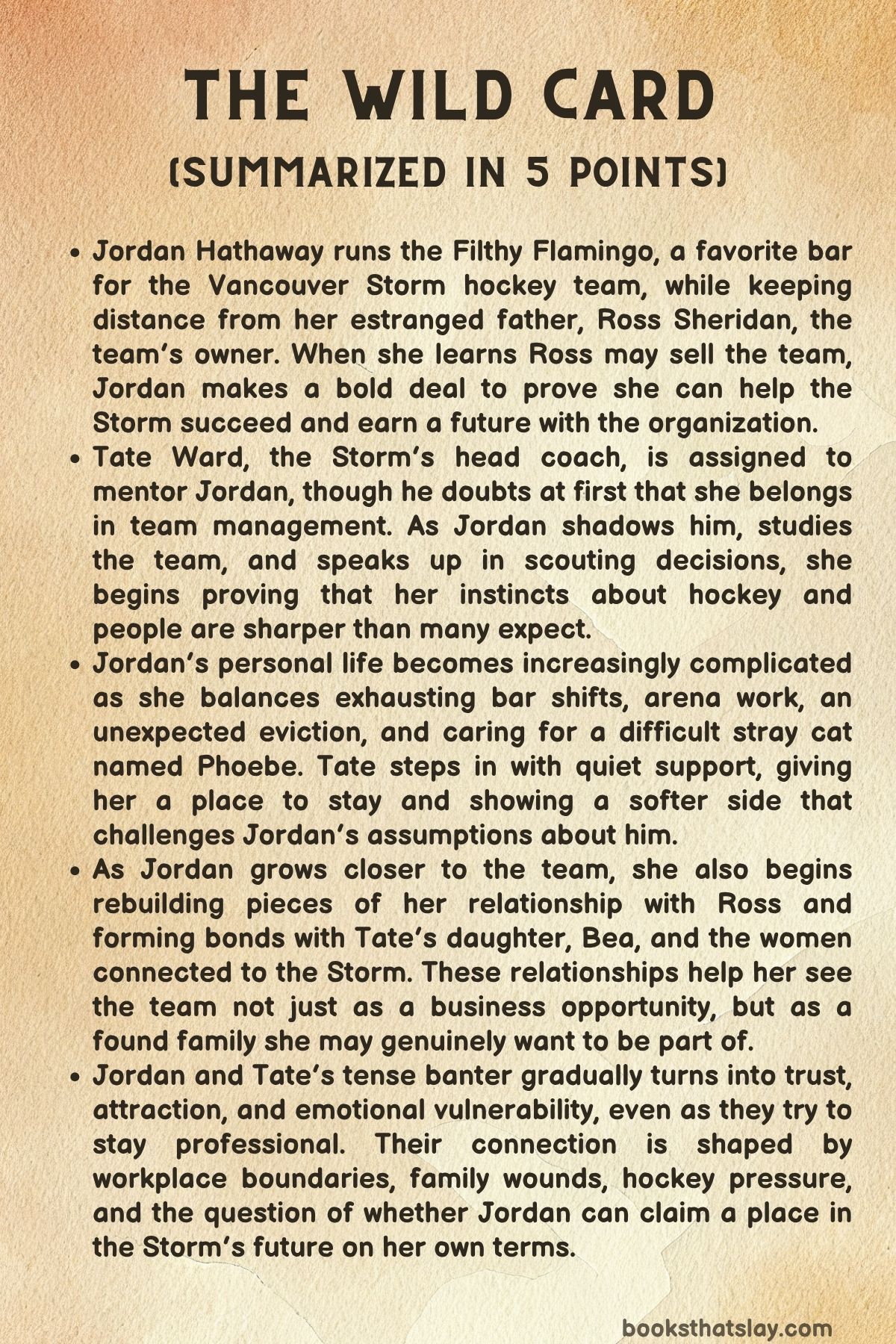
Summary
Jordan Hathaway owns and runs the Filthy Flamingo, a bar where the Vancouver Storm hockey team often celebrates. The team’s head coach, Tate Ward, visits the bar every month, partly because Ross Sheridan, the Storm’s owner, asks him to check on Jordan.
Ross is Jordan’s estranged father, though most people around the team do not know that. Jordan and Tate clash almost every time they meet.
Their arguments are sharp, but beneath the hostility is a growing curiosity neither of them wants to admit.
Tate later learns from Ross that he plans to sell the Storm because Jordan has never seemed interested in taking over the team. Tate warns Jordan, knowing a new owner could hurt the team’s future.
Jordan realizes that the Storm has become important to her, even if she has kept her distance from her father and the organization. For the first time in ten years, she goes to Ross and makes a deal.
If she works for the Storm and helps them win the Stanley Cup, Ross will give her the team.
Tate is told to mentor Jordan, although he doubts she belongs in hockey management. Jordan starts shadowing him at practices, meetings, and team events.
She tells the players that Ross is her father, but she keeps the real stakes of her deal private. At the same time, she rescues a difficult stray cat from the alley behind her bar and names her Phoebe.
The cat later bonds with Bea, Tate’s nine-year-old daughter, creating another small connection between Jordan and Tate’s home life.
Jordan is soon exhausted from working mornings at the arena and nights at the bar. When Phoebe escapes and Jordan’s landlord discovers the cat, Jordan is evicted.
Her belongings are left outside in the rain, including records and a record player that belonged to her late mother. Tate finds her, protects the items that matter most, and brings Jordan and Phoebe to his guest cottage.
He quietly arranges help for her damaged belongings and secretly buys her a professional wardrobe, pretending it came from the team. Jordan begins to see that Tate is not only stern and judgmental; he can also be careful, generous, and observant.
At work, Jordan starts proving herself. She understands hockey strategy and team chemistry better than Tate expected.
She rejects Liam Hutton as a possible trade target because she believes he would not suit the Storm, and Tate later agrees with her assessment. She recommends Brooks Yang-Hanson and argues that the team needs stronger centermen.
When an older scout named Gary dismisses her as only a bartender, Tate defends her. He later fires Gary, which leads the North American scouts to quit in protest.
Rather than backing away, Tate asks Jordan to become a scout herself because the team needs her judgment. Jordan is nervous because of past failure connected to sports psychology work with the UBC women’s team, but she accepts.
As Jordan becomes more involved with the Storm, her relationship with Tate changes. They still argue, but their arguments are mixed with care.
At a charity gala, Ross compliments Jordan, and she accidentally thanks him for a dress Tate bought. Tate later criticizes her for being rude to Ross, but Jordan finally explains how deeply Ross hurt her.
He skipped her mother Natalie’s funeral and was absent through much of her childhood. Tate realizes he has judged Jordan unfairly and that Ross’s version of events was incomplete.
He also tells Jordan that a hockey-stick keychain she thought Bea made for Ross was actually something Jordan made as a child. The discovery unsettles her and forces her to face memories she had buried.
Tate confronts Ross and tells him Jordan has been alone long enough. Around this time, the Storm players begin noticing the tension between Jordan and Tate and start meddling.
Jordan realizes she has a crush on Tate, especially after Phoebe keeps carrying Jordan’s underwear into his room. Tate is also attracted to Jordan, but he tries to stay professional because he is her boss and she is living on his property.
Jordan babysits Bea one evening, introduces her to records and classic rock, and forms a real bond with her. Later, Jordan finds her underwear in Tate’s bedside table, confirming that Tate’s interest in her is not one-sided.
After a mouse incident in the guesthouse, Jordan ends up sleeping in Tate’s bed. Tate wakes with her in his arms and is shaken by how natural it feels.
Their closeness grows during a work trip to meet Carey Colworth, a chaotic university hockey prospect Jordan identified. Carey immediately notices the attraction between them, making it harder for both Jordan and Tate to pretend nothing is happening.
Jordan also begins forming friendships with the women connected to the team. At lunch with Georgia, Hazel, Darcy, and Pippa, she realizes Tate arranged the meeting so she could feel less alone.
The women discuss Jordan becoming more visible with the Storm after a video of her bartending at a game goes viral and fans praise her as approachable and owner-like. Jordan learns that Tate defended her after Gary insulted her and that he rarely trusts anyone with Bea, making his decision to let Jordan babysit important.
Encouraged, Jordan asks Ross for more analytics staff to support Darcy. Tate backs her immediately, and Ross agrees, but only if Jordan has lunch with him every two weeks.
Jordan accepts.
The emotional distance between Jordan and Ross slowly shifts. During a game, Ross sits beside her and tries to talk personally rather than only about work.
Jordan admits she listens to her late mother’s old music on her record player, and Ross shares memories of Jordan and Natalie dancing. These moments do not erase the past, but they open a door Jordan had kept closed for years.
Jordan and Tate’s connection becomes harder to resist. One night, Phoebe steals Jordan’s underwear again and brings it to Tate.
Jordan goes to his room and finds him watching hockey on a hidden bedroom TV. He invites her to stay.
They talk about his absent father, who repeatedly abandoned his family, and Tate explains that his father became the example of the man he never wanted to be. They switch to a horror movie, and Jordan teases Tate when she discovers he is scared.
He challenges her to cuddle him, and they fall asleep together. Jordan wakes in his arms the next morning and panics.
The team later tricks Jordan and Tate into a fake dinner alone. Instead of escaping the setup, Tate takes Jordan to a small Italian restaurant.
They talk honestly about hockey, loneliness, Jordan’s future, and whether she might stay with the Storm. Tate tells her she is excellent in her role.
After dinner, he gives her his jacket, walks her to her hotel room, and calls her beautiful. Jordan confronts him about making her feel rejected.
Tate explains that he has stayed away not because she is not enough, but because he is her boss, she is younger, and he does not want to harm her career. He tells her she belongs with the team and kisses her.
The kiss becomes intense, but he stops because he wants to protect her place with the Storm more than he wants to be selfish.
During a power outage, Bea asks Tate to bring Jordan over. Jordan joins them for pizza and records, and Bea happily shows her guitar progress.
Bea also reveals she knows Jordan stayed over before because of the Ring camera. After Bea goes to bed, Tate gives Jordan his old Storm sweatshirt.
He tells her there will always be a place for her with the team. They admit they still think about the kiss, and this time they give in.
They kiss and touch on the couch, but when the power returns, Jordan panics and leaves.
At a team dinner hosted by Luca Walker, Jordan listens as Luca gives an emotional speech about adoption, chosen family, and what the Storm means to him. Jordan is deeply moved and realizes she wants to remain part of the Storm family, not only because of the deal with Ross, but because she truly belongs there.
Jordan later accidentally confesses to Tate’s brother Noah that she and Tate should only be friends, thinking he is Tate. Noah teases her and invites her to watch the game from Ross’s box.
During the game, Noah talks Tate up and points out that Tate does not look at other women the way he looks at Jordan. When the kiss cam shows Jordan and Noah, Jordan kisses Noah on the cheek.
Tate becomes jealous, snaps at staff to cut away, and rushes home after learning Noah is riding back with Jordan.
At home, Tate sends Noah away, carries Jordan upstairs, and begs her not to kiss or date anyone else. He admits he cannot stay away from her.
Since the playoffs are still ahead and their professional situation is complicated, he suggests keeping things casual and secret until the end of the playoffs. Jordan agrees.
Their attraction finally becomes physical, but it is also tender and full of trust. Tate focuses on Jordan’s pleasure and makes her ask for what she needs, showing how much he wants her to feel safe, wanted, and in control.
Through Jordan’s growing role with the Storm, her changing relationship with Ross, her bond with Bea, and her romance with Tate, the book follows a woman learning that she can claim a place in the world she once avoided. Jordan begins as an outsider with old grief and guarded ambition, but she gradually becomes someone the team trusts, someone Tate admires, and someone who may be ready to inherit not only the Storm, but the complicated family and future that come with it.
Characters
Jordan Hathaway
Jordan Hathaway is the emotional center of The Wild Card, and her character is built around guarded strength, loneliness, competence, and the slow rebuilding of trust. At the beginning of the book, she appears sharp, defensive, and stubborn, especially in the way she clashes with Tate Ward and keeps distance from her father, Ross Sheridan.
Her work at the Filthy Flamingo shows that she is independent and hardworking, but it also reveals how much of her life has been shaped by survival rather than comfort. Jordan is not simply angry for the sake of being difficult; her resentment comes from years of abandonment, grief, and feeling unsupported after her mother’s death.
This makes her guardedness understandable, because she has learned not to rely on people who may leave or disappoint her.
Her growth becomes clearer once she begins working with the Vancouver Storm. At first, she doubts whether she belongs in the organization, partly because Tate doubts her and partly because she carries the weight of past failure from her unfinished sports psychology work.
However, Jordan quickly proves that her understanding of hockey goes beyond surface knowledge. She sees the importance of team fit, chemistry, and emotional dynamics, which allows her to judge players in ways others overlook.
Her rejection of Liam Hutton, support for Brooks Yang-Hanson, and identification of Carey Colworth show that she has a strong instinct for what the team needs. Jordan’s arc is not about suddenly becoming capable; it is about finally being seen for the capability she already had.
Her relationship with Tate brings out both her vulnerability and her courage. Around him, Jordan slowly allows herself to be cared for, though she often panics when emotional intimacy becomes too real.
The loss of her apartment and Tate’s decision to protect her belongings become turning points because they force her to accept help without losing her dignity. Her bond with Bea also reveals a softer, nurturing side of her, especially through music, babysitting, and the easy affection Bea develops for her.
By the later parts of the story, Jordan is no longer only fighting against her past; she is beginning to imagine a future with the Storm, with Tate, and with a chosen family that values her.
Tate Ward
Tate Ward is one of the most layered characters in the book because he is both controlled and deeply emotional. As the Vancouver Storm’s head coach and a former star player, he carries authority, discipline, and a strong sense of responsibility.
At first, he seems judgmental toward Jordan, especially because he assumes she is careless or uninterested in the team. His early attitude is shaped by loyalty to Ross and by his own belief in structure and professionalism.
However, as he spends more time with Jordan, he begins to recognize that his first impression was incomplete and unfair.
Tate’s emotional complexity comes from his past with an absent father. He has built his life around being the opposite of the man who repeatedly abandoned his family.
This explains his caution, his self-control, and his fear of making selfish choices. His attraction to Jordan challenges him because he is her mentor, her boss in a professional sense, and the person giving her a place to live.
Rather than rushing into desire, Tate tries to protect Jordan’s career and reputation, even when his restraint hurts her. This makes his conflict meaningful: he is not rejecting Jordan because he does not want her, but because he is terrified of becoming careless with someone who deserves stability.
His care for Jordan is shown through practical, quiet actions. He protects her records, gives her shelter, arranges help for her belongings, buys her professional clothes, defends her when Gary insults her, and pushes Ross to recognize how alone she has been.
These gestures reveal a man whose love language is protection and steadiness. His tenderness with Bea also deepens his character, showing that fatherhood is central to who he is.
By the time he admits he cannot stay away from Jordan, his surrender feels emotionally earned because it comes after a long struggle between duty, desire, and love.
Ross Sheridan
Ross Sheridan is a complicated father figure whose choices have deeply shaped Jordan’s life. As the owner of the Vancouver Storm, he has power, wealth, and influence, but his relationship with his daughter is marked by absence and emotional failure.
His decision to send Tate to check on Jordan suggests that he cares in some indirect way, yet it also shows his inability to approach her honestly himself. Ross’s plan to sell the team becomes the event that pushes Jordan back into his life, but it also reveals how little he understands her.
He assumes she has no interest in the Storm, while Jordan’s later actions prove that she has cared more than he realized.
The greatest wound in Ross’s character is his absence after Natalie’s death. Jordan’s pain is not just about a distant father; it is about a father who failed her at the moment she needed him most.
This makes Ross morally imperfect rather than purely villainous. He is not portrayed as someone without feeling, because he does show signs of wanting connection.
His memories of Jordan and Natalie dancing, his compliment at the gala, and his condition that Jordan have lunch with him every two weeks suggest that he wants to repair what has been broken. However, his problem is that he often uses business arrangements or other people as substitutes for emotional honesty.
Ross’s role in The Wild Card is important because he represents both inheritance and abandonment. The team is something Jordan could gain from him, but it is also tied to the family pain she has avoided for ten years.
His relationship with Jordan forces the book to ask whether love still matters when it has been expressed badly or too late. Ross may not be fully redeemed by the events described, but he begins to move from distant authority toward flawed fatherhood, and that shift gives Jordan a chance to confront her past without being trapped by it.
Bea Ward
Bea Ward brings warmth, innocence, and emotional clarity to the story. As Tate’s nine-year-old daughter, she reveals a side of him that is gentle, devoted, and deeply protective.
Through Bea, the reader sees that Tate’s discipline is not coldness; it is rooted in love and responsibility. His reluctance to trust people with Bea makes his decision to let Jordan babysit her especially meaningful.
It shows that, even before Tate fully admits his feelings, he recognizes Jordan as someone safe and important.
Bea also plays a key role in softening Jordan’s world. Her bond with Phoebe, her interest in records and classic rock, and her excitement about guitar progress allow Jordan to connect through joy rather than conflict.
Jordan’s interactions with Bea show that she can be patient, affectionate, and nurturing when she feels accepted. Bea does not carry the complicated emotional baggage of the adults, so she often sees things plainly.
Her awareness of Jordan staying over because of the Ring camera adds humor, but it also shows how the growing closeness between Jordan and Tate is becoming visible even when they try to hide it.
Phoebe
Phoebe, the ugly and aggressive stray cat Jordan rescues, is more than a comic side character. She reflects Jordan herself in many ways: unwanted, defensive, difficult to approach, and still deserving of care.
Jordan’s decision to rescue Phoebe shows her instinct to protect vulnerable creatures, even when she is struggling to protect herself. Naming the cat after Bea bonds with her also connects Phoebe to the growing family structure around Jordan, Tate, and Bea.
Phoebe’s mischief also pushes the romance forward. Her habit of stealing Jordan’s underwear and carrying it to Tate creates embarrassment, comedy, and romantic tension.
The cat’s escape leads to Jordan’s eviction, which then brings her into Tate’s guest cottage and changes the emotional direction of the story. Phoebe functions as a chaotic little catalyst, forcing characters into situations where their hidden feelings become harder to ignore.
Natalie Hathaway
Natalie Hathaway is not physically present in the main events, but her influence is powerful. As Jordan’s late mother, she represents love, memory, music, and the part of Jordan’s past that still feels tender rather than bitter.
The record player and records that belonged to Natalie are among Jordan’s most precious belongings, and Tate’s care in protecting them shows that he understands their emotional importance before he fully understands Jordan’s history.
Natalie also shapes the conflict between Jordan and Ross. Ross’s absence from Natalie’s funeral is one of the deepest betrayals Jordan carries.
Because of this, Natalie’s memory becomes tied to grief and abandonment, but also to warmth and identity. When Ross recalls Jordan and Natalie dancing, the memory opens a small door between father and daughter.
Natalie’s role in the book is therefore quiet but essential: she is the emotional bridge between Jordan’s lost childhood, her anger at Ross, and her gradual willingness to remember without shutting everyone out.
Gary
Gary represents the old, dismissive culture Jordan has to push against in the hockey world. His insult, reducing her to “a bartender,” is not only personally cruel but professionally revealing.
He refuses to see Jordan’s intelligence, judgment, or potential because she does not fit his idea of who belongs in scouting or management. His attitude exposes the sexism and elitism that Jordan must confront as she tries to earn her place with the Storm.
Tate’s response to Gary is important because it marks a turning point in how Jordan is defended and valued. By firing Gary, Tate does more than protect Jordan’s feelings; he makes a statement about the standards of the organization.
Gary’s departure, followed by the scouts quitting in protest, creates a professional crisis, but it also clears space for Jordan to step into a role where her voice matters. Gary is therefore a negative force, but his presence helps reveal Jordan’s strength and Tate’s loyalty.
Liam Hutton
Liam Hutton is significant because he becomes an early test of Jordan’s hockey judgment. As a potential trade target, he may appear useful on paper, but Jordan recognizes that he would not fit the Storm.
Her rejection of him shows that she understands the team as a living group rather than a collection of statistics or reputations. This is one of the moments where Jordan proves that her instincts are not casual opinions; they are informed, thoughtful assessments.
Liam’s role is brief, but he helps establish one of the book’s major ideas: success in hockey depends on chemistry, character, and fit, not just talent. Tate later confirming Jordan’s opinion validates her and helps shift how others see her.
Through Liam, the story shows that Jordan’s value to the team comes from seeing what others miss.
Brooks Yang-Hanson
Brooks Yang-Hanson represents Jordan’s ability to identify what the Storm actually needs. Her recommendation of him, along with her argument that the team needs stronger centermen, shows that she is thinking strategically.
She is not trying to impress people with flashy opinions; she is focused on building a better team. Brooks becomes evidence of Jordan’s growing confidence in her professional voice.
His role also helps move Jordan from outsider to contributor. By participating in scouting discussions and making specific recommendations, she begins to occupy space in the organization with more authority.
Brooks matters because he is part of the process through which Jordan stops simply shadowing Tate and starts shaping the Storm’s future.
Carey Colworth
Carey Colworth brings chaos, humor, and unpredictability into the story. As a university hockey prospect identified by Jordan, he proves again that she has an eye for unusual talent.
His loud flaming Bronco and blunt comment about the tension between Jordan and Tate make him instantly memorable. Carey sees what the main couple is trying to deny, and his lack of filter turns their hidden attraction into something obvious.
Beyond comedy, Carey also represents Jordan’s willingness to look beyond polished appearances. She is drawn to potential, energy, and fit, even when a player seems unconventional.
That mirrors her own position in the Storm organization: she too is underestimated because she does not arrive in the expected package. Carey’s presence reinforces the idea that valuable people are sometimes messy, loud, strange, or easy to misjudge.
Georgia
Georgia serves as a friend and emotional sounding board for Jordan. She helps Jordan process her feelings for Tate and gives her space to admit things she might otherwise avoid.
Through Georgia, Jordan begins to speak more openly about attraction, confusion, and fear. This matters because Jordan often protects herself through sarcasm and independence, but Georgia’s presence encourages honesty.
Georgia also connects Jordan to a broader circle of women around the Storm. By showing Jordan the social media account featuring women in sports, she helps Jordan see herself from the outside as someone fans admire and recognize as a future owner figure.
Georgia’s role is supportive, but not shallow; she helps Jordan understand that visibility can be empowering rather than threatening.
Hazel
Hazel is part of the female support network that helps Jordan feel less isolated. At lunch with Georgia, Darcy, and Pippa, Hazel contributes to the sense that Jordan is being welcomed into a community rather than merely evaluated by a workplace.
Her presence matters because Jordan has spent much of her life emotionally alone, and this group offers her a model of friendship that is warm, direct, and practical.
Hazel also helps create an environment where Jordan can discuss Tate without shame or confusion. The women’s conversation allows Jordan to understand that Tate’s actions, especially trusting her with Bea and defending her professionally, are meaningful.
Hazel’s role may be secondary, but she belongs to the book’s larger emotional structure of chosen family and female solidarity.
Darcy
Darcy stands out as both a member of Jordan’s support circle and a professional presence connected to the Storm’s analytics needs. The conversation about hiring more analytics staff leads Jordan to ask Ross and Tate for a permanent analyst and a co-op student.
This moment is important because it shows Jordan not only recognizing Darcy’s workload but also advocating for better organizational support.
Darcy’s role highlights the importance of women’s labor and expertise within the sports environment. She is part of the world Jordan is entering, and her needs help Jordan take action as a future leader.
Through Darcy, the story shows that ownership and management are not only about big emotional promises; they are also about noticing when people need resources and then asking for them.
Pippa
Pippa contributes to the sense of community that forms around Jordan. Like Georgia, Hazel, and Darcy, she helps create a space where Jordan can be seen as more than Ross’s daughter, Tate’s romantic interest, or the woman trying to prove herself professionally.
Pippa’s presence at the lunch scene helps Jordan experience belonging among women who understand the world around the team.
Her role is quieter, but she still matters because the story is not only about romance and career ambition. It is also about Jordan finding people who make the Storm feel like family.
Pippa helps build that atmosphere of acceptance, humor, and emotional support.
Noah Ward
Noah Ward, Tate’s brother, brings humor and jealousy into the story while also helping expose Tate’s feelings. Jordan accidentally confessing to Noah because she mistakes him for Tate creates an awkward and funny moment, but Noah quickly becomes more than comic relief.
He teases Jordan, invites her to Ross’s box, and talks Tate up during the game, making him a playful but perceptive presence.
Noah’s biggest function is to force Tate’s jealousy into the open. When the kiss cam shows Jordan and Noah and Jordan kisses him on the cheek, Tate’s reaction reveals how deeply possessive and emotionally involved he has become.
Noah does not need to compete seriously for Jordan; his presence simply makes Tate confront the truth he has been trying to control. In that sense, Noah acts as a catalyst for Tate’s confession and the shift into a secret romantic relationship.
Luca Walker
Luca Walker represents the emotional heart of the Storm family. His big-check dinner and speech about adoption, gratitude, and finding family with the team deeply affect Jordan.
Through Luca, Jordan sees that the Storm is not just a business asset or a prize in a deal with Ross. It is a community where people are changed, supported, and loved.
Luca’s speech helps Jordan understand what she truly wants. She is moved because his experience reflects the kind of belonging she has been missing.
His gratitude toward Darcy, Alexei, and the team shows Jordan that family can be chosen and built through loyalty rather than blood alone. Luca’s role in The Wild Card is therefore emotionally important because he helps Jordan recognize that staying with the Storm would mean staying with a family, not just accepting a job.
Alexei
Alexei appears through Luca’s gratitude and represents part of the supportive structure within the Storm. Although his role in the provided events is limited, his mention during Luca’s emotional speech suggests that he is one of the people who helped Luca feel accepted and loved.
This connects Alexei to the book’s wider theme of found family.
His importance lies less in individual action and more in what he represents: the Storm as a place where people care for one another beyond professional obligation. Through characters like Alexei, the team becomes more than a sports organization.
It becomes the kind of community Jordan slowly realizes she wants to belong to.
Themes
Found Family and Belonging
Jordan’s connection to the Vancouver Storm grows from reluctant responsibility into a real sense of belonging. At first, she treats the team as something connected to her father’s world, a world that has hurt and excluded her.
Yet the more time she spends at the arena, the more she sees the team not as a business prize but as a living community made of players, staff, partners, and families. Luca’s speech about adoption and gratitude strongly reflects this idea because it helps Jordan understand that family is not limited to blood or perfect histories.
The Storm becomes a place where people choose one another, protect one another, and make space for those who feel unwanted. Jordan’s bond with Bea, her friendships with the women around the team, and her growing trust in Tate all show her slowly accepting care without assuming it will disappear.
In The Wild Card, belonging is not presented as instant comfort; it is something Jordan has to risk believing in.
Healing from Parental Absence
Both Jordan and Tate carry wounds created by parents who failed them, and this shared pain shapes how they understand trust, love, and responsibility. Jordan’s anger toward Ross is rooted not only in his absence but in the emotional abandonment she felt after her mother’s death.
His missed funeral becomes a symbol of all the moments when she needed him and he was not there. Tate’s past with his father creates a different but related fear: he is determined never to become unreliable, careless, or selfish in the way his father was.
These histories explain why both characters are guarded. Jordan expects disappointment, while Tate overcorrects by controlling his emotions and denying his desires.
Their healing begins when they stop accepting the old stories they have lived with. Tate challenges Ross to see Jordan’s loneliness, while Jordan slowly allows herself to reconsider whether every family bond must end in rejection.
The theme gives emotional weight to their romance and personal growth.
Proving Worth in a Male-Dominated Space
Jordan’s journey with the Storm highlights the pressure placed on women who enter spaces where their knowledge is doubted before it is tested. She is dismissed as “a bartender,” judged through assumptions about her father, and treated as though she has to justify her presence more than anyone else.
Yet her strength lies in the fact that she does not try to copy the men around her. She brings her own understanding of people, team culture, player fit, and emotional dynamics.
Her rejection of Liam Hutton and support for Brooks Yang-Hanson show that her judgment is not accidental; she reads the team with rare clarity. Tate’s defense of her matters, but the deeper victory is Jordan learning to trust her own voice again.
Her earlier fear of failure from her unfinished sports psychology work still weighs on her, making her acceptance of the scouting role more meaningful. The book shows competence as something earned through insight, courage, and persistence, not through titles alone.
Love as Care, Restraint, and Respect
Jordan and Tate’s romance is built as much on restraint as attraction. Their banter, jealousy, and physical tension create the surface conflict, but the emotional center is the way care keeps interrupting their hostility.
Tate protects Jordan’s records, gives her shelter, supports her work, buys her clothes without seeking credit, and trusts her with Bea. These acts show love before either of them can safely name it.
At the same time, Tate’s hesitation is not simple rejection. He worries about being her boss, about the age gap, and about harming the career she is only beginning to claim.
This makes their relationship complicated because desire exists beside ethical concern. Jordan, however, also needs honesty; when Tate pulls back without explaining himself, she feels unwanted.
Their strongest moments happen when they speak directly about fear, attraction, and respect. The romance suggests that love is not only passion.
It is also the choice to protect someone’s future, listen to their pain, and recognize their worth.