Blue Moon Summary, Characters and Themes
Blue Moon by Alyson Noel is the second book in the Immortals series, a young adult paranormal romance centered on Ever Bloom and Damen Auguste. The novel follows Ever as she tries to understand her new immortal powers while holding on to a love that suddenly becomes uncertain and dangerous.
What begins as a story about trust, desire, and supernatural discovery shifts into a test of loyalty when Damen changes without warning. With Summerland, time travel, revenge, and a cruel curse shaping the conflict, Blue Moon explores how love can demand sacrifice even when the right choice brings deep pain.
Summary
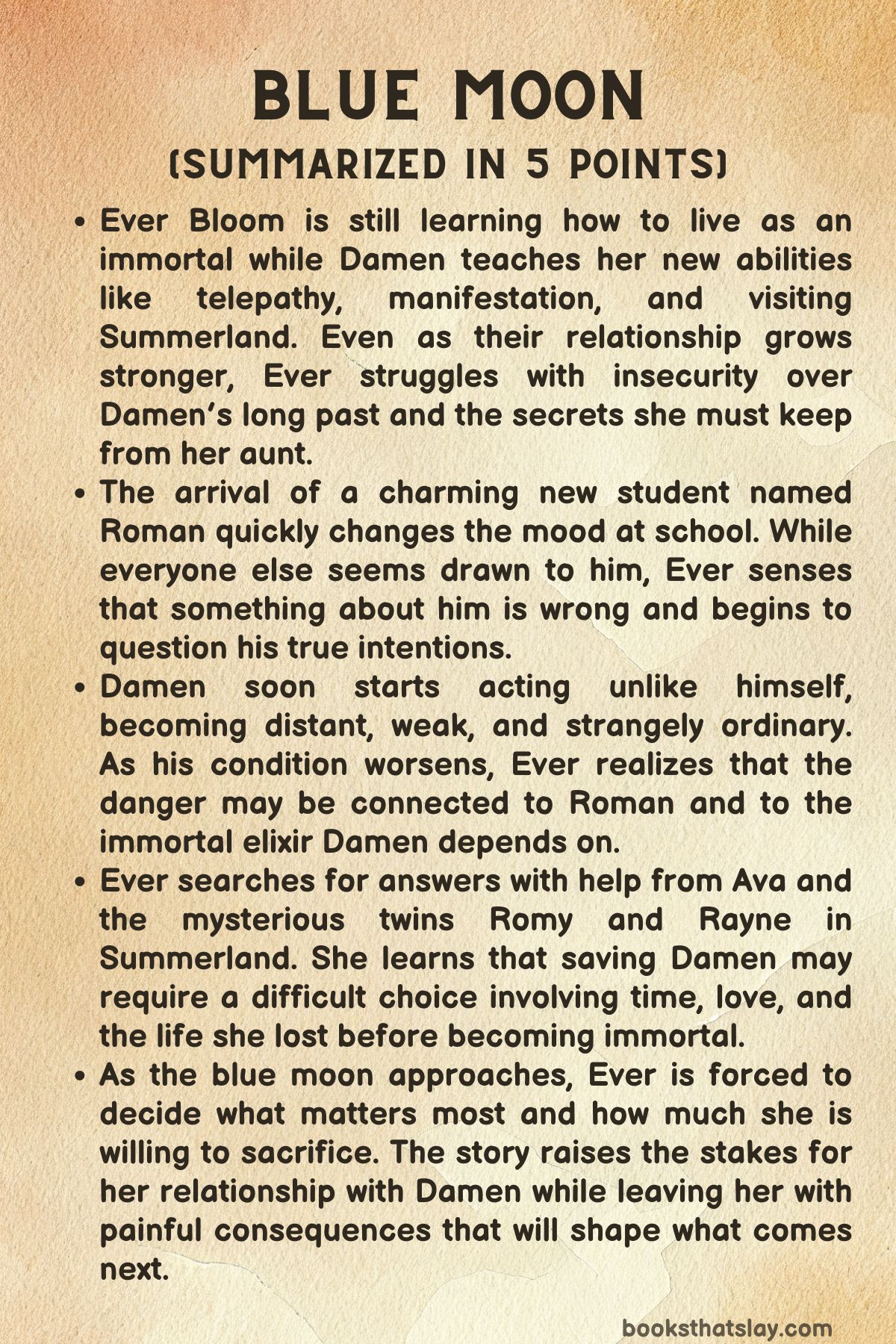
Ever Bloom is still learning what it means to be immortal. After the events that changed her life, she is now connected to Damen Auguste not only by love but by the strange new world he has opened to her.
Damen teaches her how to manifest objects, communicate through thought, and visit Summerland, a beautiful and mysterious dimension where time, energy, and possibility work differently from the ordinary world. Ever is fascinated by these abilities, but she is also overwhelmed.
Her life has become a constant balancing act between the supernatural truth she now lives with and the normal teenage life she must continue to pretend she has.
Her relationship with Damen is intense and open in a way it has not been before. They are finally together without the same barriers that once held them apart, yet Ever still feels insecure.
Damen has lived for six hundred years, and his past is filled with experiences and romances that Ever cannot help comparing herself to. She loves him deeply, but she worries that she can never measure up to all the lives he has already lived.
Their desire to be together grows stronger, but Ever hesitates when it comes to taking the final step in their relationship. She wants their love to feel certain, not shadowed by doubt.
At home, Ever’s aunt Sabine notices that something is wrong. Ever no longer eats like a normal person and survives mainly on the red immortal elixir Damen gives her.
Sabine does not know the truth about immortality, so Ever has to keep inventing excuses. Sabine also wants to meet Damen properly and insists on having him over for dinner.
For Ever, this creates more pressure. She wants to keep Sabine safe from the truth while also holding on to the life she has built with Damen.
Everything changes when Roman arrives at school. He is charming, confident, and instantly popular.
Haven and Miles like him right away, and even Damen seems unusually accepting of him. The rest of the school responds to Roman as if he can do no wrong.
Ever, however, feels uneasy from the beginning. Roman’s friendly manner does not convince her.
Something about him feels false, and her instincts warn her that he may be dangerous.
Soon after Roman’s arrival, Damen begins to change. At first, the signs are small.
He gets headaches, loses focus, and seems weaker than usual. He struggles to do things that should be easy for him, including manifesting objects and opening a portal to Summerland.
Ever becomes frightened because immortals are not supposed to become ill. Damen’s condition makes no sense, and his behavior becomes more distant and unpredictable.
The night they had planned to be together after Miles’s play, Damen disappears and leaves Ever alone, confused, and afraid.
Ever searches for him in the places that matter to them: the Montage, the beach cave, and his house. She cannot find him.
When she discovers that his supply of immortal elixir is almost gone, she begins to suspect that the drink has been poisoned or altered. Her fear grows when Damen returns to school acting like a completely different person.
He is no longer loving, wise, or spiritually aware. He becomes shallow, rude, and cruel.
Worse, he turns his attention toward Stacia, the girl who has always treated Ever badly.
Ever’s social life begins to fall apart. Her friends turn away from her, the school mocks her, and Roman’s influence seems to spread everywhere.
Damen treats Ever as if their love never existed. The more Ever watches Roman, the more convinced she becomes that he is connected to the same dark immortal world that once surrounded Drina.
Roman’s charm begins to look like control, and Ever realizes she may be facing an enemy who understands Damen’s weaknesses better than she does.
Desperate for help, Ever turns to Ava, the psychic who has guided her before. With Ava’s help, she returns to Summerland and learns more about its strange rules and hidden possibilities.
There she meets the twins Romy and Rayne, who are unusual, guarded, and more powerful than they first appear. They help Ever understand what is happening to Damen.
Roman has corrupted Damen’s elixir, and because Damen depends on it, his immortal body is breaking down. He is not simply sick; he is dying.
Ever and Ava try to save him by replacing the tainted elixir with a clean supply, but Damen’s altered state makes everything harder. He no longer trusts Ever.
When he catches them, he sees her as a threat rather than the person he loves. This breaks Ever’s heart, but it also forces her to act quickly.
Time is running out, and she has to find a cure before Damen’s body fails completely.
As the blue moon approaches, Ever learns that it creates a rare chance to travel through time. This gives her a choice that cuts into the deepest part of her grief.
She can go back and prevent the car accident that killed her family, restoring the life she lost, or she can return to the present and save Damen. Ever chooses her family at first.
She travels back to the day of the accident and sees them alive again. For a moment, she has the life she has wanted since their deaths: her parents, her little sister Riley, and the feeling of being whole.
But the moment cannot last. Riley senses that something is wrong and helps Ever understand what she is really doing.
Saving her family may mean abandoning Damen to death. Ever realizes that she cannot build a restored life on the loss of someone she loves.
She makes the painful choice to leave her family behind again and return to the present. It is a second goodbye, and in some ways it hurts even more than the first because this time she chooses it knowingly.
Back in the present, Ever rushes to Ava’s house and finds Damen close to death. Rayne has placed him inside a protective magical circle, but the situation is nearly hopeless.
Roman appears with an antidote and offers Ever the thing she needs most. But his help comes with a condition: the cure requires Ever’s blood.
Rayne warns her not to do it, sensing that Roman’s offer is a trap. Ever hears the warning, but she cannot watch Damen die.
She cuts herself and adds her blood to the antidote.
Damen revives, and for one brief moment it seems as if Ever has saved him. Roman then reveals the truth.
By adding her blood, Ever has made her own DNA deadly to Damen. They can no longer kiss, share blood, exchange bodily fluids, or complete their relationship physically without killing him.
Roman has not only saved Damen; he has placed a cruel barrier between Damen and Ever. His revenge is personal.
He loved Drina, and because Ever killed her, he wants Ever to suffer by being close to Damen yet unable to fully be with him.
Roman leaves alive because he suggests there may be another antidote, giving Ever a reason not to destroy him. Damen wakes with no memory of what has happened, unaware of the curse now placed between them.
Ever leaves with him, carrying the truth alone. She has saved his life, but their future has been changed in a devastating way.
Blue Moon ends with Ever facing a new kind of loss: Damen is alive and still hers, but loving him now means protecting him from herself.
Characters
Ever Bloom
Ever Bloom is the emotional center of Blue Moon, and her character is defined by the difficult tension between love, fear, guilt, and responsibility. At the beginning of the book, she is still adjusting to immortality, which makes her life feel both powerful and unstable.
Damen teaches her extraordinary abilities such as manifestation, telepathy, and access to Summerland, but Ever does not simply become confident because of these gifts. Instead, her new life makes her more aware of everything she does not understand.
Her hesitation in her relationship with Damen shows her insecurity and vulnerability. She loves him deeply, but his six hundred years of experience and romantic history make her feel small, inexperienced, and uncertain about whether she can truly match him.
Ever’s strongest trait is her loyalty, especially toward Damen, but that loyalty is tested in painful ways. When Damen begins changing, she does not immediately abandon him or believe the cruel version of him is his real self.
Even when he treats her coldly, humiliates her, and seems drawn to Stacia, Ever keeps searching for the truth behind his behavior. This shows that her love is not shallow or based only on how Damen treats her in the moment.
She is willing to endure confusion and rejection because she believes there is something deeper happening. At the same time, her loneliness grows because the people around her stop trusting her judgment, leaving her isolated in her own fear.
A major part of Ever’s character is her struggle between the past and the present. The blue moon gives her the chance to return to the day her family died, and this opportunity reveals how much grief still controls her.
Her desire to save her parents and Riley is completely understandable because she has been carrying the pain of their deaths for a long time. However, when Riley urges her to return to Damen, Ever is forced to make a devastating sacrifice.
She must give up the fantasy of restoring her old life in order to protect the life she has now. This choice shows her maturity, because she learns that love sometimes means accepting loss rather than escaping it.
Ever is also a flawed heroine. Her desperation leads her to trust Roman’s antidote even after Rayne warns her not to use her blood.
This mistake has terrible consequences, because she saves Damen’s life but unknowingly makes physical intimacy between them deadly. Yet this flaw makes her more human within the story.
She is not calm, perfect, or all-knowing; she acts from panic, love, and fear. Her character becomes tragic because the very action she takes to save Damen creates a new barrier between them.
By the end, Ever carries the burden of knowledge alone, knowing she must eventually tell Damen the truth. This makes her character emotionally complex, because her love saves him while also becoming the source of their next great suffering.
Damen Auguste
Damen Auguste is presented as powerful, mysterious, romantic, and spiritually advanced, but this book exposes how vulnerable he can become when his immortality is attacked. At first, he appears to be Ever’s guide into her new immortal life.
He teaches her how to use her abilities and introduces her to deeper parts of existence, especially Summerland. Because he has lived for centuries, he seems wise and almost untouchable.
However, that same long life also creates distance between him and Ever. His past makes Ever feel insecure, and his experience makes him seem difficult to fully know.
Damen’s transformation after Roman’s arrival is one of the most important parts of his character in the book. He begins as loving and controlled, but gradually becomes weak, distracted, and ordinary.
His headaches, inability to manifest, and failure to access Summerland show that his power is being stripped away. This physical decline also becomes a symbolic decline.
The noble and deeply connected Damen is replaced by someone shallow, cruel, and easily influenced. His interest in Stacia is especially painful because it makes Ever feel as though their bond has been erased.
However, the story makes it clear that this is not Damen’s true nature; he is being corrupted through the poisoned elixir.
Damen’s role also reveals how much of his identity depends on control. He is used to being the knowledgeable one, the protector, and the person who understands immortality better than Ever does.
When he becomes sick, that control disappears. He can no longer guide Ever, protect himself, or recognize the danger around him.
This reversal is important because it forces Ever to become the active rescuer. Damen’s weakness does not make him less important; instead, it shows that even someone ancient and powerful can be vulnerable when trust is exploited.
By the end of the story, Damen becomes tragic in a different way because he survives without knowing the full cost of his survival. Ever’s blood saves him, but Roman’s trap makes her body dangerous to him.
Damen wakes without memory of the events, which creates emotional irony: he is alive, but he does not yet understand that his relationship with Ever has been changed in a devastating way. His character therefore represents both Ever’s greatest love and her greatest fear.
He is the person she fights hardest to save, but his survival also forces her into secrecy and emotional suffering.
Roman
Roman is the main antagonist of the book and one of the most deceptive characters in the story. His power comes not from open violence at first, but from charm, manipulation, and social control.
When he arrives at school, he quickly wins over nearly everyone. Haven, Miles, and even Damen seem drawn to him, which makes Ever’s suspicion of him look unreasonable to others.
This is what makes Roman dangerous: he does not appear threatening on the surface. He hides his cruelty behind friendliness, making it difficult for Ever to prove that something is wrong.
Roman’s character is closely connected to corruption. After his arrival, Damen begins to weaken, Ever’s friendships collapse, and the school turns against her.
Roman does not simply attack Ever physically; he attacks her social world, emotional stability, and sense of reality. He isolates her by making everyone else doubt her.
His influence makes Ever seem paranoid, while he appears charming and innocent. This kind of villainy is psychologically cruel because it forces Ever to fight an enemy who is protected by popularity and appearances.
Roman’s motive is revenge, which gives his character emotional intensity. He loved Drina and blames Ever for killing her.
This makes him more than a random villain; his cruelty comes from grief, anger, and obsession. However, his love for Drina does not make him noble.
Instead, it twists into a desire to make Ever suffer in the most personal way possible. He does not only want Damen dead; he wants Ever to live with the consequences of saving him.
His trap with the antidote is especially cruel because he uses Ever’s love as the weapon against her. He knows she will do anything to save Damen, so he turns that devotion into a curse.
Roman’s final act makes him one of the most threatening figures in Blue Moon because he leaves Ever with hope and despair at the same time. By suggesting there may be another antidote, he ensures that Ever cannot simply defeat him or move on.
He keeps power over her by making himself necessary. His survival at the end means the conflict is not truly resolved.
Roman represents the kind of evil that understands love well enough to exploit it, and that makes him especially dangerous in the book.
Sabine
Sabine is Ever’s aunt and guardian, and her role is grounded in ordinary human concern. Unlike the immortal characters, Sabine does not understand the supernatural truth of Ever’s life.
From her perspective, Ever’s behavior is alarming because Ever no longer eats normal food and survives on the red elixir Damen provides. Sabine’s worry is reasonable because she sees the outward signs of Ever’s transformation without knowing their cause.
This makes her an important reminder of the human world Ever is trying to hide from.
Sabine represents responsibility, family structure, and adult concern. She wants to meet Damen properly over dinner because she is trying to act like a caring guardian.
Her desire is not controlling for its own sake; it comes from wanting to understand the person who has become so important in Ever’s life. Sabine’s presence creates pressure for Ever because Ever must constantly balance the truth of immortality with the ordinary expectations of home life.
This makes Sabine important even though she is not part of the supernatural conflict directly.
Sabine’s character also highlights Ever’s isolation. Ever cannot fully explain why she behaves strangely, why she depends on Damen’s elixir, or why her life has become so dangerous.
Because Sabine is outside the immortal world, Ever has to lie or hide parts of herself. This creates emotional distance between them.
Sabine’s concern shows that Ever still has a human family connection, but it also shows how difficult it is for Ever to live honestly after becoming immortal.
Haven
Haven is Ever’s friend, but in this story she also becomes an example of how easily Roman can influence people. When Roman arrives, Haven is quickly drawn to him, which places her on the opposite side of Ever’s instincts.
This creates tension because Haven’s admiration for Roman makes Ever feel even more alone. Instead of supporting Ever’s uneasiness, Haven becomes part of the group that accepts Roman’s charm.
Haven’s character reflects the vulnerability of wanting attention, belonging, and excitement. Roman’s appeal works well on her because he seems confident and magnetic.
Her response to him does not necessarily make her malicious, but it does show that she can be persuaded by appearances. In the book, Haven helps reveal how Roman’s danger spreads socially.
He does not need to control everyone through force; he only needs to become the person everyone wants to like.
Haven’s turning away from Ever also deepens the emotional stakes of the story. Ever is not only losing Damen to illness and manipulation; she is also losing her friends.
Haven’s behavior makes Ever’s school life painful and humiliating. Through Haven, the book shows how friendship can become fragile when trust is weakened by outside influence.
Miles
Miles is another of Ever’s close friends, and his role in the story is connected to both normal teenage life and Roman’s growing influence. His play becomes part of the setting around the night Ever expects to finally be with Damen, which makes the collapse of her plans even more painful.
Miles belongs to the ordinary world of school, performance, and friendship, but that ordinary world becomes increasingly distorted as Roman’s influence grows.
Like Haven, Miles is drawn in by Roman’s charm. This matters because Miles is someone Ever would normally expect to be part of her support system.
When he does not fully stand with her, Ever’s isolation becomes stronger. His reaction shows how effective Roman is at reshaping the social environment around Ever.
The people who should know her best become less able to see what she sees.
Miles’s character helps emphasize the difference between surface reality and hidden truth. On the surface, Roman seems like a likable new student, and Ever appears jealous or unstable.
Miles responds to that surface version of events. This makes him important because he represents how ordinary people can misjudge a situation when the real danger is supernatural and concealed.
Ava
Ava is the psychic Ever turns to when she becomes desperate for answers. Her character represents spiritual knowledge, guidance, and access to realms beyond ordinary understanding.
Ava has helped Ever before, and in this book she becomes important because Ever cannot solve Damen’s condition through ordinary methods. Ava helps Ever reach Summerland, where more answers become available.
Ava’s role is that of a guide, but she is not in complete control of the situation. She can help Ever access hidden knowledge, yet the danger surrounding Roman, Damen’s poisoned elixir, and the blue moon is larger than simple psychic advice.
This makes Ava useful but not all-powerful. Her presence expands the supernatural world of the story while also showing that knowledge does not always prevent tragedy.
Ava also functions as a bridge between Ever’s panic and the deeper truth. Ever comes to her because she needs someone who will take the supernatural situation seriously.
In a world where her friends doubt her and Damen no longer recognizes her properly, Ava gives Ever a place to search for answers. Through Ava, Ever gains access to the information that Damen is dying and that time is running out.
Romy
Romy is one of the twins Ever meets in Summerland, and her character is connected to mystery, guidance, and hidden knowledge. She helps point Ever toward answers about Damen’s condition and the larger possibilities of Summerland.
Romy’s presence shows that Summerland is not merely a beautiful escape; it is also a place where truth can be discovered and where Ever must confront difficult choices.
Romy’s importance comes from the way she helps Ever move forward when Ever is overwhelmed. She is not central in the same emotional way as Damen or Riley, but she plays a meaningful role in guiding Ever through the supernatural rules that shape the conflict.
Her knowledge helps Ever understand that Damen’s illness is not natural and that Roman’s actions have placed him in serious danger.
Romy also adds to the sense that Ever is entering a world much larger than she understands. Ever may be immortal, but she is still inexperienced.
Characters like Romy remind the reader that immortality has layers of history, power, and consequence that Ever is only beginning to learn.
Rayne
Rayne, like Romy, is one of the twins associated with Summerland, but she becomes especially important near the end of the story. She protects Damen inside a magical circle when he is close to death, which shows that she has real power and understands the seriousness of the situation.
Rayne’s protection of Damen places her on Ever’s side in a crucial moment.
Rayne is also significant because she warns Ever not to use her blood in Roman’s antidote. This warning proves that Rayne sees danger more clearly than Ever does in that moment.
Ever is too desperate to save Damen to think carefully, but Rayne understands that Roman’s offer cannot be trusted. Her role is therefore both protective and cautionary.
She tries to prevent Ever from making the mistake that changes her relationship with Damen.
Rayne’s character shows the importance of wisdom under pressure. She recognizes that not every cure is truly a cure, especially when it comes from someone like Roman.
Although Ever ignores her warning, Rayne’s presence makes the tragedy sharper because the danger was noticed before it happened. She stands as one of the characters who understands the cost of Ever’s desperation before Ever fully understands it herself.
Riley
Riley is Ever’s younger sister, and her role is deeply emotional because she represents Ever’s lost family and the life Ever wishes she could recover. When Ever travels back to the day of the accident, seeing Riley again brings back the pain of everything Ever lost.
Riley is not just a memory; she becomes the voice that helps Ever understand what she must do.
Riley’s importance lies in her insight. She realizes that something is wrong and urges Ever to return to Damen before it is too late.
This moment shows Riley’s love for Ever, because she does not encourage Ever to stay in the past for selfish reasons. Instead, she pushes Ever toward the painful but necessary choice.
Riley becomes a moral guide, helping Ever accept that saving her family is not the path she can take.
Riley also represents acceptance. Through her, Ever is forced to understand that love for the dead cannot erase responsibility to the living.
Ever’s decision to leave Riley and the rest of her family behind again is one of the most painful choices in the book. Riley’s character makes that sacrifice meaningful because she gives Ever the strength to choose Damen, even though it breaks Ever’s heart.
Stacia
Stacia functions as a painful symbol of Ever’s insecurity and public humiliation. When Damen begins acting strangely and becomes interested in Stacia, Ever’s fear intensifies because Stacia represents the kind of shallow attraction that the real Damen would normally rise above.
Damen’s attention toward her makes Ever feel replaced and degraded.
Stacia’s role is not only romantic rivalry; she also contributes to the social cruelty Ever experiences at school. As Ever becomes mocked and isolated, Stacia becomes part of the environment that makes Ever feel powerless.
Her presence sharpens the contrast between Damen’s true self and the corrupted version of him. The fact that he is drawn to Stacia while under Roman’s influence shows how deeply Roman’s poison has damaged his judgment and identity.
Stacia is important because she helps externalize Ever’s emotional pain. Ever’s private fear about losing Damen becomes public embarrassment.
Through Stacia, the story turns Ever’s romantic crisis into a social one as well, making her suffering more visible and more humiliating.
Drina
Drina does not dominate the present action, but her influence is extremely important because Roman’s revenge is rooted in his love for her. She is connected to the immortal darkness that Ever recognizes, and the signs linking Roman to that same darkness help Ever understand that he is not harmless.
Drina’s past actions and death continue to shape the danger Ever faces.
Drina represents the consequences of Ever’s earlier conflict. Even though Ever killed her, the emotional and supernatural effects of that act are not finished.
Roman’s grief over Drina becomes the reason he targets Ever and Damen. This makes Drina a character whose importance extends beyond her physical presence.
She remains powerful through memory, revenge, and the loyalty Roman feels toward her.
Drina also helps connect the book’s conflicts into a larger immortal world. Her relationship with Roman suggests that immortal lives are bound together by long histories of love, jealousy, violence, and revenge.
Through Drina, the story shows that Ever’s actions have consequences that reach beyond one battle or one enemy.
Ever’s Family
Ever’s family represents the life she lost and the grief that still shapes her choices. The chance to return to the day of the accident forces Ever to confront the deepest wound in her life.
Her parents and Riley are not merely part of her past; they are the emotional foundation of her longing for normalcy. Seeing them again tempts her with the possibility of undoing everything that broke her old life apart.
Their role in the story is powerful because they represent an impossible choice. Ever wants to save them, and the blue moon gives her a chance to believe that she can.
However, choosing them would mean abandoning Damen when he is dying. This does not make Ever love her family less.
Instead, it shows that love can pull a person in two unbearable directions at once.
Ever’s family also reveals how much she has changed. The old Ever wants her normal life back, but the Ever who returns to the present understands that she cannot live only in the past.
Her family remains central to her heart, but she must accept that her present responsibilities matter too. Their presence deepens the tragedy of her character because saving Damen requires her to lose them all over again.
Themes
Immortality and the Cost of Desire
In Blue Moon, immortality is not shown as a simple gift or a dream come true; it becomes a life filled with secrecy, dependence, fear, and emotional pressure. Ever’s new existence gives her extraordinary abilities, but it also separates her from ordinary human life.
She can no longer eat normally, must hide the elixir from Sabine, and has to pretend that nothing has changed. Her romance with Damen also becomes complicated because immortality does not erase insecurity.
Damen’s long past makes Ever feel inexperienced and uncertain, and his six hundred years of love, loss, and mistakes create distance between them. The novel shows that living forever does not guarantee emotional wisdom or happiness.
Instead, immortality makes every choice heavier because love, jealousy, revenge, and regret can last for centuries. Ever’s powers may seem exciting, but they also trap her in a world where one wrong decision can change her future permanently.
Trust, Deception, and Hidden Danger
Roman’s arrival shows how easily charm can hide cruelty. He wins over the school by appearing friendly, confident, and harmless, yet Ever senses something false beneath his behavior.
The danger is not only that Roman is powerful, but that he understands how to control appearances. He isolates Ever by turning her friends and classmates against her, making her seem jealous, unstable, and unreasonable.
This makes her struggle even harder because she has to trust her instincts when everyone else doubts her. Damen’s sudden change deepens the theme of deception because his altered behavior makes Ever question what is real and what has been manipulated.
The poisoned elixir becomes a symbol of hidden corruption: something meant to preserve life is turned into a weapon. The novel suggests that evil does not always announce itself openly.
Sometimes it enters through popularity, beauty, confidence, and the willingness of others to believe the easiest version of events.
Sacrifice and Moral Choice
Ever’s most painful conflict comes when she is given the chance to change the past. The blue moon offers her what she has wanted most: a way to save her family and return to the life she lost.
This choice forces her to face the difference between personal longing and responsibility. Seeing her family again reopens her grief, and for a moment the possibility of undoing the accident feels like justice.
Yet Riley’s reaction helps Ever understand that saving the past may mean abandoning the present, especially Damen, who is dying because of Roman’s revenge. Her decision to leave her family behind is not simple heroism; it is a devastating act of sacrifice.
She gives up the life she misses because someone in the present needs her. Blue Moon presents sacrifice as emotionally costly, not glamorous.
Ever’s choice proves that love often requires accepting pain rather than escaping it.
Love, Vulnerability, and Consequences
Ever and Damen’s relationship is intense, but the novel repeatedly shows that love is fragile when it is shaped by fear, secrecy, and unequal knowledge. Ever wants to be close to Damen, yet she hesitates because his past makes her feel small beside him.
Later, when Damen becomes ill and emotionally distant, love becomes an act of endurance rather than comfort. Ever keeps searching for him even when he rejects her, misunderstands her, and humiliates her under Roman’s influence.
Her desperation to save him leads her to trust the antidote that requires her blood, even after Rayne warns her. This decision saves Damen’s life but creates a new barrier between them, making physical intimacy deadly.
The ending turns romance into a painful consequence: Ever gets Damen back, but not in the way she hoped. The theme shows that love can inspire courage, but fear-driven choices can also deepen suffering.