The Dark Divine Summary, Characters and Themes
The Dark Divine by Bree Despain is a young adult paranormal romance about faith, family loyalty, forgiveness, and the fear of becoming the thing others already believe you are. The story follows Grace Divine, a pastor’s daughter whose orderly life is shaken when Daniel Kalbi, the troubled boy she once cared for, returns after a three-year absence.
His reappearance opens old wounds, especially for Grace’s brother Jude, and draws Grace into a hidden world of cursed beings, violent secrets, and difficult choices. At its center, The Dark Divine asks whether love can redeem someone who believes he is already lost.
Summary
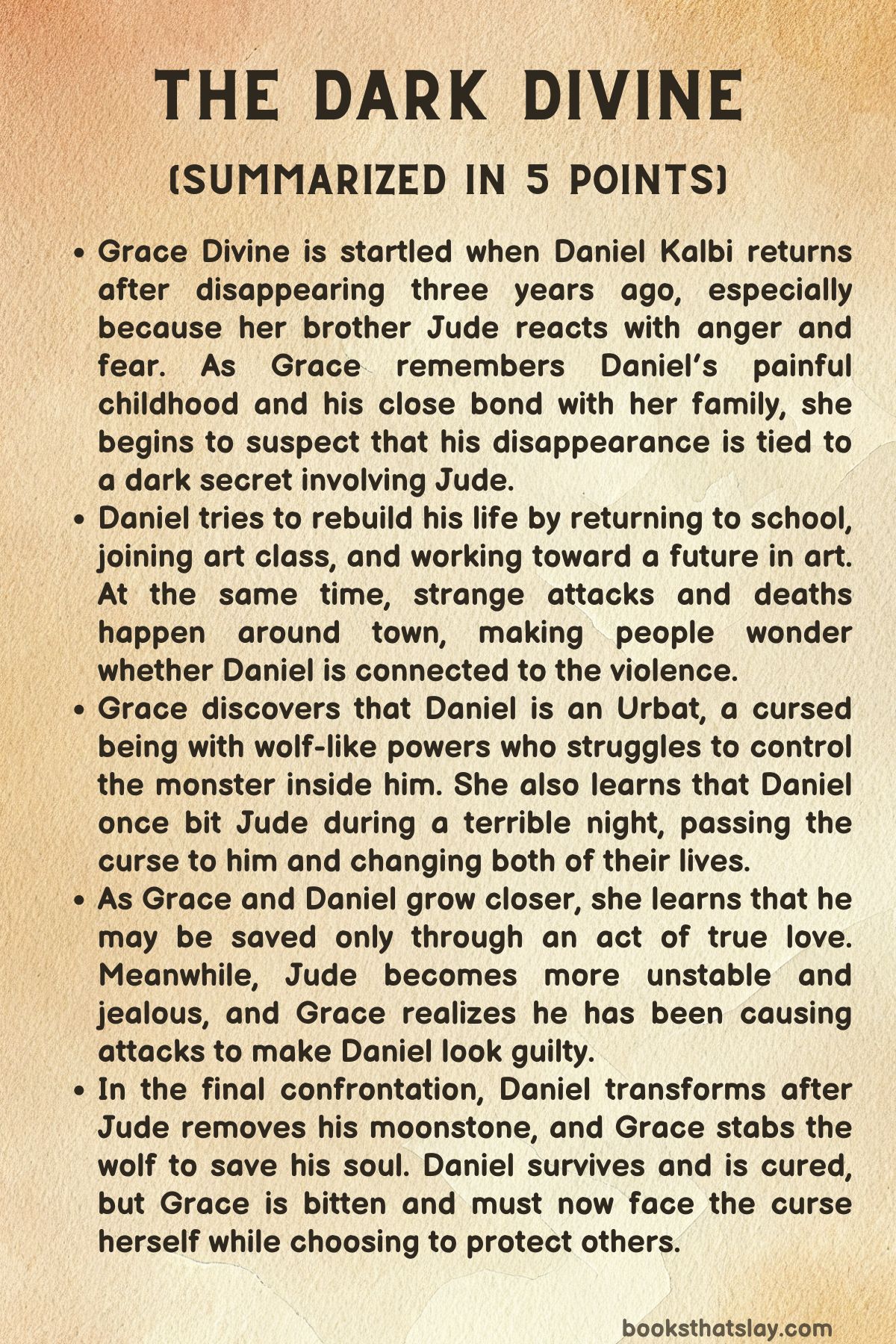
Grace Divine is the daughter of Pastor Divine, a minister at Holy Trinity, and she has grown up in a home shaped by faith, service, and the expectation that she will do the right thing. Her life changes when Daniel Kalbi suddenly returns after vanishing three years earlier.
Grace first sees him in her art class, where he has taken her seat and altered her charcoal drawing of the walnut tree from their childhood. At first, she does not recognize him.
When he reveals himself, she is startled, confused, and pulled back into memories she has tried to leave behind.
Daniel had once been very close to Grace’s family. He had a painful childhood with an abusive father, and the Divines had taken him in for a time.
He became especially close to Grace’s older brother, Jude. Then, one night, something terrible happened between Daniel and Jude, and Daniel disappeared.
The family never fully explained the event to Grace, but she knows it changed everything. Jude, who had once loved Daniel like a brother, now reacts with anger and fear when he learns Daniel is back.
He warns Grace to stay away from him and insists Daniel is dangerous.
Grace cannot easily accept Jude’s warning. She remembers Daniel as wounded, talented, and in need of kindness.
She is also drawn to the person he has become. Daniel is guarded, sarcastic, and mysterious, but he still shows signs of the boy she once knew.
When Grace is stranded in a dangerous alley with Pete Bradshaw, Daniel appears and helps her. He also repairs her father’s car and admits that he has returned because he wants to build a better future.
He hopes to get into art school, and Grace helps him regain a place in Mr. Barlow’s AP art class. Her decision angers Jude, whose suspicion of Daniel only grows.
At the same time, frightening events begin happening in town. Maryanne Duke is found dead, and her body is badly mutilated.
Old stories about the Markham Street Monster return, stirring fear among the people of the community. Daniel’s return seems to line up with the violence, and many signs appear to point toward him.
Grace, however, is not convinced that he is responsible. She senses that Daniel is hiding something, but she also believes there is more to the truth than Jude’s accusations.
The mystery deepens during Thanksgiving when Baby James, Grace’s young brother, vanishes from the family home. Panic spreads through the household, and Daniel uses strange instincts and abilities to track the child into the woods.
He finds and saves Baby James in a way that seems impossible for an ordinary person. Grace realizes that Daniel is not simply a troubled boy with a painful past.
There is something supernatural about him.
Grace’s father eventually reveals the truth. Daniel is an Urbat, one of the “Hounds of Heaven.” These beings were originally meant to fight evil, but they carry a curse that gives them a wolf nature.
If they lose control, they can become violent and monstrous. Grace also learns the truth about the night Daniel disappeared.
Daniel had lost control and bitten Jude, passing the curse to him. Daniel fled afterward, consumed by guilt and afraid of what he might become.
Daniel has been using a moonstone pendant to control the wolf inside himself. The stone helps him resist the curse, but it does not erase his fear.
He believes he may already be too damaged to save. Grace, however, sees his goodness beneath his shame.
As they spend more time together, their feelings deepen. Daniel tells her about his time away, including an artist colony where he met Gabriel, the man who gave him the moonstone and taught him more about the Urbat.
Grace begins to understand that saving Daniel will not be simple. Her father discovers old writings that suggest a possible cure.
According to the writings, the person who loves the Urbat most must kill the wolf in an act of true love. The idea horrifies Grace because it seems to mean that saving Daniel could require killing him.
Still, she begins to realize that she may be the person who loves him most, and that the choice may fall to her.
Meanwhile, Jude becomes more unstable. His anger toward Daniel turns into jealousy and obsession.
He grows distant from his family, lashes out at Grace, and behaves in ways that no longer seem like himself. Grace slowly pieces together the truth: Daniel is not the one behind the recent attacks.
Jude, affected by the wolf inside him, has been staging violence and mutilations to make Daniel look guilty. His hatred has twisted into a plan to destroy Daniel and separate him from Grace.
Jessica Day disappears, adding more fear and urgency. The danger comes to a head during the school dance.
Grace is attacked by Pete in an alley, and Don Mooney, who carries a silver knife, stabs Pete. In the chaos, Grace sees Jude’s animal-like eyes and understands that the wolf has gained a terrible hold over him.
Jude then turns his attention to Daniel.
Grace and Daniel flee to the church roof, but Jude follows them with the silver knife. The confrontation forces every hidden truth into the open.
Jude tears away Daniel’s moonstone, removing the one thing that has helped him keep control. Daniel transforms fully into a white wolf.
He fights Jude, but even then he tries not to kill him. Grace watches the struggle and realizes that Daniel’s soul can only be freed if she acts.
Grace takes the silver knife. She knows the old writings said that the person who loves the Urbat most must kill the wolf.
She also believes that doing this may pass the curse to her, since she has already been bitten. Even so, she chooses Daniel’s salvation over her own safety.
She stabs the wolf in the heart.
For a moment, it seems Daniel has died. Jude escapes, leaving the family broken and the danger unresolved.
Then Daniel’s wolf body changes back into human form, and he survives. Gabriel confirms that Grace has done something extraordinary.
Daniel is the first Urbat to be cured without dying. The act worked because Grace did not strike out of hatred or fear.
She acted out of self-sacrificing love, willing to lose herself if it meant saving him.
The ending leaves Grace changed. Daniel is freed from the curse, but Grace now carries the wolf inside her.
Daniel gives her his broken moonstone and tells her she can resist what is inside her. He believes she can protect others and become the kind of hero he can no longer be in the same way.
Grace’s life will never return to what it was, and Jude remains missing, but she has learned that love, courage, and choice still matter in the face of darkness.
Characters
Grace Divine
Grace Divine is the emotional and moral center of The Dark Divine. As Pastor Divine’s teenage daughter, she has grown up surrounded by faith, duty, forgiveness, and the expectation that she should do what is right even when it is painful.
Her character is defined by compassion, but her compassion is not simple or passive. When Daniel Kalbi returns after three years, Grace is drawn back into memories of childhood, family loyalty, and unresolved pain.
She remembers him not only as someone dangerous or mysterious, but as a wounded boy who once found safety in her home. This ability to see Daniel’s humanity even when others fear him becomes one of her strongest qualities.
Grace’s journey in the book is also a journey from innocence into difficult knowledge. At first, she does not understand the full meaning of Daniel’s disappearance, Jude’s anger, or the strange violence happening around town.
As the truth about the Urbat curse emerges, Grace is forced to confront a darker world than the one she thought she knew. Her love for Daniel becomes deeper because it is tested by fear, danger, and sacrifice.
She does not love him blindly; she sees his guilt, his fear of becoming a monster, and the damage his curse has caused. Yet she still believes he can be saved.
Grace is also important because she represents active love rather than helpless love. The cure requires the person who loves the Urbat most to kill the wolf in an act of true love, and Grace accepts this terrible responsibility.
Her choice to stab Daniel in wolf form is not an act of cruelty, but an act of courage and self-sacrifice. She believes she may lose him, and she also risks becoming cursed herself.
By the end of the story, Grace has changed from a protected pastor’s daughter into someone who understands that goodness sometimes requires painful action. Her final burden, carrying the wolf inside her, shows that her heroism comes with a cost.
Daniel Kalbi
Daniel Kalbi is one of the most tragic and morally complex figures in the book. His return to Holy Trinity immediately creates tension because he carries the weight of an unexplained past.
He is charming, artistic, wounded, and dangerous all at once. His first interaction with Grace, when he alters her charcoal drawing of the walnut tree from their childhood, shows both his playfulness and his desire to reconnect with a life he lost.
Art is central to Daniel’s character because it represents the part of him that wants beauty, control, and a future beyond violence.
Daniel’s past explains much of his emotional damage. He grew up in an abusive home and once found shelter with Grace’s family, which made the Divines a symbol of safety for him.
However, the night he lost control and bit Jude shattered that fragile sense of belonging. His guilt over infecting Jude is one of the main forces shaping his behavior.
Daniel does not simply fear being hated by others; he fears that their hatred may be deserved. His belief that he may be beyond saving reveals how deeply he has internalized the idea that he is a monster.
The Urbat curse makes Daniel’s inner conflict literal. He has extraordinary strength and tracking abilities, but these powers are tied to the wolf nature he struggles to control.
The moonstone pendant becomes a symbol of his fragile self-control. When it is torn away, Daniel transforms fully, showing how close he always is to losing himself.
Yet even in wolf form, he tries not to kill Jude, proving that his humanity has not vanished. Daniel’s survival after Grace’s act of love is meaningful because it proves that he is not defined only by the curse, his past, or his worst mistake.
He is a character who longs for redemption and finally receives it through love, sacrifice, and the belief that he can still be saved.
Jude Divine
Jude Divine is one of the most painful characters in the story because he begins as a protective brother but gradually becomes a source of danger. His anger toward Daniel is not random; it comes from betrayal, fear, and the physical and spiritual consequences of being bitten.
Once Daniel’s closest friend, Jude now sees him as a threat to Grace and to the family. His warnings that Daniel is dangerous contain some truth, but they are also shaped by jealousy and by the wolf growing inside him.
Jude’s character shows how resentment can become destructive when it is mixed with fear and hidden pain. As his behavior worsens, he becomes distant from his family and increasingly unstable.
His jealousy of Grace and Daniel reveals that he feels replaced, ignored, or betrayed by the people he loves. The wolf curse magnifies these emotions until they become violence.
His role in staging attacks and mutilations to frame Daniel shows how far he has fallen. He is not only trying to expose Daniel; he is trying to destroy him and control the story others believe.
What makes Jude especially tragic is that he is both victim and villain. He did not choose to be infected, and Daniel’s bite changed his life.
However, Jude still makes choices that harm others. His actions against Jessica Day, his manipulation of fear around the Markham Street Monster, and his attack on Daniel reveal a character who has allowed pain to turn into cruelty.
By the end, Jude’s escape leaves his story unresolved. He remains a reminder that not everyone who is wounded accepts healing, and not everyone who is loved chooses to be saved.
Pastor Divine
Pastor Divine is a major moral figure in The Dark Divine, but he is not presented as a perfect man. As Grace’s father and the pastor of Holy Trinity, he represents faith, forgiveness, and responsibility.
He tries to guide his family according to spiritual principles, and his willingness to take Daniel in years earlier shows his belief in mercy. To him, Daniel was not only a troubled boy but someone deserving of shelter, care, and redemption.
At the same time, Pastor Divine’s character carries the burden of secrecy. He knows more about Daniel, the Urbat, and the events of the past than Grace initially understands.
His decision to withhold information may come from a desire to protect his family, but it also leaves Grace confused and vulnerable. This makes him a complicated parental figure.
He loves his children deeply, yet his silence contributes to the tension between Grace, Jude, and Daniel.
Pastor Divine’s discovery of the old writings about the cure gives him an important role in the central conflict. He becomes the bridge between religious ideas of sacrifice and the supernatural reality of the Urbat curse.
His presence reinforces the book’s focus on love as something active, painful, and redemptive. Through him, the story connects faith not with easy answers, but with difficult choices and the hope that even cursed people can be restored.
Gabriel
Gabriel is a mysterious and important guide figure in the book. He is connected to Daniel’s time at the artist colony and plays a key role in Daniel’s survival before his return.
By giving Daniel the moonstone, Gabriel provides him with a way to control the wolf inside himself. This makes Gabriel a figure of knowledge and protection, someone who understands the Urbat curse more deeply than most characters.
Gabriel’s importance is not only practical but symbolic. He represents the possibility that Daniel’s condition can be understood rather than simply feared.
While other characters see Daniel mainly through suspicion, Gabriel seems to recognize both the danger and the humanity within him. His connection to art also matters because the artist colony is part of Daniel’s attempt to build a future.
Gabriel belongs to the world where Daniel tries to become more than his curse.
By the end, Gabriel confirms that Grace’s act has cured Daniel because it was rooted in self-sacrificing love rather than murder. This confirmation gives meaning to the climax and helps explain why Daniel survives when no Urbat has survived such a cure before.
Gabriel’s role is therefore that of a witness and interpreter. He helps the characters understand the spiritual meaning of what has happened and points Grace toward her new responsibility after she is bitten.
Pete Bradshaw
Pete Bradshaw functions as a threatening and predatory presence in the story. His early scene with Grace in the dangerous alley immediately places him in contrast with Daniel, who helps her when she is vulnerable.
Pete’s behavior shows that ordinary human danger exists alongside supernatural danger. The story is not only about wolves and curses; it is also about people who choose to harm others without needing a curse as an excuse.
Pete’s attack on Grace during the school dance reveals his true nature more fully. He becomes part of the chaos that brings the hidden violence of the story into the open.
His actions force Grace into immediate physical danger and contribute to the final chain of events leading to the confrontation with Jude and Daniel. Pete is not as emotionally complex as Daniel or Jude, but he is important because he shows a different kind of monstrosity.
His stabbing by Don Mooney with the silver knife also connects the human and supernatural conflicts. Pete’s violence draws Don into action, and the knife later becomes central to Daniel’s cure.
In this way, Pete’s role is smaller but significant. He helps move the story toward its climax while representing the real-world cruelty that Grace must face.
Don Mooney
Don Mooney is a strange and unsettling figure because he appears connected to the town’s fear of monsters. His possession of the silver knife makes him important to the supernatural conflict, even before the full truth becomes clear.
He seems to understand, or at least suspect, that something unnatural is happening around Holy Trinity and the surrounding community.
Don’s stabbing of Pete during the school dance is a dramatic moment because it interrupts one act of violence while introducing another danger. His use of the silver knife suggests that he is prepared to fight what he sees as evil, but his actions also feel unstable and frightening.
He is not a calm protector; he is closer to a desperate man caught in the same atmosphere of fear and suspicion that surrounds the Markham Street Monster rumors.
His knife becomes crucial in the final confrontation because Grace uses it against Daniel’s wolf form. This makes Don indirectly important to Daniel’s salvation.
Although Don himself is not the emotional center of the story, the object he carries becomes the instrument through which Grace performs her act of love. His character adds to the book’s sense that fear, folklore, and violence have been building beneath the surface of the town for a long time.
Baby James
Baby James represents innocence and vulnerability in the story. His disappearance on Thanksgiving is one of the clearest moments when the danger surrounding the Divine family becomes personal and immediate.
Until then, much of the fear around Daniel and the strange events may seem distant or uncertain. When a child vanishes from the family home, the threat enters the heart of Grace’s domestic world.
Daniel’s rescue of Baby James is also important because it reveals that Daniel’s abilities are not only dangerous. His strength and tracking power can save lives.
This moment complicates the way Grace and the reader understand him. Daniel is not simply someone to fear; he is someone whose cursed nature can still be directed toward protection.
Baby James therefore helps reveal Daniel’s heroic potential.
As a character, Baby James does not have psychological complexity in the same way as the older characters, but his role is emotionally powerful. He represents what must be protected.
His innocence raises the stakes and reminds Grace that the conflict is not only about romance, guilt, or family secrets. It is also about the safety of those who cannot defend themselves.
Jessica Day
Jessica Day’s disappearance is important because it shows the growing seriousness of the violence in the town. Her absence increases the fear surrounding the Markham Street Monster rumors and deepens the suspicion around Daniel.
At first, events like Maryanne Duke’s death and Jessica’s disappearance seem to point toward Daniel as the likely source of danger, especially because of his mysterious past and supernatural nature.
However, Jessica’s role becomes more significant when Grace realizes that Jude has been staging attacks and mutilations to make Daniel look guilty. Jessica becomes part of the pattern that exposes Jude’s manipulation.
Her disappearance is not just a plot event; it is evidence of how far Jude has gone in his attempt to control the truth and punish Daniel.
Jessica’s character is not developed in great emotional detail, but her role matters because she helps reveal the danger of false appearances. The town’s fear is directed toward Daniel, while the real threat is closer to Grace’s own family.
Through Jessica, the story shows how easily fear can be shaped by rumor, and how difficult it can be to recognize evil when it hides behind familiarity.
Maryanne Duke
Maryanne Duke’s death is one of the first major signs that something horrifying is happening in the town. The mutilation of her body revives old fears about the Markham Street Monster and creates an atmosphere of dread.
Her death pushes the story away from ordinary teenage tension and into darker mystery. It also makes Daniel’s return seem more suspicious because his presence appears to coincide with renewed violence.
Maryanne’s role is mostly symbolic and structural, but it is still important. She represents the cost of the hidden conflict before Grace understands what is really happening.
Her death shows that the danger is not imaginary and that the supernatural world has consequences for ordinary people. The violence done to her body also reflects the brutality of the wolf nature and the fear it inspires.
Because suspicion initially gathers around Daniel, Maryanne’s death helps build the moral uncertainty at the center of the story. Grace must decide whether to trust what others believe or what she knows of Daniel’s heart.
Later, when Jude’s role becomes clearer, Maryanne’s death becomes part of the evidence that the true monster is not necessarily the person everyone fears most.
Mr. Barlow
Mr. Barlow, the AP art teacher, is important because he represents Daniel’s chance at a future. Daniel wants to rebuild his life and get into art school, and Mr. Barlow’s class becomes one of the few practical paths toward that goal.
Grace’s effort to help Daniel regain a place in the class shows her belief that he deserves more than suspicion and punishment.
Art is one of the strongest signs of Daniel’s humanity, and Mr. Barlow’s classroom is where that humanity can be seen publicly. Daniel is not only a cursed being or a source of family trauma; he is also a talented artist with ambition, discipline, and hope.
Mr. Barlow’s role supports this side of Daniel’s character by giving him a space where he can create instead of destroy.
Though Mr. Barlow is not central to the supernatural plot, he matters thematically. His presence helps show what Daniel could become if he is not defined by his past.
The art class becomes a symbol of normal life, personal growth, and the future Daniel wants but fears he may never deserve.
Themes
Redemption Through Self-Sacrificing Love
Redemption in The Dark Divine is shown as something that cannot be earned through guilt, fear, or punishment alone; it requires love strong enough to face danger without selfish motives. Daniel believes he is damaged beyond repair because of his past, his violent nature, and the harm he caused Jude.
His shame makes him see himself as someone who can only hurt others, even when he is trying to change. Grace’s love challenges that belief because she refuses to define Daniel only by his curse or his worst mistake.
Her final act is not based on hatred or revenge, but on the willingness to lose herself in order to save him. This makes redemption deeply moral rather than simply magical.
Daniel is saved because Grace acts with compassion when violence would have been easier. The theme suggests that true love does not ignore evil, but confronts it with courage, sacrifice, and hope.
The Struggle Between Humanity and the Monster Within
The curse represents the hidden violence, anger, and fear that can exist inside a person. Daniel’s wolf nature is not just a supernatural problem; it reflects his terror of losing control and becoming like the people who hurt him.
Jude’s transformation shows the opposite path, where resentment and jealousy slowly overpower conscience. Both boys carry the same darkness, but they respond to it differently.
Daniel fights against it because he still values Grace, her family, and the possibility of a better life. Jude gives in because he feels betrayed, overlooked, and justified in blaming others.
This contrast shows that being a monster is not only about having dangerous instincts, but about choosing whether to resist or feed them. The story treats identity as a battle shaped by choices.
A person may carry darkness, but the final meaning of that darkness depends on whether they surrender to it or struggle against it.
Family, Loyalty, and Betrayal
Family is presented as both a source of protection and a place where pain can be hidden for too long. Grace’s family offers Daniel shelter when he is young, but the same home later becomes divided by secrets about his disappearance, Jude’s infection, and the danger surrounding them.
Grace is caught between loyalty to her brother and her growing trust in Daniel, which makes the conflict emotionally difficult rather than simple. Jude’s betrayal is especially painful because it comes from someone who was once loving, dependable, and close to Daniel.
His jealousy turns family loyalty into suspicion and control. Pastor Divine also struggles with the burden of knowing more than he tells Grace, showing that silence can be meant to protect but still cause harm.
The theme reveals that love within a family must be honest to remain strong. When truth is buried, fear fills the space, and even close relationships can become fragile.
Faith, Choice, and Moral Courage
Faith in the story is not limited to religious belief; it becomes a way of choosing hope when fear seems more reasonable. Grace grows up in a pastor’s family, but her real test is whether she can live by compassion when the people she loves are threatened.
She must decide whether Daniel is only a danger or still a person worth saving. This choice requires moral courage because the truth is frightening, and the people around her often encourage caution, suspicion, or rejection.
Grace’s faith is active: she listens, risks herself, and accepts responsibility instead of waiting for someone else to solve the problem. The cure depends on love, but it also depends on a brave decision made at the worst possible moment.
Through Grace, the story suggests that goodness is not passive innocence. It is the strength to act rightly when every choice carries pain, danger, and uncertainty.