The Greatest Show on Earth Summary and Analysis
The Greatest Show on Earth: The Evidence of Evolution is Richard Dawkins’s direct case for evolution as a fact supported by evidence. Unlike his earlier works, which often argued about religion, natural selection, or the logic of Darwin’s idea, this book concentrates on proof: fossils, genetics, artificial selection, natural selection, embryology, geography, radioactive dating, and living examples of change.
Dawkins writes for readers who may have heard evolution described as “only a theory” and explains why that phrase misunderstands science. The book presents evolution as the best-supported explanation for the diversity, complexity, waste, beauty, and cruelty of life on Earth.
Summary
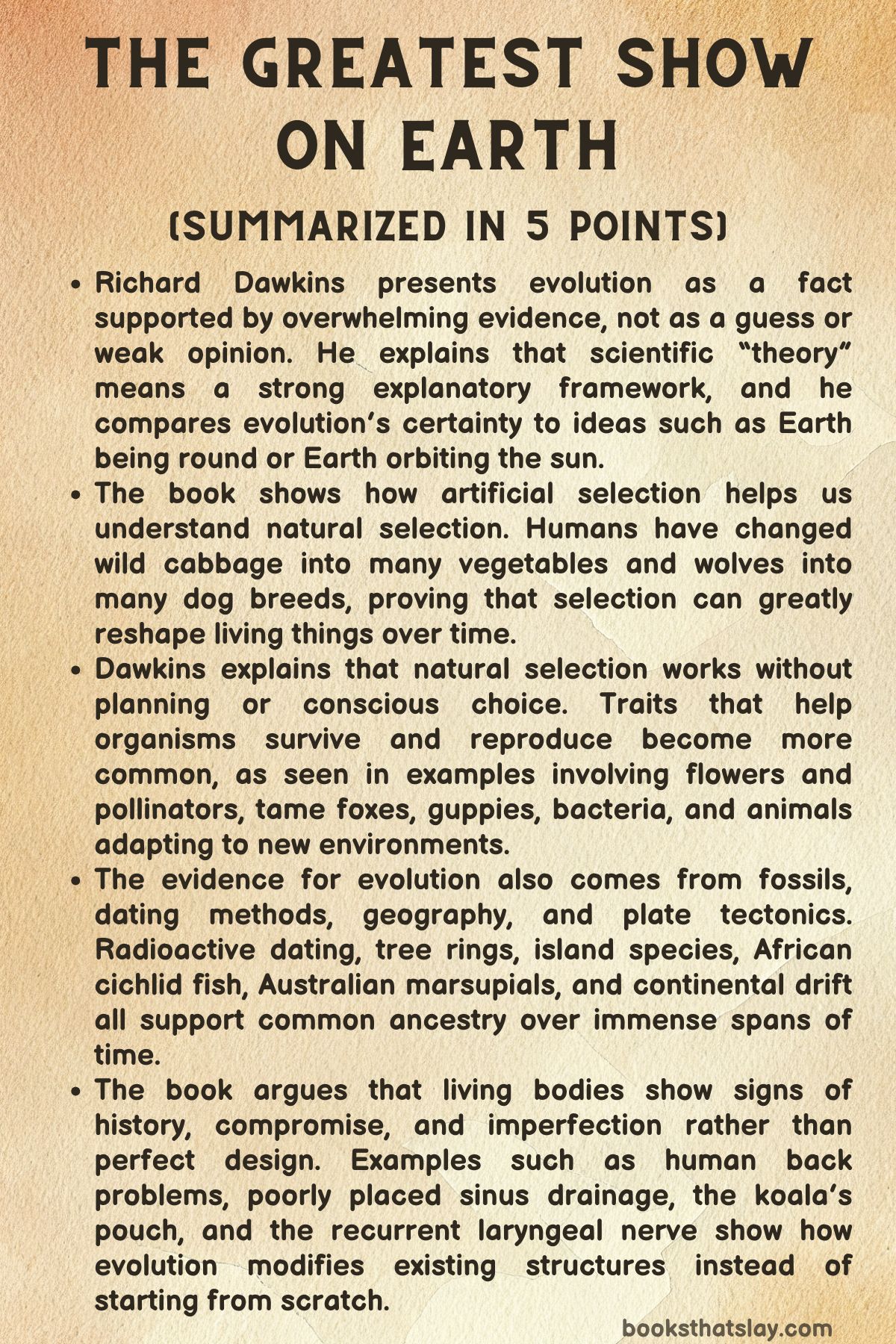
Richard Dawkins begins The Greatest Show on Earth by explaining that he wrote it to present the evidence for evolution directly. His earlier books had discussed Darwinism, natural selection, religious objections, and the power of evolutionary explanation, but this book was meant to show why evolution is not a guess or a matter of opinion.
It is a fact in the ordinary scientific sense: a conclusion supported by many independent lines of evidence.
He starts by addressing the public resistance to evolution. Dawkins compares evolution-denial to denying ancient Rome or the Holocaust: a position that forces teachers to defend what should already be beyond serious dispute.
He makes clear that many religious leaders and theologians accept evolution, so the conflict is not simply between science and all religion. The stronger problem, in his view, is widespread misunderstanding among ordinary believers, especially where people think humans were created separately and recently.
A major part of the opening argument concerns the word “theory.” In everyday speech, a theory may mean a hunch. In science, a theory is a structured explanation supported by evidence.
Evolution is a theory in the same way that the movement of Earth around the Sun is a theory. Science does not usually prove things with mathematical certainty, but it can establish facts beyond reasonable doubt.
Dawkins argues that evolution has reached that level. He also warns that direct eyewitness testimony can be unreliable, while indirect scientific evidence, such as DNA or radioactive dating, can be far stronger.
The book then explains why Darwin’s insight took so long to appear. Dawkins points to the old habit of thinking in fixed types or essences, as if every species had a perfect form and individual animals were merely imperfect copies.
Evolution requires a different way of thinking. Species are not fixed objects; they are populations full of variation.
Over long periods, small differences accumulate, and descendants can become very different from their distant ancestors. Dawkins illustrates this with the idea of an unbroken chain linking modern animals to their ancestors, where each generation resembles the one before and after it, even though the endpoints may look entirely unlike one another.
Artificial selection provides the first clear demonstration of evolutionary change. Humans have turned wild cabbage into broccoli, cauliflower, kale, and Brussels sprouts.
They have turned wolves into dogs of astonishing variety. Dawkins explains that breeders do this by controlling which individuals reproduce.
Genes do not blend like paint; they are shuffled and passed on. By repeatedly choosing certain traits, breeders reshape a gene pool.
Dog breeds, cattle, garden plants, and experimental computer creatures show how powerful selection can be when applied over many generations.
From artificial selection, Dawkins moves to natural selection. Nature does not choose with intention, but survival and reproduction still filter inherited traits.
Flowers became attractive to insects and birds because pollinators helped them reproduce. Pollinators, in turn, gained food.
Orchids give especially striking examples, including flowers with long tubes that implied the existence of moths with long tongues before such moths were found. Sexual selection also shapes bodies, as with peacocks whose display feathers help attract mates.
Predators such as angler fish show another kind of selection: any inherited feature that helps an animal catch food may spread.
Dawkins also stresses that evolution does not produce perfection. Bodies are built from compromises.
A trait that improves one function may weaken another. Stronger teeth may require resources that could otherwise go into bones, milk, or reproduction.
Dairy cows, racehorses, antelopes, and laboratory rats all show that biological improvement is always relative to circumstances. A body is not designed from scratch; it is adjusted under pressure.
The origin of dogs is used to show how natural selection can begin domestication before humans deliberately breed animals. Some wolves living near human settlements would have been less fearful and more willing to scavenge.
Those that tolerated people gained food and reproduced. Over generations, this favored tamer animals, eventually leading to village dogs.
Dmitri Belyaev’s fox experiment strengthens the point. When foxes were bred only for tameness, they quickly became friendlier, but they also developed unexpected traits such as floppy ears, curled tails, spotted coats, and dog-like behavior.
Selection for one trait can carry other traits along with it.
The book then turns to time. Dawkins compares evolutionary scientists to detectives reconstructing the past from clues.
Tree rings show how natural clocks work: patterns of wide and narrow rings can be matched across living and dead trees to date wood. Radioactive dating provides a far deeper clock.
Unstable isotopes decay at steady rates, and igneous rocks preserve evidence of when they formed. Carbon-14 helps date recent organic remains, while other isotopes date much older rocks.
Fossils are usually found in sedimentary layers, but nearby volcanic rocks and the order of strata allow scientists to place them in time.
Dawkins also gives examples of evolution happening within human lifetimes. Elephants may have evolved smaller tusks under hunting pressure because large-tusked animals were more likely to be killed.
Lizards moved to a new island changed their diet, head size, bite strength, and gut structure within decades. Richard Lenski’s long-term experiment with E. coli showed bacteria evolving through thousands of generations, including one lineage gaining the ability to use citrate as food.
Antibiotic resistance offers another modern example. John Endler’s work with guppies showed that predator pressure and mate choice could quickly change male colors, maturity, and reproductive patterns.
Geography supplies another strong line of evidence. Cichlid fishes in African lakes show how populations can split and form many species when separated by rocky outcrops, islands, bays, or changing water levels.
Australia gives a larger example. Marsupials there diversified into forms resembling wolves, cats, moles, flying squirrels, and other placental mammals elsewhere, while still remaining marsupials.
This pattern makes sense if local ancestors diversified after isolation. It does not fit the idea that all animals spread from one recent ark.
Lemurs in Madagascar, penguins in the southern hemisphere, and South American monkeys and rodents all point to local history and common ancestry.
Dawkins connects this with Darwin’s observations on islands and continents. Oceanic islands often lack amphibians because frogspawn cannot survive salt water, though seeds and some animals can travel across oceans.
Animals on a continent tend to resemble nearby living species and fossils more than unrelated animals in similar climates elsewhere. This is exactly what evolution predicts.
Plate tectonics deepens the explanation. The continents were once joined in larger landmasses such as Pangaea and Gondwana.
As they split apart, plants and animals were carried with them. Matching fossils, coastlines, rocks, and magnetic stripes on the ocean floor confirm that continents move.
The ages of rocks on either side of mid-ocean ridges form mirror patterns, showing seafloor spreading. Biological distribution is therefore tied to Earth’s changing geography.
The later parts of the book focus on imperfect design and natural competition. Dawkins describes fish swim bladders as modified lungs and human bodies as products of history rather than clean engineering.
Our upright posture explains back trouble and badly draining sinuses. The recurrent laryngeal nerve and the messy layout of organs and blood vessels also make more sense as inherited arrangements modified over time than as fresh design.
He then explains nature as an economy powered mainly by sunlight. Plants capture energy through photosynthesis, while mitochondria and chloroplasts reveal ancient partnerships with bacteria.
Energy passes through food chains, but much is lost as heat. Competition creates wasteful arms races.
Trees grow tall to beat other trees to sunlight. Predators and prey become faster because each side pressures the other.
Parasites and hosts, males and females, and parents and offspring all face similar conflicts.
Dawkins rejects the idea that nature works for the good of a species or ecosystem. Natural selection favors genes that help individuals reproduce, even when the long-term result is waste, cruelty, or extinction.
Suffering is not minimized unless reducing it helps survival. Pain likely evolved because it strongly prevents damaging behavior.
The final message of The Greatest Show on Earth is that life’s beauty, complexity, flaws, and harshness are best explained by evolution through natural selection, working over immense stretches of time.
Key Figures
Richard Dawkins
Richard Dawkins is the central explanatory voice of the book, guiding the reader through the evidence for evolution with confidence, wit, and impatience toward misunderstanding. In The Greatest Show on Earth, he appears not as a fictional character but as the intellectual presence shaping the whole argument.
His role is that of a teacher, advocate, and scientific detective who wants readers to understand that evolution is not a weak guess but an established fact supported by many independent kinds of evidence. He often uses analogies, such as Rome-deniers and Holocaust-deniers, to show how strange it seems to scientists when evolution is treated as doubtful.
His personality comes across as forceful and sometimes combative, especially when addressing creationism, but his deeper purpose is educational. He wants to move readers away from confusion about words like “theory” and toward a clearer understanding of how scientific evidence works.
Dawkins also functions as a storyteller of science. Rather than presenting evolution only through technical explanation, he builds a wide-ranging narrative using fossils, DNA, artificial selection, radioactive clocks, islands, bacteria, orchids, dogs, fish, trees, predators, and human anatomy.
His character in the book is marked by wonder as much as argument. He sees nature as beautiful precisely because it has been shaped by natural processes rather than planned design.
At the same time, he is careful to show that nature is not morally kind or organized for the comfort of living beings. Through him, the book’s emotional tone becomes a mixture of admiration, rational clarity, and sharp criticism of ideas he sees as misleading.
Charles Darwin
Charles Darwin is presented as one of the most important scientific figures in the book, even though he does not appear as an active character in a fictional sense. He represents the breakthrough that made evolution understandable through natural selection.
Dawkins treats Darwin with deep respect because Darwin supplied the key idea that explains how life can become complex without being designed. Darwin’s importance lies not only in proposing evolution, but in explaining the mechanism by which small inherited differences, accumulated over vast time, can produce enormous biological change.
Darwin also appears as a careful observer and experimenter. His work on islands, seeds, seawater, animal distribution, and fossils shows him as someone who paid attention to details that others might overlook.
His experiments with seed survival in salt water help explain why some organisms reach oceanic islands while others do not. His observations of South American animals and fossils helped him see that species are connected by geography and ancestry.
In the book, Darwin stands for patient scientific reasoning: he does not simply announce a grand theory, but builds it from evidence gathered across living nature and the geological past.
Alfred Russel Wallace
Alfred Russel Wallace is another major scientific figure in the book because he independently arrived at the idea of natural selection. Dawkins presents him as part of the same great intellectual movement as Darwin, especially in discussions of orchids and pollination.
Wallace’s role is important because it shows that natural selection was not a random thought belonging to one isolated genius; it was a powerful explanation waiting to be discovered once enough evidence had accumulated.
Wallace is especially connected with prediction and biological insight. Along with Darwin, he understood that the long nectary of the Madagascar orchid implied the existence of a pollinating moth with an extremely long tongue.
This makes Wallace a figure of scientific imagination guided by evidence. His importance in the book lies in showing how evolutionary reasoning can predict things that have not yet been directly observed.
He therefore represents the strength of evolutionary theory as a working scientific tool, not merely an interpretation of past events.
Ernst Mayr
Ernst Mayr appears as an important interpreter of evolutionary thinking. His main role in the book is to explain why Darwin’s idea took so long to emerge.
Mayr’s concept of “essentialism” helps Dawkins show how ancient habits of thought made people imagine species as fixed and unchanging. Under essentialist thinking, every species is treated as if it has a perfect inner form, while individual differences are seen as imperfect deviations from that form.
This way of thinking made evolution difficult to imagine.
Mayr’s importance comes from his contrast between essentialism and “population thinking.” Population thinking recognizes that variation is not an accidental flaw but the raw material of evolution. In this view, species are not rigid categories with permanent essences; they are changing populations full of inherited differences.
Mayr therefore helps the book explain one of the deepest mental shifts required to understand evolution. His presence is intellectual rather than dramatic, but he is essential to the argument because he clarifies why evolution requires a new way of seeing life.
Plato
Plato appears indirectly as the symbolic source of essentialist thinking. Dawkins connects Plato with the idea that real things are imperfect versions of ideal forms.
In the context of biology, this becomes a problem because it encourages people to think of species as fixed types rather than changing populations. Plato is not treated as a villain, but his philosophical influence becomes an obstacle to evolutionary understanding.
As a character in the book’s intellectual history, Plato represents the power of old ideas to shape perception long after their original context has passed. His influence shows that resistance to evolution is not only a matter of religious belief or lack of evidence; it can also come from deep habits in human thought.
By placing Plato in the background, Dawkins shows that understanding evolution requires escaping the comforting idea of perfect, unchanging categories.
Bishop Richard Harries
Bishop Richard Harries appears as an example of a religious figure who accepts evolution. His role is important because Dawkins wants to separate serious theological acceptance of science from popular creationist denial.
Dawkins mentions working with Harries on issues of science education, which shows that the conflict is not simply between science and all religion. Harries represents the religious voices that do not reject evolutionary evidence.
In the book, Harries helps Dawkins make a strategic point: creationists cannot honestly claim that evolution is rejected by all sincere believers. His presence complicates the idea of a simple war between faith and science.
Dawkins remains critical of religion in many ways, but Harries functions as evidence that educated religious leaders can accept evolution as fact. This makes ordinary evolution-denial appear less like a necessary religious position and more like a refusal to engage with evidence.
Tony Blair
Tony Blair appears briefly in connection with science education and faith schools. He is not analyzed as a political personality in depth, but he serves as a figure of public authority to whom scientific and religious leaders appealed.
His role is to show that the teaching of evolution is not only a scientific issue but also a social and educational one.
In the book, Blair represents the political arena where scientific truth must be defended against public pressure. By mentioning a letter sent to him, Dawkins shows that evolution is not confined to laboratories or universities; it affects school policy, public understanding, and the intellectual formation of young people.
Blair’s presence therefore widens the book’s concern from biology to culture.
Josh Timonen
Josh Timonen is mentioned in the dedication, and his role is personal rather than scientific. He stands as someone important to Dawkins in the creation or support of the book.
Though he is not part of the evolutionary argument, his mention gives the opening a human dimension. Scientific writing often appears impersonal, but dedications and acknowledgements remind readers that books are also made through relationships, collaboration, and gratitude.
Timonen’s presence is brief, yet meaningful. He represents the network of people behind the finished work: colleagues, editors, supporters, and assistants who help scientific ideas reach a wider audience.
In that sense, he belongs to the book’s human background rather than its scientific foreground.
Dmitri Belyaev
Dmitri Belyaev is one of the most memorable scientific figures in the book because of his Russian silver fox experiment. He appears as a researcher who demonstrated how powerful selection can be, even when applied to one trait.
By breeding foxes only for tameness, Belyaev showed that major behavioral changes could arise quickly across generations. His work also revealed that selecting for one trait can produce unexpected physical side effects, such as floppy ears, curled tails, piebald coats, and dog-like sounds.
Belyaev’s character in the book is that of an experimental proof-maker. He transforms an abstract evolutionary principle into something visible and concrete.
His foxes show that domestication is not mysterious and does not require deliberate design of every feature. Instead, selection acting on temperament can reshape an entire organism because genes and development are interconnected.
Belyaev therefore strengthens one of the book’s central claims: small selection pressures, repeated over generations, can produce striking change.
Raymond Coppinger
Raymond Coppinger appears through his idea about the self-domestication of dogs. His role is to challenge the simple view that humans deliberately turned wolves into dogs from the beginning.
Coppinger’s explanation suggests that some wolves began adapting to human settlements by scavenging near villages. Those that were less fearful gained access to food, survived better, and gradually changed through natural selection before deliberate human breeding became important.
Coppinger’s importance lies in showing that domestication can begin without a conscious human plan. He helps Dawkins bridge artificial selection and natural selection by showing that wolves could be shaped by the ecological opportunity created by human rubbish.
In the book, Coppinger represents the kind of scientist who notices that evolution often begins through ordinary practical pressures rather than dramatic events. His view makes dog evolution feel more gradual, plausible, and deeply evolutionary.
John Endler
John Endler is presented as a scientist who showed evolution happening within observable time. His guppy experiments are important because they demonstrate how predator pressure and mate choice can rapidly shape living populations.
Male guppies changed in color patterns, spot size, maturity, and reproductive behavior depending on the dangers and mating pressures around them. This makes Endler’s work a direct answer to the claim that evolution is too slow to observe.
Endler’s role in the book is to make natural selection immediate. He shows that evolution is not only something inferred from fossils or ancient rocks; it can be measured in real populations under known conditions.
His experiments also reveal the balance between survival and reproduction. Bright colors may attract mates, but they can also attract predators.
Through Endler, the book shows that organisms are shaped by competing pressures, not by a single simple drive toward perfection.
Richard Lenski
Richard Lenski appears as the scientist behind the long-term E. coli evolution experiment. His work is one of the strongest examples in the book of evolution unfolding under direct observation.
By following bacteria through tens of thousands of generations, Lenski showed how populations change, diversify, and sometimes acquire striking new abilities, such as one lineage gaining the capacity to use citrate as a food source under the experimental conditions.
Lenski’s character in the book is defined by patience and experimental discipline. His bacteria become a living record of evolutionary change, allowing scientists to watch mutation, selection, contingency, and adaptation in real time.
The importance of his work is that it turns evolution from a distant historical process into an observable laboratory fact. Lenski therefore strengthens Dawkins’s larger argument that evolution is not speculation but evidence-based science.
Alfred Wegener
Alfred Wegener appears as the bold proposer of continental drift. His role is crucial because the movement of continents helps explain the distribution of animals, plants, and fossils across the world.
Wegener noticed the matching shapes of continents, especially Africa and South America, as well as geological and fossil similarities across separated landmasses. Although his proposed mechanism was not correct, the larger idea was later confirmed through plate tectonics.
Wegener’s character in the book represents scientific insight ahead of its full explanation. He saw a real pattern before the necessary mechanism was understood.
This makes him an example of how science can preserve a good idea while correcting its details. In the evolutionary argument, Wegener matters because continental drift makes biogeography intelligible.
Marsupials, lemurs, penguins, and other geographically concentrated groups make far more sense when continents are understood as moving platforms carrying life through deep time.
Creationists
Creationists function as the main opposing force in the book’s argument. They are not presented as a single individual, but as a recurring collective presence that challenges or denies evolution despite overwhelming evidence.
Dawkins compares their denial to imaginary Rome-denial or Holocaust-denial in order to show how unreasonable it appears from a scientific perspective. Their role is to create the need for the book’s central defense of evolution as fact.
In the book, creationists represent confusion about evidence, misunderstanding of the word “theory,” and resistance to scientific inference. Dawkins is especially concerned that they influence education by demanding that evolution be treated as controversial in science classrooms.
As a group, they are important because they reveal the difference between genuine scientific debate and manufactured doubt. Their presence gives the book much of its argumentative energy.
Senior Clergy and Theologians
Senior clergy and theologians appear as a contrasting group to creationists. Dawkins mentions that many educated religious leaders accept evolution, which complicates the idea that evolution must be rejected for religious reasons.
They serve as evidence that accepting evolution is compatible with some forms of religious belief, even if Dawkins himself remains skeptical of religion more broadly.
Their role in the book is mainly rhetorical and social. They show that evolution-denial is not the only religious response available.
By including them, Dawkins narrows his criticism toward those who reject evidence rather than toward every believer in the same way. This group helps him argue that opposition to evolution often comes from popular misunderstanding rather than from serious theological necessity.
Science Teachers
Science teachers are presented as people placed in an unfair position. Dawkins compares them to Latin teachers forced to defend ancient Rome or history teachers forced to defend the Holocaust against organized deniers.
Their role is important because they stand on the front line of public understanding. They are expected not only to teach science but also to answer ideological attacks against one of biology’s foundations.
In the book, science teachers represent the burden created when settled scientific facts are treated as open controversies. Dawkins’s sympathy for them is clear.
He sees them as educators who should be able to explain evolution in depth, rather than spend time defending whether it happened at all. Through them, the book connects scientific evidence with the practical realities of classrooms and public education.
Breeders
Breeders are important collective figures because they demonstrate the power of selection in a familiar human setting. Through selective breeding, humans have transformed wolves into many dog breeds and wild cabbage into broccoli, cauliflower, kale, Brussels sprouts, and other vegetables.
Breeders do not need to understand genes perfectly in order to change gene pools; by choosing which organisms reproduce, they alter future generations.
In the book, breeders function as a bridge between artificial selection and natural selection. Their work makes evolution easier to grasp because it shows that inherited traits can be shaped dramatically over relatively short periods.
Once readers understand how human choice can produce Pekinese dogs, bulldogs, dairy cows, racehorses, and other specialized forms, Dawkins can then show that nature has had vastly longer periods to produce even greater transformations without conscious intention.
Farmers and Human Selectors
Farmers and other human selectors appear as practical agents of artificial selection. They shape animals and plants according to human needs, such as milk production, muscular cattle, speed in horses, or desired vegetable forms.
Their role is not mainly intellectual but practical: they demonstrate through action that heredity can be directed by selective reproduction.
Their importance in the book lies in the contrast between usefulness and compromise. A high-yield dairy cow may be valuable to humans but would not necessarily thrive under wild conditions.
A racehorse may be fast but fragile. A bulldog may have exaggerated features that create health problems.
These examples show that selection does not produce perfect organisms; it produces organisms shaped for particular pressures, often with costs attached.
Pollinators
Pollinators, including insects, birds, moths, bees, wasps, and flies, act almost like evolutionary partners in the book. They shape flowers by favoring traits such as color, scent, nectar, patterns, and structures that guide or manipulate them.
Their relationship with flowers shows that evolution is often interactive: one species changes in response to another, and both become part of each other’s selective environment.
Pollinators are especially important in the orchid examples. Some are rewarded with nectar or fragrance, while others are deceived into attempting mating or other behaviors.
Male insects fooled by orchid mimicry unknowingly carry pollen. Euglossine bees collect perfumes from bucket orchids and become part of the flower’s reproductive process.
In the book, pollinators reveal that natural selection can produce relationships of cooperation, exploitation, deception, and mutual dependence without any conscious plan.
Orchids
Orchids are among the most striking living examples in the book. They function almost like characters because their forms and strategies are so elaborate.
Some orchids offer nectar, while others avoid that cost by deceiving insects. They imitate female bees, wasps, or flies, manipulate insect movement, and use complex structures to attach pollen to their visitors.
Their beauty is not presented as mere decoration, but as the result of selection acting on reproductive success.
In the book, orchids represent the inventiveness of evolution. They show that natural selection can produce structures that appear astonishingly designed, yet arise through gradual changes favored by reproductive advantage.
The Madagascar orchid is especially important because its long nectary led Darwin and Wallace to predict a moth with a matching tongue. Orchids therefore serve both as examples of adaptation and as evidence that evolutionary reasoning can make successful predictions.
Dogs
Dogs are major animal figures because they make selection visible and familiar. Their variety, from large breeds to tiny lapdogs, from long-snouted borzois to short-faced bulldogs, shows how much change can arise from selective breeding.
Dawkins uses dogs to show that gene pools can be separated and reshaped when humans control reproduction. Different breeds become almost like isolated populations, kept apart by human rules.
Dogs also help explain the transition from natural selection to artificial selection. Through Coppinger’s idea of self-domestication, early dogs are shown as descendants of wolves that adapted to human settlements before humans deliberately bred them.
This makes dogs powerful evidence that major changes in behavior and body form can arise through selection. They are not just pets in the book; they are living demonstrations of evolutionary possibility.
Wolves
Wolves appear mainly as the ancestors of dogs. Their role is important because they show how a wild population can begin to change when placed under new ecological pressures.
Wolves that scavenged near human settlements had different survival opportunities depending on their fear of humans. Those with shorter flight distances could feed more successfully, while more fearful wolves lost access to food.
In the book, wolves represent the starting point of domestication. They show that the difference between wild and domestic forms does not require a sudden transformation.
Instead, small behavioral differences can alter survival and reproduction, gradually producing a new kind of animal. Wolves therefore help Dawkins explain how natural selection can create the conditions for later artificial selection.
Silver Foxes
The silver foxes in Belyaev’s experiment are among the clearest examples of rapid evolutionary change in the book. Selected only for tameness, they became friendlier across generations and also developed unexpected dog-like traits.
These traits included floppy ears, curled tails, changed coat patterns, altered breeding cycles, and new vocal behaviors. The foxes show that selection can have broad effects because traits are developmentally connected.
As figures in the book, the foxes make evolution tangible. They are not ancient fossils or abstract gene pools; they are living animals visibly changed by a controlled selection process.
Their importance lies in showing that behavioral selection can reshape physical appearance. They also help explain how domesticated animals can acquire suites of traits without each trait being chosen separately.
Laboratory Rats
Laboratory rats appear in the discussion of tooth decay and selection. They are used to answer the question of why natural selection has not produced perfect resistance to dental problems if artificial selection can improve such traits.
Dawkins explains that laboratory rats live under protected conditions very different from wild rats, so weak teeth may not seriously reduce their chances of reproduction. He also explains that improving one trait may require resources taken away from another.
The rats are important because they introduce the idea of evolutionary trade-offs. They show that bodies are not built to be perfect in every respect.
Strengthening teeth might mean reducing calcium available for bones, milk, or other functions. Through them, the book explains that organisms are compromises shaped by competing demands, not ideal machines designed without cost.
Antelopes
Antelopes appear as examples of animals shaped by trade-offs. Their bodies must balance speed, strength, energy use, reproduction, and survival.
A trait that seems beneficial in one context may become costly in another. Dawkins uses them to show that natural selection does not maximize every feature independently.
In the book, antelopes help explain why evolution produces workable compromises rather than perfection. An antelope could perhaps be faster, stronger, or more heavily defended, but every improvement has a price.
More muscle might require more food; heavier structures might reduce agility; investment in one system may reduce investment in another. Antelopes therefore embody the economic logic of living bodies.
Dairy Cows
Dairy cows appear as examples of artificial selection producing extreme usefulness for humans. They have been bred for high milk yield, but that does not mean they are generally superior animals.
Their specialized productivity may come with costs in health, survival, or independence under natural conditions. They show that selection always depends on the environment and the selector’s priorities.
In the book, dairy cows reveal the difference between human usefulness and biological fitness. A trait that serves human agriculture may not help an animal survive in the wild.
This supports Dawkins’s larger point that selection does not create universal improvement; it creates adaptation to particular circumstances. Dairy cows are therefore examples of both the power and the narrowness of selective breeding.
Racehorses
Racehorses are used to show how selection can intensify a specific trait, such as speed, while creating vulnerabilities elsewhere. They represent the way human breeders can push organisms toward specialized performance.
Yet their speed does not make them perfect animals, because specialization often involves fragility, high maintenance, or reduced suitability for other environments.
In the book, racehorses help explain evolutionary compromise. Like dairy cows and bulldogs, they show that selection can exaggerate traits beyond what would be useful in nature.
Their presence reminds the reader that selection is not a moral or aesthetic force aiming at balance. It preserves what succeeds under a given set of pressures, even when that success carries hidden costs.
Peacocks and Peahens
Peacocks and peahens appear in the discussion of sexual selection. The peacock’s showy tail is not explained mainly as a survival tool, because it can make the bird more visible and cumbersome.
Instead, it exists because peahens have favored males with impressive displays. This makes the peacock an example of how mate choice can shape evolution powerfully.
Peahens are equally important because they represent the selecting force. Their preferences influence which males reproduce, and over generations this can produce extravagant traits.
In the book, peacocks and peahens show that survival is not the only pressure in evolution. Reproductive success can favor traits that are costly, beautiful, or dangerous, as long as they increase mating opportunities.
Angler Fish
Angler fish appear as examples of natural selection producing deceptive attraction. Their lure helps them catch prey, and individuals with more effective lures are more likely to survive and reproduce.
Unlike human breeders or choosing peahens, no conscious selector is required. The environment itself filters organisms according to survival and reproduction.
In the book, angler fish are important because they mark a transition from selection by conscious choice to selection by consequence. Their lure may look designed, but Dawkins uses it to show how useful traits are preserved naturally.
The angler fish therefore helps explain the central logic of natural selection: traits that help organisms leave descendants become more common, even without intention or planning.
Elephants
Elephants appear in the discussion of evolution within human lifetimes. The possibility that tusks have become smaller because hunters killed large-tusked individuals shows how human pressure can alter animal populations.
Elephants are not used merely as symbols of grandeur; they become evidence that selection can occur rapidly when survival and reproduction are changed.
In the book, elephants represent the unintended evolutionary effects of human behavior. Hunters may seek ivory, but by removing large-tusked animals from the breeding population, they can favor smaller tusks.
This example shows that selection is not always natural in the untouched sense; human actions can become powerful evolutionary pressures. Elephants therefore demonstrate that evolution is ongoing and responsive to present conditions.
Lizards of Pod Mrcaru
The lizards moved to Pod Mrcaru are important because they show rapid evolutionary change in a natural setting. Within decades, they developed larger heads, stronger bites, a more plant-based diet, and gut changes.
Their transformation provides evidence against the idea that evolution is always too slow to observe.
In the book, these lizards represent the speed with which populations can respond to new environments. When food sources, competition, and habitat change, natural selection can favor different traits quickly.
The lizards are therefore living evidence that evolution is not confined to ancient history. They make adaptation visible on a human timescale.
E. coli Bacteria
E. coli bacteria appear through Lenski’s long-term experiment and serve as some of the most direct evidence for evolution. Because bacteria reproduce quickly, they allow scientists to observe many generations in a relatively short period.
Their changes across tens of thousands of generations show mutation, competition, adaptation, and historical contingency in action.
In the book, E. coli bacteria are powerful because they remove much of the distance between theory and observation. They show that evolution can be tested experimentally.
The lineage that gained the ability to use citrate is especially important because it demonstrates the emergence of a significant new capacity under recorded conditions. These bacteria therefore act as microscopic witnesses to evolutionary change.
Guppies
Guppies appear in John Endler’s experiments and show how predator pressure and mate choice interact. Male guppies may benefit from bright colors because females notice them, but those same colors can make them more visible to predators.
Different environments therefore favor different patterns, sizes, and reproductive strategies.
In the book, guppies are important because they show evolution as a balance of competing pressures. They are shaped not by a simple movement toward beauty or safety, but by the tension between attracting mates and avoiding death.
Their rapid changes make them one of the clearest examples of evolution occurring quickly and measurably.
Cichlid Fishes
Cichlid fishes, especially those in African lakes, are major examples of rapid speciation. In Lake Malawi and Lake Victoria, different populations became isolated by rocky outcrops, islands, bays, inlets, and changing water levels.
These separations allowed populations to diverge into many forms. The Mbuna fishes are especially important because different rocky regions contain distinctive varieties.
In the book, cichlids represent evolutionary diversification on a grand scale. They show how geographical separation and ecological opportunity can produce many species from common ancestors.
Their presence supports the argument that new species do not need separate creation; they can arise when populations become isolated and adapt to different conditions. Cichlids therefore make the process of speciation vivid and geographically concrete.
Marsupials
Marsupials are central to the book’s discussion of biogeography. In Australia, marsupials diversified into many ecological roles, producing forms comparable to wolves, cats, rabbits, moles, shrews, lions, flying squirrels, kangaroos, and wombat-like giants.
Despite these varied roles, they remain fundamentally marsupial. This makes them strong evidence for evolution from local ancestors rather than separate creation.
In the book, marsupials show how geography and ancestry shape life. Their concentration in Australia makes sense if ancestral marsupials evolved and diversified there, especially after continental separation.
It does not make sense under the idea that all animals dispersed from one ark. Marsupials therefore function as living evidence that the history of life is tied to the history of the Earth’s landmasses.
Lemurs
Lemurs appear as part of the evidence from animal distribution. Their concentration in Madagascar supports the idea that species evolve in particular places from local ancestors.
They are important because their location is not random. If all animals had spread from a single ark, one would expect a very different global pattern.
In the book, lemurs represent the distinctiveness of island evolution. Madagascar’s isolation allowed certain lineages to persist and diversify in ways that differ from mainland continents.
Lemurs therefore help show that biogeography carries the imprint of ancestry, isolation, and deep time. Their presence strengthens the rejection of separate creation as an explanation for animal distribution.
Penguins
Penguins are mentioned as another example of geographical pattern. Their concentration in the southern hemisphere fits an evolutionary and biogeographical explanation better than an ark-based dispersal story.
They show that species are not scattered randomly across the globe but follow patterns shaped by ancestry, environment, and movement through time.
In the book, penguins help Dawkins argue that animal distribution is evidence. Their location matters because it matches what one would expect from local evolution and historical dispersal, not from universal migration from a single point.
Penguins therefore serve as one more piece in the larger case that life’s arrangement on Earth has a history.
Frogs, Toads, and Newts
Frogs, toads, and newts appear in Darwin’s island investigations. Their eggs do not survive salt water well, which helps explain why oceanic islands often lack amphibians even when those islands could support them if humans introduced them.
Their absence becomes meaningful evidence rather than an accident.
In the book, these amphibians show how the limits of dispersal shape life. They help explain why some organisms reach islands and others do not.
Their role is important because it turns a negative fact, their absence, into evidence for evolution and biogeography. They show that island life depends not only on survival after arrival but also on the practical possibility of getting there.
Koalas
Koalas appear as examples of evolutionary inheritance and imperfect design. Their pouch opens downward, a feature that seems odd for a tree-living animal.
Dawkins explains this by tracing koalas back to wombat-like digging ancestors, for whom a backward-opening pouch helped protect young from dirt. When koalas later adapted to trees, the inherited pouch arrangement remained.
In the book, koalas show that evolution works by modifying what already exists rather than redesigning from scratch. Their bodies carry traces of ancestry, even when those traces are no longer ideal for current habits.
Koalas therefore help Dawkins argue that living organisms look like historical patchworks, not perfectly engineered machines.
Wombat-like Ancestors
The wombat-like ancestors of koalas are important because they explain a feature that otherwise seems poorly designed. As digging animals, they benefited from a pouch orientation that protected young from soil.
This ancestral condition helps make sense of the koala’s later body structure.
In the book, these ancestors represent the power of historical explanation. They show that a trait may appear strange if judged only by present function, but becomes understandable when viewed through descent.
Their role is to remind readers that organisms are shaped by past forms as well as present needs.
Fish
Fish appear in the discussion of swim bladders, lungs, and evolutionary modification. The swim bladder allows fish to control buoyancy, rising or sinking without constant muscular effort.
Dawkins explains it as a modified lung, itself descended from a gut pouch, and notes that in some fish it has even been adapted for hearing.
In the book, fish show how evolution repurposes structures. An organ can begin with one function and later be modified for another.
This undermines the idea that complex organs must have been designed all at once for their current use. Fish therefore demonstrate the evolutionary principle of transformation through historical stages.
Humans
Humans appear as biological products of evolutionary history rather than as separate or perfectly designed beings. Dawkins discusses human bipedalism, back problems, sinus drainage, and other bodily imperfections to show that our bodies were not cleanly engineered for upright life.
Our ancestors spent vast stretches of time with horizontal backbones and four-legged movement, so upright walking required modifications of an inherited body plan.
In the book, humans are important because they bring the argument close to the reader. The imperfections of the human body become evidence of descent.
Poorly draining sinuses, vulnerable backs, and awkward internal arrangements make sense when seen as evolutionary compromises. Humans therefore serve as examples of both the power and the limitations of natural selection.
Trees
Trees are used to explain competition and waste in nature. A tree growing alone in a field may spread beautifully, but forest trees grow tall because they compete for sunlight.
If all trees remained short, they could save energy, but any tree that grew slightly taller would gain more light and leave more descendants. Over time, height increases until the costs balance the benefits.
In the book, trees represent evolutionary arms races. Their height is not evidence of a planned natural economy but of competitive escalation.
Each tree is shaped by the pressure created by neighboring trees. Through them, Dawkins shows that evolution can produce wasteful outcomes because selection favors individual genetic success, not the collective efficiency of a forest.
Cheetahs
Cheetahs appear as examples of predator evolution. Their speed is shaped by the need to catch prey.
However, their improvement does not occur in isolation, because prey animals also evolve better escape abilities. This creates an evolutionary arms race in which both sides must keep improving simply to maintain their relative position.
In the book, cheetahs represent the Red Queen-like logic of nature: organisms may have to “run” evolutionarily just to stay in place. Their speed is impressive, but it is also part of a costly competition.
They show that natural selection can produce beauty and athleticism through struggle, danger, and repeated escalation.
Lions
Lions appear in two major ways: as predators in evolutionary arms races and as examples in the discussion of “prudent predators.” Dawkins rejects the idea that lions would naturally restrain themselves for the long-term good of prey populations. Even if restraint might benefit lions collectively, an individual lion that exploited prey more aggressively could leave more descendants.
In the book, lions show that natural selection does not work for the good of the species or the ecosystem. It favors traits that increase individual reproductive success.
This makes lions important to the book’s darker view of nature. They reveal why natural selection can produce destructive or short-sighted outcomes, even to the point of endangering future survival.
Gazelles
Gazelles appear as prey animals shaped by the pressure of predators. Their speed, alertness, and agility are responses to the danger of being caught.
Like cheetahs, they are part of an arms race in which each side’s improvement changes the selective pressure on the other.
In the book, gazelles represent the cost of survival. Their grace and speed are not presented as decorative gifts, but as products of relentless danger.
They show how natural beauty can emerge from fear, pursuit, and death. Gazelles therefore help Dawkins show that evolution produces elegance without kindness.
Wildebeest
Wildebeest appear alongside other prey animals in the discussion of predator-prey competition. Their bodies and behavior are shaped by the need to survive in environments where predators are constantly testing them.
They are part of the wider argument that animal traits often arise through conflict between hunters and hunted.
In the book, wildebeest represent the collective pressure experienced by prey species. Their survival depends not on perfection but on being good enough, often enough, to escape and reproduce.
Their role helps make the arms-race model broader than a single predator-prey pair.
Pronghorns
Pronghorns appear as another example of extreme speed shaped by evolutionary pressure. Their abilities suggest a history of selection involving fast predators, even if the exact modern predator context has changed.
They help illustrate that present traits may reflect past conditions as well as current ones.
In the book, pronghorns show that organisms carry evolutionary history in their bodies. A trait may be difficult to explain only by looking at today’s environment, but it becomes clearer when past selection pressures are considered.
They therefore support the book’s repeated message that living bodies are historical records.
Parasites
Parasites are important figures in the book’s darker account of nature. They evolve to exploit hosts, while hosts evolve defenses.
This creates ongoing arms races similar to predator-prey conflicts. Parasites are not cruel in a conscious sense, but their effects can be painful, damaging, and deadly.
In the book, parasites show that natural selection has no moral concern for suffering. If exploiting a host helps a parasite reproduce, that strategy can be favored.
Parasites therefore help Dawkins reject sentimental views of nature. They demonstrate that evolution explains both beauty and horror through the same basic logic of reproductive success.
Viruses
Viruses appear as agents of suffering and survival pressure. Like parasites, they reproduce by exploiting living organisms.
Their role is to show that nature does not avoid harm unless avoiding harm improves reproductive success. Viruses can spread, damage, and kill because their success is measured by replication, not mercy.
In the book, viruses represent the impersonal character of natural selection. They are not evil, but they show why the natural world contains disease and pain.
Their presence strengthens Dawkins’s argument that life is not arranged according to human moral expectations. It is shaped by what works reproductively.
Ichneumon Wasps
Ichneumon wasps appear as one of the most unsettling examples of natural cruelty. They are famous for reproductive strategies that involve laying eggs in or on other living creatures, allowing their young to feed in ways that seem horrifying from a human perspective.
Dawkins uses them to show that nature does not minimize suffering for its own sake.
In the book, ichneumon wasps represent the challenge that natural history poses to comforting ideas of design. Their behavior makes sense under natural selection because it supports reproduction, but it is difficult to reconcile with a benevolent plan.
They therefore play a key role in the book’s moral and philosophical argument: evolution explains nature’s cruelty without needing to justify it.
Plants
Plants appear as the foundation of life’s energy economy. Through photosynthesis, they capture sunlight and make energy available to herbivores, carnivores, scavengers, fungi, bacteria, and entire food chains.
Their role is fundamental because they connect life on Earth to solar energy.
In the book, plants are not passive background organisms. They are energy gatherers, competitors, and evolutionary participants.
Their chloroplasts are descended from bacteria, which also makes them evidence of deep cellular history. Plants therefore represent both ecological dependence and evolutionary inheritance.
Chloroplasts
Chloroplasts are treated as living evidence of ancient symbiosis. They perform photosynthesis in plant cells, but they are descended from once-free bacteria.
Their existence shows that major evolutionary changes can occur not only through competition but also through incorporation and cooperation across lineages.
In the book, chloroplasts expand the meaning of ancestry. They show that the history of life includes mergers as well as branching descent.
Their bacterial origin reveals that even the basic machinery of plant life carries traces of ancient evolutionary events. Chloroplasts therefore help connect cell biology with the larger evolutionary story.
Mitochondria
Mitochondria are another example of ancient bacterial origin. They release energy from food in both plant and animal cells and are descended from once-free bacteria.
Their role is essential because they show that some of the most basic features of complex life arose through symbiotic history.
In the book, mitochondria represent hidden ancestry inside every complex organism. They make evolution visible at the cellular level.
Their presence shows that living beings are not simple, separately created units, but layered products of ancient relationships. Mitochondria therefore strengthen the argument that evolution is written into the structure of life itself.
Fossils
Fossils are not characters in the human sense, but they act as witnesses in the book’s detective-like reconstruction of the past. They preserve traces of organisms that lived long before humans and allow scientists to place life within geological time.
Their importance depends not only on their forms but also on their positions in rock layers and their connection to dating methods.
In the book, fossils help show that evolution is historical fact. They are clues that can be compared with living species, geological strata, and radioactive dates.
Dawkins uses them as part of a larger evidentiary network rather than as isolated curiosities. Fossils therefore function as silent but powerful testimony for common ancestry and deep time.
Rocks and Geological Strata
Rocks and strata serve as the book’s timekeepers and archives. Sedimentary rocks preserve fossils, while nearby igneous rocks can be dated through radioactive decay.
The order of geological layers helps scientists place organisms in time and reconstruct the sequence of life’s history.
In the book, rocks are part of the detective story of science. They do not speak directly, but they contain patterns that can be read through careful methods.
Their role is to make the past measurable. By explaining tree rings, radioactive clocks, carbon-14, potassium-argon dating, and strata, Dawkins shows that evolutionary history rests on physical evidence, not guesswork.
Nature
Nature itself functions almost like the largest character in The Greatest Show on Earth. It is creative, wasteful, beautiful, cruel, and indifferent.
Dawkins does not present nature as a wise planner or moral guide. Instead, he shows it as the arena in which genes, bodies, environments, predators, prey, parasites, mates, and resources interact through selection.
As a character-like force in the book, nature produces astonishing complexity without intention. It shapes orchids, dogs, fish, trees, bacteria, humans, and countless other forms through accumulated historical change.
Yet it also produces pain, arms races, waste, disease, and extinction. Dawkins’s portrayal of nature is therefore both admiring and unsentimental.
Its grandeur lies not in perfect design, but in the fact that such richness can emerge from natural processes over immense time.
Themes
Evolution as a Fact Supported by Evidence
Richard Dawkins treats evolution not as a loose guess but as a conclusion supported by many independent lines of evidence. In The Greatest Show on Earth, he shows that scientific knowledge often works like detective work: the past is reconstructed through clues, patterns, and tests rather than direct eyewitnesses.
Fossils, DNA, geological dating, artificial selection, natural selection, island species, and living anatomical features all point toward common ancestry. A central part of this theme is the correction of the word “theory.” In ordinary speech, a theory may mean an uncertain idea, but in science it can mean a powerful explanation supported by repeated evidence.
Dawkins argues that evolution belongs in this stronger category. His comparisons with heliocentrism and the roundness of Earth help show that science can reach practical certainty without mathematical proof.
The theme also challenges the idea that direct observation is always superior. Evidence such as DNA, radioactive dating, and geographical distribution can be more reliable than human memory or eyewitness reports.
Selection, Change, and the Power of Small Differences
Selection is presented as a force that can produce dramatic change by preserving small inherited differences over time. Artificial selection makes this easy to see because humans have transformed wolves into many dog breeds and wild cabbage into vegetables as different as broccoli, kale, and cauliflower.
These examples prepare the reader to understand natural selection, where no conscious breeder is needed. Survival and reproduction do the selecting.
Traits that help an organism leave more descendants become more common, while harmful traits tend to disappear unless protected by special conditions. Dawkins also stresses that selection does not always produce perfection.
Bodies involve trade-offs: stronger teeth, faster legs, larger antlers, or greater milk production may come at a cost elsewhere. The examples of foxes, dogs, flowers, pollinators, guppies, bacteria, and lizards show that evolution can happen quickly when selection pressures are strong.
This theme makes evolution feel practical and observable rather than distant, abstract, or limited to ancient fossils.
Common Ancestry and the Geography of Life
The distribution of living things across the world becomes powerful evidence for common ancestry. Animals and plants are not spread randomly, nor do they match the pattern expected if all species had migrated from a single recent starting point.
Instead, they reflect local histories, isolation, migration, extinction, and descent from earlier forms. Marsupials in Australia, lemurs in Madagascar, penguins in the southern hemisphere, and cichlid fishes in African lakes all make sense when seen through evolution.
Islands and lakes act as natural laboratories, separating populations and allowing them to change in different directions. Plate tectonics expands this idea further by showing that continents themselves have moved, split, and carried life with them.
The breakup of ancient landmasses explains why related organisms and fossils appear on lands now separated by oceans. This theme connects biology with geology, showing that life’s history cannot be understood apart from Earth’s history.
Species carry the marks of where their ancestors lived, moved, and became isolated.
Imperfection, Competition, and the Absence of Design
Living bodies often make more sense as products of history than as products of perfect design. Dawkins uses examples such as human back problems, poorly draining sinuses, the koala’s pouch, fish swim bladders, and the recurrent laryngeal nerve to show that evolution modifies existing structures rather than starting from scratch.
These features are not always elegant, but they are understandable as inherited compromises. The same theme appears in nature’s waste and cruelty.
Forest trees grow tall not because height is best for the forest, but because each tree competes for sunlight. Predators and prey become faster because each side pressures the other.
Parasites, hosts, males, females, parents, and offspring are often locked in similar struggles. Natural selection favors traits that help genes survive and reproduce, not traits that serve kindness, beauty, efficiency, or the good of the species.
This explains both the grandeur and the harshness of nature. Life can be astonishingly complex without being planned, and deeply impressive without being morally gentle.