The Strain Summary, Characters and Themes | Guillermo del Toro
The Strain by Guillermo del Toro and Chuck Hogan is a dark horror thriller about an ancient vampiric infection entering modern New York through a mysterious airplane disaster. The story blends folklore, medical investigation, urban fear, and survival drama.
At its center are Dr. Ephraim Goodweather, a CDC specialist trying to understand an impossible outbreak, and Abraham Setrakian, an old survivor who recognizes the threat from a lifetime of trauma and preparation. The book treats vampirism less as romance and more as disease, invasion, and corruption. It is a story about family, denial, power, and the cost of fighting evil too late.
Summary
The Strain begins with an old legend from Romania, where a young Abraham Setrakian learns about Jusef Sardu from his grandmother. Sardu was once known as a gentle nobleman and a giant of a man.
Though his size made him unusual, he was remembered as kind and quiet rather than cruel. During a wolf-hunting trip, he disappeared, and when he returned, something about him had changed.
He became stronger, more secretive, and terrifying to the people around him. Children began vanishing near his castle, and the sound of his cane became a sign of fear.
This childhood story shapes Setrakian’s understanding of evil long before he meets it directly. Later, during the Nazi occupation, his family is forced to flee.
His grandmother sacrifices herself so he can escape, leaving him with grief, guilt, and a lifelong awareness that monstrous things can exist in human history as well as in old legends. The memory of Sardu’s cane stays with him, linking childhood fear to the real horrors he will face as an adult.
Many years later, in 2010, a passenger plane from Berlin lands at John F. Kennedy International Airport in New York. Regis Air Flight 753 arrives normally, but after landing, it stops on the taxiway and goes completely dark.
The aircraft does not respond to radio calls. Its lights are off, the window shades are closed, and no passengers call their families or emergency services.
Air-traffic controllers, ground staff, firefighters, TSA officers, and Port Authority teams gather around the silent plane, unsure whether they are facing terrorism, disease, mechanical failure, or something stranger.
The situation becomes even more disturbing when one of the plane’s doors opens without clear human action. Officers enter and find almost everyone on board dead.
The bodies remain calmly seated, as though death came without panic or struggle. There is no visible violence, no signs of a fight, and no obvious explanation for the sudden mass death.
Dr. Ephraim Goodweather, known as Eph, is called in because of his work with the CDC’s Canary project, a rapid-response disease investigation unit. He is pulled away from time with his son, Zack, during an already strained custody arrangement with his estranged wife, Kelly.
Eph’s personal life is under pressure, but the Flight 753 case demands his full attention. He arrives with his colleague Nora Martinez, and together they board the aircraft in protective gear.
Inside the plane, Eph and Nora find a scene that does not match any normal outbreak. The cockpit crew is dead.
The air marshal’s gun has not been fired. There is no evidence of panic, poisoning, or a common medical event.
Then they discover that one pilot, Captain Redfern, is still alive. Three other survivors are also identified: Joan Luss, a lawyer; Ansel Barbour, a computer programmer; and Gabriel Bolivar, a famous rock musician.
Their survival seems like a miracle, but it soon becomes one of the most dangerous parts of the mystery.
In the cargo hold, Eph and Nora find a large black coffin-like cabinet filled with soil. It has no proper cargo record and should not be on the plane.
Its presence suggests planning rather than accident. Even worse, the cabinet appears to have opened from the inside.
This object becomes the key to the disaster, though the authorities do not yet understand what it means.
Across the city, Abraham Setrakian sees the news and immediately recognizes the signs. Now an elderly pawnbroker in Harlem, he has spent decades waiting for the return of the evil tied to the Sardu legend.
While the official response treats the plane as a medical or security emergency, Setrakian understands that something ancient has arrived in New York. At the same time, billionaire Eldritch Palmer watches events unfold with secret satisfaction.
He has helped bring the creature to America because he believes it can grant him power and freedom from his failing body.
During a total solar eclipse, the dead from Flight 753 begin to change. The bodies that had seemed lifeless start rising in morgues and homes.
They return to their families, but not as the people they once were. They attack loved ones and spread a parasitic infection through a feeding organ and wormlike organisms.
The outbreak moves through intimacy and trust: spouses, children, parents, and friends become the first victims because they open their doors to those they love.
The four survivors also begin to transform. At first, they seem alive and possibly recovering, which gives doctors and officials false confidence.
Gabriel Bolivar quickly becomes violent and predatory, killing and infecting people around him. Ansel Barbour senses that something is wrong with him and tries to protect his family by chaining himself up, but the infection overpowers his will.
Joan Luss returns home and becomes a danger to her own household. Captain Redfern worsens while under medical observation, and when he attacks Eph and Nora, Setrakian appears and kills him with a silver sword.
Setrakian then explains the truth to Eph and Nora. The being that arrived in the black cabinet is the Master, an ancient vampire whose power is far beyond the newly infected creatures.
The Master is not merely a monster feeding in secret; he is creating an outbreak designed to spread through New York and beyond. Vampirism here behaves like a biological plague as much as a supernatural curse.
The infection changes bodies, destroys identity, and turns human relationships into routes of transmission.
Eph and Nora struggle to accept what Setrakian tells them, but the evidence becomes impossible to deny. They join him, and soon Vasiliy Fet, a city exterminator, becomes part of the group.
Fet has noticed that rats are fleeing underground areas, reacting to a threat humans have not yet recognized. His knowledge of the city’s hidden spaces makes him valuable, and his practical courage helps the group survive as the outbreak expands.
New York begins to break down. The authorities are slow to understand the danger, and some information is suppressed or misread.
What should be treated as an emergency becomes trapped in confusion, denial, and bureaucracy. Palmer continues preparing for the Master’s rise, believing he will benefit from the new order.
Meanwhile, Eph tries to protect Zack and Kelly. His family conflict becomes far more urgent as the infection spreads into homes and neighborhoods.
Kelly is eventually attacked and transformed, turning Eph’s private life into part of the larger horror.
Setrakian leads Eph, Nora, and Fet into subway tunnels and underground spaces in search of the Master. They discover nests of infected creatures and learn the rules of survival.
Sunlight can destroy the vampires, and silver is a powerful weapon against them. The group also finds signs that other ancient vampires exist and that not all of them support the Master.
These older beings seem to be watching the crisis, suggesting that the outbreak is part of a larger conflict.
The hunt brings the group to the Master’s lair near the World Trade Center site. There, they fight through danger and manage to wound him, but they fail to kill him.
The Master escapes, leaving the city in deeper danger. Their partial victory proves he can be hurt, but it also shows how difficult the fight will be.
As fires, panic, and violence spread through New York, Eph’s attention returns to Zack. The group goes to Kelly’s house to rescue him, but Kelly, now transformed, comes for her son.
Her love has been twisted into a hunting instinct. Fet uses silver to drive her back, and she escapes into the night.
Eph understands that Kelly will keep searching for Zack and that family bonds have become weapons in the Master’s plague.
The story ends with Eph sending video proof of the vampires to the world. He hopes evidence will force people to recognize the truth before it is too late.
Yet the outbreak continues to grow, the Master remains alive, and New York stands at the beginning of a much larger disaster.
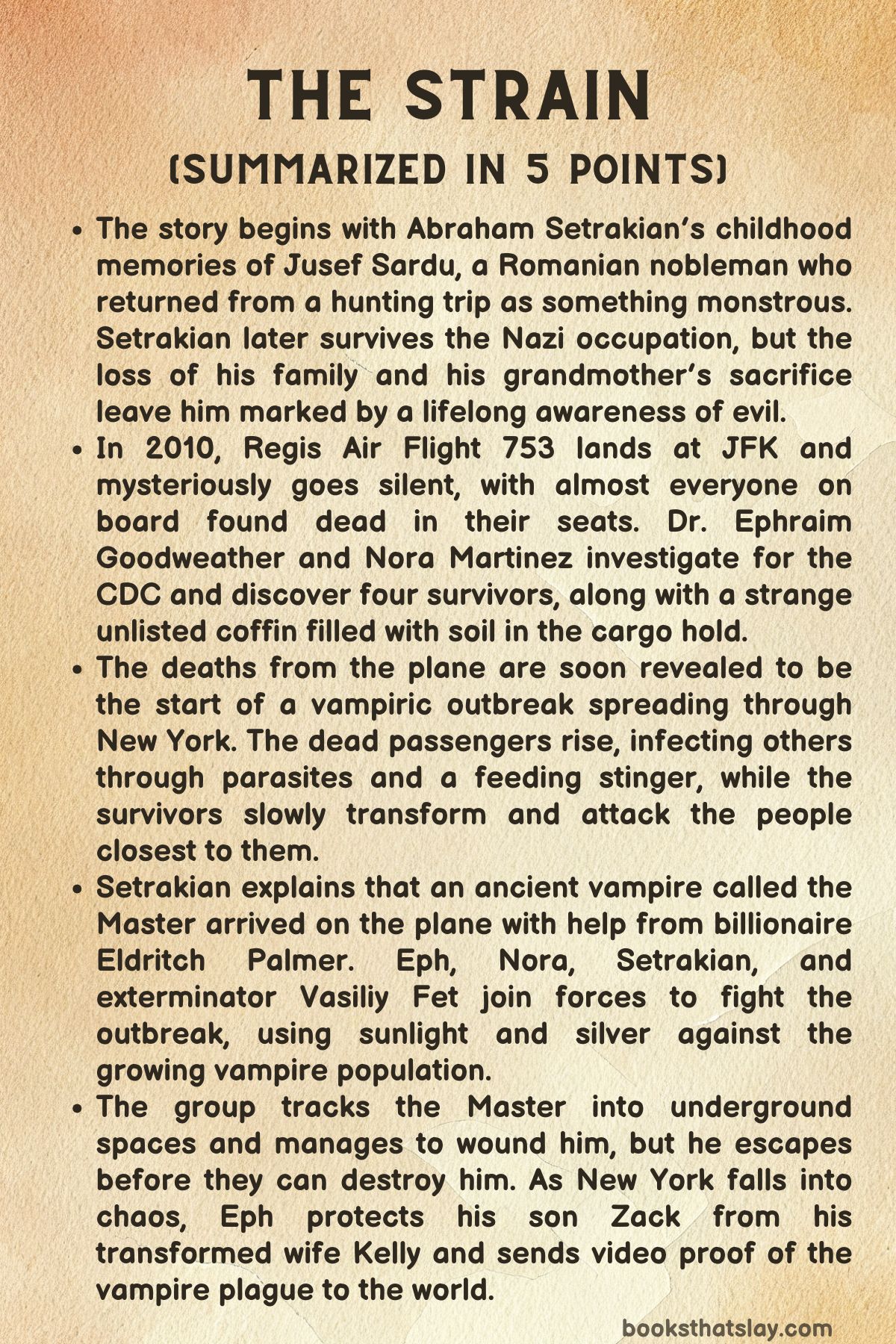
Characters
In The Strain, the characters are shaped by fear, infection, grief, ambition, and survival. The story uses them not only as individuals facing a supernatural plague, but also as symbols of different human responses to evil: denial, sacrifice, obsession, courage, selfishness, and love.
Abraham Setrakian
Abraham Setrakian is one of the most important and morally forceful characters in the book. His childhood in Romania marks him deeply, especially through his grandmother’s stories about Jusef Sardu and the strange evil connected to him.
Setrakian grows up with an understanding of darkness that most people would dismiss as superstition, but his later experiences under Nazi occupation prove to him that evil can take both human and monstrous forms. His grandmother’s suicide so that he can escape becomes one of the defining wounds of his life, leaving him with guilt, grief, and a sense of responsibility.
As an old man, he appears physically weakened, but his knowledge, patience, and determination make him far stronger than many younger characters. His cane, sword, and pawnshop all suggest a man who has spent decades preparing for a battle others do not even know exists.
Setrakian’s tragedy is that he understands the threat almost too well, but he is surrounded by a modern world that refuses to believe in ancient evil until it is too late.
Dr. Ephraim Goodweather
Dr. Ephraim Goodweather, often called Eph, is the central scientific and emotional figure of the story. As a CDC doctor, he begins the book as a man trained to trust evidence, procedure, and rational explanation.
The dead passengers on Flight 753 challenge everything he knows because the situation looks like a disease outbreak but behaves like something far older and more terrifying. Eph’s character is also defined by his personal struggles, especially his strained relationship with his son Zack and his estranged wife Kelly.
This makes his battle against the vampire plague painfully personal, because he is not only trying to save a city but also trying to protect what remains of his family. His transformation is gradual: he moves from skepticism to horror, from professional duty to desperate resistance.
By the end, Eph understands that science alone cannot explain everything, but he does not abandon reason; instead, he combines medical knowledge with Setrakian’s ancient wisdom. His greatest weakness is his emotional vulnerability, especially where Zack and Kelly are concerned, but that same love also gives him the will to fight.
Nora Martinez
Nora Martinez is intelligent, brave, and emotionally perceptive, serving as both Eph’s colleague and one of the first people willing to face the truth of the outbreak. She enters the aircraft with Eph and shows the same professional courage, but her importance goes beyond her role as a CDC investigator.
Nora often acts as a bridge between science and human feeling. She understands the medical danger of the infection, but she also recognizes the emotional horror of what is happening to families, victims, and survivors.
Her willingness to follow Setrakian’s explanation shows that she is not limited by pride or institutional thinking. Unlike many officials who cling to ordinary explanations, Nora is able to adapt when reality becomes impossible to ignore.
Her character represents disciplined compassion: she is frightened, but she continues to act; she is shocked, but she does not look away. In the group, she becomes essential because she combines intelligence, courage, and moral steadiness.
Zack Goodweather
Zack Goodweather represents innocence, family, and the emotional stakes of the book. He is not a fighter or investigator, but his presence gives Eph’s struggle a deeply personal meaning.
Zack is the child Eph wants to protect, but he is also caught between his parents’ broken relationship and the larger collapse of the world around him. Through Zack, the story shows that the vampire outbreak does not only threaten bodies; it attacks families, trust, and safety.
Kelly’s transformation makes Zack especially vulnerable because the person who should protect him becomes one of the greatest dangers to him. His character also reveals Eph’s deepest fear: that he may fail as a father just as the world is failing around him.
Zack’s importance lies in the way he humanizes the conflict. The battle is not only against the Master; it is also a father’s attempt to keep his child alive in a world where love itself can be twisted into a weapon.
Kelly Goodweather
Kelly Goodweather is one of the most tragic characters in the story because her transformation turns an ordinary family conflict into horror. At first, she belongs to Eph’s personal life rather than the supernatural crisis.
She is his estranged wife and Zack’s mother, representing the broken domestic world Eph is still trying to repair. Once she is attacked and turned, however, her role changes completely.
The tragedy of Kelly is that the infection does not erase her connection to Zack; instead, it corrupts it. Her maternal bond becomes dangerous because the transformed Kelly continues to seek her son, but no longer in a human, protective way.
This makes her one of the most emotionally painful figures in the book. She is not simply a monster; she is the remains of someone Eph and Zack loved.
Her transformation shows the cruelty of the plague, which does not merely kill people but uses their former relationships to spread fear, grief, and infection.
Vasiliy Fet
Vasiliy Fet is practical, observant, and physically courageous. As a city exterminator, he understands the hidden systems beneath New York better than most officials or scientists.
His knowledge of rats and underground spaces makes him unusually prepared to recognize that something unnatural is spreading below the surface. Fet’s role is important because he brings a working-class, hands-on intelligence to the group.
He is not guided by academic theory or ancient legend at first; he notices patterns, trusts his instincts, and acts decisively. His courage is blunt and practical, making him a strong contrast to Eph’s scientific hesitation and Setrakian’s haunted wisdom.
Fet also represents the city itself: tough, alert, and familiar with what lives in tunnels, basements, and forgotten spaces. Once he joins the fight, he becomes one of the group’s most reliable protectors.
His use of silver against Kelly shows his ability to act quickly under emotional pressure, even when others might freeze.
Eldritch Palmer
Eldritch Palmer is a deeply corrupt and ambitious figure whose fear of death makes him vulnerable to evil. As a billionaire, he already possesses enormous worldly power, but his wealth cannot give him the one thing he desires most: escape from mortality.
This weakness allows the Master to use him. Palmer’s character shows how human greed and desperation can open the door to catastrophe.
Unlike the infected victims, Palmer is not simply attacked or transformed against his will; he chooses to help bring the ancient evil to America because he believes it will benefit him. His physical frailty contrasts with his financial power, making him both pitiable and repulsive.
He is a man who has everything except peace, and his hunger for continued life makes him willing to sacrifice countless others. Palmer’s evil is human before it is supernatural.
He proves that monsters do not always need to force their way into the world; sometimes people invite them in.
The Master / Jusef Sardu
Jusef Sardu begins as a gentle giant nobleman in the old legend, but the being who returns from the hunting trip is no longer truly the same man. The transformation of Sardu into the Master is one of the book’s clearest examples of corrupted identity.
The story of his return, his strange strength, his secrecy, and the disappearance of children creates an atmosphere of ancient dread around him long before he arrives in New York. As the Master, he is not merely a vampire but a commanding, parasitic force that spreads control through infection.
He is terrifying because he is patient, strategic, and almost mythic. The coffin filled with soil links him to old-world horror, while his arrival by airplane places that horror inside the modern world.
He turns technology, travel, bureaucracy, and disbelief into tools of invasion. His power is not only physical; it is psychological and social.
He thrives because people deny what they are seeing until the infection has already spread.
Jusef Sardu Before the Transformation
Before becoming associated with the Master, Jusef Sardu is remembered as a gentle and unusual figure. His size makes him physically remarkable, but the legend emphasizes that he was not originally cruel.
This contrast is important because it makes his later change more disturbing. The horror does not come from a villain simply becoming more villainous; it comes from a once-gentle person returning as something predatory and unnatural.
His noble background also adds to the sense that evil can invade even places of status, tradition, and apparent safety. The changed Sardu becomes feared not only because of his power, but because the people around him sense that the person they knew has been replaced.
His character, in this earlier form, serves as a warning about possession, corruption, and the terrifying possibility that a human body can continue walking while the original soul or self is gone.
Gabriel Bolivar
Gabriel Bolivar is one of the four survivors of Flight 753, but his survival quickly becomes a curse. As a rock star, he is associated with fame, excess, attention, and bodily indulgence, which makes his transformation especially grotesque.
At first, his celebrity status separates him from ordinary victims, but the infection strips away the glamour surrounding him. His violence after the flight shows how quickly the disease can turn a public figure into a predator.
Bolivar’s character also reflects the danger of appearances. To the outside world, the survivors seem miraculous, but they are actually carriers of something monstrous.
His transformation is disturbing because it occurs in spaces connected with pleasure, fame, and private appetite. Through Bolivar, the book shows that status offers no protection against infection.
In fact, his fame may make him even more dangerous because people are drawn toward him, unaware that he has become a source of death.
Ansel Barbour
Ansel Barbour is one of the most sympathetic of the infected survivors because he recognizes that something is terribly wrong and tries to protect his family from himself. As a computer programmer, he appears to be an ordinary man with an ordinary life, which makes his transformation especially painful.
Unlike Bolivar, who gives in to predatory behavior, Ansel struggles against what he is becoming. His decision to chain himself up shows that a part of his humanity remains aware of the danger.
This makes him tragic rather than simply frightening. He understands enough to fear himself, but not enough to save himself.
His character reveals the horror of losing control over one’s own body and instincts. Ansel’s downfall shows that goodness and self-awareness are not always enough to defeat the infection.
The plague does not care whether its victims are loving, guilty, responsible, or afraid; it consumes them all the same.
Joan Luss
Joan Luss is another survivor whose return home becomes a source of horror. As a lawyer, she is connected to order, status, and social confidence, but her infection destroys that surface identity.
Her attack on her family demonstrates one of the story’s cruelest patterns: the infected are most dangerous to those who trust them. Joan’s character is significant because she shows how the plague enters domestic spaces under the disguise of normal life.
A survivor coming home should be a moment of relief, but in this story it becomes a moment of invasion. Joan’s transformation also reflects the failure of appearances and institutions.
Her profession suggests control, language, and rules, yet none of these can protect her or those around her from the biological and supernatural force taking over her body. She becomes part of the book’s larger argument that modern identity is fragile when faced with ancient predation.
Captain Redfern
Captain Redfern is important because he provides one of the first living medical links between the plane disaster and the truth of the infection. As a pilot, he should represent control, authority, and safe passage, but his survival becomes deeply unsettling.
His deterioration under observation allows Eph and Nora to witness the infection’s progression more directly. Redfern’s attack is a turning point because it pushes the situation beyond mystery and into undeniable horror.
For Eph especially, Redfern proves that the survivors are not simply traumatized or ill in a familiar way. His death at Setrakian’s hands also marks the moment when ancient knowledge interrupts modern medicine.
Redfern is not developed as deeply as some of the central characters, but his role is crucial because his body becomes evidence. He shows the characters that the danger is active, contagious, and violently transformative.
Setrakian’s Grandmother
Setrakian’s grandmother is a powerful early influence even though she appears mainly through memory. She preserves the legend of Sardu and passes on a knowledge of evil that later becomes essential to Setrakian’s survival and purpose.
Her stories are not childish folklore; they are warnings. She understands that evil can hide behind familiar shapes and that some horrors must be remembered across generations.
Her suicide during the Nazi occupation is one of the most devastating sacrifices in the story. She chooses death so that Setrakian can escape, and that act shapes his entire life.
Her character represents inherited memory, cultural wisdom, and sacrificial love. She also connects personal trauma with historical horror, showing that Setrakian’s fight against the Master is not only a monster hunt but the continuation of a lifelong confrontation with cruelty, loss, and survival.
Themes
Evil as a Force That Adapts to History
The Strain presents evil not as something trapped in old legends, but as a force that survives by changing its form across time. Setrakian first understands it through childhood stories, where Sardu’s transformation feels like folklore, fear, and local superstition.
Later, during the Nazi occupation, evil appears through human cruelty, persecution, and the destruction of families. By the time the Master reaches New York, the same darkness has taken a modern form: international travel, government confusion, medical uncertainty, and media spectacle.
This progression shows that evil does not disappear when society becomes more advanced. It simply finds new systems to use.
The airplane, the coffin, the city tunnels, and the public health crisis all become tools through which an ancient threat enters a modern world. The theme becomes especially powerful because Setrakian recognizes the danger while others dismiss it as impossible.
His memory allows him to see continuity where modern institutions see only isolated incidents.
The Fragility of Modern Systems
The story shows how quickly organized society can fail when faced with a threat it cannot understand. Airports, emergency teams, medical agencies, law enforcement, and political authorities all respond to Flight 753 with procedures, equipment, and expertise, yet these systems are not prepared for something outside ordinary explanation.
The silence of the plane exposes the limits of technology, because radios, surveillance, medical tests, and official protocols cannot explain what has happened. The CDC investigation begins with logic and science, but the infection spreads faster than institutions can name it.
This theme does not reject science; instead, it shows that science becomes vulnerable when bureaucracy, disbelief, secrecy, and public image slow down action. Eph and Nora are capable investigators, but they are trapped inside a system that demands proof even as the danger multiplies.
The city’s collapse begins not because people lack tools, but because their tools are built for familiar crises. The outbreak reveals that civilization depends on trust, speed, communication, and shared reality.
Family as Love, Weakness, and Weapon
Family bonds carry emotional weight throughout the story, but the outbreak turns those bonds into sources of danger. Eph’s love for Zack gives him purpose, yet it also makes him vulnerable, because every decision is shaped by the need to protect his son.
Setrakian’s past is also defined by family: his grandmother’s stories prepare him to recognize the Master, while her sacrifice leaves him with grief and responsibility. The infected do not simply attack strangers; they return to the people they once loved.
This makes the horror more personal because the victims are forced to face familiar faces emptied of human feeling. Ansel’s attempt to chain himself shows the last remains of love fighting against the infection, while Kelly’s transformation makes the theme even darker.
As Zack’s mother, she should represent safety and care, but after being turned, that bond becomes a path the infection can use. The story suggests that love is powerful, but it can also become a weakness when evil learns how to exploit attachment.
Survival Through Knowledge and Belief
The characters who survive longest are not always the strongest, but those willing to accept hard truths and learn quickly. Setrakian’s knowledge comes from memory, trauma, folklore, and years of preparation.
Eph and Nora begin from a scientific worldview, but their survival depends on their ability to expand that worldview when the evidence becomes undeniable. Fet also survives because he pays attention to patterns others ignore, especially the movement of rats and changes beneath the city.
Together, these characters show different kinds of intelligence: scientific observation, practical experience, historical memory, and moral courage. The theme is not that old knowledge is better than modern knowledge, but that survival requires both.
Setrakian understands the ancient enemy, Eph and Nora understand disease and evidence, and Fet understands the hidden life of the city. Their failure to destroy the Master also reinforces the cost of incomplete knowledge.
They learn enough to resist, but not enough to win completely. Survival becomes a process of adapting before denial becomes fatal.