Warbreaker Summary, Characters and Themes
Warbreaker by Brandon Sanderson is a standalone fantasy novel set in a world of the Cosmere Universe. The story follows two princesses of Idris, a silent God King, a doubting god, a dangerous immortal, and a sword with a mind of its own.
At its center are political fear, religious power, false assumptions, and the cost of using people as symbols. The book moves between court intrigue, street survival, hidden rebellion, and ancient history, showing how war can be built from lies before anyone realizes who is truly guiding events.
Summary
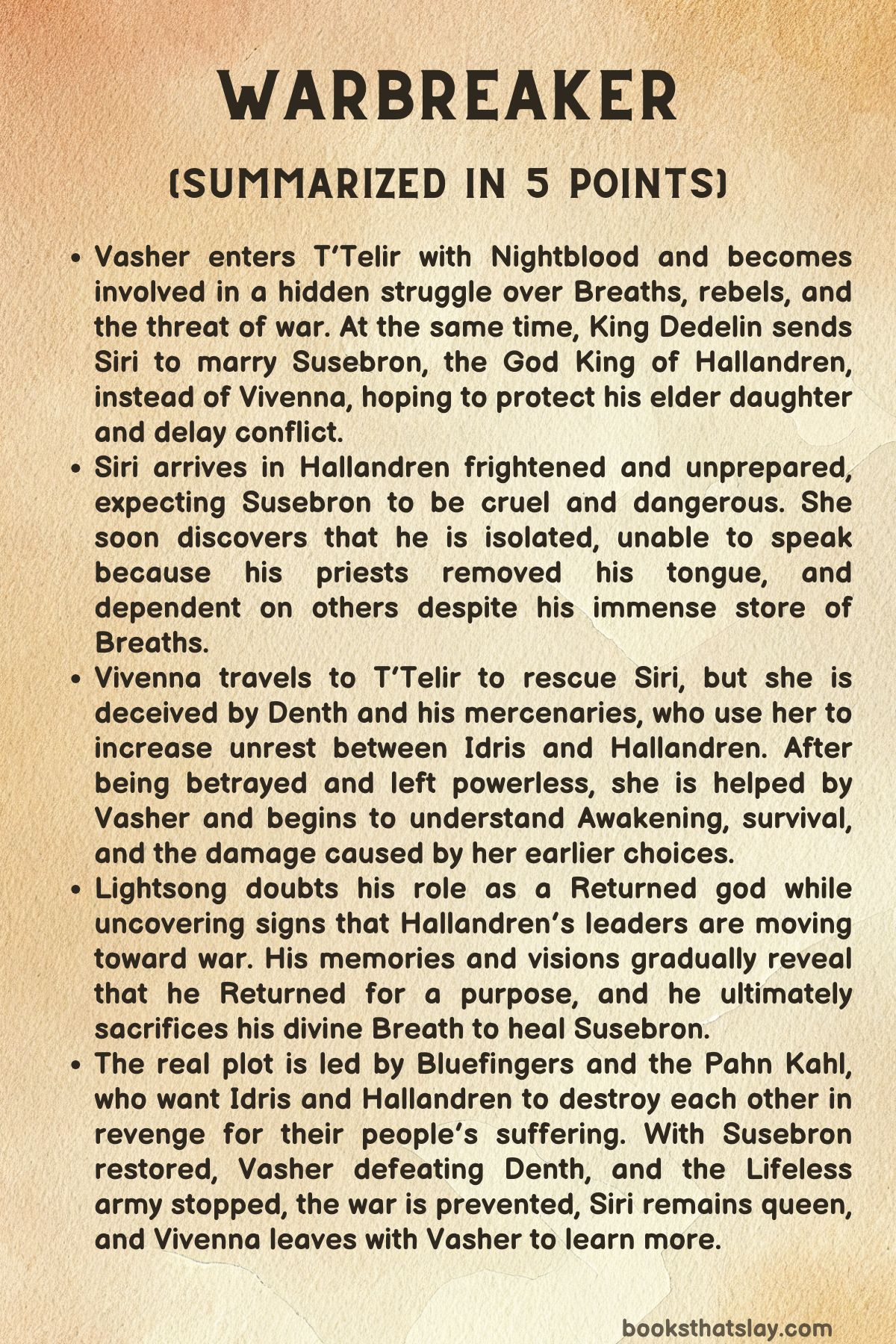
Warbreaker begins in T’Telir, the capital of Hallandren, where Vasher, a skilled and feared Awakener, allows himself to be captured. He carries Nightblood, a black, sentient sword with a terrible hunger to destroy evil.
Vasher’s imprisonment is not a mistake. He wants access to Vahr, a rebel leader who has been captured and is being held by Hallandren.
Vahr possesses a hoard of BioChromatic Breaths, the magical essence that gives people power, awareness, and the ability to Awaken objects through Commands. Vasher forces Vahr to transfer those Breaths to him in exchange for a quick death, then kills him and escapes.
Far away in Idris, King Dedelin faces the weight of an old treaty with Hallandren. The treaty requires him to send a royal daughter to marry Susebron, the God King.
His eldest daughter, Vivenna, has spent her entire life preparing for this role. She has been trained to serve as a political bride, protect Idris, and endure Hallandren’s customs.
Yet when the moment comes, Dedelin cannot bear to send her. Instead, he sends his youngest daughter, Siri, hoping the unexpected choice might delay conflict or give Idris more time.
Siri is shocked by the decision. Unlike Vivenna, she has not been trained for courtly sacrifice.
She is spirited, impulsive, and frightened when she arrives in T’Telir. Hallandren overwhelms her with its bright colors, religious ceremony, luxury, and strict expectations.
She is taken into the Court of Gods and prepared to meet Susebron. On her wedding night, she enters his bedchamber terrified, believing him to be a cruel and inhuman ruler.
She obeys the humiliating instructions given to her, waiting for him to command her. Instead, he does nothing.
He leaves her untouched, and Siri realizes that the priests and servants do not know what truly happens in the room. She burns the bedsheets to make it appear that the marriage has been consummated.
Over time, Siri discovers that Susebron is not the monster she expected. He is silent, sheltered, and strangely innocent.
The priests have removed his tongue so he cannot speak Commands or use the enormous store of Breaths passed down through generations of God Kings. Publicly, he is treated as divine and all-powerful, but privately he is controlled and isolated.
Siri begins teaching him to communicate. Their fear of each other slowly changes into trust, friendship, and then love.
Together they begin to question the priests’ authority and consider whether they can survive the political machinery surrounding them.
Vivenna, meanwhile, is consumed by guilt. She believes Siri has been sacrificed in her place and secretly travels to T’Telir with Parlin, a man from Idris who cares for her but is no longer certain he wants the future once assumed for them.
Vivenna intends to rescue Siri and prevent a war. In the city, she meets Denth and Tonk Fah, mercenaries who claim to have worked with Lemex, her father’s spy.
Lemex is dying when she finds him, and before his death he forcibly transfers his large store of Breaths to her. Vivenna, raised to see Breath and Hallandren magic as corrupt, is horrified by this sudden power.
Denth and his companions offer to help her continue Lemex’s work. Vivenna trusts them, believing they are serving Idris.
With their guidance, she tries to support Idrian communities in T’Telir and undermine Hallandren’s plans for war. She sees Siri in the Court of Gods dressed in revealing Hallandren fashion and assumes her sister is being degraded and imprisoned.
This belief hardens her resolve. Yet Vivenna does not understand the city, its politics, or the way her actions are being used.
Denth is not the loyal servant he appears to be. He and his team are manipulating Vivenna to increase unrest and push Hallandren and Idris closer to war.
They killed Lemex, murdered other Idrian agents, and use Vivenna’s royal identity as a tool. When Vasher abducts Vivenna, she sees him as an enemy, but after escaping him she returns to Denth and learns the truth.
Parlin is dead, and Denth’s group has betrayed her completely. Vivenna uses the Command phrase “Howl of the sun” to make Clod, a Lifeless soldier, attack Denth, giving her enough time to flee.
Left alone, robbed of her Breath, and hunted, Vivenna collapses into poverty. She spends weeks starving on the streets, stripped of status, certainty, and pride.
This suffering changes her. She sees how little she understood about the people she tried to lead and how dangerous her assumptions were.
Vasher eventually finds her again, rescues her from thugs, returns her Breath, and nurses her through illness. He teaches her survival, Awakening, and the hard truth that good intentions can still cause harm.
Vivenna chooses to help him stop the war her earlier actions helped feed.
At the same time, Lightsong, one of Hallandren’s Returned gods, struggles with his role. He is worshipped as divine but does not believe in his own godhood.
He avoids responsibility with jokes, luxury, and boredom, yet he is drawn into the growing crisis. Blushweaver, another Returned, pushes him toward political action, especially concerning Hallandren’s Lifeless armies.
Lightsong begins having visions of destruction and investigates strange events in the Court of Gods. His doubts deepen as he learns that Returned may come back from death for a purpose they do not remember.
Eventually, pieces of his past return to him: he once died saving his niece, and his Return was tied to sacrifice.
The deeper plot is not simply Hallandren aggression or Idrian resistance. The true conspirators are the Pahn Kahl, a people oppressed and overlooked beneath Hallandren rule.
Bluefingers, the palace steward who seemed to help Siri, is one of their leaders. The Pahn Kahl have manipulated both kingdoms, hoping to make Hallandren and Idris destroy each other in revenge for their own suffering.
Bluefingers imprisons Siri and Susebron, planning to use them in the final stage of the plot.
As war nears, Vasher and Vivenna move to stop Denth and expose the truth. The priests prepare to unleash Hallandren’s Lifeless army against Idris, while the Pahn Kahl push events toward disaster.
In the crisis, Lightsong finally understands his purpose. He gives up his divine Breath to heal Susebron, restoring the God King’s tongue.
This act allows Susebron to speak Commands and use the vast power locked inside him.
With his voice restored, Susebron Awakens on a massive scale and stops the Lifeless army before it marches on Idris. Siri is saved, and the Pahn Kahl plot collapses.
Vasher defeats Denth and reveals his true identity: he is Peacegiver, the legendary figure who ended the Manywar by giving away his treasure of Breaths. He also reveals that Kalad’s Phantoms, believed to be statues, are actually hidden Lifeless soldiers.
He gives Susebron the knowledge needed to command them.
By the end of Warbreaker, the threatened war is prevented, Siri remains beside Susebron as queen, and Hallandren’s future shifts under a God King who can finally speak and act for himself. Vivenna, changed by failure and hardship, leaves with Vasher to learn more about Awakening and the hidden history behind him.
The novel closes with its central conflicts resolved, but with wider mysteries still open: the past of Vasher, the nature of Nightblood, and the lasting consequences of power built on Breath, faith, and fear.
Characters
In Warbreaker, Brandon Sanderson builds the character drama around mistaken assumptions, political manipulation, religious power, personal guilt, and the moral dangers of power. The major characters are not only part of the plot but also represent different ways of understanding duty, faith, sacrifice, identity, and responsibility.
Siri
Siri is one of the central characters in the book, and her growth is shaped by fear, captivity, courage, and emotional intelligence. At the beginning, she is impulsive, underprepared, and not considered the proper daughter for political responsibility.
Being sent to Hallandren in Vivenna’s place makes her feel powerless, especially because she enters the Court of Gods with almost no understanding of its customs, dangers, or hidden politics. Her first nights with Susebron are especially important because they show her vulnerability and terror, but they also reveal her ability to observe, adapt, and survive.
Instead of remaining crushed by fear, Siri slowly realizes that the God King is not the monster she expected. Her courage grows through small acts of resistance, such as hiding the truth about the unconsummated marriage, questioning palace rules, and learning how to use her position to protect both herself and Susebron.
Siri’s strongest quality is her ability to see the person beneath the role. Where others see Susebron as a divine ruler, a political tool, or a terrifying symbol, Siri recognizes his loneliness, innocence, and helplessness.
Her relationship with him becomes one of the emotional centers of the story because it is built on trust rather than power. She teaches him communication, gives him companionship, and helps him understand that the priests have controlled him through lies and isolation.
Siri also changes politically. She begins as someone trapped inside a system, but she learns to negotiate with Bluefingers, challenge Treledees, and use the court’s expectations against those who would control her.
Her arc is not about becoming physically powerful; it is about becoming brave, perceptive, and capable of acting wisely in a dangerous world.
Vivenna
Vivenna is one of the most complex characters in the book because her journey forces her to confront the difference between moral certainty and true understanding. At first, she believes she is prepared for everything.
She has been trained to marry the God King, to represent Idris, and to sacrifice herself for her people. Because of this upbringing, she sees herself as disciplined, devout, and politically responsible.
However, when Siri is sent in her place, Vivenna feels guilt and resentment, and her decision to travel to T’Telir comes from both sisterly love and wounded identity. She wants to rescue Siri, but she also wants to reclaim the purpose that was taken from her.
Her time in Hallandren exposes the weaknesses in her worldview. Vivenna initially judges the city, its colors, its customs, and especially its use of Breath through the narrow lens of Idrian values.
She trusts Denth and Tonk Fah because they appear useful and friendly, yet she fails to see how thoroughly they are manipulating her. Her involvement in unrest among the Idrian slums shows that good intentions can still cause harm when they are guided by ignorance.
After Denth betrays her and she loses her Breath, pride, money, and status, Vivenna is forced into a period of suffering that strips away her illusions. Her time on the streets is painful but transformative because it teaches her humility, survival, and empathy.
When Vasher later teaches her Awakening and reveals how she has been used to provoke war, Vivenna becomes far more self-aware. By the end, she is no longer the sheltered princess who thinks virtue is the same as certainty.
She becomes a learner, someone willing to question her assumptions and follow a more difficult path toward responsibility.
Vasher
Vasher is a dangerous, mysterious, and morally burdened figure in the book. He first appears as a ruthless Awakener who gets himself imprisoned so he can reach Vahr and take his Breaths before killing him.
This makes him seem brutal and frightening, especially because he carries Nightblood, a sentient sword whose power is both terrifying and unstable. Yet Vasher’s violence is not simple villainy.
He is a man shaped by centuries of guilt, war, and knowledge that most other characters do not possess. His actions are often harsh, but they are usually directed toward preventing something worse.
Vasher’s importance comes from the contrast between what he appears to be and who he truly is. He seems like a criminal, wanderer, or assassin, but he is eventually revealed as Peacegiver, the ancient figure who ended the Manywar by giving away a vast treasure of Breaths.
This revelation reframes his entire character. Vasher is not seeking glory or worship; he is trying to contain the consequences of past violence and prevent another catastrophic war.
His relationship with Vivenna is especially important because he becomes the person who breaks her illusions but also helps rebuild her understanding. He does not comfort her with easy answers.
Instead, he teaches her survival, Awakening, and moral caution. Vasher represents power combined with regret.
He knows how dangerous BioChromatic power can be, and his grimness comes from having seen what happens when ambition, invention, and warfare combine.
Susebron
Susebron, the God King of Hallandren, is one of the most surprising characters in the story because his public image is almost completely false. He is believed to be overwhelmingly powerful, divine, and politically dominant, but in private he is isolated, innocent, and controlled.
His tongue has been removed by his priests, preventing him from speaking Commands or using his immense store of Breaths. This physical mutilation is also symbolic: Susebron has been denied his own voice, his own agency, and his own understanding of the world.
He is treated as a god, but he is also a prisoner.
His relationship with Siri reveals his gentleness and emotional vulnerability. Instead of being cruel or predatory, he is shy, curious, and deeply lonely.
Because he has been raised within a carefully controlled environment, he lacks ordinary experience, yet he is not foolish. He gradually learns to trust Siri and begins to question the priests who have shaped his entire life.
Susebron’s arc is about gaining voice in both a literal and symbolic sense. When Lightsong sacrifices his divine Breath to heal him, Susebron finally receives the ability to speak, use his power, and act as a true ruler.
His final use of Awakening is not selfish or tyrannical; it is protective. He stops the Lifeless army, saves Siri, and helps prevent war.
His transformation turns him from a hidden victim of the system into someone capable of reshaping that system.
Lightsong
Lightsong is one of the most thoughtful and emotionally layered characters in the novel. He presents himself as lazy, witty, skeptical, and unserious, often mocking the religious devotion surrounding him.
Yet beneath his humor is a deep spiritual crisis. He doubts his own divinity and avoids responsibility because he cannot understand why he was Returned or what purpose his life is supposed to serve.
This makes him different from many other gods in the Court of Gods, who are more comfortable with worship, pleasure, or political influence.
His character develops through investigation, dreams, and reluctant moral awakening. Lightsong is drawn into the political tensions around war even though he tries to remain detached.
His visions of destruction trouble him, and his conversations with Llarimar gradually reveal that his apparent irreverence hides a longing for truth. The discovery of his past gives his arc tragic beauty.
He Returned after dying heroically while saving his niece, meaning that his life as a god began with sacrifice even though he has forgotten it. His final act completes that buried purpose.
By giving up his divine Breath to heal Susebron, Lightsong accepts the responsibility he spent much of the story avoiding. His sacrifice is one of the clearest examples of true divinity in the book because it is not based on worship or power, but on selfless action.
Nightblood
Nightblood is not human, but the sword is one of the most memorable characters because it has personality, power, and moral danger. As a sentient weapon, Nightblood speaks into people’s minds and believes itself to be devoted to destroying evil.
The disturbing part is that Nightblood does not truly understand evil in a human moral sense. This makes the sword both strangely innocent and horrifyingly destructive.
It can tempt, sicken, corrupt, or destroy those who come into contact with it, and its presence changes the tone of every scene in which it appears.
Nightblood also deepens Vasher’s character. The sword shows that Vasher carries not only a weapon but also a burden from a larger and darker history.
Nightblood’s cheerful simplicity contrasts with the horror it causes, creating an unsettling mixture of comedy and menace. It represents the danger of power created without sufficient wisdom.
A command like destroying evil may sound noble, but when placed inside a weapon without moral understanding, it becomes catastrophic. In that sense, Nightblood reflects one of the story’s larger concerns: power is never safe simply because it was created for a righteous purpose.
Denth
Denth is one of the most effective antagonistic characters because he hides cruelty beneath charm. When Vivenna first meets him, he appears relaxed, funny, practical, and loyal.
He jokes about mercenary work and seems to offer exactly the kind of guidance she needs in an unfamiliar city. This friendly surface makes his betrayal far more damaging.
Denth understands how to manipulate trust, and he uses humor as a way to make danger seem harmless.
His true role is to exploit Vivenna and help push Hallandren and Idris toward war. He and his allies murder, deceive, and stage events while allowing Vivenna to believe she is acting for her people.
Denth is especially dangerous because he knows how to make evil look ordinary. He does not behave like a distant villain; he behaves like a companion.
His history with Vasher gives him additional depth, suggesting old wounds and long-standing resentment. Denth’s character shows how cynicism can become a moral disease.
He has lived long enough and done enough violence that manipulation seems natural to him, and he uses Vivenna’s idealism as a weapon against her.
Tonk Fah
Tonk Fah is disturbing because his foolish, cheerful personality hides casual brutality. He appears to be Denth’s comic partner, often joking and behaving in a simpleminded or lighthearted way.
This makes him seem less threatening at first, but the truth is much darker. Tonk Fah is fully involved in the mercenaries’ violence and deception, and his humor makes his cruelty feel even more unsettling.
His role in the book is to show how evil can wear a harmless face. Unlike characters who are openly severe or intimidating, Tonk Fah masks danger with silliness.
His participation in the deaths of Lemex’s associates, the manipulation of Vivenna, and the killing connected to Parlin reveals that he is not merely following along. He is part of the machinery of betrayal.
His character strengthens the sense that Vivenna has misread the world around her. She assumed that friendliness meant safety, but Tonk Fah proves that charm and cruelty can exist together.
Bluefingers
Bluefingers is one of the most politically significant characters because he represents hidden resentment and long-term manipulation. As the palace steward, he seems like a nervous, helpful servant who understands the inner workings of the Court of Gods.
Siri initially sees him as a possible ally because he gives her warnings and information. However, his real loyalty is to the Pahn Kahl, a people who have suffered under the larger political order.
His politeness and anxiety conceal a revolutionary plot.
Bluefingers is not a simple villain because his motives come from historical grievance and the oppression of his people. However, the methods he chooses are ruthless.
He helps manipulate Hallandren and Idris toward mutual destruction, intending to use Siri and Susebron as pieces in a broader revenge plot. His character raises an important moral question: suffering may explain anger, but it does not justify sacrificing innocent people.
Bluefingers is dangerous because he understands bureaucracy, secrets, and timing. He does not need overwhelming physical power; he uses access, information, and patience.
His betrayal is personal for Siri because she had reason to believe he might protect her, when in reality he was using her vulnerability.
Blushweaver
Blushweaver is a politically ambitious Returned goddess whose confidence, sensuality, and intelligence make her a major force within the Court of Gods. She often interacts with Lightsong through flirtation and teasing, but beneath that playful surface she is deeply concerned with power.
She understands that the God King’s marriage to an Idrian princess could destabilize Hallandren politics, and she sees war as a possibility that must be prepared for, controlled, or exploited.
Her character is important because she represents the political side of divinity in Hallandren. While Lightsong doubts himself and avoids authority, Blushweaver embraces influence.
She gathers Commands for Lifeless armies and tries to draw Lightsong into political action. She is not foolish or shallow; she is strategic, persuasive, and alert to danger.
At the same time, her willingness to maneuver around war shows the moral risk of treating military power as a political tool. Blushweaver’s presence forces Lightsong to confront the fact that avoiding decisions can also become a decision.
Through her, the book explores how charisma and intelligence can be used in the service of both protection and ambition.
Llarimar
Llarimar is Lightsong’s priest and one of the quiet emotional anchors of the story. On the surface, he appears patient, dutiful, and accustomed to Lightsong’s sarcasm.
He manages Lightsong’s responsibilities, interprets religious expectations, and tries to guide him without forcing him. His loyalty is steady rather than dramatic, and that steadiness makes him essential to Lightsong’s development.
Llarimar’s deeper importance comes from his knowledge of Lightsong’s past. He understands more than he reveals, and his conversations with Lightsong gently push him toward the truth of his Returned purpose.
Unlike many religious figures in the court, Llarimar’s faith is personal and painful. He believes in Lightsong not merely because of doctrine, but because he remembers the human act of sacrifice that led to Lightsong’s Return.
His character shows a more sincere form of devotion than the political worship surrounding the gods. He helps transform Lightsong’s doubts from empty cynicism into a search for meaning.
Treledees
Treledees is one of the priests responsible for controlling Susebron, and his character represents the rigid, fearful side of religious authority. He is devoted to maintaining the system around the God King, even when that system is built on secrecy, mutilation, and control.
To him, Susebron is both sacred and dangerous, someone who must be protected but also contained. This makes Treledees a complicated figure rather than a purely selfish one.
His conflict with Siri reveals how power operates inside the palace. Treledees is used to controlling access, information, and ritual, but Siri’s intelligence and boldness unsettle him.
When she realizes that he can read the changes in her hair because of his Breath, the balance between them shifts. He is not as untouchable as he first appears.
Treledees shows how people can justify cruelty when they believe they are preserving a holy order. He may think he is protecting Hallandren, but his obedience to tradition has helped keep Susebron voiceless and imprisoned.
Dedelin
King Dedelin is a character shaped by fear, love, and political desperation. As the ruler of Idris, he faces the old treaty requiring him to send a royal daughter to marry the God King.
His decision to send Siri instead of Vivenna comes from a deeply human place: he cannot bear to lose the daughter who has been trained for sacrifice. Yet this choice also reveals his weakness as a ruler.
By sending the unprepared daughter, he places Siri in danger and destabilizes the careful plans surrounding the treaty.
Dedelin’s character shows the painful conflict between family and kingship. He wants to protect Vivenna, but his decision burdens Siri and indirectly contributes to the confusion that follows.
He is not malicious, but his fear causes harm. His role is important because it begins the chain of mistaken assumptions that drives much of the story.
Dedelin represents a kind of protective love that becomes morally compromised when it avoids responsibility.
Parlin
Parlin is a smaller but meaningful character because he helps reveal Vivenna’s changing relationship with her own past. He travels with her to T’Telir and initially seems connected to the life she understood in Idris.
However, his conversation with her about their supposed engagement is significant because it breaks one of Vivenna’s quiet assumptions. He does not see himself as bound to her romantically in the way she may have believed, and he came to Hallandren to help Siri rather than to prove devotion to Vivenna.
His death is one of the cruel turning points in Vivenna’s arc. Finding Parlin dead makes Denth’s betrayal immediate and personal.
Parlin represents innocence caught inside larger political manipulation. He is not powerful enough to shape events, but his presence matters because he reminds Vivenna of home, loyalty, and the human cost of her misjudgments.
His death deepens her guilt and pushes her further into the painful transformation that follows.
Lemex
Lemex is King Dedelin’s chief spy in T’Telir, and his role exposes the moral compromises already present beneath Idris’s supposedly pure image. Vivenna expects him to be a loyal agent working cleanly for her father, but she discovers him dying and secretly holding hundreds of BioChromatic Breaths.
This shocks her because Breath is religiously and culturally troubling to Idris. Lemex therefore becomes an early sign that the world is more complicated than Vivenna has been taught.
His forced transfer of Breaths to Vivenna is a major turning point. It gives her power she does not want and forces her into direct contact with the very magic her beliefs reject.
Lemex’s embezzlement also complicates ideas of patriotism. He may have been serving Idris, but he did so through deception, theft, and forbidden means.
His character matters because he begins Vivenna’s disillusionment before Denth’s betrayal fully destroys her certainty.
Jewels
Jewels is a member of Denth’s group and is closely connected to Clod, the Lifeless she repairs and cares for. Her presence complicates Vivenna’s understanding of Lifeless soldiers.
Vivenna has been taught to see Lifeless as horrifying objects, but watching Jewels repair Clod creates discomfort because it suggests attachment, memory, and personhood in places Vivenna does not expect. Jewels is practical, guarded, and emotionally difficult to read, but her care for Clod gives her more depth than a simple mercenary role.
Her character also contributes to the unsettling atmosphere around Denth’s crew. Like the others, she exists in a morally compromised world of contracts, secrets, and violence.
Yet her relationship with Clod suggests grief and loyalty beneath that harshness. Jewels helps the story question easy categories.
The living are not always humane, and the Lifeless are not always emotionally meaningless to those around them.
Clod
Clod is a Lifeless soldier, but he carries unusual significance because he unsettles the boundary between person and tool. As a Lifeless, he is supposed to be a reanimated body used for obedience and combat.
However, Denth explains that some Lifeless retain skills from life, and Clod’s behavior raises questions about what remains after death. Vivenna’s growing pity for him is important because it shows her moral imagination expanding beyond what she was taught.
Clod becomes especially important during Vivenna’s escape from Denth. When she uses the security phrase to command him to attack, he becomes the means by which she survives betrayal.
His character is quiet but symbolically powerful. He represents the hidden cost of BioChromatic warfare and the discomfort of using bodies as instruments.
Through Clod, the story asks whether something can be treated as a weapon without erasing the traces of the person it once was.
Vahr
Vahr is a captured rebel leader whose brief role reveals the ruthless political and magical stakes of the story. Vasher reaches him in prison because Vahr possesses a hoard of Breaths, and their encounter shows how valuable and dangerous Breath can be.
Vahr’s exchange with Vasher is grim: he gives up his Breaths in return for a quick death. This moment immediately establishes a world where magic, mercy, murder, and politics are tightly connected.
Though Vahr does not occupy much space in the plot, he helps define Vasher’s character. Vasher’s treatment of him is brutal but purposeful, suggesting that Vasher is willing to commit morally troubling acts to prevent larger disasters.
Vahr also represents rebellion and instability in Hallandren, reminding the reader that the city’s beauty and divine pageantry exist alongside prisons, conspiracies, and violence.
Allmother
Allmother is one of the Returned gods whose importance lies mainly in the political struggle over Lifeless Commands. She possesses authority connected to Hallandren’s military power, and this makes her a figure others must influence or pressure.
Lightsong’s attempts to obtain her Commands show how the gods’ personal choices are tied to the possibility of war.
Allmother’s role also helps reveal the fragmented nature of power in the Court of Gods. No single god controls everything, so political actors like Blushweaver and Lightsong must gather support, persuade others, or maneuver around them.
Allmother may not be as emotionally central as Siri, Vivenna, or Lightsong, but she is important because she shows how divine status in Hallandren is inseparable from military responsibility. Her existence reminds the reader that the Returned are not merely worshipped figures; they are also guardians of weapons and political decisions that can affect entire nations.
Themes
Power and the Moral Burden of Command
Power in Warbreaker is never shown as simple strength; it is a responsibility that exposes character. Breath, armies, divine status, royal authority, and political influence all give people the ability to control others, but the story repeatedly questions whether anyone can use such power without causing harm.
Vasher carries immense knowledge and destructive ability, yet his past teaches him that power used carelessly can shape wars and ruin nations. Susebron possesses overwhelming strength but has been denied speech, education, and freedom, turning him into a symbol controlled by others.
Vivenna begins with royal confidence and political purpose, but once she gains Breath and influence in T’Telir, her actions unintentionally increase unrest because she does not fully understand the forces around her. The theme becomes clear through contrast: power without understanding becomes dangerous, while power joined with humility can protect.
The final prevention of war depends not only on great magical ability, but on people choosing restraint, truth, and sacrifice over domination.
Identity, Assumption, and Self-Discovery
Characters repeatedly suffer because they accept false ideas about themselves and others. Siri is sent to Hallandren as the unprepared daughter, supposedly less useful than Vivenna, yet she adapts with courage, emotional intelligence, and political instinct.
Her growth comes from rejecting the role others assigned her and building a relationship with Susebron based on trust rather than fear. Vivenna’s identity is even more severely challenged.
She believes herself disciplined, moral, and ready to save Idris, but T’Telir strips away her certainty. Her training, prejudices, and royal pride leave her vulnerable to manipulation.
Only after betrayal, poverty, and guilt does she begin to see herself honestly. Lightsong’s struggle is different: he is worshipped as divine but doubts that identity, using humor to hide discomfort.
His forgotten past finally proves that his worth does not depend on public worship, but on the kind of person he chooses to be. Across the story, identity is not fixed by title, birth, religion, or reputation; it is tested by action.
Manipulation, Misinformation, and Political Fear
The conflict between Idris and Hallandren grows because people act on partial truths, inherited fear, and deliberate lies. Siri enters Hallandren believing the God King is a monster, while Hallandren leaders view Idris through suspicion and political convenience.
Vivenna’s mission is shaped by patriotic duty, but her lack of real information allows Denth to guide her into actions that serve a hidden agenda. The Pahn Kahl conspiracy shows how resentment, secrecy, and revenge can exploit existing tensions between nations.
They do not need to create every fear from nothing; they only need to push people toward believing the worst about one another. Priests, mercenaries, rebels, and nobles all use controlled information to influence events, making truth one of the most powerful forces in the story.
The near-war is not caused by a single misunderstanding, but by layers of silence, propaganda, and assumption. Peace becomes possible only when hidden motives are exposed and characters begin acting from knowledge rather than panic.
Sacrifice, Redemption, and Choosing to Repair Harm
Sacrifice in the story is not limited to dramatic death; it also includes giving up pride, certainty, comfort, and control. Lightsong’s final act is the clearest example, as he gives his divine Breath to heal Susebron and fulfill the purpose he spent so long doubting.
His sacrifice transforms doubt into meaning, proving that faith in one’s purpose may come only at the moment of action. Vasher’s life is shaped by older guilt, especially his role in past violence and his decision as Peacegiver to surrender power in order to end destruction.
His redemption is not clean or public; it is practical, difficult, and burdened by memory. Vivenna also seeks a quieter form of repair.
After realizing that her choices helped worsen political unrest, she does not defend her pride. Instead, she learns, listens, and accepts responsibility.
The theme suggests that harm cannot always be undone, but people can still choose to prevent further damage. Redemption begins when characters stop protecting their image and start repairing what they can.