Why Men Love Bitches Summary and Analysis
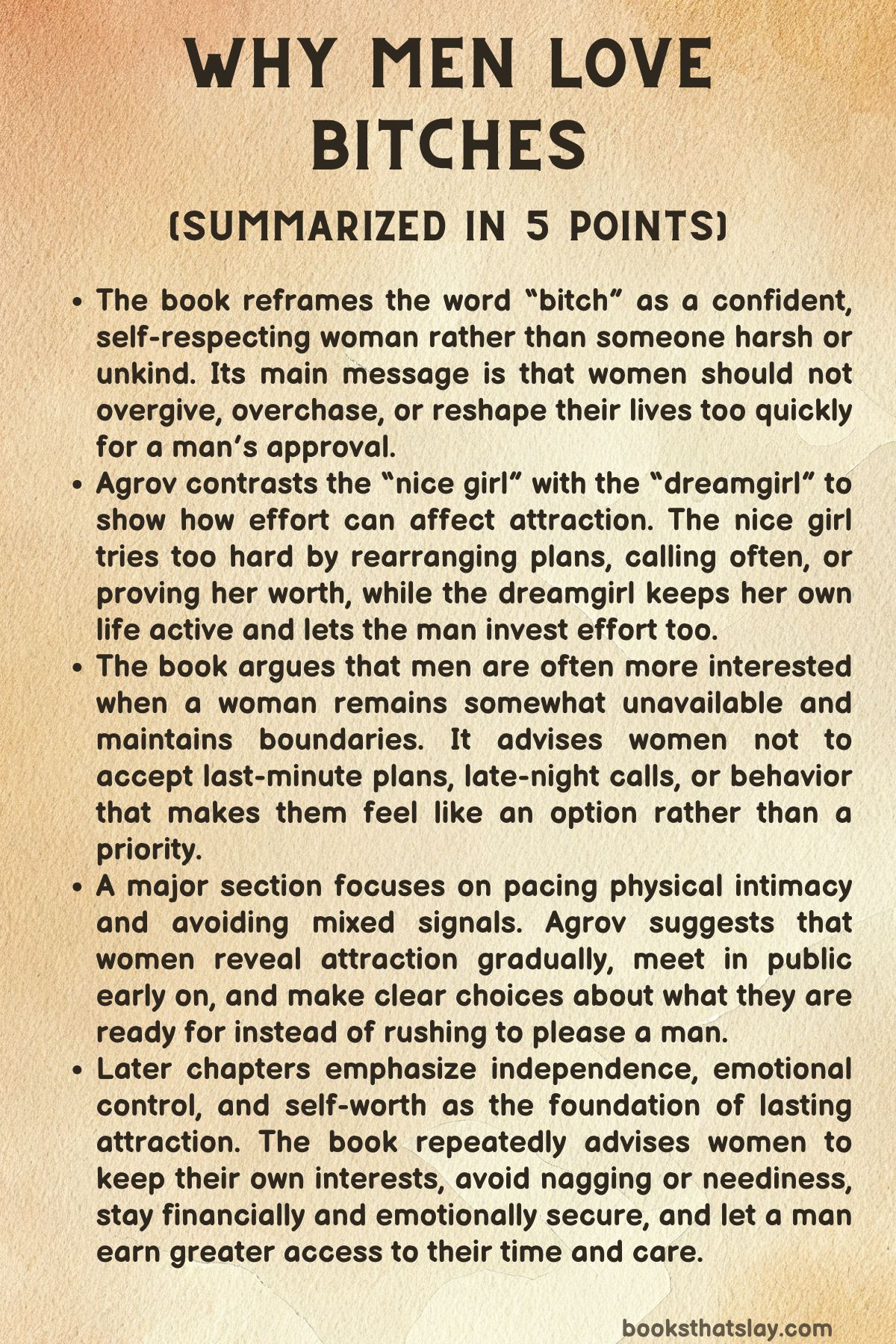
Why Men Love Bitches by Sherry Argov is a self-help dating book aimed at women who lose themselves by trying too hard to be liked. The book reframes the word “bitch” to mean a woman with confidence, boundaries, independence, and self-respect.
Its main argument is not that women should become cold or unkind, but that they should stop acting desperate, overgiving, or endlessly available. Argov encourages women to keep their own lives, let men invest effort, and protect their dignity. The book presents attraction as closely tied to confidence, emotional control, and the ability to set limits.
Summary
Why Men Love Bitches begins with a direct message to women who often become “too nice” in relationships. The book argues that many women lose power in dating not because they are loving, but because they give too much before trust, effort, and commitment have been earned.
Sherry Argov redefines the word “bitch” in a positive way. In her usage, it does not mean a cruel, rude, or aggressive woman.
It means a woman who is kind but not weak, feminine but not dependent, interested but not desperate, and loving without surrendering her self-respect.
The central idea is that men are more attracted to women who remain a mental challenge. A woman who is always available, always agreeable, and always trying to prove her value may seem easy to take for granted.
A woman who has her own plans, opinions, friendships, interests, and limits is harder to control, and the book argues that this creates more respect and attraction. Argov repeatedly contrasts the woman who chases with the woman who lets a man show effort first.
The book introduces the “nice girl” as someone who overcompensates in the early stages of dating. She may cook elaborate meals too soon, cancel plans for a man, drive across town late at night, call repeatedly, or change her appearance and opinions to match what he wants.
She often believes that if she gives more, he will value her more. Argov argues that the opposite usually happens.
When a woman gives too much too quickly, she can seem as if she does not value her own time or attention.
Against this image, the book presents the “dreamgirl.” She is not perfect, but she is secure. She does not abandon her own life for a man.
She does not rush to prove she is worthy. She lets interest grow naturally and expects effort from him as well.
She is warm, playful, and feminine, but she is also selective. She knows that her time, care, and affection have value.
This balance is what the book identifies as attractive: softness without submission, interest without neediness, and generosity without self-erasure.
A major point in the book is that men enjoy pursuit. Argov compares dating to competition, sports, and games of chance, suggesting that people often value what requires effort.
When everything is handed over immediately, excitement may fade. When a woman has standards and does not hand over complete access to her life, a man has more reason to invest.
The book does not frame this as manipulation so much as self-protection. A woman should not pretend to be busy or uninterested, but she should genuinely have a full life that does not stop because a man appears.
The book gives several examples of how a woman can maintain this balance. If a man calls at the last minute, she should not automatically cancel her plans.
If he calls late at night expecting her to come over, she should not treat herself like a backup option. If he tests whether she will tolerate disrespect, lateness, or weak effort, her response should come through action rather than a long speech.
Argov suggests that men learn how to treat a woman from what she accepts. Boundaries, therefore, are not just words; they are habits.
Another important idea is the warning against becoming too motherly. The book describes a pattern in which a woman begins acting less like a romantic partner and more like a caretaker.
She may check up on him, organize his life, plan all his free time, ask constant questions about where he has been, or smother him with concern. Argov argues that this can reduce attraction because it makes the relationship feel controlling or parental.
Instead, she recommends giving a man space and allowing him to come forward on his own.
The book also encourages women to have opinions and preferences. A woman who agrees with everything a man says may think she is being easygoing, but the book argues that too much agreement can make her seem less interesting.
Having preferences does not mean being argumentative. It means being a full person.
A woman can say what she likes, what she dislikes, where she wants to go, and what does not work for her. The point is to avoid shaping herself entirely around a man’s comfort.
The discussion of sex focuses on pacing. Argov advises women not to become physically intimate too quickly if they want emotional investment to develop first.
She argues that gradual closeness allows a man to appreciate a woman beyond physical attraction. The book suggests meeting in public, avoiding late-night private situations too early, and being clear about the difference between attraction and readiness.
It also warns against sending mixed signals, such as escalating physical contact heavily and then suddenly stopping without clarity. The goal is not to shame sexuality, but to encourage women to move at a pace that supports their emotional well-being and self-respect.
The book then introduces the idea of the “dumb fox.” This is a woman who appears relaxed and agreeable while still protecting her interests. She does not lecture, nag, or criticize in public.
Instead, she uses appreciation, humor, timing, and distance. For example, she may praise a man when he helps, let him feel useful, and avoid turning every disappointment into a dramatic confrontation.
Argov suggests that men often respond better to admiration and quiet consequences than to repeated complaints.
Neediness is one of the book’s biggest concerns. Argov argues that neediness shows up when a woman becomes too focused on a man’s attention.
She waits for calls, worries about every delay, changes her schedule constantly, and treats the relationship as the center of her identity. The book advises women to stay busy with real interests, friendships, work, and goals.
This is not only a dating strategy; it is also a way to remain emotionally steady. A woman with her own life is less likely to panic over small changes in a man’s behavior.
The book also talks about communication. It suggests that men may not respond well to long emotional explanations, repeated demands, or constant analysis of the relationship.
Instead, Argov recommends simple statements and consistent behavior. If something is unacceptable, the woman should not argue endlessly.
She should calmly show through her choices that she will not reward poor treatment. This approach is presented as more powerful than trying to convince a man to respect her.
Financial and emotional independence are also central themes. The book tells women not to become dependent on a man for identity, money, approval, or direction.
A woman who can support herself and make her own decisions is less likely to tolerate bad behavior out of fear. Independence gives her the freedom to choose love rather than cling to it.
In the later sections, the book returns to the idea of maintaining attraction over time. Argov argues that women should not stop being individuals once they enter a relationship.
They should continue seeing friends, pursuing interests, caring about their appearance for themselves, and keeping personal goals alive. The relationship should add to their lives, not replace their lives.
Overall, Why Men Love Bitches presents a dating philosophy built around self-respect. Its message is that a woman should be loving, but not self-sacrificing; available, but not on demand; affectionate, but not desperate; and committed, but not at the cost of her dignity.
The book’s advice is direct: keep your life, set limits, do not chase, do not overgive, and let a man earn deeper access to your time, loyalty, and care.
Key Figures and Metaphorical Characters
The “Too Nice” Woman
The “too nice” woman is the central figure around whom Why Men Love Bitches builds its relationship advice. She is not presented as a bad person, but as someone whose kindness becomes excessive because it is mixed with fear, insecurity, and a desire to be chosen.
She gives too much too soon, changes her plans too easily, and tries to prove her worth through constant availability. Her emotional weakness is not that she loves deeply, but that she begins to treat love as something she must earn by overperforming.
In the book, she represents women who lose their own rhythm, preferences, and dignity in the hope that a man will appreciate their sacrifice. Her problem is that she confuses selflessness with self-abandonment.
The book uses her to show how a woman can unintentionally make herself less respected when she gives away her time, energy, affection, and attention before the man has shown equal investment.
The “Nice Girl”
The “nice girl” is a more specific version of the too nice woman. She is eager, accommodating, and often anxious to make a man comfortable.
She may cook elaborate meals too early, rearrange her schedule, drive across town late at night, call too often, or pretend to enjoy things just because he enjoys them. Her behavior comes from the belief that if she is sweet enough, useful enough, and agreeable enough, she will become unforgettable.
However, the book presents her as someone who accidentally removes the mystery and challenge from the relationship. She makes herself too available, which allows the man to feel that he does not have to make much effort.
The nice girl’s tragedy is that her goodness is real, but it is offered without enough self-protection. She wants affection, but her fear of losing it makes her give more than she receives.
The “Dreamgirl”
The “dreamgirl” is the woman who keeps her sense of self while dating. She is not cold, cruel, or manipulative; rather, she is calm, independent, and selective.
She does not rush to prove herself because she already believes she has value. In the book, she represents the woman who lets a man come toward her instead of chasing him.
She keeps her plans, maintains her friendships, protects her schedule, and allows attraction to develop gradually. Her power lies in balance.
She can be warm without being desperate, interested without being clingy, and feminine without becoming submissive. The dreamgirl is attractive because she has a life outside the relationship, which makes her attention feel meaningful rather than automatic.
She teaches that confidence is often shown not through loud declarations, but through quiet boundaries.
The “New and Improved Bitch”
The “new and improved bitch” is the book’s redefined ideal woman. Despite the provocative label, she is not meant to be rude, harsh, or heartless.
She is kind, but not easily used; affectionate, but not needy; feminine, but not dependent. She knows how to enjoy a man’s attention without making him the center of her identity.
Her independence is emotional as well as practical. She has passions, opinions, humor, standards, and a private life that does not disappear when romance begins.
This character is important because she challenges the idea that women must choose between being loving and being self-respecting. In the book, she is powerful because she does not beg to be valued.
She assumes her own worth, and that assumption changes how others treat her.
Crystal
Crystal is one of the clearest example characters in the book because she demonstrates boundary-setting through action rather than complaint. When Brett calls her after midnight expecting her to drive to him, Crystal does not respond like someone desperate for his approval.
Instead, she turns the situation around and makes him experience the inconvenience he expected her to accept. Her role in the story is to show that a woman can refuse disrespect without giving a long emotional speech.
Crystal’s strength is her quick intelligence and her refusal to be treated as a backup plan. She understands that accepting a late-night demand would teach Brett that her time has little value.
By responding playfully but firmly, she protects her dignity and shows that access to her is not automatic.
Brett
Brett represents the kind of man who tests a woman’s availability and boundaries. His late-night call to Crystal suggests that he assumes she may be willing to inconvenience herself for him.
He is not necessarily portrayed as deeply evil, but he is careless and opportunistic in the way he approaches her. His function in the book is to reveal how some men may behave when they sense that a woman is too eager or too available.
Brett becomes a test case for the book’s larger argument: when a woman accepts low-effort treatment, she may receive more of it, but when she sets limits, the man is forced to reassess her value. Through Brett, the story shows that a man’s behavior is often shaped by what a woman allows.
The “Dumb Fox”
The “dumb fox” is one of the most strategic figures in Why Men Love Bitches. She is not actually unintelligent; the phrase describes a woman who appears agreeable while quietly protecting her own interests.
She understands male pride and uses appreciation instead of nagging to influence situations. She may let a man feel useful, masculine, admired, or protective, but she does not surrender control of her own life.
Her intelligence is subtle rather than confrontational. In the book, she shows that power does not always need to appear aggressive.
She can guide outcomes by choosing her timing, tone, and reactions carefully. The dumb fox is important because she represents emotional strategy: she knows that direct criticism may create resistance, while praise and distance can often produce better results.
The Motherly Woman
The motherly woman is the character who turns romance into caretaking. She checks up on the man, asks where he is, plans his free time, reminds him of responsibilities, and tries to manage his emotional or practical life.
Her intentions may be loving, but the book presents her behavior as dangerous to attraction because it changes the romantic dynamic into something parental. Instead of being seen as a desirable partner, she risks being seen as a caretaker or authority figure.
Her flaw is over-involvement. She believes that giving more care will create closeness, but the book argues that too much care can make a man feel trapped, monitored, or less masculine.
This character shows how affection can become smothering when it removes space, mystery, and independence.
The Needy Woman
The needy woman is driven by anxiety. She waits for calls, worries about silence, changes her behavior to avoid rejection, and becomes overly focused on the man’s responses.
Her emotional world depends too heavily on whether he is giving her attention. In the book, she is used to show how neediness weakens attraction because it makes the woman appear to have no center of her own.
She may be loving and sincere, but her sincerity becomes overwhelming when it is attached to fear. Her deepest problem is that she seeks reassurance before the relationship has earned that level of emotional dependence.
The needy woman is not criticized for wanting love; she is criticized for abandoning her stability in order to get it.
The Independent Woman
The independent woman represents the healthier alternative to neediness. She has her own money, interests, plans, standards, and emotional balance.
She does not depend on a man to define her worth or rescue her from boredom. In the book, her independence is not presented as hostility toward men, but as the foundation of mutual respect.
She can enjoy romance because she is not using it as her only source of identity. This makes her harder to control and easier to admire.
Her strength is that she does not collapse when a man pulls away, nor does she chase when he becomes uncertain. She allows a relationship to add to her life rather than replace it.
The Man Who Enjoys the Chase
The man who enjoys the chase is less of an individual character and more of a recurring male type in the book. He is attracted to pursuit, challenge, competition, and gradual reward.
The book compares his romantic interest to hunting, gambling, and sports because he becomes more invested when he has to make effort. He loses excitement when everything is given too quickly, but becomes more engaged when the woman remains somewhat unpredictable and self-contained.
This character is important because he explains the book’s repeated advice about pacing, boundaries, and mystery. He is not shown as someone who should be manipulated, but as someone whose interest grows when he feels he is choosing, pursuing, and earning a woman’s attention.
The Controlling or Testing Man
The controlling or testing man is the figure who probes a woman’s limits. He may call at inconvenient times, make last-minute plans, arrive late, ask for too much too soon, or see whether she will rearrange her life around him.
His role in the book is to expose whether a woman values herself enough to say no. He often does not need to make dramatic demands; small tests are enough to reveal the balance of power.
If the woman accepts everything, he learns that she can be taken for granted. If she responds with calm limits, he learns that her time and attention have conditions.
This character helps the book argue that respect is built through behavior, not pleading.
The Woman Who Paces Intimacy
The woman who paces intimacy is thoughtful, self-controlled, and aware of how physical closeness affects emotional investment. She does not treat sex as a bargaining tool, but she also does not rush into it before trust and appreciation have developed.
In the book, she understands that revealing everything too quickly can reduce anticipation and make the relationship feel less emotionally grounded. She is affectionate, but careful.
She avoids late-night private situations too early, chooses public settings when needed, and makes the difference between interest and readiness clear. Her strength lies in self-command.
She does not deny her sexuality, but she reveals it gradually so that the man learns to value her whole presence, not only her physical availability.
The Woman with Opinions
The woman with opinions is important because she refuses to disappear into a man’s preferences. She does not agree with everything simply to seem easygoing.
She has likes, dislikes, choices, and standards, and she expresses them without apology. In the book, this character shows that individuality is attractive because it creates depth and resistance.
A woman who agrees with everything may seem pleasant at first, but she can also become predictable and unchallenging. The woman with opinions keeps the relationship alive because she brings her own mind into it.
She is not difficult for the sake of being difficult; she simply remains a full person. Her presence reminds the reader that being loved should not require becoming blank.
The Financially Independent Woman
The financially independent woman represents practical self-respect. She does not rely on a man as her only source of security, and because of that, she is less likely to tolerate poor treatment out of fear.
Her independence gives her choices. In the book, money is connected to emotional power because a woman who can support herself is harder to pressure, control, or manipulate.
This character does not reject generosity or romance, but she does not confuse financial dependence with love. Her strength is freedom.
She can stay because she wants to, not because she has no other option. This makes her more confident and less likely to sacrifice her dignity for stability.
The Self-Respecting Woman
The self-respecting woman is the final ideal toward which the book points. She may contain elements of the dreamgirl, the new and improved bitch, the dumb fox, and the independent woman, but her defining trait is dignity.
She knows when to give, when to wait, when to walk away, and when to let a man prove himself. She does not chase affection at the cost of self-worth.
Her love is not weak, but it is measured. In the story, she represents the woman who understands that attraction is strongest when it is joined with respect.
She does not need to dominate a man, but she also refuses to be dominated by her fear of losing him. Her character closes the book’s larger message: a woman becomes more attractive when she remains loyal to herself.
Themes
Self-Respect as the Basis of Attraction
Why Men Love Bitches presents self-respect as the foundation of romantic attraction because the woman who values herself does not treat a relationship as proof of her worth. She does not overextend herself, cancel her life, or rush to impress a man before he has earned that level of care.
This theme is shown through the contrast between a woman who tries too hard and a woman who remains calm, selective, and secure. The book suggests that excessive niceness can become a form of self-abandonment when a woman ignores her own comfort, time, and standards just to keep a man interested.
Self-respect is not shown as coldness or cruelty, but as quiet confidence. A self-respecting woman can be affectionate and kind, but she does not make herself constantly available or allow herself to be treated as an option.
The deeper message is that attraction grows when a woman’s actions show that she already considers herself valuable.
Independence and Personal Identity
Independence is treated as one of the strongest qualities a woman can bring into a relationship because it prevents her from becoming emotionally dependent on a man’s attention. The book argues that a woman becomes more appealing when she keeps her own plans, interests, friendships, routines, and ambitions instead of shaping her entire life around someone else.
This independence creates balance: the man is not made the center of her world, and she does not lose herself in the effort to be loved. The text presents availability as something that should increase gradually, not be handed over immediately.
When a woman continues living her life, she sends the message that her time has value. This does not mean she is uninterested; rather, she is not desperate.
Her identity remains whole whether the relationship progresses or not. The theme shows that lasting attraction depends not only on romance, but also on the ability to remain a complete person outside the relationship.
Boundaries and Emotional Control
Boundaries are shown as a practical way of teaching others how to treat you. The book repeatedly suggests that a woman should set limits through her behavior rather than through long explanations, complaints, or emotional pleading.
For example, she should not accept late-night calls, last-minute plans, or situations where she feels like a backup choice. These boundaries protect her dignity and also prevent the man from assuming he has unlimited access to her time and affection.
Emotional control is closely connected to this idea. A woman who waits anxiously, chases, checks up constantly, or demands reassurance gives away too much power.
The book advises her to remain composed, continue with her plans, and avoid reacting from fear. This theme is not about playing games, but about refusing to reward careless behavior.
By staying calm and consistent, she shows that attention from a man is welcome, but not necessary for her stability.
The Power of Challenge and Gradual Investment
The theme of challenge appears through the idea that attraction grows when a man has to invest effort, patience, and attention. The book argues that when everything is offered too quickly, the excitement fades because there is no sense of earning closeness.
This applies not only to sex, but also to time, emotional care, favors, and personal sacrifices. The text advises women to reveal themselves gradually so that interest has room to develop.
A woman who does not chase, does not overgive, and does not rush intimacy creates space for the man to participate actively. The book presents this as a shift from proving worth to allowing worth to be recognized.
Gradual investment also protects the woman because it gives her time to observe whether the man is respectful, consistent, and serious. The larger message is that attraction is strengthened when access to a woman’s energy, body, and care is paced with self-control.