The Physick Book of Deliverance Dane Summary, Characters and Themes
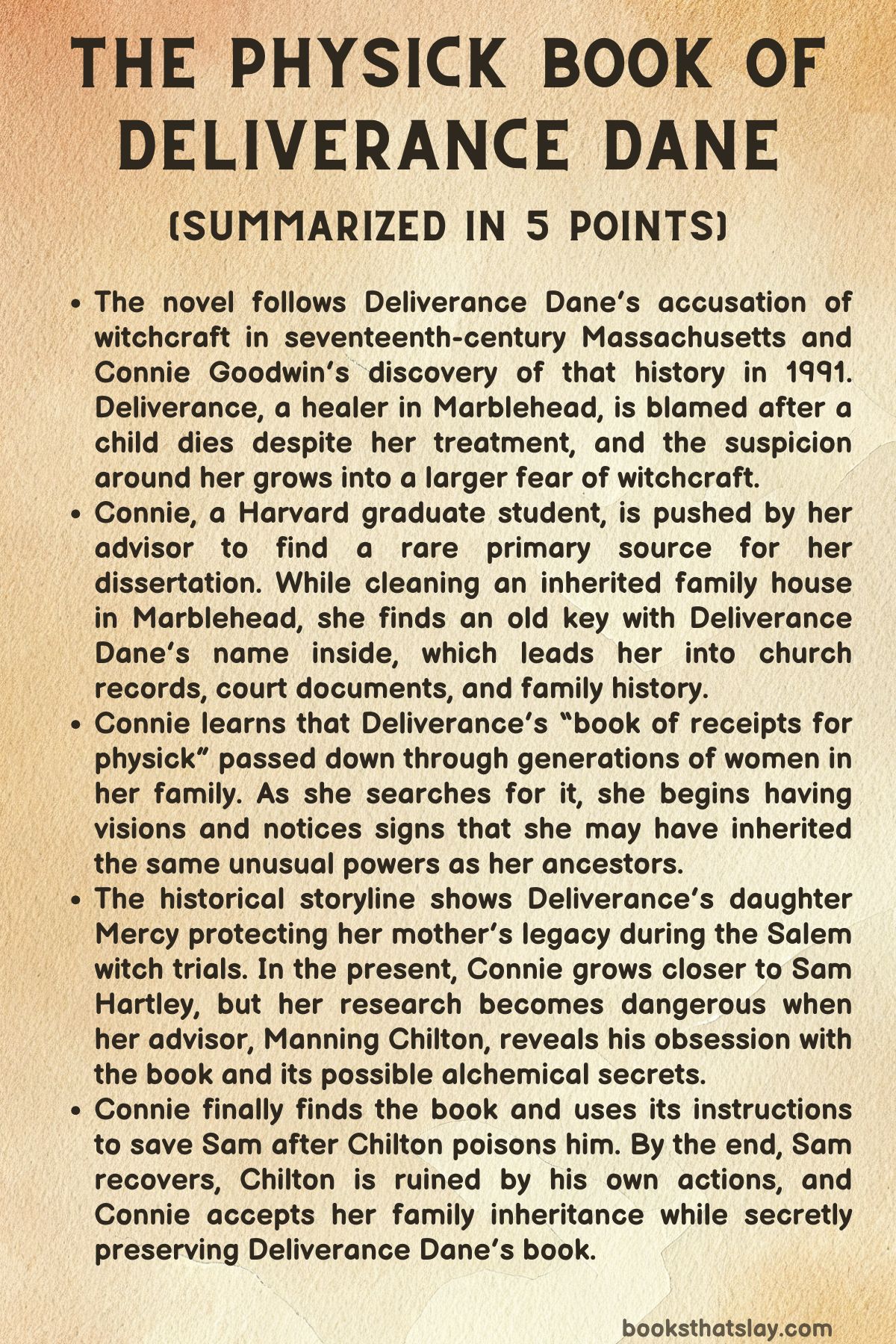
The Physick Book of Deliverance Dane by Katherine Howe is a historical mystery about memory, inheritance, scholarship, and the long reach of the Salem witch trials. The novel moves between colonial New England and 1990s Massachusetts, following Harvard graduate student Connie Goodwin as she uncovers a hidden family connection to an accused healer named Deliverance Dane.
What begins as academic research becomes personal when Connie finds traces of old knowledge, buried manuscripts, and powers she cannot easily explain. The book blends archival investigation, family secrets, folk healing, and danger, showing how women’s knowledge can be preserved, misunderstood, feared, and reclaimed.
Summary
The Physick Book of Deliverance Dane begins in seventeenth-century Marblehead, Massachusetts, where Deliverance Dane is known as a woman with knowledge of healing. She is called to the home of Peter Petford, whose young daughter Martha is gravely ill.
Deliverance tries to help the child using the remedies and methods available to her, but Martha dies after suffering terrible fits. Peter, overcome by grief and fear, turns against Deliverance and accuses her of witchcraft.
Deliverance later sues him for slander in Salem, hoping to protect her reputation. During the case, witnesses describe her herbs, bottles, charms, and unusual healing practices.
Peter insists she harmed his daughter. Though the legal matter does not immediately destroy Deliverance, it leaves suspicion around her and shows how easily a healer’s work can be recast as evil.
Centuries later, in 1991, Connie Goodwin is a graduate student at Harvard studying colonial American history. She has just passed her doctoral qualifying exam, a major step in her academic career.
Her advisor, Manning Chilton, is pleased with her performance but pushes her to aim higher. He tells her that a successful dissertation needs a rare, original primary source, something no scholar has properly examined before.
Connie feels the pressure of academic expectation and the need to prove herself.
Soon after, Connie’s mother, Grace, asks her to spend the summer in Marblehead cleaning out an old family house. The property belonged to Connie’s grandmother, Sophia, and has been sitting neglected for years.
Unpaid taxes have put the house at risk, so Connie must prepare it for sale. Connie is not thrilled by the task, but she agrees.
With her friend Liz, she visits the house on Milk Street and finds it nearly swallowed by vines and weeds. Inside, the home feels suspended in time.
Old furniture, bottles, herbs, books, and household objects remain in place, as though generations of women simply stepped away.
While sorting through the house, Connie discovers an old Bible. Hidden inside it is an antique key, and inside the key is a small slip of paper bearing the name Deliverance Dane.
The discovery sparks Connie’s curiosity. Since she is trained as a historian, she begins to research the name through archives, church records, court files, and probate documents.
At the Salem church archives, she meets Sam Hartley, a preservation worker restoring the building. Sam helps her look through old materials, and their connection grows as they spend time together.
Connie learns that Deliverance Dane was more than a passing name in local records. Deliverance had a daughter named Mercy, and after Deliverance’s death, Mercy inherited a “book of receipts for physick.” At first, this sounds like a medical or household remedy book, the kind many women kept in early New England.
But as Connie follows the line of ownership, she begins to suspect that the book may contain something far more unusual. It appears to have passed through generations of women in her own family: from Mercy to Prudence, then Patience, Temperance, Sophia, Grace, and eventually Connie herself.
As Connie’s research deepens, she starts having intense visions of the past. These experiences are not ordinary memories or scholarly imagination.
She seems to see moments from the lives of the women she is studying, especially Deliverance and Mercy. At the same time, she notices strange effects around her.
Her touch appears to influence plants and people. The old house seems to respond to her presence.
Connie, who has built her life around evidence and rational explanation, struggles to accept what is happening.
Grace, Connie’s mother, hints that the women in their family have always carried a special gift. Connie resists this idea because it clashes with her academic training and her sense of herself.
She wants to understand Deliverance through documents, not through inherited magic. Yet the more she searches, the harder it becomes to separate history from family truth.
The past is no longer distant. It begins to press directly into Connie’s life.
The novel also returns to the colonial period to show what happened to Deliverance’s family. Mercy grows up under the burden of her mother’s reputation.
She understands that Deliverance’s knowledge is dangerous in a society ruled by fear, suspicion, and strict religious authority. During the Salem witch trials, that fear reaches its height.
Deliverance is imprisoned and eventually executed as an accused witch. Mercy survives, but she must protect what remains of her mother’s legacy.
She hides the book and passes it forward, ensuring that the knowledge does not disappear.
Meanwhile, Connie’s advisor, Chilton, becomes increasingly interested in her discovery. His academic encouragement begins to feel less like mentorship and more like obsession.
He believes Deliverance’s book may contain a missing alchemical process connected to the philosopher’s stone, the legendary substance said to grant transformation and power. Chilton is not simply interested in history.
He wants the book for his own purposes.
The danger becomes immediate when Sam suffers a sudden seizure while working on scaffolding. He falls, breaks his leg, and then grows dangerously ill.
His symptoms include vomiting, convulsions, and a worsening condition that doctors cannot easily explain. Connie fears that something unnatural is involved.
Using old methods she finds in her grandmother’s house, she tries to determine what is happening to him. The signs suggest that Sam will die unless she acts, and that the answer lies in Deliverance’s missing book.
Connie finally tracks the manuscript to a neglected collection at Radcliffe, where it has been miscatalogued as an old cookbook. The discovery confirms much of what she has suspected.
The book is a record of remedies, rituals, and hidden knowledge passed down by women in her family. It is both a historical source and a living inheritance.
Connie now understands why Chilton wants it and why the book has been hidden for so long.
Desperate to save Sam, Connie follows instructions from the manuscript and prepares a witch-bottle ritual in the Milk Street house. She hopes to draw the illness out of him.
Instead, the ritual exposes Chilton’s role. He arrives, revealing that he poisoned Sam with alchemical substances to force Connie to locate the book.
Sam’s suffering was a calculated act. Chilton used Connie’s love and fear to push her toward the manuscript.
Chilton demands that Connie hand over the book, convinced it will complete his work. Connie faces him with the knowledge she has inherited but only recently accepted.
Using the bottle, herbs, mandrake, and spoken charms, she completes a reversal that turns the poisoning back upon Chilton. Sam begins to recover, while Chilton is left severely damaged, suffering seizures and neurological harm from the effects of his own actions.
By October, Connie has successfully presented her research. Chilton has been replaced by Janine Silva, and Connie’s academic future is no longer under his control.
Sam is healing, and Grace returns to the Marblehead house, reconnecting with the family home Connie had once viewed only as a burden. Connie also comes to terms with her inheritance.
She no longer sees Deliverance Dane as merely a research subject. Deliverance is part of her family’s story, and the knowledge passed down through the women before her now belongs to her as well.
Connie tells Liz and Sam that she did not fully destroy Deliverance’s book. A copy still survives, hidden within Radcliffe’s records.
The ending suggests that history is never completely buried and that women’s knowledge, even when attacked or dismissed, can find ways to endure. The final image of Arlo, Connie’s unusual little dog, near an old Marblehead grave marked with a fading initial D, leaves a quiet sense that Deliverance’s presence still lingers.
Characters
Connie Goodwin
Connie Goodwin is the central modern character in The Physick Book of Deliverance Dane, and her journey is shaped by the conflict between academic logic and inherited mystery. At the beginning of the story, she is a disciplined Harvard graduate student who believes in evidence, archives, and historical method.
Her world is built around research, proof, and intellectual achievement, which makes her the perfect character to uncover a hidden past while also resisting its supernatural meaning. Connie’s discovery of Deliverance Dane’s name begins as a scholarly investigation, but it slowly becomes a personal awakening.
She is not simply studying history from a distance; she is being pulled into a family legacy that belongs to her own bloodline.
Connie’s character develops through her growing acceptance of what she once dismissed as impossible. Her visions, her strange effect on plants and people, and her connection to the old Marblehead house force her to recognize that the past is not dead or separate from her.
She begins the story as someone who wants to find an original source for her dissertation, but she ends it as someone who understands that knowledge can be emotional, inherited, dangerous, and sacred. Her relationship with Deliverance’s book shows this transformation clearly.
At first, the book is an academic treasure; later, it becomes a living inheritance, a source of power, responsibility, and identity.
Connie is also important because she stands between different worlds. She belongs to Harvard’s rational, competitive academic culture, but she also belongs to a line of women associated with healing, intuition, and hidden knowledge.
Her struggle is not just to solve a mystery but to decide what kind of person she will become. By choosing to save Sam, confront Chilton, and protect the surviving knowledge of Deliverance’s book, Connie becomes more than a researcher.
She becomes a guardian of her family’s history. Her final decision to preserve the book’s existence rather than destroy it shows that she has accepted both scholarship and magic as parts of her identity.
Deliverance Dane
Deliverance Dane is one of the most powerful and tragic figures in the book. She is a healer whose knowledge of herbs, charms, bottles, and old medical practices makes her valuable to her community but also dangerously vulnerable to suspicion.
Her treatment of Martha Petford shows the unstable position of women healers in the seventeenth century. When healing succeeds, it may be accepted; when it fails, it can be twisted into evidence of evil.
Deliverance is not shown as a simple victim or a simple witch figure. She is complex because her knowledge appears both practical and mysterious, rooted in healing but surrounded by fear.
Deliverance’s character represents the danger faced by women who possessed knowledge outside male-controlled institutions. Her skill gives her authority, but that authority threatens others.
Peter Petford’s accusation after Martha’s death shows how quickly grief, fear, and ignorance can turn against a woman like Deliverance. Her decision to sue him for slander also reveals her strength.
She does not passively accept disgrace. She tries to defend her name through the legal system, even though the same society that depends on her healing is already prepared to condemn her.
Deliverance’s execution during the Salem witch trials makes her a symbol of historical injustice, but her importance does not end with her death. Through her book, her knowledge survives.
She becomes a presence that shapes generations of women after her, especially Mercy and Connie. In The Physick Book of Deliverance Dane, Deliverance is not only a historical ancestor but also the source of the story’s central inheritance.
Her character shows how women’s knowledge can be erased publicly while surviving privately through memory, objects, and family lines.
Mercy Dane
Mercy Dane, Deliverance’s daughter, is a deeply significant character because she becomes the bridge between her mother’s life and the generations that follow. As a child, Mercy inherits not only Deliverance’s love but also the burden of her reputation.
Living under suspicion because of her mother’s identity, she represents the way accusations of witchcraft did not end with the accused person. They damaged families, futures, and entire bloodlines.
Mercy’s life is shaped by fear, secrecy, and survival.
Mercy’s greatest importance lies in her preservation of her mother’s book. She understands that the book is dangerous, but she also understands that it is precious.
Her decision to hide and pass it down shows courage and loyalty. She does not allow the violence done to Deliverance to erase her mother’s knowledge.
In this sense, Mercy becomes a protector of memory. She preserves what official history tries to destroy.
Mercy also shows how trauma can become inheritance. She carries the pain of her mother’s persecution, but she also carries her mother’s power.
Her role in the story is quiet but essential. Without Mercy, Deliverance’s book would likely disappear, and Connie would never be able to uncover the truth.
Mercy’s strength is not dramatic in the same way as Connie’s confrontation with Chilton, but it is just as important. She survives, remembers, and passes on.
Grace Goodwin
Grace Goodwin, Connie’s mother, is a free-spirited and unconventional character whose attitude contrasts sharply with Connie’s academic seriousness. Grace understands the family gift more naturally than Connie does, but she does not explain everything directly.
Her behavior may seem vague or evasive, yet it reflects a different way of knowing. Grace is connected to intuition, inheritance, and the emotional side of the family’s history.
She does not need the same kind of proof that Connie needs.
Grace’s request that Connie clean out the Marblehead house is one of the most important actions in the story because it sends Connie toward her discovery. On the surface, Grace is asking for practical help with an inherited property.
Beneath that, she is guiding Connie toward a hidden legacy. Whether fully intentional or partly intuitive, Grace’s role is that of an initiator.
She opens the door to the past without forcing Connie to walk through it.
Grace also represents the tension between mothers and daughters. Connie does not fully understand her mother at first, and Grace does not communicate in the structured, rational way Connie prefers.
However, as Connie learns more about the family line, she begins to see Grace differently. Grace is not careless or strange simply for the sake of being strange.
She is part of a tradition that Connie has not yet learned to understand. By the end, Grace’s move back into the Marblehead house suggests restoration, not only of a building but also of family continuity.
Manning Chilton
Manning Chilton is the main antagonist of the modern storyline. At first, he appears to be a demanding but ordinary academic advisor who wants Connie to produce original research.
His pressure on her seems professional, even if intense. However, as the story develops, it becomes clear that his interest in Connie’s work is not purely scholarly.
His obsession with Deliverance’s book and the philosopher’s stone reveals ambition, greed, and moral corruption.
Chilton is dangerous because he hides exploitation behind intellectual authority. He uses his position at Harvard to pressure Connie, making his manipulation appear like academic mentorship.
His search for alchemical knowledge turns scholarship into possession. He does not value the book as history, inheritance, or healing; he values it as a tool for his own desire.
This makes him a sharp contrast to Connie, who gradually learns to respect the book’s human and familial meaning.
His poisoning of Sam reveals the full extent of his cruelty. Chilton is willing to harm an innocent person in order to force Connie into finding what he wants.
This act transforms him from a merely unethical scholar into a violent predator. His final punishment, when the reversal charm turns the effects back on him, is fitting because he becomes a victim of the very hidden forces he tried to control.
Chilton’s character shows the danger of knowledge without humility, ambition without conscience, and scholarship without respect for the lives behind the documents.
Sam Hartley
Sam Hartley is Connie’s romantic interest, but his role is more meaningful than simply being the person she loves. As a preservation worker restoring the Salem church, Sam is also connected to the past, though in a different way from Connie.
While Connie studies documents and archives, Sam works physically with old buildings and historical spaces. His profession makes him a fitting companion for Connie because both of them are involved in uncovering and preserving history.
Sam’s kindness, steadiness, and openness balance Connie’s intensity. He helps her search records and becomes emotionally connected to her investigation, but he does not try to control her work.
This makes him very different from Chilton. Where Chilton uses Connie’s research for selfish purposes, Sam supports her curiosity and growth.
His relationship with Connie gives the story emotional warmth and raises the stakes of the conflict.
When Sam is poisoned and begins suffering seizures, vomiting, and worsening illness, he becomes the person Connie must save. His suffering forces Connie to move beyond research into action.
She can no longer treat Deliverance’s book as an object of study alone; she must use its knowledge. Sam’s illness therefore becomes a turning point in Connie’s acceptance of her power.
His recovery at the end also allows Connie’s personal and magical awakening to be connected with healing rather than destruction.
Peter Petford
Peter Petford is a crucial character because his accusation against Deliverance helps set the tragedy in motion. His grief over Martha’s death turns into blame, and that blame becomes an accusation of witchcraft.
Peter represents how fear and sorrow can be redirected toward a vulnerable target. He may see himself as a wronged father seeking justice, but his actions contribute to the larger pattern of suspicion that destroys women like Deliverance.
Peter’s character is important because he shows how accusations often grow out of emotional desperation rather than truth. Martha’s death is painful, and his need to explain it leads him to believe that Deliverance murdered her.
In a society already fearful of mysterious illness, women’s healing practices, and spiritual danger, his accusation becomes powerful. His words do not remain private grief; they become public danger.
Peter also represents the fragility of reputation in a superstitious community. Once he names Deliverance as a witch, ordinary objects and healing methods can be reinterpreted as sinister.
Bottles, charms, herbs, and remedies become evidence against her. Through Peter, the story shows how quickly a healer can become a suspect when a community is ready to believe the worst.
Martha Petford
Martha Petford is not present for long, but her death has major consequences. She is the suffering child whose illness brings Deliverance into Peter Petford’s home.
Her fits and death create the emotional crisis that leads to Deliverance’s accusation. Martha is therefore a catalyst character.
She does not control the events around her, but what happens to her changes the lives of others.
Martha’s character also represents the vulnerability of children in the historical world of the story. Illness is frightening, poorly understood, and often explained through religious or supernatural thinking.
Because Martha dies despite Deliverance’s treatment, her body becomes the center of competing interpretations. To a healer, she is a patient who could not be saved.
To her grieving father, she becomes evidence of murder. To the community, her death becomes part of a larger fear of witchcraft.
Her importance lies in the way her tragedy exposes the dangers of fear-based judgment. Martha is innocent, but her death is used to condemn another innocent person.
Through her, the book shows how private suffering can become public hysteria when people search for someone to blame.
Liz
Liz is Connie’s friend and a grounding presence in the modern storyline. She helps Connie discover the Marblehead house and provides companionship as Connie begins exploring the strange inheritance left behind by her grandmother.
Liz’s role is important because she connects Connie to ordinary friendship and contemporary life while Connie becomes increasingly absorbed in the past.
Liz also functions as a contrast to Connie’s secrecy and intensity. While Connie becomes drawn deeper into archives, visions, magic, and danger, Liz remains more socially and emotionally direct.
Her presence reminds the reader that Connie is not only a scholar or descendant of accused witches; she is also a young woman with friendships, worries, and personal attachments. This makes Connie feel more human and less isolated.
By the end, Connie’s admission to Liz and Sam that she did not truly destroy Deliverance’s book shows that Liz has become part of Connie’s trusted circle. Liz may not carry the same family inheritance, but she is close enough to witness Connie’s transformation.
Her character adds warmth and balance to a story filled with secrecy, suspicion, and inherited danger.
Sophia
Sophia, Connie’s grandmother, is important even though she is largely connected to the story through memory, inheritance, and the Marblehead house. Her old home preserves the physical traces of the family’s past: herbs, bottles, books, furniture, and mysterious remnants of earlier lives.
Through Sophia, the house becomes more than property. It becomes a container of memory.
Sophia’s role is tied closely to the passing down of women’s knowledge. As one of the descendants who inherited the book and the family gift, she belongs to the chain connecting Deliverance to Connie.
Her life shows that the inheritance did not disappear after the witch trials. It continued quietly, hidden in domestic spaces and family habits.
The objects in her house suggest that she understood more than Connie initially realizes.
Sophia also represents the silence that often surrounds family history. Connie does not receive a clear explanation from her grandmother; instead, she must interpret what Sophia left behind.
This makes Sophia a mysterious but powerful presence. Her house guides Connie toward discovery, and her preserved belongings become clues in the larger story of female knowledge, secrecy, and survival.
Prudence
Prudence is one of the women in the line of descendants through whom Deliverance’s book passes. Her individual life is not explored as deeply as Connie’s or Mercy’s, but her place in the family chain is still meaningful.
She represents continuity across generations. Through Prudence, the book survives beyond the immediate trauma of Deliverance’s execution and Mercy’s fear.
Prudence’s importance lies in the idea that inheritance depends on preservation. Each woman in the line must receive, protect, and pass on knowledge that could be dangerous if exposed.
Prudence therefore stands for the quiet endurance of female memory. Even when history does not record every detail of her life, her role in carrying the book forward matters.
Her character also helps show that the story is not only about one woman accused of witchcraft or one modern student uncovering the truth. It is about a long chain of women whose lives are connected by knowledge, secrecy, and responsibility.
Prudence is part of that hidden structure.
Patience
Patience is another descendant in the family line, and her name itself suggests endurance, waiting, and survival. Like Prudence, she may not dominate the action, but her role is essential to the book’s generational design.
The passing of Deliverance’s book through Patience shows that this inheritance had to survive not just one moment of danger but many years of changing circumstances.
Patience represents the quiet labor of keeping forbidden or misunderstood knowledge alive. She is part of a tradition that exists outside public recognition.
The family’s knowledge is not preserved through official institutions at first; it survives through women who understand its value and protect it within the private world of family.
Her presence in the lineage also deepens the story’s focus on women’s history. Many women’s lives are only partially visible in records, but that does not mean they were unimportant.
Patience matters because she helps carry forward what the official world might ignore, fear, or destroy.
Temperance
Temperance belongs to the later chain of women who inherit the book and the family legacy. Her role, like that of Prudence and Patience, emphasizes continuity rather than dramatic individual action.
She helps show that Deliverance’s knowledge moves through time carefully and privately, surviving because each generation preserves it.
Temperance’s name suggests restraint, balance, and control, qualities that fit the hidden nature of the family inheritance. The women who carry the book cannot use or reveal it carelessly.
They must balance knowledge with caution. Through Temperance, the story reinforces the idea that power is not only about dramatic spells or visible magic.
Sometimes power lies in restraint and secrecy.
Her character also adds to the sense that Connie’s discovery is not accidental. Connie is the result of many generations of preservation.
Temperance is one of the women who make Connie’s awakening possible. Even with limited direct detail, her role is structurally important because she strengthens the chain between past and present.
Janine Silva
Janine Silva becomes important near the end of the story when she replaces Chilton. Her role is brief but meaningful because she represents a healthier academic future for Connie.
After Chilton’s manipulation and obsession, Janine’s presence suggests that scholarship can continue without corruption. She stands as a contrast to Chilton’s exploitative authority.
Janine’s replacement of Chilton also helps restore balance in Connie’s academic life. Connie’s research survives, but it is no longer controlled by a man who wants to use it for dangerous personal ambition.
This matters because Connie’s work deserves to exist as history, not as a tool for Chilton’s alchemical obsession.
Her character shows that institutions are not entirely evil, even though they can be corrupted by individuals. Harvard and academic research are not rejected at the end of the story.
Instead, Connie’s relationship to scholarship is reshaped. Janine’s presence helps make that possible.
Arlo
Arlo, Connie’s strange little dog, is a small but memorable character whose presence adds mystery and atmosphere to the story. He is not simply a pet in the ordinary sense.
His unusual behavior and final appearance near the old grave marked with a fading initial D suggest that he is connected to the deeper supernatural currents of the story.
Arlo often seems to sense things that humans do not fully understand. This makes him part of the book’s pattern of intuition and hidden knowledge.
Animals in stories involving magic often serve as watchers, guides, or signs, and Arlo fits that role. He quietly reinforces the idea that the world around Connie contains meanings beyond rational explanation.
His final appearance near the grave creates a haunting closing image. It links the modern world back to Deliverance and leaves the story with a sense of mystery rather than complete closure.
Arlo’s role may be small, but he helps preserve the atmosphere of enchantment, memory, and unresolved connection between the living and the dead.
Themes
Inherited Knowledge and Female Lineage
The Physick Book of Deliverance Dane presents inheritance as something far deeper than property, bloodline, or family history. Connie’s discovery of the old house, the key, the hidden name, and the receipt book gradually shows that knowledge can survive through women even when public history tries to erase them.
Deliverance’s healing practices are treated with suspicion by outsiders, yet within the family they become a form of protection, memory, and identity. Mercy’s role is especially important because she preserves what her mother leaves behind, not only as a physical book but as proof that women’s knowledge has value even when society calls it dangerous.
Connie begins as a scholar trained to trust archives, documents, and academic proof, but she slowly learns that her own family has carried a different kind of record across generations. The theme shows how women preserve truth through private spaces, domestic objects, stories, and guarded traditions when official history refuses to protect them.
The Fear of Women’s Power
Suspicion gathers around women who understand healing, herbs, bodies, and unseen forces because their knowledge threatens the limits set by the society around them. Deliverance is feared not simply because people believe she can harm others, but because she possesses skills that men in authority cannot fully explain or control.
Peter Petford’s accusation turns grief into blame, and the community’s discomfort with female independence becomes a public charge of witchcraft. This fear continues into Connie’s world in a different form.
Her academic training values evidence, yet even modern institutions are shaped by male control, ambition, and dismissal of knowledge that does not fit accepted systems. Chilton’s obsession shows another version of the same fear and desire: he wants the power connected to Deliverance’s book, but he does not respect the women who protected it.
The theme reveals how female knowledge is often attacked, stolen, or renamed when it challenges social authority.
History, Memory, and Hidden Truth
The past is not treated as something dead or distant; it remains active, waiting to be read correctly. Connie’s research begins as an academic search for an original source, but it becomes a confrontation with the gaps and failures of recorded history.
Court documents, probate records, and church archives give her fragments, yet they do not fully capture Deliverance’s life, Mercy’s fear, or the emotional cost of persecution. The hidden book matters because it contains a truth that official records cannot explain: the women accused of witchcraft were not merely names in legal files but people with knowledge, families, and motives for survival.
Connie’s visions add another layer to this theme by showing that memory can exist outside formal documents. The story suggests that history is shaped by whoever has the power to record it, but buried truths can return through objects, places, and descendants who are willing to question the accepted version.
Ambition and the Corruption of Knowledge
Knowledge becomes dangerous when it is pursued without humility, care, or moral responsibility. Connie seeks the receipt book because she wants to understand the past, complete meaningful research, and eventually save Sam.
Chilton, however, seeks it because he wants control, recognition, and access to alchemical power. His role exposes the darker side of scholarship: the desire to possess rare knowledge can become exploitative when the researcher values discovery more than human life.
He pressures Connie academically, manipulates her search, and harms Sam in order to force progress. This makes him a contrast to the women who preserved the book across generations.
For them, knowledge is connected to healing, protection, and responsibility; for Chilton, it is a tool for personal gain. The theme shows that learning itself is not automatically noble.
Its value depends on the purpose behind it and the ethical limits a person is willing, or unwilling, to respect.