Clear and Present Danger Summary, Characters and Themes
Clear and Present Danger is a political and military thriller about America’s covert war against Colombian drug cartels and the moral damage caused when power operates without accountability. Tom Clancy builds the story around secret operations, intelligence failures, military action, and political self-protection.
The book follows Jack Ryan in the 5th book of the titular series, John Clark, Domingo Chavez, and several government figures as an anti-drug campaign turns into an illegal war. It is a story about patriotism tested by secrecy, soldiers abandoned by leaders, and the dangerous belief that national goals can justify any method.
Summary
Clear and Present Danger begins with a secret American operation called SHOWBOAT, created as part of the President’s campaign promise to act aggressively in the war on drugs. The President and his adviser James Cutter discuss the operation in guarded terms, with Cutter assuring him that the plan is under control.
At the same time, events in the Caribbean begin exposing the brutality of the drug trade. Two men, Ramón Capati and Jesús Castillo, board a yacht called the Empire Builder in disguise.
The yacht later becomes the scene of a terrible crime involving murder, sexual assault, and drug cargo. Meanwhile, Sergeant Domingo Chavez is finishing what he believes will be his last field mission before moving into a teaching role in the Army.
The Coast Guard cutter Panache, commanded by Captain Red Wegener, searches for the missing Empire Builder. Wegener has spent his career saving people at sea, but he has grown bitter because many of his missions now involve drug smugglers and cartel violence.
When the Panache finds the yacht, the crew discovers drugs and signs of a massacre. Wegener quickly concludes that the two men aboard are responsible.
Furious at the violence done to the American family, he decides that ordinary procedure may not be enough. He stages a harsh interrogation using an old Coast Guard legal authority, creating the appearance of a shipboard trial and execution.
One prisoner is made to believe the other has been hanged, forcing him to cooperate. Although the prisoners survive and are later turned over to federal agents, Wegener’s actions create legal and political consequences that echo through the rest of the story.
In another part of the operation, CIA operative John Clark enters Colombia under cover and works with Carlos Larson, an undercover pilot who has spent months studying cartel movements. Clark learns that the Colombian drug leaders are guarded, informed, and difficult to reach through ordinary law enforcement or military methods.
Robert Ritter, the CIA’s Deputy Director of Operations, is deeply involved in planning the American response. Cutter, who has immense influence over the President, gives the operation political backing while trying to keep a protective distance from its details.
Jack Ryan, temporarily serving in a senior intelligence role at the CIA while Admiral James Greer fights cancer, senses that he is being excluded from something important. He distrusts Cutter and worries that intelligence work is being bent toward political ends.
Domingo Chavez is recruited away from his expected teaching assignment by a man using the name Colonel Smith. Chavez soon discovers that the recruits are all Latino soldiers, selected for a classified mission.
They are taken to the Rocky Mountains for training under Colonel Brown. At first, Chavez assumes they may be preparing to train foreign forces, but the weapons and tactics suggest a far more direct operation.
The soldiers are eventually told that they will enter Colombia in small teams to observe cartel airfields and drug-processing sites. Their intelligence will guide a connected air operation called EAGLE EYE, in which American pilots intercept and destroy drug aircraft.
Chavez and the others accept the mission because many of them have seen the harm of drugs in their own communities and families.
The operation begins to produce results. Chavez’s team, known as KNIFE, observes cartel aircraft, reports their movements, and helps American pilots intercept drug flights.
The pilots, including Paul Johns, Buck Zimmer, and Bronco Winters, become part of a secret campaign that captures or destroys cartel transport planes. In Washington, the FBI investigates the Empire Builder case and discovers that the yacht’s owner was not simply an innocent victim but a major money launderer connected to the cartel.
FBI Director Emil Jacobs prepares to seize hundreds of millions of dollars in cartel assets from American and European banks. This legal attack on cartel money threatens to damage the drug organization more effectively than any battlefield strike.
Felix Cortez, a former Cuban intelligence officer working with the cartel, becomes one of the most dangerous figures in the story. In Washington, he begins an affair with Moira Wolfe, secretary to the FBI Director, while using the name Juan Diaz.
Through Moira, he learns that Jacobs is planning a trip to Colombia. Cortez passes information to Ernesto Escobedo, a powerful cartel leader who is frustrated by his lack of respectability despite his wealth.
After the United States announces the asset seizures, the cartel strikes back. Jacobs, the DEA Director, the American Ambassador, and others are killed in a bombing in Bogotá.
The President, enraged and politically pressured, demands revenge. Ritter and Cutter respond by expanding the secret war through a new operation called RECIPROCITY.
The American response becomes more violent. Chavez and his team are ordered to attack cartel facilities, kill guards, destroy airfields, and sabotage production sites.
The soldiers carry out their orders, but Chavez begins to question the purpose and limits of the mission. He is a disciplined soldier, yet the close-range killing affects him deeply.
At the same time, Clark helps arrange precision bombing attacks against cartel leaders. A stealth bomb dropped from the aircraft carrier Ranger kills several cartel figures, but it also kills innocent civilians, including members of a cartel leader’s family.
This causes fear in Washington. The President worries about the political damage if American responsibility is exposed.
Cutter leaks a false explanation suggesting the bombing was caused by cartel infighting.
As more people begin to suspect the truth, the secret operation becomes harder to hide. Jack Ryan sees signs that the United States is involved in illegal action in Colombia.
Robert Jackson, a Navy officer connected to the Ranger, also realizes that the ship may have been used without proper Navy authority. His brother Tim Jackson notices that Chavez’s disappearance does not match the official story.
Inside the FBI, Daniel Murray and Acting Director Bill Shaw investigate leaks and corruption. They discover that Moira Wolfe unintentionally gave Cortez the information that led to Jacobs’s death.
Horrified by her role, Moira tries to end her life, but she survives and helps identify Cortez.
Cortez sees opportunity in the chaos. He realizes that the Americans are killing cartel leaders and decides he can use the situation to rise in power.
He manipulates Escobedo into suspecting rivals while also preparing his own army of cartel fighters to hunt the American teams in Colombia. The SHOWBOAT soldiers come under increasing danger.
One battalion is ambushed, and several men are killed. Clark discovers the bodies of American soldiers being moved by cartel fighters, kills the Colombians involved, and returns with the dead.
He tells Ritter that the operation must be stopped and the soldiers removed.
The President eventually orders Cutter to shut the operation down, but Cutter chooses betrayal. He meets secretly with Cortez, who has proof of American involvement in the bombings.
Cortez offers to reduce drug shipments to the United States by half if the Americans help him become the leading cartel figure. Cutter accepts, sacrificing the American soldiers still in Colombia.
He gives Cortez their locations and cuts off their communications, leaving them exposed to cartel forces. Chavez, Ramirez, and the remaining troops realize something is wrong when their extraction does not arrive and their radios go silent.
Jack Ryan discovers classified files on SHOWBOAT, EAGLE EYE, and RECIPROCITY by breaking into Ritter’s safe. He copies them and brings the information to Daniel Murray and Bill Shaw.
At the same time, John Clark, grieving the death of James Greer and furious over the abandoned soldiers, turns to Ryan for help. Ryan steps outside normal channels and helps organize an unofficial rescue.
Robert Jackson arranges transport, and the rescue effort eventually brings Ryan, Clark, Larson, Wegener, and the pilots into a desperate attempt to recover the remaining American troops.
In Colombia, Chavez and the surviving soldiers fight for their lives. Ramirez’s group is attacked by large numbers of cartel fighters.
Chavez and another soldier help set an ambush, killing many attackers, but reinforcements keep coming. The battle becomes devastating, and most of the Americans are killed, including Ramirez.
Chavez leads a small group of survivors away through the mountains. Clark makes contact with surviving SHOWBOAT teams and helps organize helicopter extractions.
Ryan joins the rescue, operating a machine gun during the mission. Paul Johns and Buck Zimmer fly into danger to extract the men.
Zimmer is mortally wounded, and Ryan promises to help his children through college.
Clark and Chavez also capture Cortez and Escobedo during the rescue operation. Because bringing Escobedo into the United States would create too many complications, Clark returns him to Colombia and leaves him with cartel leaders who are likely to kill him.
Cortez is kept as proof against Cutter. The rescuers land on the Panache when a hurricane prevents them from reaching their original destination.
The surviving soldiers are saved, but the price has been severe.
In the end, Clark confronts Cutter in his office and presents a taped statement from Cortez proving Cutter’s conspiracy. Clark pressures him to avoid a public scandal that would damage national trust and national security.
Cutter soon dies by walking into traffic. Ryan then confronts the President at the White House in front of two members of Congress.
The President denies knowledge of the operations, but Ryan knows he is lying. The Congressmen decide to keep the scandal hidden to protect the country from the shock of the truth.
The President deliberately loses the election, allowing the matter to remain buried. Clark recruits Chavez into the CIA, while Cortez is returned to Cuban intelligence.
The story ends with justice only partly served, leaving behind troubling questions about power, secrecy, loyalty, and the moral cost of undeclared war.
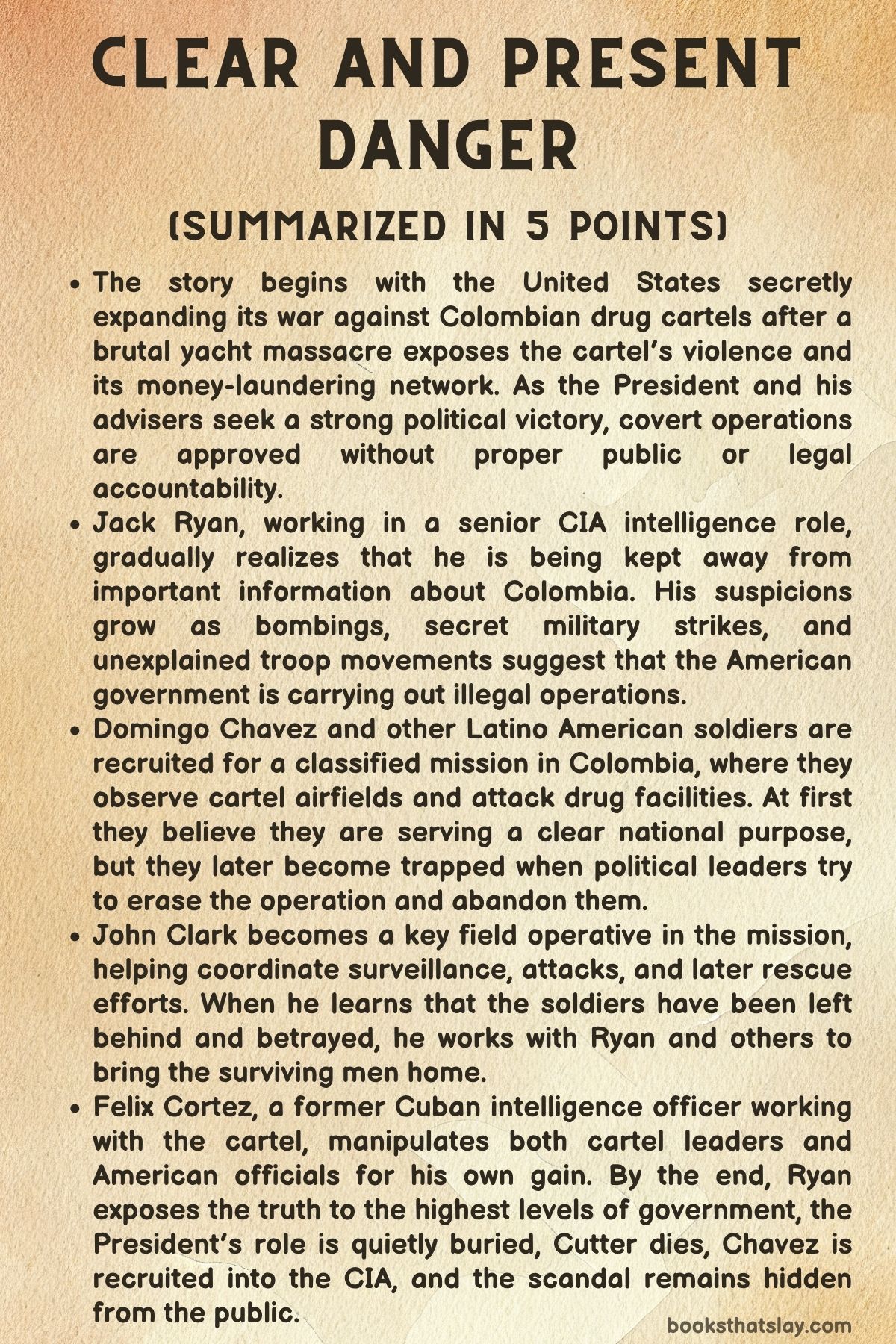
Characters
Jack Ryan
Jack Ryan is the moral center of the book, even though he spends much of the story outside the secret operation itself. His intelligence, caution, and loyalty to lawful process make him a contrast to men like Cutter and Ritter, who treat secrecy as permission to act without restraint.
Ryan is not naïve; he understands that intelligence work often requires silence, deception, and hard choices. What separates him from others is his refusal to let national security become an excuse for illegality.
In Clear and Present Danger, Ryan’s growth comes through his movement from suspicion to action. At first, he senses that something is wrong but lacks proof.
Once he uncovers the files and realizes that American soldiers have been abandoned, he accepts personal risk to expose the truth and help rescue them. His loyalty to James Greer also shapes him.
Greer’s advice to do what is right becomes Ryan’s guiding principle. By the end, Ryan understands that telling the whole truth may harm the country, but he still forces accountability inside the highest levels of power.
John Clark
John Clark is one of the most capable and morally complicated figures in the story. He is a professional operator who can move through dangerous spaces with calm efficiency, whether in Colombia, Panama, or Washington.
His past contains violence and secrecy, but the book does not present him as a simple instrument of force. He is practical, disciplined, and often ruthless, yet he has a strong code about responsibility toward the men placed in danger.
His work in Clear and Present Danger begins as part of the covert machinery, but he becomes increasingly disturbed by the way political leaders use soldiers and then try to erase them. Clark’s defining quality is loyalty to those who serve under dangerous orders.
When Cutter and others choose self-protection, Clark chooses rescue. His bond with Ryan grows from shared grief over Greer and shared anger at betrayal.
He is not innocent, but he is honorable in a harsh way, guided by action rather than speeches.
Domingo Chavez
Domingo Chavez, often called Ding, is the soldier through whom the human cost of the covert war becomes most visible. He begins as a disciplined Army sergeant with a difficult background, having escaped gang life through military service.
His identity matters because he is chosen partly for cultural and linguistic reasons, yet he is never reduced to those traits. Chavez is intelligent, observant, physically resilient, and naturally suited for leadership.
During the mission in Colombia, he proves calm under pressure and earns the respect of both his comrades and superiors. The book also shows his emotional burden.
Killing at close range, watching comrades die, and realizing that his unit may have been abandoned force him to face the darker side of obedience. Chavez follows orders, but he is not unthinking.
His survival depends on discipline, courage, and loyalty to the men beside him. By the end, his recruitment into the CIA suggests that his abilities are recognized, though the story also makes clear that such service will demand further moral endurance.
James Cutter
James Cutter is one of the book’s clearest examples of political ambition turning into moral collapse. As the President’s powerful adviser, he stands close enough to authority to shape policy while maintaining enough distance to protect himself when things go wrong.
Cutter wants results, especially results that serve the President’s political image, but he lacks the courage to accept responsibility for the means used to obtain them. His greatest failure is not simply approving dangerous operations; it is his willingness to sacrifice American soldiers when the operation threatens his career and reputation.
His secret bargain with Felix Cortez shows the depth of his corruption. He agrees to keep American troops exposed so Cortez can gain power in the cartel, all while pretending to shut the operation down.
Cutter is not a battlefield villain but a bureaucratic one, and that makes him especially dangerous. He commits betrayal through memos, meetings, denials, and silence.
His death closes his personal arc, but it does not erase the damage he caused.
Robert Ritter
Robert Ritter is a hardened intelligence official who understands covert action as a world of limited choices and unpleasant necessities. He is far more competent than Cutter and far less shallow, but his moral weakness lies in his willingness to operate in gray zones for too long.
Ritter believes in the mission and accepts the logic of covert warfare, including deception and collateral damage. He often sees the world in terms of operations, outcomes, and containment.
This makes him effective, but it also makes him dangerous when oversight is weak. Unlike Cutter, Ritter is not driven mainly by political self-interest.
He is driven by a belief that the intelligence services must do what others cannot publicly admit. Still, the book shows that this belief can become a trap.
When the operation begins to fail morally and practically, Ritter hesitates before doing the right thing. His eventual support for the rescue suggests that he has limits, but his earlier choices helped create the disaster.
The President
The President represents the danger of leadership guided by image, anger, and deniability. He wants to appear strong in the war on drugs, and his desire for a visible victory makes him receptive to secret operations that promise results without public accountability.
He is not shown as a mastermind who controls every detail, but that does not absolve him. His position gives him responsibility for the atmosphere in which Cutter and Ritter act.
After the Bogotá bombing kills American officials, he reacts with fury and demands revenge, creating pressure for escalation. When civilians die and the risk of exposure grows, he becomes concerned less with justice than with political damage.
His final denial to Ryan shows his instinct for self-preservation. Yet the story gives him a limited form of punishment when he deliberately loses the election to keep the scandal hidden.
He remains a troubling figure because he understands enough to be accountable, but chooses distance whenever responsibility becomes dangerous.
Felix Cortez
Felix Cortez is the book’s most calculating antagonist. A former Cuban intelligence officer, he brings professional training, emotional control, and ideological hostility into the world of drug trafficking.
Unlike Escobedo, who wants wealth and acceptance, Cortez wants power through strategy. He studies people carefully and exploits their weaknesses, especially Moira Wolfe’s loneliness and trust.
His relationship with her is not romantic in any honest sense; it is an intelligence operation disguised as intimacy. Cortez is dangerous because he can think several moves ahead.
He understands both cartel politics and American political fear, which allows him to manipulate Escobedo, bargain with Cutter, and turn American violence into an opportunity for personal advancement. His calmness after brutality makes him chilling.
He does not act out of rage but out of calculation. By the end, his return to Cuban intelligence is a fitting consequence: he survives, but he is delivered back into a system he once abandoned.
Ernesto Escobedo
Ernesto Escobedo is a cartel leader whose wealth cannot satisfy his desire for legitimacy. He has power, money, armed men, and influence, but he resents being excluded from respectable international society.
That insecurity shapes many of his choices. He wants the cartel’s money to become clean, accepted, and socially useful, not because he has become moral, but because he wants status.
His order to kill the owner of the Empire Builder reveals his brutality and his belief that betrayal must be answered without mercy. At the same time, Escobedo is vulnerable to manipulation.
Cortez understands his pride and fear, leading him toward suspicions that serve Cortez’s ambitions. Escobedo’s authority looks strong on the surface, but the story gradually reveals how unstable cartel power can be.
It depends on fear, money, loyalty, and information, all of which can shift quickly. His final return to cartel hands suggests that the violent world he helped build will turn on him.
Moira Wolfe
Moira Wolfe is one of the story’s most tragic figures because her mistake comes from loneliness and trust rather than malice. As secretary to the FBI Director, she has access to sensitive information, but she does not see herself as a political actor.
Cortez targets her precisely because she is emotionally open and unaware of the larger game around her. Under the identity of Juan Diaz, he gives her affection and attention, then draws information from her in casual conversation.
Moira’s leak about Jacobs’s trip has catastrophic consequences, but the book treats her with more sympathy than contempt. Her horror after realizing what she has done shows that she is not corrupt.
She is devastated by guilt and tries to die by suicide, which reveals how completely Cortez has destroyed her life. Later, her cooperation helps identify him.
Moira’s role shows how espionage can exploit ordinary human needs, turning private vulnerability into public disaster.
Daniel Murray
Daniel Murray is a steady law-enforcement figure who balances practicality with conscience. As an FBI official, he first appears in connection with the Panache incident, where he understands that Wegener likely staged an illegal mock execution but also knows that the case against the yacht killers serves a larger public demand for justice.
Murray is not perfect; he is willing to accept compromised testimony when the result seems necessary. Yet he becomes increasingly important as someone who still believes in legal accountability.
His investigation into Jacobs’s death, his handling of Moira Wolfe’s confession, and his support for Ryan show his commitment to uncovering the truth. Murray operates in a world where law, politics, and national security collide, but he does not abandon the idea that facts matter.
He is also emotionally grounded, especially when he realizes how deeply the cartel has penetrated American systems. His partnership with Ryan and Shaw becomes essential to resisting Cutter’s cover-up.
Red Wegener
Captain Red Wegener is a man of service whose sense of justice has been hardened by years of witnessing the damage caused by drug crime. As commander of the Panache, he is brave, experienced, and deeply loyal to his crew.
He is also willing to cross legal lines when he believes the law will fail. His treatment of Ramón Capati and Jesús Castillo comes from rage at the murders on the Empire Builder, but the book does not allow the act to remain simple revenge.
Wegener’s mock execution creates evidence problems and moral complications, showing how even understandable fury can damage justice. He is not portrayed as corrupt in the same way as Cutter.
Wegener wants punishment for terrible crimes, not political advantage. Still, his actions prove that personal certainty can become dangerous when it replaces lawful process.
Later, his willingness to help Ryan and Murray during the rescue effort shows that his courage and loyalty remain real.
Carlos Larson
Carlos Larson is a valuable undercover asset whose knowledge of Colombia makes much of the covert operation possible. As a Danish-Venezuelan pilot working with the CIA, he understands cartel routes, personalities, locations, and habits.
He functions as a bridge between Clark and the Colombian environment, helping identify cartel homes and movement patterns. Larson is practical and observant, but he is also trapped in a dangerous role that leaves little room for safety.
His long undercover work places him under constant risk of exposure. Clark’s promise to get him out of the country shows how much Larson has given to the mission.
Unlike some officials in Washington, Larson is close enough to danger to understand its real cost. He is not making abstract policy; he is flying, watching, lying, and surviving.
His presence also shows how covert operations rely on people whose names may never become public, even when their work shapes major events.
Paul Johns
Paul Johns is a skilled pilot and rescue leader whose professionalism becomes vital when the abandoned soldiers must be extracted. Earlier, he is connected to EAGLE EYE, the air operation that supports the secret campaign against cartel flights.
Later, his role shifts from offensive action to rescue, and this change reveals his strongest qualities. Johns is brave, technically capable, and willing to enter extreme danger to bring men home.
He does not treat the soldiers as expendable assets, which makes him a moral contrast to Cutter. During the final rescue effort, he works under pressure, facing cartel fire and difficult flying conditions.
His loyalty to Buck Zimmer and the men on the ground gives the rescue emotional weight. Johns represents the military professional who follows dangerous orders but still holds to the principle that no soldier should be abandoned.
His courage helps turn a government betrayal into a partial act of repair.
Buck Zimmer
Buck Zimmer is a supporting character whose death gives the rescue mission a personal cost. As Paul Johns’s longtime friend and fellow pilot, he brings experience, skill, and steadiness to the operation.
His work may not receive the same political attention as decisions made in Washington, but it is far more honorable. Zimmer enters the rescue knowing the risks and continues to perform his duty under fire.
His fatal wounding during the extraction highlights the difference between those who create danger from a distance and those who pay for it directly. Ryan’s promise to help Zimmer’s seven children through college is one of the book’s clearest moments of personal responsibility.
It shows Ryan refusing to let Zimmer become only another hidden casualty of a secret mission. Zimmer’s character matters because he stands for the quiet bravery of service members whose sacrifices are often known only to the people beside them.
Ramirez
Ramirez is the officer responsible for Chavez’s battalion, and his arc shows the burden of command under secrecy. He leads men into Colombia believing there is a chain of command, a purpose, and an extraction plan.
As communications fail and support disappears, he begins to understand that his unit may have been left behind. His suspicion grows from tactical awareness, not panic.
Ramirez remains focused on survival and leadership even as the situation worsens. His relationship with Chavez is important because he recognizes Chavez’s ability and relies on him during dangerous moments.
Ramirez’s death during the mountain fighting marks one of the most painful consequences of Cutter’s betrayal. He is not killed because of battlefield failure alone; he is killed because political leaders chose to erase responsibility.
Through Ramirez, the book shows how officers are asked to maintain discipline and courage even when the larger system has failed them.
Robert Jackson
Robert Jackson is a Navy officer whose suspicions help connect the military side of the operation to Ryan’s search for truth. He is intelligent enough to notice that the Ranger may have been used for a mission that does not fit its official purpose.
His concern is not only procedural; he understands that unauthorized use of military assets can put service members and national institutions at risk. His conversation with his brother Tim strengthens his doubts, and his decision to contact Ryan shows moral courage.
Robert does not have the full picture at first, but he refuses to ignore what he sees. He also helps arrange the transport that makes the rescue effort possible.
His character shows the importance of professional integrity inside large institutions. Even when he lacks final authority, he uses his position and judgment to prevent a deeper wrong.
Tim Jackson
Tim Jackson plays a smaller but important role as one of the first people to sense that Chavez’s reassignment is not what it appears to be. As Chavez’s former lieutenant, he respects him and notices when the official story does not match reality.
His concern grows when attempts to trace Chavez run into strange barriers. Tim’s role shows how secrecy can spread confusion beyond the immediate operation, affecting colleagues and friends who are left with partial information.
He is persistent, and that persistence matters because it contributes to the chain of suspicion that eventually reaches Ryan. Tim also provides a personal connection to Chavez outside the covert mission, reminding the reader that the soldiers in Colombia are not anonymous units.
They have histories, friendships, and people who care whether they return.
James Greer
James Greer is physically weakened by illness, but his influence over Ryan remains powerful. As Ryan’s mentor, he represents an older model of intelligence service rooted in duty, judgment, and personal honor.
Greer does not need to solve the crisis directly to shape its outcome. His advice to Ryan to trust his instincts and do what is right becomes one of the moral anchors of the story.
His death also brings Ryan and Clark closer together, giving them a shared emotional reason to act outside normal channels when normal channels have failed. Greer’s importance lies in the standard he leaves behind.
He reminds Ryan that intelligence work is not only about secrets and analysis, but also about character. In a story filled with officials who hide behind authority, Greer’s legacy pushes Ryan toward responsibility.
Mark Bright
Mark Bright is an investigator whose work helps expose the financial and political reach of the cartel. His discovery that the Empire Builder’s owner was involved in money laundering changes the meaning of the yacht crime and connects a violent murder case to a much larger criminal network.
Bright is careful, observant, and willing to follow evidence where it leads. He also plays an important role in tracking Cutter’s secret meeting with Cortez, producing proof that turns suspicion into actionable knowledge.
Bright’s character shows the importance of patient investigative work in a story dominated by covert missions and military force. While others use aircraft, weapons, and secret teams, Bright uses records, observation, and evidence.
His work proves that legality and investigation can uncover truths that violence alone cannot resolve.
Themes
Political Power and the Evasion of Responsibility
Power in Clear and Present Danger often works through distance. The people who authorize danger rarely stand near it, and the people who suffer most are soldiers, agents, civilians, and lower-level officials.
The President wants success in the war on drugs, but he avoids direct ownership of the methods used to produce that success. Cutter becomes the perfect instrument for this kind of politics because he can push operations forward while preserving layers of denial.
The result is a government structure where responsibility becomes blurred by design. Orders are implied, approvals are hidden, records are destroyed, and blame is shifted.
This theme is especially strong because the illegal actions do not arise from simple chaos. They come from ambition, fear, and the desire to look decisive before voters.
The book suggests that secrecy becomes most dangerous when political leaders use it to protect themselves rather than the country. Ryan’s confrontation with the President matters because it forces power to face a witness who understands both national security and moral duty.
Yet even then, the truth is contained rather than fully revealed, leaving a troubling question about whether private accountability is enough when public trust has already been betrayed.
The Moral Limits of Revenge
Revenge repeatedly appears as an answer to violence, but the story shows how unstable and destructive that answer becomes. Wegener’s reaction to the murders on the Empire Builder is understandable in emotional terms.
He sees horrific cruelty and wants punishment that feels immediate and certain. Yet his mock execution of the suspects damages the legal process and shows how personal rage can corrupt justice, even when directed at guilty men.
The government’s response after the Bogotá bombing follows the same pattern on a larger scale. The President demands retaliation, and the covert operation shifts from surveillance and interdiction into assassination and sabotage.
The killing of cartel leaders may seem strategically useful, but the deaths of civilians expose the moral cost of using revenge as policy. The book does not pretend that the cartel deserves sympathy as an organization.
It is violent, corrupt, and predatory. Still, the story insists that the character of a lawful nation is tested not by how it treats easy cases, but by how it acts when anger is justified.
Revenge offers speed and emotional satisfaction, but it also invites cover-ups, civilian casualties, and betrayal. Justice requires restraint, process, and accountability, all of which are repeatedly threatened.
Loyalty, Duty, and Abandonment
The sharpest emotional conflict in the story comes from the difference between true loyalty and institutional self-protection. The soldiers in Colombia accept danger because they believe they are serving their country.
Chavez, Ramirez, and the other SHOWBOAT troops follow orders, trust their chain of command, and risk death in a mission they do not fully understand. Their loyalty is active and costly.
In contrast, Cutter’s loyalty extends only to power and survival. When the operation becomes politically dangerous, he abandons the same soldiers whose courage made the mission possible.
This betrayal gives the book its strongest moral urgency. Duty is not shown as blind obedience alone; it is also the obligation leaders owe to those they command.
Clark, Ryan, Johns, Zimmer, Wegener, and others restore part of that broken duty by organizing the rescue. Their actions suggest that institutions can fail, but individuals within them can still choose honor.
Chavez’s survival is not only a tactical victory. It is a rebuke to the idea that soldiers can be treated as disposable tools.
The theme becomes even more painful because many men do not survive. Their deaths are tied not just to enemy fire, but to decisions made by officials trying to protect themselves.
Deception, Intelligence, and Human Vulnerability
The world of intelligence in the story depends on deception, but the book separates professional deception from moral emptiness. Clark and Larson use false identities and hidden movements for operational reasons, while Cortez uses deception to exploit trust and destroy lives.
His manipulation of Moira Wolfe is one of the clearest examples of intelligence tradecraft turned cruelly personal. He identifies her loneliness, creates intimacy, and turns casual conversation into a weapon.
Moira’s mistake has national consequences, but the story also shows her as a human being used by someone trained to turn emotion into access. Deception also shapes Washington.
Officials hide operations from Ryan, the public, the Navy, and even parts of their own government. False stories are leaked to explain bombings, files are concealed, and denials are carefully worded.
The theme is not simply that secrecy is bad. Intelligence work requires secrecy, and the book recognizes that.
The deeper issue is whether secrecy serves a lawful purpose or becomes a shield for wrongdoing. Ryan’s role as an analyst is important because he reads gaps, evasions, and patterns.
Truth in the story is rarely handed over directly. It must be inferred, proven, and defended against people who benefit from keeping it buried.