Cane River Summary, Characters and Themes
Cane River by Lalita Tademy is a historical novel rooted in the author’s own family history, tracing several generations of women in Louisiana from enslavement through the early twentieth century. The book follows Elisabeth, Suzette, Philomene, Emily, and their descendants as they struggle with violence, racial hierarchy, colorism, motherhood, survival, and the constant search for land, dignity, and family security.
Tademy blends researched records with fiction to give emotional shape to lives that official documents often reduced to names, prices, race, and property status. It is a story about inheritance, both painful and sustaining.
Summary
The story begins with the author’s reflection on her family history and her curiosity about the women who came before her. She grows up hearing stories about Emily Fredieu, her great-grandmother, who is remembered as elegant but also as a woman shaped by color prejudice.
As Tademy researches her ancestry, she becomes drawn especially to Philomene, Emily’s mother, whose life begins in enslavement and whose will to protect her family becomes central to the story. The novel grows from this research, combining documented history with imagined scenes that restore depth and feeling to women whose lives were often recorded only through legal papers, church records, and census forms.
The narrative first follows Suzette, a young enslaved girl on Rosedew Plantation in Louisiana. Suzette lives with her mother, Elisabeth, who works as the cook, and with other family members under the control of Louis and Françoise Derbanne.
Because Suzette works in the house and serves as a companion to Oreline, the Derbannes’ niece, she grows up close to white people and receives small privileges that separate her from field workers. Yet the limits of her position are always clear.
She is denied education, expected to obey, and punished when she speaks too boldly. Elisabeth repeatedly teaches her that fairness has no place in their world, only survival.
As Suzette grows older, she becomes more aware of both her vulnerability and the racial order around her. She admires Nicolas, a free boy of color, but Elisabeth warns her that his freedom makes marriage between them impossible.
Suzette’s childhood illusions are broken when Eugene Daurat, a white man connected to the Derbanne household, rapes her. She becomes pregnant while still very young, and the people around her respond in ways that reveal the cruelty of the society she inhabits.
Elisabeth comforts her by sharing her own history of sexual violence, while Françoise blames Suzette. Oreline becomes jealous and cold, and the enslaved community reacts with mixed sympathy and resentment.
Suzette gives birth to a son, Gerant, and later to a daughter, Philomene. Eugene continues to exploit Suzette, and she realizes that neither Françoise nor the household will protect her.
When Louis Derbanne dies, the plantation begins to decline. Financial trouble, mismanagement, and debt lead Françoise to sell land and enslaved people.
After Françoise’s death, the enslaved families on Rosedew face the terror of auction. Suzette pleads for her family to be kept together, but the sale still fractures them.
She, Philomene, and Palmire are bought by Oreline, while others are separated. Eugene buys Gerant but not Philomene.
The auction leaves Suzette emotionally shattered, and the burden of hope slowly passes to Philomene.
Philomene grows up with a gift she calls glimpsing, a form of seeing possible futures. As a child, she has visions of Clement, a boy she loves, and of her family gathered around a table with food that belongs to them.
Elisabeth encourages her to trust love despite the dangers of enslavement, insisting that family remains family even when separated. Philomene marries Clement, though their marriage is constrained by slavery and depends on the permission of their owners.
Their union brings her joy, and she gives birth to twin daughters, Bet and Thany. Clement makes her a rocking chair by moonlight, a symbol of his love and of the small beauty they create in a life ruled by others.
That fragile happiness is soon threatened by Narcisse Fredieu, a white man who becomes obsessed with Philomene. When Clement loses valuable goods during a storm but saves the chair he made for Philomene, Narcisse tries to use the incident to gain control over him.
Suzette and Philomene act quickly, using white men’s rivalries and self-interest to protect Clement. For a short time, Clement is sold to Ferrier, Oreline’s husband, allowing him to live closer to Philomene.
But when Ferrier dies, Oreline’s financial position collapses. Narcisse takes over her affairs, sells Clement away, and blocks Philomene from saying goodbye.
Philomene falls silent from grief.
More loss follows when yellow fever strikes. Philomene becomes ill and, during fevered visions, sees Clement and one of the children in a boat.
When she recovers, she learns that both twins are believed dead. Her losses harden her.
When Narcisse continues pursuing her, she decides to turn his desire and his fear of her visions into tools. She tells him false glimpsings designed to gain protection, a cabin, and eventually security for the children she expects to have by him.
This decision is not romantic; it is practical, painful, and dangerous. Philomene understands that in a world controlled by white men, she must use whatever power she can claim.
During the Civil War, Philomene bears Narcisse a daughter, Emily, whose light skin gives Narcisse pride and gives Philomene hope for social advantage. War disrupts the old order.
Cotton loses value, men leave to fight, and the enslaved people begin slowing work or escaping. Philomene suffers another pregnancy loss during the chaos.
When emancipation comes, Oreline expects gratitude and continued labor, but Philomene rejects that logic. Freedom does not immediately bring safety or wealth, so she becomes a sharecropper and keeps pushing toward land ownership.
Narcisse still controls much of her life, but she keeps pressing him for advantages for her children.
After the war, family reunions bring both comfort and pain. Elisabeth is reunited with one of the sons taken from her long ago, and she learns that Clement died before freedom reached him.
Philomene receives the news with controlled bitterness, seeing that Clement was spared the knowledge of all she endured. Suzette eventually reconnects with Nicolas and marries him, claiming a kind of love that had long been denied to her.
Philomene, meanwhile, focuses on Emily’s future. She worries about skin color, keeps Emily from darkening in the sun, and hopes her children will be able to pass into safer or more privileged spaces.
Elisabeth warns her that colorism can damage a family, but Philomene sees light skin as one of the few forms of protection available.
Emily grows into a beautiful, light-skinned young woman and is sent to school in New Orleans. There she meets Joseph Billes, a French immigrant and friend of Narcisse.
Joseph is charmed by her, and later he moves to the area, builds a store, and begins a life with Emily, though marriage between them is blocked by law and racial custom. Emily becomes pregnant as a teenager and gives birth to Angelite.
Joseph speaks openly about wanting to provide for Emily and their children, but their relationship draws gossip and hostility. Emily manages his store, raises children, and endures disrespect from white business associates and Joseph’s relatives.
Philomene’s long struggle for land finally bears fruit when Narcisse, after learning that one of her visions was false, turns against her. In anger, he reveals that Bet, one of Philomene’s twins, survived after all.
He had sent the child away during the fever outbreak and never brought her back. This revelation causes deep shock, but it also leads to a major victory: Narcisse agrees to sign over land to his children with Philomene.
Philomene gathers her family, including Bet, onto that land, and her childhood vision of the family seated together at their own table finally comes true.
The final section centers on Emily and Joseph’s life together as racial violence and social pressure intensify. Emily remains proud, capable, and deeply tied to Joseph, but she also knows that without legal marriage, her children’s future depends on what Joseph chooses to give them.
White society grows increasingly hostile to their open relationship. Joseph is warned to marry a white woman and keep Emily hidden, but he resists for a time.
Eventually nightriders threaten him, burn property, and terrorize the family. Joseph forces Emily to leave Billes Landing, deeds land to their children, gives her money, and marries Lola Grandchamp, a white woman who offers him social cover.
Emily is devastated by the loss of her home and the public place she once held in Joseph’s life. Philomene supports her by moving the family near her and reminding her that strength is part of their inheritance.
Joseph later resumes visiting Emily, but his marriage becomes bitter, his drinking worsens, and conflict over his estate grows. He tries to leave land and money to his children with Emily, but white relatives and associates scheme to keep the property from them.
T.O., Emily’s son, overhears plans connected to Joseph’s death, but racial law and violence leave him powerless to speak safely. After Joseph and Lola are found dead, the courts refuse to recognize Emily’s children as legitimate heirs because Joseph and Emily were never married.
The family continues despite these losses. Suzette dies after a life marked by trauma, rebellion, and endurance.
Philomene nears death having secured land, family continuity, and a hard-won legacy. She gives T.O. a final vision of a future woman in their line speaking before a respectful mixed-race audience, suggesting that the family’s struggle will carry forward into a different world.
T.O. marries Eva, a darker-skinned woman, rejecting the family’s long fixation on whiteness. In the last movement, Emily is elderly, proud, and still conscious of race, class, beauty, and status.
She moves through a changed Louisiana with memories of the past and money sewn into her mattress, still carrying the marks of survival, loss, pride, and inheritance.
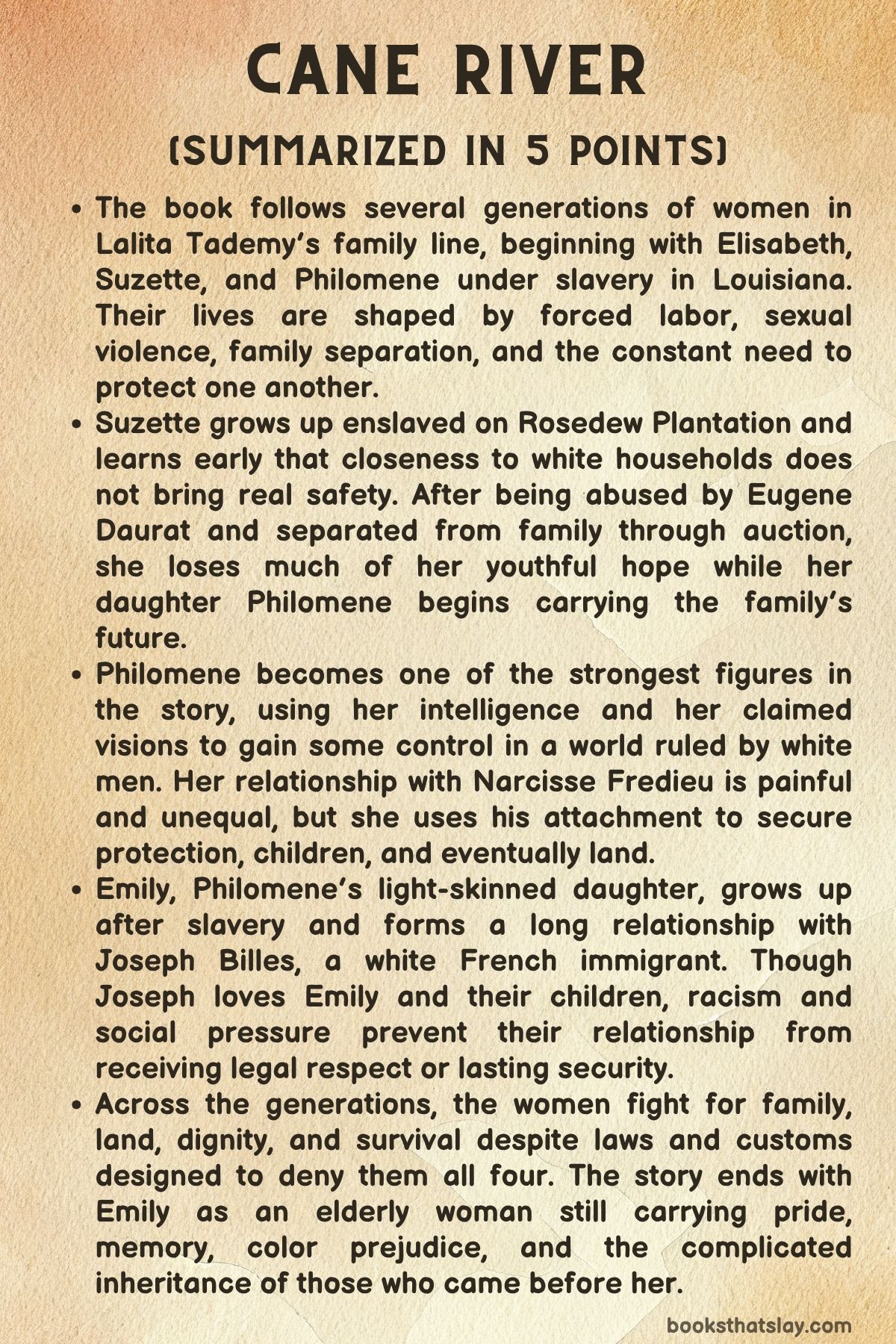
Characters
Elisabeth
Elisabeth stands at the root of the female line in Cane River, and her importance comes from the steadiness she gives to people who live under constant threat. She has endured sexual violence, separation from children, forced movement from one plantation to another, and the daily humiliation of enslavement, yet she does not become empty or passive.
Her strength is practical rather than dramatic. She teaches Suzette and Philomene that survival often requires silence, caution, and the protection of family above personal pride.
Elisabeth understands the emotional cost of this lesson because she has paid it herself. Her memories of the sons taken from her shape her belief that family cannot be erased by distance, ownership, or law.
She is also one of the clearest moral voices in the book. When Suzette and later Philomene become caught in color prejudice, Elisabeth challenges the idea that lighter skin equals greater worth.
Her wisdom comes from grief, but it also comes from love. She anchors the family not by controlling everyone, but by reminding them of what must not be forgotten.
Suzette
Suzette is shaped by a painful movement from childhood confidence to adult exhaustion. As a girl, she believes closeness to the Derbanne household gives her some protection, and she takes pride in the signs that separate her from field labor.
That belief collapses when she is punished for speaking truth, denied education, and sexually abused by Eugene Daurat. Suzette’s life shows how enslavement destroys innocence not only through labor, but through the constant reminder that a Black girl’s body is not treated as her own.
After the auction separates her family, she loses much of her inner force, and her depression becomes one of the book’s most painful portraits of trauma. Yet Suzette is not only a victim.
She rebels in small ways, loves deeply, and eventually claims a late form of happiness by marrying Nicolas after emancipation. Her color prejudice, especially toward darker-skinned men and children, is one of her flaws, and it shows how racism can be absorbed by those harmed by it.
Suzette’s life is marked by damage, but also by endurance.
Philomene
Philomene is the central force of the story’s middle movement and one of the most complex figures in the book. She inherits pain from Suzette and Elisabeth, but she responds with a sharper strategic mind.
Her glimpsings give her a special position in the family and in the wider community, but her real power lies in her ability to read people, especially white men who believe they control her. Her love for Clement reveals her capacity for tenderness and hope, while the loss of Clement and her children transforms her into someone far harder.
When she decides to use Narcisse’s desire and fear to protect herself and her family, she makes a morally difficult choice within a world that has given her almost no safe options. Philomene’s hunger for land is not greed; it is her answer to generations of being bought, sold, moved, and denied stability.
Her colorism toward Emily and the younger children is troubling, but it comes from a survival logic formed by racism. She is loving, controlling, wounded, visionary, and relentless.
Emily Fredieu
Emily is born after slavery, and that difference shapes her sense of herself. Unlike Elisabeth, Suzette, and Philomene, she does not grow up with the same direct memory of being owned, and this gives her a pride that can seem both powerful and naive.
Her light skin, beauty, education, and connection to Narcisse and Joseph place her in a social position unlike that of the women before her. She wants refinement, recognition, and a secure family life, yet the law and racial custom refuse to recognize her relationship with Joseph as legitimate.
Emily’s life shows the limits of privilege based on color. She may be able to sit closer to whiteness, but she cannot escape the violence of a society built on racial control.
Her relationship with Joseph gives her love, children, work, status, and pain. When he marries Lola and separates her from Billes Landing, Emily is forced to rebuild herself.
Her pride remains one of her defining traits, but by the end she is also a woman living among memories, losses, and the stubborn remains of dignity.
Clement
Clement represents one of the purest forms of love in the story, though his life is constrained by enslavement at every turn. His relationship with Philomene is tender, mutual, and rooted in care rather than power.
The moonlight chair he makes for her shows his patience and devotion, because it is built in the small hours left to him after forced labor. When he saves the chair during the storm instead of the valuable goods he was ordered to protect, his choice reveals what matters most to him: Philomene, their marriage, and the fragile home they are trying to imagine.
Yet Clement’s fate also shows how little protection love offers under slavery. He can be sold away without warning, and Philomene has no legal right to keep him near her.
His death away from her confirms one of the story’s harshest truths: enslaved families could create deep bonds, but white ownership could break those bonds at any time.
Narcisse Fredieu
Narcisse is one of the most disturbing and important men in Cane River because he combines desire, vanity, entitlement, and selective generosity. His obsession with Philomene is not love in any healthy sense; it is rooted in possession and control.
He uses his position as a white man to shape her life, threaten her family, and remove Clement. At the same time, he is not written as a simple villain without contradictions.
He provides certain forms of protection, acknowledges some of his children, and eventually gives land that helps Philomene secure the family’s future. These actions matter, but they do not erase the harm he causes.
Narcisse wants to see himself as honorable while continuing to benefit from racial and sexual power. His belief in Philomene’s glimpsings makes him vulnerable to manipulation, and Philomene turns that weakness into leverage.
He embodies a society in which white men could harm Black women, claim affection, offer favors, and still avoid real accountability.
Joseph Billes
Joseph Billes is charming, ambitious, and emotionally tied to Emily, but he is also limited by cowardice and the racial world from which he benefits. As a French immigrant, he sees opportunity in Louisiana and builds a business life around trade, land, and local relationships.
His love for Emily appears more sincere than many of the exploitative relationships that came before, and he openly cares for their children. Yet sincerity does not make him brave enough to fully protect them.
When social pressure and racial terror intensify, Joseph chooses compromise. He moves Emily away, marries Lola for respectability, and tries to manage two worlds rather than openly defy the one that grants him power.
His later attempt to leave property to Emily’s children shows guilt and responsibility, but it comes too late to overcome the legal and social barriers around them. Joseph is tragic because he knows what is right in private but cannot make that truth secure in public.
Oreline Derbanne
Oreline begins as Suzette’s childhood companion, but her role exposes the false intimacy between white children and enslaved Black children raised near them. As a girl, she can play with Suzette, dress her, and share domestic space with her, but she never forgets the boundary that gives her power.
When Suzette asks to learn to read, Oreline refuses because the law and custom of slavery matter more to her than friendship. As an adult, Oreline becomes dependent on the labor of Suzette, Philomene, and Palmire, and after financial losses she continues to think of herself as kind because she is not always physically cruel.
Her expectation of gratitude after emancipation reveals how deeply she misunderstands the people she once owned. Oreline is not the most openly violent white character, but that is precisely why she matters.
She represents the everyday moral blindness of people who benefited from slavery while imagining themselves decent.
Eugene Daurat
Eugene Daurat is a figure of predation, hypocrisy, and self-justification. His sexual abuse of Suzette begins when she is still young, and the consequences shape multiple generations.
He fathers children with her but does not protect them in any meaningful way. When the auction comes, he buys Gerant but leaves Philomene behind, then comforts himself with excuses about law, practicality, and social limits.
His relationship with Doralise also reveals his selfishness. He imagines his sacrifices as proof of feeling, yet the people around him bear the deeper costs.
Eugene repeatedly frames himself as more sympathetic than other white men, but his actions show that he still accepts the system that gives him access to Black women’s bodies and children without lasting responsibility. He is important because he represents a common pattern in the story: white men who feel guilt, call it love or helplessness, and still choose themselves.
Bet
Bet’s return is one of the story’s most powerful reversals because she represents both loss and recovery. For years, Philomene believes that both twins died of yellow fever, and the discovery that Bet survived exposes Narcisse’s cruelty in hiding the truth.
Bet grows up apart from her mother, and that separation shapes her personality. She is sharper, more direct, and less impressed by Emily’s sense of loneliness or specialness.
Her darker skin also places her in contrast with Emily, making her a living challenge to the family’s color hierarchy. Bet’s presence reminds the family that survival is not always neat or tender; it can produce anger, distance, and blunt honesty.
She often says what others avoid saying, especially about Emily’s privilege and Philomene’s choices. Through Bet, the story examines how a family can be reunited without pretending that lost years do not matter.
T.O.
T.O. carries the burden of being Joseph and Emily’s son in a society that refuses to grant him full legitimacy. He is close enough to whiteness to understand what has been denied to him, but not able to safely claim the power attached to it.
His secret visits to Joseph’s house show his hunger for connection and recognition, while his discovery of the plot around Joseph’s estate forces him into a dangerous knowledge he cannot easily use. T.O. knows the truth, but he also knows that a Black man’s word against a white man’s can place his entire family at risk.
His later decision to marry Eva is deeply significant because it rejects the family pattern of treating whiteness as the route to safety. He does not solve the damage caused by generations of colorism, but he marks a turn away from it.
Philomene’s final charge to him gives his life a larger purpose: to add to the family’s inheritance rather than merely carry its wounds.
Doralise
Doralise occupies a complicated position as a free woman of color who has more legal standing than enslaved women but remains vulnerable to male violence and racial limits. As Suzette’s godmother, she seems at first like someone who might offer protection, yet her own life reveals how narrow her freedom is.
She suffers abuse from her husband and later becomes Eugene’s mistress after he helps her obtain a divorce. Her property and social position give her some power, but not enough to save Suzette’s children or control Eugene’s choices.
Doralise shows that freedom before emancipation was uneven and fragile for people of color, especially women. She can move in circles closed to the enslaved, yet she still must negotiate dependence, reputation, and white male desire.
Her character adds depth to the story’s social world by showing that race, gender, wealth, and legal status create many layers of vulnerability.
Gerasíme
Gerasíme, Suzette’s father and Elisabeth’s partner, brings music, tenderness, and sorrow into the early life of the family. His fiddle playing offers moments of release in a world that otherwise measures enslaved people by labor and price.
His relationship with Elisabeth is one of mutual loyalty, and their promise not to remarry if separated shows the depth of their bond. Yet he is also painfully aware of his inability to protect his family from sale.
When the plantation is assessed and each person is assigned monetary value, Gerasíme’s despair reflects the emotional violence of being treated as property. His death during the Civil War years marks the passing of an older generation that endured slavery directly.
Through him, the story honors enslaved men whose love for their families was real even when the law denied them authority over their own households.
Palmire
Palmire’s story is brief but devastating. As Suzette’s sister, she is Deaf and unable to speak, which makes her even more vulnerable in a world that already denies enslaved women safety.
Louis Derbanne sexually abuses her, and she bears children by him, yet he does not free them when he makes provisions for some of his other children. Palmire’s life shows how disability, gender, and enslavement combine to create extreme powerlessness.
Her presence also reveals the selective nature of white men’s recognition. Louis can acknowledge some children and ignore others depending on convenience, reputation, and desire.
Palmire’s death from cholera deepens Suzette’s despair and adds to the family’s repeated experience of being broken by forces beyond their control. Though she does not occupy much space in the story, her suffering is part of the foundation on which later generations build their determination to survive.
Eva Brew
Eva Brew enters later in the family line, but her role is important because she challenges the customs and prejudices that Emily tries to preserve. She is darker-skinned, Baptist, English-speaking, and direct, which makes her feel like an outsider among the Creole Catholic women around Emily.
Emily excludes her and uses language, manners, and family hierarchy to keep distance. Eva refuses to accept this treatment quietly.
Her marriage to T.O. represents a rejection of the family’s long pursuit of whiteness through partner choice and childbearing. She is practical, hardworking, and willing to take on manual labor to support her household.
Her decision to leave Emily’s control and move with T.O. shows independence and self-respect. Eva’s presence suggests that the family’s future cannot be built only on light skin, old pride, or inherited social codes.
It must also make room for honesty, labor, and a broader understanding of Black identity.
Themes
Family as Survival and Inheritance
Family in the story is not simply a source of affection; it is the main structure through which the women survive systems designed to separate them. Enslavement turns mothers, children, spouses, and siblings into property that can be sold at any time, so the act of remembering family becomes a form of resistance.
Elisabeth’s belief that family remains family even across distance becomes one of the story’s guiding ideas. Suzette loses much of herself after the auction because separation attacks the center of her identity.
Philomene’s vision of everyone gathered at one table matters because it imagines more than reunion; it imagines ownership, food, land, and belonging. Each generation inherits pain, but also methods of endurance.
The women braid hair, raise children, share warnings, keep stories, and make practical sacrifices for those who come next. Even when they argue or wound one another, the family remains the place where damaged people are held together.
By the end, inheritance is not only bloodline or property. It is memory, strategy, pride, grief, and the command to continue.
The Cost of Colorism
Colorism runs through the family as both a survival strategy and a source of harm. Lighter skin can bring better treatment, greater mobility, and the possibility of passing, so characters such as Suzette and Philomene learn to treat whiteness as a kind of shield.
This belief is not random vanity; it grows from a racist society that rewards proximity to whiteness and punishes visible Blackness. Yet the emotional cost is severe.
Suzette judges darker-skinned men as unsuitable, and Philomene tries to protect Emily’s light complexion as if her daughter’s future depends on it. Emily, in turn, grows ashamed of darker features in her own family, especially Elisabeth’s hair and skin.
These attitudes create distance between relatives who should be united by shared history. Bet’s return challenges this hierarchy because she cannot be folded easily into the family’s ideal of lightness, yet she carries the same blood, loss, and claim to belonging.
Cane River shows colorism as a wound passed across generations: born from racism, used as defense, and capable of injuring the very people it is meant to protect.
Women’s Power Under Constraint
The women in the story rarely possess open legal, economic, or political power, so they build influence through observation, patience, memory, and negotiation. Elisabeth survives by understanding when speech is dangerous and when comfort is necessary.
Suzette performs small acts of rebellion even when larger freedom is impossible. Philomene becomes the clearest example of power under constraint because she learns to use Narcisse’s desire, fear, and vanity to gain a cabin, protection, and eventually land.
Her choices are not free in the fullest sense, but they are still choices made by a mind determined to secure a future. Emily’s power looks different.
She manages a store, raises children, saves money, and pushes Joseph to provide legal and financial support. These women often operate inside relationships with men who hold greater public authority, but the story makes clear that survival depends on female intelligence.
Their power is imperfect and sometimes morally painful. It can include silence, manipulation, compromise, and emotional hardness.
Still, it keeps children alive, gathers scattered relatives, and slowly turns dispossession into inheritance.
Land, Legitimacy, and the Meaning of Freedom
Freedom in the story is incomplete without land, legal recognition, and the ability to protect one’s children. Emancipation ends slavery, but it does not erase poverty, racial violence, or dependence on white landowners.
Philomene understands this quickly, which is why land becomes her central goal. To own land is to escape, at least partly, the condition of being moved at someone else’s will.
It means a table filled with food that belongs to the family, a place where generations can gather, and a claim that cannot easily be dismissed. Yet the story also shows how law protects white power even after slavery.
Emily and Joseph’s children are denied full inheritance because their parents cannot legally marry, and Joseph’s private intentions cannot overcome public racism and court authority. Legitimacy becomes a weapon: white society decides which children count, which relationships count, and which documents matter.
The search for property is therefore also a search for recognition. The family’s struggle shows that freedom is not a single event, but a long fight for security, name, home, and future.