Mad Mabel Summary, Characters and Themes
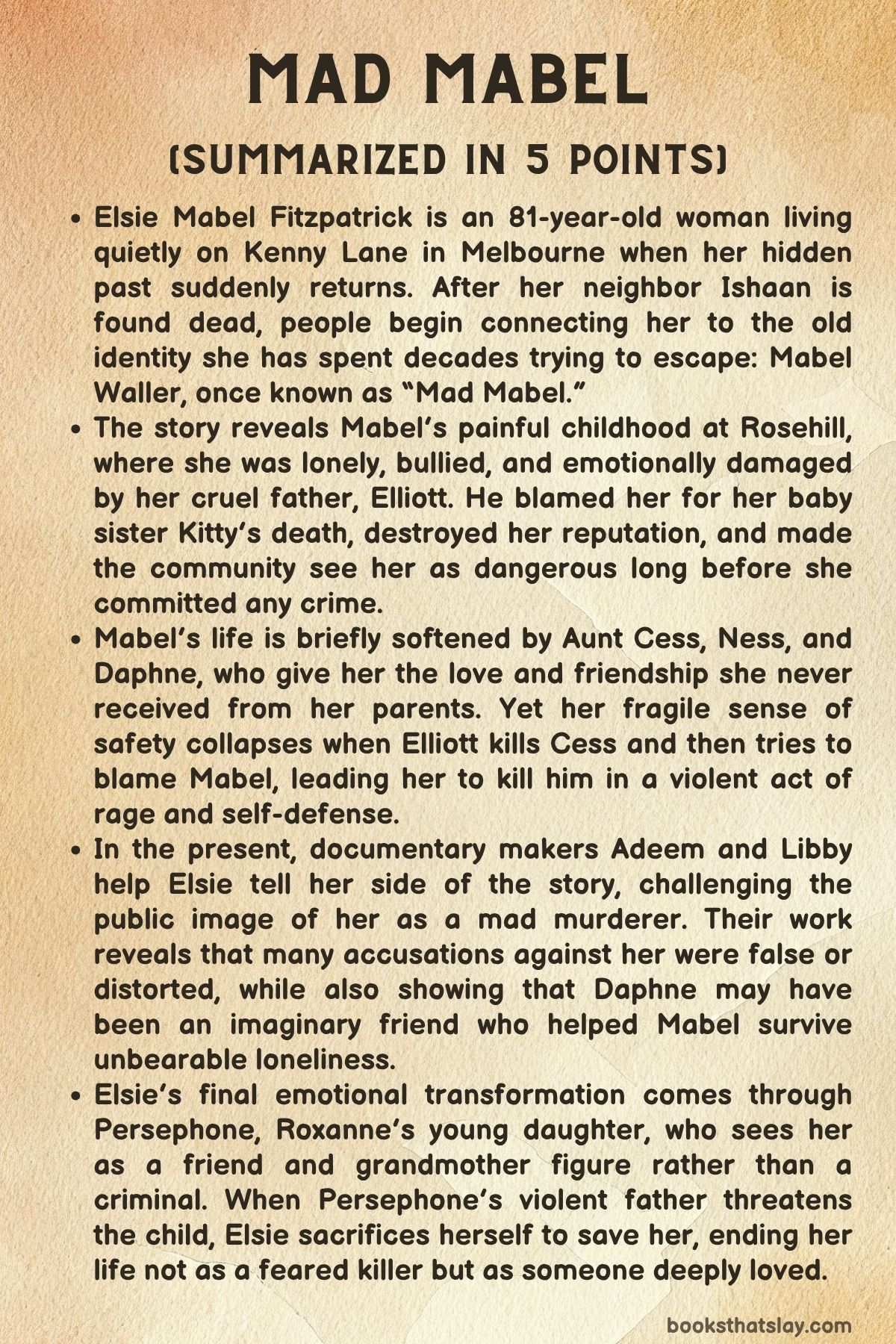
Mad Mabel by Sally Hepworth is a mystery centered on Elsie Mabel Fitzpatrick, an 81-year-old woman whose quiet life in a Melbourne laneway is shattered when her violent past resurfaces. Once known publicly as “Mad Mabel,” she has spent decades hiding from a childhood defined by loneliness, cruelty, scandal, and murder.
The novel moves between her present-day life and her painful past, revealing how friendship, trauma, public judgment, and survival shaped her identity. At its core, it is a story about the people society condemns too quickly and the forms of love that can arrive too late, yet still matter deeply.
Summary
Elsie Mabel Fitzpatrick is an 81-year-old woman living on Kenny Lane, a small cobbled street in Melbourne. Tall, sharp, unsentimental, and fiercely private, she has spent nearly six decades keeping to herself.
Her neighbors know her as difficult but familiar: Peter Pantages lives nearby and often checks on her; Joan Waters is suspicious and legal-minded; Roxanne is a struggling single mother raising her seven-year-old daughter, Persephone; Ishaan lives next door with his noisy Chihuahua, Nugget; and the Nguyens remain mostly in the background. Elsie’s closest companion is Daphne, a childhood friend whose presence has sustained her through most of her life.
Elsie’s carefully protected privacy begins to collapse when a photocopied newspaper article is slipped under her door. The article exposes her old identity as Mabel Waller, the girl once called “Mad Mabel.” It refers to long-buried events from her youth: the death of her sister Kitty, her mother’s suicide, the death of a teacher, and the murder for which she was convicted as a teenager.
Elsie immediately understands that someone on Kenny Lane has discovered who she really is.
The next disruption comes through Persephone, who appears at Elsie’s house wanting to interview an elderly person for school. Elsie resists, but the child is persistent.
When Persephone mentions that Ishaan has not answered his door and that boxes have piled up outside, Elsie investigates. She climbs into his backyard and sees him dead on his kitchen floor.
The police arrive, and Elsie’s discovery of the body makes her a person of interest, especially because she had a tense relationship with Ishaan and had often complained about his dog.
As the investigation begins, the story turns back to Elsie’s childhood as Mabel Waller. She was born into wealth and lived at Rosehill, a grand Edwardian mansion.
Her father, Elliott Waller, prized the house more than he valued his family. Her mother, Mary, was glamorous but deeply unhappy and dependent on alcohol.
Mabel was lonely, bullied, and misunderstood. Children called her “Mad Mabel” because of rumors surrounding the death of her baby sister, Kitty, who died of polio after somehow coming into contact with Mabel during her own illness.
Elliott believed, or chose to claim, that Mabel had deliberately exposed Kitty out of jealousy. Mabel had no memory of doing so, but the accusation shaped her entire childhood.
Mabel’s life improves when her Aunt Cecily, known as Cess, and Cess’s closest companion, Ness, become more involved in her care. Cess is unconventional, protective, and bold, while Ness is gentle, intelligent, and loving.
Together, they give Mabel the attention and affection she has never received from her parents. Ness encourages her to keep a diary, and Mabel begins recording the world around her in careful detail.
She also finds comfort in stories about deep female friendship and longs for a friend of her own.
That friend appears in Daphne Barton, a girl Mabel knew in kindergarten who seems to return at the exact moment Mabel needs her most. Daphne is lively, loyal, funny, and fearless.
She gives Mabel the companionship she has always craved, calling her “Maybelline” instead of the cruel nickname used by others. Their friendship becomes Mabel’s refuge during her most painful years.
Mabel’s relationship with her mother is complicated by Mary’s sorrow and Elliott’s cruelty. After Mabel breaks her arm at camp, Mary tells her the truth about Kitty’s death and reveals Elliott’s belief that Mabel caused it.
When Mabel later tells Mary that Elliott has been unfaithful with Susan McGinty, Mary reacts with rage and despair. Soon afterward, she throws herself from a hospital fire escape.
Mabel is left with grief, guilt, and the growing certainty that her father destroys everyone close to him.
After Mary’s death, Elliott becomes more openly threatening. He tries to remove Cess from Rosehill and reclaim control of Mabel and the estate.
Cess reveals that Rosehill legally belongs to Mabel, with Cess acting as trustee until Mabel comes of age. Elliott is enraged, especially because he wants the house for his new life with Susan and her daughter, Amelia.
Mabel begins to understand that her father’s love has always been directed toward property, status, and power, not people.
At school, Mabel is still treated as strange and dangerous. Billy Harris, a cruel classmate, taunts her about Kitty and her mother.
His words reveal that Elliott has spread the story that Mabel killed her sister, poisoning the community against her. After Billy later suffers a serious head injury near the beach, rumors blame Mabel again, though she was not responsible.
The public image of Mabel as dangerous grows stronger.
Mabel also becomes involved with Mr. Loukas, a young teacher who exploits her loneliness and grief. He makes her believe he loves her, meeting her secretly and making her feel special.
She mistakes his attention for romance because she has been starved of affection. The illusion breaks when she discovers he is engaged and has a history of inappropriate relationships with students.
Shortly afterward, he dies in what is first reported as an accident, then ruled a homicide. Mabel had punctured his car tire in anger, but his fiancée, Tessa, later confesses to killing him.
Even after the truth comes out, Elliott continues to spread rumors that Mabel was involved.
Mabel briefly finds gentler affection with Christos, a Greek classmate who treats her with humor and respect. He sees beyond the rumors and offers her genuine companionship.
Yet when he is injured in an accident involving Billy, his mother forbids him from seeing Mabel. Once again, Mabel learns that public suspicion can destroy even the few good things she has.
The central tragedy occurs when Mabel comes home during heavy rain and hears Elliott attacking Cess and Ness with cruel, homophobic insults. She sees enough to understand that Cess and Ness are romantic partners.
Elliott plans to take Mabel away and use her as a legal tool to claim Rosehill. Terrified, Mabel runs to Daphne for comfort.
When she returns, she finds Cess dead in her bedroom, her neck broken. Elliott is standing over the body.
He calmly tells Mabel that she will be blamed for the murder. In a moment shaped by years of fear, rage, and abuse, Mabel grabs Elliott’s silver-handled umbrella and kills him brutally.
Mabel is convicted, but because of her mental state and the court’s understanding of her imaginary companion, she spends five years in a psychiatric hospital rather than prison. During that time, she gives birth to a son but refuses to hold him because she knows he will be taken from her.
The child is later adopted by Ness. That child grows up to be Peter, the neighbor who has cared for Elsie for years without knowing the full truth of their bond.
In the present, the old story returns with force. Media attention floods Kenny Lane after Adeem and Libby, two young documentary makers, find Elsie and ask to interview her.
At first, Elsie hopes that telling her story will make the public leave her alone. Instead, the process forces her to confront the full truth of her past, including Daphne’s nature.
Adeem and Libby discover that while a real Daphne Barton existed in kindergarten, there is no proof she returned from England. Daphne was likely an imaginary friend, created by Mabel as a survival mechanism.
Elsie resists calling her unreal, because Daphne’s companionship kept her alive when no one else did.
Meanwhile, Elsie becomes increasingly attached to Persephone. The child is lonely, bold, and persistent, and she slips into Elsie’s life despite Roxanne’s worries.
When Shane, Persephone’s abusive father, threatens Roxanne and the child, Elsie protects Persephone without hesitation. She babysits her, comforts her, and begins to experience the painful vulnerability of loving someone.
Persephone sees Elsie not as a monster, but as a grandmother figure.
The documentary, titled Magnificent Mabel, reframes Elsie’s life for the public. Rather than presenting her as a mad killer, it shows her as a child failed by her father, her community, and the justice system.
Public sympathy replaces fear. People send apologies and support, and Peter learns the full truth of his birth.
Rosehill, long kept from Elsie because of the law, passes through a loophole to Peter as her biological son.
The final crisis comes when Shane breaks into Roxanne’s home and takes Persephone at gunpoint. Elsie runs outside and confronts him.
When Persephone escapes his grip and he aims the gun at her, Elsie steps in front of the child. Shane fires, and Elsie is killed protecting the girl she has come to love.
After Elsie’s death, Persephone grieves deeply but begins to heal. Roxanne and Persephone move to a safer home with financial help from Peter.
Nugget stays with Persephone. In the final revelation, Persephone speaks with her friend Daisy, who comforts her about losing Elsie.
Daisy then reveals that Elsie once knew her as Daphne. The ending suggests that the friend who once saved Mabel has now come to help Persephone, carrying forward the novel’s deepest belief: that love, whether imagined, remembered, or real, can help the lonely survive.
Characters
Elsie Mabel Fitzpatrick / Mabel Waller
Elsie Mabel Fitzpatrick is the emotional center of the book, a woman who has lived most of her life under the shadow of a name the world used to shame and simplify her. As a child, Mabel is lonely, intelligent, observant, and desperate to be loved.
She is not naturally gentle in the way society expects girls to be; she is tall, sharp-tongued, intense, and unusually perceptive. These qualities make her easy to isolate, especially once her father begins spreading lies about her.
Her childhood shows how a person can be shaped by repeated rejection before they ever have the chance to define themselves. By old age, Elsie has turned survival into a personality.
She is blunt, suspicious, funny, and prickly, but underneath that hardness is a woman still wounded by the belief that anyone she loves may be taken from her. Her relationship with Persephone becomes her late-life transformation.
The child does not erase Elsie’s past, but she gives Elsie a chance to love actively, protectively, and without hiding. In Mad Mabel, Elsie is not presented as innocent in a simple way; she did kill her father.
Yet the book insists that her violence must be understood within the long history of abuse, abandonment, and terror that led to it.
Daphne Barton
Daphne is one of the most moving figures in the story because she exists in the space between imagination and emotional truth. To Mabel, Daphne is not a fantasy in any shallow sense; she is loyalty, laughter, courage, and comfort given a human shape.
She appears when Mabel is at her lowest, first as a friend from childhood and later as the companion who helps her endure grief, shame, fear, and isolation. Daphne’s role is especially important because the adults around Mabel either fail her or harm her, while society treats her as a monster before she has done anything monstrous.
Daphne offers a version of friendship that is total and unquestioning. She defends Mabel, names her lovingly, shares rituals with her, and helps her feel less alone.
The later revelation that Daphne may be imaginary does not weaken her importance. Instead, it deepens the tragedy of Mabel’s life by showing how neglected she was that her mind had to create the friend she needed.
Daphne represents both loneliness and resilience. She proves that the human need for companionship is so strong that, when the world refuses to provide it, the mind may build its own form of rescue.
Persephone
Persephone is a seven-year-old child whose boldness hides deep loneliness. She enters Elsie’s life with comic force, refusing to be intimidated by Elsie’s age, temper, or reputation.
She misnames Elsie, invites herself into her house, demands food, asks intrusive questions, and treats friendship as something obvious rather than fragile. At first, she seems like a source of irritation, but her persistence gradually exposes Elsie’s capacity for tenderness.
Persephone is also a vulnerable child living in an unsafe adult world. Her mother is loving but exhausted, her father is dangerous, and her home life is marked by secrecy and fear.
She understands more than adults want her to understand, yet she still seeks safety in the simple ways children do: through routine, affection, play, and the presence of a trusted adult. Her bond with Elsie is powerful because she sees the person beneath the public label.
She does not approach Elsie as a criminal or scandal; she approaches her as a lonely neighbor who might become a friend. By the end of the book, Persephone becomes the person Elsie dies protecting, proving how completely Elsie has moved from isolation into love.
Roxanne
Roxanne is a portrait of a mother trying to protect her child while trapped inside economic pressure and the long reach of domestic abuse. She is not careless, though some of her choices initially appear alarming.
Leaving Persephone alone at night is dangerous, but the book frames it within the brutal reality of a woman who needs income, cannot afford overnight childcare, and has been failed by systems that should protect her. Roxanne’s fear of Shane controls much of her life.
She has escaped him physically, but she remains psychologically and practically cornered by his ability to find her and threaten what she loves most. Her initial reaction to Elsie’s past is believable: she is horrified that her daughter has spent time with a convicted murderer.
Yet Roxanne is also capable of changing her view when Elsie proves herself through action. Her trust grows slowly, shaped by necessity but also by recognition.
Roxanne’s relationship with Elsie becomes a quiet alliance between two women who understand danger. Through Roxanne, the story shows that survival is not always clean or brave-looking.
Sometimes it means taking imperfect choices because every option is unsafe.
Peter Pantages
Peter is one of the story’s most quietly significant characters. At first, he appears to be Elsie’s kind neighbor, a man who checks on her, helps with practical matters, and shows her more warmth than she comfortably accepts.
His role seems simple until the later revelation that he is Elsie’s biological son, born while she was in the psychiatric hospital and adopted by Ness. This revelation changes the emotional meaning of his entire presence in the book.
Peter has been close to his mother without knowing it, caring for her in the ordinary language of neighborliness. His kindness suggests that family bonds can exist without formal recognition, though the truth gives those bonds a new depth.
Peter also represents a life that was taken from Elsie and yet not entirely lost. She did not raise him, and the pain of that absence remains, but he grew into someone compassionate.
His response to learning the truth is not rejection but embrace. In Mad Mabel, Peter becomes a form of delayed justice: not legal justice, but emotional restoration.
Through him, Elsie receives a connection she believed she had forfeited forever.
Aunt Cecily “Cess”
Cess is the first adult who fights for Mabel with real force. She is unconventional, witty, impatient with social rules, and deeply protective.
Unlike Mary, who loves Mabel imperfectly but is too damaged to defend her, Cess has the strength to stand between Mabel and Elliott. She sees Mabel clearly, not as a problem or a rumor, but as a brilliant child who has been starved of affection.
Her love is practical as well as emotional. She feeds Mabel, comforts her, challenges her, protects her inheritance, and refuses to let Elliott take control.
Cess’s relationship with Ness also gives Mabel an early model of devoted female partnership, even though the world around them treats that love as shameful. Her death is devastating because it destroys the safest home Mabel has ever known.
Elliott kills not only a person but the fragile structure of care that had begun to save Mabel. Cess’s importance lies in her refusal to accept the story others tell about Mabel.
She gives Mabel the rare gift of being believed, and that belief changes how Mabel understands herself.
Vanessa “Ness”
Ness is gentle, perceptive, and emotionally generous. Where Cess is fierce and confrontational, Ness is steady and nurturing.
She gives Mabel books, attention, encouragement, and physical affection without making the child feel like a burden. Her suggestion that Mabel keep a diary becomes crucial, because the diary later preserves Mabel’s version of events with striking accuracy.
Ness understands the healing power of being listened to. She does not treat Mabel as strange; she treats her as a child worthy of time and care.
Her bond with Cess also expands the book’s understanding of love. Their relationship is not officially recognized by the society they live in, yet it is one of the strongest and most honest relationships in the story.
After the tragedy at Rosehill, Ness remains linked to Mabel’s life through Peter, whom she adopts. This decision turns her love into a long-term act of protection.
Ness may not be as dramatic as Cess, but her influence is profound. She represents quiet devotion, moral clarity, and the kind of care that continues after catastrophe.
Elliott Waller
Elliott Waller is the central source of destruction in the story. He is not merely an unkind father; he is a man who uses reputation, money, gender, and social respectability as weapons.
His cruelty is often psychological, which makes it harder for others to see and easier for him to deny. He blames Mabel for Kitty’s death, spreads rumors that isolate her, humiliates Mary, conducts affairs openly enough to wound his family, and treats Rosehill as the true object of his devotion.
Elliott’s love is possessive, not human. He wants the house, the status, and the power that come with controlling others.
His abuse of Mabel is especially vicious because he turns the community against a child, ensuring that she is punished socially before any crime occurs. His murder of Cess reveals the violence beneath his polished exterior.
When he tells Mabel she will be blamed, he proves that he understands exactly how thoroughly he has built the public case against her. Elliott is frightening because he does not simply hurt people in private; he shapes reality around them so that their pain becomes their supposed guilt.
Mary Waller
Mary is a tragic figure whose beauty and social position conceal misery. She is not a consistently protective mother, but she is not without love for Mabel.
Her affection appears in unstable flashes: makeovers, hospital visits, apologies, and moments of tenderness that mean everything to her neglected daughter. Yet Mary is trapped in a marriage that has eroded her sense of self.
Her drinking, emotional collapse, and final suicide reflect years of humiliation and despair. Her conversation with Mabel about Kitty is especially painful because Mary cannot fully release her daughter from suspicion.
When she asks whether Mabel caused Kitty’s death, she reveals how deeply Elliott’s version of events has infected the household. Mary’s failure is not a lack of feeling but a lack of strength against Elliott’s cruelty.
Her death leaves Mabel with guilt and confusion, but the larger story makes clear that Mary was another of Elliott’s victims. She matters because she shows how abuse can make love unreliable, turning a mother into someone who both comforts and wounds her child.
Joan Waters
Joan begins as a suspicious and abrasive neighbor, the kind of person who watches, judges, and threatens legal action. Her decision to expose Elsie’s past to the police and possibly to the media causes real harm, making her appear narrow-minded and cruel.
Yet Joan becomes more complex as the story progresses. Her fear is not entirely irrational; she discovers that someone living near her has a violent public history, and she reacts as many people might.
What matters is that Joan is capable of shame and correction. After seeing how the community responds to Elsie and how deeply Persephone trusts her, Joan recognizes that she has misjudged the situation.
She apologizes, offers help through her lawyer nephew, and becomes part of the protective circle around Elsie. Joan’s development is important because it shows that public judgment can change when people are willing to face the human being behind the story.
She never becomes soft or sentimental, but she becomes fairer. Her late kindness suggests that suspicion is not the same as moral failure unless a person refuses to learn.
Ishaan
Ishaan is more important in death than he is in life. As Elsie’s neighbor, he is mostly associated with irritation: his barking dog, Nugget, and the disputes that make him Elsie’s “nemesis.” His death triggers the present-day investigation and causes Elsie’s hidden past to be dragged back into public view.
The suspicion around his death shows how quickly an old label can override evidence. Because Elsie once killed someone and because she openly disliked Ishaan, the police and public find it easy to imagine her as guilty again.
Ishaan’s eventual cause of death, a vitamin overdose, clears Elsie but only after damage has been done. His role is also tied to Nugget, who becomes one of the unexpected sources of connection in Elsie’s later life.
The dog first appears as a nuisance but becomes part of Elsie and Persephone’s shared world. Ishaan’s character is not deeply explored, yet his death performs a major narrative function: it proves that society is ready to retry Elsie forever, regardless of the truth.
Adeem Anand and Libby Conquest
Adeem and Libby are the documentary makers who reopen Elsie’s past, but they are not simple opportunists. Their YouTube project could easily have become another act of exploitation, especially because they arrive during a media frenzy and ask an elderly woman to revisit trauma.
Adeem can be pushy, while Libby is more sensitive and careful. Together, however, they give Elsie something the public never gave Mabel: the chance to speak in her own voice.
Their role is morally complicated because they benefit from her story, but they also help correct the false narrative around her. They question her, challenge her evasions, and uncover details about Daphne and Peter that force painful truths into the open.
Yet they also believe in her sanity and humanity. Their documentary changes public opinion not by inventing innocence, but by providing context.
Adeem and Libby represent a more modern form of storytelling, one that can still be invasive but can also create space for reconsideration. In Mad Mabel, they become part investigators, part witnesses, and eventually part of Elsie’s small circle of friends.
Billy Harris
Billy Harris represents the cruelty of children when they repeat the prejudices of adults. He is not the origin of Mabel’s suffering, but he becomes one of its loudest carriers.
His taunts about Kitty and Mary are especially damaging because they reveal how Elliott’s lies have spread through the community and reached the schoolyard. Billy’s harassment is physical, sexual, and emotional.
He humiliates Mabel during the kissing game, follows her, insults her, and later assaults her boundaries in increasingly aggressive ways. After his head injury, rumors that Mabel harmed him strengthen her public image as dangerous, even though Billy himself is often the aggressor.
His character shows how a community’s chosen story can empower bullies. Because Mabel has already been marked as “mad,” Billy feels free to mistreat her and expect others to blame her for whatever happens next.
He is significant not because he is powerful in himself, but because he reflects a larger culture of cruelty, misogyny, and scapegoating.
Christos
Christos offers Mabel one of the few experiences of ordinary teenage affection. He begins as part of the group that laughs at her, but he soon shows more independence and kindness than the others.
He apologizes for not stopping Billy, recognizes the injustice of the way Mabel is treated, and speaks to her with humor rather than fear. Their bond matters because it lets Mabel imagine a life beyond isolation and scandal.
With Christos, she can talk, joke, and feel admired without being manipulated in the way Mr. Loukas manipulates her. Yet this connection is fragile because it exists inside a community that has already condemned her.
After Christos is injured and his mother learns who Mabel is, he is forbidden from seeing her. This loss reinforces Mabel’s belief that good things are not meant for her.
Christos is not a savior, but he is a reminder of what Mabel might have had if she had been allowed to grow up without the burden of Elliott’s lies.
Mr. Loukas
Mr. Loukas is a predator who disguises exploitation as romance. To a lonely, grieving teenage girl, he appears kind, attentive, and understanding.
He offers Mabel words she has never heard before, especially the claim that he loves her. Because Mabel has been emotionally neglected, she is vulnerable to mistaking his attention for genuine care.
The book handles this relationship as a violation of trust, not a love story. Mr. Loukas is an adult and a teacher, and he uses his authority, secrecy, and charm to make Mabel feel chosen.
The revelation that he has done this before confirms that his behavior is patterned, not accidental. His death and Tessa’s later confession complicate the public story around Mabel, because suspicion falls on the girl already marked as dangerous.
Mr. Loukas’s character exposes how easily adults can exploit children who lack protection. He also shows how society often punishes the vulnerable child more readily than the respectable adult who harmed her.
Shane
Shane is the present-day embodiment of domestic terror. He is controlling, violent, and determined to keep power over Roxanne even after she escapes him.
His danger lies not only in physical violence but in his understanding of Roxanne’s fear. He knows that Persephone is the person through whom he can hurt her most.
His appearances on Kenny Lane bring a different kind of threat from the media or the police: immediate, bodily danger. Shane’s gun, his drunkenness, and his willingness to use Persephone as leverage make him a direct threat to the fragile safety Elsie and the neighbors have built.
He also creates the situation in which Elsie’s final act becomes possible. By stepping between Shane and Persephone, Elsie rejects the helplessness that defined much of her childhood.
Shane is not given much psychological depth, and that is fitting. His function is to show abuse as coercive, repetitive, and escalating.
He is the kind of man systems fail to stop until someone else pays the price.
Nugget
Nugget begins as comic irritation, the noisy Chihuahua associated with Ishaan and Elsie’s complaints. Yet the dog slowly becomes part of the emotional life of Kenny Lane.
After Ishaan’s death, Nugget ends up with Elsie, and the relationship between them softens her in small but meaningful ways. Nugget also helps connect Elsie and Persephone, since the child is fascinated by the dog and later becomes closely attached to her.
The dog’s presence adds warmth to scenes that might otherwise be dominated by suspicion, grief, or danger. Nugget is also a sign that Elsie’s life is changing despite her resistance.
She begins the story wanting quiet, distance, and control, but she ends up caring for a dog, a child, and a community. After Elsie’s death, Nugget remains with Persephone, becoming a living link to the woman who protected her.
Nugget’s role may be small, but emotionally the dog helps carry Elsie’s memory forward.
Themes
The Damage Caused by Public Judgment
Public judgment in Mad Mabel behaves almost like a second legal system, one that punishes before it understands and rarely corrects itself. Mabel is condemned as strange long before she is convicted of anything, and that condemnation shapes the way every later event is interpreted.
Kitty’s death becomes proof of childhood malice, Mary’s suicide becomes another mark against her, Billy’s injury becomes suspicious, and Mr. Loukas’s murder becomes attached to her reputation even after the real killer confesses. The community does not simply misunderstand Mabel; it needs her to be guilty because a shared villain gives people an easy story to repeat.
In the present, the same pattern returns after Ishaan’s death. Elsie’s age, current behavior, and actual evidence matter less than the old name attached to her.
The book shows how labels can outlive facts. Once a person has been made into a symbol, others stop looking closely.
The documentary’s success is powerful because it does not change the past; it changes the frame. By allowing Elsie to speak, it proves that judgment without context is not justice.
It is another form of harm.
Female Friendship as Survival
The deepest relationships in the story are not built around romance but around female companionship, loyalty, and care. Mabel survives because of women and girls who give her what her family and society deny her.
Cess protects her with fierce practical love. Ness gives her tenderness, books, attention, and a sense of being valued.
Daphne, whether understood as real, imagined, or both in emotional terms, becomes the friend Mabel needs in order to endure unbearable loneliness. Later, Persephone enters Elsie’s life with the same disruptive force that Daphne once did, refusing to let her disappear into isolation.
These bonds are not decorative; they are life-preserving. The book treats friendship as a structure of safety, especially for those who have been failed by family.
It also recognizes that friendship can be painful because loving someone means becoming vulnerable to loss. Elsie spends much of her life avoiding that pain, but Persephone teaches her that the pain of attachment is inseparable from its meaning.
The story’s final movement from Daphne to Persephone suggests that saving friendship can pass from one lonely person to another across generations.
Abuse, Control, and the Long Reach of Fear
Abuse in the book is shown through more than physical violence. Elliott’s cruelty is social, emotional, legal, and psychological.
He controls the story around Mabel so thoroughly that even strangers believe his version of her. He weakens Mary, threatens Cess and Ness, and uses respectability to hide the damage he causes.
Shane, in the present, operates through a more openly violent pattern, but his goal is similar: control through fear. Roxanne may have left him, yet he still shapes her choices, her work, her housing, and her sense of safety.
By placing Elliott and Shane in different time periods, the story shows that abuse changes its setting but not always its logic. Both men treat other people as possessions or tools.
Both understand that threatening a loved one can be more powerful than threatening the person directly. The book also shows how institutions fail victims.
The police do not adequately protect Roxanne, just as the legal and social systems failed young Mabel. Against this failure, protection often comes from neighbors, friends, and chosen family rather than official authority.
Love, Loss, and the Courage to Be Needed
Elsie’s life is shaped by the belief that love leads to terror. As a child, the people she loves are unstable, taken away, or used against her.
Kitty’s death becomes a source of blame, Mary dies after a moment of painful truth, Cess is murdered, Christos is removed from her life, and her baby is taken from her before she can hold him. After so much loss, Elsie chooses hardness because it seems safer than need.
Her old age is defined by routines that keep people at a distance. Persephone changes this not through grand speeches but through need.
She needs food, attention, protection, bedtime care, and eventually a safe adult to stand between her and danger. Elsie’s emotional growth comes from accepting that being needed is frightening but also meaningful.
When she cries beside the sleeping child, the moment marks the return of a feeling she has avoided for decades. Her final act is not driven by guilt or reputation but by love freely chosen.
She dies protecting Persephone, and while the ending is tragic, it gives Elsie a form of peace: she is no longer the girl everyone accused, but the woman someone loved and called family.